
Do you already know what you are looking for ? Skip the scroll and search…
Just browsing ? Enjoy Eclectic Collectors journey…
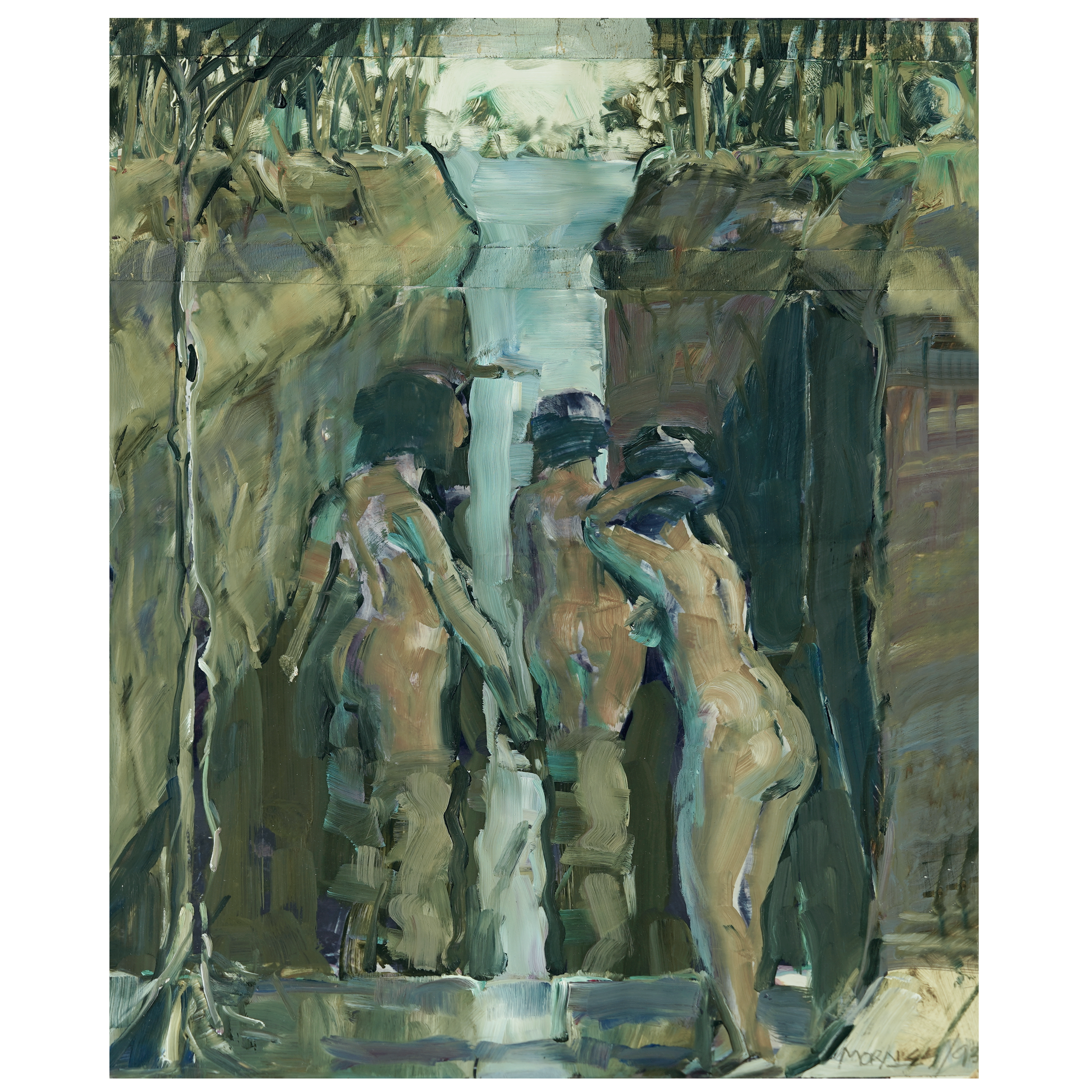
Armando Morales (1927–2011)
Oil on canvas
Dimensions: 35 × 28 cm
Composition by Nicaraguan painter Armando Morales depicting three nude figures gathered at the edge of a cascading waterfall, immersed in a timeless ritual of bathing. Executed in his characteristic painterly style, Morales layers earthy and muted green-blue tones, capturing both the sensuality of the human form and the raw vitality of nature.
Morales, renowned for his fusion of figuration and abstraction, frequently revisited themes of memory, myth, and sensuality. In this work, the tactile impasto brushwork conveys both movement and intimacy, as the figures appear simultaneously rooted in their environment and dreamlike in presence. The interplay between shadow and light accentuates the mystery of the scene, suggesting a timeless moment of communion between humanity and nature.
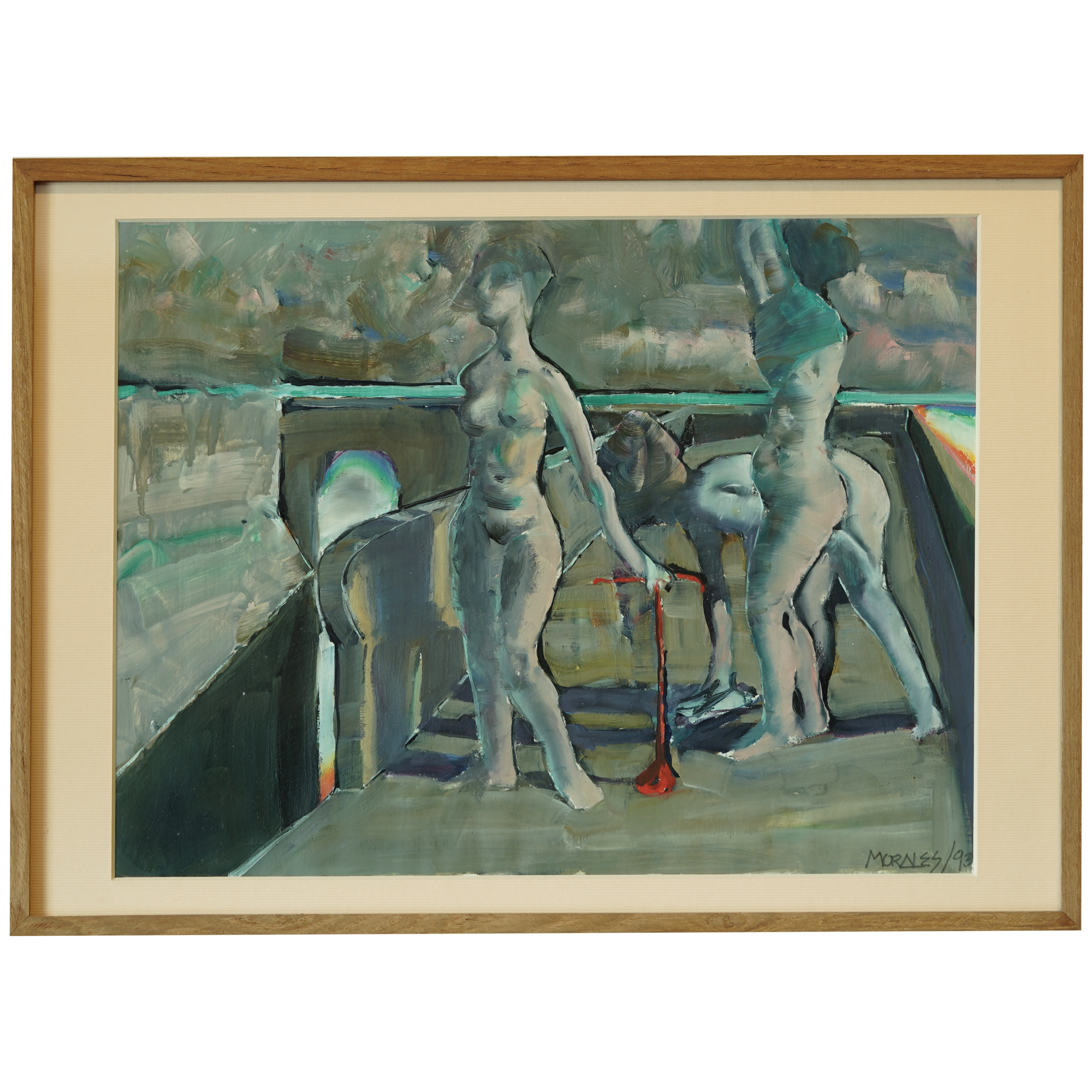
Artist: Armando Morales (Nicaraguan, 1927–2011)
Date: 1993
Medium: Oil on canvas
Signature: Signed and dated lower right, Morales / 93
Dimensions: 29 × 37 cm
Oil on canvas from 1993, Armando Morales presents three nude female figures set within a monumental architectural setting that opens onto a distant seascape. Painted in a restrained, cool-toned palette dominated by muted blues, greens, and greys, the figures emerge with sculptural solidity, their contours modeled with both softness and precision. One central figure holds a striking red staff, a vivid vertical accent that disrupts the otherwise harmonious tonal composition..
Artistic Context:
Armando Morales is celebrated as one of Latin America’s foremost modern painters, renowned for merging realist figuration with surrealist and symbolic elements. His paintings often combine nudes, still lifes, and landscapes in enigmatic, timeless environments. This work exemplifies Morales’s mature style of the late 1970s, in which the human form is reimagined within architecturally inspired, almost stage-like settings that invite multiple readings—mythological, allegorical, or psychological.

Artist: Sol LeWitt (American, 1928–2007)
Medium: Painted wood panel with triangular cutout
Dimensions: 37 × 37 cm
Collection: Private Collection
Description:
Artwork by Sol LeWitt featuring a sharply incised triangular form cut through a black-painted panel, revealing layered strata of red and underlying hues. The geometric intervention disrupts the otherwise solid surface, emphasizing LeWitt's conceptual interest in structure, process, and visual logic.
LeWitt was a leading figure of Minimalism and Conceptual Art. This work reflects his exploration of simple forms and systems, where the act of cutting or modifying the surface becomes part of the aesthetic language. The triangle — precise yet raw — invites viewers to consider the materiality of the object and the ideas behind its construction.
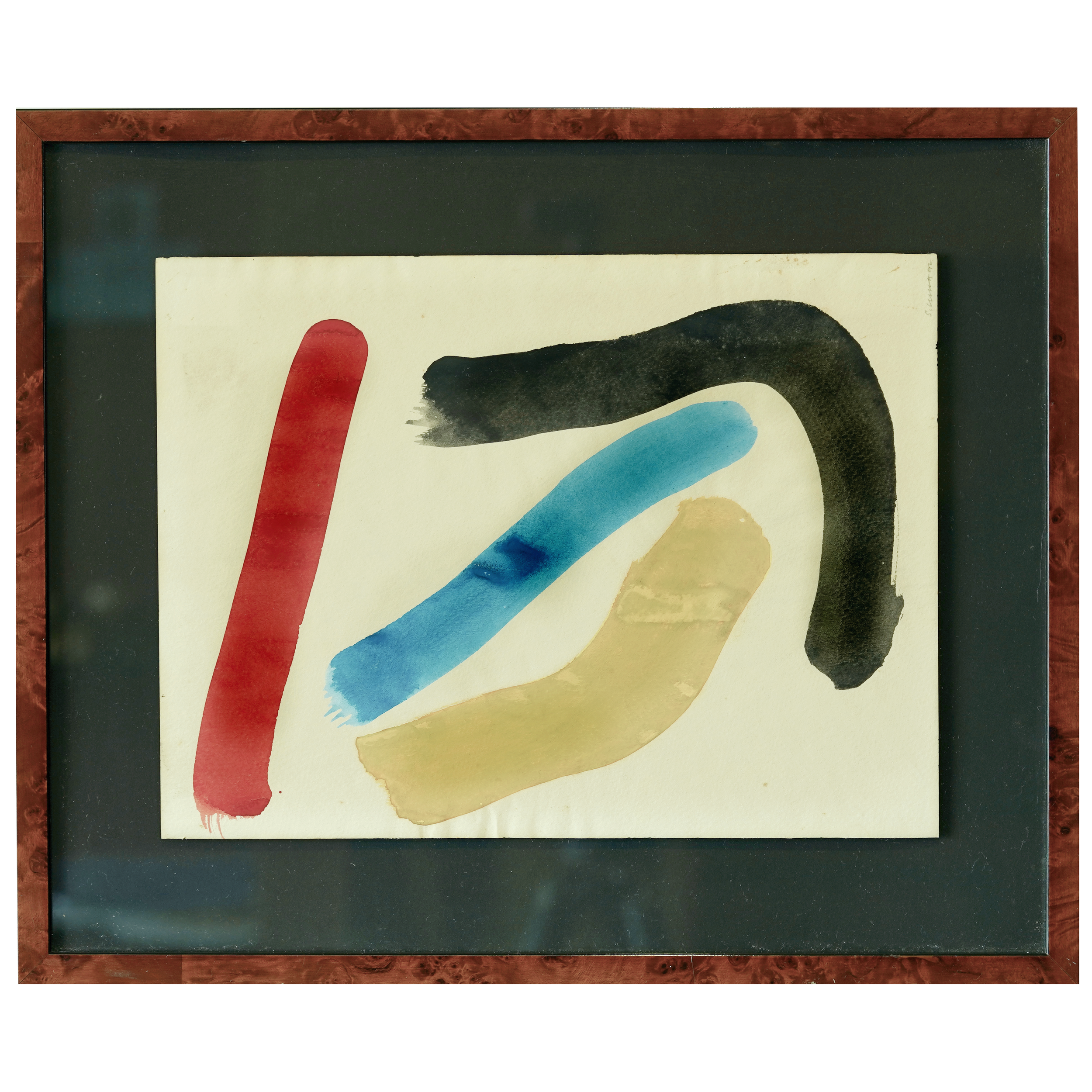
SOL LEWITT Original gouache painting. Dated and Signed top right.
Title:Untitled (Brushstrokes)
Artist: Sol LeWitt (American, 1928–2007)
Date: 1992
Medium: Watercolor on paper
Dimensions: 32 × 24 cm
Collection: Private Collection
Description:
Watercolor by Sol LeWitt featuring four broad, gestural strokes in red, black, blue, and ochre. Departing from his well-known systematic and geometric compositions, this work reveals a more spontaneous and tactile side of the artist’s practice.
Though best known for his conceptual and minimal works, LeWitt also produced a significant body of watercolors later in his career. These pieces explore color, form, and movement in a freer, more organic manner, showcasing the artist’s ongoing curiosity about the possibilities of visual language.
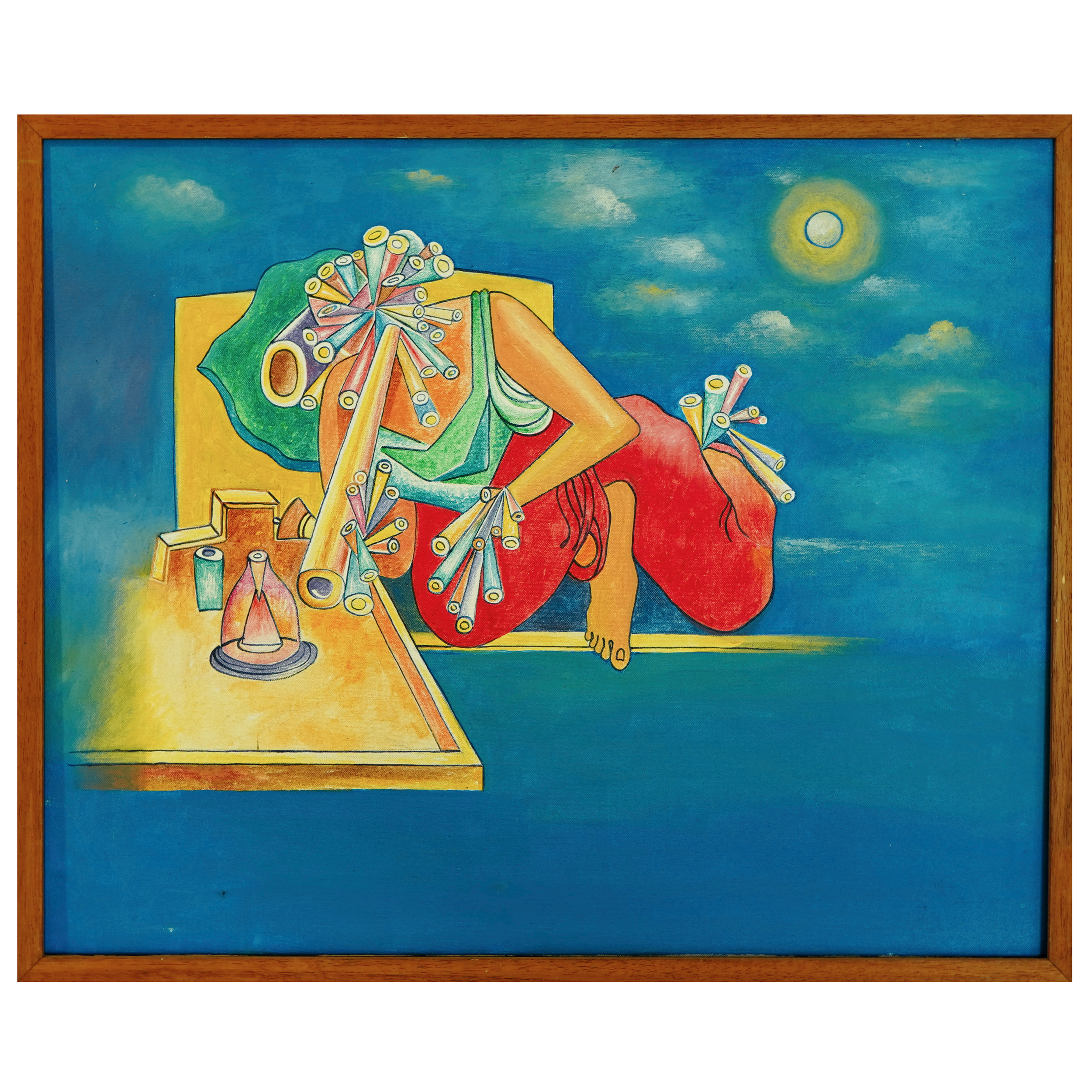
PHILIPPE BOSIO. Oil painting.
Title:L’Opiomane au Soleil
Artist: Philippe Bosio (French, b. 20th c.)
Medium: Oil on Canvas
Dimensions: 52×63 cm
Description:
French artist Philippe Bosio presents a surrealist tableau of a man in the throes of an opium-induced reverie. The composition centers on a semi-reclined figure, whose fragmented form is composed of radiating cylinders and mechanical motifs, suggesting both euphoria and disintegration. This psychedelic abstraction imbues the subject with a hallucinatory aura, reflecting the inner landscape of altered consciousness.
Bosio’s bold palette—rich in primary reds, blues, and yellows—intensifies the psychological charge of the work, while the crisp outlines and flattened perspective lend it a modernist clarity. This painting evokes themes of escapism, solitude, and the seductive peril of narcotic indulgence.
This work exemplifies Philippe Bosio’s distinctive fusion of figurative surrealism with social commentary. Through abstraction and symbolic distortion, L’Opiomane au Soleil probes the complex relationship between intoxication and identity, inviting the viewer into a meditative space where perception is both heightened and obscured.
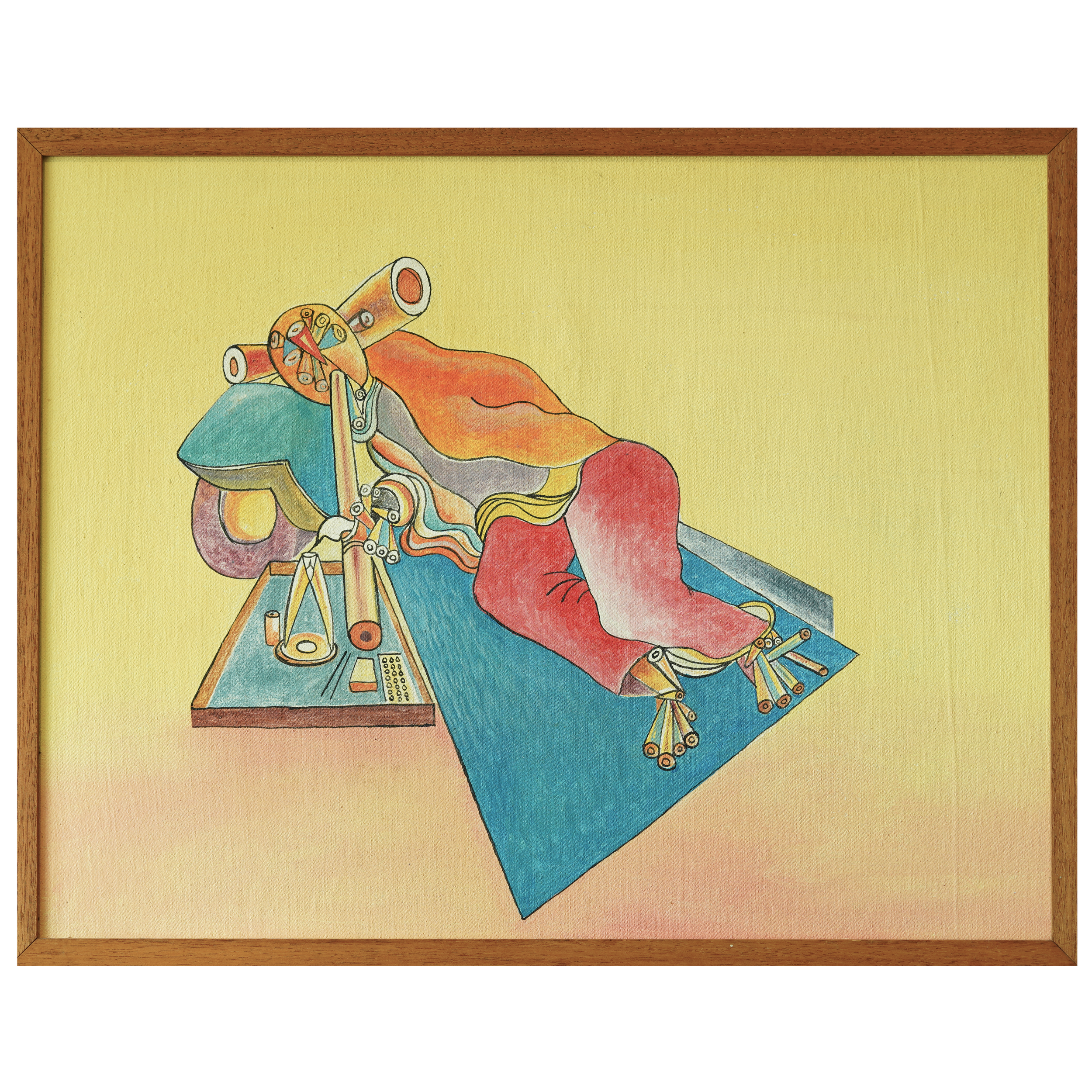
BOZE Oil painting.
Title:Opium Smoker
Artist: BOZE (French, 20th century)
Medium: Acrylic on canvas
Dimensions: 39 × 50 cm
Description:
Original painting by BOZE depicting a reclining man smoking opium. The figure is stylized with mechanical and abstract forms, combining human anatomy with components reminiscent of gears, levers, and tubes. Rendered in warm reds, oranges, and blues against a soft yellow background, the scene evokes both dreamlike detachment and physical ritual.
Boze’s work reinterprets traditional opium-smoking imagery through a surreal and modern lens. The composition reflects the introspective and isolating nature of the opium experience, while the mechanical details suggest the ritual’s repetition and systemic place in society.
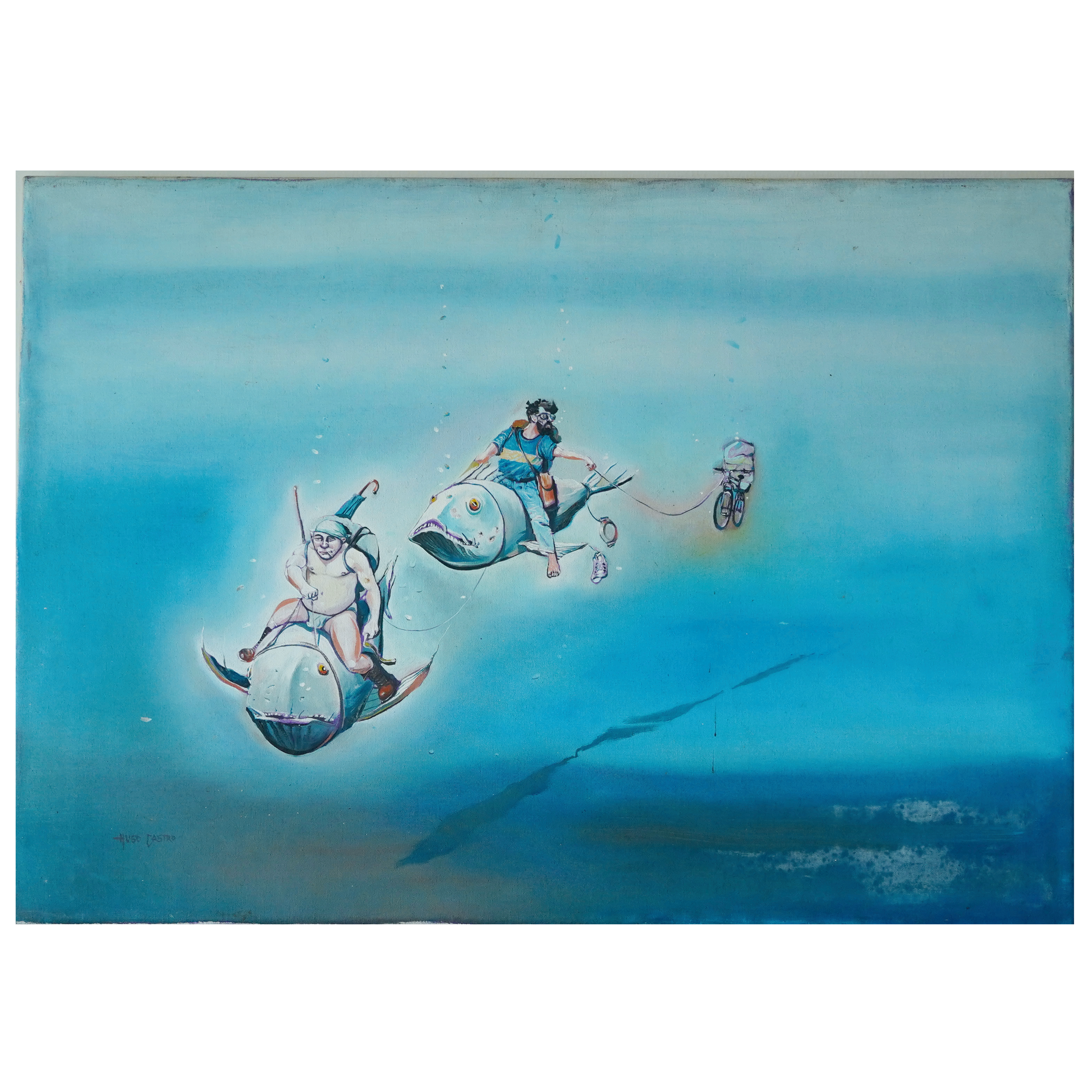
HUGO CASTRO Original Acrylic Painting. Signed bottom left
Artist: Hugo Castro (Mexican, 20th–21st century)
Medium: Acrylic on canvas
Dimensions: 50 × 70 cm
Description:
Underwater scene, Hugo Castro is depicting a fantastical journey through the deep sea. Two human figures, dressed in modern and playful attire, ride large mechanical fish with expressive, cartoon-like faces. A child follows behind, seemingly tethered to the group and riding a small bicycle
Blending fantasy, satire, and a touch of science fiction, Castro’s work reflects on themes of escapism, environmental imagination, and childlike wonder. The fluid motion of the composition and the vibrant palette create a sense of weightlessness and absurd adventure. The juxtaposition of human and mechanical-animal forms challenges traditional boundaries between nature, machine, and human experience.
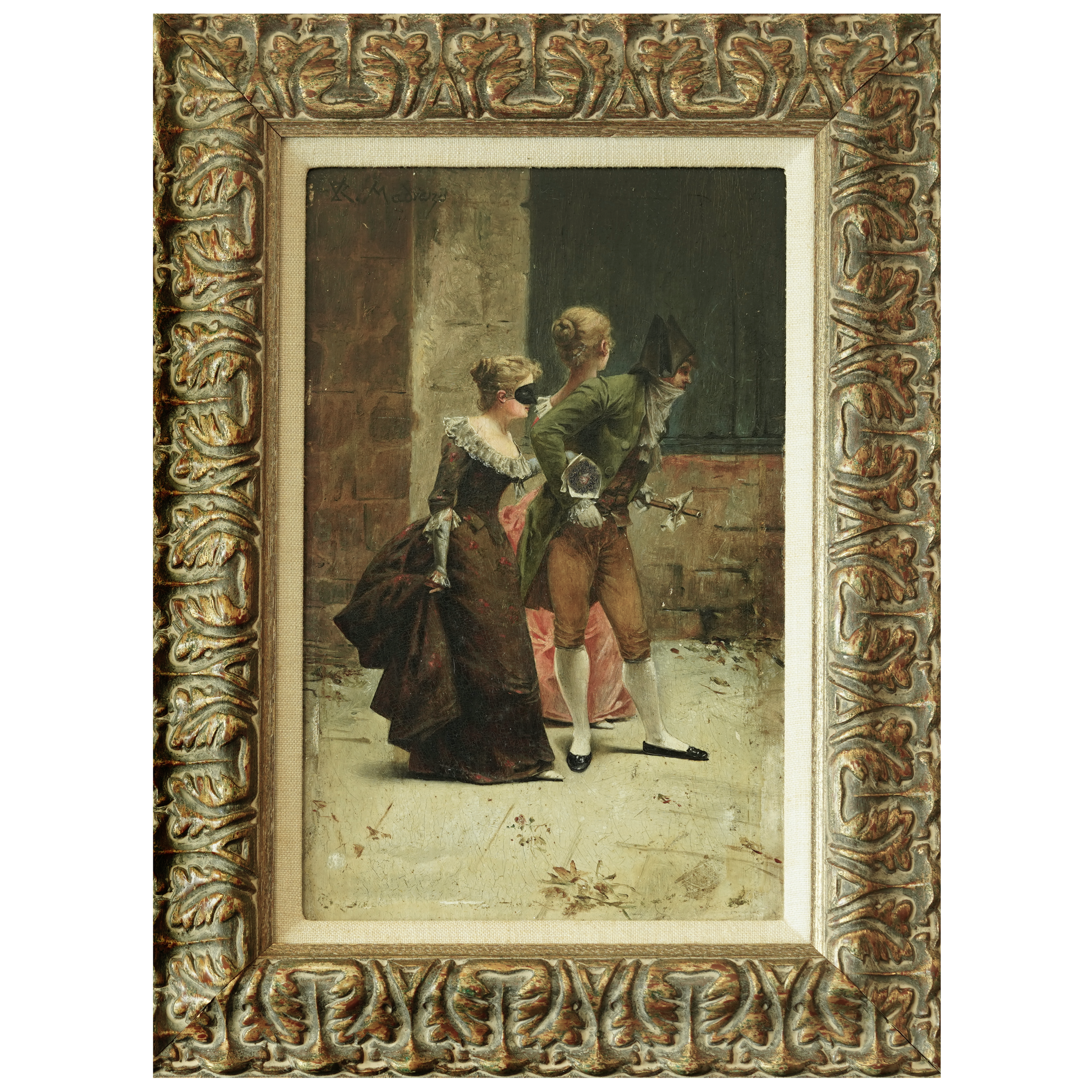
RAIMUNDO MADRAZO. Original Oil painting. Signed top left
Artist: Raimundo de Madrazo y Garreta (1841–1920)
Date: Late 19th century
Medium: Oil on canvas
Dimensions: 32 × 21 cm
Museum Description:
Painting by Raimundo Madrazo showing a scene with two women and one man dressed in 18th-century clothing. One woman is wearing a dark gown and a mask, while the man, dressed in a green coat.
Madrazo was known for painting elegant and romantic scenes. This artwork captures a moment with great attention to costume and detail.
Raimundo Madrazo was known for his depictions of refined interiors and courtly figures. His work often draws on themes of flirtation, gallantry, and historical nostalgia, making this painting a quintessential example of his richly romantic style.

MARIANO FORTUNY. Oil painting. Signed bottom left
Artist: Mariano Fortuny y Marsal (1838–1874)
Date: c. 1860s
Medium: Oil on canvas
Dimensions: 17 × 31 cm
Museum Description:
Mariano Fortuny captures a quiet riverside scene with several figures in traditional clothing. The background features a broad landscape and distant hills under a soft blue sky, while the foreground shows figures walking or gathering near the water and ruins.
Fortuny was known for his detailed brushwork and vivid use of light. This painting combines everyday life with architectural remnants.
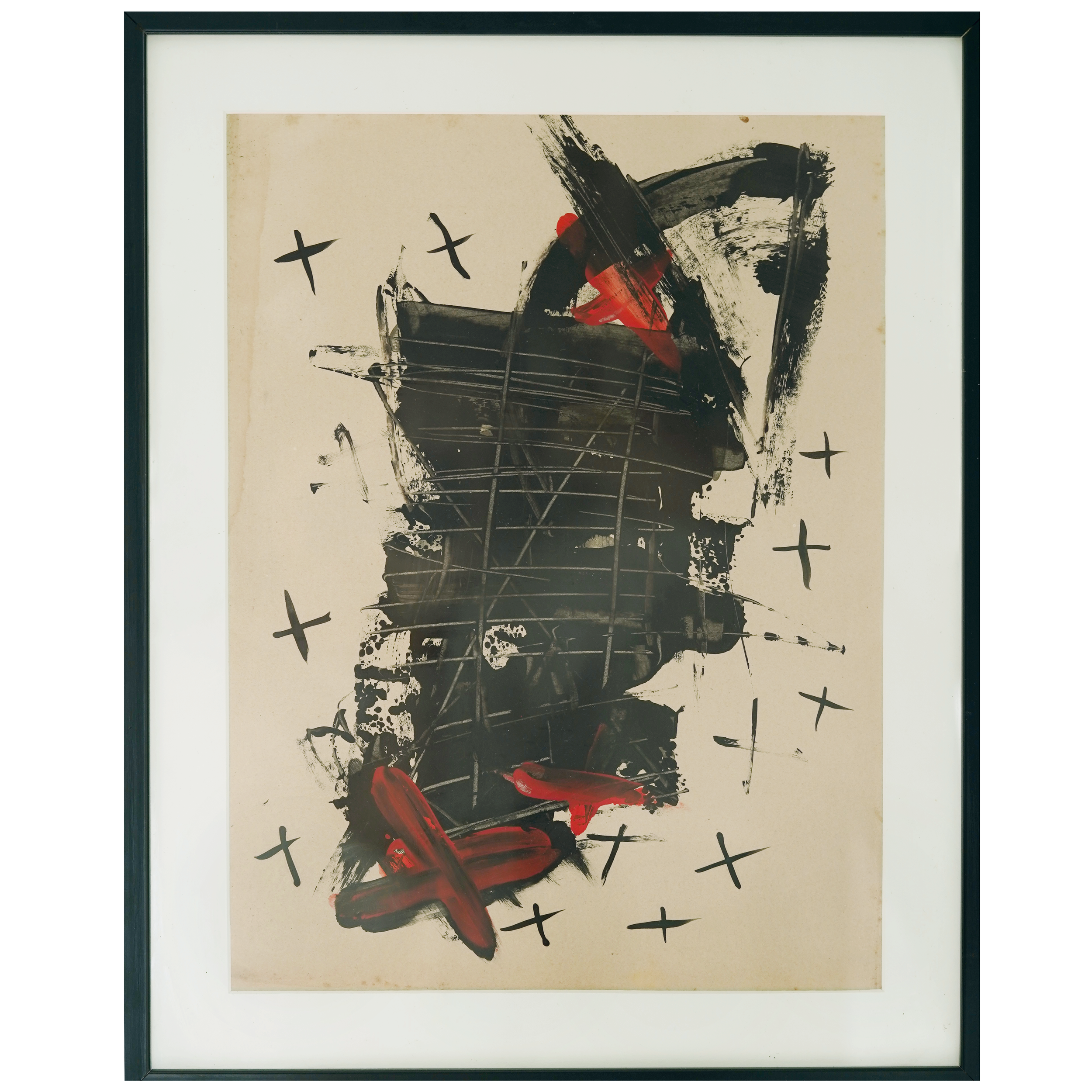
ANTONI TAPIES - Original Painting Untitled
Title:Untitled
Artist: Antoni Tàpies (1923–2012)
Medium: Mixed media on paper
Dimensions: 40 × 30 cm
Description:
Composition by Antoni Tàpies combining gestural brushstrokes, abstract symbolism, and raw texture to evoke a sense of emotional tension and philosophical depth. Dominated by black and red pigments, the piece features layered forms suggestive of barricades or scratched surfaces, with cross-like marks floating in space.
A leading figure in postwar European abstraction, Antoni Tàpies fused material experimentation with deep metaphysical concerns. His work often challenges the boundary between painting and object, using humble media to express inner and social conflict. This piece exemplifies his mature style, balancing chaos with control, and abstraction with symbolic charge.
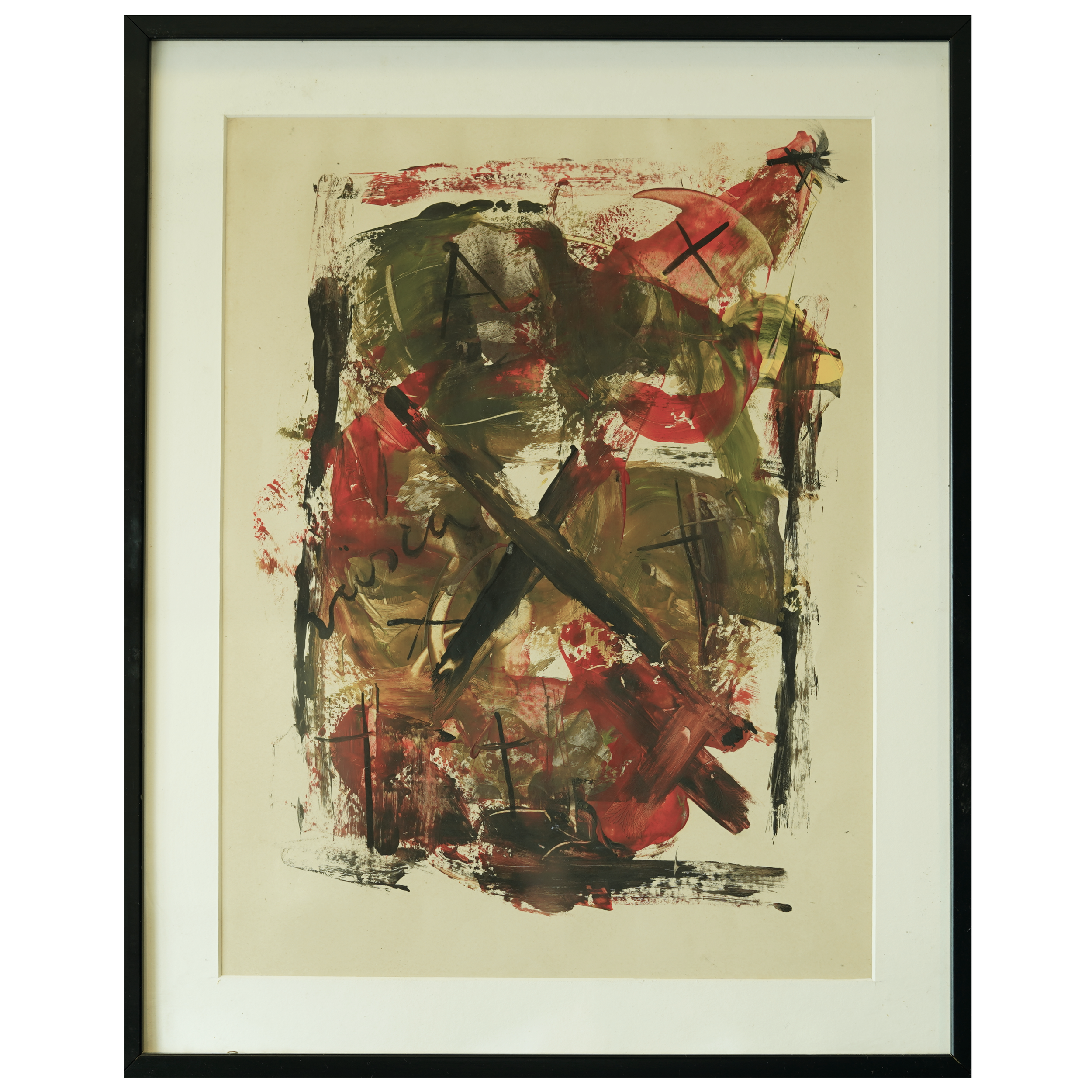
ANTONI TAPIES - Original Painting Untitled
Title:Untitled
Artist: Antoni Tàpies (1923–2012)
Medium: Mixed media on paper
Dimensions: 40 × 30 cm
Description:
Artwork by Antoni Tàpies, layers of earthy reds, greens, blacks, and ochres collide and blend across the paper in a dense field of marks and textures. Bold gestural strokes and scratched-in symbols—most notably recurring X and cross motifs—create a chaotic, raw surface that invites introspection.
Antoni Tàpies, a pivotal figure in the postwar European avant-garde, developed a unique approach that fused abstract expressionism with a material-focused sensibility. His works often confront the viewer with physicality and spiritual tension.
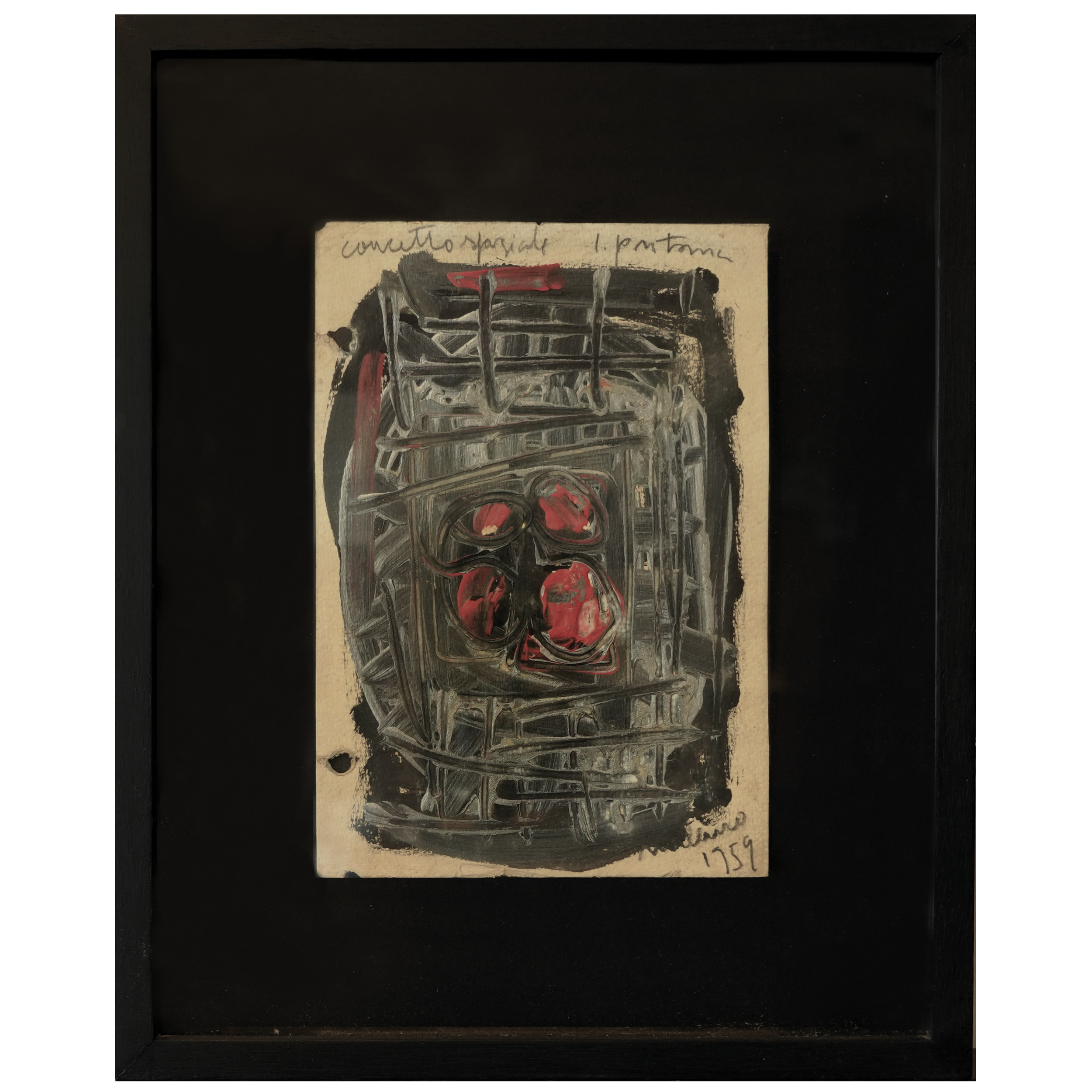
Painting on paper by Lucio Fontana, Concetto Spaziale
Title:Concetto Spaziale (Spatial Concept)
Artist: Lucio Fontana (1899–1968)
Medium: Mixed media on paper
Dimensions: 23 × 16 cm
Description:
Artwork by Lucio Fontana featuring a dense interplay of white, black, and red pigments applied with energetic gestures over a layered surface. At the center, a cluster of vibrant red forms pulses within an intricate web of strokes and lines, evoking spatial tension and organic energy. The handwritten inscription "Concetto Spaziale" above the composition anchors the work in Fontana’s broader artistic pursuit of transcending traditional two-dimensional art.
As the founder of Spatialism, Lucio Fontana sought to integrate space, movement, and materiality into a new visual language. This painting is a vivid testament to that vision, merging abstract form and visceral texture to create a sense of depth and rupture.
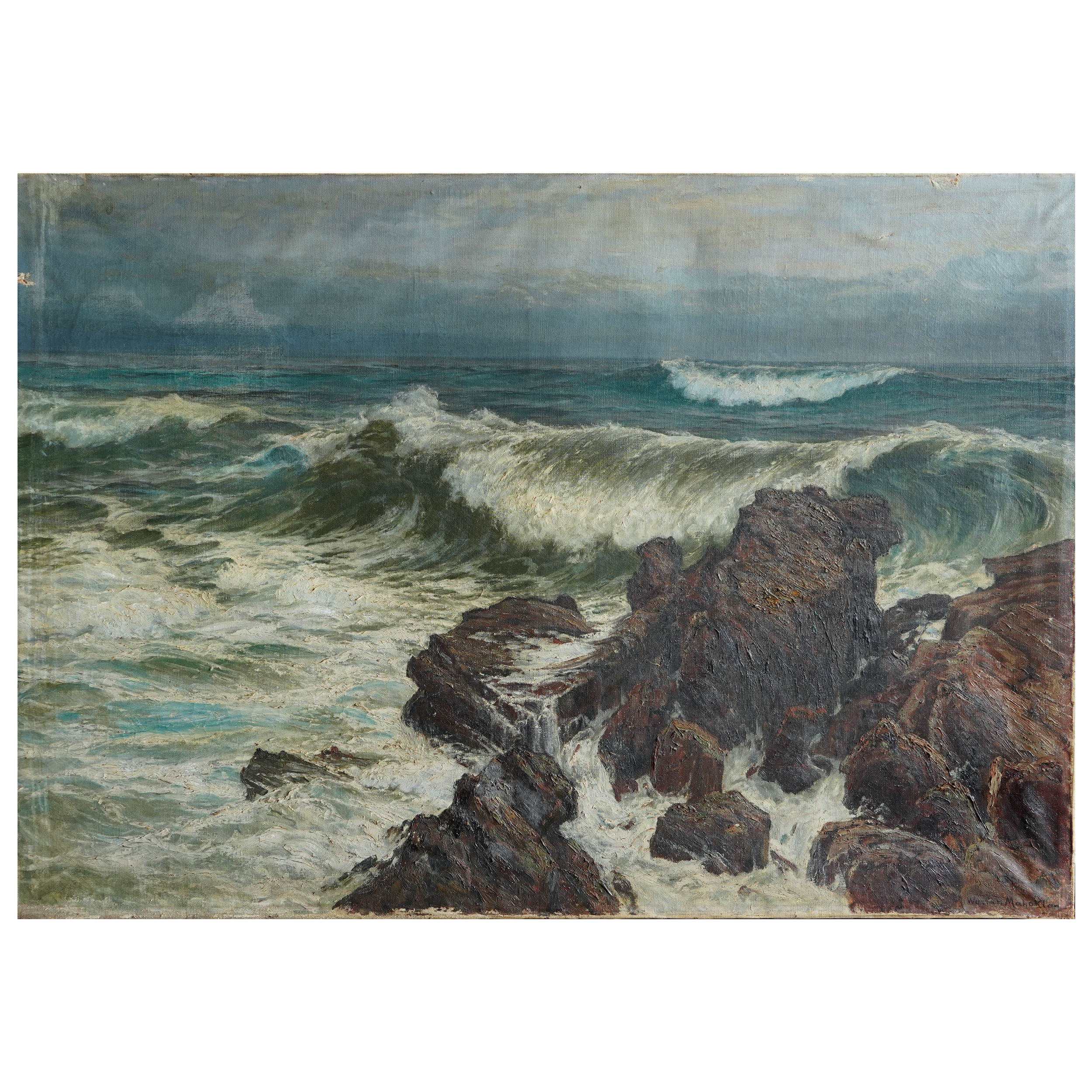
VARTAN MAHOKIAN. Marine painting. Signed bottom right
Title:Rocky Coast with Breaking Waves
Artist: Vartan Mahokian (1869–1937)
Medium: Oil on canvas
Dimensions: 82 × 118 cm
Description:
Original seascape painting by Vartan Mahokian capturing the raw energy of the ocean as waves crash against jagged coastal rocks. The artist’s command of brushwork and tonal variation brings a sense of movement and tension to the composition, while the swirling foam and turbulent skies suggest both natural beauty and elemental power.
Renowned for his maritime scenes, Mahokian was one of the rare Armenian painters of his time devoted almost entirely to seascapes. His works reflect both technical precision and an emotional reverence for the sea. This piece exemplifies his gift for portraying the grandeur and volatility of coastal landscapes.
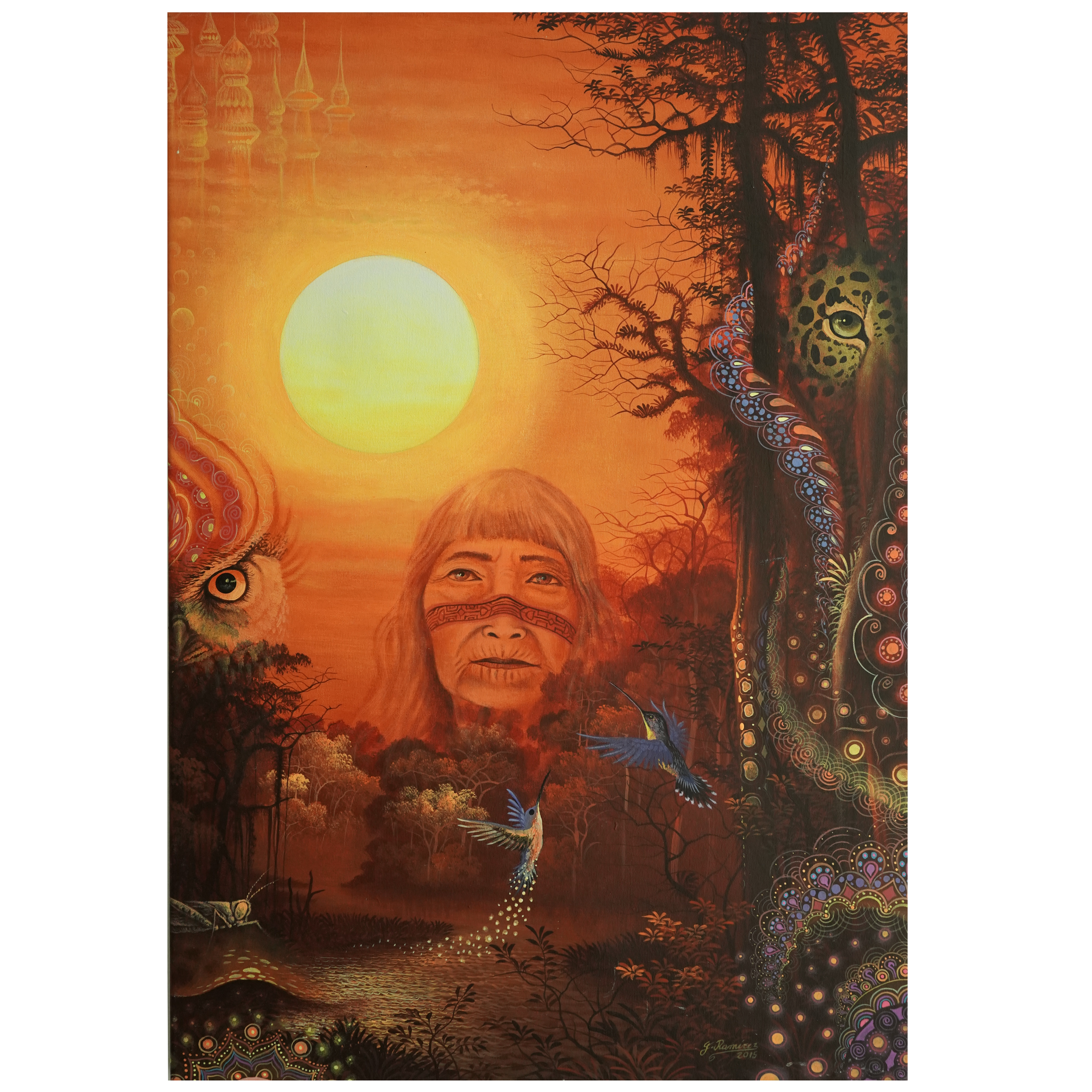
J RAMIREZ. “Ayahuasca Reverie “ Acrylic on canevas. Signed bottom right
Year: 2015
Artist: J Ramírez
Medium: Acrylic on canvas
Dimensions: 80 × 55 cm
Description:
Original painting by Peruvian artist J Ramírez evoking the spiritual depth of the Amazon rainforest. In the warm glow of an otherworldly sun, the central figure—a shamanic presence—emerges from the misty foliage, surrounded by a symphony of natural and mythical elements. Eyes of jaguars and owls peer from the trees, vibrant birds soar with luminous trails, and intricate visionary patterns echo the influence of ayahuasca-inspired visions.
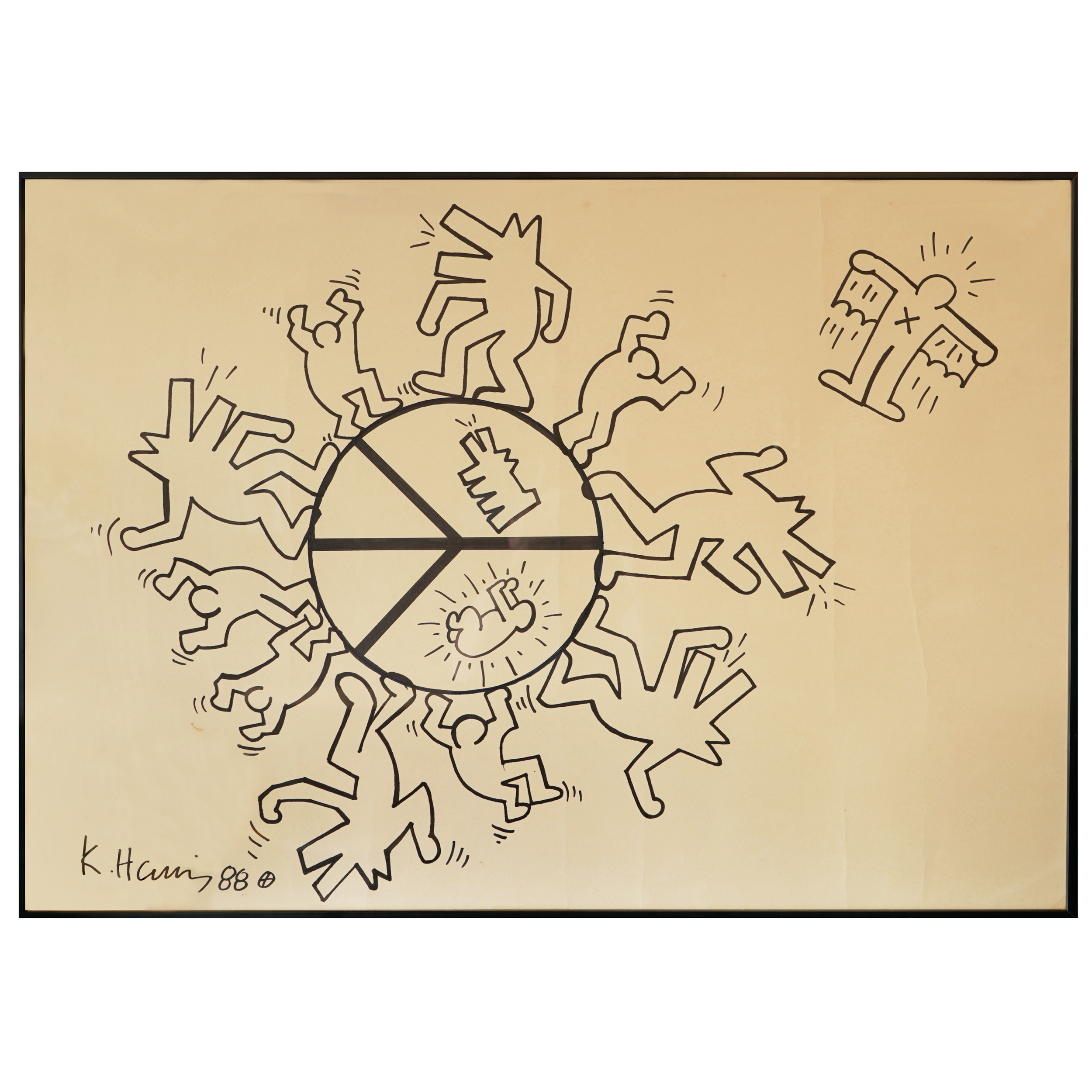
KEITH HARING - Black ink painting. Dated and Signed bottom left
Year: 1988
Title:Untitled
Artist: Keith Haring (1958–1990)
Medium: Ink on paper
Dimensions: 70 × 100 cm
Description:
Original work by Keith Haring showcasing his unmistakable visual language: bold lines, energetic figures, and symbols radiating with urgency. At the center, a peace sign divides a circle containing Haring’s iconic motifs—radiant baby, barking dog, and vibrating television—surrounded by dynamic human forms in motion.
Created in the final years of his life, this 1988 piece reflects Haring’s commitment to activism through art. A central figure in the 1980s street art movement, Haring used his accessible graphic style to address social justice, AIDS awareness, and human rights, imbuing his work with both playfulness and profound political resonance.
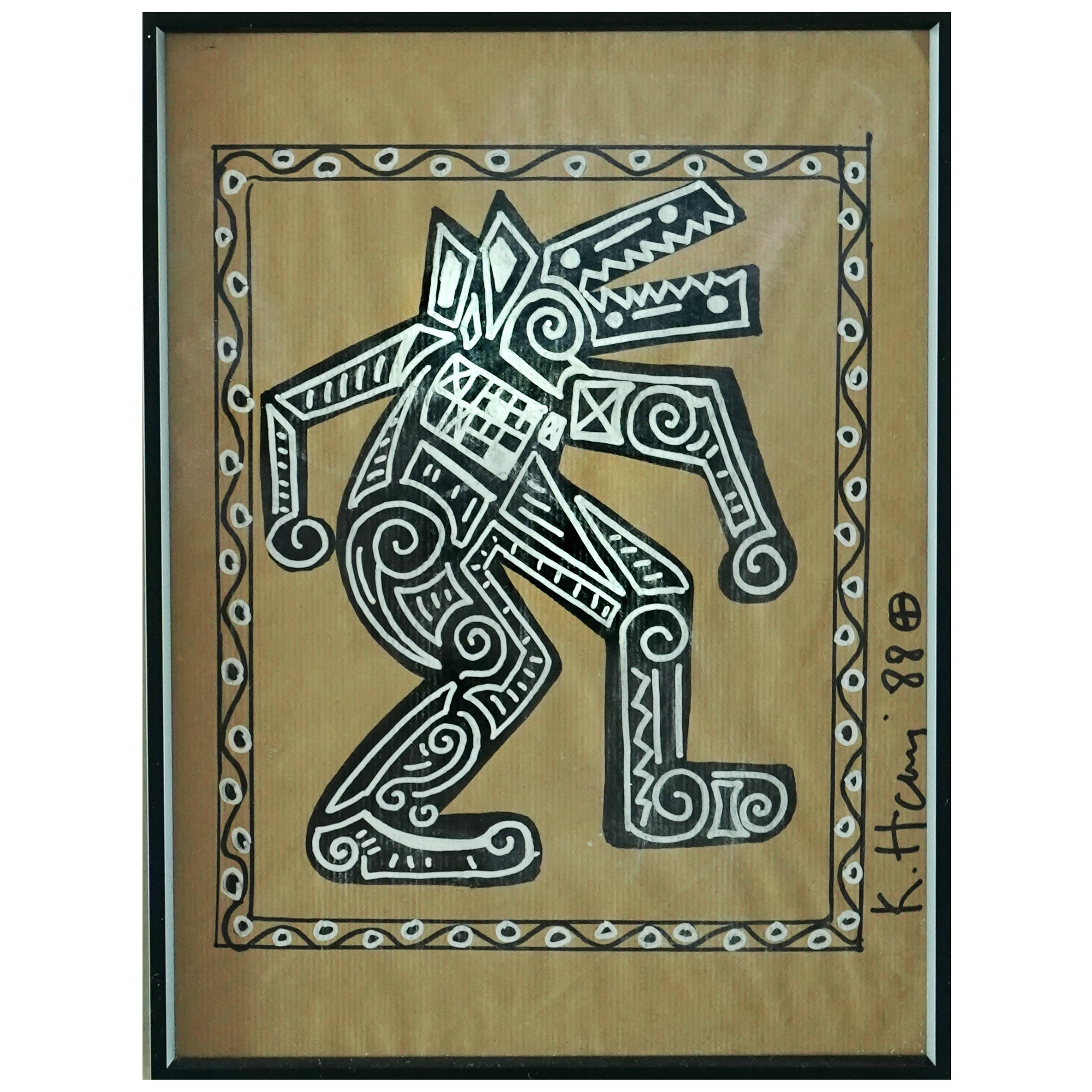
KEITH HARING - DOG Black ink on craft paper. Signed bottom right
Year: 1988
Title:Untitled (Patterned Dogman)
Artist: Keith Haring (1958–1990)
Medium: Ink and paint on paper
Dimensions: 40 × 30 cm
Description:
Original artwork by Keith Haring featuring one of his signature anthropomorphic figures—part human, part dog—rendered in bold black and white with intricate tribal-like patterns. Unlike his usual flat, fluid outlines, this composition is filled with ornamental swirls, grids, and geometric detailing, giving it a totemic, almost ceremonial presence.
Produced in 1988, this work illustrates Haring’s ongoing experimentation with cultural symbolism and his deep interest in global visual languages. Known for merging graffiti, pop, and primitivist aesthetics, Haring’s art bridges the urban and the mythic—inviting viewers into a world where bold simplicity carries complex, universal themes.
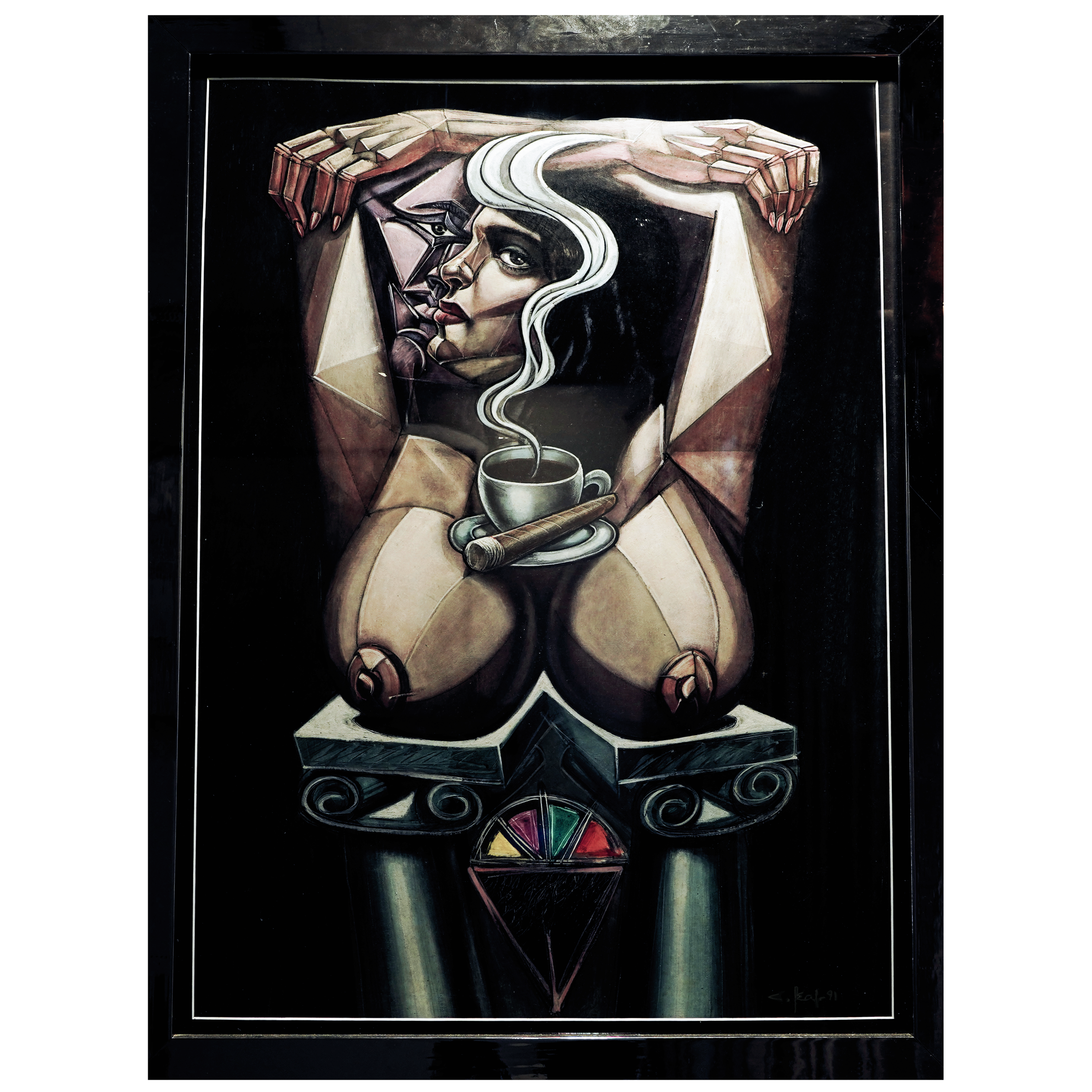
Acrylic on board by Cesar LEAL JIMENEZ. Dated and signed bottom right “C LEAL 91”
“FUNDATIONS OF CUBA”
Year: 1991
Artist: César Leal Jiménez
Medium: Oil on canvas
Dimensions: 80 × 60 cm
Description:
Painting by César Leal Jiménez blenings elements of Cubism and surrealism to depict a woman emerging from an architectural pedestal. Her fragmented, geometric form emphasizes both strength and sensuality, with her body serving as both structure and symbol. A cup of steaming coffee and a cigar rest upon her chest, their smoke entwining with her flowing white hair, linking pleasure, ritual, and identity.
César Leal Jiménez’s work often explores the complexity of feminine identity through bold symbolism and architectural references. Here, the female figure becomes both temple and totem—embodying power, allure, and cultural resonance in a single enigmatic composition.
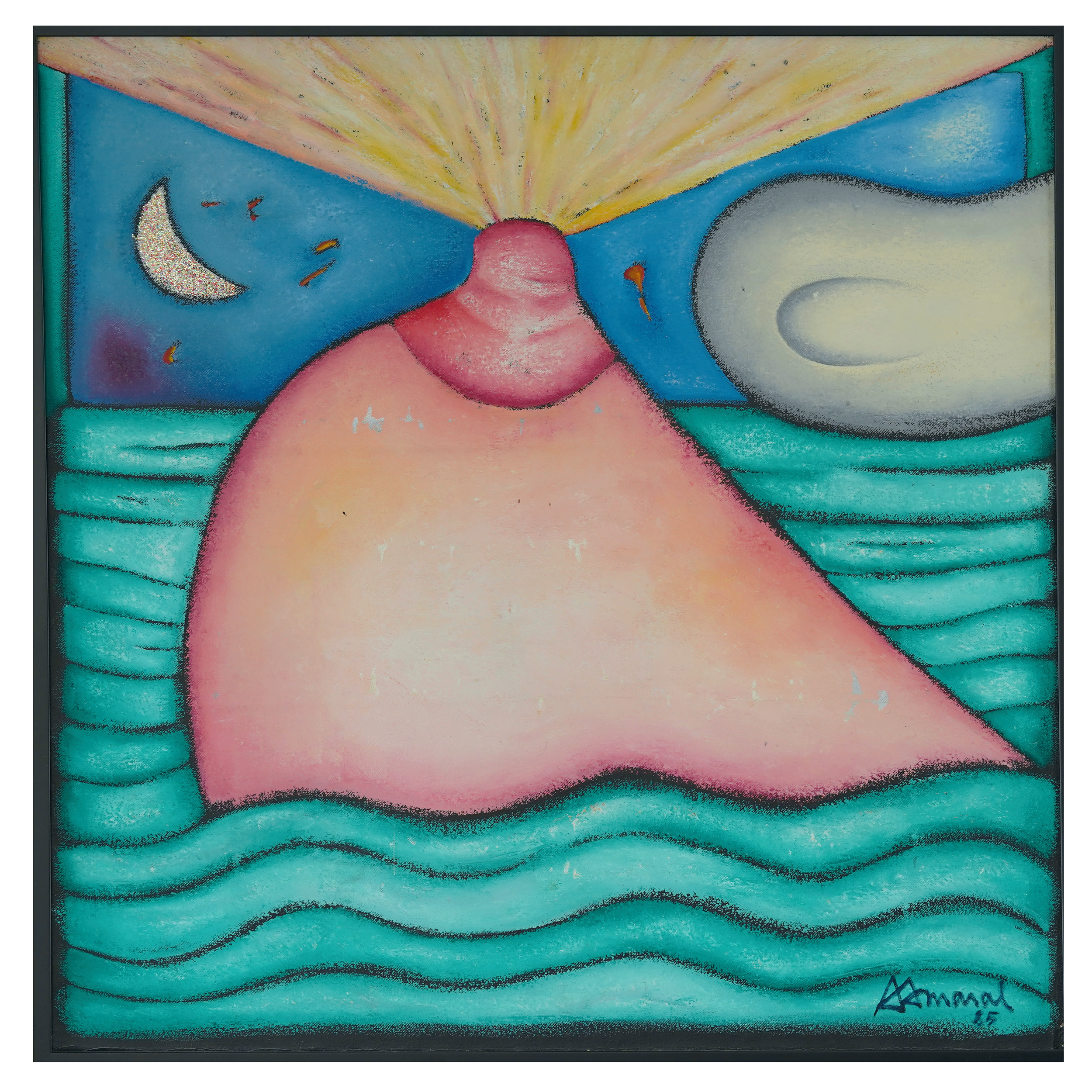
ANTONIO HENRIQUE AMARAL. Acrylic on canevas. Signed bottom right
Title:Untitled
Artist: Antonio Enrique Amaral (1935–2006)
Medium: Pastel and mixed media on paper
Dimensions: 102 × 102 cm
Description:
Composition by Antonio Enrique Amaral fusing human anatomy with elements of nature, depicting a breast-shaped volcano rising from stylized turquoise waves. The volcano erupts with radiant energy into a deep blue sky, where a crescent moon and cloud float nearby, reinforcing the dreamlike quality of the work. Amaral's use of bold color, curved lines, and sensual forms evokes a playful yet symbolic narrative of creation, nature, and transformation.
A prominent figure in Latin American modernism, Amaral often explored themes of power, identity, and the body through surreal allegories. This work reflects his signature fusion of political symbolism and poetic imagery, offering a visual meditation on the intersection of the natural world and the human form.
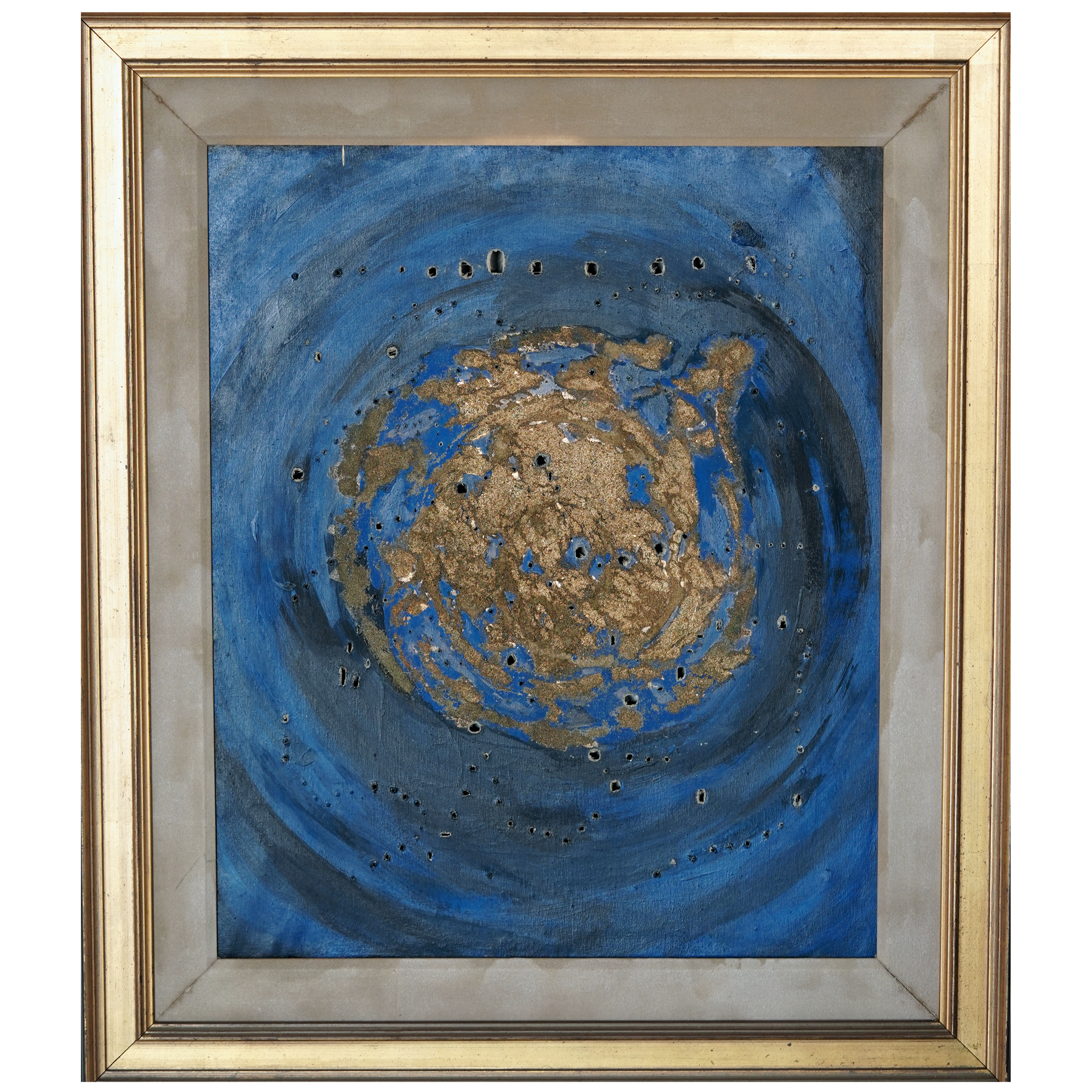
Painting by Lucio Fontana, from Original Concetto Spaziale
Title:Concetto Spaziale
Artist: Lucio Fontana (Italian, 1899–1968)
Medium: Oil, gold leaf, and perforations on canvas
Dimensions: 79 × 68 cm
Description:
Concetto Spaziale (Spatial Concept), Lucio Fontana transcends the two-dimensional limits of traditional painting. At the heart of the canvas lies a swirling planetary form rendered in lustrous gold, set against a rich, celestial field of blue. True to Fontana’s radical vision, the surface is punctuated by a constellation of deliberate perforations, creating literal and conceptual depth.
Lucio Fontana's Concetto Spaziale works marked a groundbreaking shift in postwar art, merging painting, sculpture, and conceptualism. This piece, with its dynamic textures, tactile incisions, and cosmic overtones, exemplifies Fontana’s revolutionary aim to open the artwork to new dimensions—literally piercing the veil of representation to embrace the void beyond.
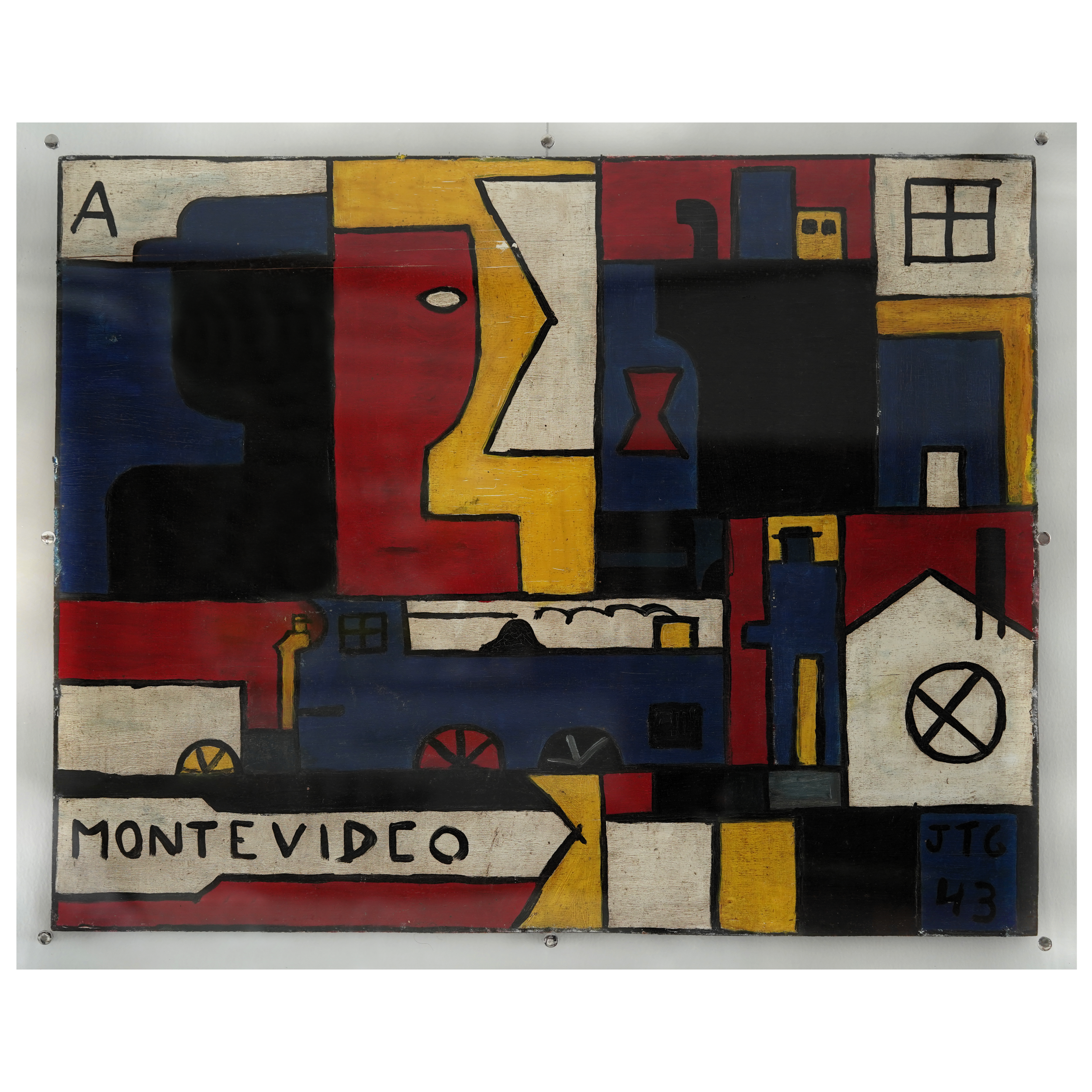
Year: 1943
Title:Montevideo
Artist: Joaquín Torres-García (1874–1949)
Medium: Oil on board
Dimensions: 52 × 65 cm
Description:
Composition by Joaquín Torres-García rendering the city of Montevideo through a symbolic and constructivist lens. Geometric forms—houses, trains, arrows, clocks, and abstracted figures—are arranged in a structured grid, evoking both urban dynamism and spiritual balance. The palette of primary colors (red, blue, yellow) paired with black and white reflects his characteristic visual language.
A leading figure in Latin American modernism, Torres-García sought to merge European avant-garde principles with indigenous and universal symbolism. His philosophy of Constructive Universalism aimed to connect ancient traditions with modern abstraction. Painted upon his return to Uruguay, this piece is a visual testament to his cultural synthesis—placing Montevideo at the crossroads of memory, identity, and modern thought.
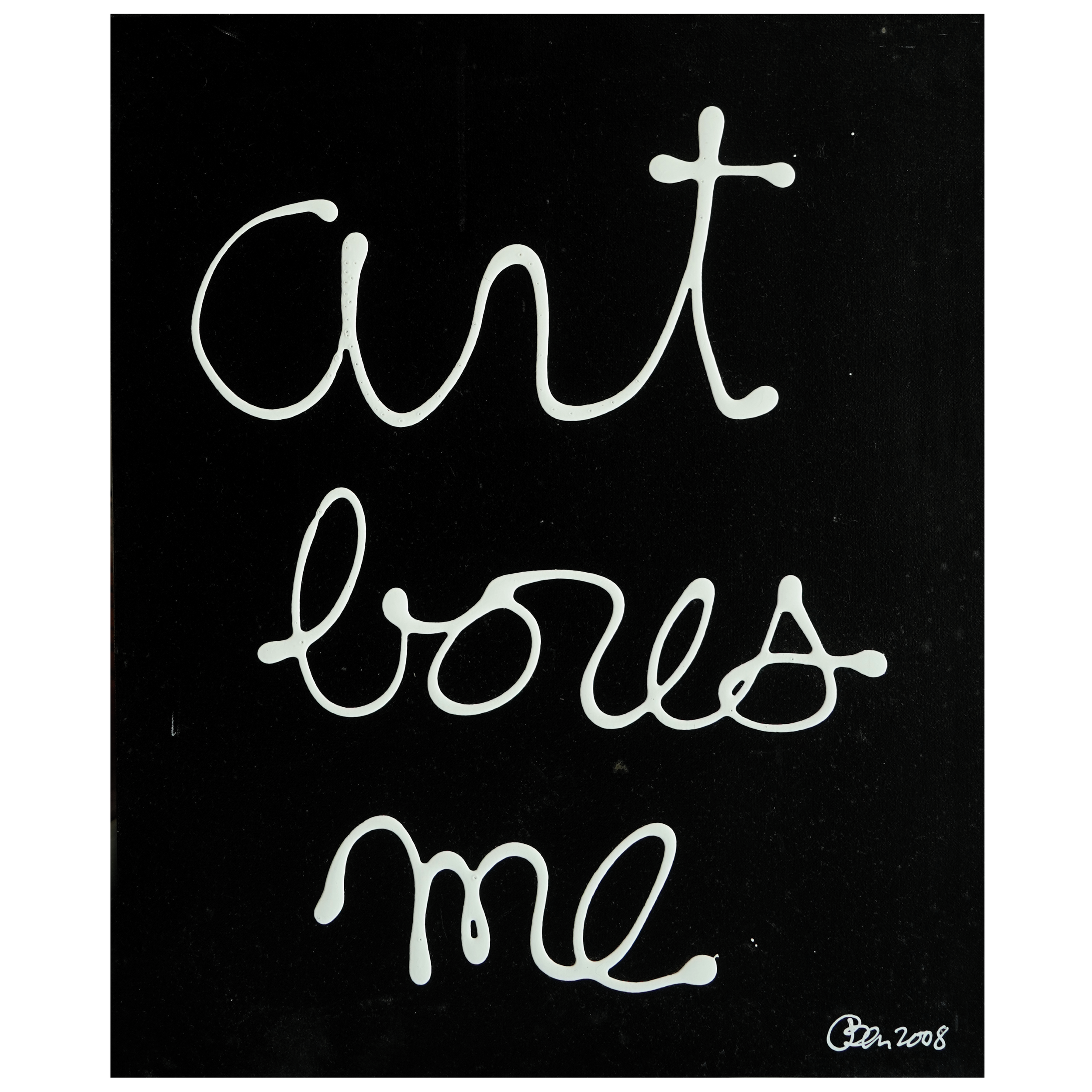
Title:Art Bores Me
Artist: Ben Vautier (born 1935)
Date: 2008
Medium: Acrylic on canvas
Dimensions: 61 × 50 cm
Signature: Signed and dated “Ben 2008” (lower right)
Description:
With his unmistakable handwriting and minimalist style, Ben Vautier delivers a paradoxical statement: “Art bores me.” Painted in white on a stark black background, this work exemplifies his conceptual approach to art, where language is both the subject and the medium.
Art Bores Me functions as both artwork and anti-artwork, in line with the Dadaist spirit Ben often channels. By using the written word as a visual object, he blurs the line between art and statement, and between artist and viewer. In this way, the work becomes a mirror — asking not whether art is boring, but why we look at it in the first place.
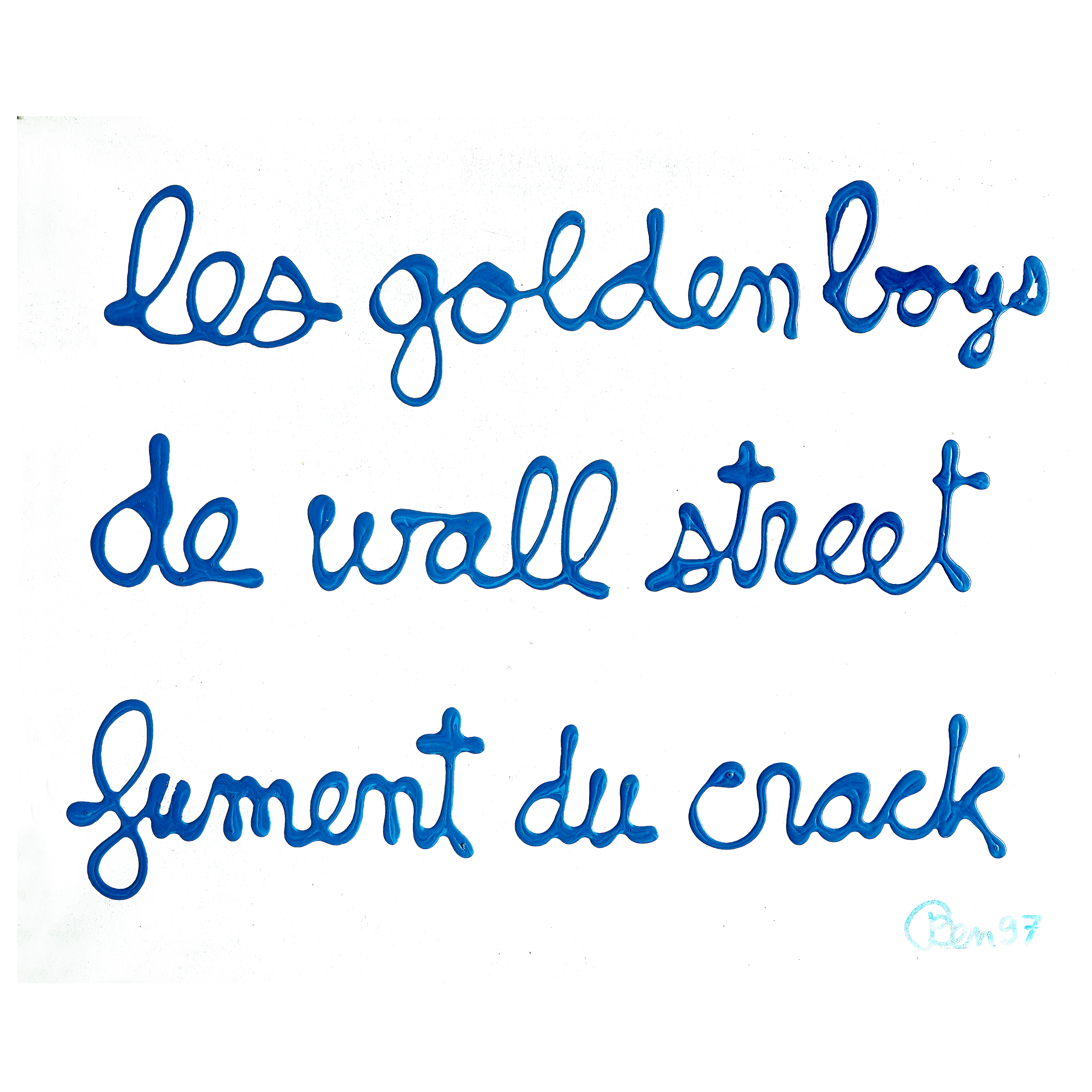
Title:Les golden boys de Wall Street fument du crack
Artist: Ben Vautier (born 1935)
Medium: Acrylic on canvas
Dimensions: 50 × 61 cm
Signature: Signed and dated “Ben 97” (lower right)
Description:
Ben Vautier delivers a biting commentary on capitalism and financial culture. The text, rendered in his signature cursive style in vibrant blue acrylic, reads: “les golden boys de Wall Street fument du crack” ("the golden boys of Wall Street smoke crack").
Ben’s use of text as image forces a direct encounter between viewer and idea. This piece exemplifies his flair for mixing irony and protest, confronting the viewer with the absurdities and excesses of contemporary society. Like much of his oeuvre, it raises questions rather than answers — about money, morality, and the messages we choose to display.
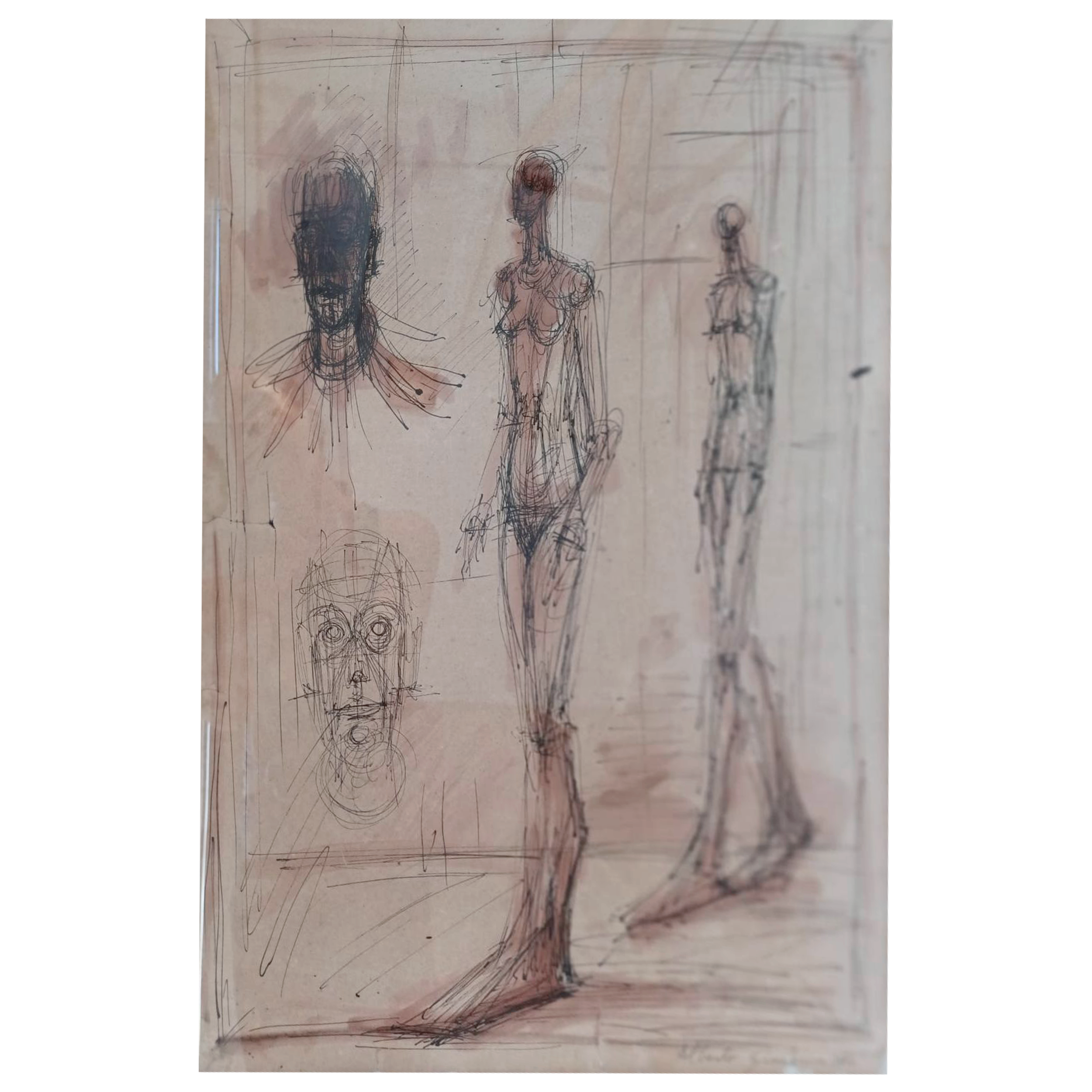
Alberto Giacometti (1901–1966)
Figure Studies
Ink and wash on paper
Drawing exemplifying Alberto Giacometti’s relentless search for the essence of human presence. Combining studies of heads with elongated standing nudes, the composition reveals his characteristic linear draftsmanship—nervous, repetitive strokes that seem to etch the figure into existence. The attenuated bodies anticipate the sculptural forms for which Giacometti is most celebrated, evoking both fragility and permanence. The ink wash adds tonal depth, situating the figures in a spatial field while underscoring their spectral, almost immaterial quality.
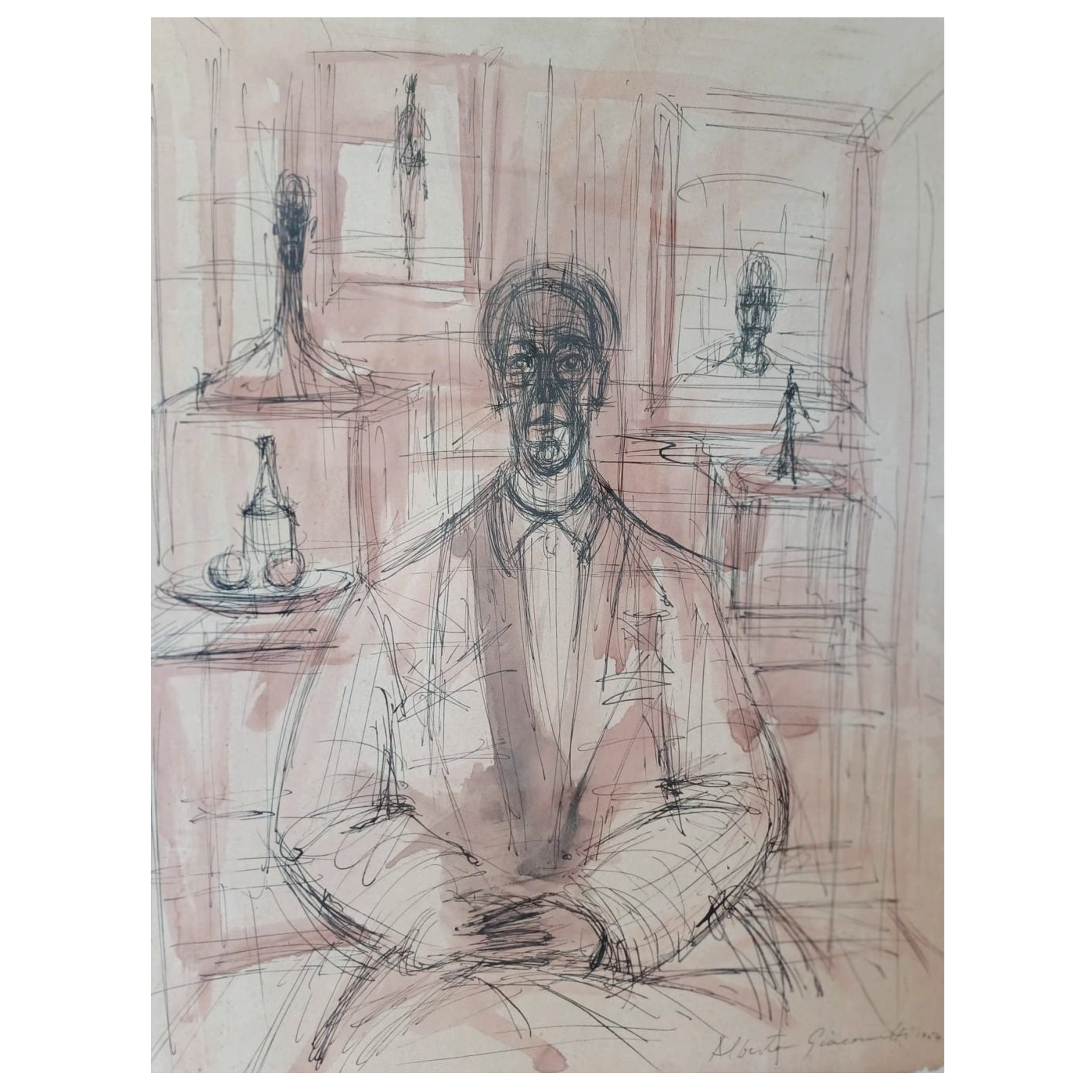
Alberto Giacometti (1901–1966)
Seated Man in Interior
Ink and wash on paper, c. 1950s
Drawing by Alberto Giacometti exemplifying his distinctive draftsmanship, where restless lines and overlapping contours convey both form and psychological presence. The central figure, seated in a frontal pose, is defined through dense linear crosshatching and layered washes of muted tones. Surrounding him, Giacometti sketches elements of a studio interior: sculptures, paintings, and still-life objects that echo the artist’s lifelong exploration of the human figure and its relation to space.

Artist: Alberto Giacometti (Swiss, 1901–1966)
Medium: Lithograph on paper
Edition: Numbered lower left 47/100
Signature: Printed signature of the artist lower right, Alberto Giacometti
Dimensions: 47 × 31 cm
Description:
Lithograph reproducing a seated male figure in Alberto Giacometti’s distinctive, searching line. The subject, rendered with sparse yet deliberate marks, sits in a relaxed but introspective pose, arms loosely resting on his knees. Giacometti’s trademark web of overlapping lines conveys both the structure of the body and the artist’s intense process of observation, imbuing the image with an almost vibrating presence.
The composition leaves the background bare, allowing the figure to emerge in isolation. The head and upper body are drawn with heightened focus, evoking a psychological depth that is characteristic of Giacometti’s portrait work.
Artistic Context:
Giacometti’s lithographs, often based on his original drawings, preserve the immediacy and spontaneity of his hand while making his vision accessible to a wider audience. They reflect his enduring fascination with the human figure as an existential presence, existing between physical form and fleeting perception.
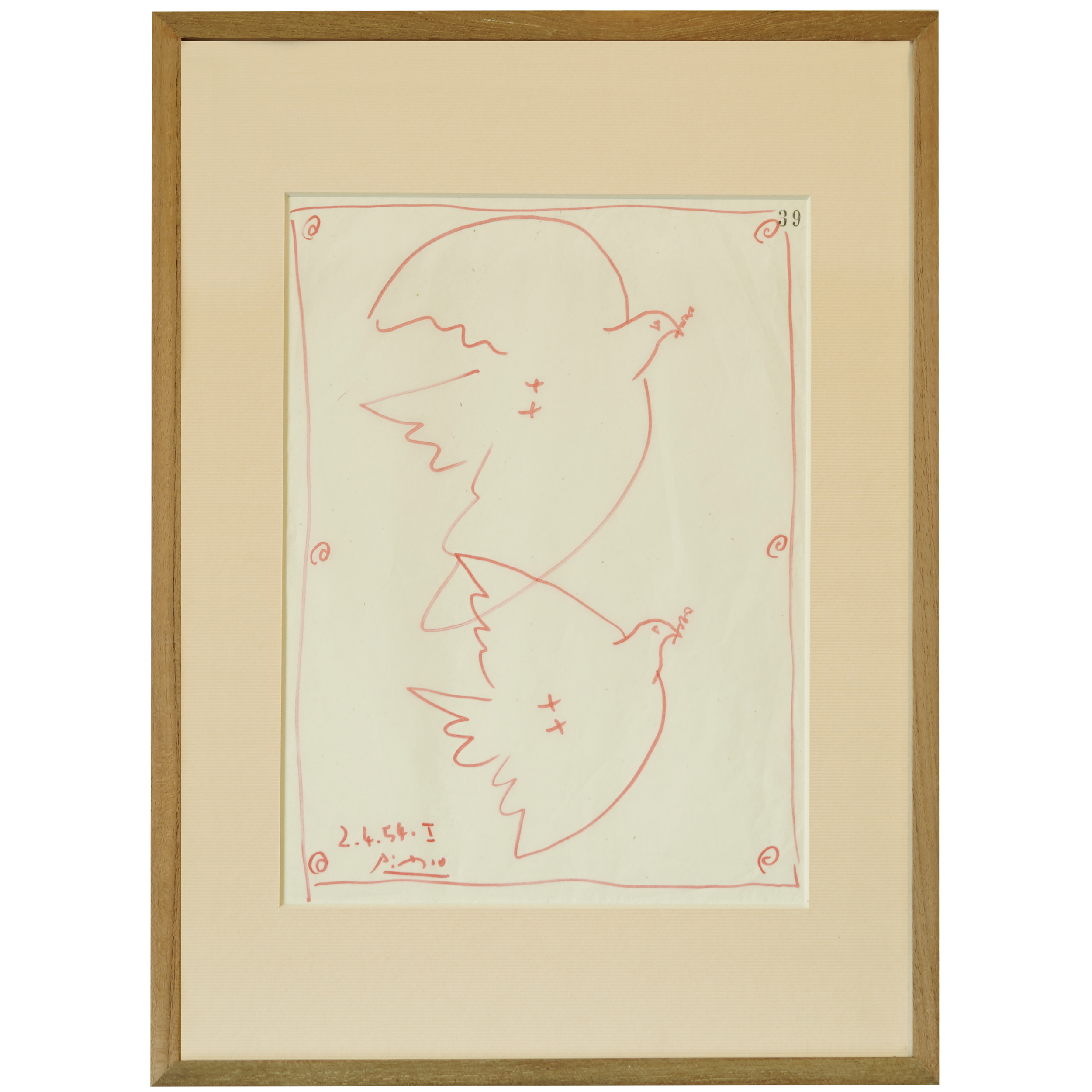
Original PICASSO two doves of peace, in flight, a sprig of olive in the beak. Dated and signed bottom left 2.4.54 I
Year: 1954
Dimensions: 27 × 20 cm
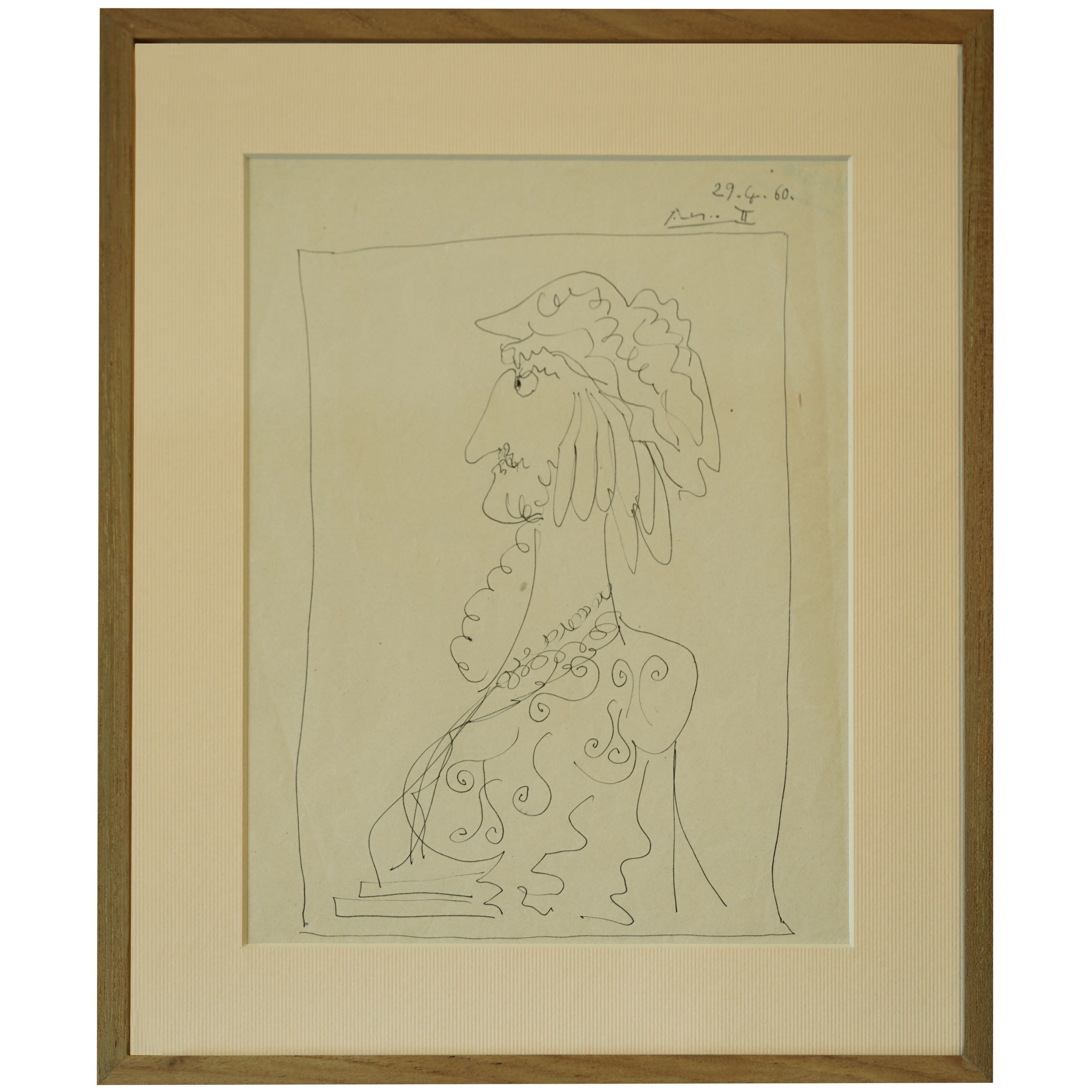
Bust profile of a burlesque character, wearing a headpiece, looking to the left, outlined by a rectangular ink stroke. Dated and signed top right 29.4.60 II
Year: 1960
Dimensions: 26 × 20 cm
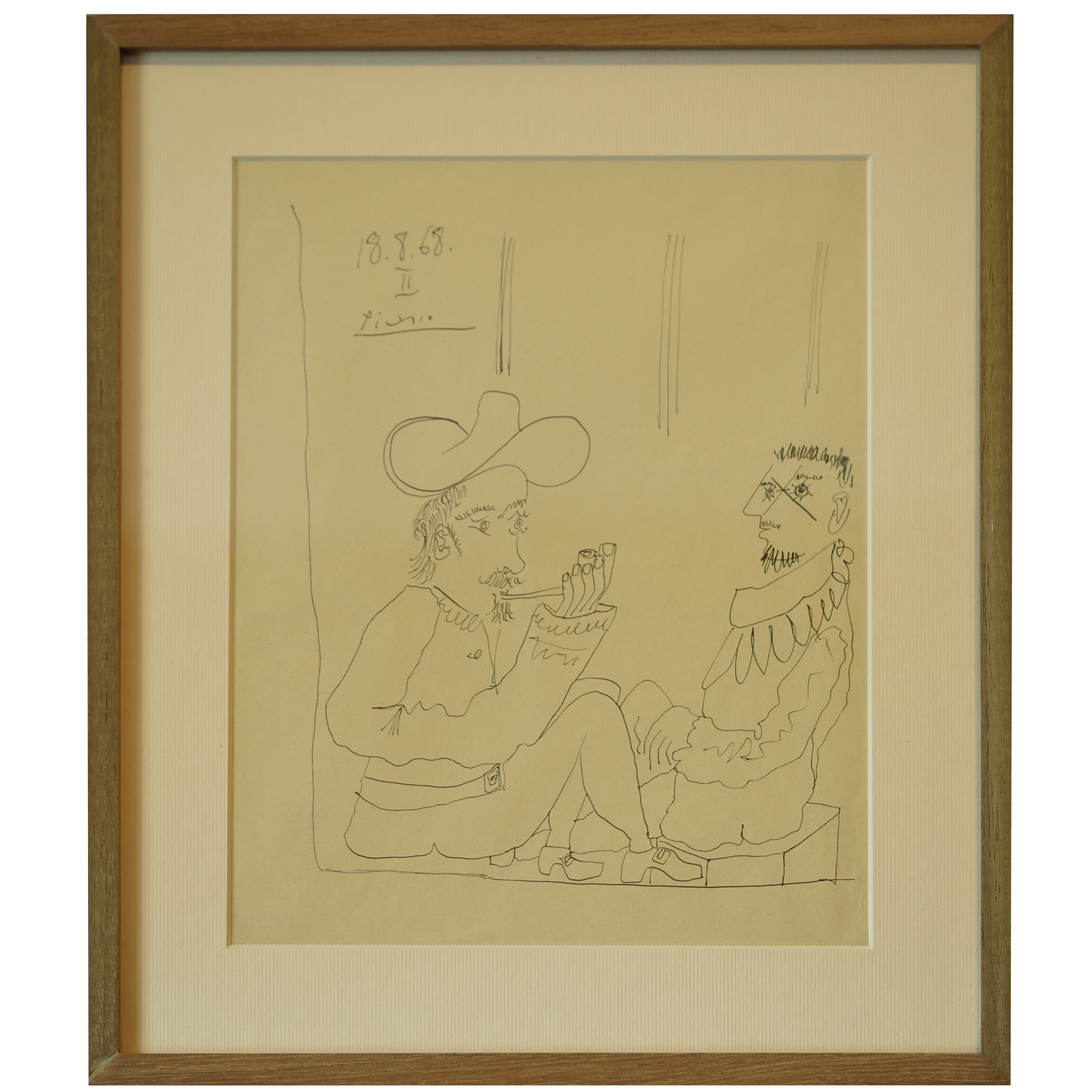
A hatted pipe smoker sits facing a figure with an X-shaped face and a jabot, set before a row of columns. Dated and signed top left 18.8.68 II
Year: 1968
Dimensions: 26 × 20 cm

Original Picasso horned bull’s head carried by two running legs. Dated and signed top left 1.2.54 XV
Year: 1954
Dimensions: 16 × 22 cm

Original Picasso, Galerie Louise Leiris, 8th arrondissement, surmounting a lively scene of a picador on his mount, flanked by two toreadors signed bottom left
Year:
Dimensions: 20 × 20 cm
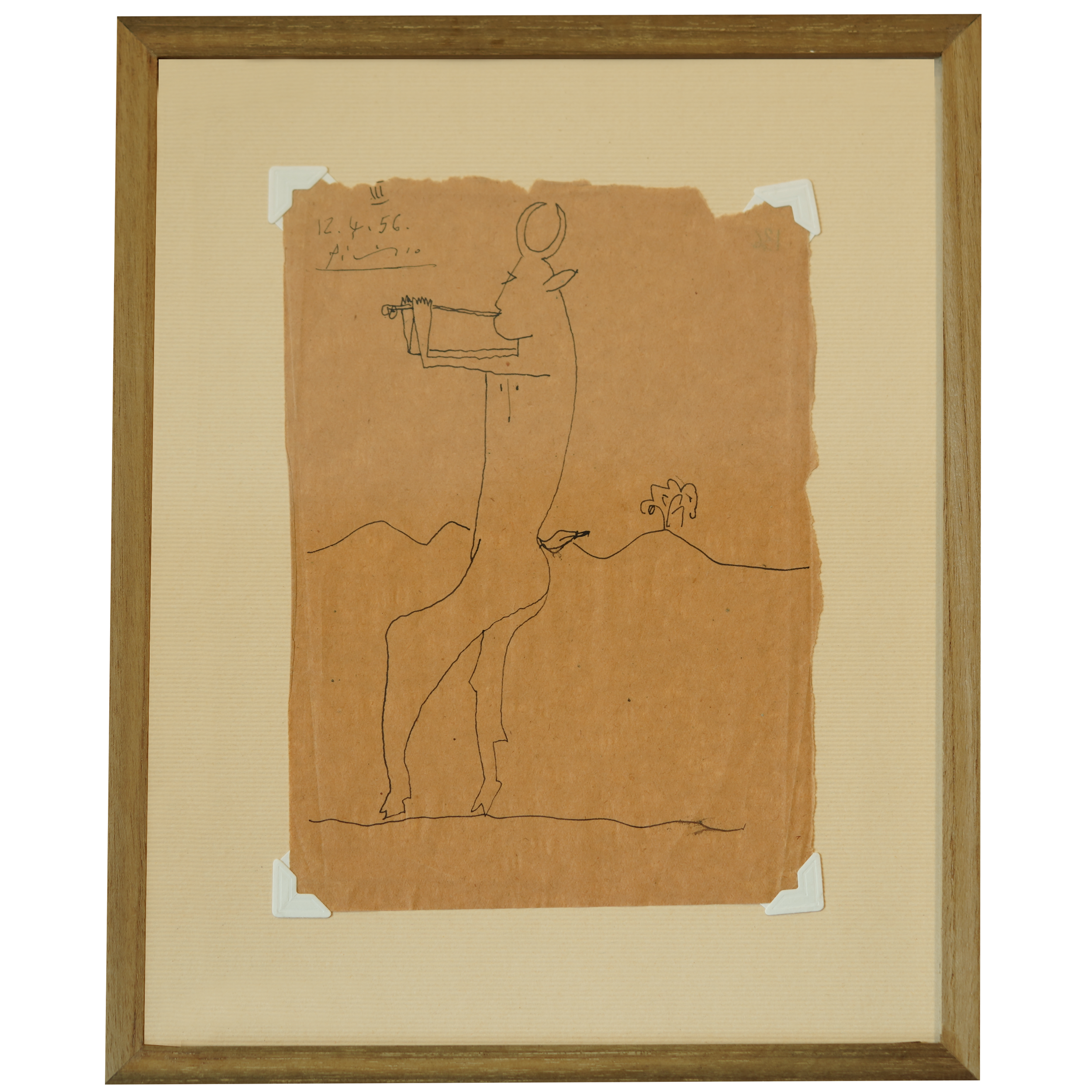
Horned faun standing, playing the flute in front of a tree-lined ridge dated and signed bottom right 12.4.56 III
Year: 1956
Dimensions: 19 × 14 cm
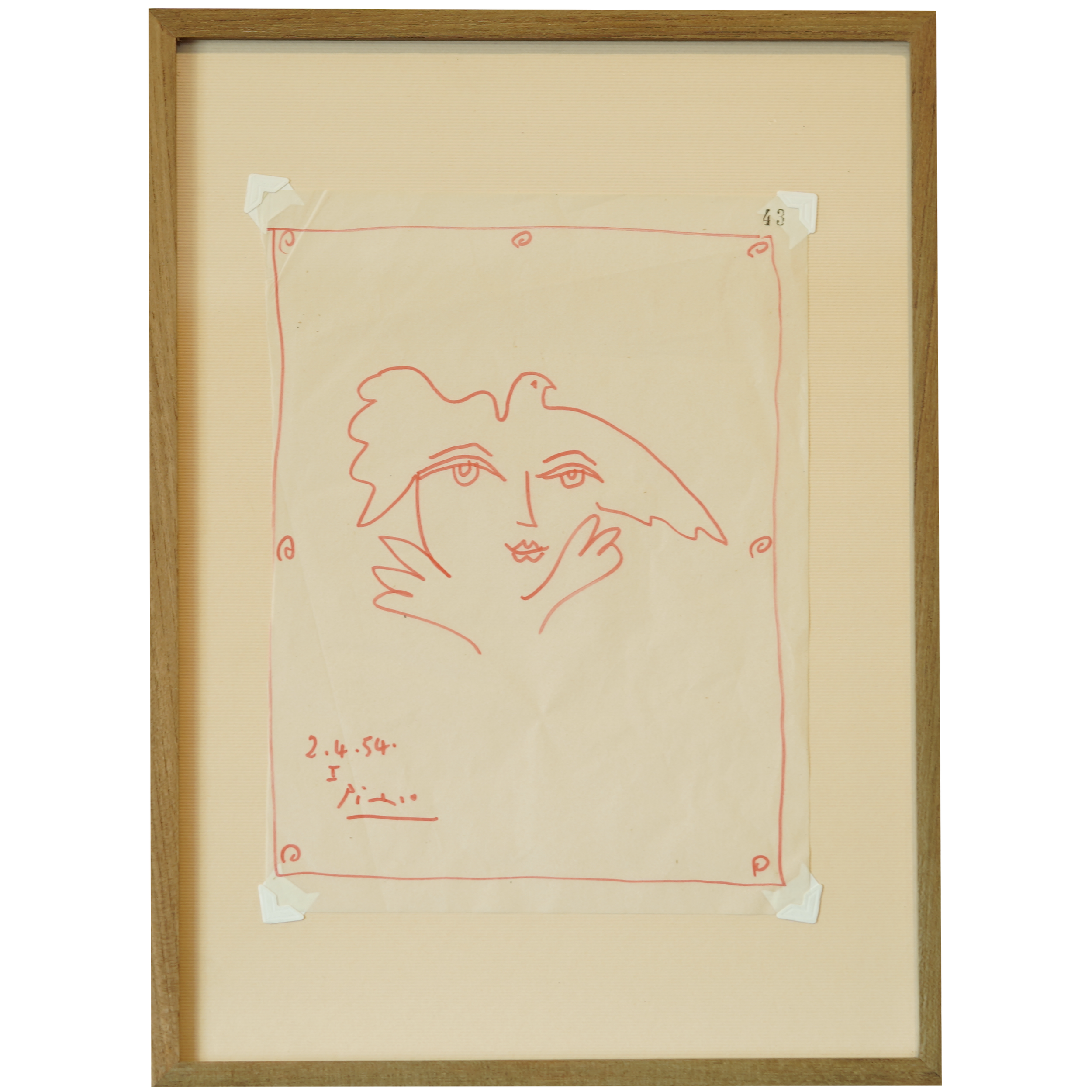
Feminine face adorned with a dove with outstretched wings, supported by two open hands dated and signed bottom left 2.4.54 I
Year: 1954
Dimensions: 27 × 20 cm
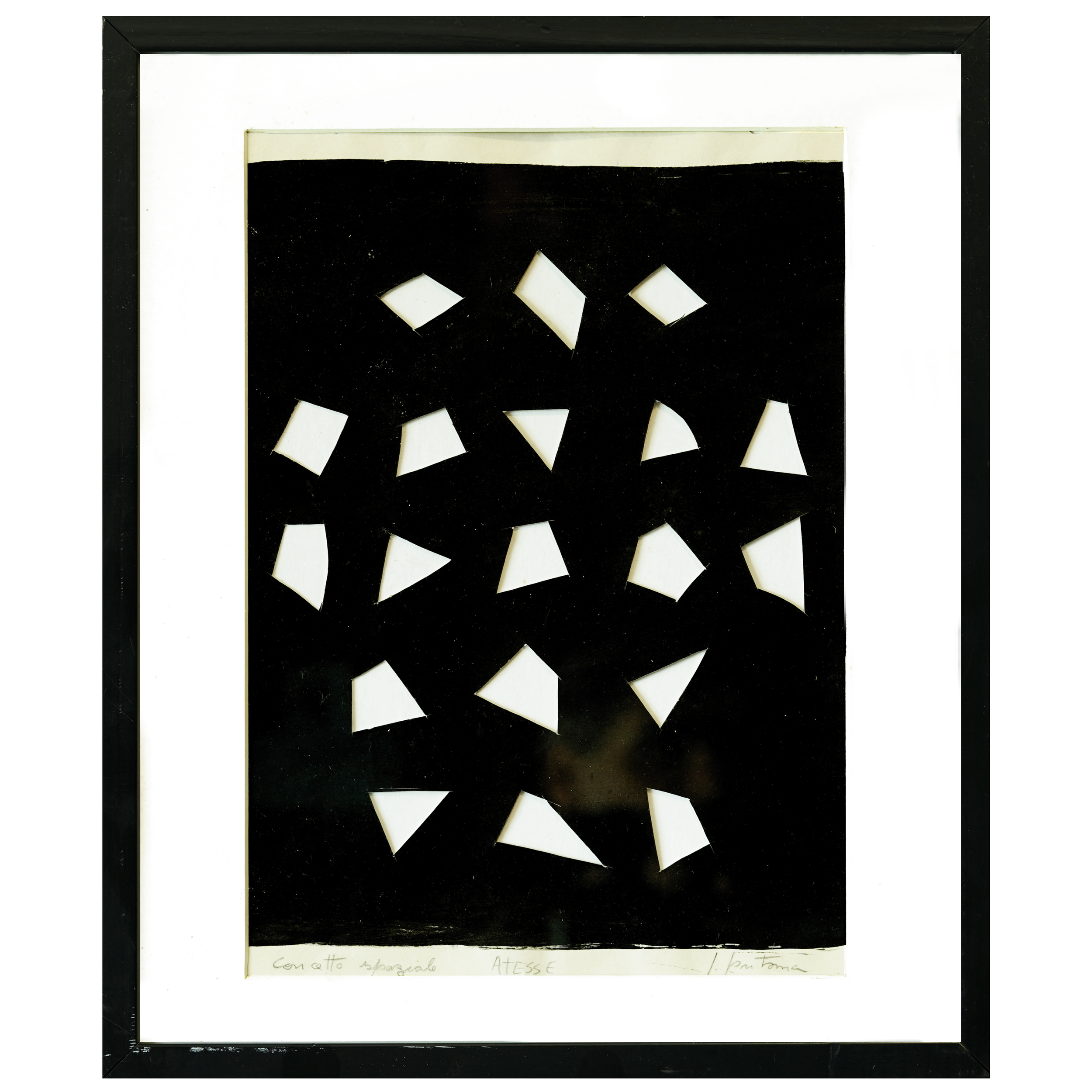
LUCIO FONTANA - Original “Concetto Spaziale”. Dated and signed at the bottom
Artist: Lucio Fontana (1899–1968)
Date: c. 1960s
Medium: Cut paper with black ink
Dimensions: 30 × 21 cm
Collection: Private Collection
Description:
Artwork part of Lucio Fontana’s Concetto Spaziale, Attese series. The piece features a black surface with a grid of precise cuts through the paper. The white background visible through the cuts creates a contrast that emphasizes space and depth.
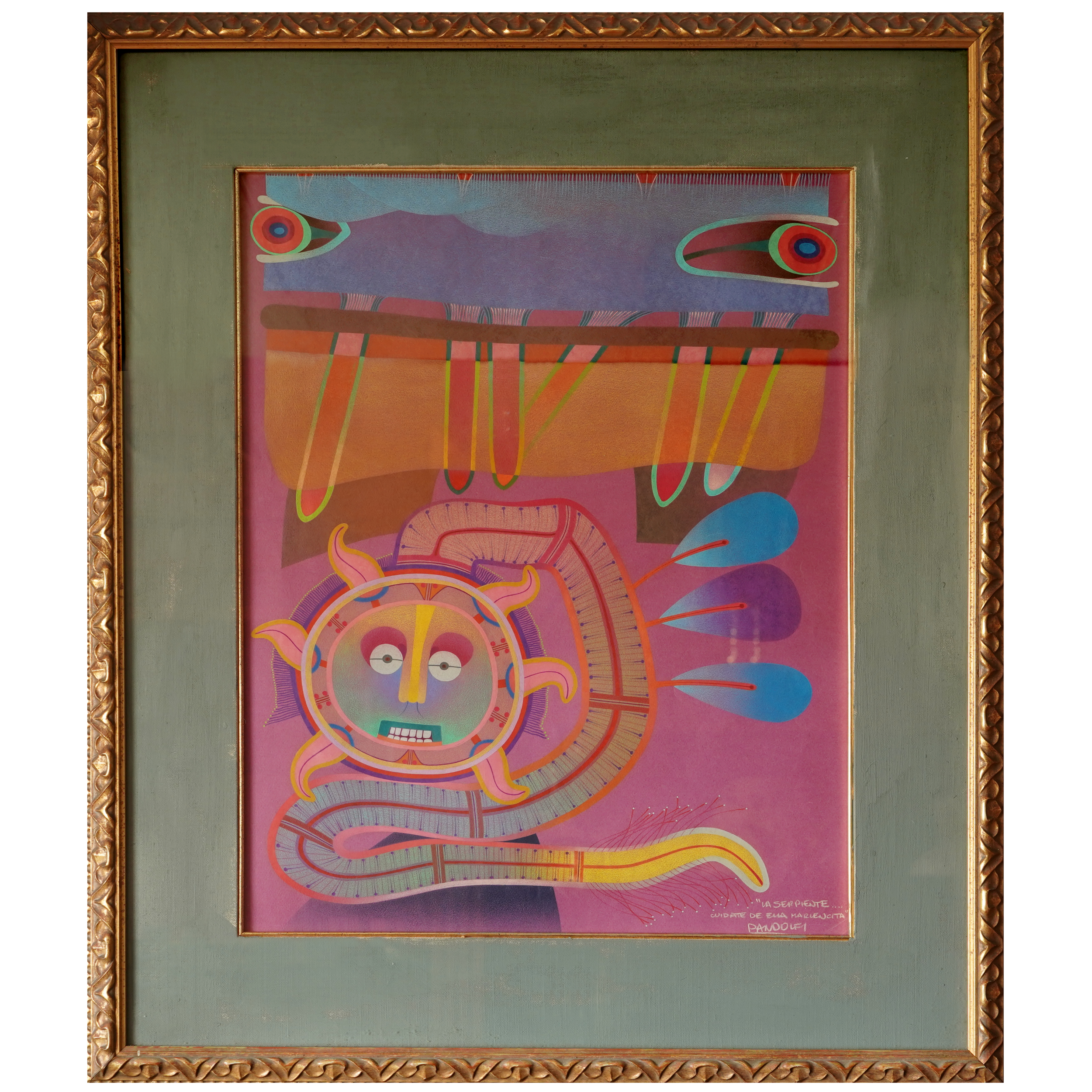
ROBERTO PANDOLFI. ORIGINAL DRAWING. Signed bottom right
Artist: Roberto Pandolfi (Argentine, 20th–21st century)
Medium: Ink and colored pencil (or pastel) on paper
Dimensions: 60 × 47 cm
Description:
Original drawing by Roberto Pandolfi depicting a fantastical figure composed of serpentine and humanoid elements. The central face, surrounded by sinuous, coiling forms and appendages, appears both mechanical and organic. Set against a vivid magenta background, the composition bursts with electric hues—neon yellows, blues, and reds—evoking a psychedelic or dreamlike state.
Pandolfi’s work merges Latin American symbolism with a personal surrealist language, often exploring dualities—man and beast, spirit and matter, inner and outer vision. In this piece, the creature’s hypnotic gaze and winding body suggest transformation, control, and introspection. The composition’s playful menace and intense chromatic contrasts reflect Pandolfi’s unique voice in contemporary visionary art.
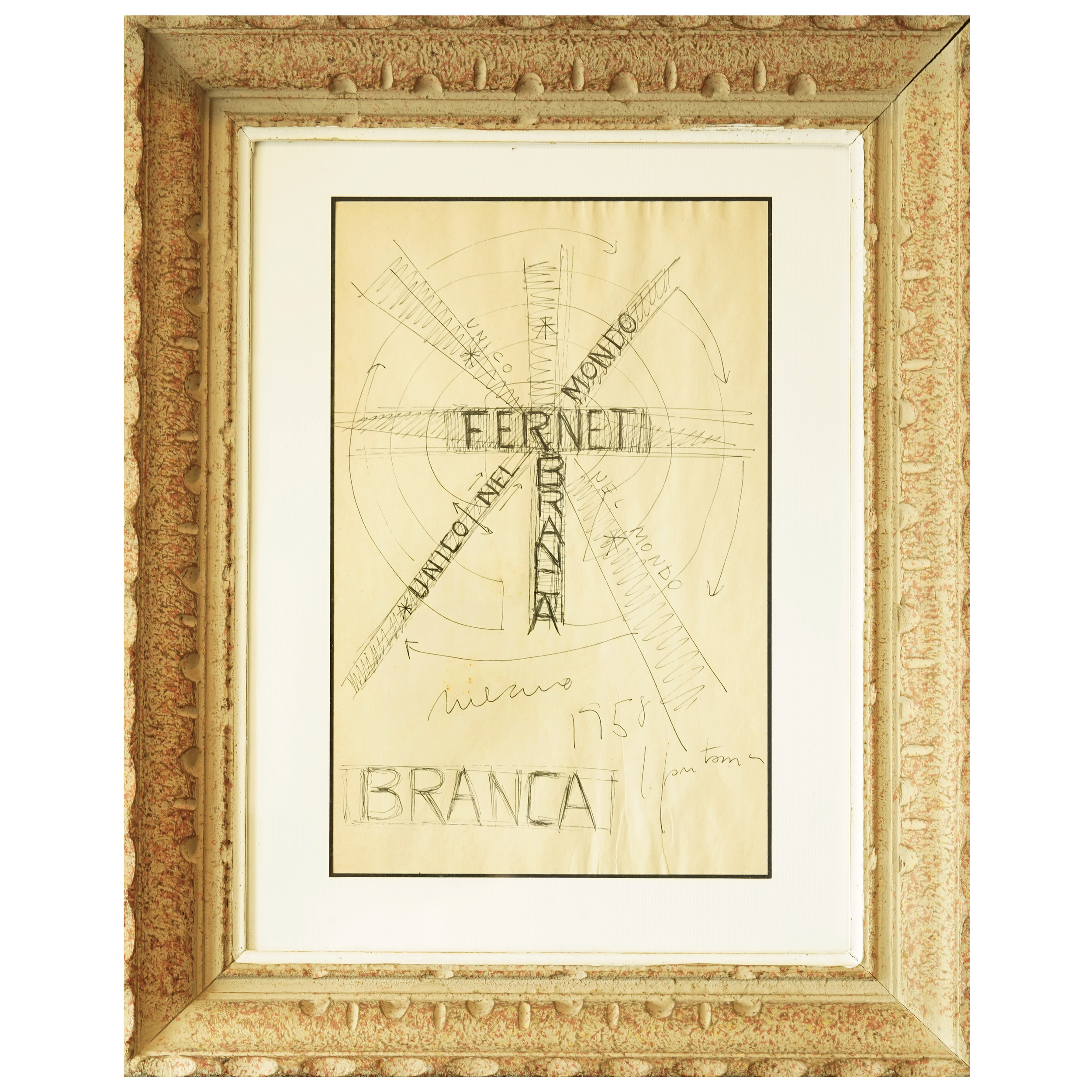
LUCIO FONTANA - Original Drawing “FERNET BRANCA”. Dated and signed bottom right
Year: 1958
Title:Fernet Branca Study
Artist: Lucio Fontana (1899–1968)
Medium: Pencil on paper
Dimensions: 33 × 21 cm
Description:
Original drawing by Lucio Fontana offering a glimpse into the conceptual design process of the artist. Featuring hand-drawn lettering and radiating arrows, the work centers around the words “FERNET BRANCA,” referencing the iconic Italian amaro. The concentric forms and dynamic arrows suggest movement and global reach—possibly a design sketch for an advertisement or poster.
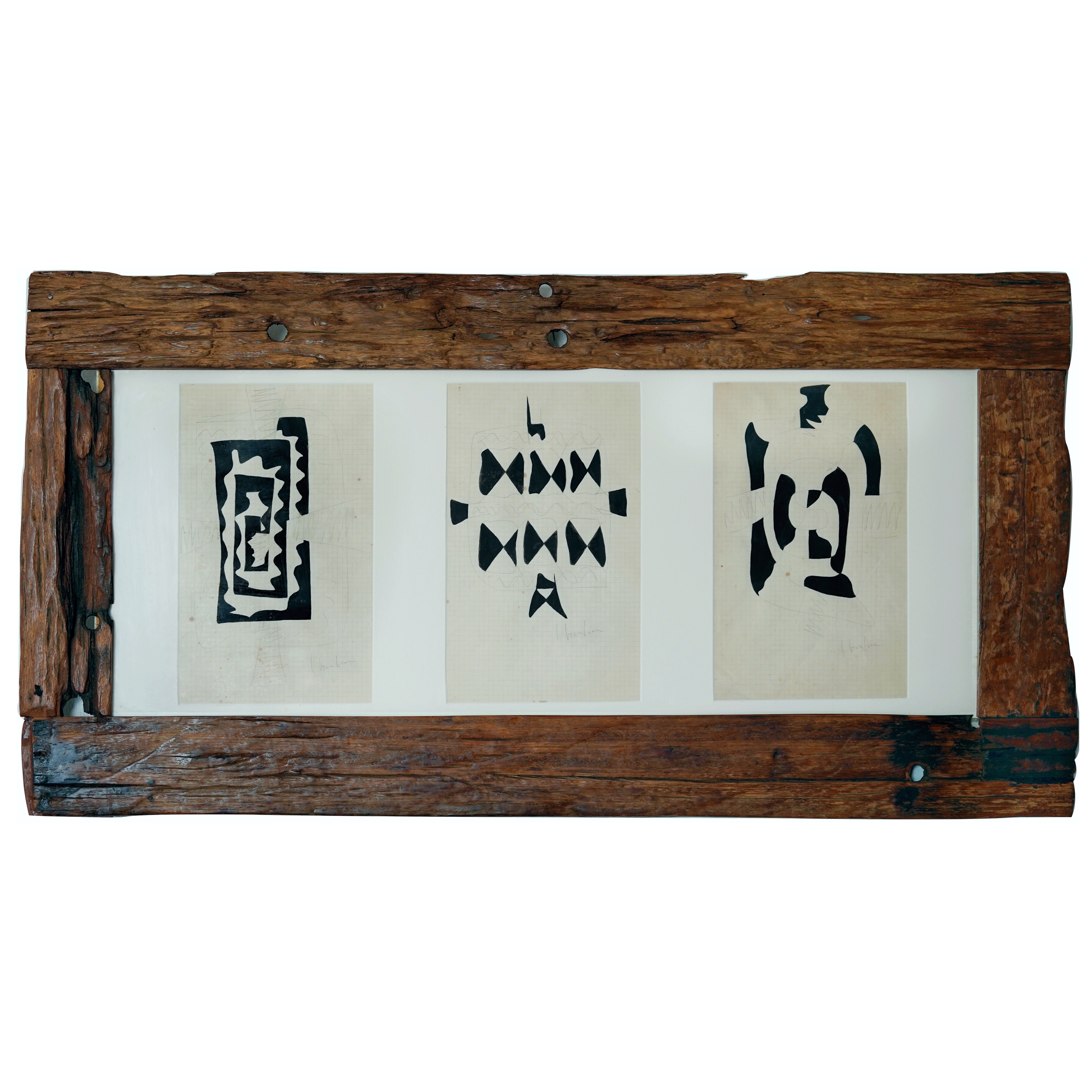
LUCIO FONTANA - Concetto Spaziale. Signed on each bottom right
Title:Spatial Concepts (Triptych)
Artist: Lucio Fontana (1899–1968)
Medium: Ink on graph paper, mounted in reclaimed wood frame
Dimensions: 33 × 20 cm (x3) -with frame : 52 × 117 cm
Description:
Triptych by Lucio Fontana featuring three abstract ink drawings on graph paper, each exploring a unique spatial rhythm through black geometric forms. The compositions display Fontana’s signature interest in breaking traditional pictorial boundaries, reducing form to raw, symbolic essence. Mounted in a rough-hewn wooden frame.
Lucio Fontana, founder of the Spatialism movement, sought to go beyond the flat surface of the canvas and redefine art through space, light, and gesture. In this rare triptych, Fontana turns to paper to explore spatial energy in two dimensions, creating meditative symbols that appear to pulse with dynamic force.
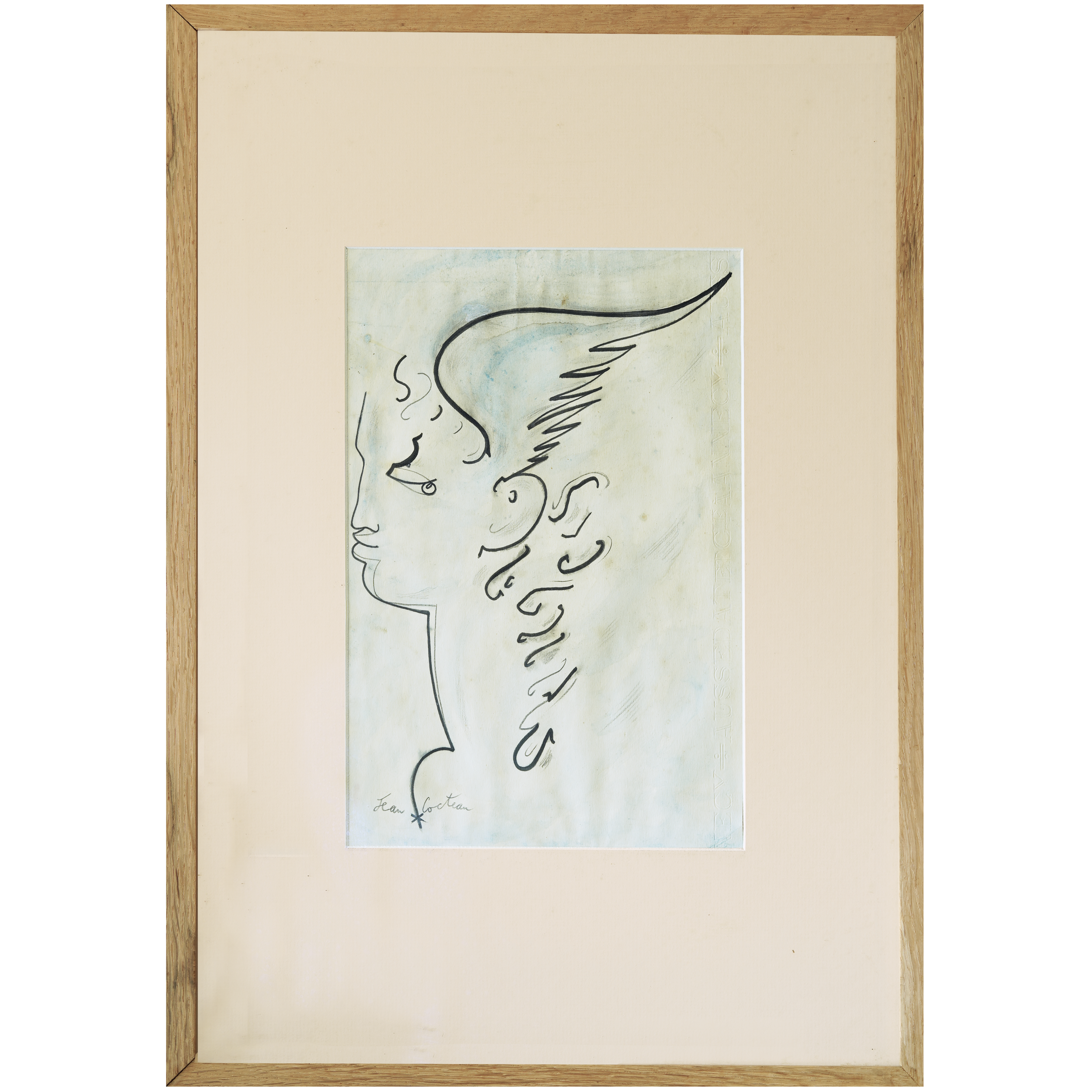
Original drawing by Jean COCTEAU depicting a winged profile.
Title:Winged Profile
Artist: Jean Cocteau (1889–1963)
Medium: Ink on paper
Dimensions: 32 x 21 cm
Description:
Original drawing by Jean Cocteau presenting a stylized human profile with wing-like extensions flowing from the head, evoking classical mythology and poetic symbolism. Rendered in fluid, elegant lines, the figure's face is both serene and enigmatic, a hallmark of Cocteau’s linear aesthetic. The composition is signed by the artist at the bottom.
Jean Cocteau, a French polymath and central figure of 20th-century avant-garde art, often blended poetry, myth, and surrealism in his work. This drawing exemplifies his ability to merge simplicity of line with psychological depth, evoking themes of transformation, flight, and inner vision.
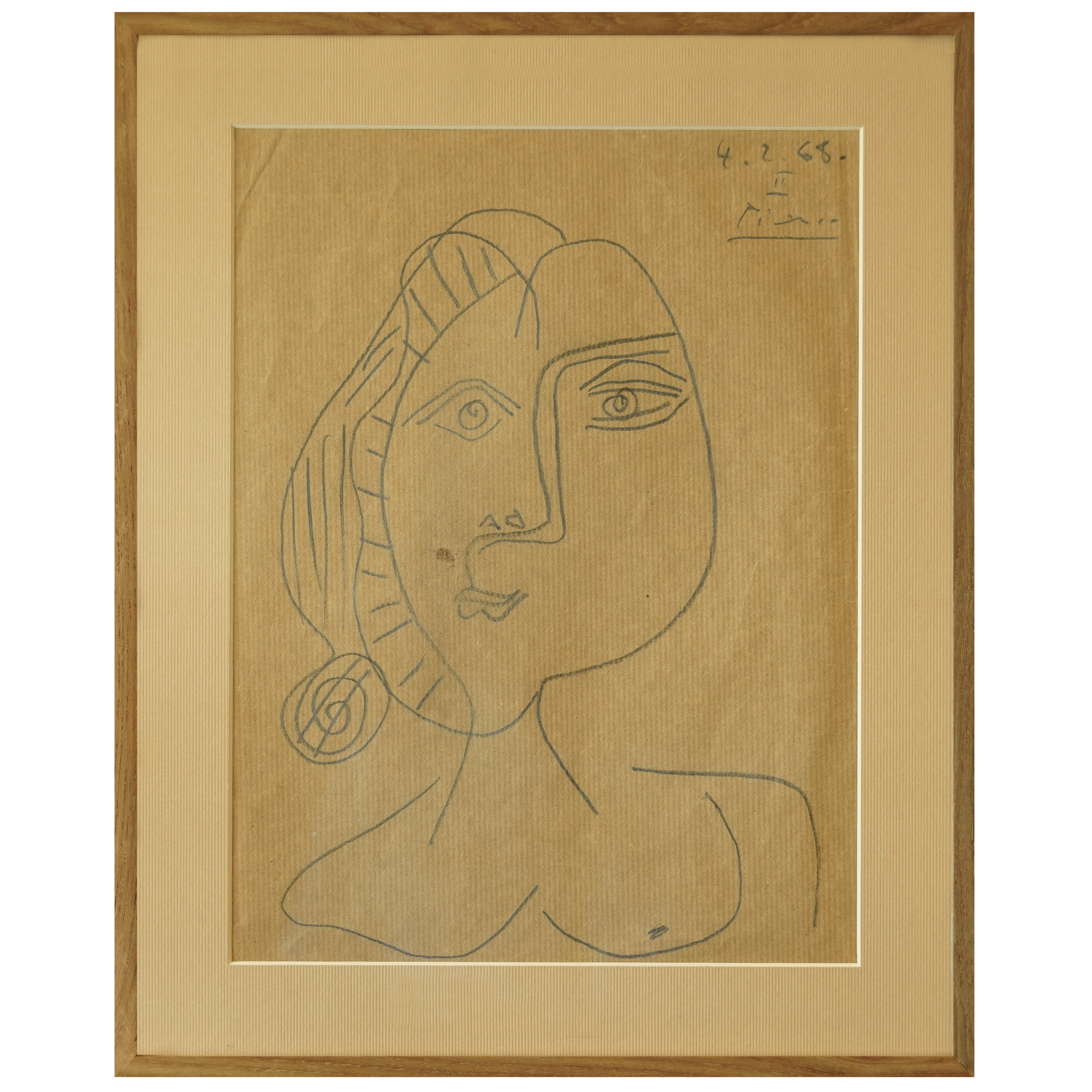
Original drawing by Picasso depicting a woman’s face, executed with pencil on brown paper, dated and signed at the top right 4.2.68 II
Year: 1968
Artist: Pablo Picasso (1881–1973)
Medium: Graphite on brown paper
Signature: Dated and signed upper right
Dimensions: 32 × 24 cm
Description:
Drawing by Pablo Picasso capturing the essence of his late period: confident, fluid, and bold in its abstraction. Rendered in a few uninterrupted lines, this drawing portrays a woman's bust-length figure, with a split or dual visage—two profiles merging into a single frontal form.
The use of brown paper and sparse line work highlights Picasso’s mastery of expressive minimalism. Despite the simplicity of the materials, the drawing conveys a vivid sense of presence, sensuality, and introspection.
Dated February 4, 1965, this work reflects Picasso’s continued fascination with the female form and psychological duality. The face, at once serene and enigmatic, is emblematic of the artist’s late-in-life synthesis of Cubist innovation and Mediterranean lyricism.
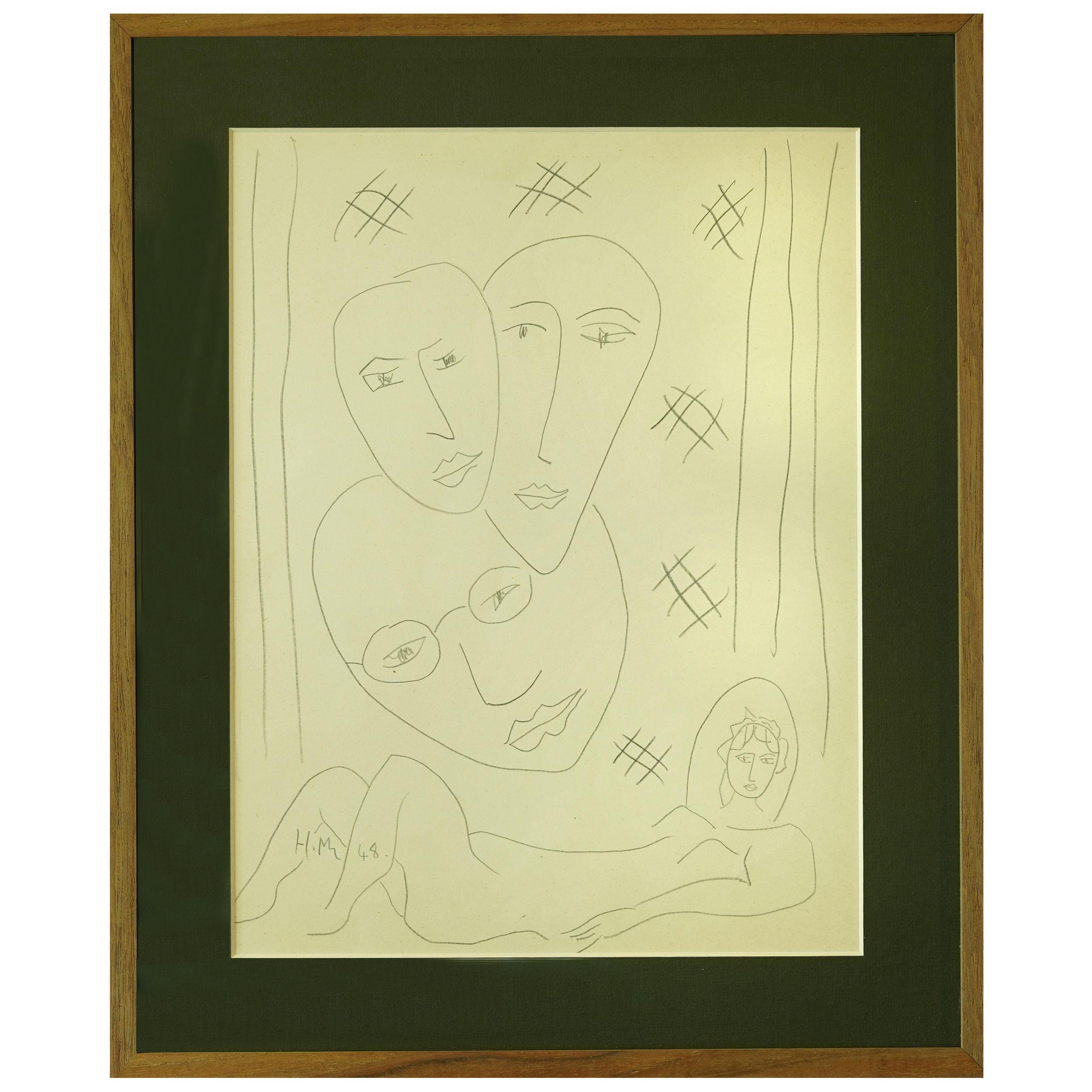
Original pencil drawing depicting a reclining woman, topped by three stylized faces, bearing Matisse's monogram "HM" and dated '48
Year: 1948
Title:Trois Visages et Figure Allongée
Artist: Henri Matisse (1869–1954)
Medium: Pencil on paper
Signature: Signed and dated lower left "H. M. 48"
Dimensions: 29 × 23 cm
Description:
Drawing by Henri Matisse capturing the artist’s late-career mastery of minimalism and expression. Rendered in a few delicate strokes, the composition juxtaposes three stylized heads, suspended in space, above a reclining figure.
Created in 1948, during Matisse’s late period, this drawing exemplifies his pursuit of purity through line. It reflects his deep interest in human emotion, abstraction, and the lyrical simplicity that defined his later works. The dreamlike grouping of figures evokes both intimacy and distance—hallmarks of Matisse’s poetic visual language.
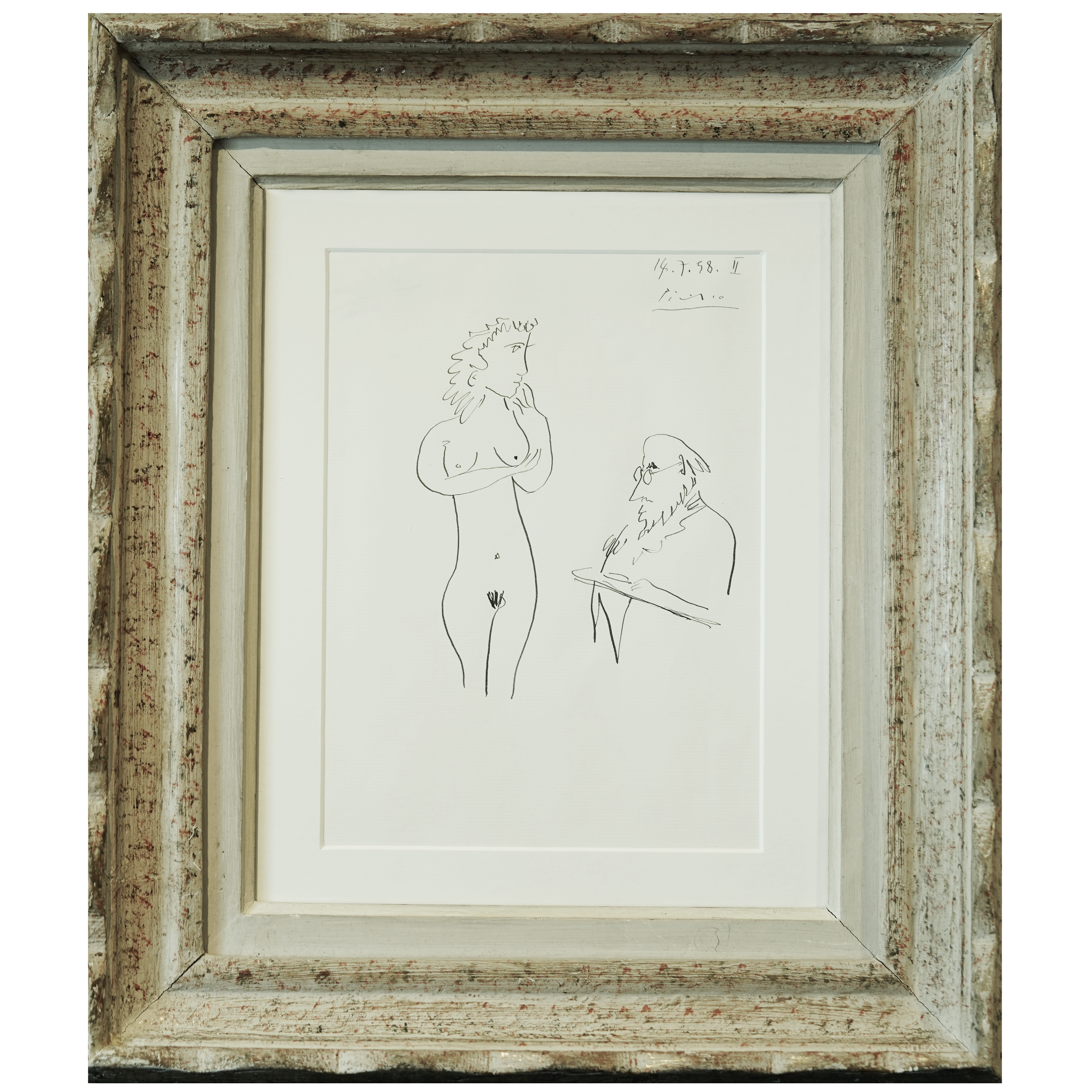
Original drawing by Picasso depicting a nude woman and a man. Drawing in black ink on beige paper, dated and signed in the top right 14.7.58 II
Year: 1958
Artist: Pablo Picasso (1881–1973)
Medium: Ink on paper
Dimensions: 26 × 18 cm
Signature: Signed and dated upper right
Description:
Original drawing by Pablo Picasso capturing a classic artistic theme—the intimate moment between an artist and his nude model. Executed with remarkable economy of line, the composition features a seated male figure sketching a standing nude woman.
In his later years, Picasso frequently returned to the theme of the artist and his muse—a dynamic reflecting both his own life and the enduring classical tradition. Here, the sparse elegance of line reflects his masterful control and spontaneous energy. Dated July 14, 1958, this drawing belongs to a prolific period where Picasso explored the fusion of eroticism, artistic creation, and mythic intimacy in its most distilled form.
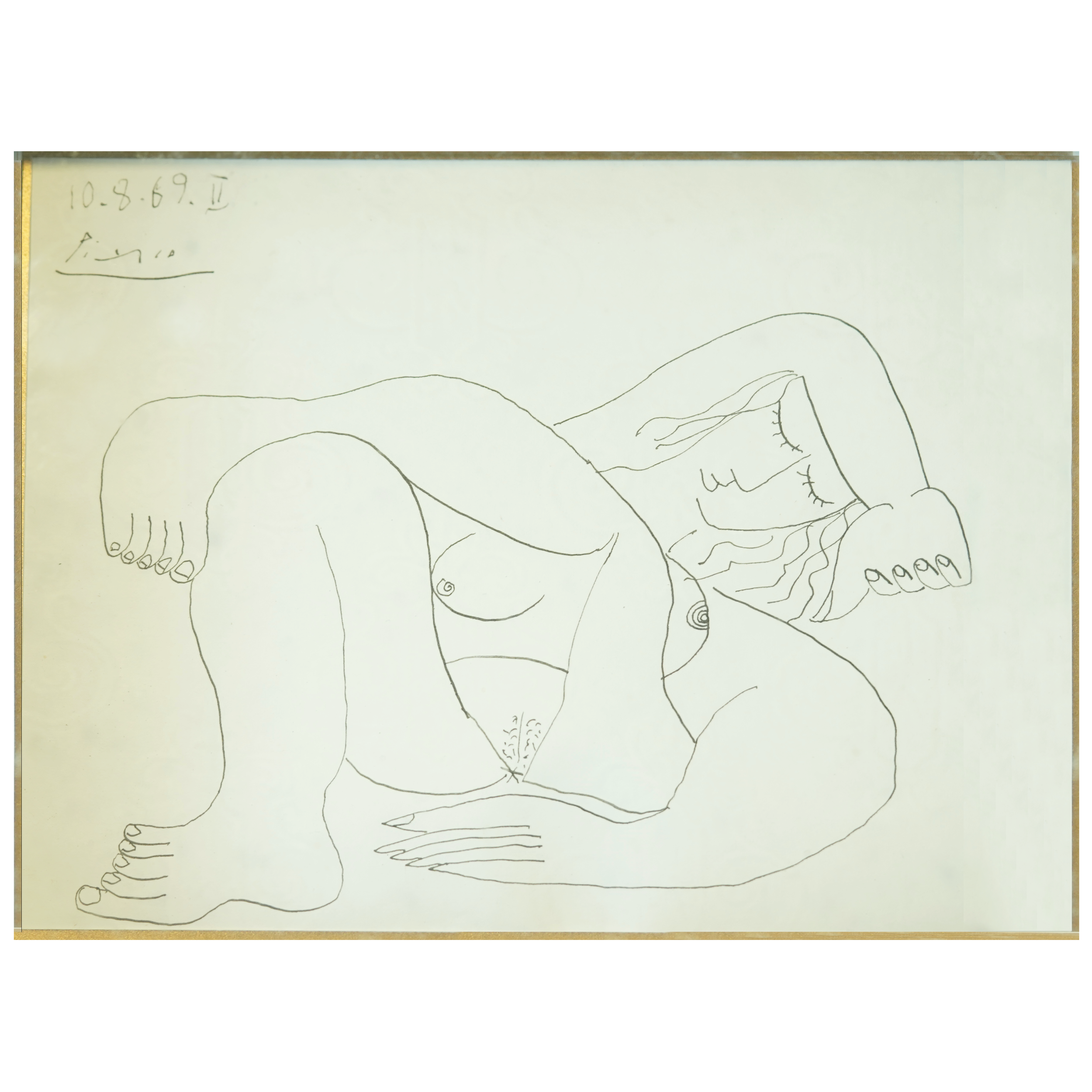
Original ink drawing depicting a reclining nude woman, bearing PICASSO's monogram and dated on the top left 10/08/1969 II
Year: 1969
Title:Reclining Nude
Artist: Pablo Picasso (1881–1973)
Medium: Ink on paper
Signature: Signed and dated upper left “10.8.69 II / Picasso”
Dimensions: 17 × 22 cm
Description:
Drawing by Pablo Picasso capturing a reclining nude in a pose that is both sensual and serene. Executed with characteristic fluency and economy of line, the female figure is shown folded into herself, limbs curled and overlapping in a contorted yet natural position.
Created in the final years of Picasso’s life, this drawing reflects his undiminished fascination with the female form and his continued exploration of expressive distortion.
Drawn in 1969 at the age of 88, this work stands as a testament to Picasso’s enduring creative vitality. His late style embraced a raw spontaneity that distilled decades of mastery into unfiltered expression.
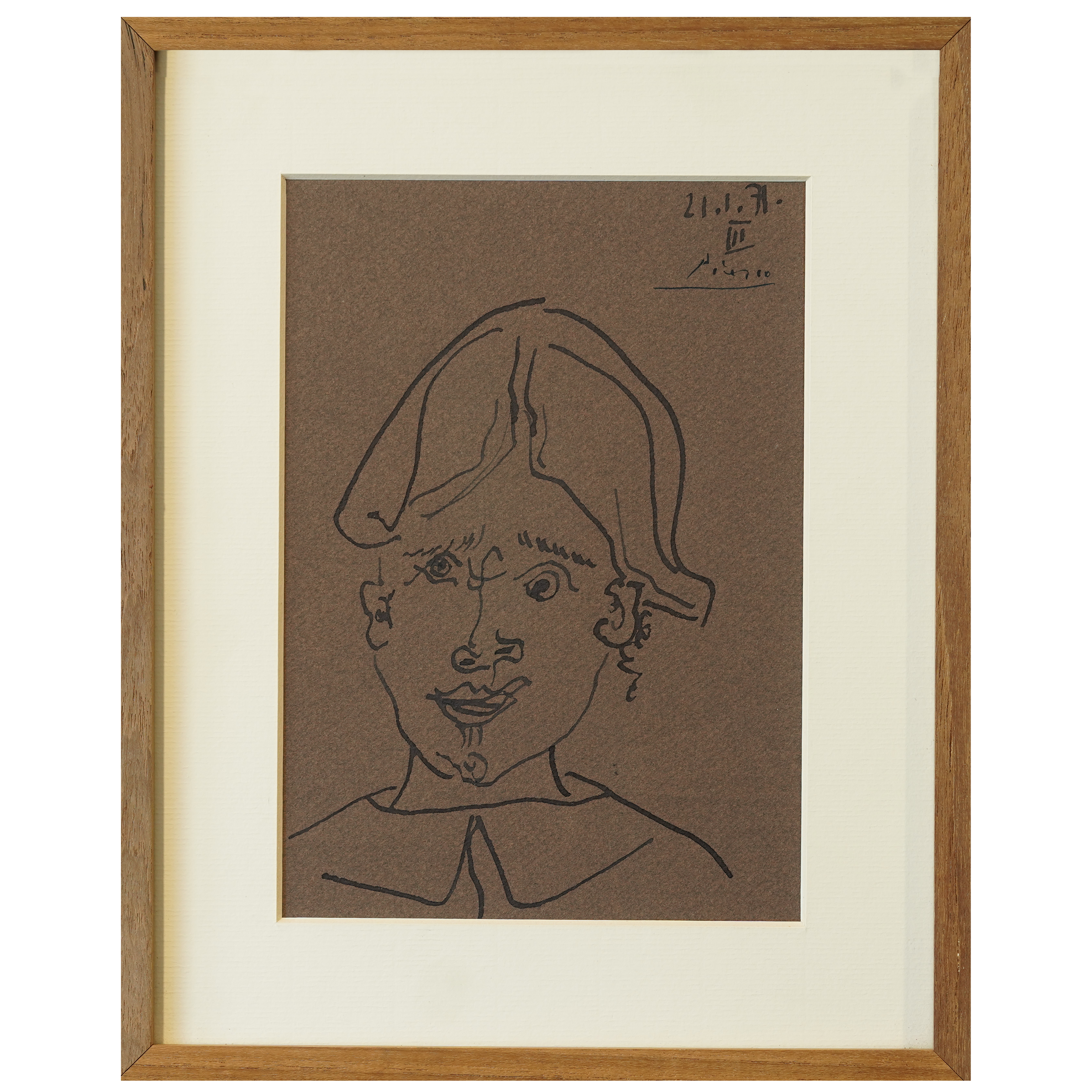
Original drawing by Picasso depicting the head of a capped Pierrot, executed in black ink on brown paper, dated and signed at the top right 21.1.71 II
Year: 1971
Title:Pierrot
Artist: Pablo Picasso (1881–1973)
Medium: Ink on brown paper
Signature: Signed and dated upper right
Dimensions: 20 × 14 cm
Description:
Drawing by Pablo Picasso reimagining Pierrot—the melancholic clown from the Italian Commedia dell’arte tradition—through his distinctive late-period style. With confident, continuous lines, the artist distills the character to its emotional essence. The figure’s wide-brimmed hat, delicate features, and stylized collar unmistakably evoke the iconic costume of the theatrical sad clown.
Drawn in the final years of his life, Pierrot reflects Picasso’s enduring fascination with theatrical archetypes, identity, and the emotional power of gesture.
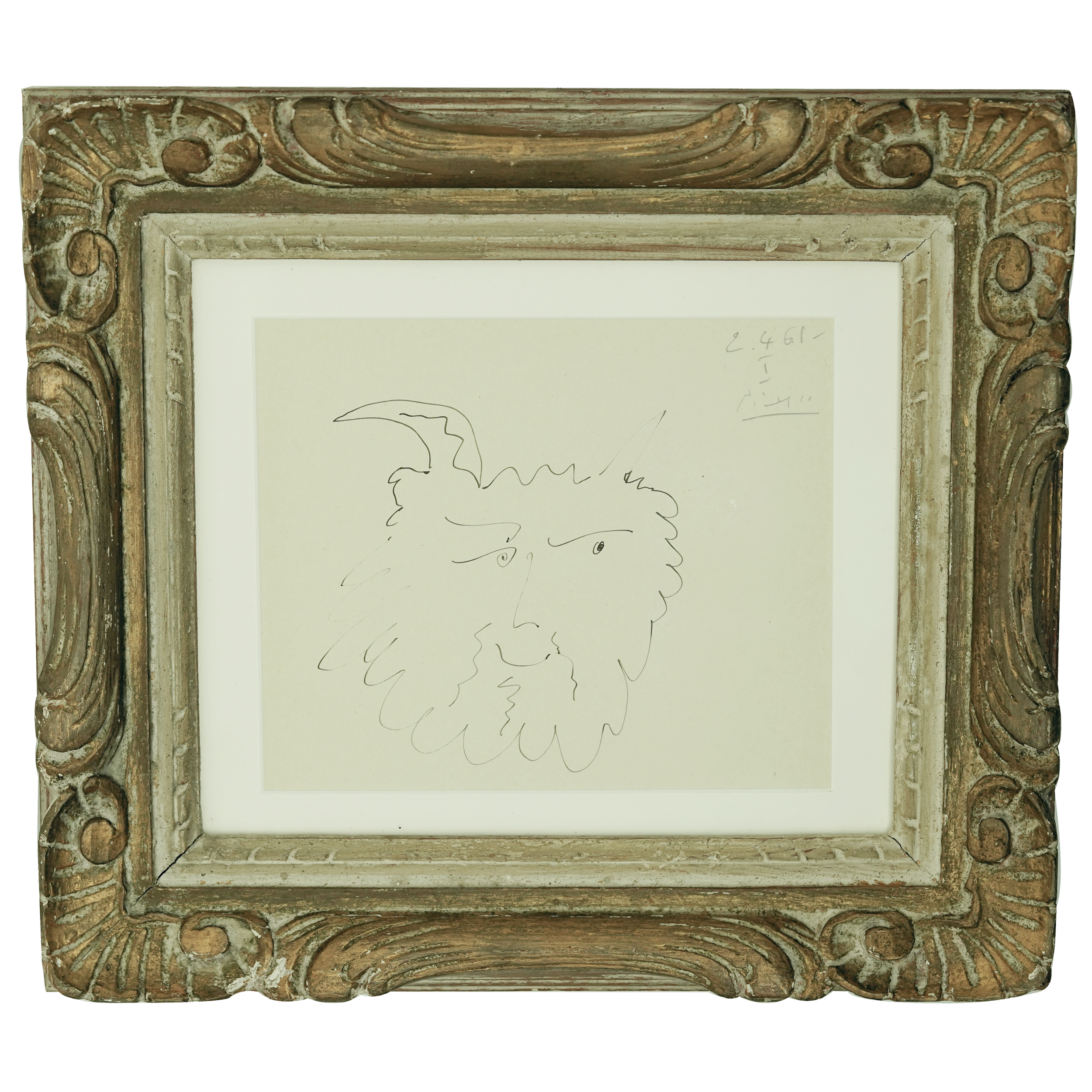
Original drawing by Picasso depicting a "Head of a Faune." Drawing in black ink on beige paper, dated and signed in pencil at the top right: 2.4.61
Year: 1961
Title:Head of a Faun
Artist: Pablo Picasso (1881–1973)
Medium: Ink on paper
Signature: Dated and signed upper right
Dimensions: 17 × 21 cm
Description:
Original drawing by Pablo Picasso depicting the head of a faun, a recurring mythological subject in his oeuvre. Executed with a few fluid and confident ink lines, the composition captures the essence of the creature’s dual nature—part man, part beast—with a single curved horn, a pointed ear, and an unruly beard framing an enigmatic expression. Despite its apparent simplicity, the drawing exudes character, wit, and Picasso’s mastery of spontaneous line.
In his later years, Picasso often returned to mythological and classical themes with renewed freedom and economy of gesture. This work distills the faun’s identity into a minimal yet evocative image, underscoring the artist’s lifelong fascination with Mediterranean mythology. "Head of a Faun" is both whimsical and archetypal, revealing the artist’s ability to imbue even the briefest sketch with expressive depth and symbolic resonance.
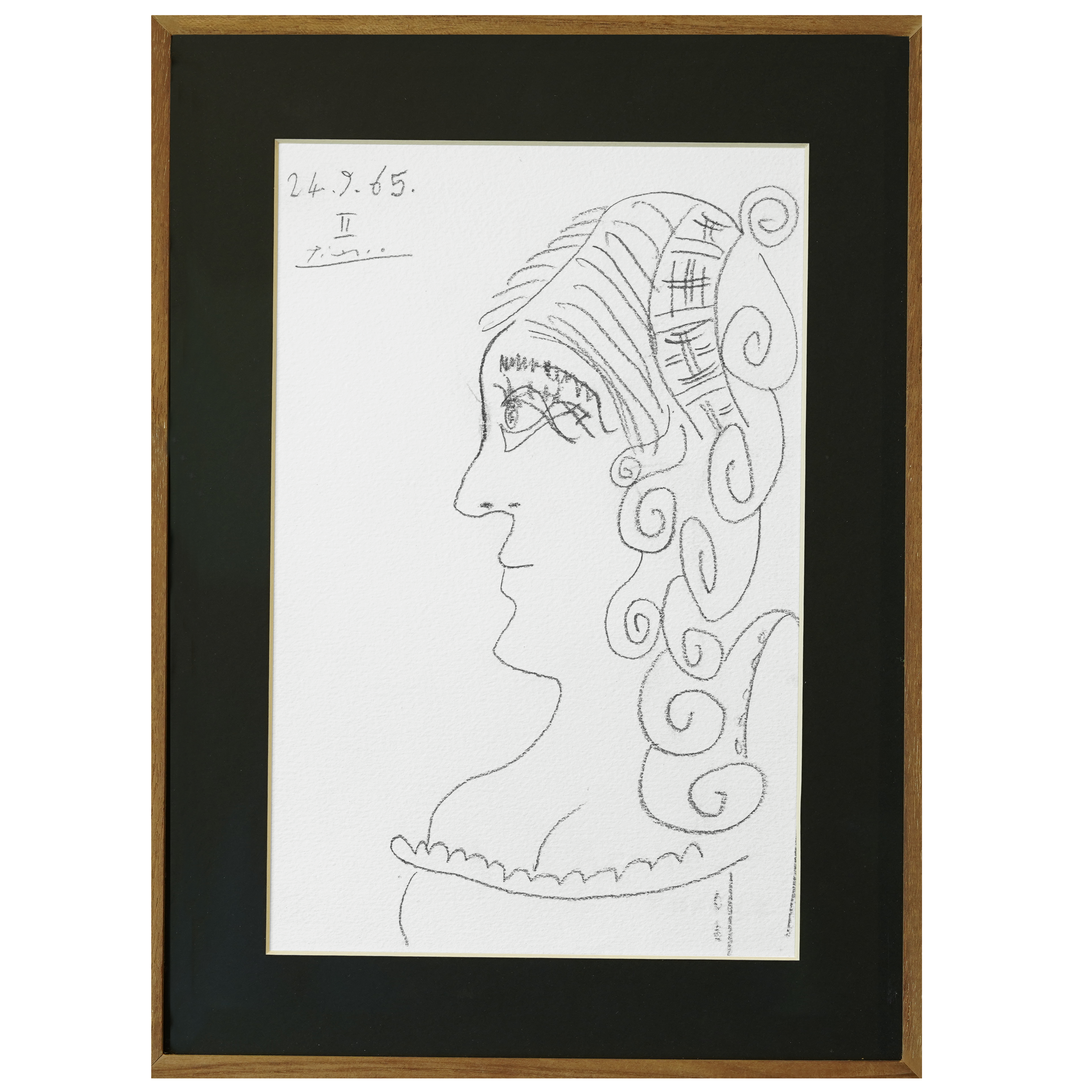
Original drawing by Picasso, in grease pencil, depicting the profile of a young woman with a low neckline over her chest, signed and dated at the top left: 24.9.65
Year: 1965
Title:Portrait of a Woman in Profile
Artist: Pablo Picasso (1881–1973)
Medium: Pencil on paper
Signature: Dated and signed upper left
Dimensions: 27 × 18 cm
Description:
Original drawing by Pablo Picasso presenting a stylized profile of a woman, rendered with fluid yet deliberate pencil strokes. The elegant subject is shown in left-facing profile, her hair composed of a rhythmic play of curls, loops, and crosshatched textures that frame her composed features. Her large, expressive eye and delicate neckline suggest a sense of classical serenity while simultaneously revealing Picasso’s playful linear abstraction.
Created in 1965, this portrait reflects the late period of Picasso’s career, during which he embraced spontaneity, confidence, and minimalism in his drawing practice. The economy of line and ornamental composition in Portrait of a Woman in Profile captures the artist’s enduring fascination with the female figure—now distilled to its essential, lyrical essence. It is both a tribute to tradition and an assertion of Picasso’s bold artistic language.
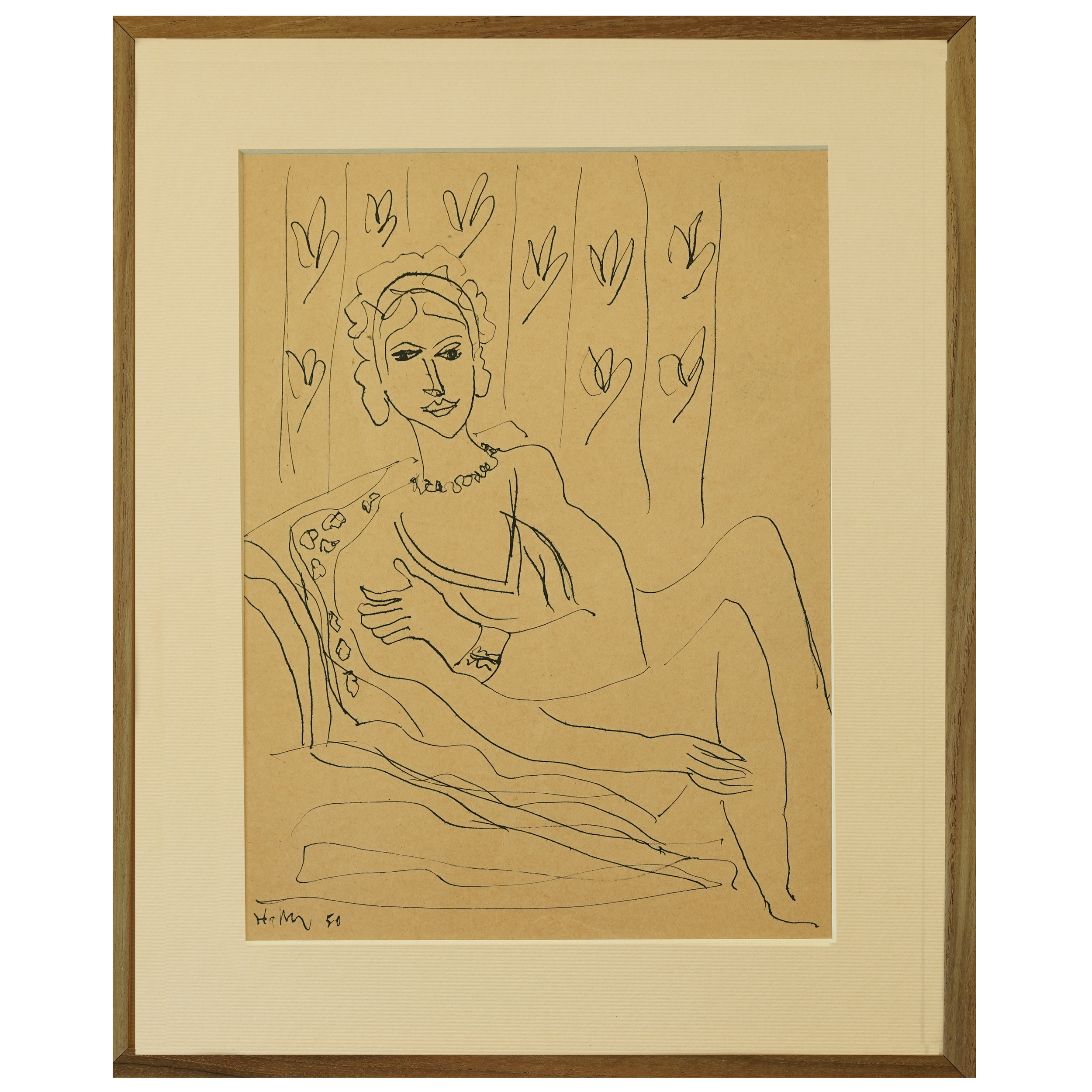
Original pencil drawing depicting a reclining woman, bearing Matisse's monogram "HM" and dated '50
Year: 1950
Title:Reclining Woman with Floral Drapery
Artist: Henri Matisse (1869–1954)
Medium: Ink on paper
Signature: Signed and dated lower left "H. M. 51"
Dimensions: 26 × 20 cm
Description:
Drawing by Henri Matisse’s refined late style, where bold, economical line work conveys elegance, sensuality, and grace. A reclining woman gazes outward with calm poise, her figure gently undulating across the page.
Created in the final years of Matisse’s life, this drawing reflects his ongoing fascination with the female form and interior space. It embodies the artist’s pursuit of harmony and clarity, and illustrates his belief that art should be “something like a good armchair” — comforting, beautiful, and serene.
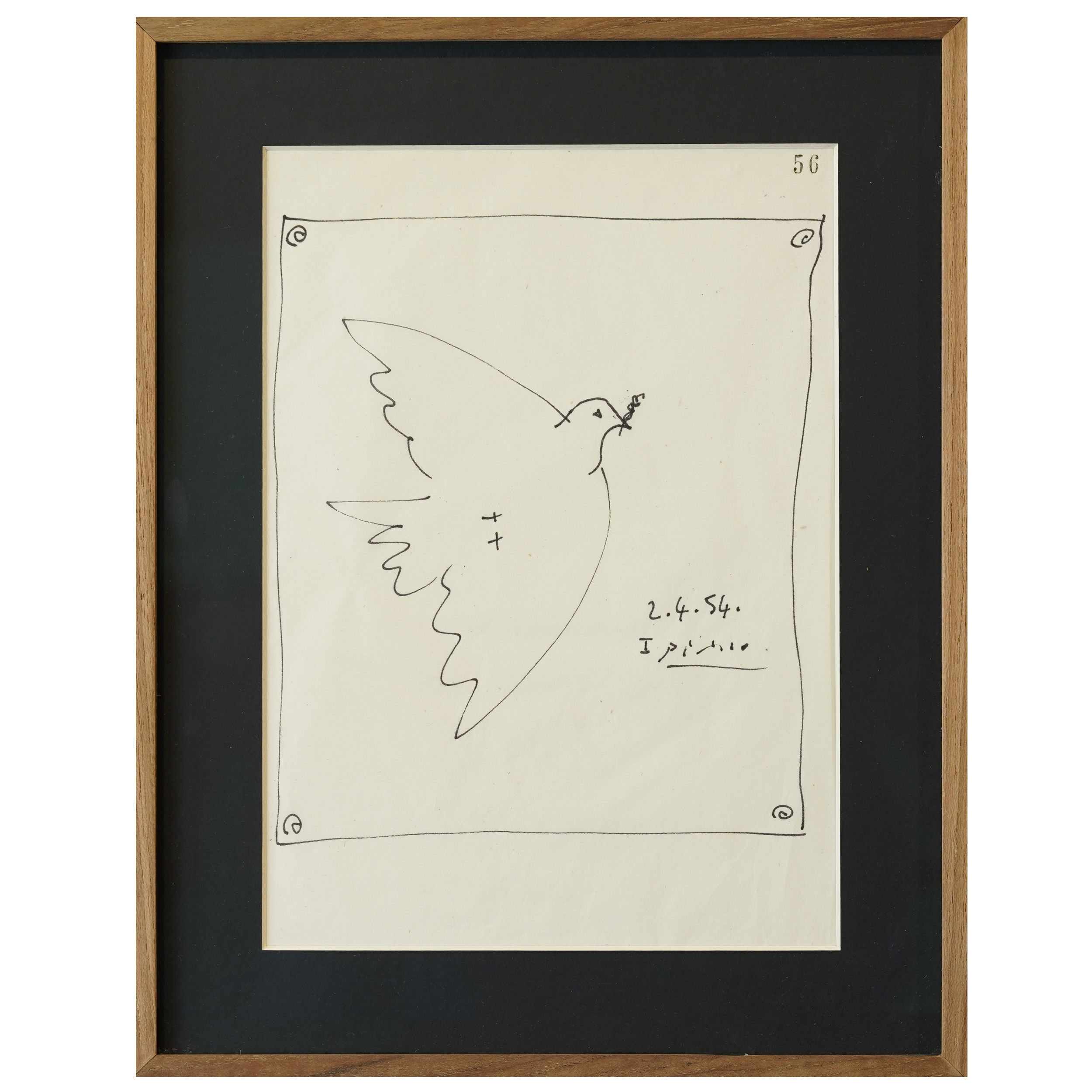
Original drawing by Picasso, in India ink on tracing paper, depicting a dove, signed and dated at the bottom right: 2.4.54
Year: 1954
Title:Dove of Peace
Artist: Pablo Picasso (1881–1973)
Medium: Ink on paper
Signature: Signed and dated lower right
Dimensions: 26 × 19 cm
Description:
This minimalist yet powerful drawing captures one of Pablo Picasso’s most iconic symbols: the dove. Rendered with a few confident lines, the bird is shown in flight, bearing an olive branch in its beak — a universal emblem of peace. The image radiates both movement and serenity, embodying Picasso’s ability to convey profound meaning through simplicity.
Originally adopted as the emblem for the 1949 World Peace Congress in Paris, the dove became a recurring motif in Picasso’s work and a personal symbol of his political engagement. This particular version, executed in 1954, exemplifies his mature graphic style, where form is distilled to its essence while maintaining emotional weight and clarity.
Dove of Peace is more than a drawing — it is a message. Created in a post-war world still striving for harmony, Picasso’s bird became a beacon of hope, embraced worldwide by peace movements. The artist’s line, fluid and unwavering, turns a simple sketch into a timeless plea for unity.
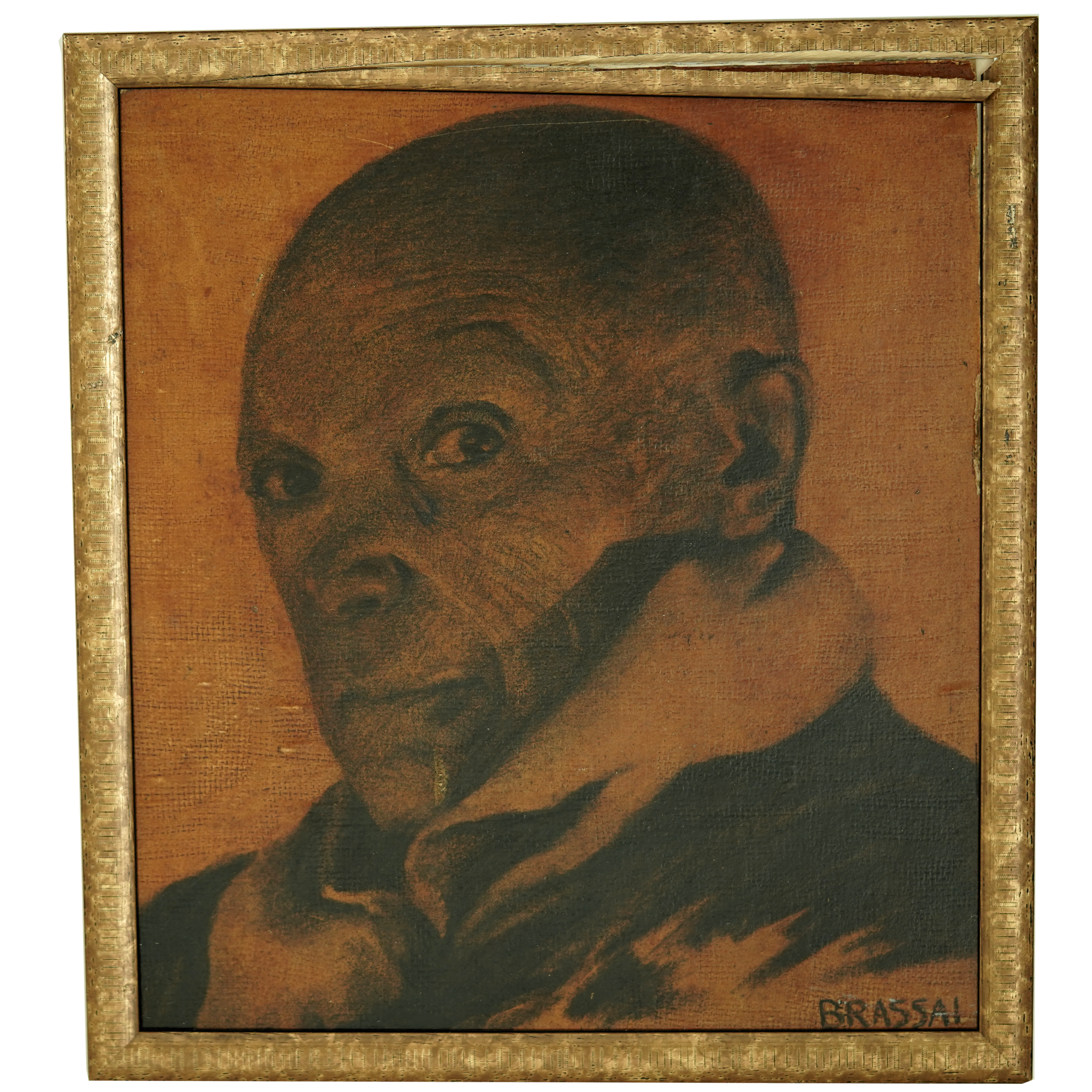
Title:Portrait of Pablo Picasso
Artist: Brassaï (Hungarian-French, 1899–1984)
Medium: Charcoal and pigment on canvas
Dimensions: 32 × 28 cm
Signed: Lower right, "Brassaï"
Description:
Portrait of Pablo Picasso by Brassaï revealing an introspective and intense depiction of one of the most influential artists of the 20th century. Rendered in a restrained yet striking palette of burnt sienna and black, the image radiates a quiet force. .
Better known for his photography, Brassaï was deeply immersed in the artistic circles of Paris and held a close friendship with Picasso, whom he photographed extensively over several decades. This rare painted work demonstrates Brassaï’s deep understanding of his subject, capturing Picasso not only as an iconic figure of modern art but also as a man immersed in thought and creative gravity.
This portrait stands as a powerful testament to the mutual admiration and artistic dialogue between Brassaï and Picasso. With its hauntingly intimate perspective, the painting bridges the realms of photography, painting, and psychological portraiture, showcasing Brassaï’s ability to capture the essence of a person with profound sensitivity.

Original drawing by Picasso depicting reclining nude man. Drawing in black ink on beige paper, signed in the top right II
Title:Reclining Bearded Man
Artist: Pablo Picasso (1881–1973)
Date: Undated (inscribed “II” in upper right corner)
Medium: Ink on paper
Signature: Signed "Picasso" upper right
Dimensions: 20 × 20 cm
Description:
Drawing by Pablo Picasso presenting a reclining male nude with a prominent beard and an air of calm self-possession. Rendered with his unmistakable linear economy, the figure appears at once archaic and contemporary — a classical pose stripped to its essentials through modernist abstraction.
Picasso's late drawings reflect a liberated, confident hand that distilled decades of technical skill into immediate visual poetry. In Reclining Bearded Man, the artist combines sensuality, wit, and timeless form in a deceptively simple composition.
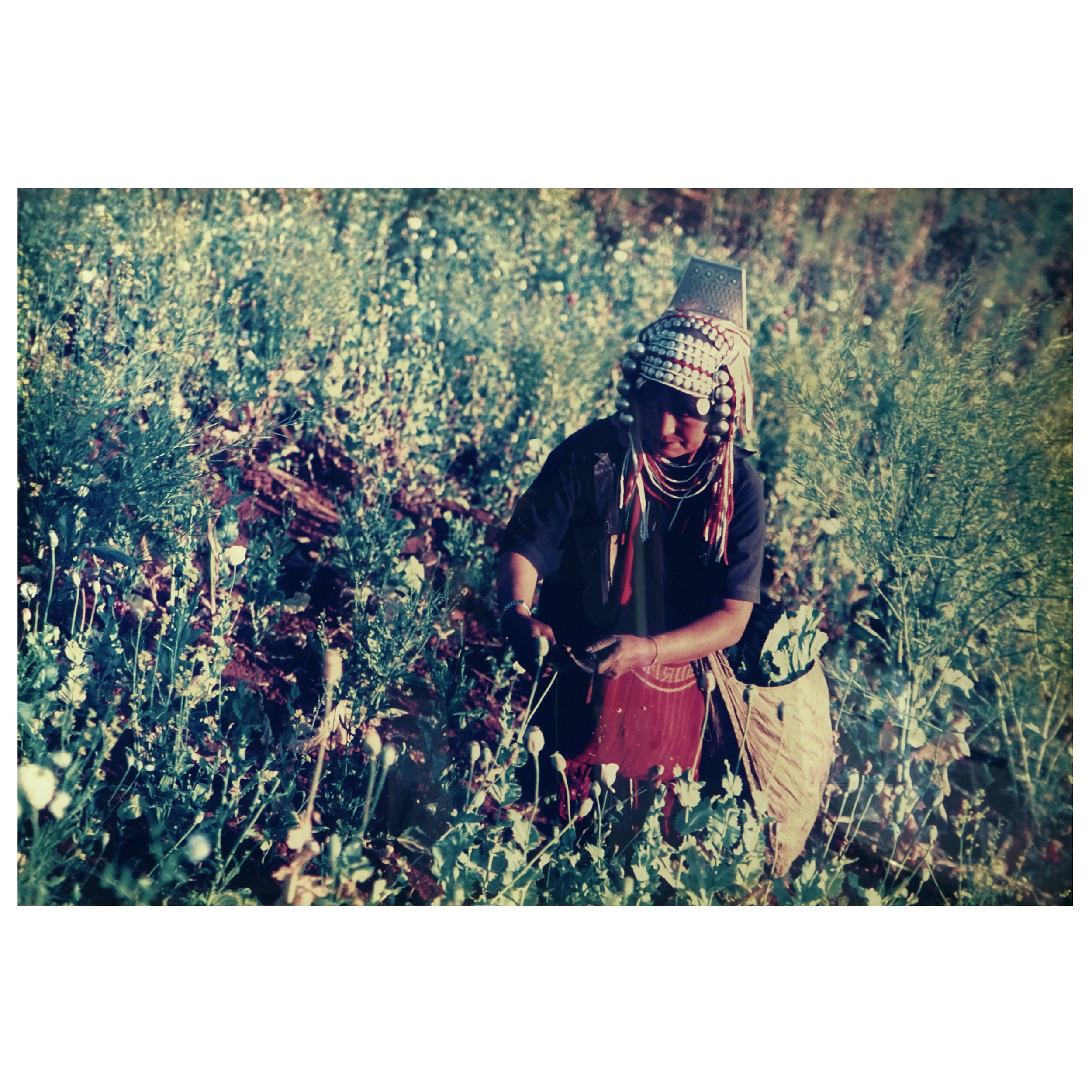
robert Curran
Akha Woman Harvesting in the Fields, Chromogenic print, late 20th century
Dimensions: 76 × 114 cm
This photograph depicts an Akha woman engaged in agricultural work, surrounded by dense vegetation. She wears traditional attire adorned with elaborate silver headdresses and beads, a hallmark of Akha cultural identity in the highlands of Southeast Asia.
US$ 5000
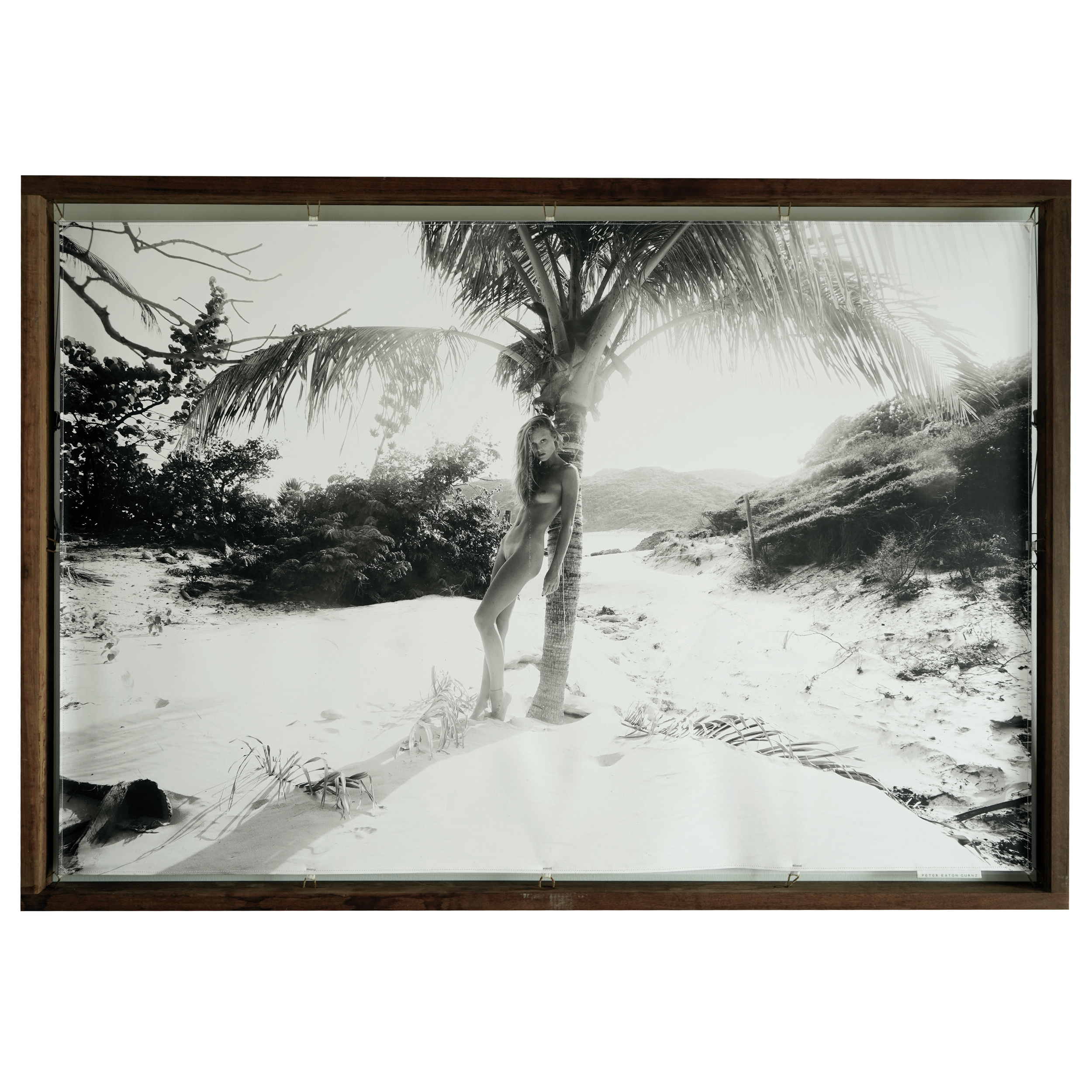
Peter Eaton Gurnz (b. 1968)
Untitled (Nude on the Beach), Gelatin silver print, ca. late 20th century
Dimensions: 111 × 153 cm
Black-and-white photograph by Peter Eaton Gurnz capturing a nude female figure leaning gracefully against a palm tree on a secluded beach. The composition balances the natural contours of the human form with the organic lines of the tropical landscape, evoking themes of vulnerability, strength, and harmony with nature. Gurnz, known for his refined exploration of the body and its dialogue with environment, frames the subject in a timeless and contemplative manner, emphasizing both intimacy and grandeur.
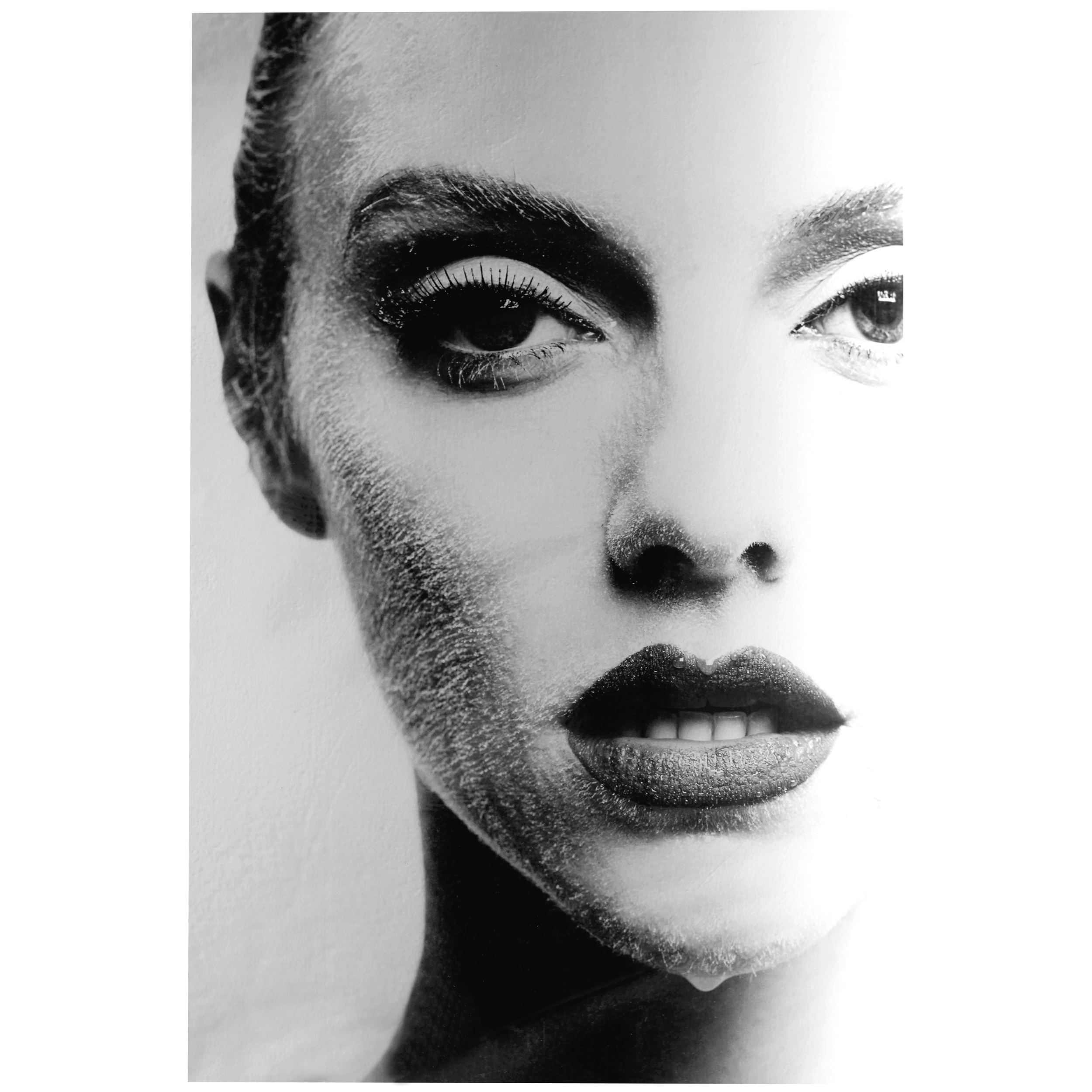
Artist: Peter Eaton Gurnz (American, contemporary)
Date: c. 21st century
Medium: Archival pigment print on paper
Dimensions: 57 × 43 cm
Description:
Black-and-white portrait by Peter Eaton Gurnz isolates the model’s face in an extreme close-up, cropped tightly to emphasize the eyes and lips. The lighting is starkly directional, with one side of the face fading almost completely into a field of pure white, creating a striking contrast between shadow and overexposed brilliance. The texture of the skin and the precision of the makeup—dark, defined brows, voluminous lashes, and perfectly contoured lips—convey both glamour and intensity.
The asymmetrical framing draws immediate attention to the model’s gaze, which meets the viewer head-on with a mixture of vulnerability and assertiveness. The high contrast between light and dark areas strips away extraneous detail, allowing the interplay of form, shadow, and expression to dominate the composition.
Artistic Context:
Peter Eaton Gurnz’s portraiture often merges the refined aesthetics of fashion photography with the emotional depth of fine art. In this work, he uses minimal composition and heightened contrast to create an image that feels both iconic and intimate, placing the viewer in an almost confrontational proximity to the subject.
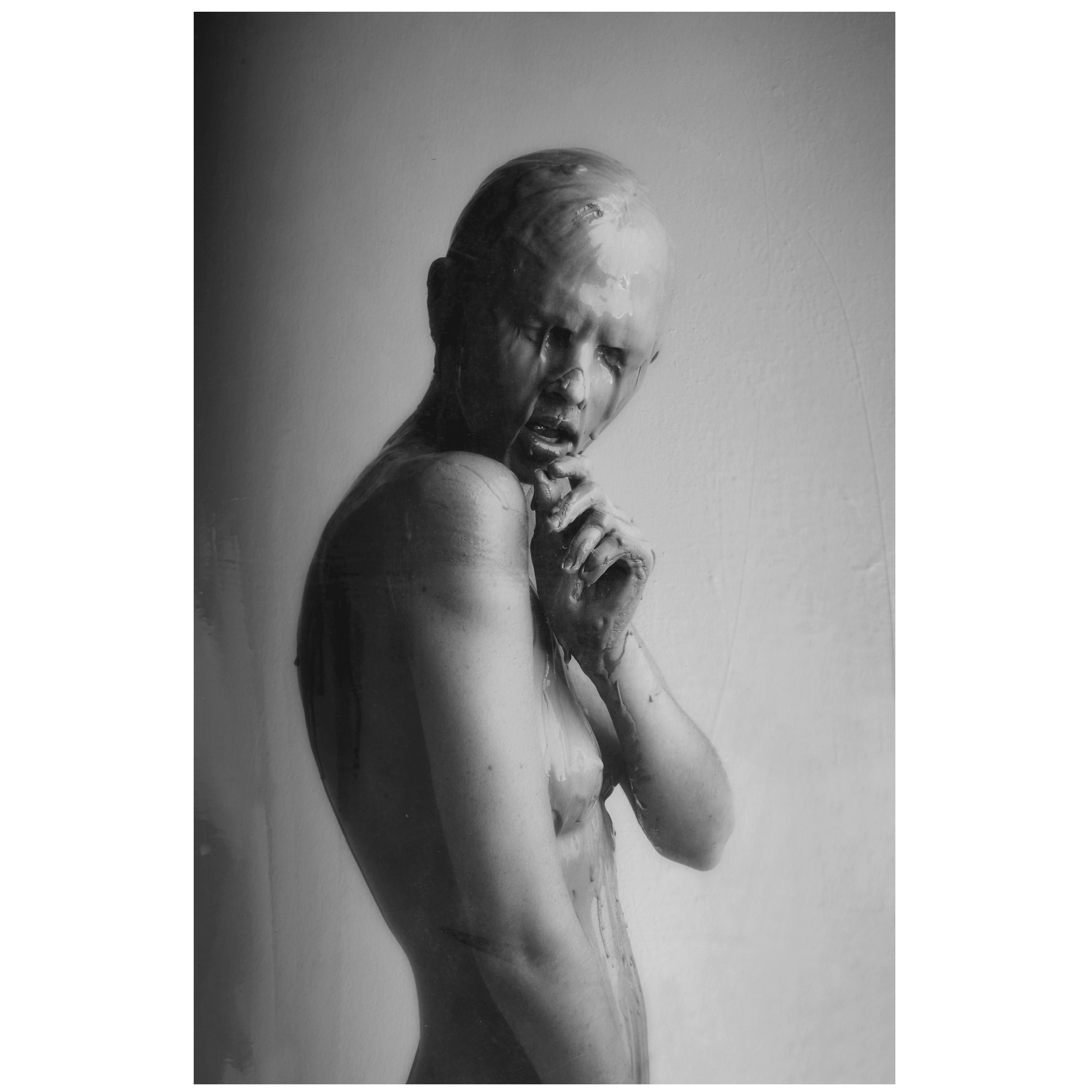
Artist: Peter Eaton Gurnz (American, contemporary)
Date: 21st century
Medium: Archival pigment print on paper
Dimensions: 57 × 43 cm
Description:
A nude figure is shown in three-quarter profile, skin slick with water that beads and streams across the body. The subject’s eyes are softly closed, the mouth slightly parted, and one hand lifts toward the chin in a gesture of introspection. Side lighting sculpts the shoulders and ribs while the pale ground keeps the focus on the luminous, wet surface of the skin. The photograph balances vulnerability and poise, transforming the body into a study of light, texture, and tone.
Artistic Context:
Gurnz often explores the sensorial intersection of human form, water, and light. Here, without intervening barriers, he uses the sheen of moisture to create a natural “veil,” heightening tactility and emotional immediacy.
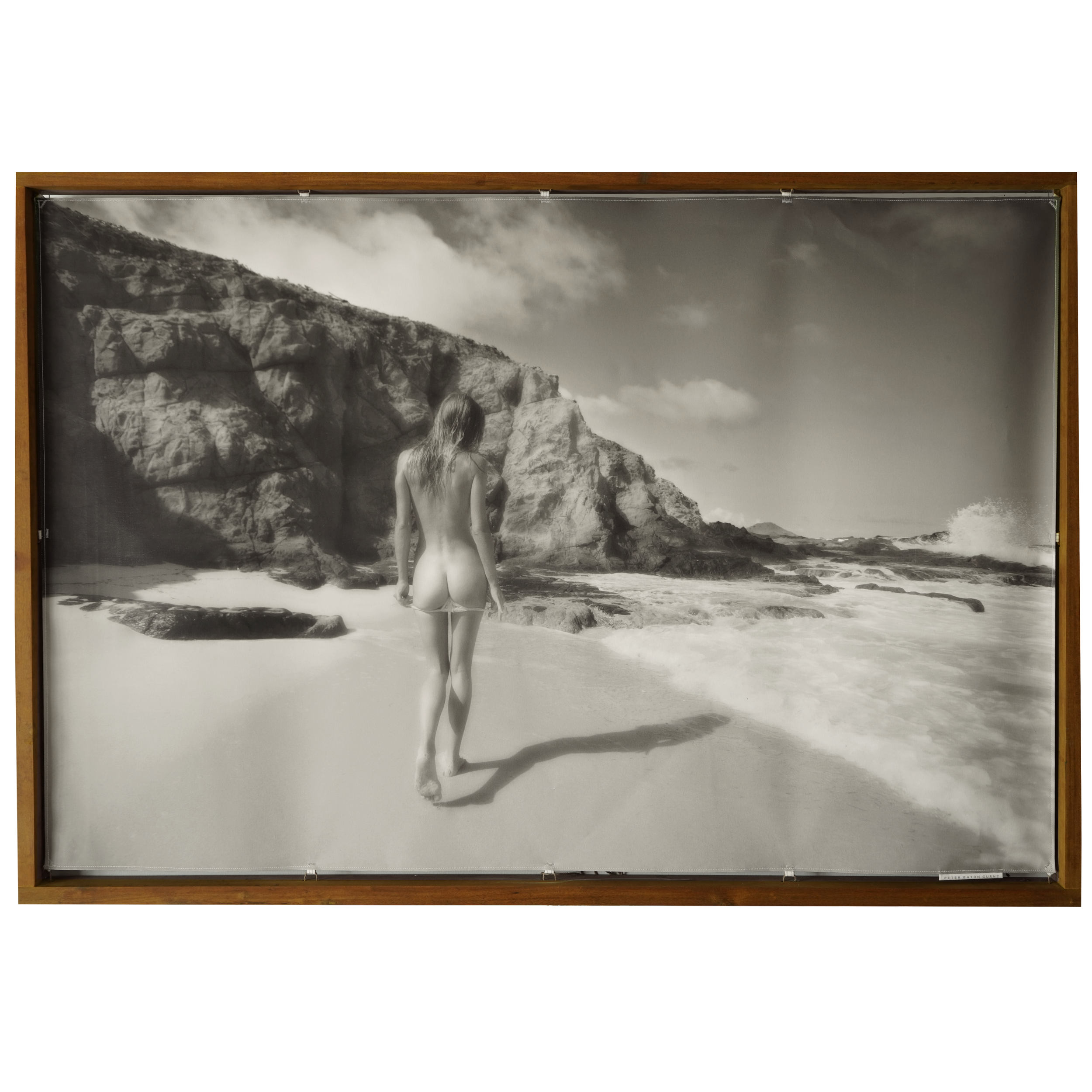
Artist: Peter Eaton Gurnz (American, contemporary)
Date: 21st century
Medium: Archival pigment print on paper, framed
Dimensions: 104 × 157 cm
Description:
In this serene black-and-white seascape, Peter Eaton Gurnz captures a nude figure walking along the surf toward a rugged, rocky outcrop. Photographed from behind, the subject’s body is illuminated by soft daylight, its contours standing in contrast to the sweeping expanse of sand and the textured face of the cliff. The ocean’s tide laps at the shore, its foam blurring the boundary between land and sea, while a distant wave crashes against the rocks at the far right of the frame.
The composition is expansive, allowing the natural environment to envelop the figure and emphasize the quiet intimacy of the moment. The monochrome palette heightens the interplay of light and shadow, lending the scene a timeless, almost cinematic quality.
Artistic Context:
Gurnz’s work often places the human form in dialogue with vast natural landscapes, exploring themes of freedom, vulnerability, and harmony with the environment. Here, the subject’s stride and the receding perspective evoke both a physical journey and an emotional passage.
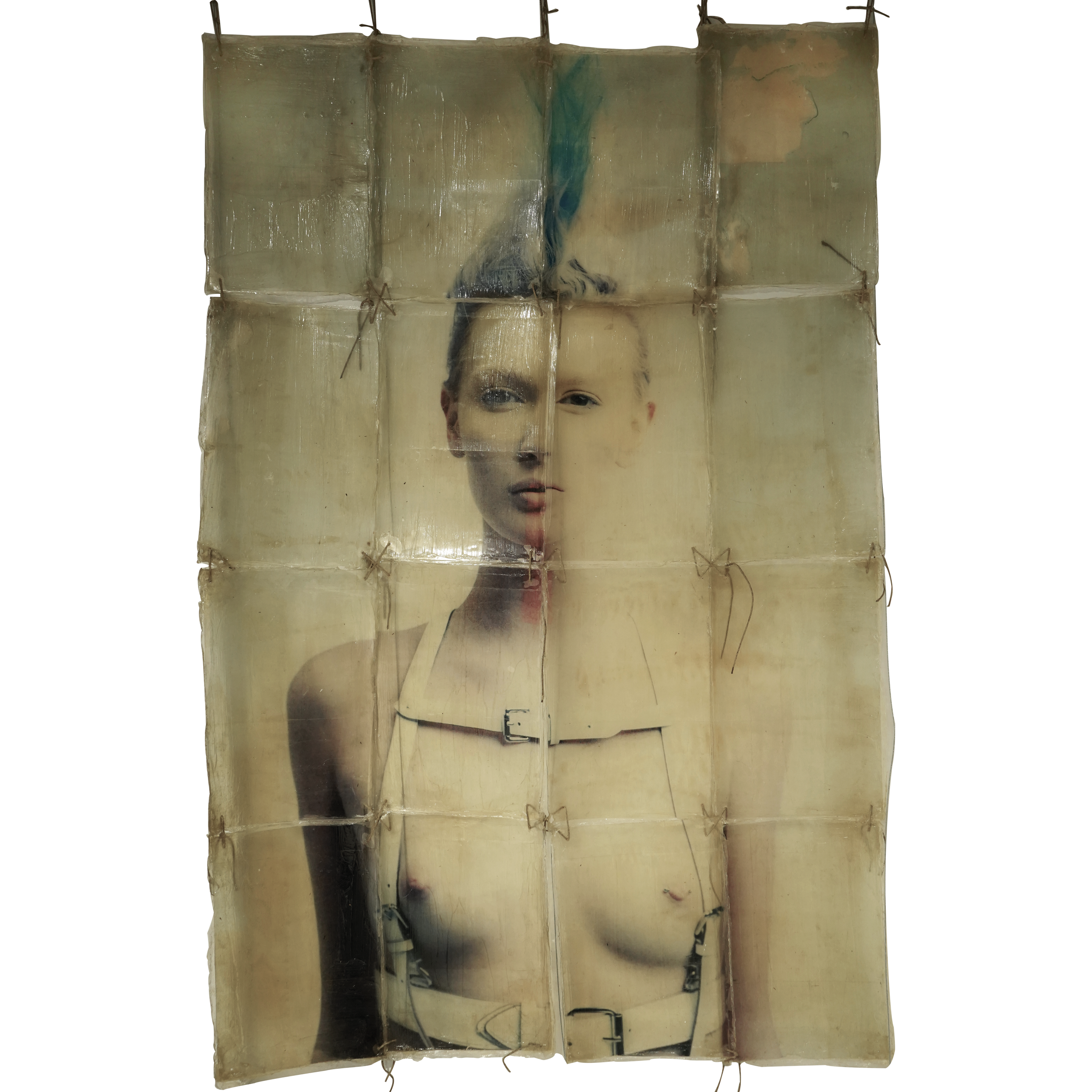
Artist: Peter Eaton Gurnz (American, contemporary)
Date: 21st century
Medium: Mixed media—archival photographic print on translucent panels, bound with string
Dimensions: 169 × 115 cm
Description:
In this arresting mixed-media work, Peter Eaton Gurnz presents a fashion-inflected portrait fragmented across a grid of translucent panels. The image depicts a woman in a harness-like garment, her gaze steady yet enigmatic, her torso rendered with a balance of vulnerability and strength. A vivid streak of turquoise hair punctuates the otherwise muted palette, introducing a sharp accent of color amid the pale flesh tones and soft shadows.
The photographic surface is physically divided into rectangular sections, each panel bound together with coarse string, creating both a visual and tactile grid. The tied seams interrupt the continuity of the image, forcing the viewer to reconcile the disjointed parts into a whole. The layered textures of the translucent material and knots add depth, suggesting themes of fragmentation, restraint, and reconstruction.
Artistic Context:
Known for merging high-fashion aesthetics with conceptual presentation, Gurnz here moves beyond traditional photographic framing. The physical structure of the piece becomes integral to its meaning, transforming the image from a single photographic surface into an object with sculptural and tactile presence.

Artist: Peter Eaton Gurnz (American, contemporary)
Date: c. 21st century
Medium: Archival pigment print on paper
Dimensions: 43 × 57 cm
Description:
Black-and-white portrait, Peter Eaton Gurnz frames a close profile view of a model whose wet hair clings in loose strands across her face. Delicate beads of water catch the light along her skin, enhancing the sculptural planes of her jaw and cheekbones. Large, smooth leaves arc across the composition, their organic shapes echoing the soft curve of the subject’s neck and shoulder.
The shallow depth of field isolates the figure and foliage against a blurred background, lending the image a dreamlike stillness. The tonal range—rich in silvery highlights and soft shadows—creates an ethereal mood, while the upward angle of the model’s pose conveys quiet strength and introspection.
Artistic Context:
Peter Eaton Gurnz is known for intertwining natural elements with the human form, creating portraits that are as much about texture and atmosphere as they are about likeness. This work exemplifies his ability to merge fashion sensibility with fine-art intimacy, using natural light and minimal staging to capture fleeting, emotive moments.
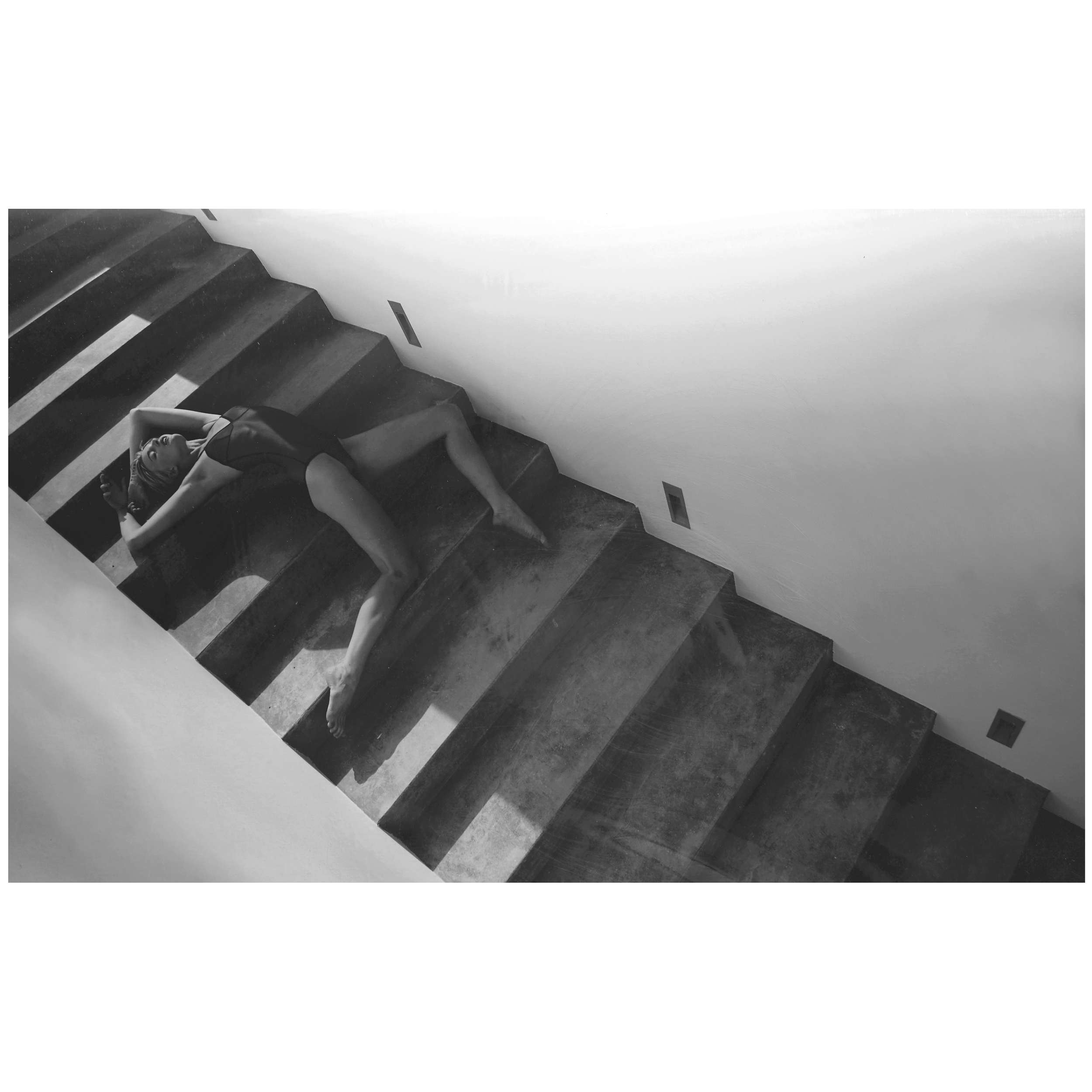
Artist: Peter Eaton Gurnz (American, contemporary)
Date: c. 21st century
Medium: Archival pigment print on paper
Dimensions: 43 × 57 cm
Description:
Black-and-white composition, Peter Eaton Gurnz captures a model in a dramatic, almost sculptural pose on a concrete staircase. Dressed in a simple black bodysuit, the figure reclines diagonally across the steps, her elongated limbs creating a dynamic interplay of lines that both echo and disrupt the rigid geometry of the architecture. The stark light streaming from above casts angular shadows that heighten the contrast between body and structure, while the expansive white wall provides a minimalist backdrop that accentuates the scene’s spatial clarity.
Her upward gaze and extended arms introduce a sense of openness and vulnerability, while the strong architectural setting lends a modernist, almost cinematic atmosphere.
Artistic Context:
Gurnz’s work often merges the human form with architectural space, exploring how posture, light, and structure can combine to create emotionally charged images. Here, the body becomes part of the built environment, its organic curves counterbalancing the severity of concrete and shadow.
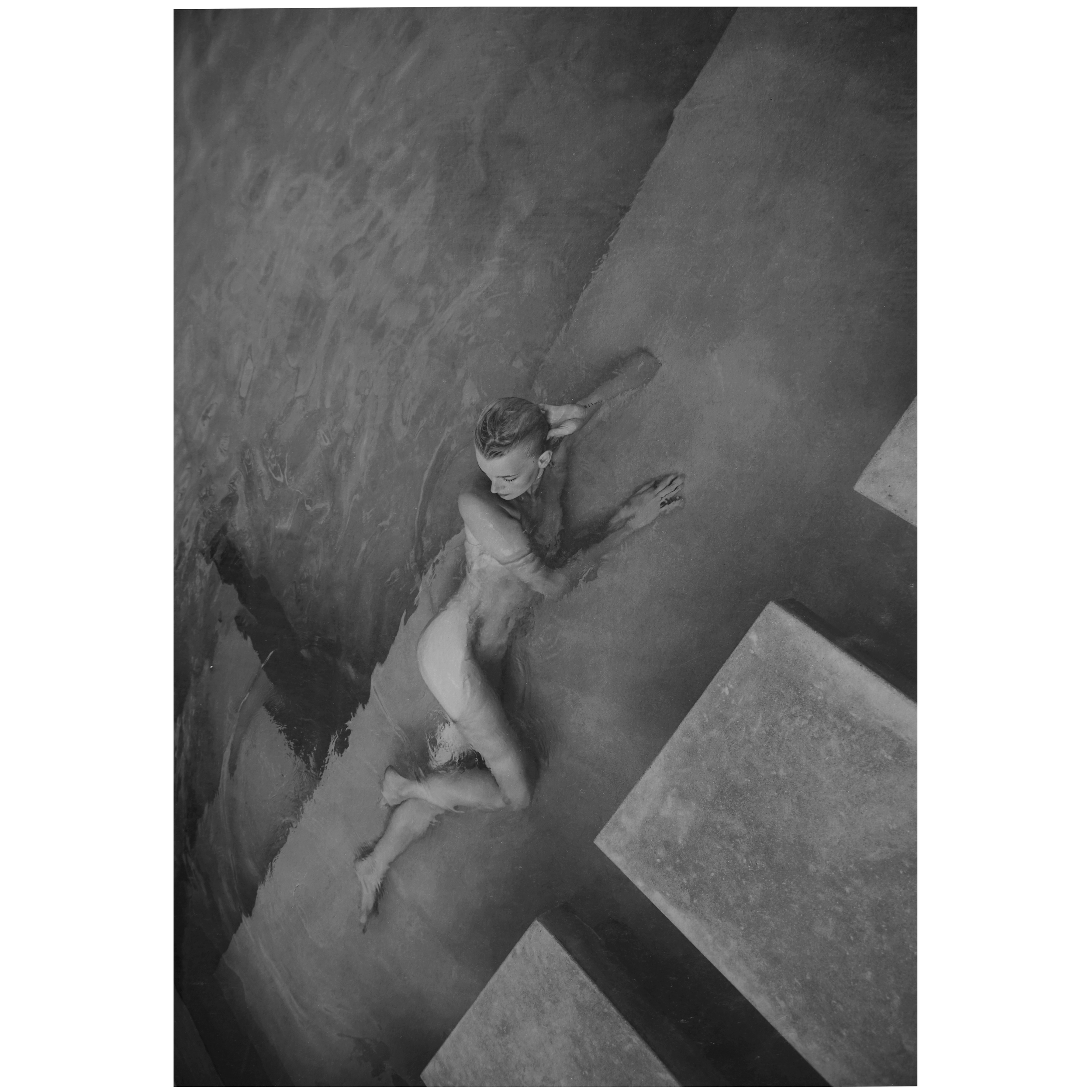
Artist: Peter Eaton Gurnz (American, contemporary)
Date: c. 21st century
Medium: Archival pigment print on paper
Dimensions: 57 × 43 cm
Description:
Black-and-white composition, Peter Eaton Gurnz captures a nude figure reclining along the sloped edge of a pool, her body half-submerged in water. Viewed from above, the subject’s pose elongates her form into a graceful diagonal, contrasting against the stark geometry of the steps to the right. The smooth planes of stone and the rippling water create an interplay of texture, while the soft gradations of light and shadow lend the scene a sculptural quality.
The model’s turned head and relaxed posture suggest introspection, while the overhead perspective lends a sense of quiet detachment, as though the viewer is witnessing a private moment from a hidden vantage.
Artistic Context:
Peter Eaton Gurnz is known for merging the sensuality of the human form with architectural and environmental elements. This photograph exemplifies his minimalist yet evocative style, where the human body becomes an integral part of a broader compositional design, balancing organic curves with rigid structures.

Artist: Peter Eaton Gurnz (American, contemporary)
Date: c. 21st century
Medium: Archival pigment print on paper
Dimensions: 57 × 43 cm
Description:
Black-and-white portrait by Peter Eaton Gurnz captures the raw immediacy of a face just emerged from the water. The subject’s short, wet hair falls forward in loose strands, partially veiling the eyes, while beads of water and salt cling to the skin, catching the light in subtle highlights. The direct gaze—both steady and enigmatic—anchors the composition, drawing the viewer into an intimate moment suspended between vulnerability and quiet defiance.
The close cropping eliminates all distractions, focusing solely on the texture of skin, the sheen of moisture, and the sculptural interplay of light and shadow. The tonal range is soft yet precise, heightening the sense of immediacy and tactility.
Artistic Context:
Known for blending elements of fashion photography, portraiture, and fine art, Peter Eaton Gurnz often distills human presence into elemental visual experiences. This image exemplifies his minimalist yet emotionally charged style, in which the human face becomes a landscape of texture, light, and mood.
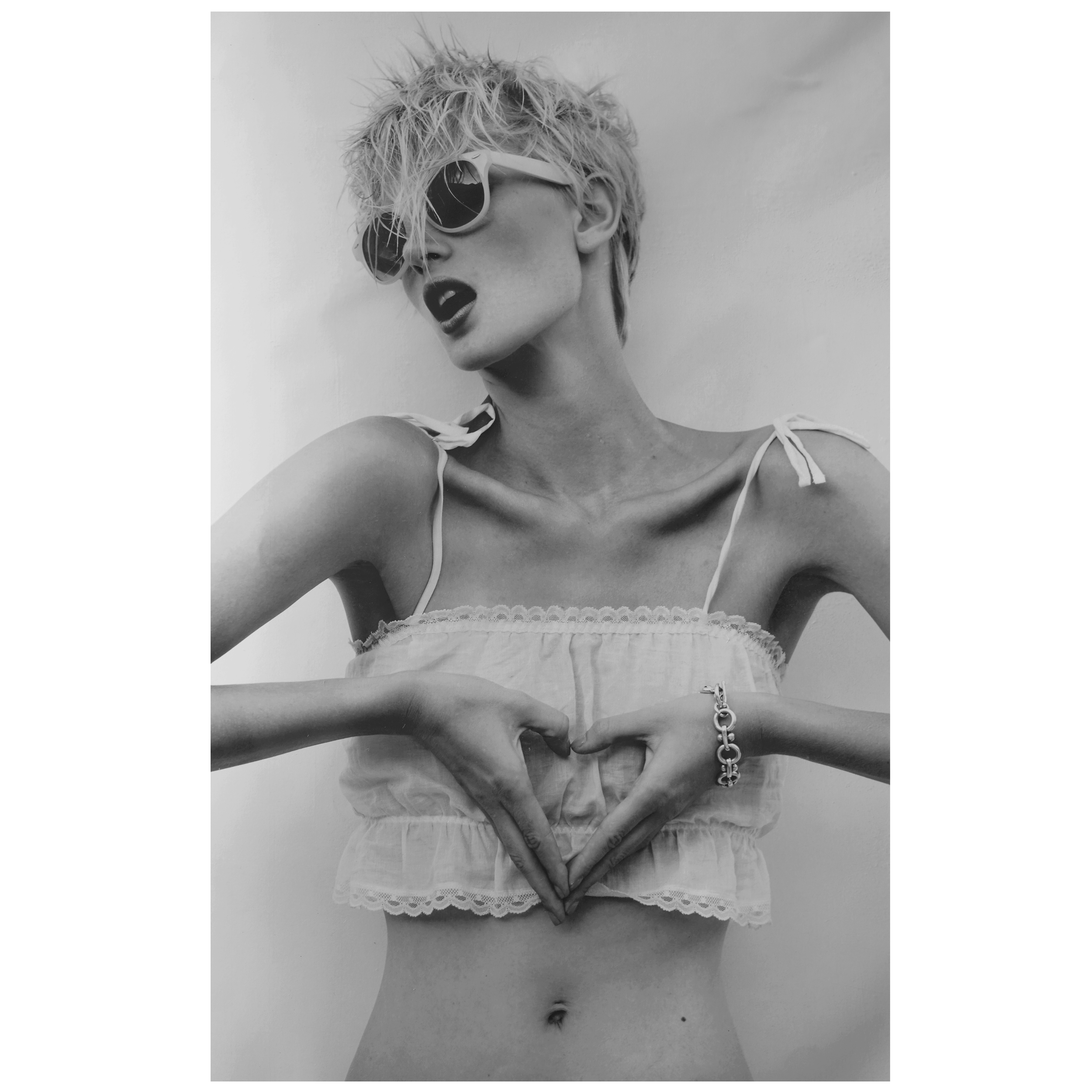
Artist: Peter Eaton Gurnz (American, contemporary)
Date: c. 21st century
Medium: Archival pigment print on paper
Dimensions: 57 × 43 cm
Description:
Black-and-white portrait, Peter Eaton Gurnz captures a moment of raw, contemporary cool. The subject, wearing oversized sunglasses and a cropped camisole, tilts her head back with parted lips, her expression caught between defiance and playfulness. Her platinum-blonde, tousled hair partially obscures her face, intensifying the sense of spontaneity.
Her hands form a heart shape at the center of the frame, a gesture that contrasts with her otherwise angular posture and the sharp shadows accentuating her collarbones. The silver bracelet on her wrist adds a subtle gleam, punctuating the monochrome palette with a tactile detail.
Artistic Context:
Peter Eaton Gurnz is known for blending elements of fashion photography, portraiture, and fine art, often playing with contrasts—sensuality and edge, elegance and irreverence. Here, the staged gesture of affection is reframed within a high-fashion aesthetic, making the image simultaneously intimate and iconic.
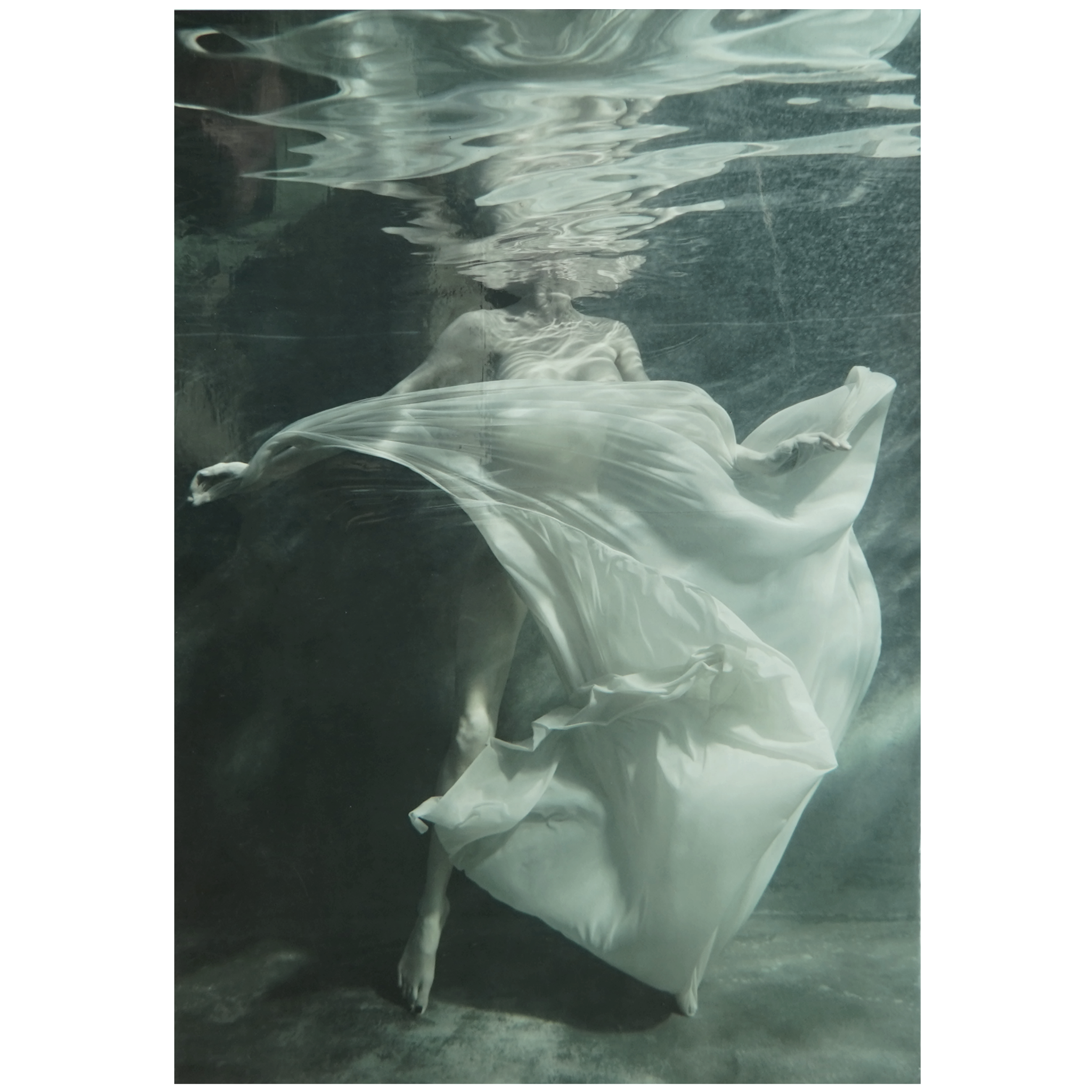
Underwater Figure in Flowing White)
Artist: Peter Eaton Gurnz (American, contemporary)
Date: c. 21st century
Medium: Archival pigment print on paper
Dimensions: 57 × 43 cm
Ethereal underwater composition, Peter Eaton Gurnz captures a solitary figure submerged, enveloped in a billowing white fabric that unfurls in the surrounding water like liquid light. The subject’s face is partially obscured by the water’s surface distortion, creating an interplay between clarity and abstraction. Rippling reflections above mirror the shapes below, blurring the boundary between the corporeal and the ephemeral.
The weightlessness of the scene transforms the fabric into an extension of the body’s movement, evoking both dance and dream. Light refracts through the water, softening the palette into muted greys and luminous whites, while the fluid environment suspends the moment in perpetual stillness.
Artistic Context:
Peter Eaton Gurnz is known for his striking underwater photography, in which fabric, light, and human form merge to explore themes of beauty, transformation, and the subconscious. His work often dissolves the conventional spatial cues, placing viewers in an otherworldly environment that invites both introspection and wonder.
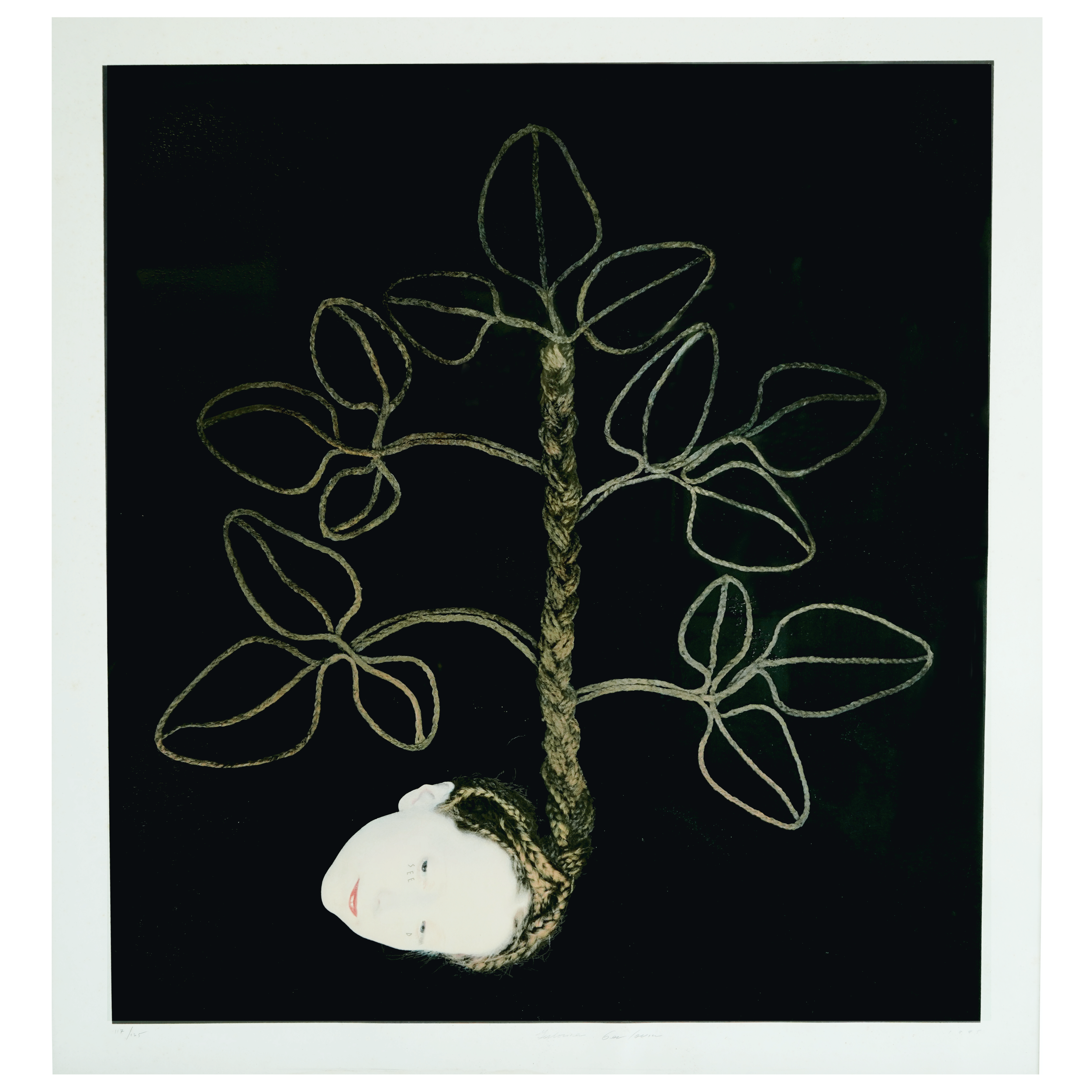
RIMMA GERLOVINA and VALERY GERVOLIN Silkscreen print photograph - SEED
Year: 1995
Edition: 117/125
Medium: Gelatin silver print (or photographic print)
Dimensions: 100 × 94 cm
Collection: Private Collection
Description:
Photograph by Rimma Gerlovina reflecting her conceptual approach to visual language and symbolism. The image features strong contrasts and a thoughtful composition that invites the viewer to engage with layered meanings beyond the surface.
A key figure in the Soviet Nonconformist and Sots Art movements, Gerlovina’s work often explores identity, metaphysics, and the role of language in perception. Her photography is known for its minimalist aesthetic paired with philosophical depth, bridging visual art and poetry in a uniquely personal voice.
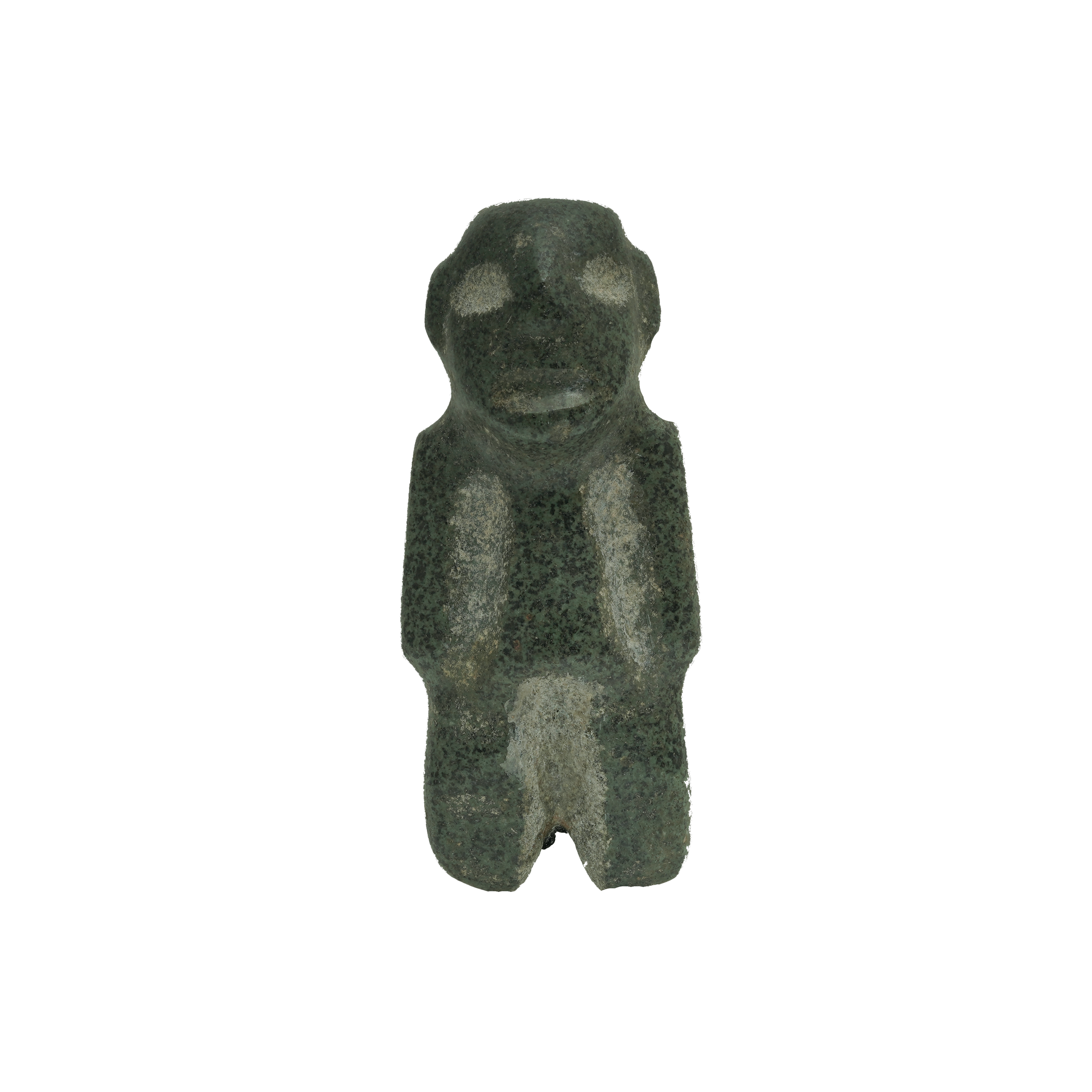
Jade Figurine
Region uncertain, date unknown
Nephrite or jadeite
Size: 11 × 5 cms
This small figurine is carved from dark green jade with lighter inclusions. It depicts a stylized standing human figure with simplified facial features and prominent limbs. The carving is minimal yet deliberate, suggesting symbolic or ritual significance rather than purely decorative intent. Figurines of this type have been used in various cultures as amulets, offerings, or representations of ancestors or deities. The piece’s weathered surface and patina indicate age and prolonged handling, enhancing its tactile quality and historical resonance.
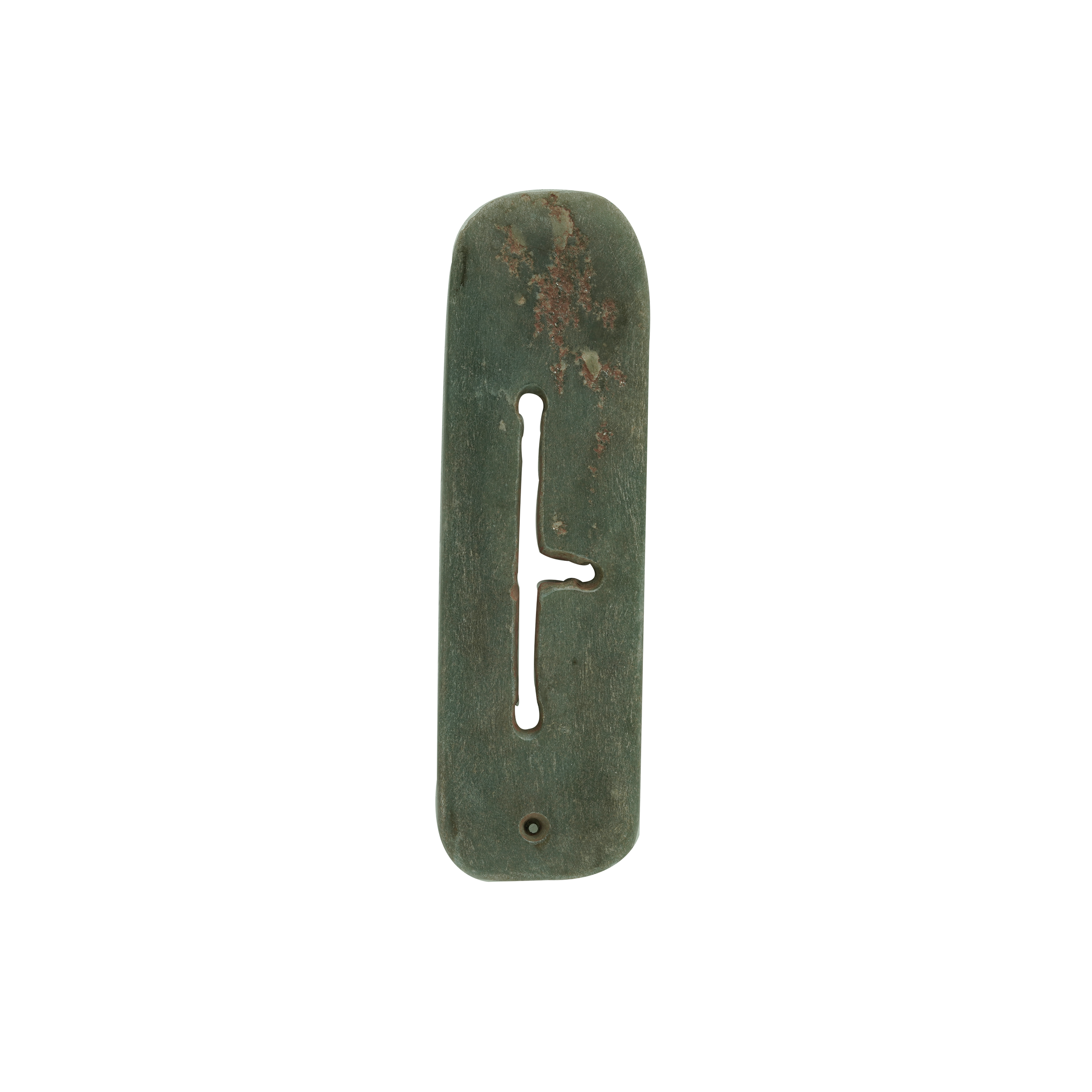
Jade Ornament
China, date uncertain (possibly 20th century or earlier)
Nephrite or jadeite
Size : 12 × 4 cms
This elongated, rectangular jade ornament is carved from dark green stone with a smooth, weathered surface showing areas of natural inclusions and surface alteration. A central openwork cut runs vertically with a lateral extension, and a small drilled perforation is located near one end, likely for suspension or attachment. The form and piercing suggest it may have been used as a decorative fitting, garment accessory, or symbolic amulet. The piece reflects the adaptability of jade craftsmanship, combining functional use with the enduring cultural esteem for jade in Chinese tradition..
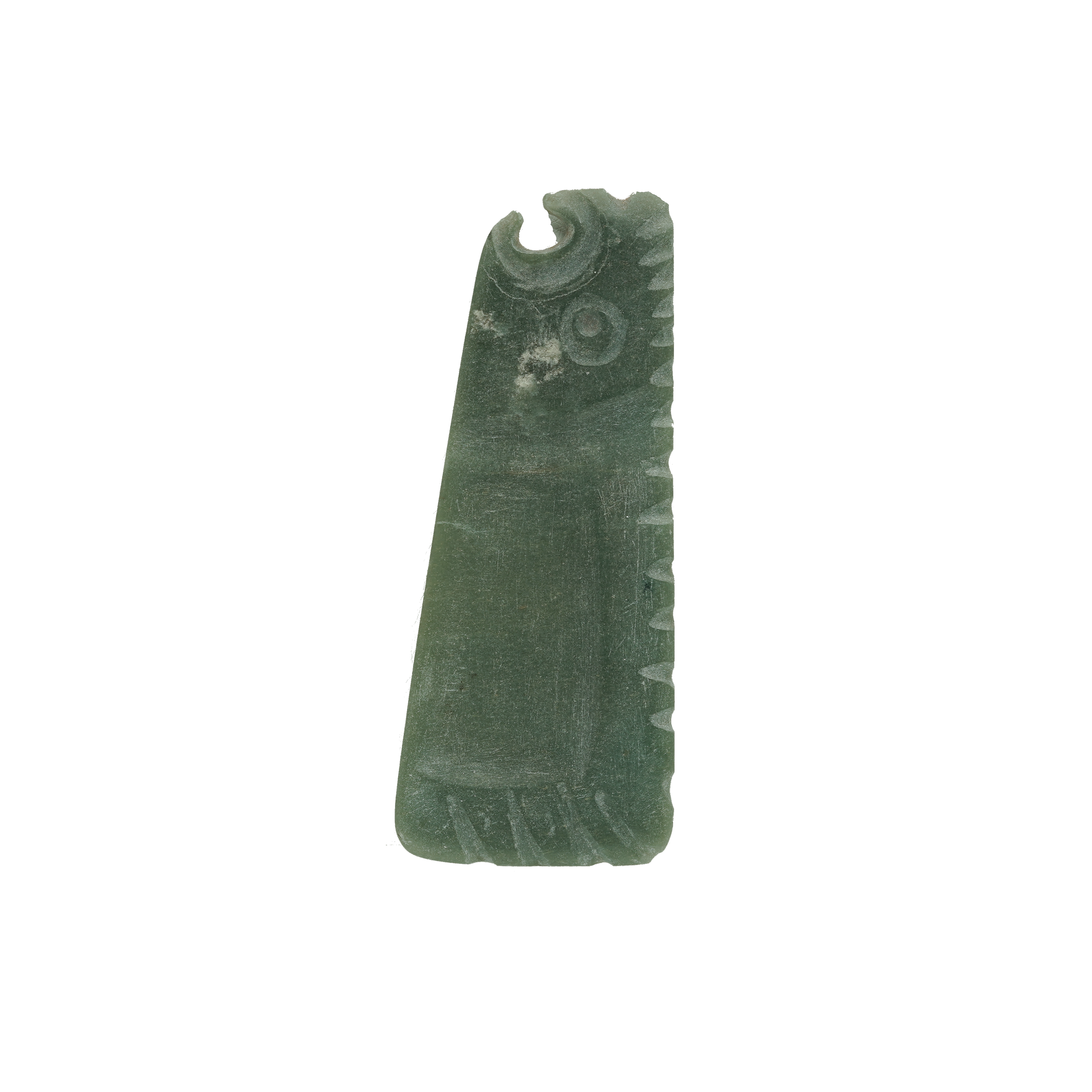
Jade Pendant
China, 20th century or earlier
Jadeite or nephrite
Size: 12 × 5 cms
This pendant is carved from dark green jade in a tapered form with one end featuring a stylized zoomorphic motif and a pierced suspension hole. The edges are finely notched, and the surface bears shallow incised decoration. Such pendants may have served both decorative and symbolic purposes, with the animal-like design elements possibly representing protective or auspicious creatures in Chinese tradition. The piece combines functional wearability with artistic craftsmanship, reflecting jade’s long-standing cultural value as a material associated with status, protection, and spiritual significance.
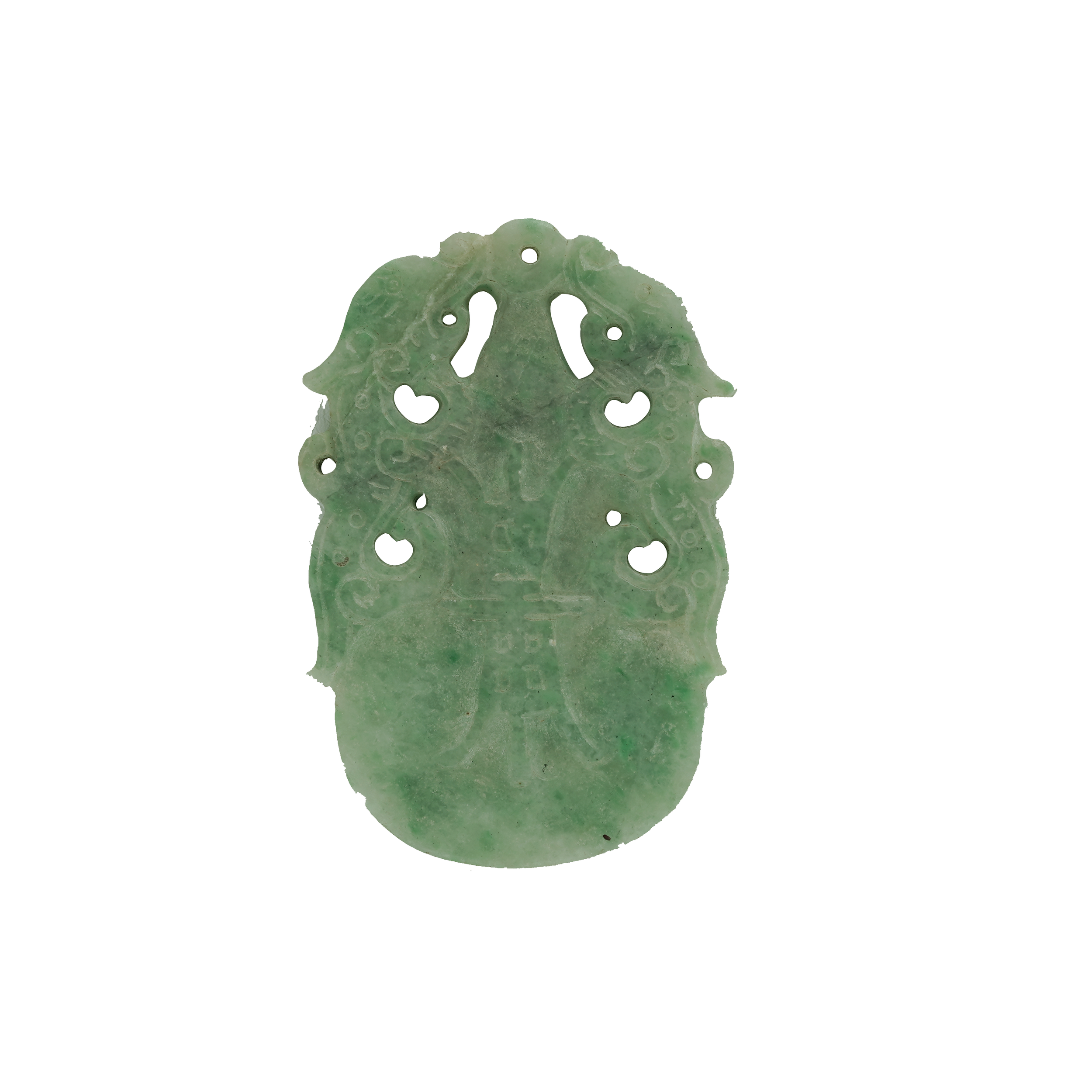
Jade Pendant
China, 20th century
Jadeite or nephrite
Size : 6 × 4 cms
This intricately carved pendant is made from green jade, featuring openwork designs and stylized motifs. The surface shows both raised and incised patterns, possibly including auspicious symbols and characters. In Chinese culture, jade pendants are worn as amulets for protection, prosperity, and good fortune. The craftsmanship and detailed carving reflect the enduring cultural significance of jade as a material prized for both beauty and symbolic meaning.
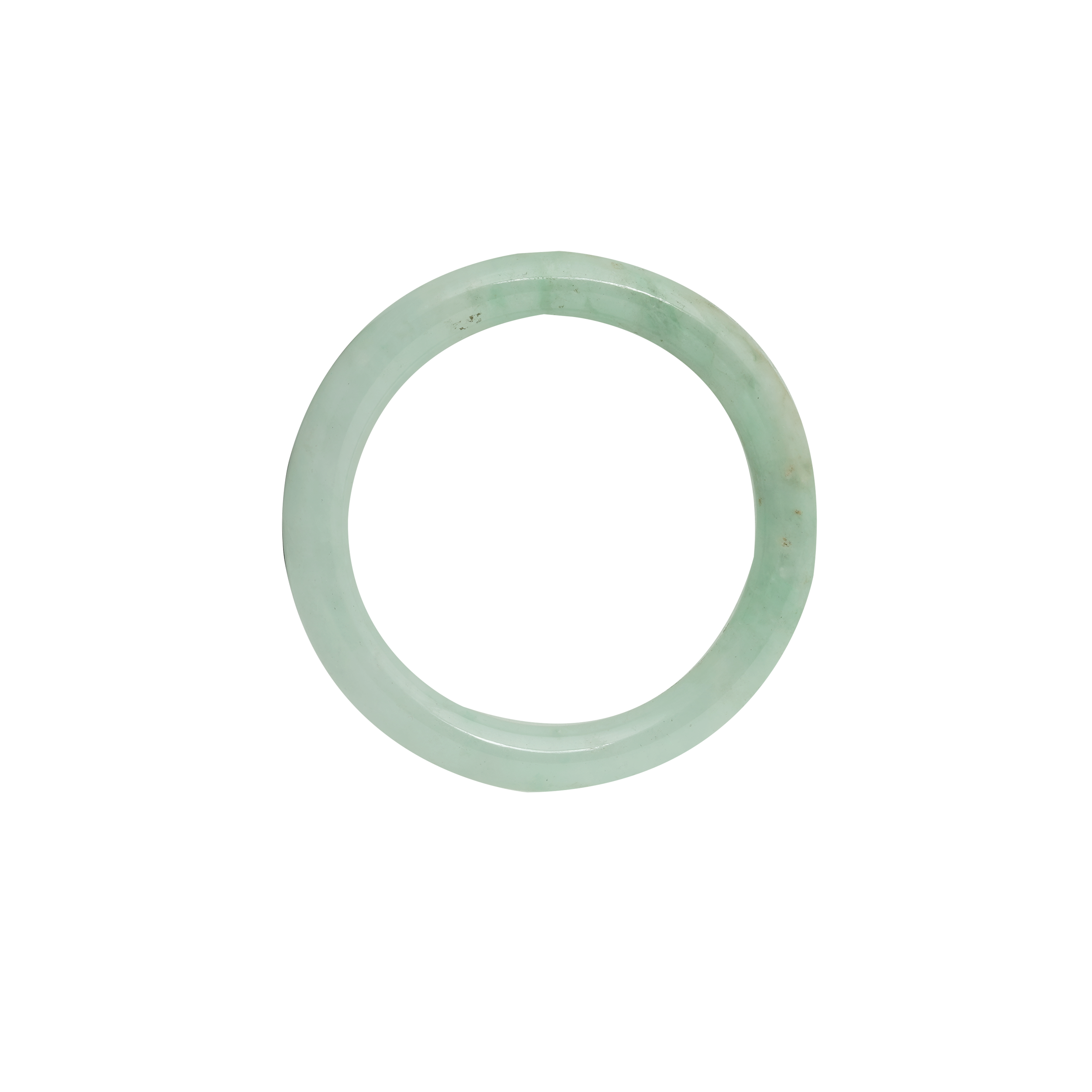
Jade Bangle
China, 20th century
Jadeite or nephrite
Size 7 × 7 cms
This bangle is carved from a single piece of light green jade with a smooth, polished finish. The stone shows slight natural variations in tone, with areas of deeper green and minor inclusions. In Chinese tradition, jade bangles are prized for their beauty and durability, and are believed to offer protection and good fortune to the wearer. The unbroken circular form represents unity and continuity.
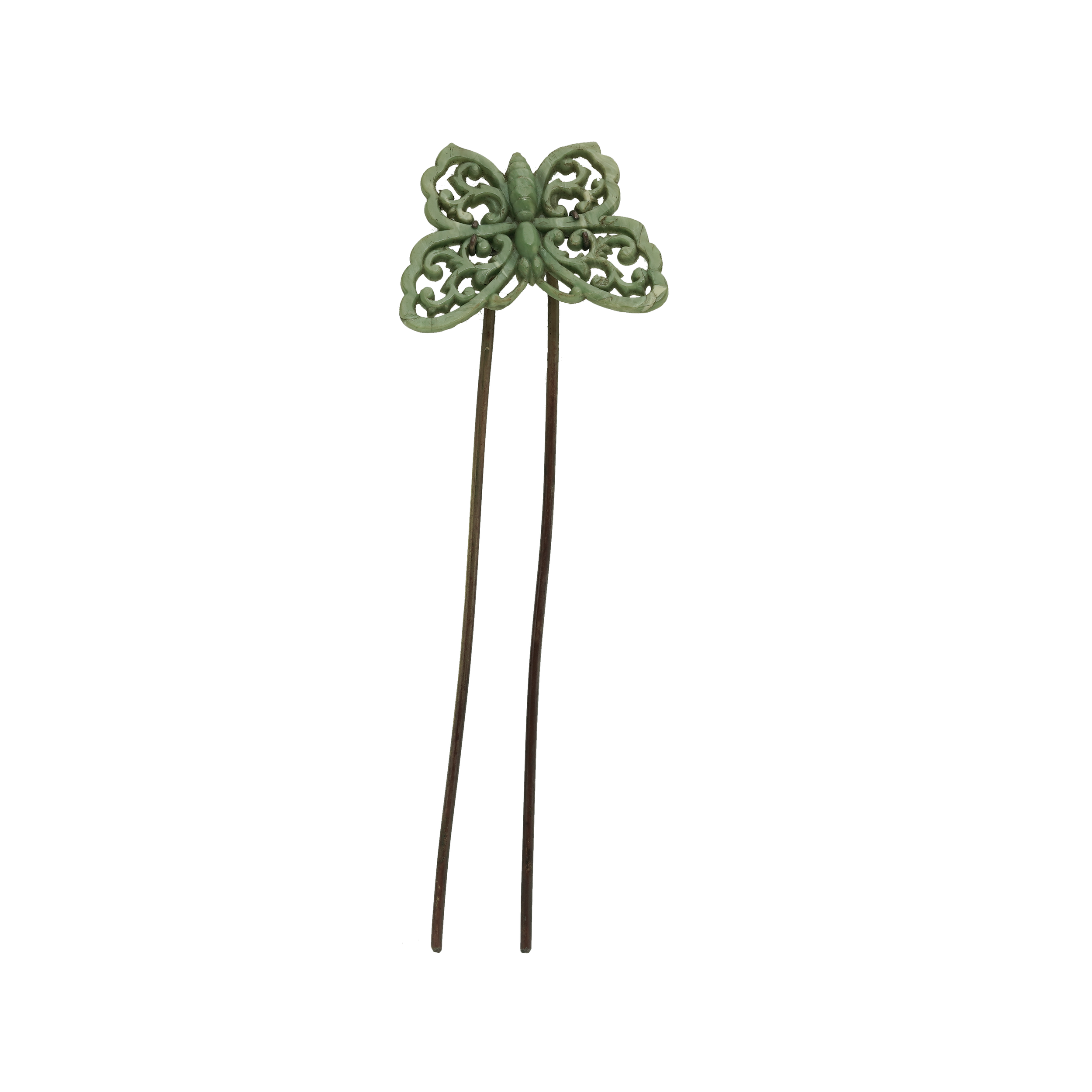
Japanese Jade Hair Ornament in the Form of a Butterfly
Culture: -
Date: c. 600–900 CE (Late Classic Period)
Materials: Jade, metal (possibly copper alloy)
Dimensions: 11 × 3cms
Hair ornament featuring an intricately carved jade butterfly, its openwork wings filled with swirling scroll motifs. The carving is mounted on two slender metal pins, suggesting it was designed to be worn in an elaborate hairstyle, likely as part of ceremonial attire.
Jade was a material of profound spiritual and political significance, representing fertility, life force, and divine authority. Hair ornaments such as this would have been reserved for members of the elite, used to display status and cultural identity during important rituals and public gatherings.
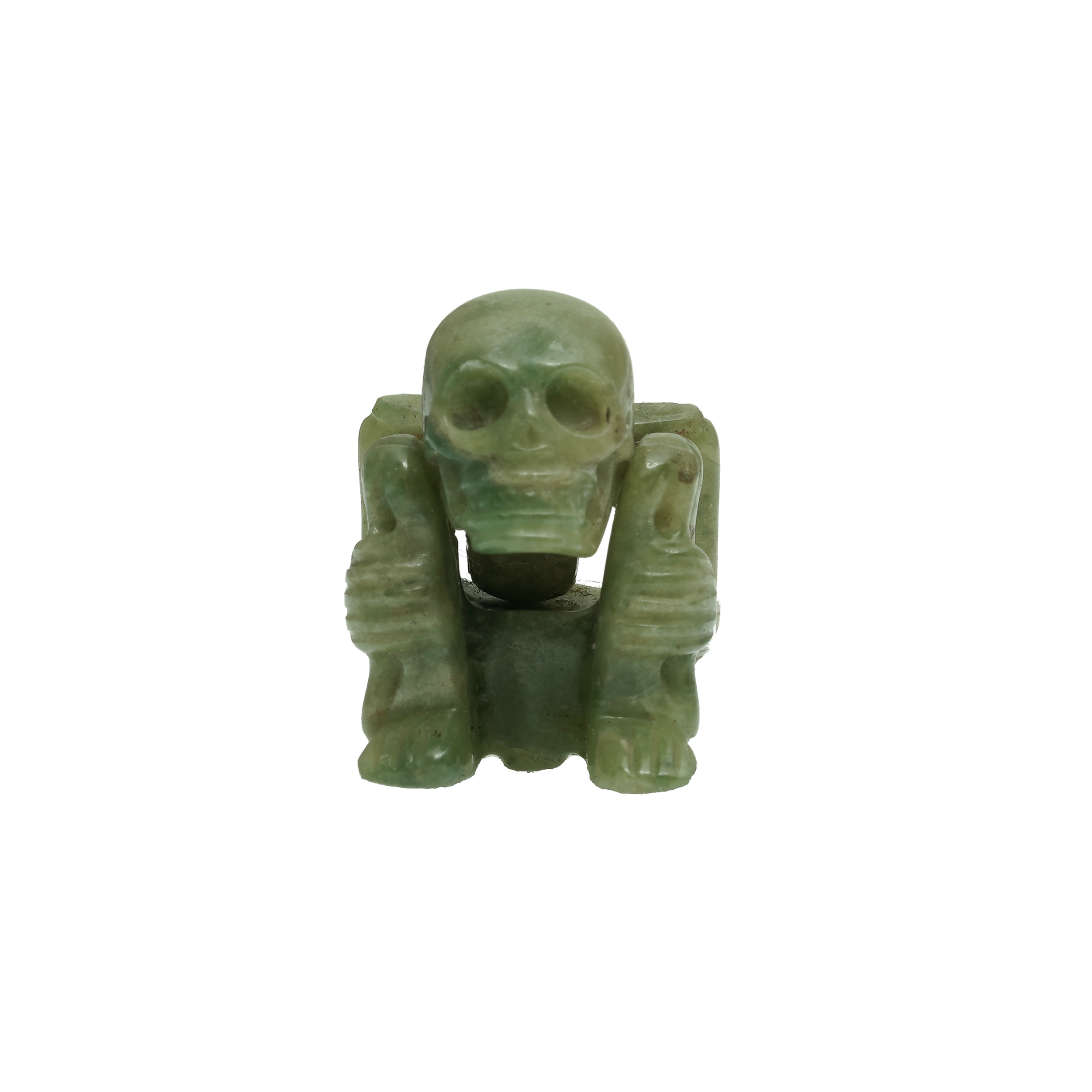
Maya Jade Figurine of a Seated Skeleton
Culture: Maya Civilization
Date: c. 600–900 CE (Late Classic Period)
Materials: Jade
Dimensions: 3.0 × 2.0 cm
Finely carved jade figurine depicting a seated skeletal figure, knees drawn up to the chest, arms wrapped around the legs, and a prominent skull with hollowed eye sockets. The skeletal imagery likely references themes of death, rebirth, and the cyclical nature of existence central to Maya cosmology.
Jade was considered a sacred material by the Maya, associated with life force, fertility, and elite status.
Provenance:
Likely from the southern Maya lowlands, present-day Guatemala or Mexico.

Pendant with Carved Ivory Plaque Depicting a Dragon
Culture: East Asian, likely Chinese
Date: Late 19th–Early 20th Century
Materials: Ivory, silver
Dimensions: 5.2 × 4.0 cm
Pendant featuring a finely carved rectangular ivory plaque set within a silver frame. The central motif depicts a sinuous dragon in high relief, surrounded by swirling cloud patterns, a design deeply rooted in East Asian symbolism. The dragon, a revered mythical creature, is traditionally associated with power, prosperity, and auspicious energy, while the surrounding clouds symbolize celestial realms and divine presence.
The craftsmanship, with precise incisions and layered carving, highlights the artisan’s skill in working with ivory to achieve both depth and movement.
Provenance:
Probably crafted in China for personal adornment or as a treasured gift, reflecting the enduring symbolic power of the dragon motif in East Asian art.

Maya Pendant with Anthropomorphic Figure
Culture: Maya Civilization
Date: c. 600–900 CE (Late Classic Period)
Materials: Jade, brass
Dimensions: 9.5 × 7.0 cm
Pendant depicting a human figure carved from jade, rendered in a stylized, almost abstract form. The figure is framed by an oval border with decorative brass fittings, giving the impression of a symbolic enclosure or ceremonial frame. The simple yet expressive facial features and proportionally elongated limbs reflect the Maya’s symbolic rather than naturalistic approach to human representation.
Jade, a material revered by the Maya for its rarity and spiritual significance, was associated with life, fertility, and divine authority. The combination of jade and brass suggests this piece was a prestigious adornment, possibly worn by a noble or priest during ceremonial events.
Provenance:
Likely from the southern Maya lowlands, in present-day Guatemala or Mexico.
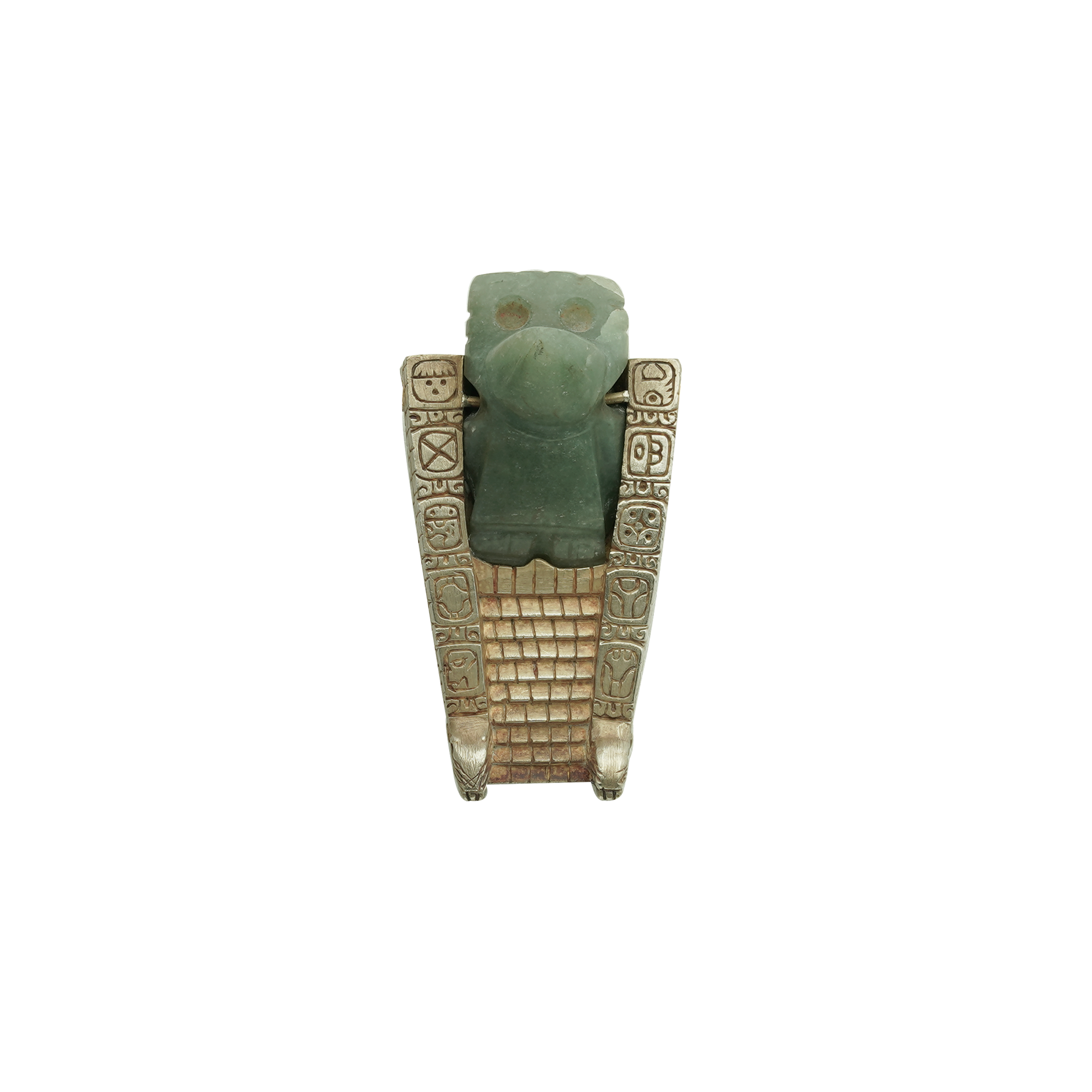
Maya Pendant with Zoomorphic Jade Figurine and Brass Mount
Culture: Maya Civilization
Date: c. 600–900 CE (Late Classic Period)
Materials: Jade, brass
Dimensions: 8.0 × 4.5 cm
Pendant featuring a carved jade figurine, possibly representing a stylized animal or mythological creature, set within an intricately worked brass mount. The mount is decorated with geometric and symbolic motifs, including a textured, scale-like surface and terminal ends shaped as stylized animal heads. Such designs reflect the Maya’s rich symbolic vocabulary, where zoomorphic imagery was often linked to deities, transformation, and cosmic forces.
The jade’s deep green hue was among the most valued materials in Maya culture, symbolizing life, fertility, and divine authority.
Provenance:
Probably from the southern Maya lowlands, in present-day Guatemala or Mexico.
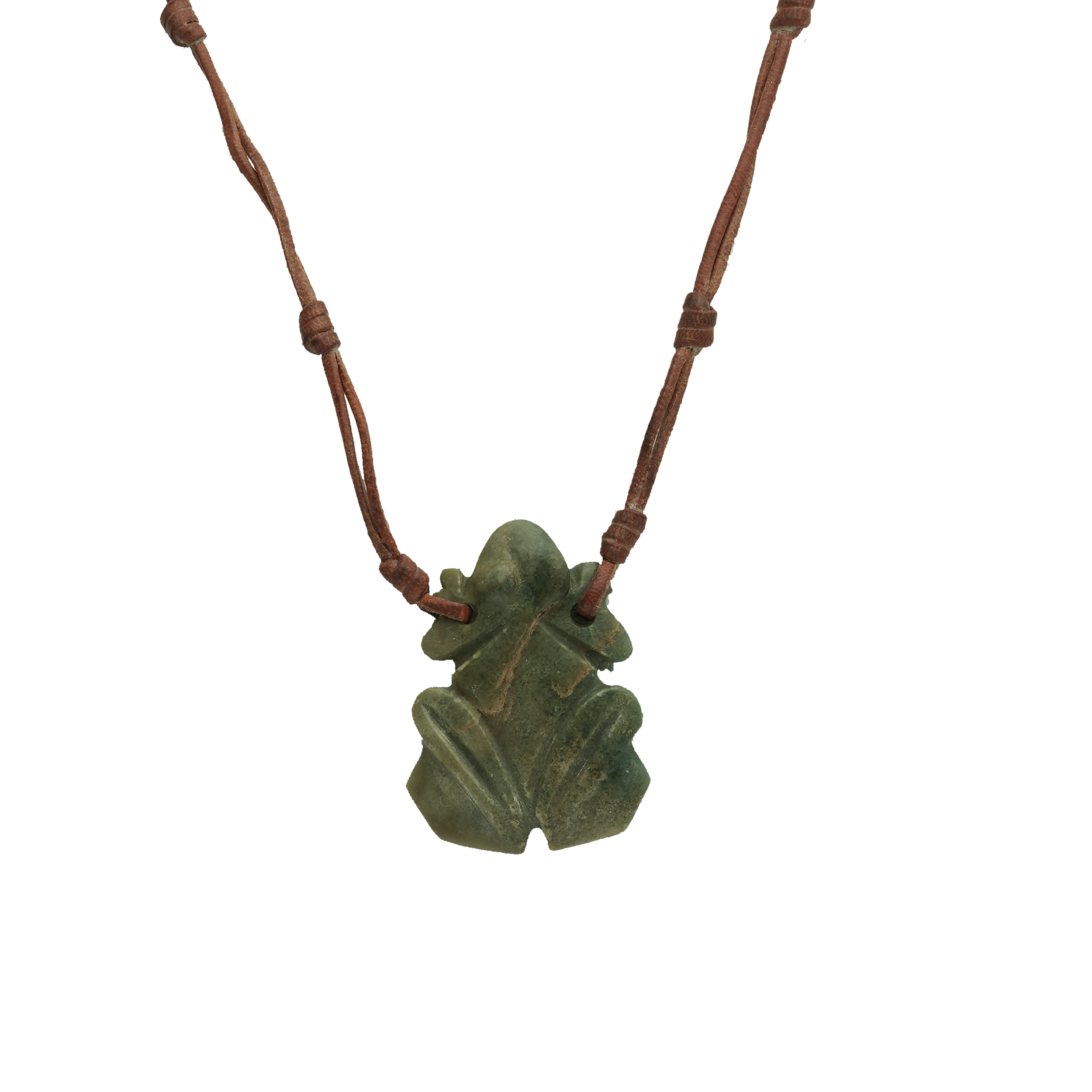
Culture: Maya Civilization
Date: Late Classic Period (c. 600–900 CE)
Materials: Carved green jadeite, leather cord (modern)
Dimensions: 5 × 3 cm
Collection: Private Collection
Description:
Carved pendant in the form of a stylized frog is crafted from green jadeite, a material held in the highest regard by the ancient Maya. Frogs were potent symbols within Mesoamerican cosmology—linked to rain, fertility, and the regenerative power of water. As amphibians, frogs were seen as creatures of dual worlds, able to navigate both land and water, embodying transition and transformation.
Suspended today on a simple leather cord, the pendant merges ancient iconography with modern presentation. The contemporary mounting respects the original function of the piece as adornment while making it accessible as an object of both historical reverence and aesthetic appreciation.
This pendant exemplifies how the Maya encoded spiritual significance into everyday objects. Its frog motif speaks to ecological awareness and the sacred cycles of nature—values deeply embedded in Maya belief systems and still resonant today.
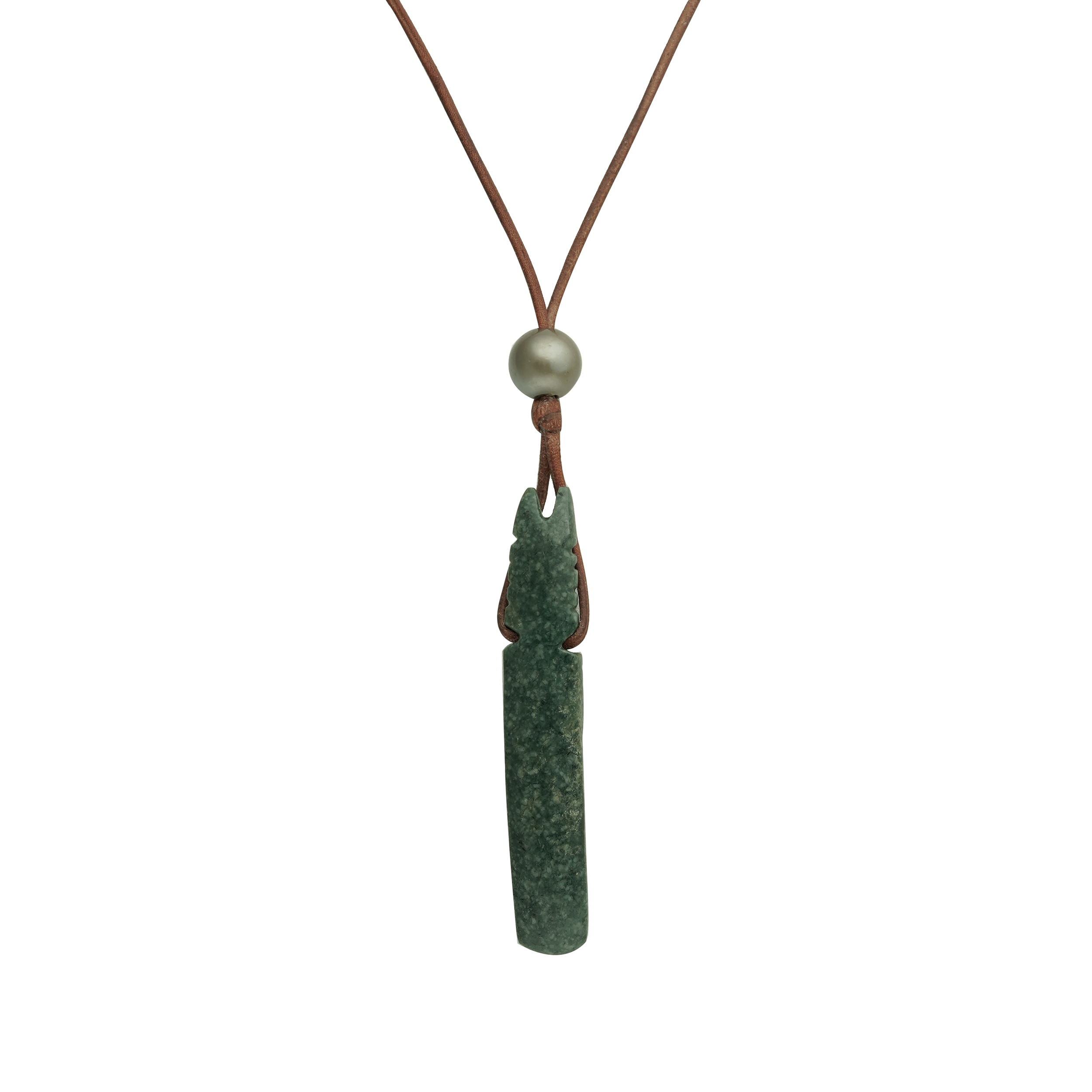
Culture: Maya Civilization (pendant) / Contemporary assemblage
Date: Jade carving, Classical Period (c. 250–900 CE); pearl and leather cord, contemporary
Materials: Maya green jadeite, Tahitian black pearl, leather cord
Dimensions: 6 × 1 cm
Collection: Private Collection
Description:
Pendant bringing together the ancient artistry of the Maya civilization with modern design sensibilities. The central element is a finely shaped green jadeite pendant—likely originating from Mesoamerica and once revered by the Maya as a sacred material associated with life, fertility, and power. Its vertical form evokes ceremonial celts or ritual tools, which were often buried as offerings or worn by elites.
Suspended on a contemporary leather cord, the jade pendant is paired with a single Tahitian black pearl, creating a striking juxtaposition of ancient and modern, raw and refined. While the jade carries the spiritual and social gravitas of its Maya origins, the pearl contributes a sense of contemporary elegance and global connectivity.
This hybrid piece serves as a powerful example of how ancient materials and symbols can be reimagined in contemporary contexts, maintaining their cultural weight while acquiring new layers of meaning across time and space.
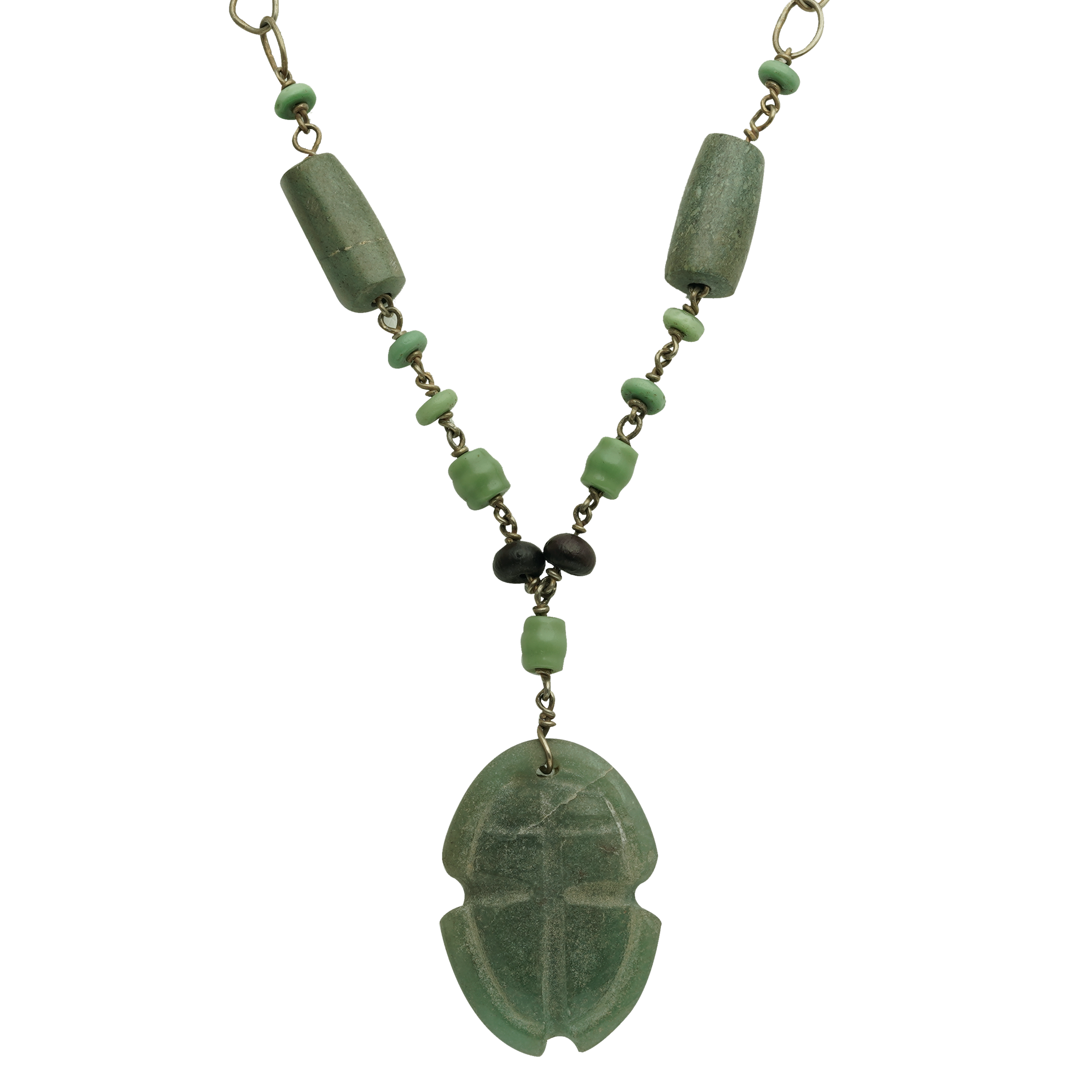
Maya Necklace with Jade Pendant and Beads
Culture: Maya Civilization
Date: c. 600–900 CE (Late Classic Period)
Materials: Carved jadeite, stone beads, shell or bone beads, metal fittings
Dimensions: Pendant height approx. 6 cm; overall necklace length variable
Necklace featuring a carved jadeite pendant in the stylized form of an abstracted insect or shield-like emblem, defined by symmetrical lobes and a central vertical ridge with transverse bar. The pendant’s smooth, mottled green surface is characteristic of high-quality jadeite prized in Maya culture.
The necklace strand is composed of cylindrical jadeite beads, smaller green stone beads, and darker interspersed beads, possibly made of shell, bone, or stone. These are strung on metal-linked connectors, forming a V-shaped drop that emphasizes the central pendant.
Provenance:
Likely from the Maya lowlands, in present-day Guatemala, Belize, or southern Mexico.
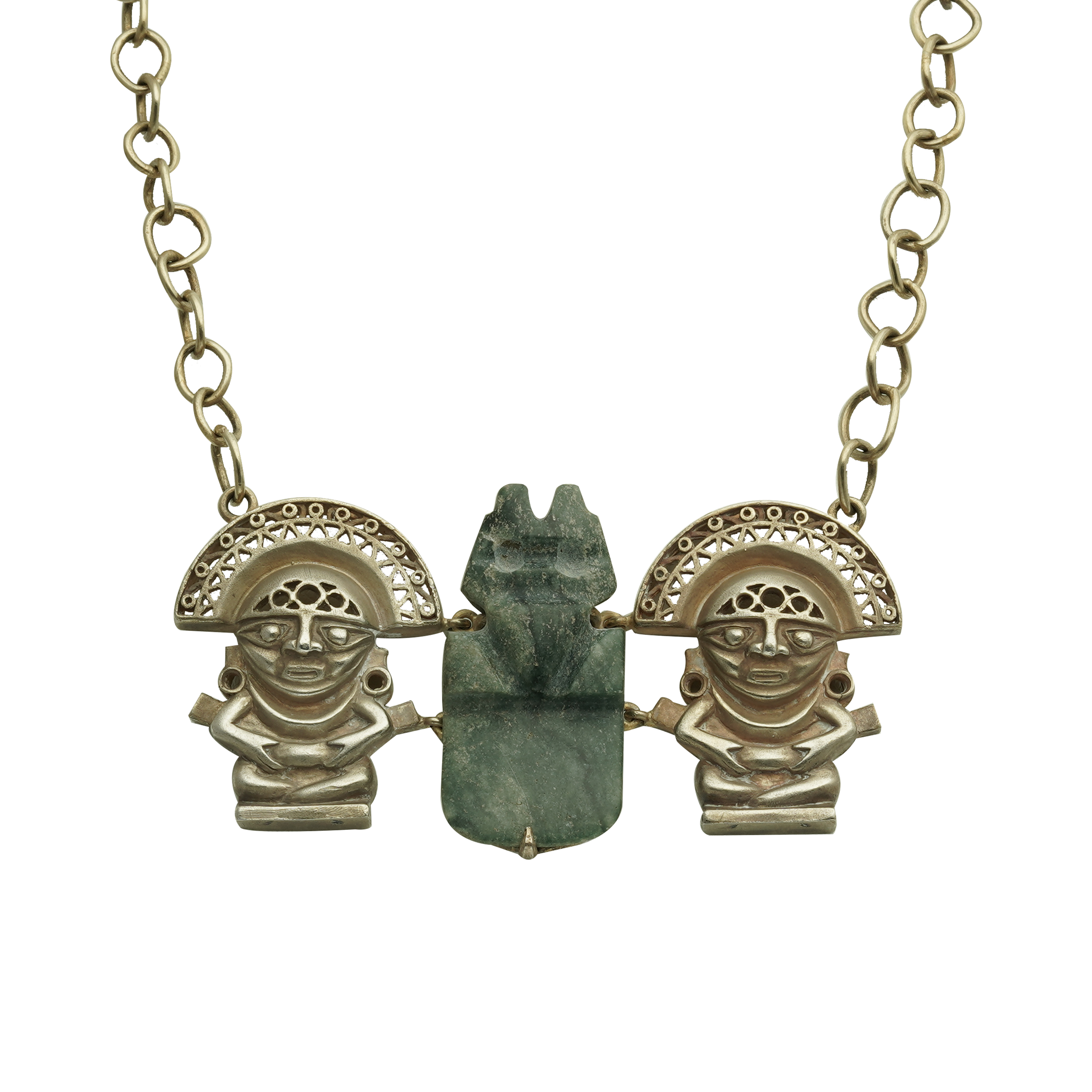
Maya Necklace with Seated Figures and Central Jade Pendant
Culture: Maya Civilization
Date: c. 600–900 CE (Late Classic Period)
Materials: Carved jadeite, metal (gilded metal), metal chain
Dimensions: Central pendant height approx. 6 cm; total width with figures approx. 10–12 cm
Ceremonial necklace featuring a central jadeite carving flanked by two cast metal anthropomorphic figures. The jade element, carved from deep green stone, depicts a stylized form possibly representing an animal-headed or deity-like figure. It is polished smooth with minimal incised detail, emphasizing the natural beauty of the jade.
On each side, finely crafted metal figures are shown seated cross-legged, holding an object across their chests. They wear large semicircular headdresses with openwork and geometric patterns, suggesting elite status or ceremonial roles. The figures are symmetrically placed and joined to the jade pendant by small connecting mounts, with the entire assembly suspended from a simple oval-link chain.
Provenance:
Likely from the southern Maya lowlands, in present-day Guatemala or southern Mexico.
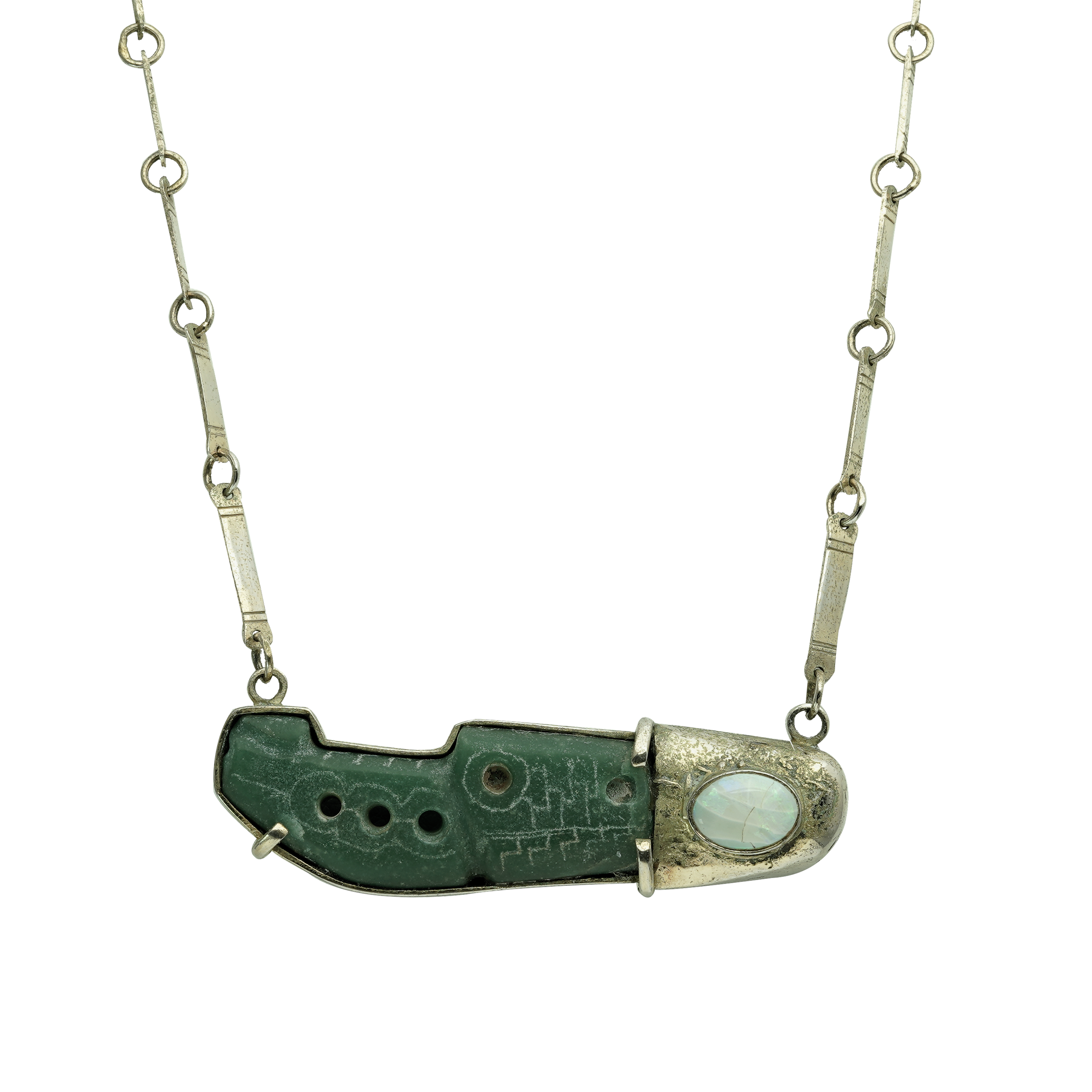
Maya Necklace with Jade Zoomorphic Pendant and Opal Inlay
Culture: Maya Civilization
Date: c. 600–900 CE (Late Classic Period)
Materials: Carved jadeite, opal inlay, metal (gilded metal)
Dimensions: Pendant length approx. 7–8 cm; chain length variable
Necklace featuring a pendant carved from jadeite in an elongated zoomorphic form, possibly representing a crocodile, lizard, or serpent—animals with deep symbolic meaning in Maya cosmology. The jade surface is pierced with three circular holes and decorated with incised stepped and linear patterns that may suggest scales or ritual markings.
One end of the pendant is enclosed in a textured metal fitting set with an oval cabochon opal. The opal’s shifting iridescence contrasts strikingly with the rich green of the jade, creating a visual focal point. The pendant is suspended from a chain composed of alternating round and elongated bar links, enhancing the necklace’s refined and balanced design.
Provenance:
Likely from the Maya lowlands, in present-day Guatemala, Belize, or southern Mexico.
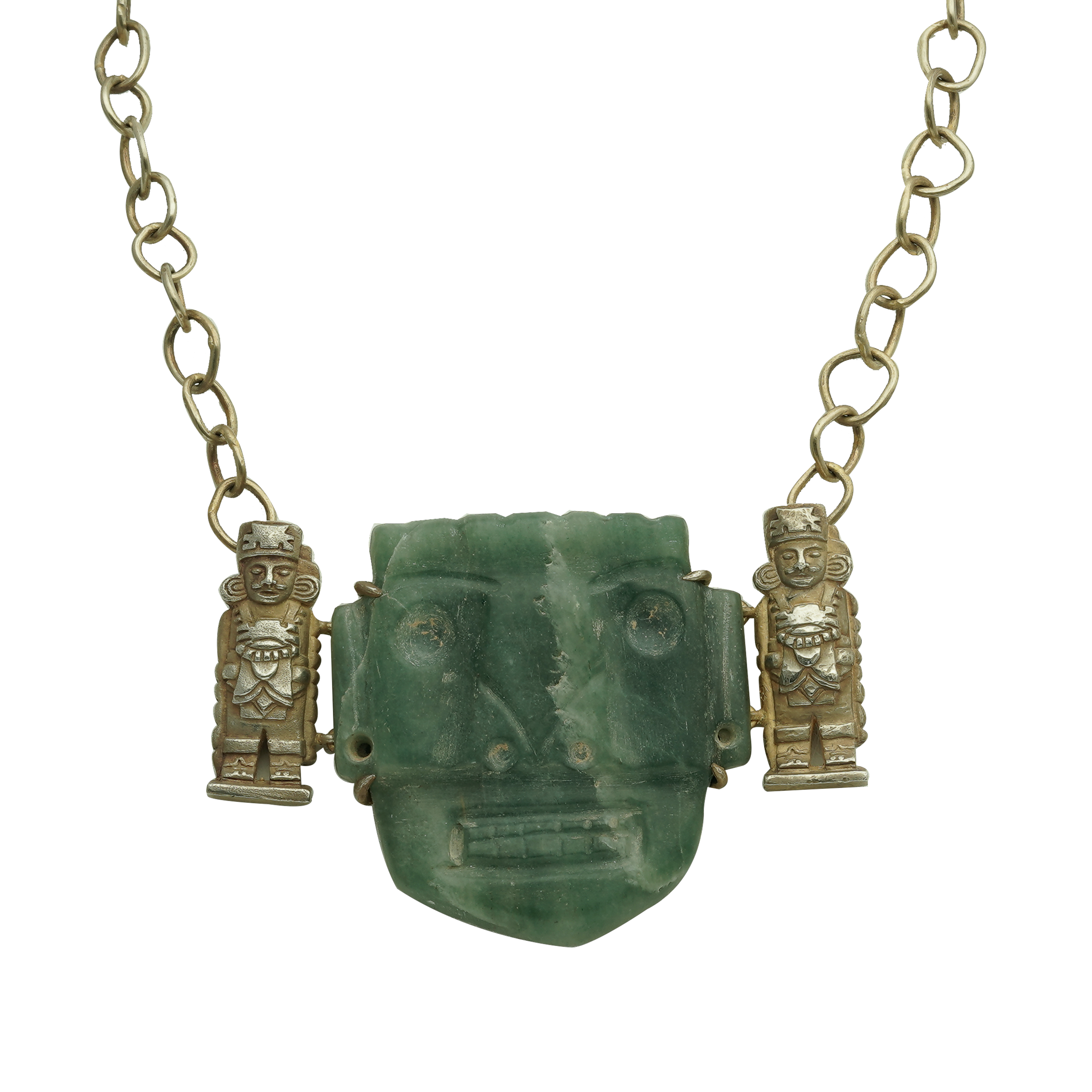
Maya Necklace with Jade Mask and Anthropomorphic Figures
Culture: Maya Civilization
Date: c. 600–900 CE (Late Classic Period)
Materials: Carved jadeite, metal (gilded metal), metal chain
Dimensions: Pendant approx. 6 cm x 9 cm width chain length variable
Necklace showing a central jadeite mask carved in a stylized human form, with geometric facial features, drilled eyes, and incised mouth. The carving exhibits the green hue and subtle mottling characteristic of jadeite valued in Maya culture. The mask is mounted in a simple metal frame and flanked by two cast metal anthropomorphic figures in full ceremonial attire. Each figure wears a headdress, earspools, and layered garments, with one hand resting on the chest in a gesture of authority.
The figures are attached directly to the central mask, forming a symmetrical pendant suspended from a simple oval-link chain. The juxtaposition of jade carving and detailed metal work demonstrates both the lapidary skill and the metallurgical craftsmanship of the piece.
Provenance:
Likely from the Maya lowlands, present-day Guatemala, Belize, or southern Mexico.
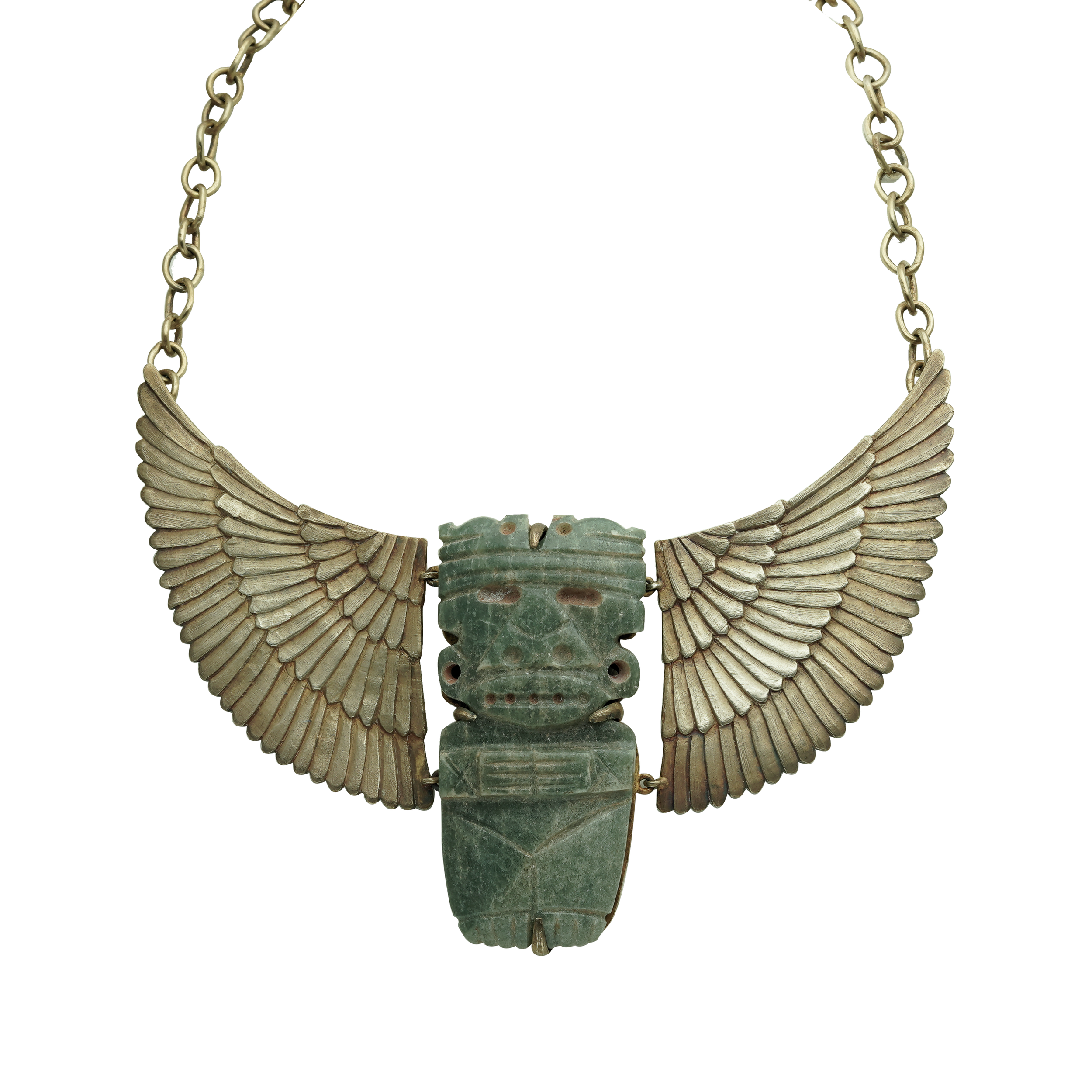
Maya Necklace with Winged Jade Pendant
Culture: Maya Civilization
Date: c. 600–900 CE (Late Classic Period)
Materials: Carved jadeite, metal (gilded metal), metal chain
Dimensions: Pendant height approx. 10–12 cm; wingspan approx. 16-20 cm
Ceremonial necklace featuring a central carved jadeite pendant depicting a stylized human or deity figure. The face is rendered with drilled eyes, a squared jawline, and incised details suggesting a headdress or cranial adornment. The body below is simplified into geometric sections, a hallmark of Classic Maya lapidary style.
Flanking the central jade carving are two finely cast metal wings, each composed of layered feather motifs with subtle texturing, extending outward to form a dramatic, symmetrical composition. The wings are attached to a sturdy metal chain, indicating the piece was intended to be worn prominently across the chest.
Provenance:
Likely from the Maya lowlands, in present-day Guatemala or southern Mexico.
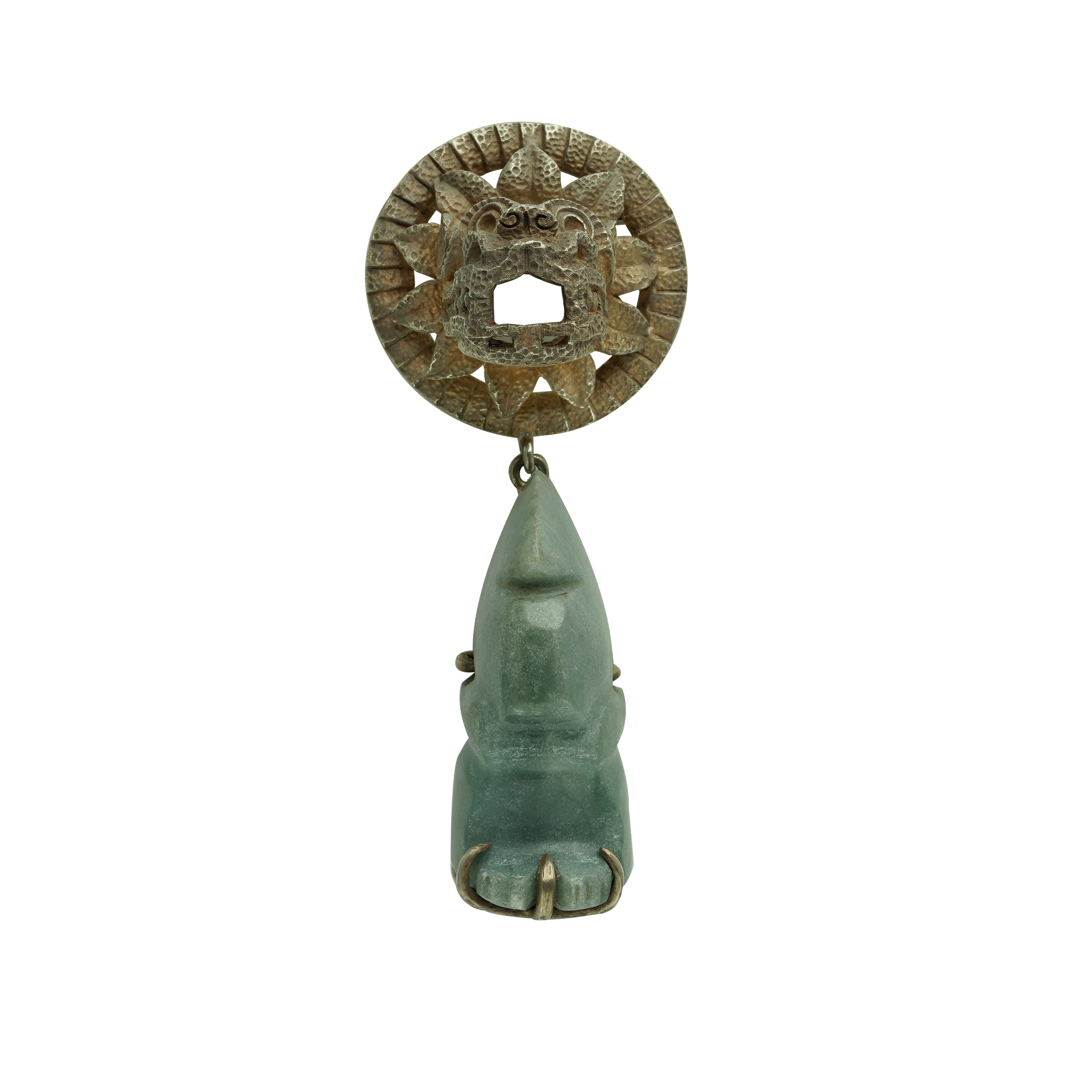
Maya Pendant with Jade Carving and Dragon/Serpent Head Mount
Culture: Maya Civilization
Date: c. 600–900 CE (Late Classic Period)
Materials: Carved jadeite, metal (gilded)
Dimensions: Approx. 9x4 cms
Pendant featuring a carved jadeite element suspended from an intricately cast metal mount in the form of a stylized dragon or serpent head. The jade carving, pierced laterally for suspension, is abstract in form, suggesting a profile or glyphic representation. The surface exhibits a smooth polish with areas of natural mottling in the green stone, typical of Maya jadeite.
The metal mount is highly detailed, with a fierce open-jawed expression, spiral eye, and textured scales or feathers, possibly representing the Feathered Serpent deity (Kukulkan in Maya, Quetzalcoatl in Central Mexican tradition). The combination of jade and the serpent imagery strongly links this pendant to elite ceremonial contexts.
Provenance:
Likely from the Maya lowlands, possibly Guatemala or southern Mexico.
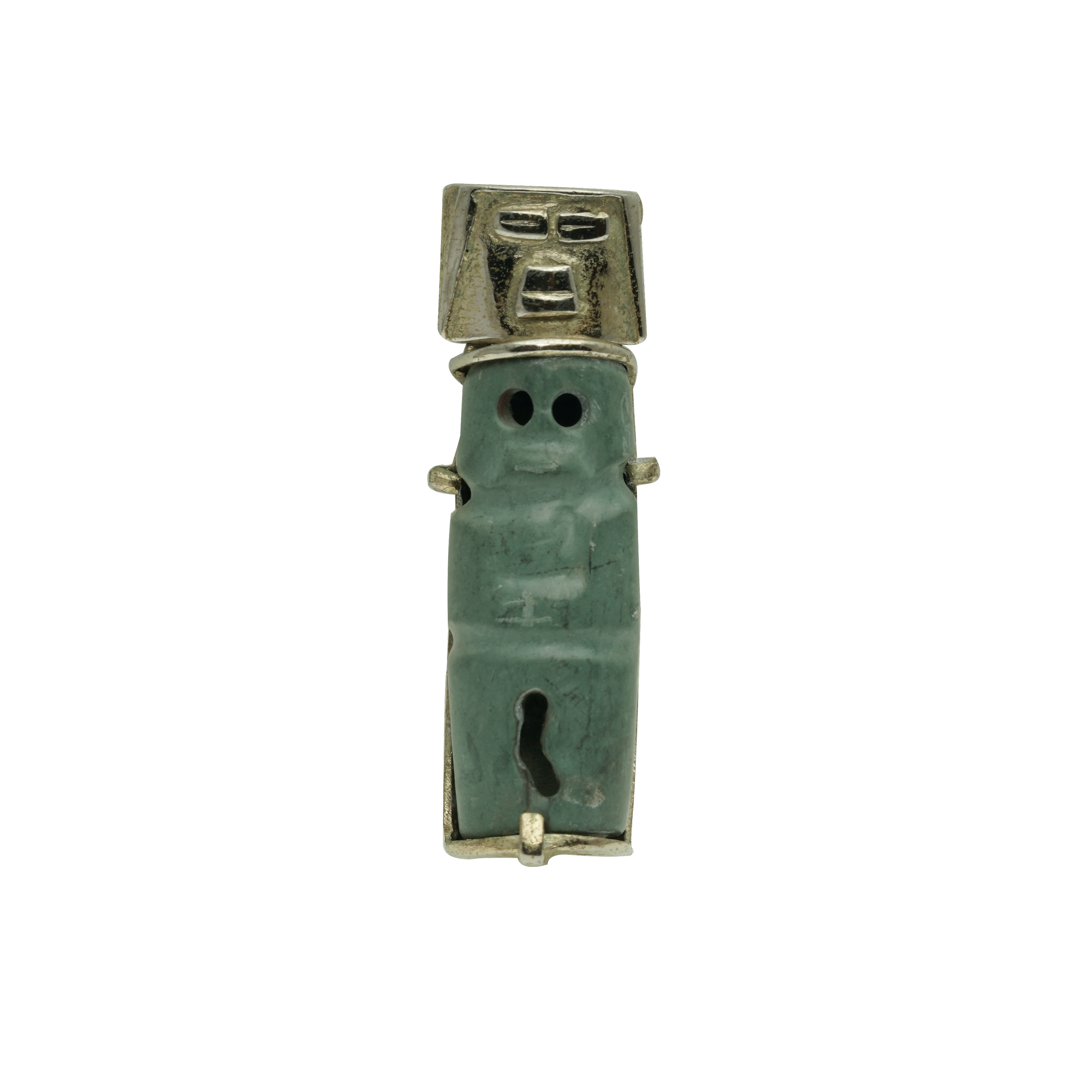
Maya Pendant with Carved Jade Figure and Metal Headdress
Culture: Maya Civilization
Date: c. 600–900 CE (Late Classic Period)
Materials: Carved jadeite, metal (gilded metal)
Dimensions: Approx. 6.5x2 cms
Pendant featuring a small, stylized jadeite carving of a human figure, set within a simple metal frame. The jade figure is rendered in an abstract form with drilled circular eyes and an elongated body, the surface marked with subtle carved details suggesting arms and clothing. A vertical slot-shaped perforation near the lower section may have served as part of its original suspension system or as symbolic detailing.
At the top, a metal element depicts a schematic face in a block-like form, possibly representing a mask or headdress. The contrast between the deep green jade and the metallic fitting enhances the pendant’s ceremonial appearance.
Provenance:
Likely originating from the Maya lowlands, present-day Guatemala, Belize, or southern Mexico.
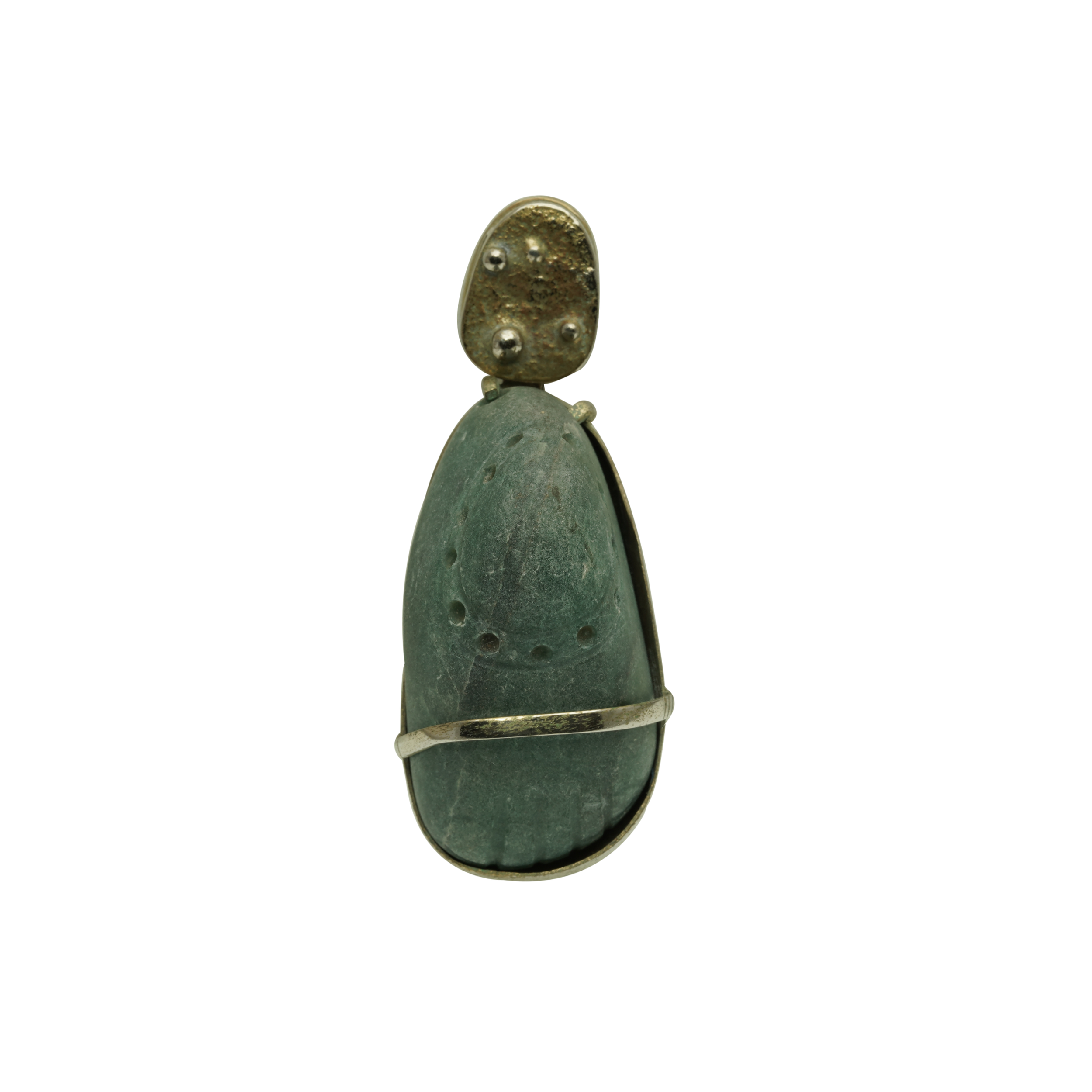
Maya Pendant with Carved Jade Head and Metal Fitting
Culture: Maya Civilization
Date: c. 600–900 CE (Late Classic Period)
Materials: Carved jadeite, metal (gilded metal)
Dimensions: Approx. 10x4 cms
Pendant consisting of a smoothly carved jadeite head form, secured within a simple metal mount. The jade carving is oval in shape with subtle facial detailing, including drilled depressions that outline the eyes and mouth, a minimalist yet characteristic feature of Maya lapidary work. The natural green tones of the jade exhibit slight mottling, adding depth to its surface.
At the top, a small metal fitting is attached, decorated with raised circular studs, possibly representing symbolic ornaments or celestial elements. The overall simplicity of the mounting serves to highlight the jade carving as the focal point of the piece.
Provenance:
Probably from the Maya lowlands, in present-day Guatemala, Belize, or southern Mexico.
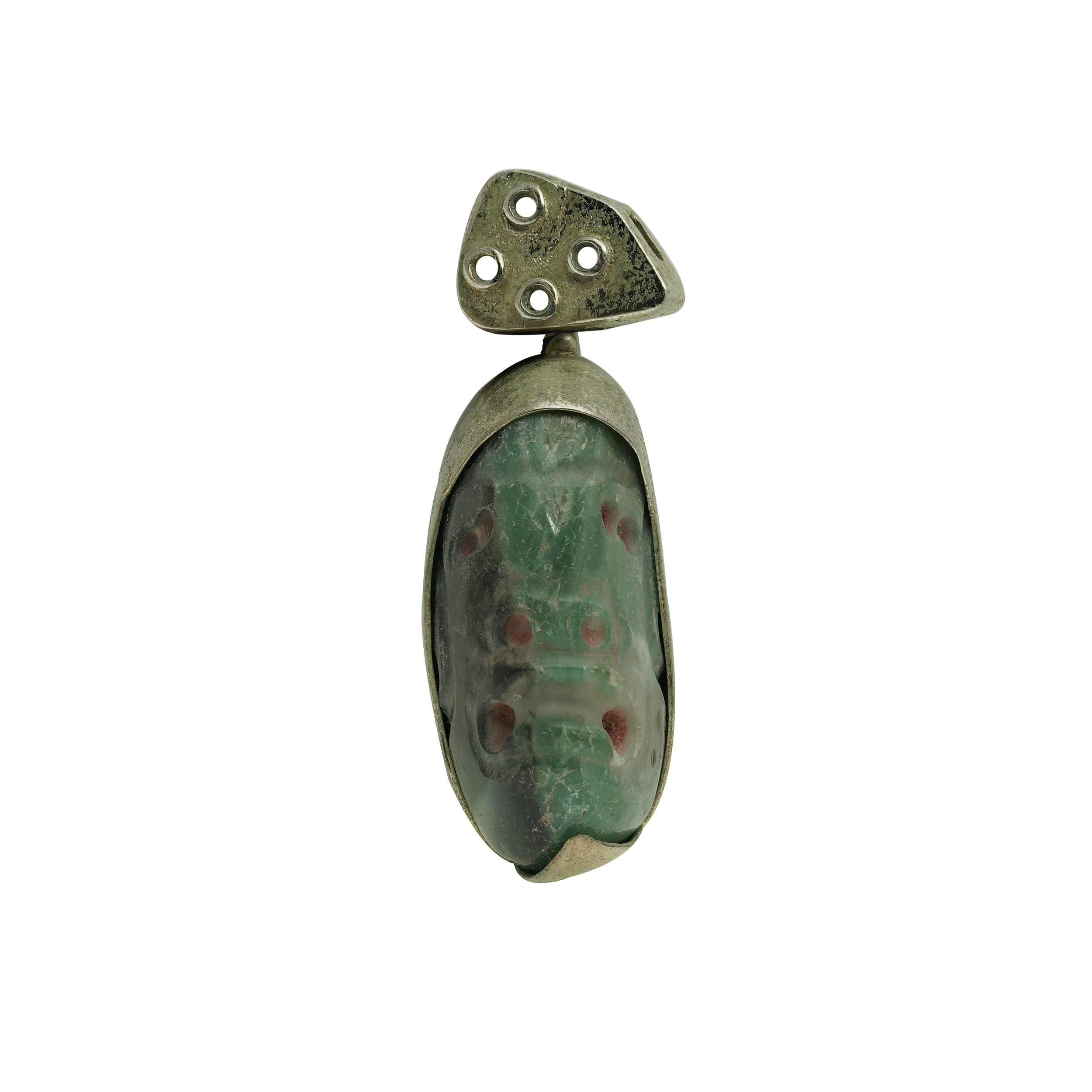
Maya Pendant with Carved Jade Head and Metal Fitting
Culture: Maya Civilization
Date: c. 600–900 CE (Late Classic Period)
Materials: Carved jadeite, metal (gilded metal)
Dimensions: Approx. 10x4 cms
Pendant consisting of a smoothly carved jadeite head form, secured within a simple metal mount. The jade carving is oval in shape with subtle facial detailing, including drilled depressions that outline the eyes and mouth, a minimalist yet characteristic feature of Maya lapidary work. The natural green tones of the jade exhibit slight mottling, adding depth to its surface.
At the top, a small metal fitting is attached, decorated with raised circular studs, possibly representing symbolic ornaments or celestial elements. The overall simplicity of the mounting serves to highlight the jade carving as the focal point of the piece.
Provenance:
Probably from the Maya lowlands, in present-day Guatemala, Belize, or southern Mexico.

Maya Pendant with Carved Jade Figure and Glyph Ornament
Culture: Maya Civilization
Date: c. 600–900 CE (Late Classic Period)
Materials: Carved jadeite, metal (gilded metal)
Dimensions: Approx. 10.0x4 cms
Pendant featuring an elongated jadeite carving of a stylized human figure, set in a simple metal frame. The figure displays a prominent face with deeply incised features, a squared torso, and faintly carved details on the body, possibly representing clothing or glyphic symbols. The surface shows signs of age and wear, indicating both use and antiquity.
At the top of the pendant, a separate metal fitting depicts a small glyph-like ornament with triangular and stepped motifs, possibly referencing mountains, temples, or symbolic elements from Maya writing. The form and iconography suggest a blend of portraiture and hieroglyphic art, a hallmark of elite Maya adornment.
Provenance:
Likely from the Maya lowlands, in present-day Guatemala, Belize, or southern Mexico.
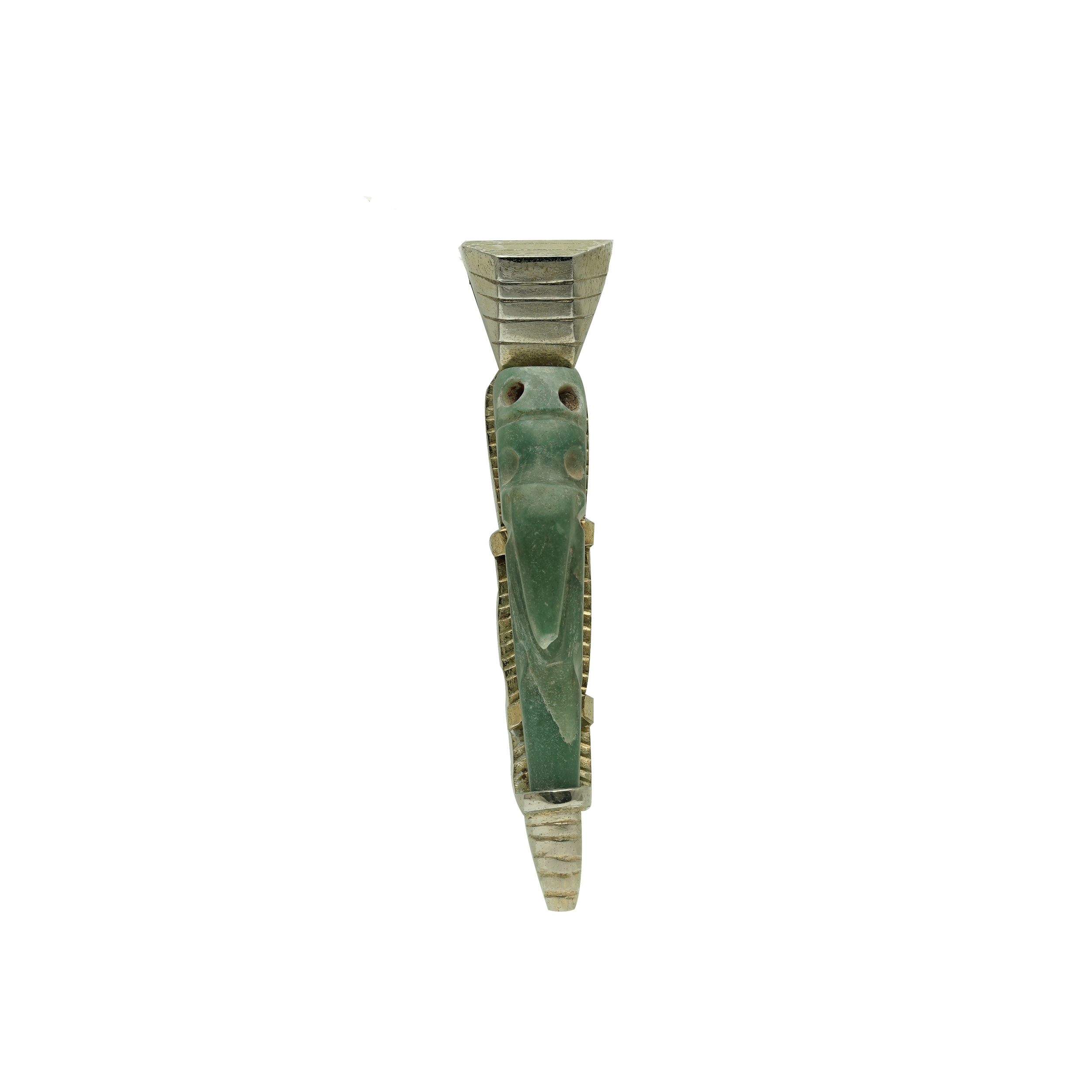
Maya Pendant with Carved Jade Avian Figure
Culture: Maya Civilization
Date: c. 600–900 CE (Late Classic Period)
Materials: Carved jadeite, metal (gilded metal)
Dimensions: Approx. 12x3 cm
Pendant showing a slender, elongated jadeite carving in the form of a stylized bird, likely a parrot or falcon, both important symbols in Maya iconography. The figure is defined by a streamlined body, incised wings, and drilled eyes, all rendered with a minimalist elegance typical of Late Classic lapidary art.
The jade carving is secured in a metal mount that follows the contours of the figure, with a textured edging suggesting feathers or scales. At the top, the suspension element takes the form of a stepped pyramid motif, reinforcing the pendant’s connection to Maya architecture and ceremonial symbolism.
Function:
Bird imagery in Maya art often symbolized the sky, divine messengers, and rulers’ ability to communicate with the supernatural realm. Such a pendant would have been worn as a marker of high status and spiritual authority, possibly during rituals associated with the heavens or celestial deities.
Provenance:
Likely from the southern Maya lowlands, in present-day Guatemala or Chiapas, Mexico.
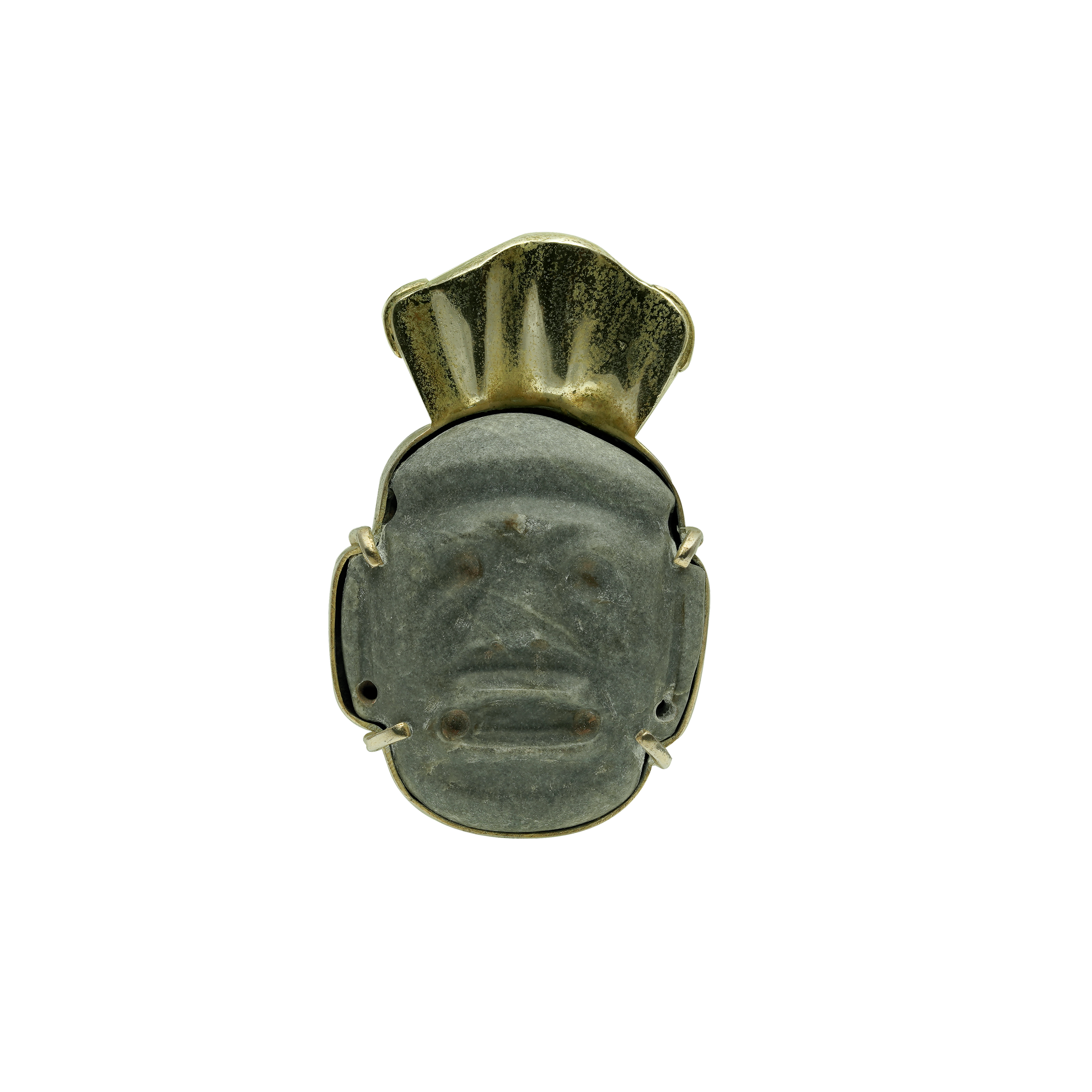
Maya Pendant with Jade Face and Metal Headdress
Culture: Maya Civilization
Date: c. 600–900 CE (Late Classic Period)
Materials: Carved jadeite, metal (Gilded metal)
Dimensions: Approx. 10.5x6.0 cm
Pendant featuring a carved jadeite face, framed in a simple metal mount and topped with a stylized metal headdress. The facial carving is minimalist yet expressive, with deeply set eyes, a broad nose, and prominent lips, characteristic of Maya jade portraiture. Small perforations in the jade suggest it may once have been part of a larger ornament or mask before being set as a pendant.
The headdress element, rendered in metal, likely represents a stylized feathered or cloth adornment, a common indicator of high status in Maya culture. Its placement above the jade face reinforces the imagery of rulership and ceremonial dress.
Provenance:
Likely originating from the Maya lowlands, in present-day Guatemala, Mexico, or Belize.
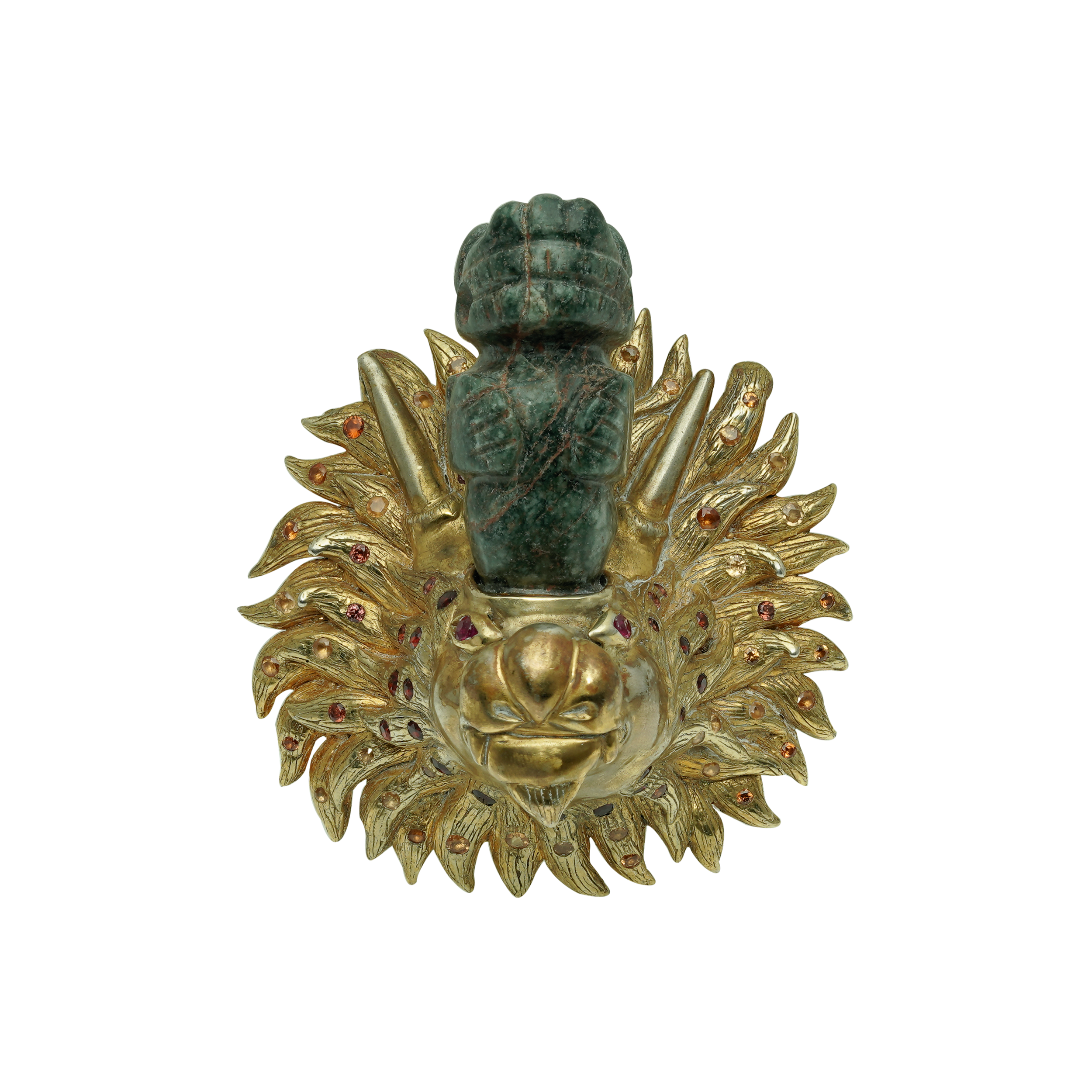
Object Title: Maya Pendant with Jade Figurine and Gilded Zoomorphic Head
Culture: Maya Civilization
Date: c. 600–900 CE (Late Classic Period)
Materials: Carved jadeite, gilded metal, inset red gemstones (likely garnet or spinel)
Dimensions: Approx. 8.5×6.0cm
Pendant combining a carved jadeite figure with an ornate gilded metal fitting in the form of a animal head, possibly representing a jaguar— powerful symbol in Maya art. The jade figure, rendered in a upright posture, is perforated for suspension and likely depicts a deity or spirit being.
The gold-colored metal mount is richly detailed, with deeply incised feather or mane textures and set with numerous small red gemstones, giving the piece a striking and luxurious appearance. The eye is accented with a larger stone, lending a lifelike intensity to the zoomorphic head.
Provenance:
Likely from the Maya lowlands, present-day Guatemala or southern Mexico.
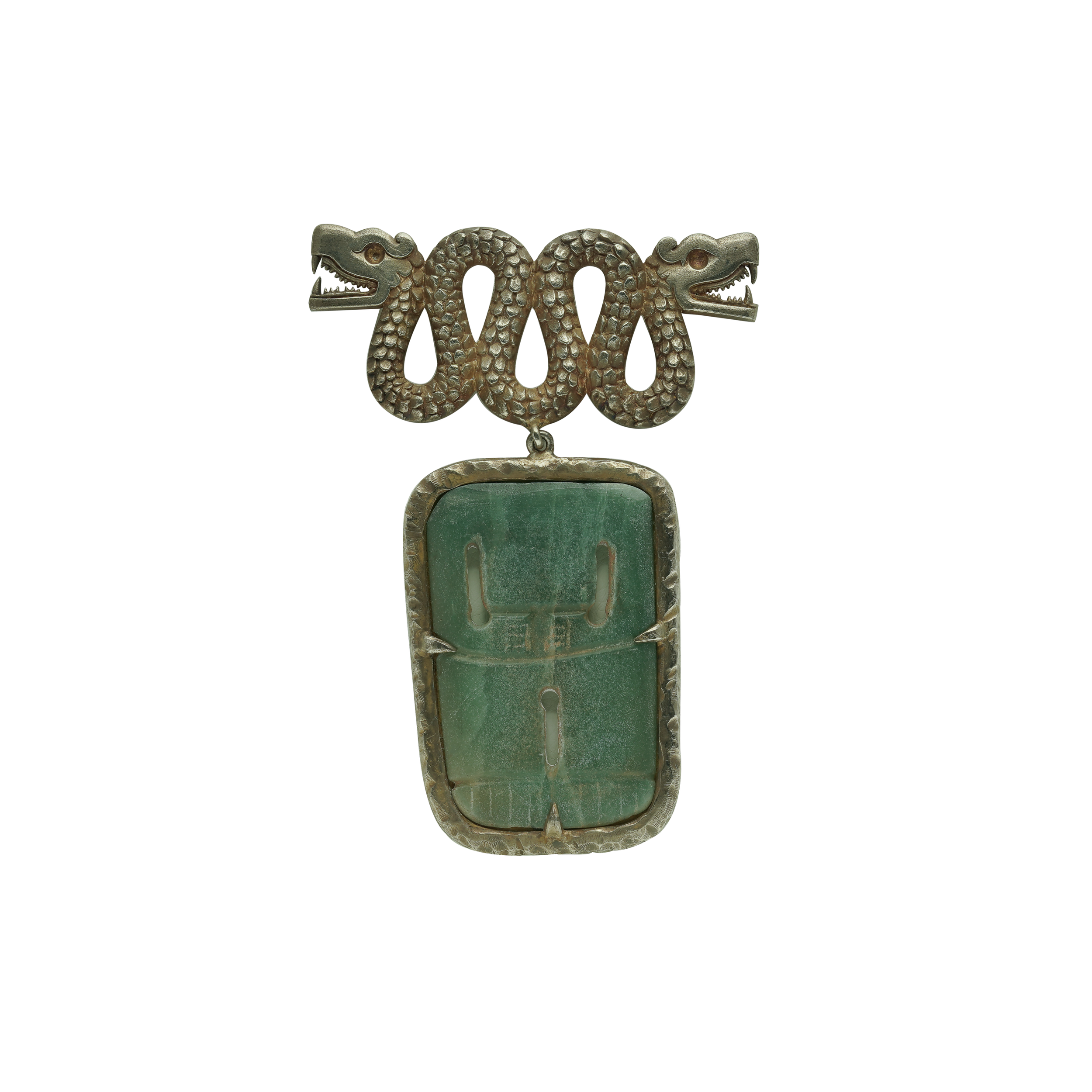
Maya Pendant with Double-Headed Serpent and Jade Plaque
Culture: Maya Civilization
Date: c. 600–900 CE (Late Classic Period)
Materials: Jade, metal (golden plated brass)
Dimensions: 11.0×8.0
Pendant featuring a rectangular carved jadeite plaque set in a metal frame and topped by a double-headed serpent. The serpent is shown in a looping pattern with open jaws, a common Maya symbol of power, transformation, and connection to the spirit world.
The jade plaque is carved with abstract facial or glyph-like features. Its deep green color was highly prized by the Maya, representing life, fertility, and divine authority. The combination of jade and metal indicates that this was an object for someone of high rank, such as a ruler or priest.
Provenance:
Probably from the southern Maya lowlands, in present-day Guatemala or Mexico.
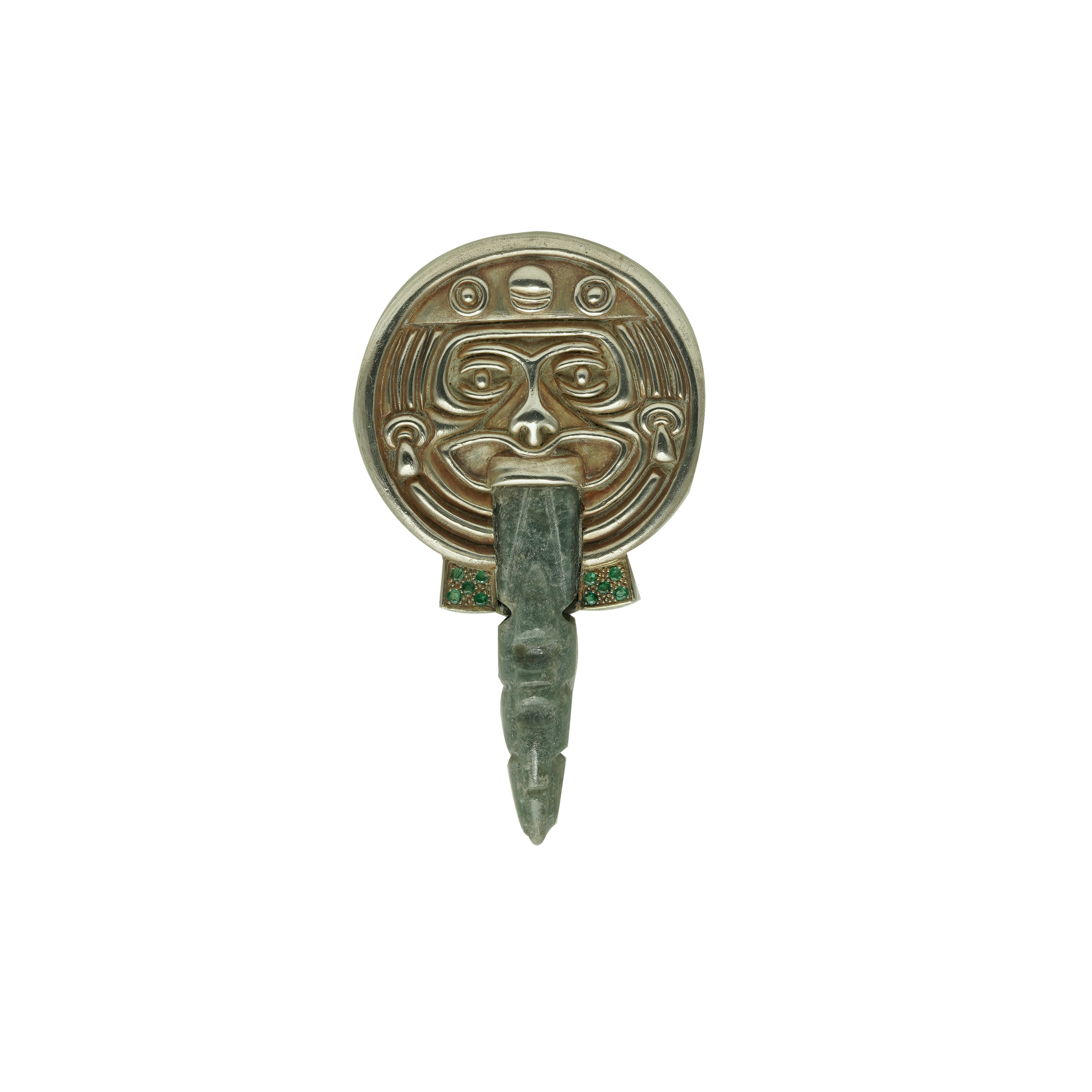
Culture: Maya
Date: c. 600–900 CE (Late Classic Period)
Material: Jadeite, Gold plated Brass, and greenstone inlays
Dimensions: approx. 8x4 cms
Carved pendant representing a stylized Mayan deity—likely a solar or celestial god—characterized by a circular face with prominent features, including deeply incised eyes, a broad nose, and pronounced cheek elements. The mouth appears open, extending downward into a jadeite tongue, which doubles as a symbolic blade or scepter. The tongue itself is carved in the likeness of a human face, suggesting themes of speech, sacrifice, or transformation.
The round disk may symbolize the sun or moon, aligning with Maya cosmological themes, while the elaborate inlays of greenstone (perhaps jade or turquoise) near the base reinforce the object's ritual significance and the elite status of its wearer. Jade, considered sacred by the Maya, was associated with life force, breath, and rulership.
Provenance:
Unknown; likely from the Petén region or southern lowlands of present-day Guatemala or Mexico.
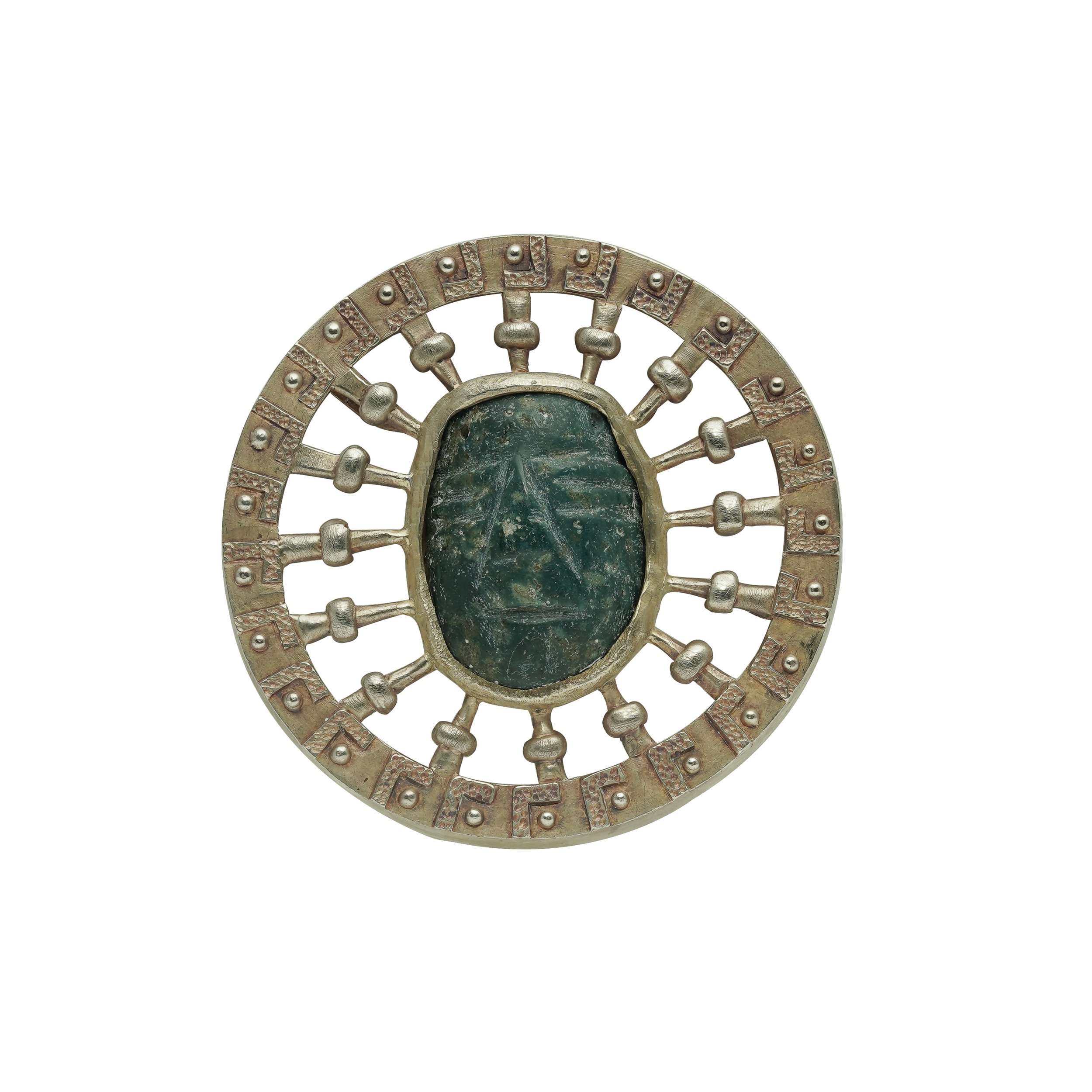
Culture: Maya Civilization
Date: c. 600–900 CE (Late Classic Period)
Materials: Jade, Gold plated brass
Dimensions: 7.5×7.5cms
Carved jadeite maskette depicting a stylized human face with abstracted geometric features, a hallmark of Late Classic Maya lapidary work. The green hue of the jadeite—valued by the Maya as a symbol of life force, fertility, and divine authority—provides a striking contrast to its encircling openwork frame of precious metal.
The radiating metal elements, evenly spaced around the perimeter, are composed of small rectangular segments adorned with raised patterns and connected to the central bezel by rod-like struts ending in spherical nodes. This radial arrangement may symbolize the sun’s rays, reinforcing associations with celestial power and rulership. The integration of jade and metal speaks to elite status, as both materials were restricted to high-ranking individuals within Maya society.
Provenance:
Origin uncertain; stylistically consistent with objects from the Maya lowlands (modern-day Guatemala, Mexico, Belize).
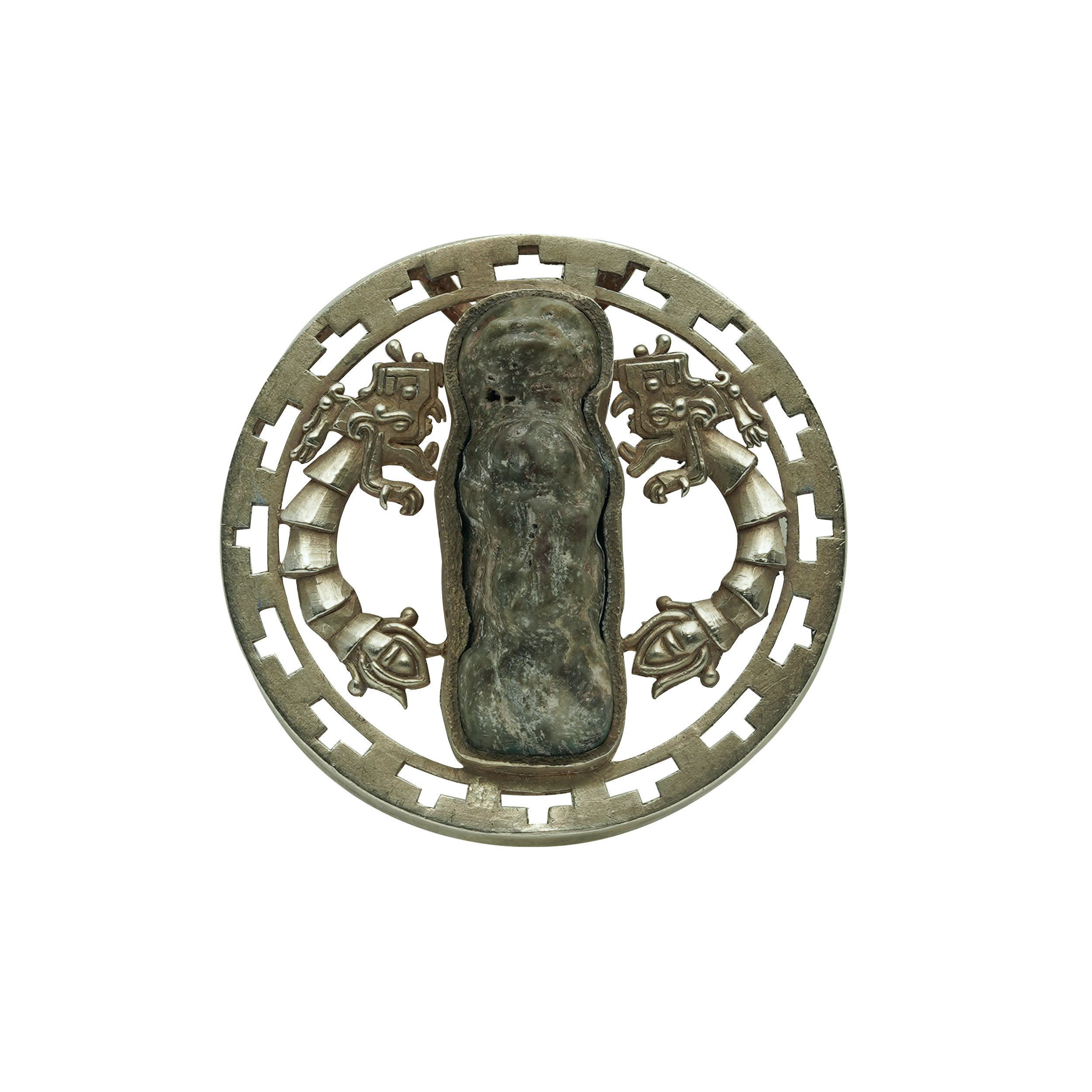
Mayan Pendant with Central Jade Figure and Dual Serpent Imagery
Culture: Maya
Period: Late Classic Period, c. 600–900 CE
Materials: Carved jadeite, cast or hammered metal (copper)
Dimensions: 5.5×5.5 cms
Mayan pendant featuring a central jadeite form, possibly representing a stylized human figure, deity, or sacred object. Flanking the figure are two mirror-opposed serpent forms, their bodies rendered with articulated joints and their heads adorned with geometric headdresses, evoking imagery of the Vision Serpent, a central figure in Maya mythology symbolizing divine communication and ritual bloodletting.
The circular border is decorated with a stepped-fret motif, referencing sacred Maya architectural forms and possibly the cosmic or calendrical order. The choice of jade—reserved for the elite and used in ceremonial contexts—alongside the high level of metal craftsmanship, suggests that this piece was likely worn by a high-ranking noble or priest.
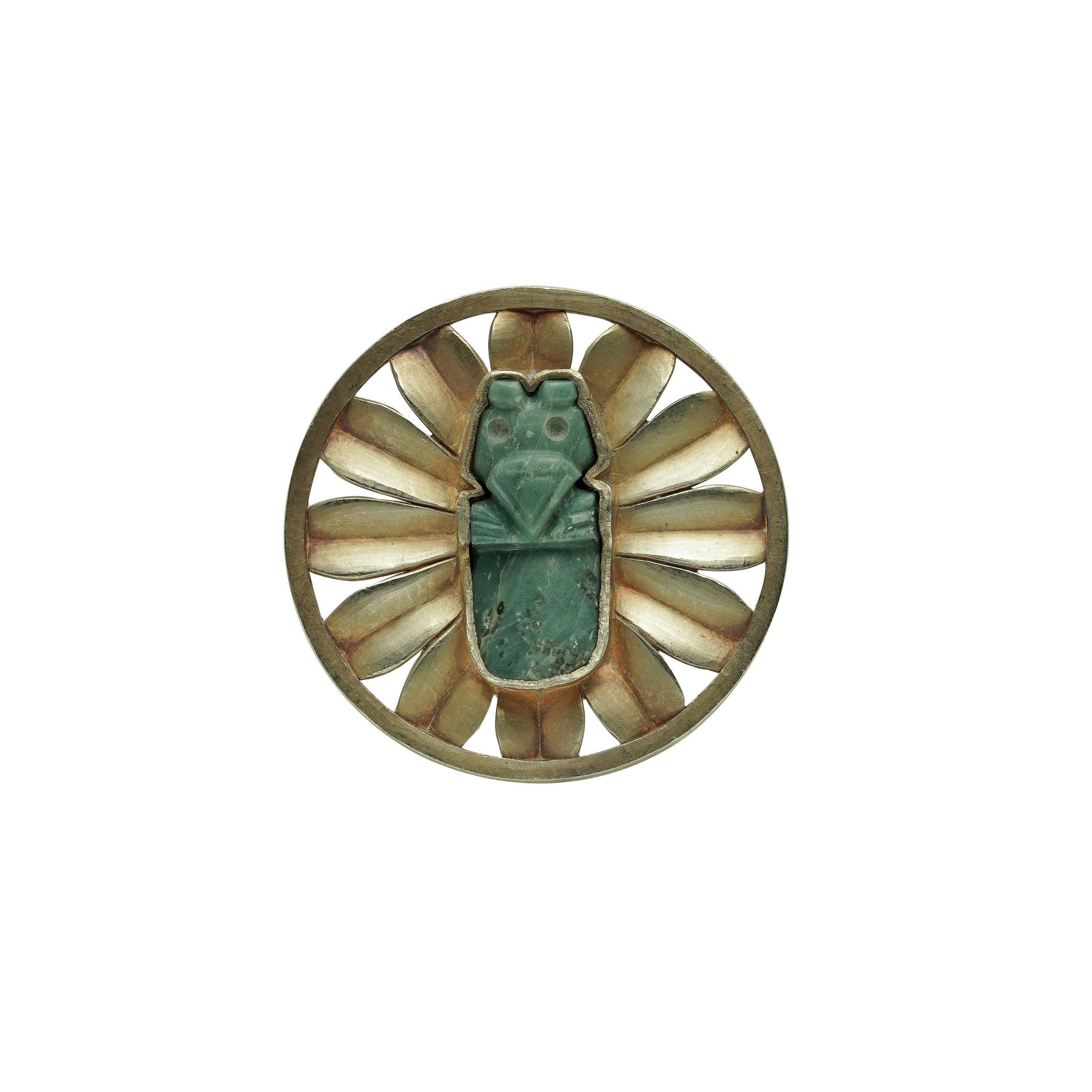
Mayan Pendant with Avian Motif and Radiant Frame
Culture: Maya
Date: c. 600–900 CE
Materials: Carved greenstone Jadeite, copper
Dimensions: 8.0×8.0 cms
Circular pendant showcasing a central carved greenstone figure, interpreted as a stylized bird— an owl or parrot—symbolizing wisdom, vision, or communication in Maya cosmology. The figure is framed by a circular motif resembling sun rays or feathers, crafted in metal to emphasize movement and sacred geometry. The integration of jade, a stone revered by the Maya for its life-giving and spiritual qualities, indicates that this piece likely served both ornamental and ceremonial functions. Its symmetrical design and expert craftsmanship reflect the sophisticated metallurgical and lapidary skills of the Classic Maya period.
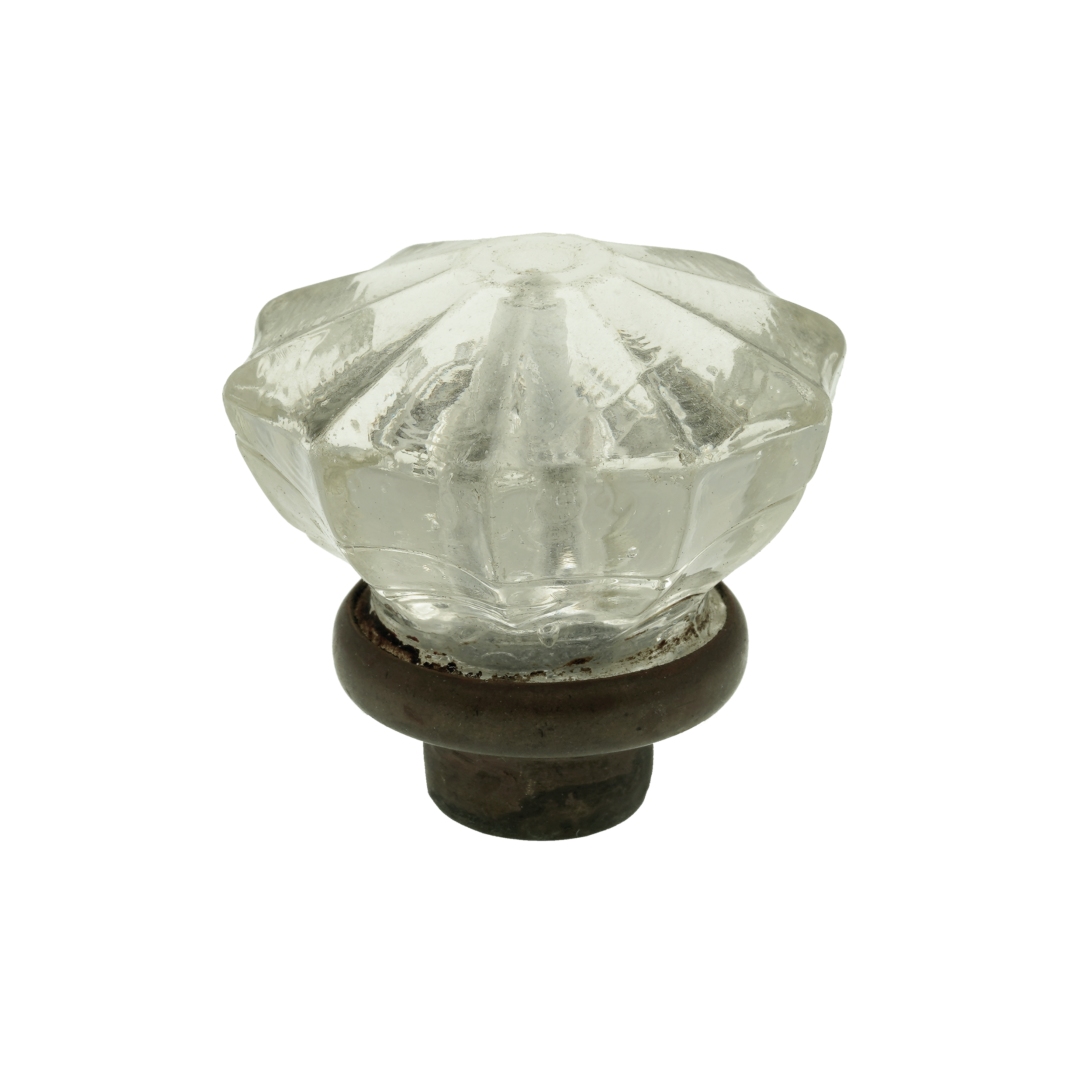
Opium Pipe Bowl – Glass
Dimensions: Appro 6 × 5 cm
Glass opium pipe bowl with a faceted, domed shape and central aperture. The clear glass body is set into a ceramic collar for attachment to the pipe stem. Likely late 19th to early 20th century, used for heating opium in traditional smoking practices.
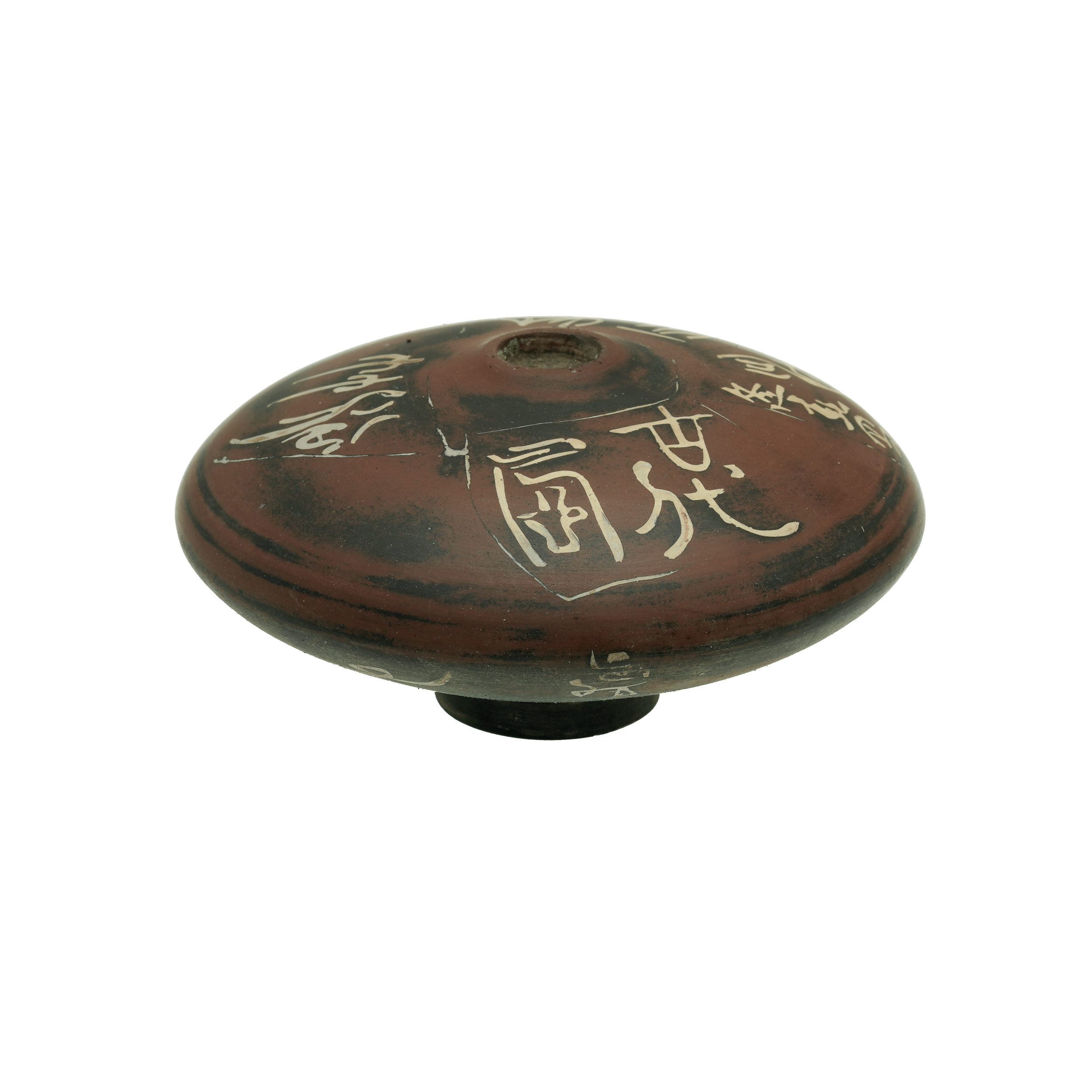
Opium Pipe Bowl – Ceramic
Dimensions: Appro 4 × 9 cm
Ceramic opium pipe bowl with a flattened, rounded form and central aperture. The surface is finished in a reddish-brown glaze and inscribed with Chinese characters in contrasting white slip. Likely late 19th to early 20th century, used for heating opium during traditional smoking rituals.
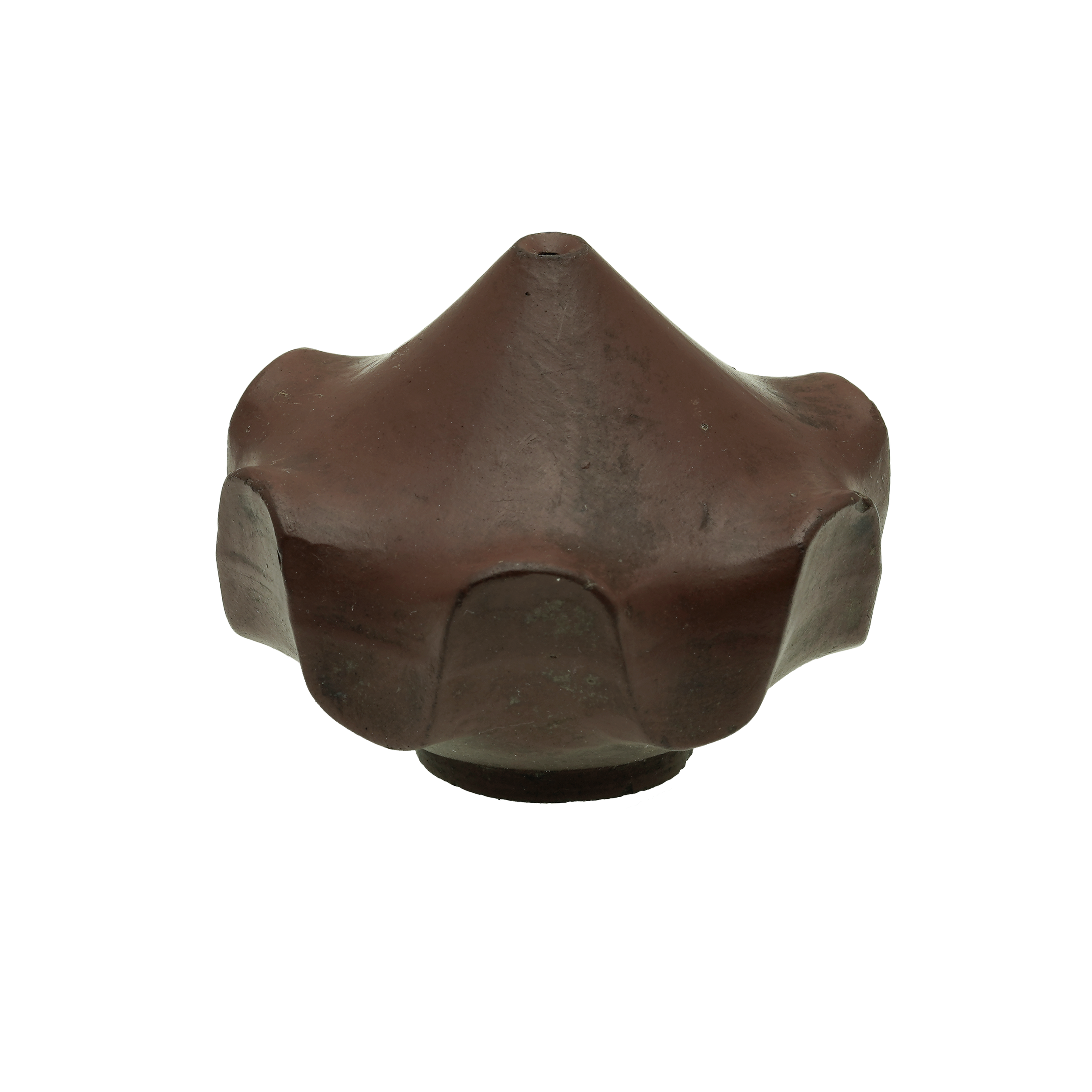
Opium Pipe Bowl – Ceramic
Dimensions: Appro 5 × 7 cm
Ceramic opium pipe bowl with a fluted, star-shaped body and a conical top featuring a central aperture. The reddish-brown glaze covers the entire surface, giving it a smooth, uniform finish. Likely late 19th to early 20th century, used for heating opium in traditional smoking practices.
Opium Pipe Bowl – Ceramic
Dimensions: Appro 6 × 7 cm
Domed ceramic opium pipe bowl with a central aperture. The upper section is glazed in black and encircled with a raised bead-and-wave relief pattern. Likely late 19th to early 20th century, used for heating opium in a pipe.
Opium Pipe Bowl – Ceramic
Dimensions: Appro 3 × 8 cm
Flat, disc-shaped ceramic opium pipe bowl with a small central aperture. The surface is decorated with hand-painted black bamboo motifs. Used for heating opium in a pipe. Likely late 19th to early 20th century.
Opium Pipe Bowl – Ceramic
Dimensions: Appro 4 × 7 cm
Black-glazed ceramic opium pipe bowl with a shallow domed form. Incised circular and geometric motifs decorate the sides. The central metal-lined aperture was used for heating opium. Likely late 19th to early 20th century.
Opium Pipe Bowl – Ceramic (Crab Motif)
Dimensions: Appro 7 × 8 cm
Ceramic opium pipe bowl modeled in the form of a crab, with a central metal-lined perforation for heating the opium. The sculptural detailing combines functional design with symbolic or decorative elements. Likely late 19th to early 20th century..
Opium Pipe Bowl – Porcelain
Dimensions: Appro 6 × 6 cm
Small hexagonal ceramic opium pipe bowl with a crackled glaze and faint blue decoration near the top. The burner has a central perforation and is mounted on a metal fitting for attachment to a pipe. Likely late 19th to early 20th century.
Opium Pipe Bowl – Ceramic
Dimensions: Appro 3 × 6 cm
Hexagonal ceramic opium pipe bowl decorated with black geometric and floral motifs, including a meander border around the top. The piece has a central perforation and a metal fitting underneath for attachment to a pipe. Likely late 19th to early 20th century.
Opium Pipe Bowl – Ceramic
Dimensions: Appro 6 × 6 cm
Opium pipe bowl with a crackle-glazed ceramic body, decorated with faint circular motifs around the sides and a subtle blue band near the top. Fitted with a metal base for attachment to the pipe. Likely late 19th to early 20th century.
Opium Pipe Bowl – Ceramic
Dimensions: Appro 5 × 6 cm
Opium pipe bowl with a smooth, rounded ceramic body in reddish-brown finish. Minimalist design without surface decoration. Fitted with a metal base for attachment to the pipe. Likely late 19th to early 20th century.
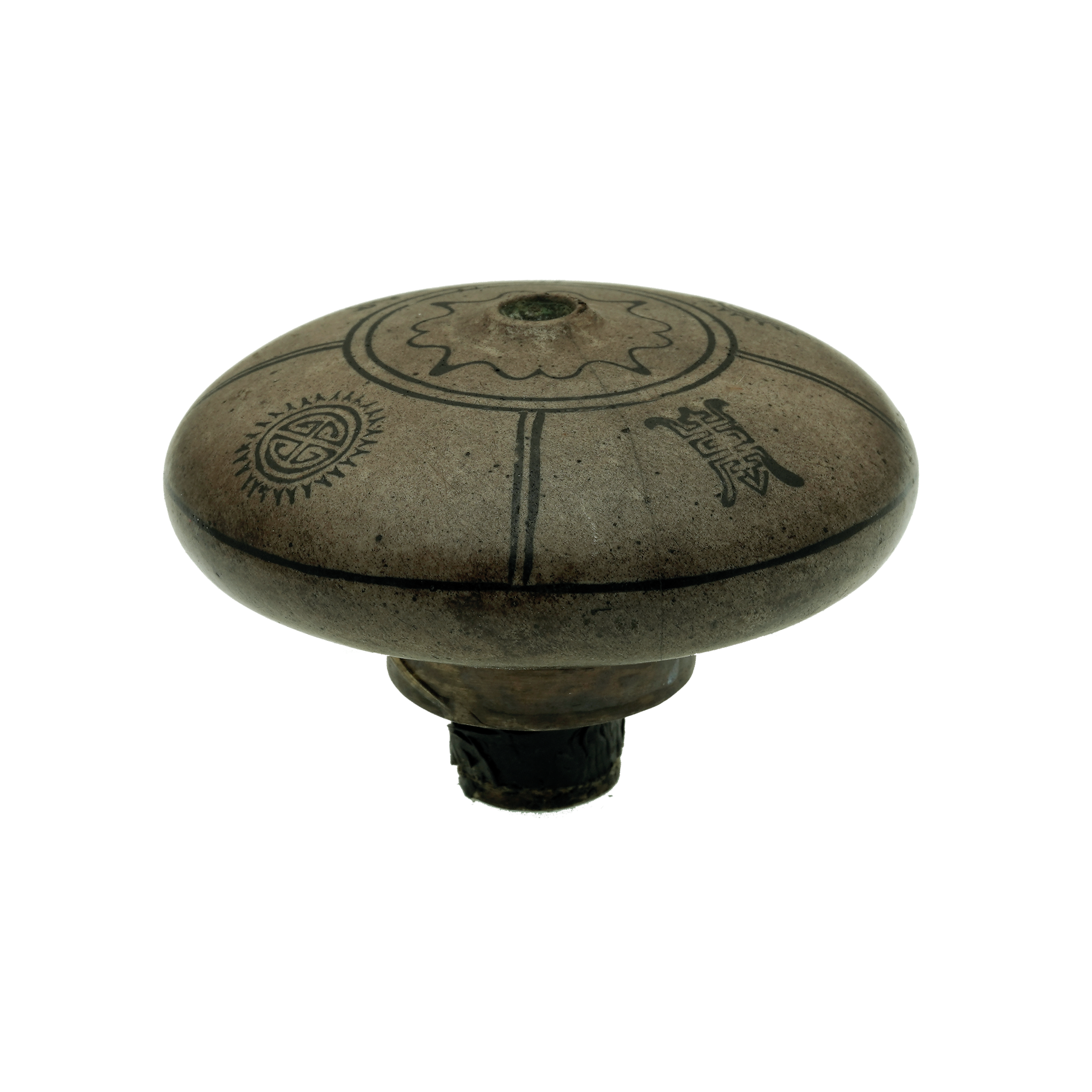
Opium Pipe Bowl – Ceramic
Dimensions: Appro 5 × 7 cm
Opium pipe bowl with a wide, flattened ceramic body decorated with black linear and symbolic motifs, including geometric and character designs. Fitted with a metal base for attachment to the pipe. Likely late 19th to early 20th century.
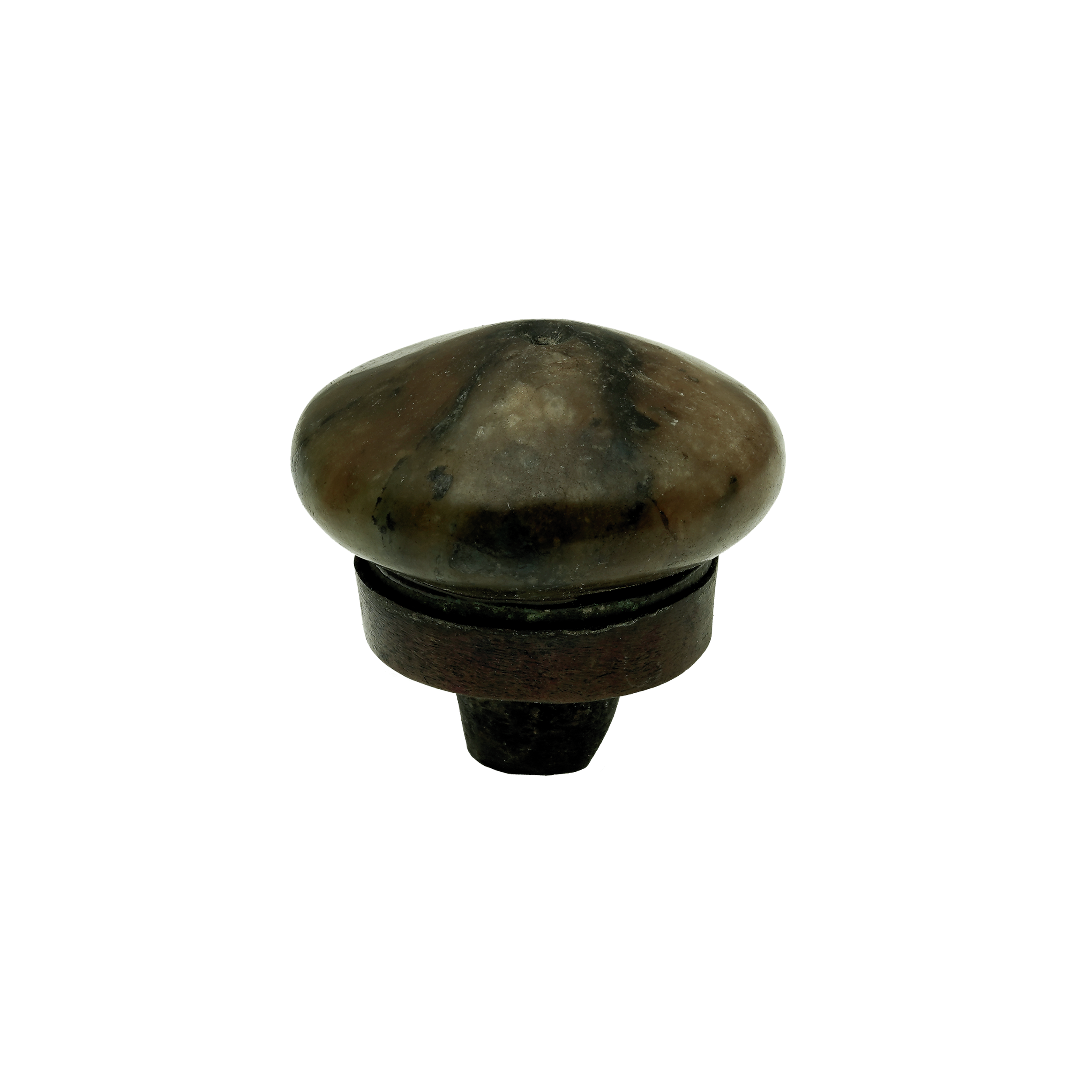
Opium Pipe Bowl – Wood
Dimensions: Appro 5 × 5 cm
Opium pipe bowl with a smooth, rounded wooden body, slightly domed at the top. Fitted with a metal base for attachment to the pipe. Likely late 19th to early 20th century.
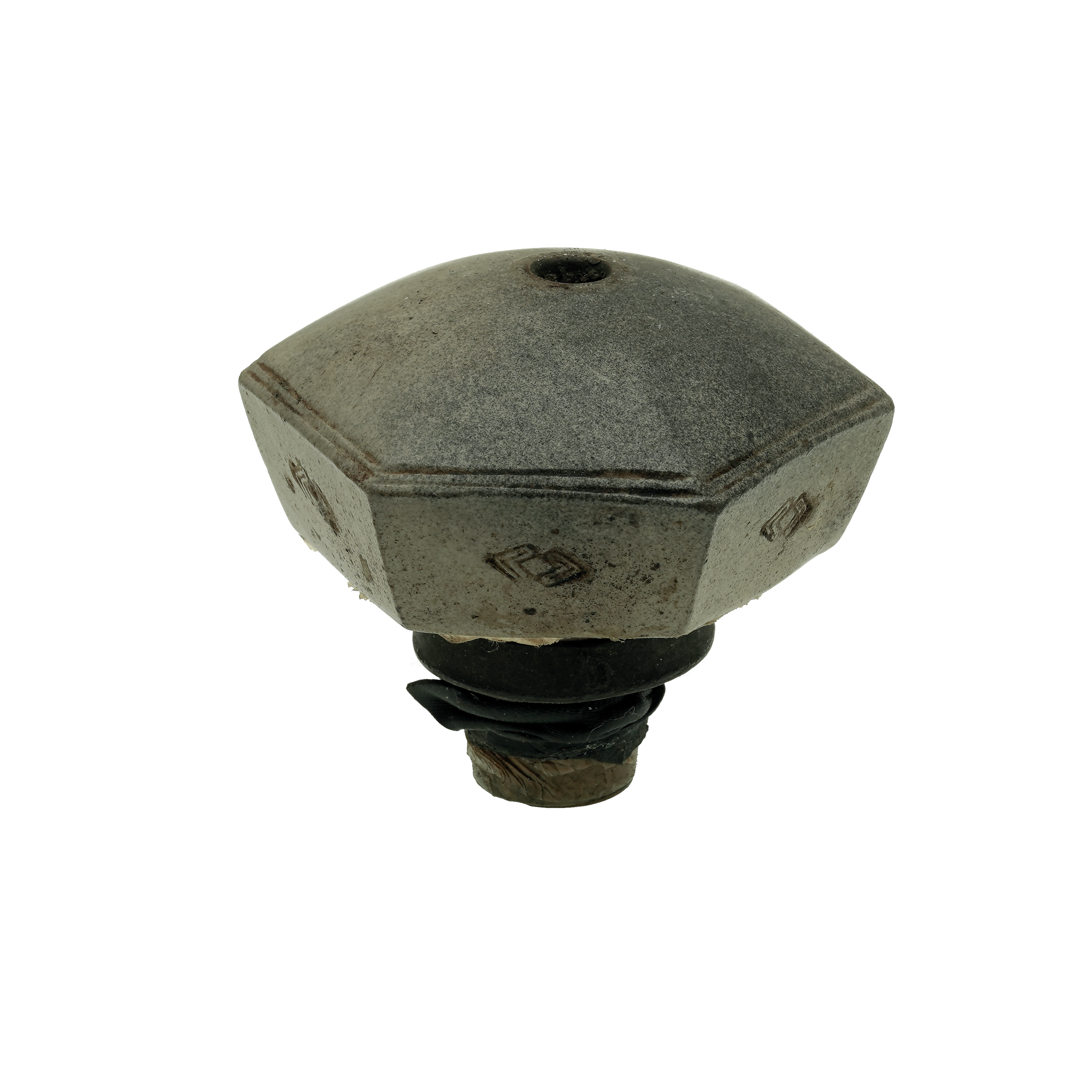
Opium Pipe Bowl – Ceramic
Dimensions: Appro 5 × 5 cm
Opium pipe bowl with a faceted, hexagonal ceramic body. Each facet is stamped with a small symbol, and the top has a central hole for heating opium. Likely late 19th to early 20th century.
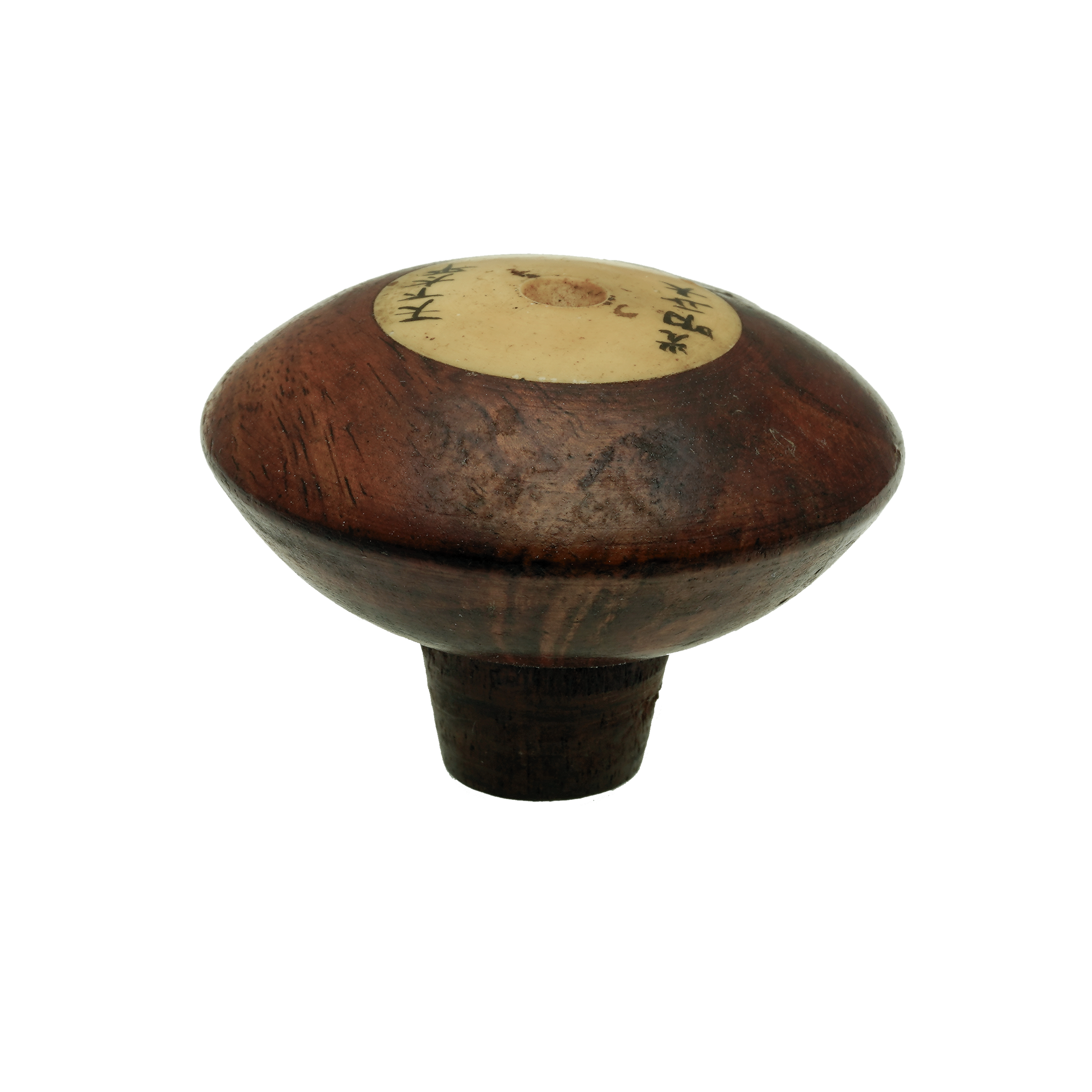
Opium Pipe Bowl – Wood and Ceramic
Dimensions: Appro 5 × 6 cm
Opium pipe bowl with a rounded wooden body and a cream-colored ceramic top. The ceramic surface features a central opening for heating opium and black painted characters around it. Likely late 19th to early 20th century.
Opium Pipe Bowl – Stamped Ceramic
Dimensions: Appro 5 × 6 cm
Square ceramic opium pipe bowl with slightly rounded edges and a central opening for heating opium. Each face is decorated with a grid of stamped geometric motifs. Mounted on a metal fitting. Likely late 19th to early 20th century.
Opium Pipe Bowl – Ceramic with Script
Dimensions: Appro 6 × 6 cm
Round ceramic opium pipe bowl with a central opening for heating opium. Features incised lines around the circumference and Chinese script on the side. Shows discoloration from use. Likely late 19th to early 20th century.
Opium Pipe Bowl – Ceramic
Dimensions: Appro 5 × 7 cm
Hexagonal ceramic opium pipe bowl with a flat top and central hole for heating opium. The surface shows signs of wear and discoloration. Likely late 19th to early 20th century.
Opium Pipe Bowl – Ceramic
Dimensions: Appro 5 × 6 cm
Ceramic opium pipe bowl with a rounded form and flat top. Features a central hole for heating opium and a simple painted circular motif. Likely late 19th to early 20th century.
Opium Pipe Bowl – Glazed Ceramic
Dimensions: Appro 4 × 5 cm
Glazed ceramic opium pipe bowl with a crackle pattern and faceted sides. Features a central top opening for heating opium. Likely late 19th to early 20th century.
Opium Pipe Bowl – Ceramic
Dimensions: Appro 7 × 5 cm
Ceramic opium pipe bowl with a conical top and geometric black-painted designs around the body. Central top opening for heating opium. Mounted on a metal fitting. Likely late 19th to early 20th century.
Opium Pipe Bowl – Porcelain
Dimensions: Appro 5 × 5 cm
Porcelain opium pipe bowl with a hexagonal form, decorated in blue-and-white floral motifs. Central top opening for heating opium during smoking. Mounted on a metal fitting. Likely Chinese, late 19th to early 20th century.
Opium Pipe Bowl – Ceramic
Dimensions: Appro 5 × 5 cm
Ceramic opium pipe bowl with a geometric, faceted form. Each panel is decorated with incised triangular motifs and small floral or seed-like emblems. Central opening on top for heating opium in traditional pipe smoking. Likely Chinese, late 19th to early 20th century.
Opium Pipe Bowl – Ceramic
Dimensions: Appro 6 × 7 cm
Hexagonal ceramic opium pipe bowl with a small central opening. The upper edge features a simple geometric border pattern, and small protruding side lugs are present. Used for heating opium in traditional pipe smoking. Likely Chinese, late 19th to early 20th century.
Opium Pipe Bowl – Stone
Dimensions: Appro 3 × 9 cm
Flat, disc-shaped stone opium pipe bowl with a small central opening. The surface is engraved with simple linear patterns, possibly decorative or symbolic. Used to heat and vaporize opium when mounted on a pipe. Likely Chinese, late 19th to early 20th century.
Opium Pipe Bowl – Stoneware
Dimensions: Appro 6 × 6 cm
Stoneware opium pipe bowl with a flared, petal-like rim and narrow central chimney. The body shows signs of heat exposure and surface residue from use. Such burners were fitted into the pipe to vaporize opium over a flame. Likely produced in China during the late 19th to early 20th century.
Glass Opium Pipe Bowl
Dimensions: Appro 6 × 6 cm
A clear glass opium pipe bowl with a faceted, fluted design, mounted on a metal fitting for attachment to the pipe stem. Used for heating and vaporizing opium, dating to the late 19th or early 20th century.
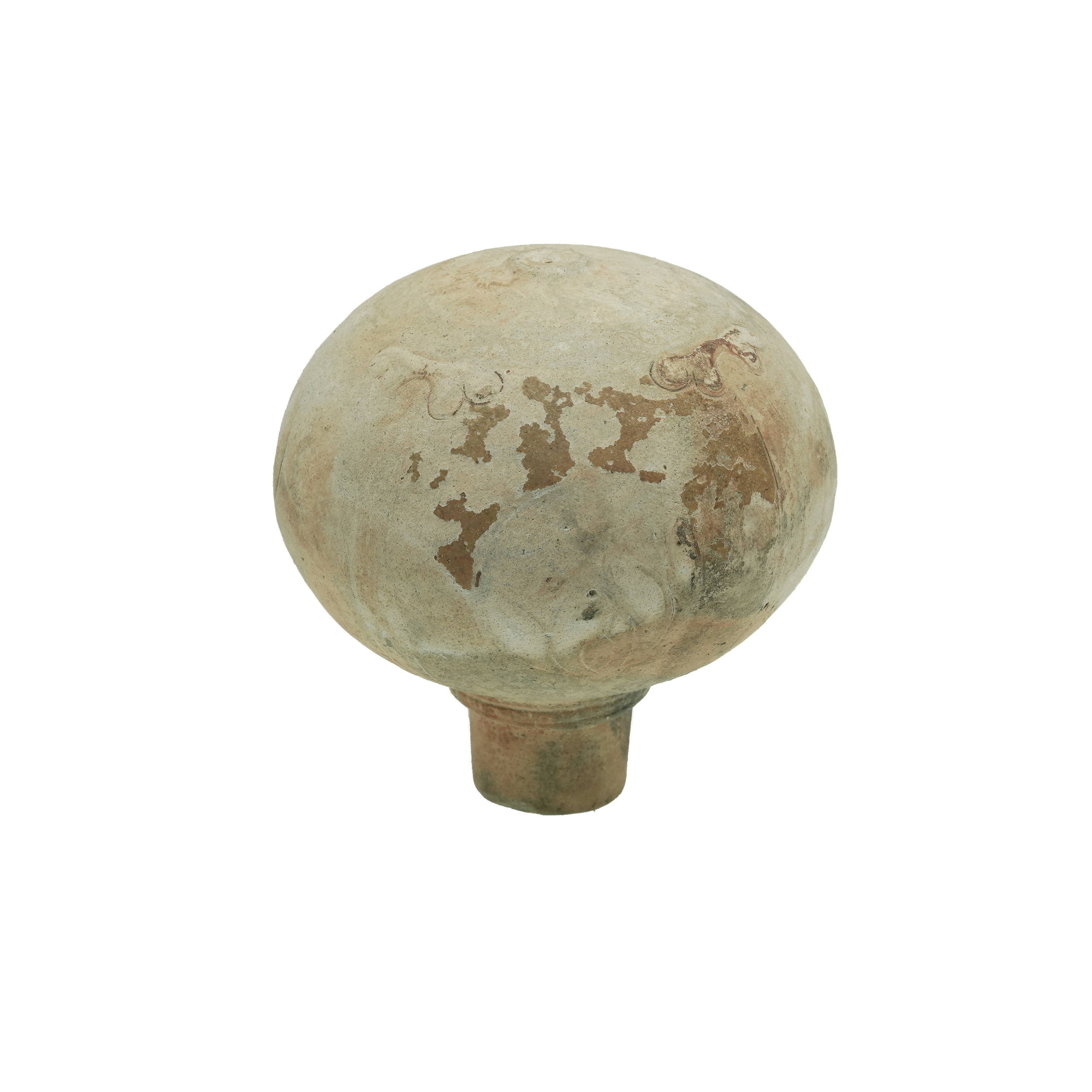
Terracotta Opium Pipe Bowl
Dimensions: Appro 6 × 6 cm
Opium pipe bowl fashioned from unglazed terracotta. The surface shows natural wear and patina from age and use. Such utilitarian yet subtly ornamented pieces were common in opium-smoking cultures of the 19th and early 20th centuries, blending practical craftsmanship with modest aesthetic detail.
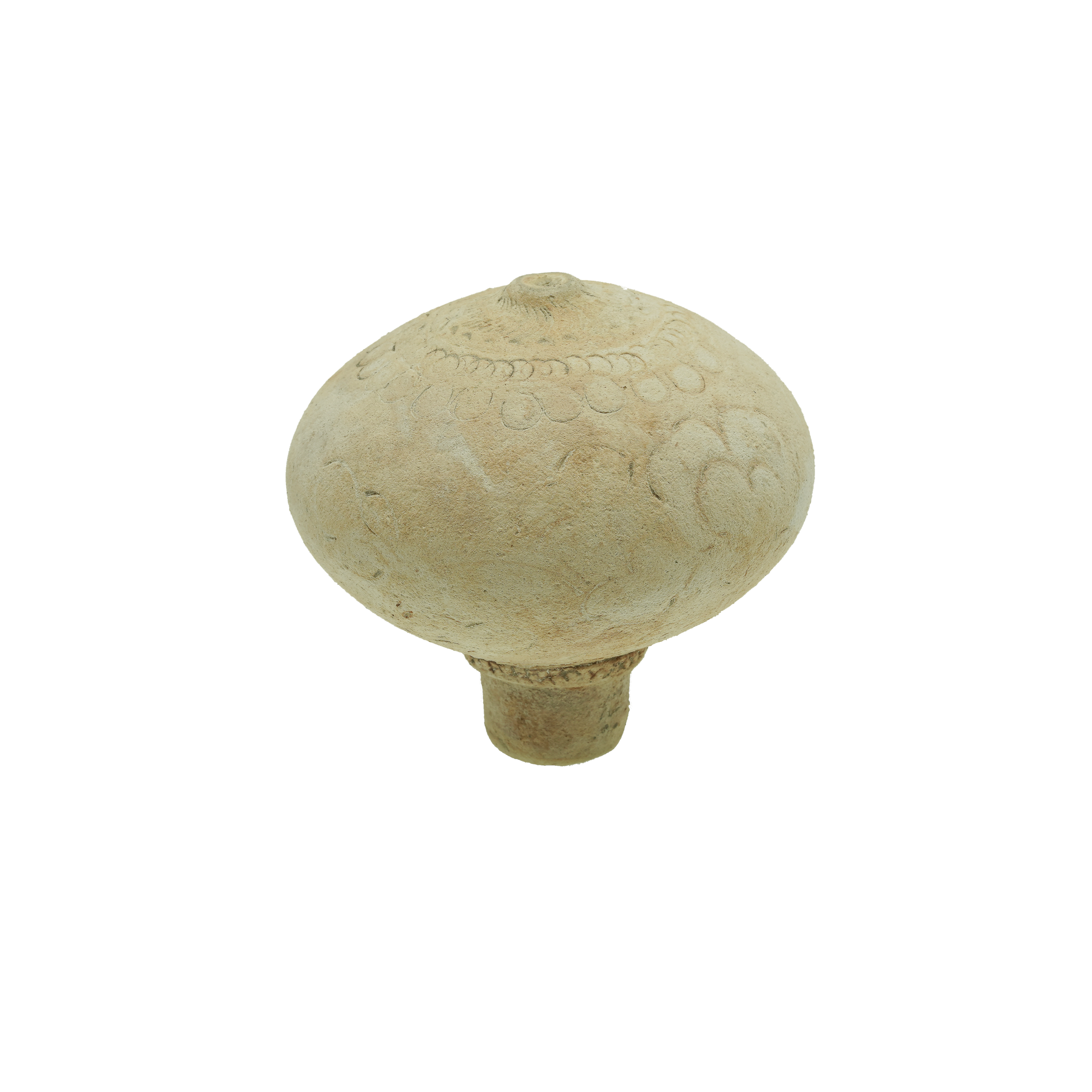
Terracotta Opium Pipe Bowl
Dimensions: Appro 6 × 7 cm
opium pipe bowl crafted from unglazed terracotta with incised patterns around its upper surface. The porous, earthenware body allowed for even heat distribution during use, while its narrow base was designed to fit securely into an opium lamp.
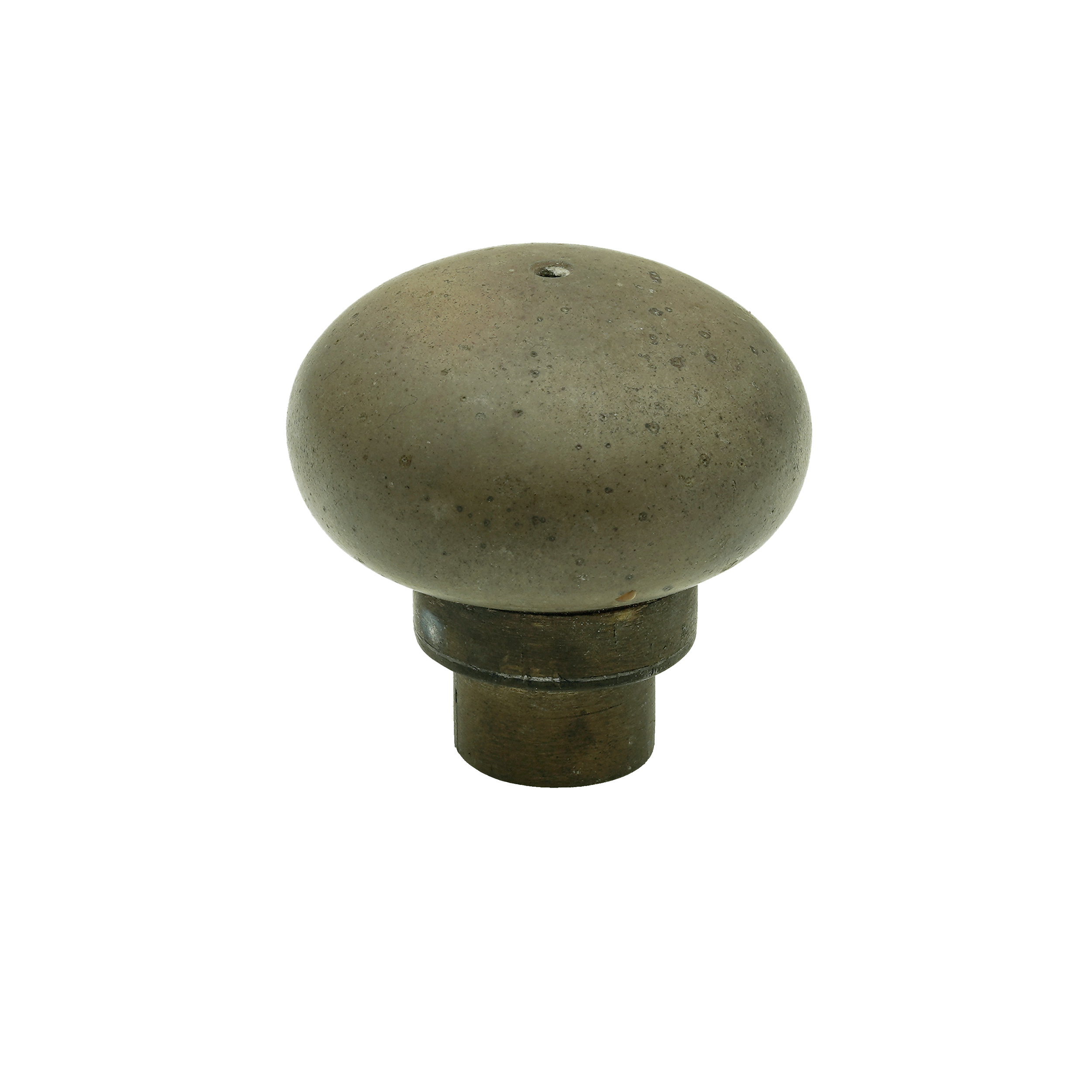
Opium Pipe Bowl
China, late 19th – early 20th century
Stone and metal
Dimensions: Appro 5 × 4 cm
Opium pipe bowl carved from smooth stone and mounted on a metal fitting. The domed stone head, with a small central aperture, held the prepared opium, which was gently heated over a lamp to release vapour.
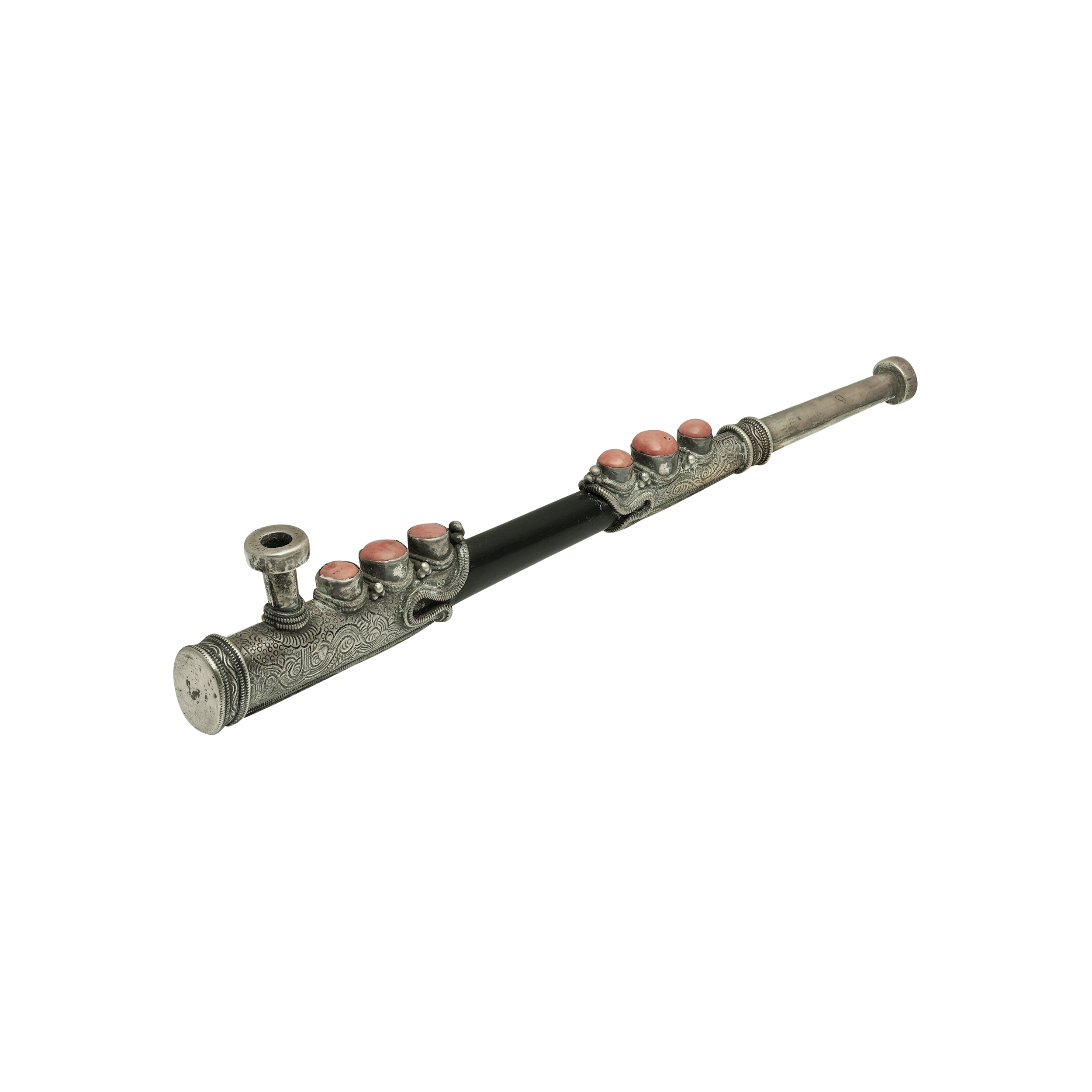
Origin: Tibet
Date: Late 19th–early 20th century
Materials: Silver, black-lacquered wood or horn, coral cabochons
Dimensions: Appro 39 × 6 cm
Description:
Crafted Tibetan opium pipe featuring ornate silver mounts over a black-lacquered central shaft, likely made from wood or horn. The pipe is decorated with repoussé and chased floral and scroll motifs along the silver sections. Six raised silver bezels, each set with a polished coral cabochon, provide both ornamentation and symbolic significance, as coral is considered a protective and auspicious material in Tibetan culture.
The bowl is positioned at one end, fitted into an intricately worked silver headpiece that extends into a capped section. The opposite end tapers to a silver mouthpiece, with an additional decorative silver sleeve at the junction with the shaft. The combination of luxurious materials and intricate detailing suggests that this pipe belonged to a wealthy or high-ranking individual.
Cultural Context:
While opium smoking spread widely in China during the Qing dynasty, it also reached Tibet, where pipes were often made to reflect local aesthetics and spiritual symbolism. The use of coral and silver links this example to Tibetan jewelry traditions, where such materials are prized for their beauty, rarity, and protective powers. In this way, the pipe served as both a functional smoking implement and a status-laden personal possession.
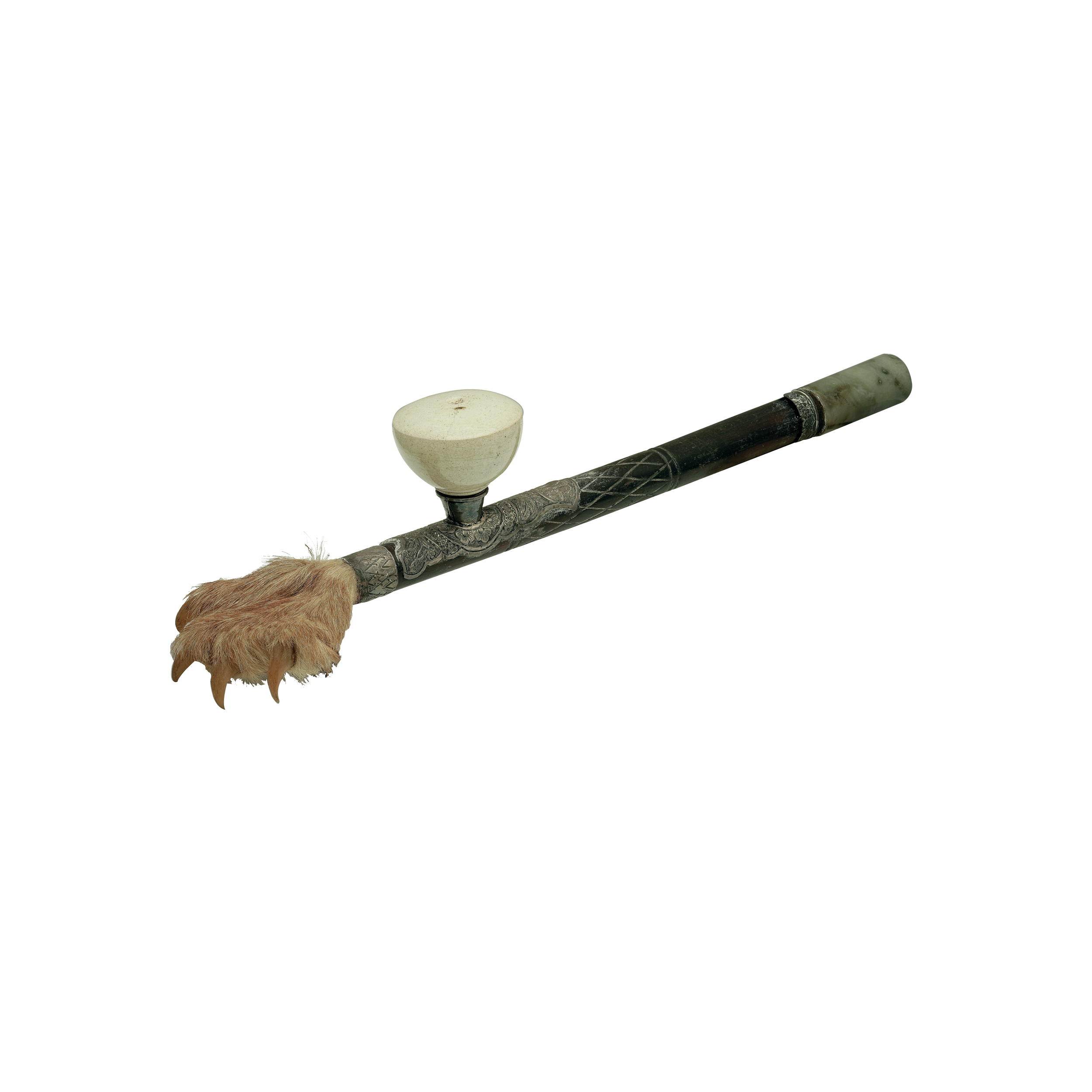
Origin: China or Southeast Asia
Date: Late 19th–early 20th century
Materials: Metal, ceramic, animal paw (likely feline)
Dimensions: Appro 49 × 10 cm
Description:
Unusual custom-made opium pipe combining traditional materials with a personalizing feature. The long cylindrical stem, crafted from metal and engraved with geometric and foliate motifs, is fitted with a white ceramic bowl for vaporizing prepared opium. The mouthpiece appears to be carved from pale green jade.
Most notably, the opposite end of the stem is capped with a preserved animal paw—likely feline—complete with fur and claws intact. This distinctive finial transforms the piece into a unique personal statement, possibly signifying the owner’s status, identity, or totemic beliefs. The fusion of refined materials with an organic ornamentation marks this pipe as a rare example of individualized opium-smoking paraphernalia.
Cultural Context:
In the opium-smoking traditions of China and Southeast Asia, pipes could range from utilitarian bamboo examples to elaborately decorated personal possessions. The use of jade in the mouthpiece reflects the material’s long-standing association with purity, health, and nobility, while the animal paw suggests either a symbolic talisman or an expression of eccentricity and power. Such a piece may have been commissioned by an elite smoker wishing to stand out in a competitive social milieu.
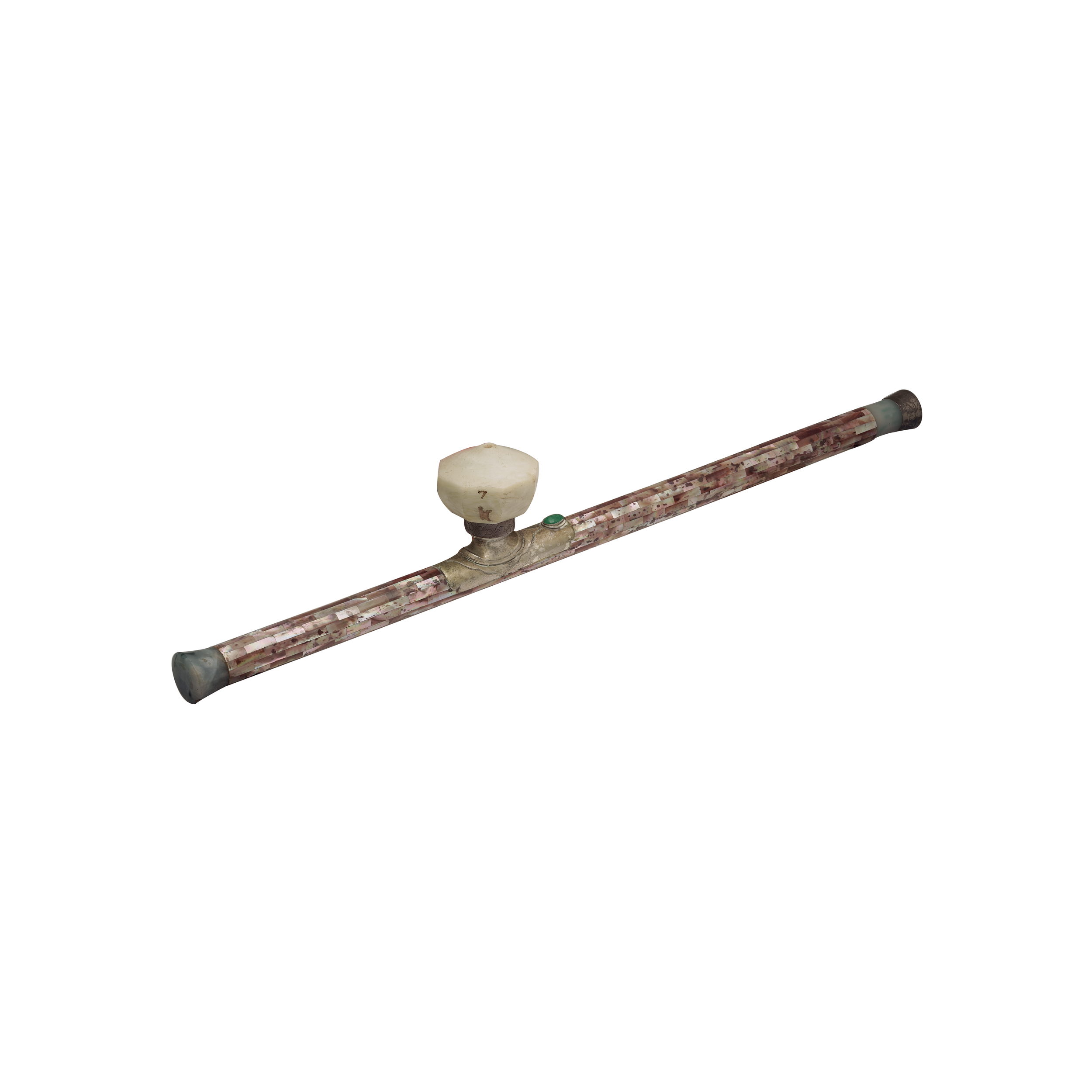
Origin: China
Date: Late 19th–early 20th century
Materials: mother-of-pearl, jade, ceramic, metal fittings
Dimensions: Appro 54 × 9 cm
Description:
Chinese opium pipe slender stem, inlaid with hundreds of small pieces of shimmering mother-of-pearl arranged in repeating floral and geometric motifs. The inlay work covers nearly the entire surface, creating a luminous effect when viewed under soft light. At the center sits a hexagonal white ceramic bowl, used for heating and vaporizing the prepared opium.
Adjacent to the bowl’s metal fitting is a small jade cabochon, possibly serving both decorative and symbolic purposes, as jade is traditionally associated with purity, protection, and high social standing. The ends of the stem are capped with metal fittings, one forming the mouthpiece, the other reinforcing the opposite extremity.
Cultural Context:
In the Qing dynasty and into the early Republican era, opium smoking was a highly ritualized activity, and pipes were often crafted to reflect the wealth and refinement of their owners. Mother-of-pearl inlay was a labor-intensive art, requiring patience and skill, and its inclusion here suggests that the pipe belonged to a patron of means who valued both function and beauty.
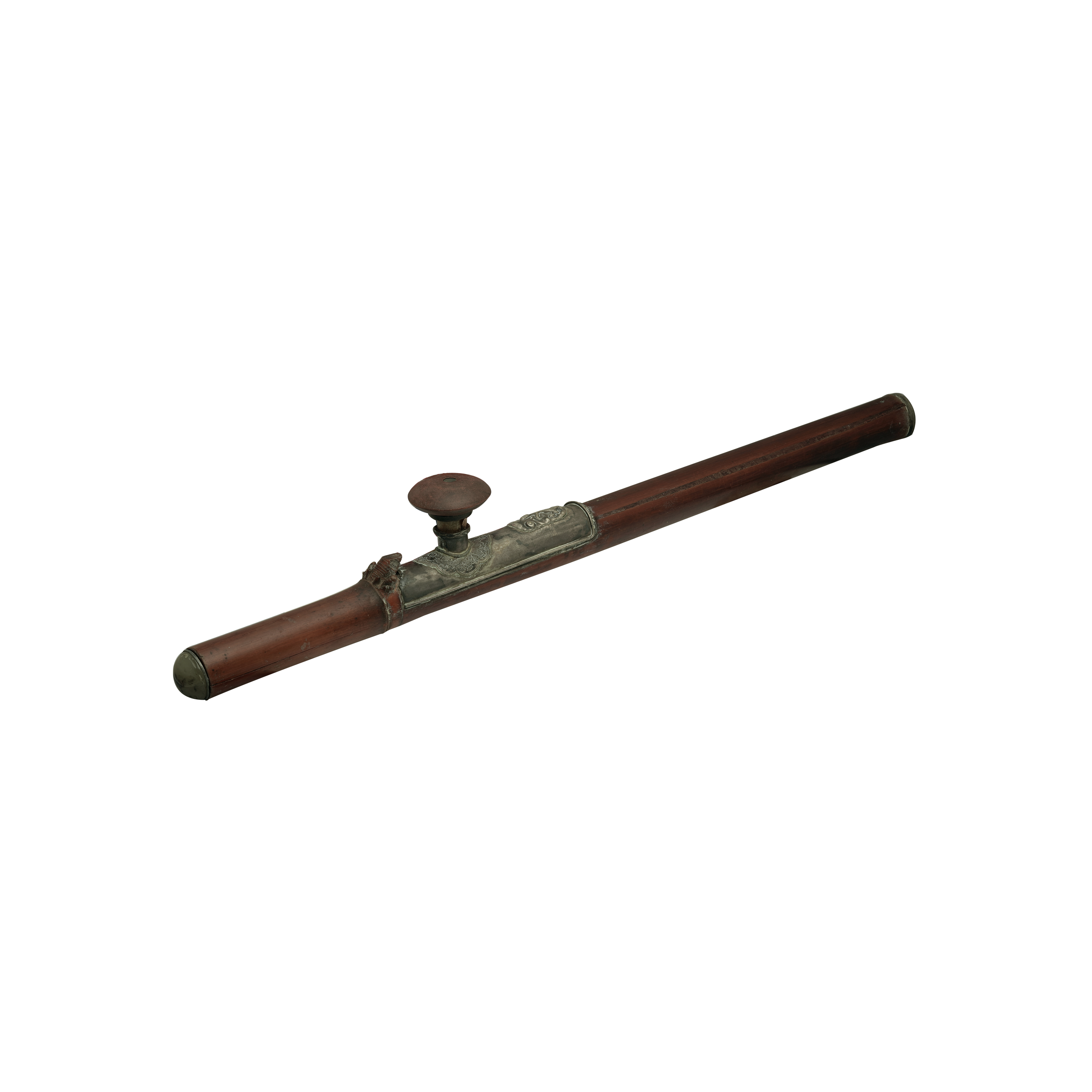
Origin: China
Date: Late 19th–early 20th century
Materials: Bamboo, brass, metal alloy
Dimensions: Appro 57 × 12 cm
Description:
Chinese opium pipe featuring a smooth cylindrical bamboo stem with warm reddish-brown patina, complemented by brass end caps and a central metal fitting to hold the ceramic or metal bowl. The central section, cast in metal alloy, displays modest decorative flourishes, including low-relief scroll motifs and a stylized clasp to secure the bowl.
The bowl itself is of small, rounded form—ideal for controlled heating of prepared opium paste over a specialized lamp. The bamboo stem’s natural durability, paired with the resilience of brass fittings, speaks to a practical yet refined approach to pipe-making, balancing utility with understated ornamentation.
Cultural Context:
Opium pipes such as this were essential implements in Chinese opium-smoking rituals, which peaked in popularity during the Qing dynasty. Bamboo was a favored stem material for its light weight, resistance to heat, and smooth draw, while brass fittings added durability and a subtle decorative element.
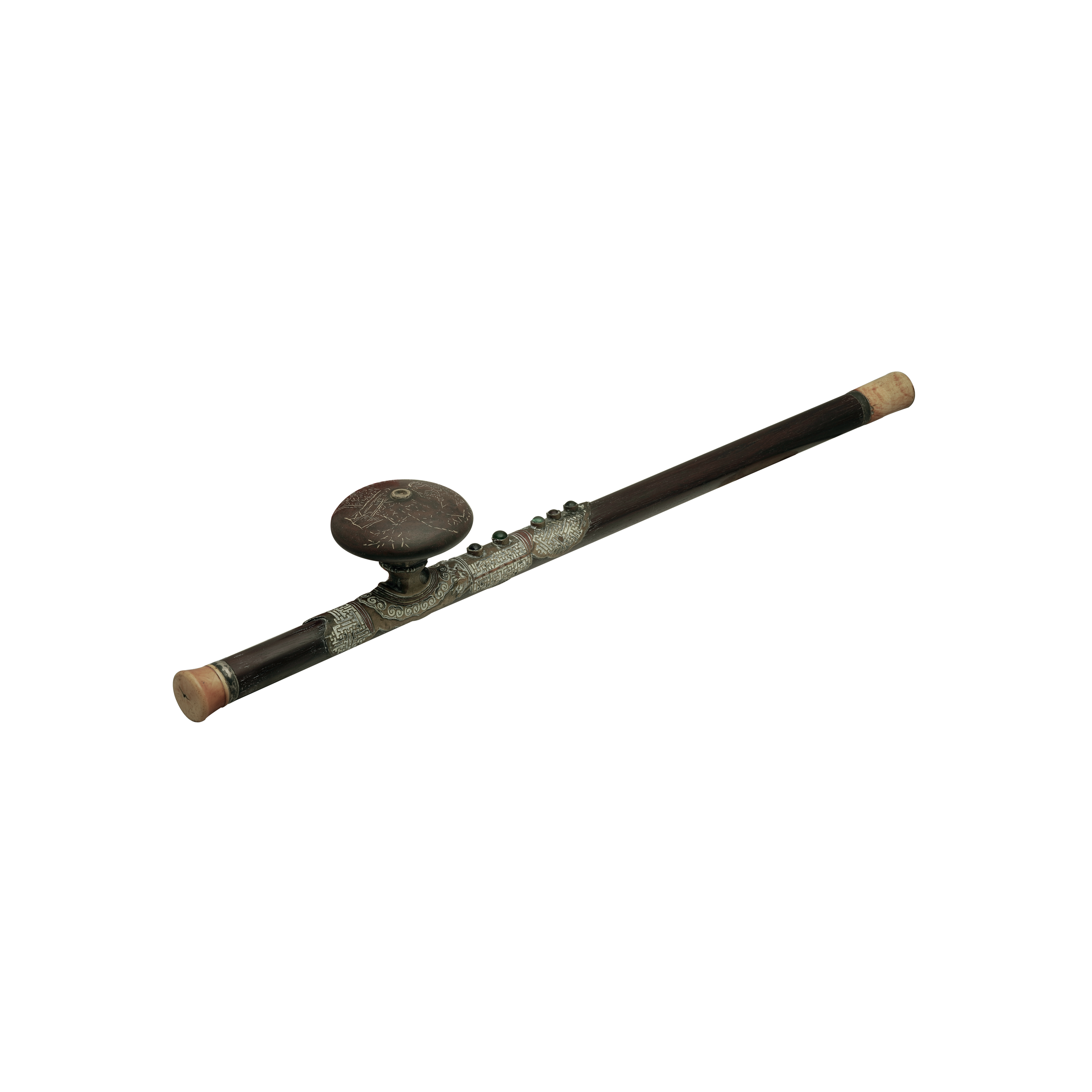
Origin: China
Date: Late 19th–early 20th century
Materials: Hardwood, metal alloy, lacquer, jade or stone mouthpieces
Dimensions: Appro 56 × 9 cm
Description:
Chinese opium pipe crafted with a hardwood stem flanked by smooth stone or jade mouthpieces at either end. The pipe features an ornate metal saddle with fine engravings of floral scrollwork, symbolizing prosperity and refinement. Resting atop the saddle is a lacquered ceramic bowl, its surface decorated with delicate gilt-painted motifs, possibly floral or calligraphic, that would have caught the light during use.
A row of small metal bosses embellishes the saddle, providing both decorative and tactile interest. The combination of rich hardwood, polished stone, and engraved metal reflects the harmony of materials prized in Qing dynasty smoking culture.
Cultural Context:
Such pipes were used in the ritualized practice of opium smoking, a pastime closely associated with leisure, social gatherings, and expressions of status in late imperial China. The luxurious details of this example suggest ownership by a connoisseur who valued both the art of smoking and the craftsmanship of the tools involved.
Origin: China
Date: Late 19th–early 20th century
Materials: Hardwood, metal alloy, lacquer, inlay
Dimensions: Appro 57 × 10 cm
Description:
Chinese opium pipe featuring a straight, polished hardwood stem of rich reddish-brown hue, capped at each end with fitted collars for durability. At its center sits a domed metal bowl cover, engraved with Chinese characters, mounted on a short, ridged neck that connects to an engraved metal saddle. The saddle bears a worn but elegant surface, possibly from years of careful use, and is accented with small inset stones or beads, hinting at the owner’s appreciation for refinement.
The smooth, lacquered wood contrasts with the utilitarian yet decorative metalwork, a hallmark of Qing-era smoking implements. The engraved inscription on the bowl may carry auspicious or poetic meaning, underscoring the cultural practice of pairing opium consumption with artistry and wordplay.
Cultural Context:
During the late Qing dynasty, opium smoking was a ritualized pastime that blended craftsmanship, social etiquette, and personal indulgence. Pipes of this kind were often custom-made, with fittings that reflected the wealth, status, and taste of their owner. The combination of inscribed metalwork and hardwood stem places this example within the tradition of refined domestic paraphernalia used by the literati and elite classes.
Origin: China
Date: Late 19th–early 20th century
Materials: Hardwood, metal alloy
Dimensions: Appro 54 × 10 cm
Description:
Chinese opium pipe featuring a straight hardwood stem with a polished patina, indicative of frequent handling over time. At its center sits a distinctive hexagonal metal bowl with a pointed, conical lid—a rare and striking form compared to the more typical rounded bowls. The bowl is mounted on an engraved metal saddle, adorned with scrolling floral and foliate motifs, adding both visual interest and a touch of luxury.
The hardwood body is capped at each end with smooth, fitted collars, providing durability and balance. The geometric form of the bowl contrasts elegantly with the organic patterns of the engraved saddle, merging utilitarian function with decorative artistry.
Cultural Context:
Opium smoking in late Qing China was as much a social ritual as it was a private indulgence. Pipes like this, with distinctive and high-quality fittings, often belonged to affluent individuals who took pride in the craftsmanship of their paraphernalia. The unusual bowl shape suggests either a regional variation or a custom-made commission, reflecting the owner’s personal taste.
Origin: China
Date: Late 19th–early 20th century
Materials: Hardwood, brass, lacquer, pigment
Dimensions: Appro 49 × 7 cm
Description:
Chinese opium pipe featuring a long, polished hardwood stem of reddish-brown tone, fitted at both ends with protective metal collars. At the center sits a circular, slightly domed metal bowl cover with a patinated surface, connected to an engraved brass saddle decorated with stylized floral and foliate motifs. A section of the front stem bears red-painted Chinese characters, likely denoting a workshop name, auspicious phrase, or ownership mark. A small protruding support—possibly for resting the pipe—extends from the saddle area, adding both functionality and visual balance to the design.
The combination of warm hardwood, decorative brass, and hand-painted calligraphy reflects the Qing-era appreciation for craftsmanship and refinement in smoking implements.
Cultural Context:
Opium smoking during the late Qing dynasty was not only a leisure activity but also a social ritual among China’s literati and upper classes. Pipes such as this were often personalized, incorporating inscriptions or motifs meaningful to their owners. The addition of painted calligraphy aligns with the cultural practice of merging artistry, poetry, and daily objects, elevating the pipe from a utilitarian tool to an object of aesthetic and cultural value.
Origin: China
Date: Late 19th–early 20th century
Materials: Tortoiseshell, metal alloy, lacquer
Dimensions: Appro 67 × 10 cm
Description:
Opium pipe showcasing a stem crafted from richly patterned tortoiseshell, exhibiting warm hues of amber and deep brown in its naturally mottled surface. At the center, a domed metal bowl cover rises on a narrow collar and connects to an ornate metal saddle, intricately engraved with scrolling motifs and stylized forms typical of the Qing dynasty aesthetic.
The vivid tortoiseshell, prized for its beauty and rarity, complements the finely detailed metalwork. The integration of precious organic and metallic materials suggests this piece was created for a refined clientele, likely within elite social circles.
Cultural Context:
During the height of opium use in late imperial China, smoking implements were often bespoke, combining function with visual elegance. Tortoiseshell, a symbol of longevity and high status, was favored by the wealthy for personal objects. The pipe’s refined craftsmanship and costly materials reflect the ritualized and aristocratic nature of opium consumption during this period.
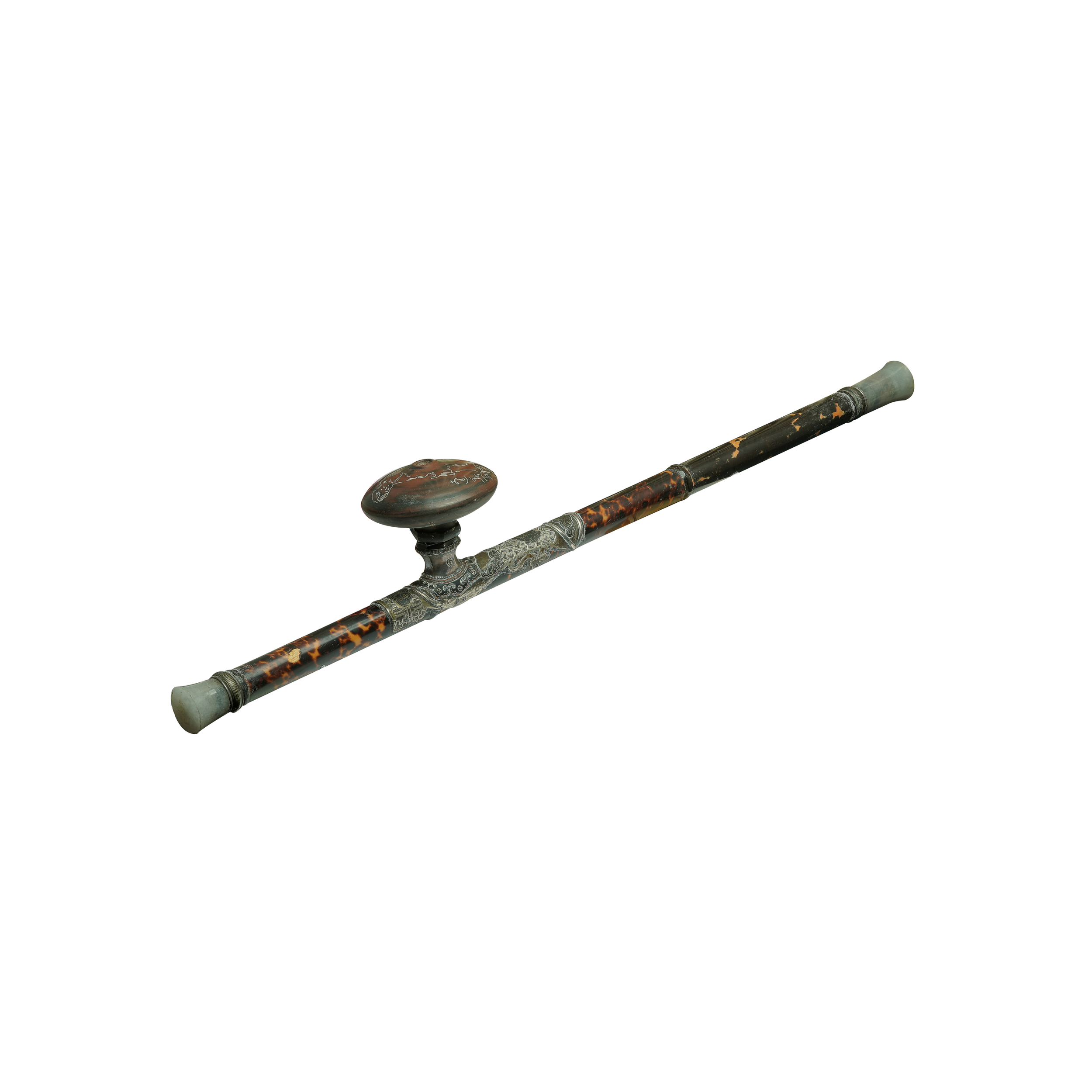
Origin: China
Date: Late 19th–early 20th century
Materials: Tortoiseshell, metal alloy, lacquer
Dimensions: Appro 65 × 9 cm
Description:
Chinese opium pipe featuring a stem crafted from mottled tortoiseshell, its natural amber and dark brown patterns enhanced by age and use. At the center, a domed metal bowl cover, possibly copper alloy, rests on a short neck and connects to an engraved metal saddle adorned with intricate scrolling motifs. The metalwork shows subtle signs of wear, attesting to its history..
Cultural Context:
In late Qing dynasty China, opium smoking was not merely a habit but a cultivated ritual among the upper classes. The use of tortoiseshell signified wealth and refinement, while engraved metal fittings reflected the artistry expected of personal objects in elite society. Pipes of this quality were often treasured possessions, sometimes gifted or passed down through generations.
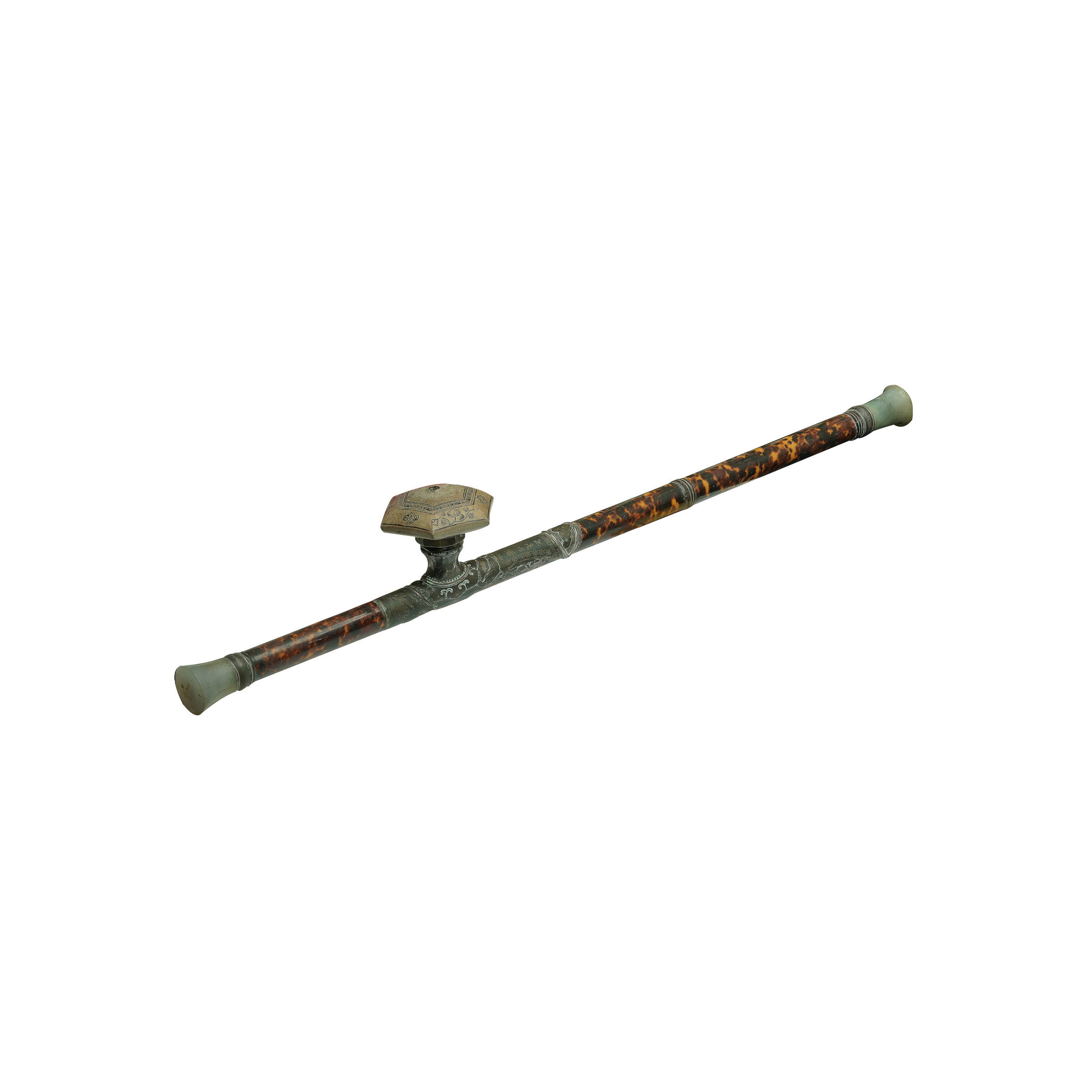
Origin: China
Date: Late 19th–early 20th century
Materials: Tortoiseshell, metal alloy, lacquer
Dimensions: Appro 62 × 9 cm
Description:
Chinese opium pipe showing a long, polished stem crafted from mottled tortoiseshell, prized for its warm amber and deep brown tones. At its center rises a hexagonal metal bowl cover, finely engraved with decorative patterns and mounted on a short, ridged neck that connects to an elaborately worked metal saddle. The engraved designs on the saddle include scrolling motifs and stylized flourishes, reflecting the fine craftsmanship typical of luxury opium-smoking implements.
Cultural Context:
During the late Qing dynasty, opium smoking was a ritualized social practice among China’s wealthy elite. High-quality pipes such as this were often custom-made, incorporating precious and exotic materials that signified the owner’s status and taste. Tortoiseshell, in particular, was valued not only for its beauty but also for the skill required to work it into such long, slender forms without fracture.
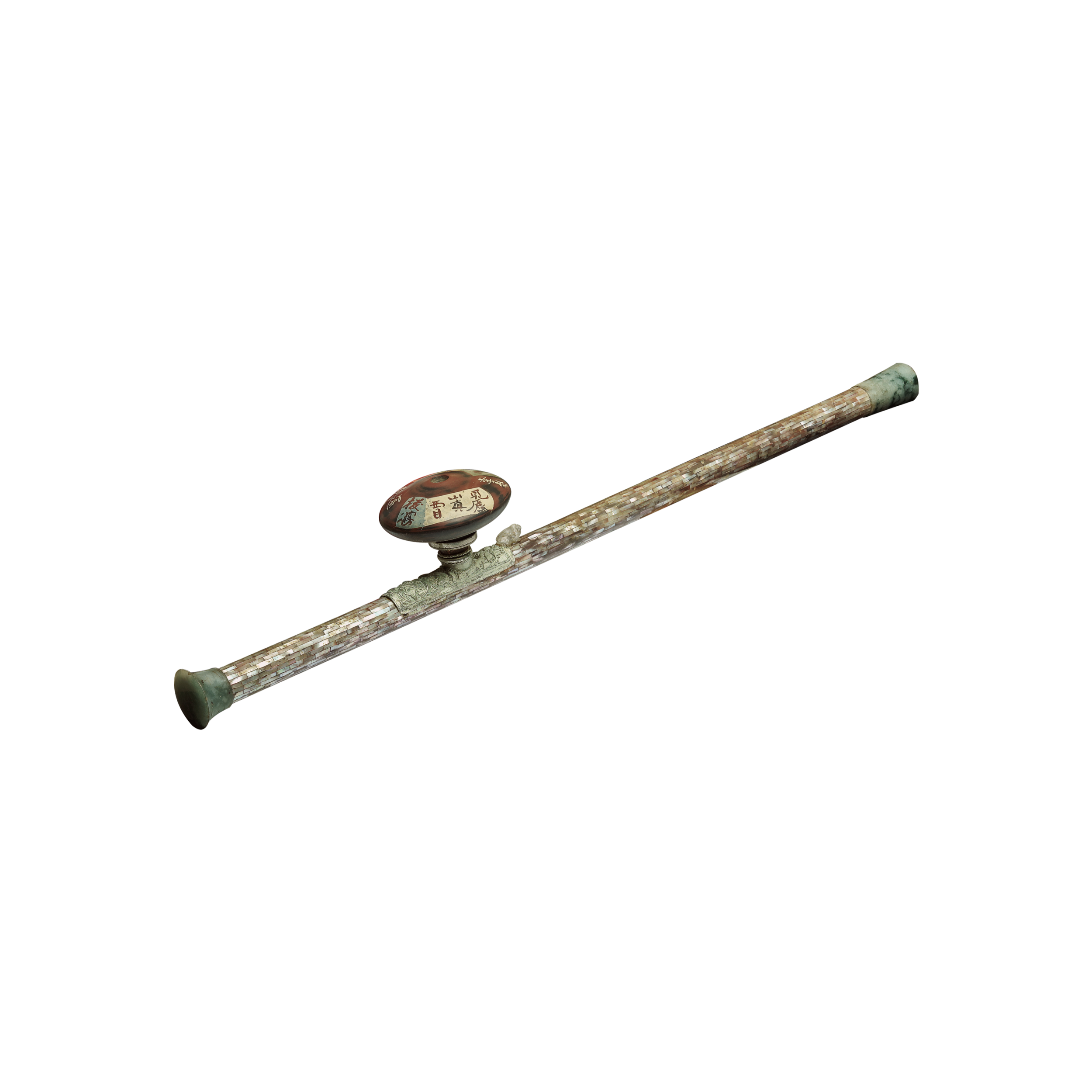
Origin: China
Date: Late 19th–early 20th century
Materials: Hardwood, mother-of-pearl, metal alloy
Dimensions: Appro 66 × 10 cm
Description:
Chinese opium pipe distinguished by its hardwood stem, inlaid with iridescent mother-of-pearl in geometric and floral patterns. The inlay catches the light, producing a visual richness that reflects the high status of its original owner.
Cultural Context:
In late Qing dynasty China, opium smoking was as much an aesthetic ritual as it was an indulgence. Pipes of this caliber, combining precious inlay and hand-painted porcelain, were not merely functional objects but expressions of refined taste, wealth, and cultural literacy. The inscriptions would often carry moral, literary, or auspicious meanings, enhancing the contemplative experience of smoking.
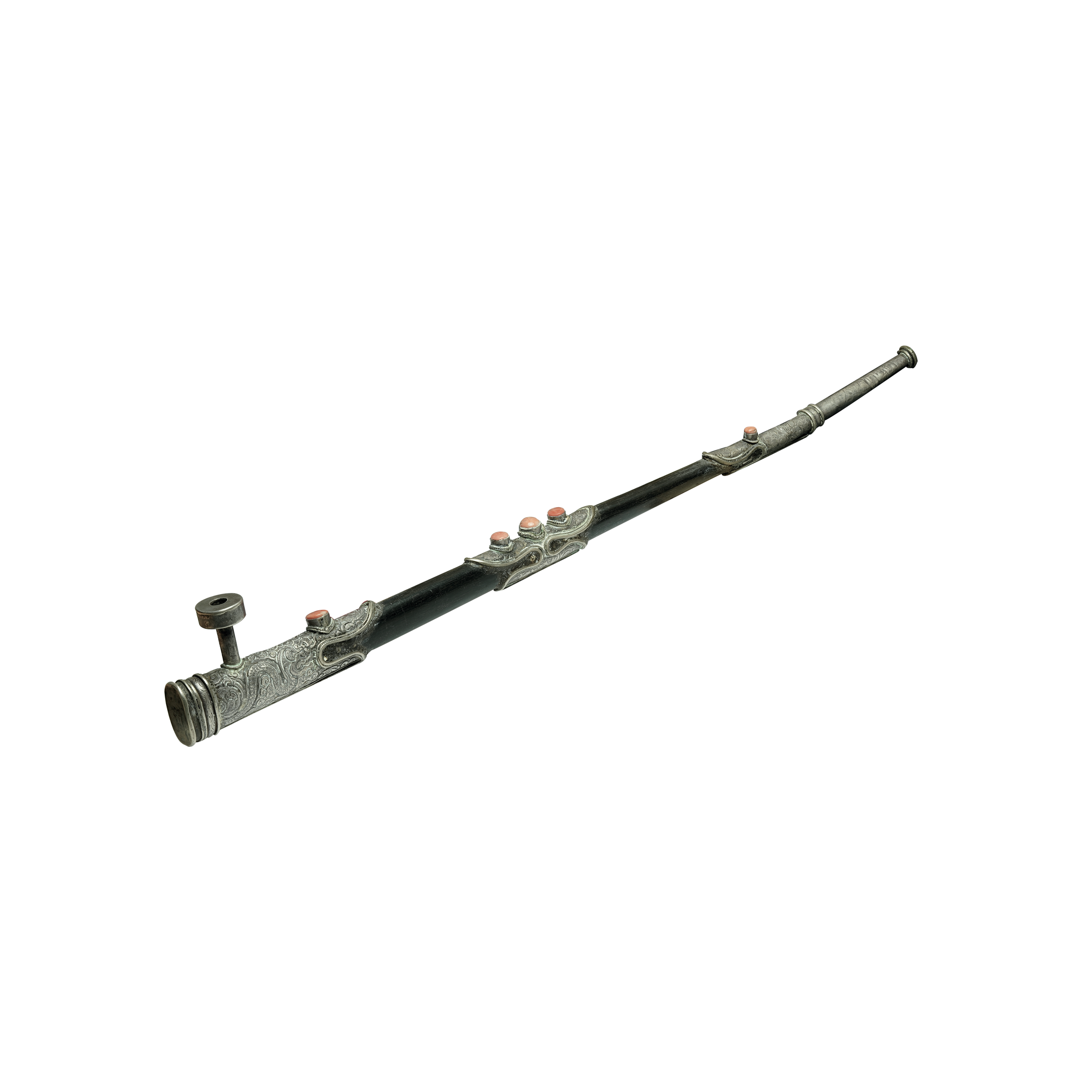
Origin: Tibet
Date: Late 19th–early 20th century
Materials: Silver, coral, wood, metal alloy
Dimensions: Appro 58 × 8 cm
Description:
Tibetan opium pipe featuring a long, dark wooden stem fitted with elaborate silver mounts. The mounts are engraved with scrolling floral patterns and set with domed coral cabochons in symmetrical arrangements along the length of the pipe. The bowl, positioned near one end, is made of metal and designed to hold the opium for smoking. Both ends of the stem are capped with decorated metal fittings, ensuring durability and adding visual harmony to the design.
Cultural Context:
Tibetan opium pipes of this type were luxury items, often crafted for affluent users. The use of silver and coral not only added beauty but also reflected Tibetan decorative traditions, where coral was prized as a protective and auspicious material. These pipes served as both functional smoking instruments and symbols of wealth and status.
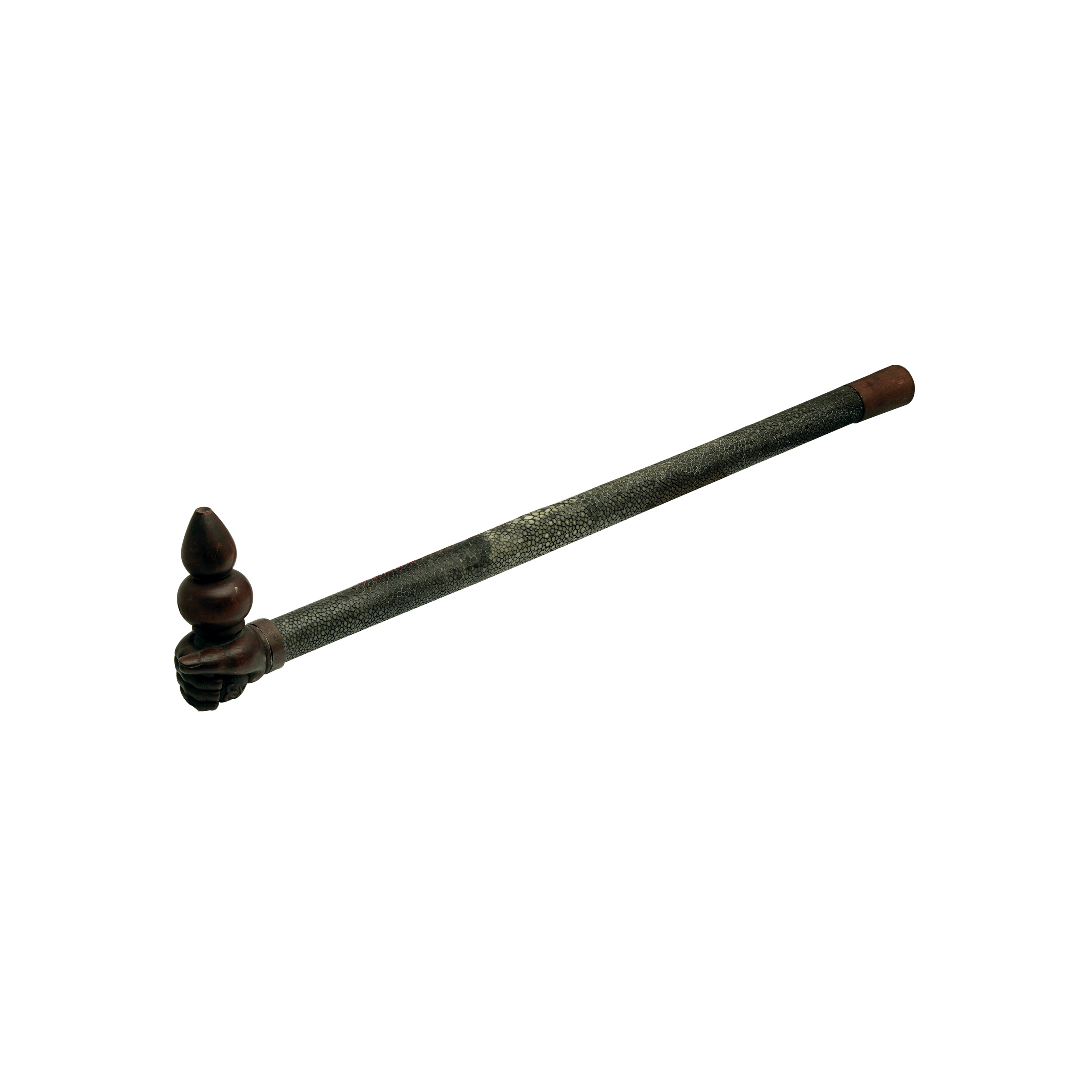
Origin: China
Date: Late 19th–early 20th century
Materials: Hardwood, ray skin (shagreen), metal alloy
Dimensions: Appro 52 × 10 cm
Description:
Chinese opium pipe featuring a long stem clad in ray skin, giving it a textured, pebbled surface prized for its durability and appeal. The mouthpiece and bowl mount are crafted from dark hardwood, with the bowl shaped into a tiered, finial-like form. The bowl base is carved in the shape of a hand.
Cultural Context:
Ray skin was a favored decorative material in Qing dynasty luxury goods, valued for both its exotic appearance and longevity. The carved hand motif may have represented protection or a blessing, integrating artistry into the opium-smoking ritual. Such pipes were not merely utilitarian but also served as personal statements of taste and status.
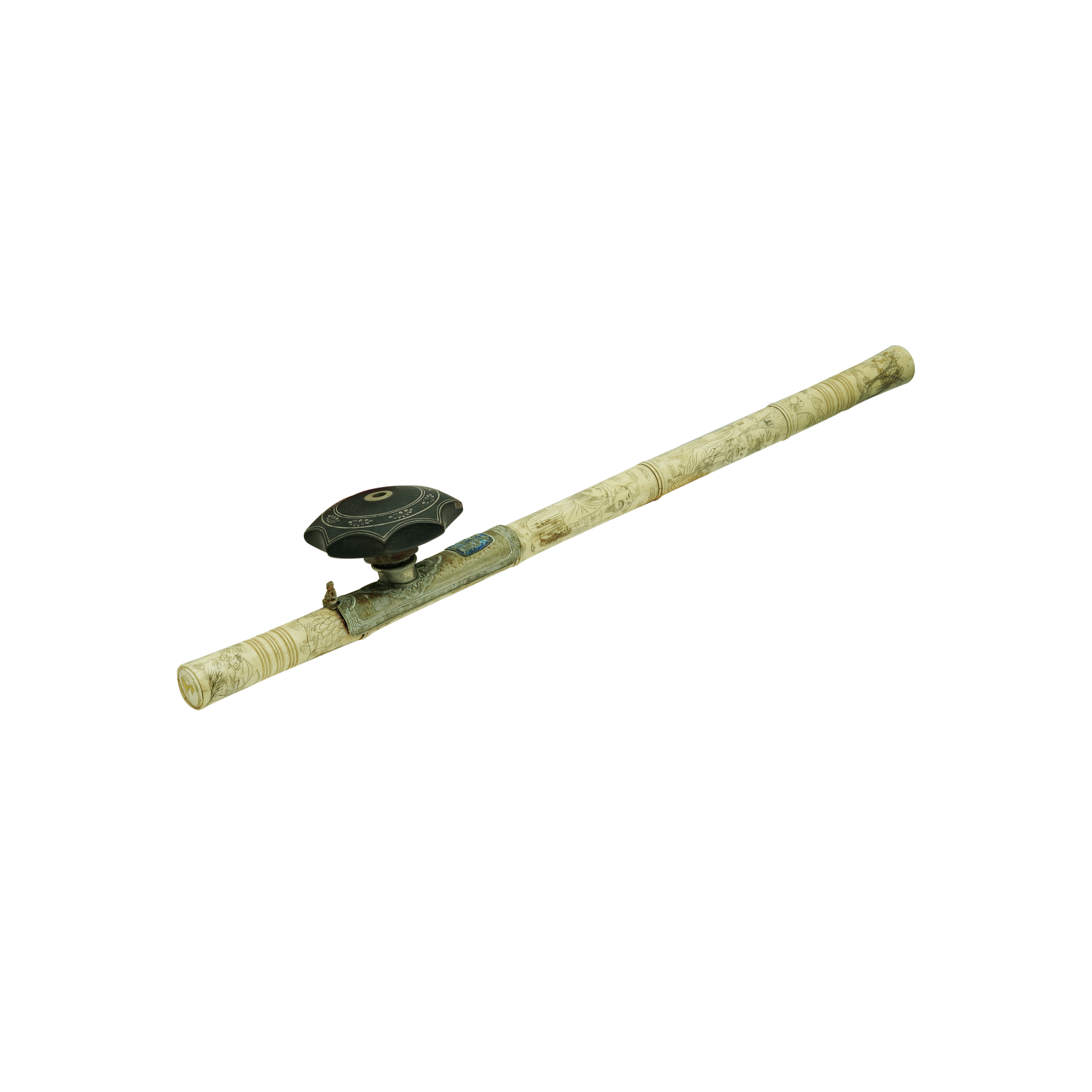
Origin: China
Date: Late 19th–early 20th century
Materials: Bone, metal alloy, lacquer
Dimensions: Appro 51 × 10 cm
Description:
Chinese opium pipe showcasing a straight stem crafted from carved bone, its surface decorated with incised motifs that may include floral patterns and symbolic imagery. The stem is fitted with a central metal saddle, engraved with traditional scrollwork, which supports a black lacquered ceramic bowl cover decorated with white linework. The pipe’s light bone hue contrasts with the dark bowl, highlighting the interplay of texture and color.
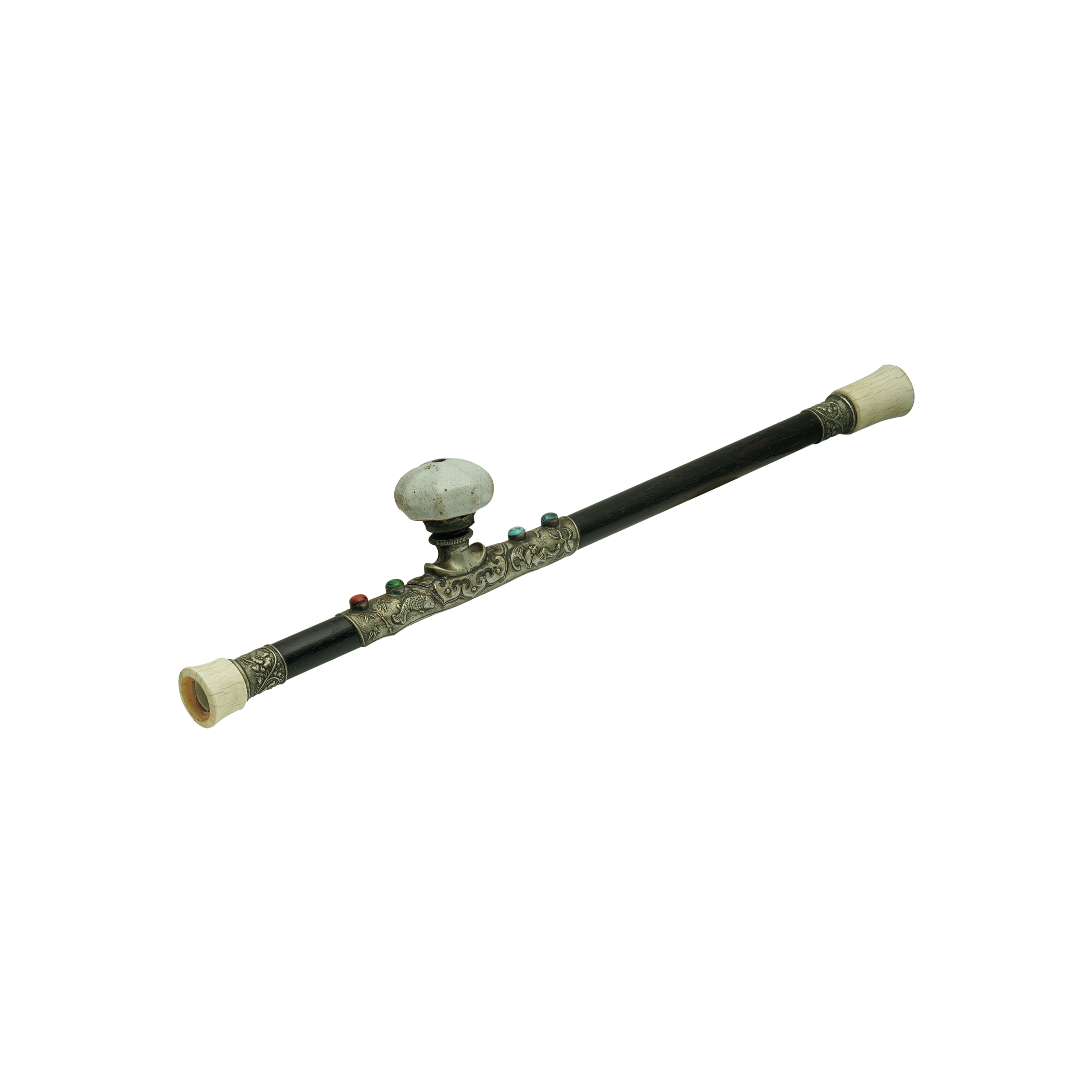
Origin: China
Date: Late 19th–early 20th century
Materials: Blackwood, metal alloy, ivory or bone, semi-precious stones
Dimensions: Appro 54 × 10 cm
Description:
Chinese opium pipe featuring a straight blackwood stem fitted with carved bone mouthpieces at both ends. The central saddle is crafted from engraved metal in a scrolling floral design, supporting a domed white ceramic bowl. Along the saddle are inset beads in red, green, and turquoise tones, providing colorful ornamentation.
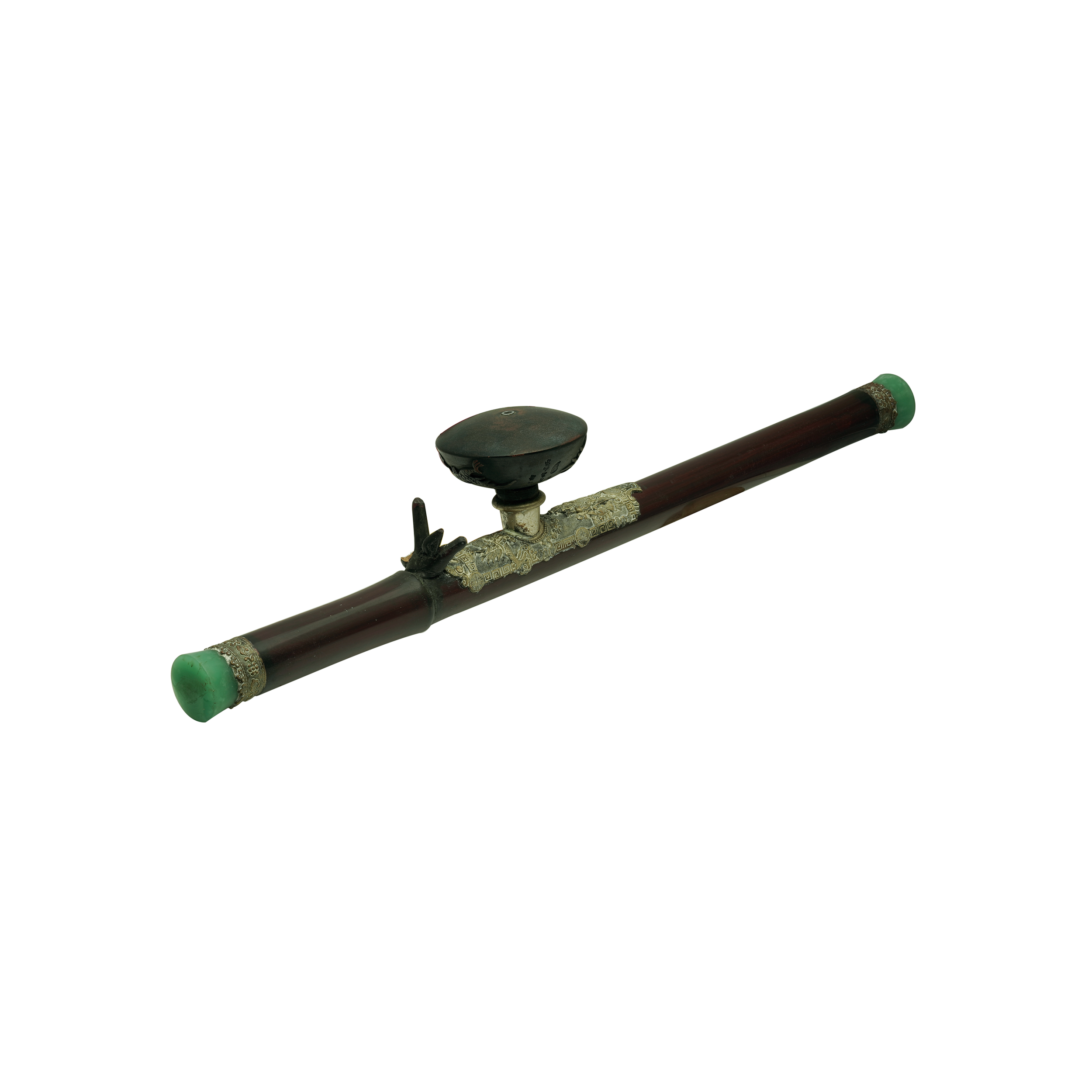
Origin: China
Date: Late 19th–early 20th century
Materials: Hardwood, metal alloy, green stone
Dimensions: Appro 54 × 12 cm
Description:
Crafted Chinese opium pipe featuring a polished hardwood stem fitted at both ends with smooth green stone mouthpieces. The central saddle is made of engraved metal with floral motifs, supporting a dark, domed metal bowl. A small upright prong, also in metal, extends beside the bowl, likely for resting or manipulating the opium needle during preparation.
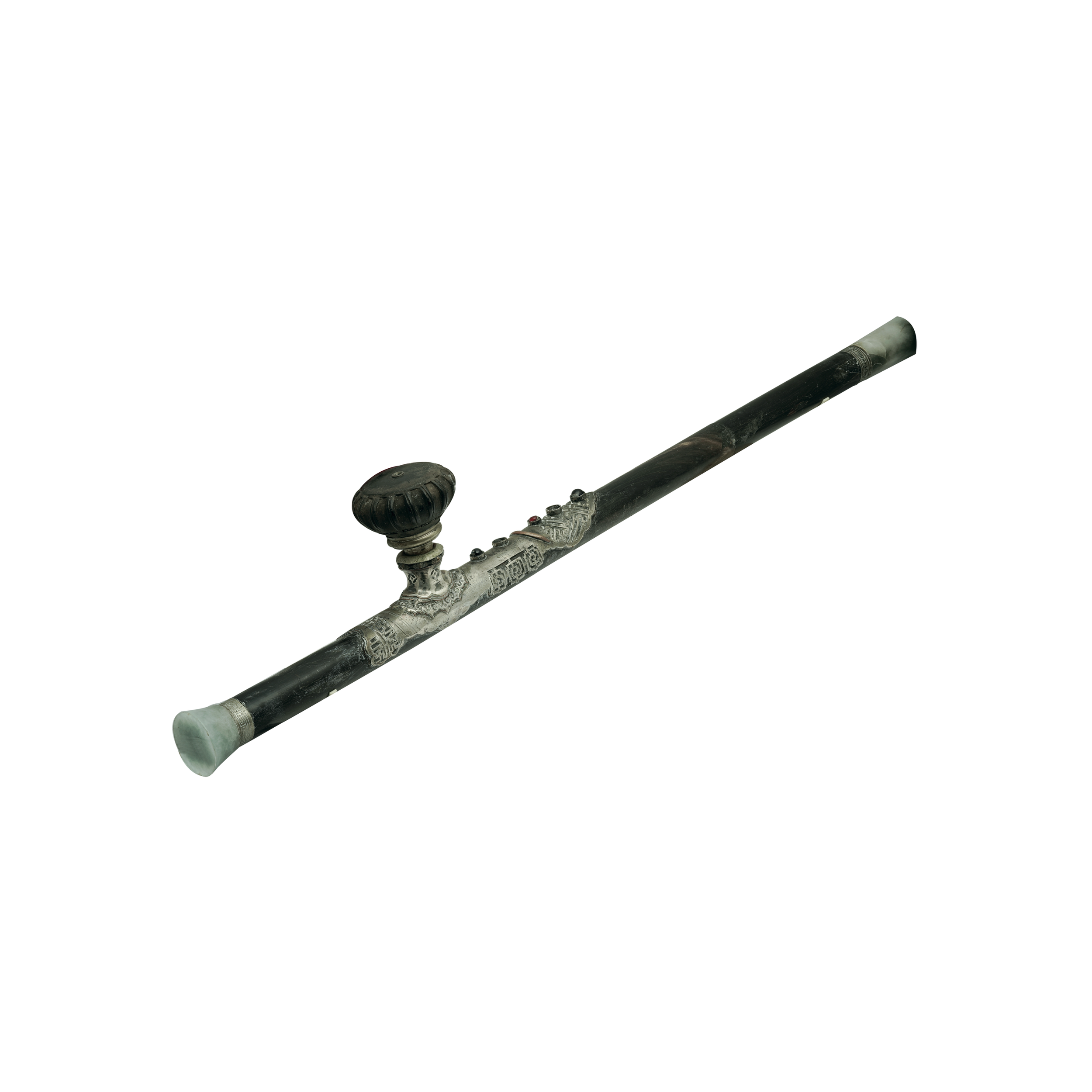
Origin: China
Date: Late 19th–early 20th century
Materials: Metal alloy, hardwood, jade, semi-precious stones
Dimensions: Appro 61 × 14 cm
Description:
Chinese opium pipe featuring a straight dark stem, fitted with a pale jade mouthpiece at one end. The central metal saddle is engraved with scrolling motifs and geometric designs, and is adorned with small semi-precious stone inlays. Rising from the saddle is a ribbed, circular bowl fitting crafted from dark metal, designed to hold the removable opium bowl.
Cultural Context:
Opium pipes such as this were often made with high-quality materials and intricate decoration to reflect the status of their owner. Jade, highly prized in Chinese culture, symbolized purity and virtue, while inlays and fine engravings elevated the piece into a work of personal luxury.
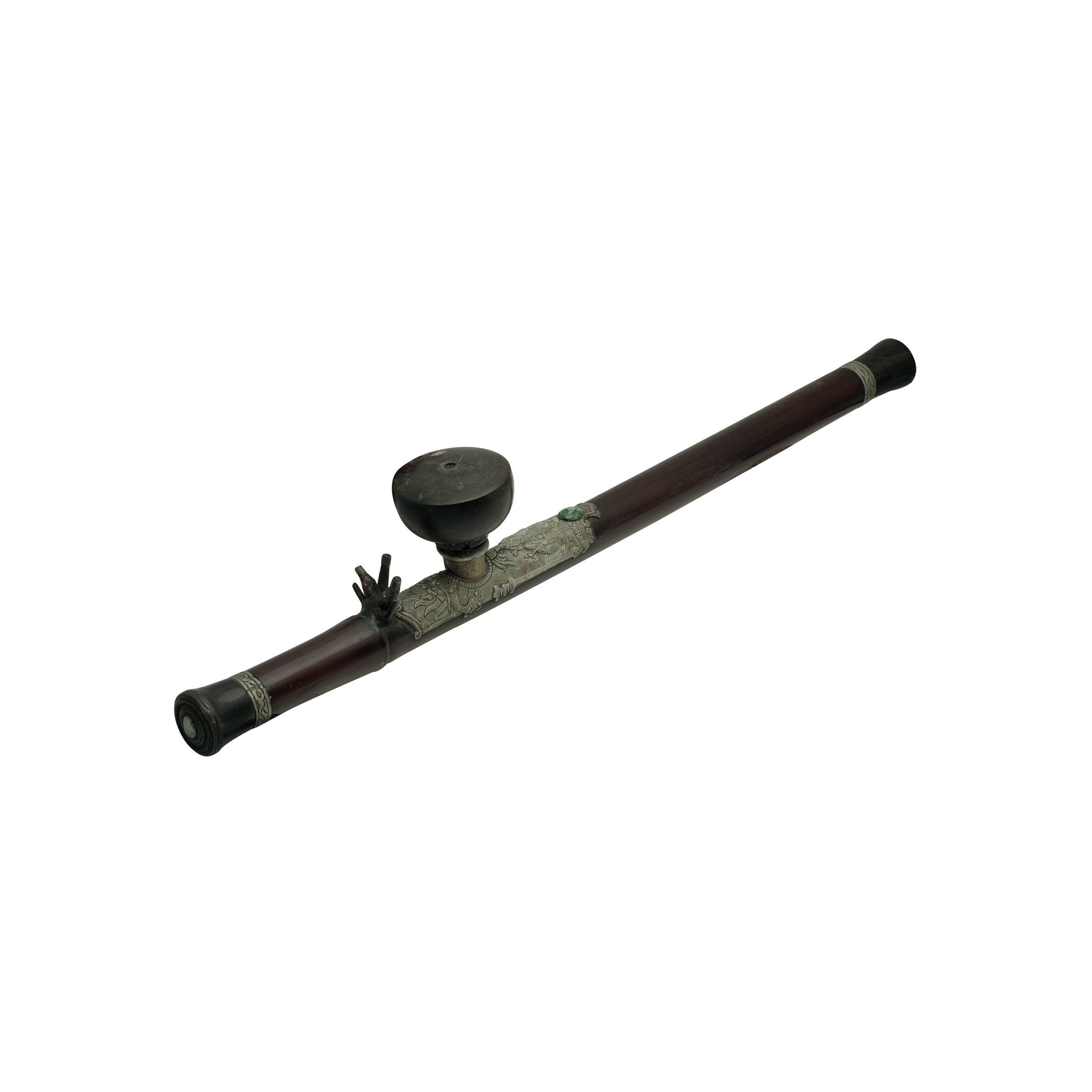
Origin: China
Date: Late 19th–early 20th century
Materials: Hardwood, metal alloy, ceramic
Dimensions: Appro 52 × 12 cm
Description:
Chinese opium pipe featuring a straight, polished hardwood stem of deep reddish-brown hue, capped at both ends with decorative metal fittings. The centerpiece is an engraved metal saddle, adorned with floral motifs and accented by a small inset stone. Mounted atop the saddle is a rounded ceramic bowl, darkened from historical use. Extending from the saddle’s side is a metal tool rest—shaped into a small hand-like form—intended to hold the opium needle or other implements between preparations.
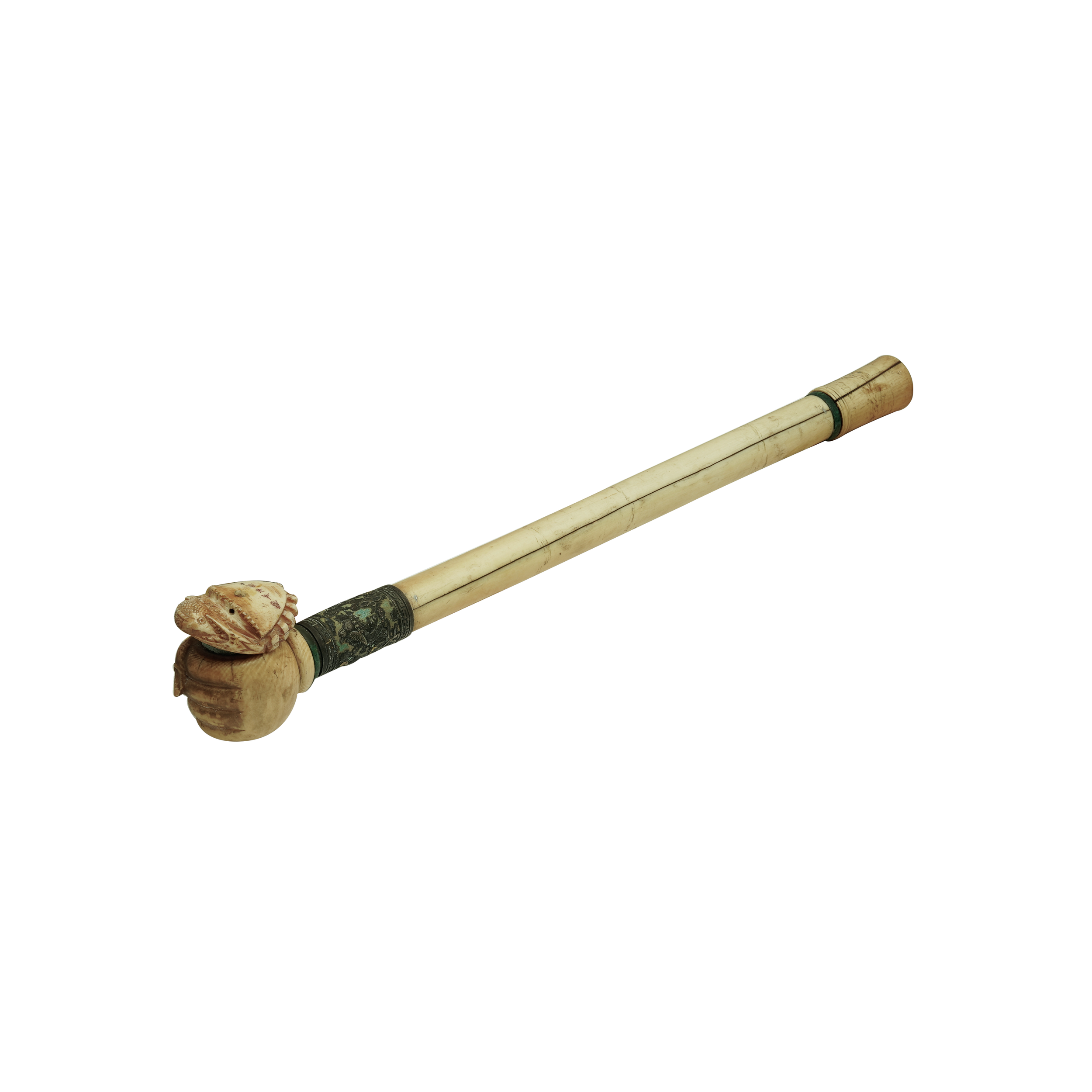
Origin: China
Date: Late 19th–early 20th century
Materials: Bone, metal alloy, shell
Dimensions: Appro 35 × 6 cm
Description:
Chinese opium pipe crafted from polished bone, giving it a smooth, ivory-toned finish. The stem is capped with fitted metal bands for reinforcement, one of which sits just behind the saddle area. The pipe’s unusual feature is its hand-carved fist-shaped saddle, grasping a natural shell that serves as the opium bowl.
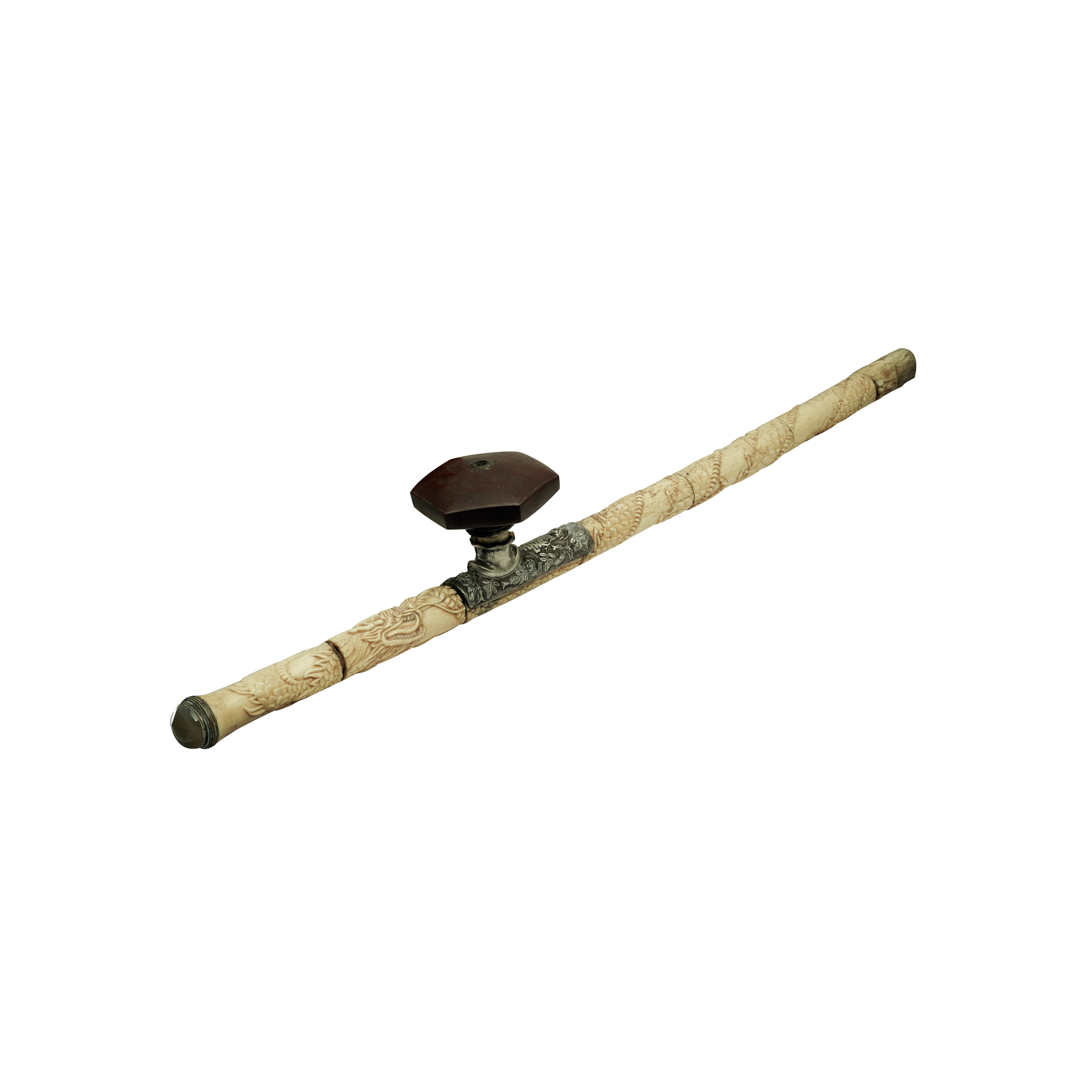
Origin: China
Date: Late 19th–early 20th century
Materials: Carved bone, metal fittings, hardwood bowl
Dimensions: Appro 12 × 62 cm
Description:
Carved opium pipe featuring a cylindrical bone shaft adorned with intricate dragon motifs, symbolizing power and protection in Chinese culture. The pipe is fitted with a dark hardwood bowl mounted on a metal saddle, which serves as the receptacle for the opium during smoking. The ornate metalwork and the precision of the carving reflect the craftsmanship and aesthetic sensibility associated with high-quality opium-smoking paraphernalia of the period.
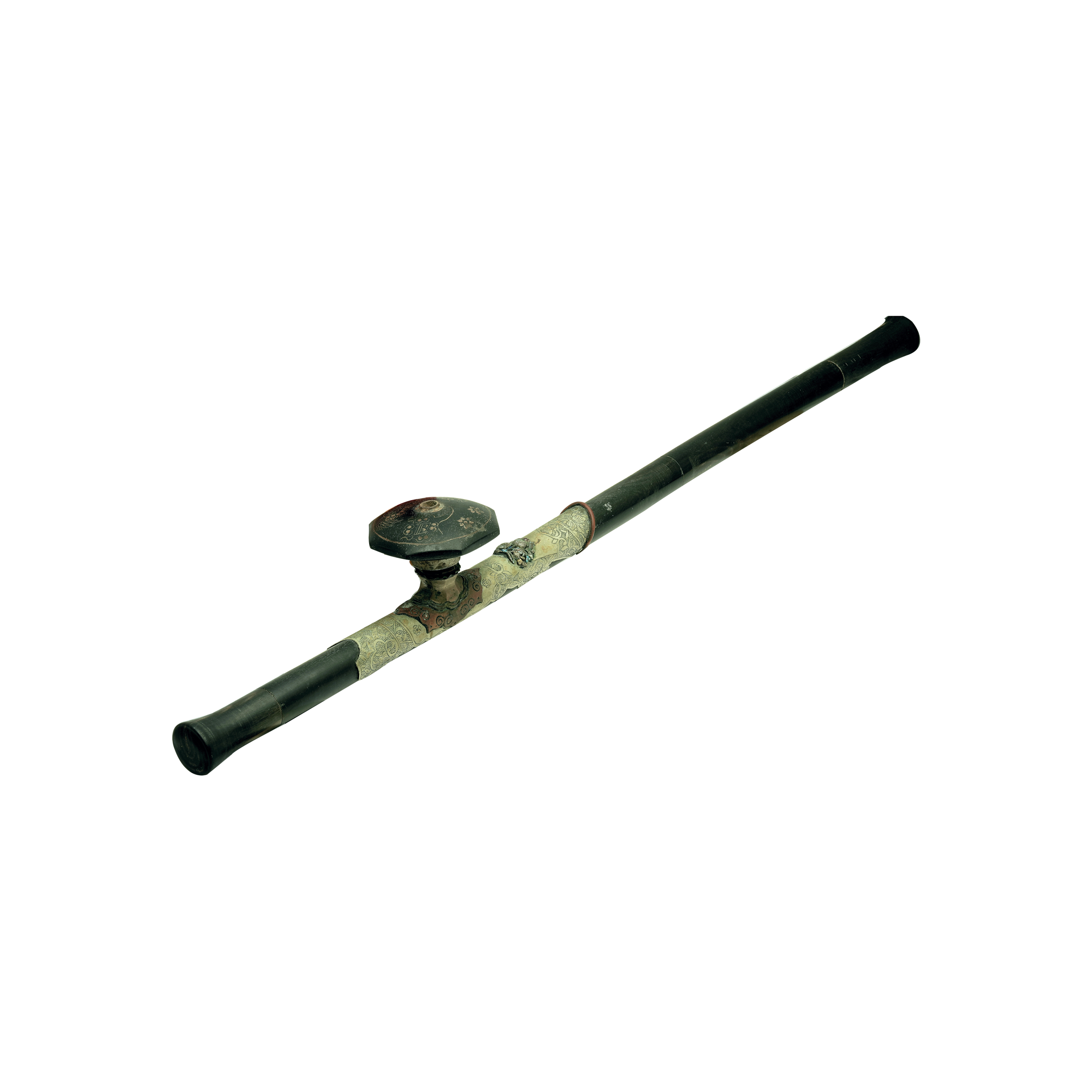
Origin: China
Date: Late 19th–early 20th century
Materials: Hardwood, lacquer, metal alloy, ceramic
Dimensions: Appro 61 × 12 cm
Description:
Chinese opium pipe featuring a straight, dark hardwood stem finished with a smooth lacquered surface, capped at both ends with fitted collars. At its center, a black ceramic bowl sits atop an unpainted engraved metal saddle, decorated with motifs typical of late Qing craftsmanship. The dark tones of the lacquered stem contrast elegantly with the metallic fittings, giving the piece both visual appeal and functional resilience.
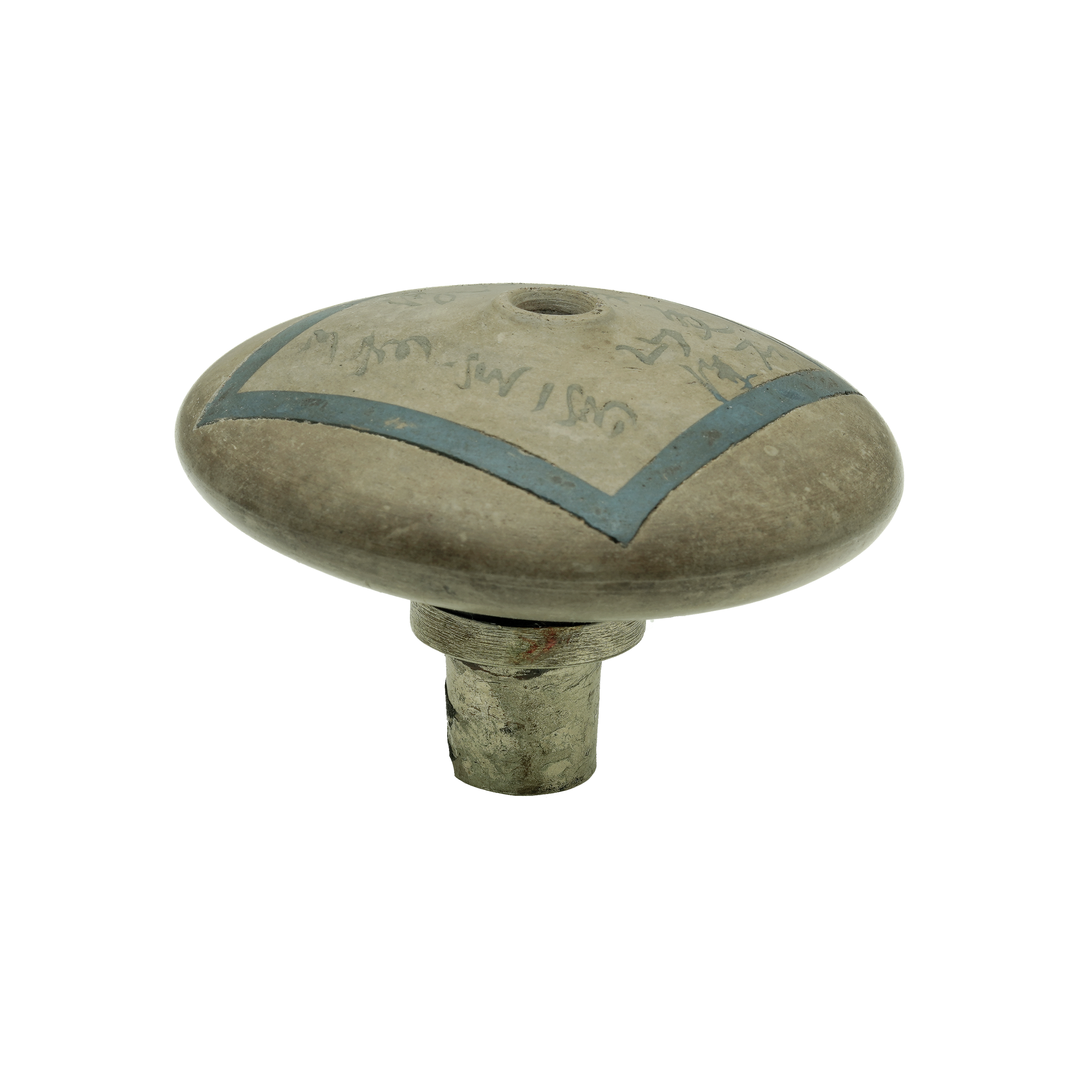
Opium Pipe Bowl – Ceramic
Dimensions: Appro 4 × 9 cm
Ceramic opium pipe bowl with a rounded form and central aperture. The surface is decorated with a blue chevron motif and faint inscriptions, showing signs of wear from use. Mounted on a metal fitting. Likely late 19th to early 20th century.
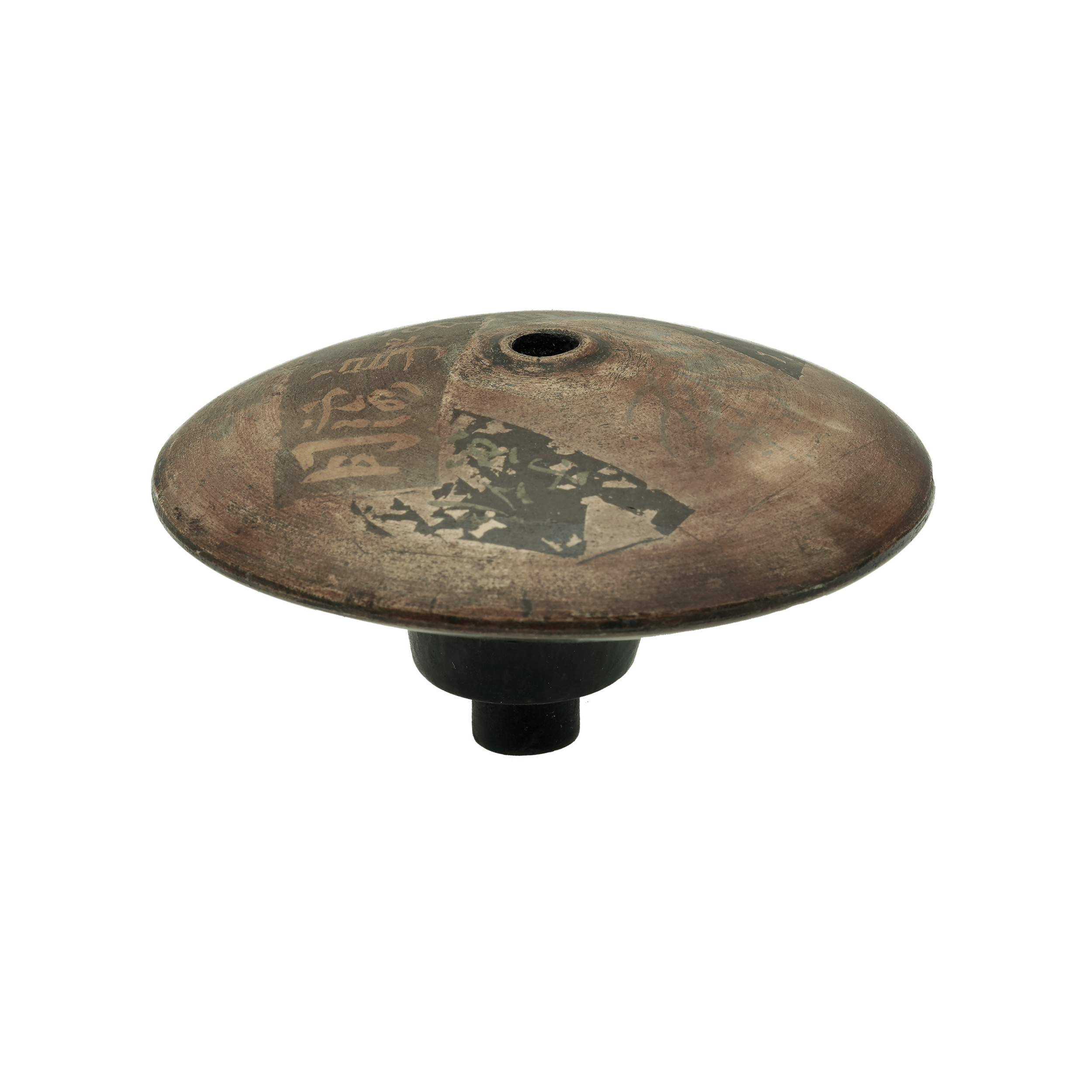
Opium Pipe Bowl – Ceramic
Dimensions: Appro 4 × 9 cm
Wide, shallow ceramic opium pipe bowl with a central aperture for heating opium. The surface features faded painted motifs, including Chinese characters and abstract patterns, with areas of wear consistent with extended use. Likely late 19th to early 20th century.
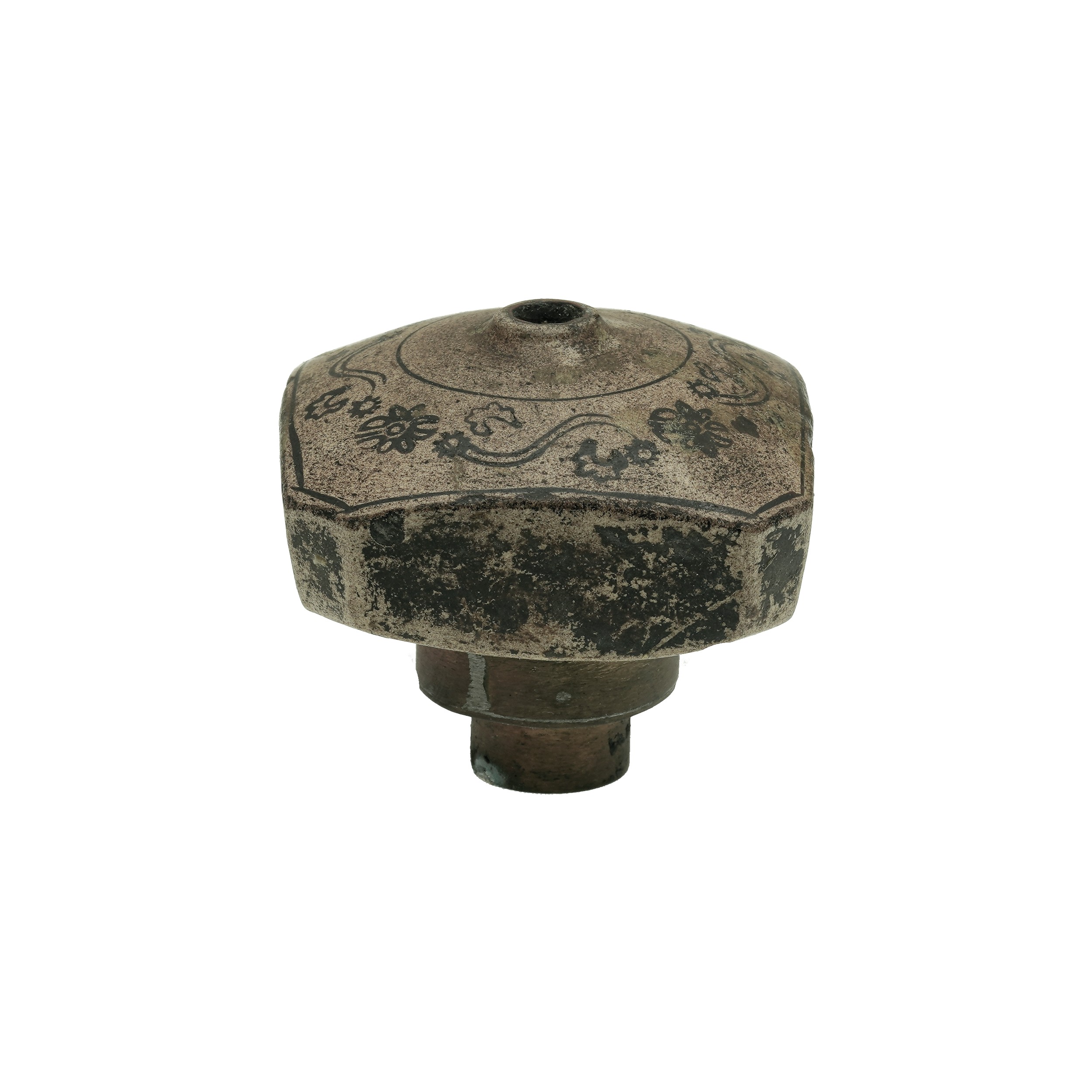
Opium Pipe Bowl – Ceramic
Dimensions: Appro 5 × 4 cm
Hexagonal ceramic opium pipe bowl decorated with a floral scroll motif on the top and geometric borders along the edges. Features a small central aperture for heating opium. Surface shows signs of wear and soot deposits from use. Likely late 19th to early 20th century.
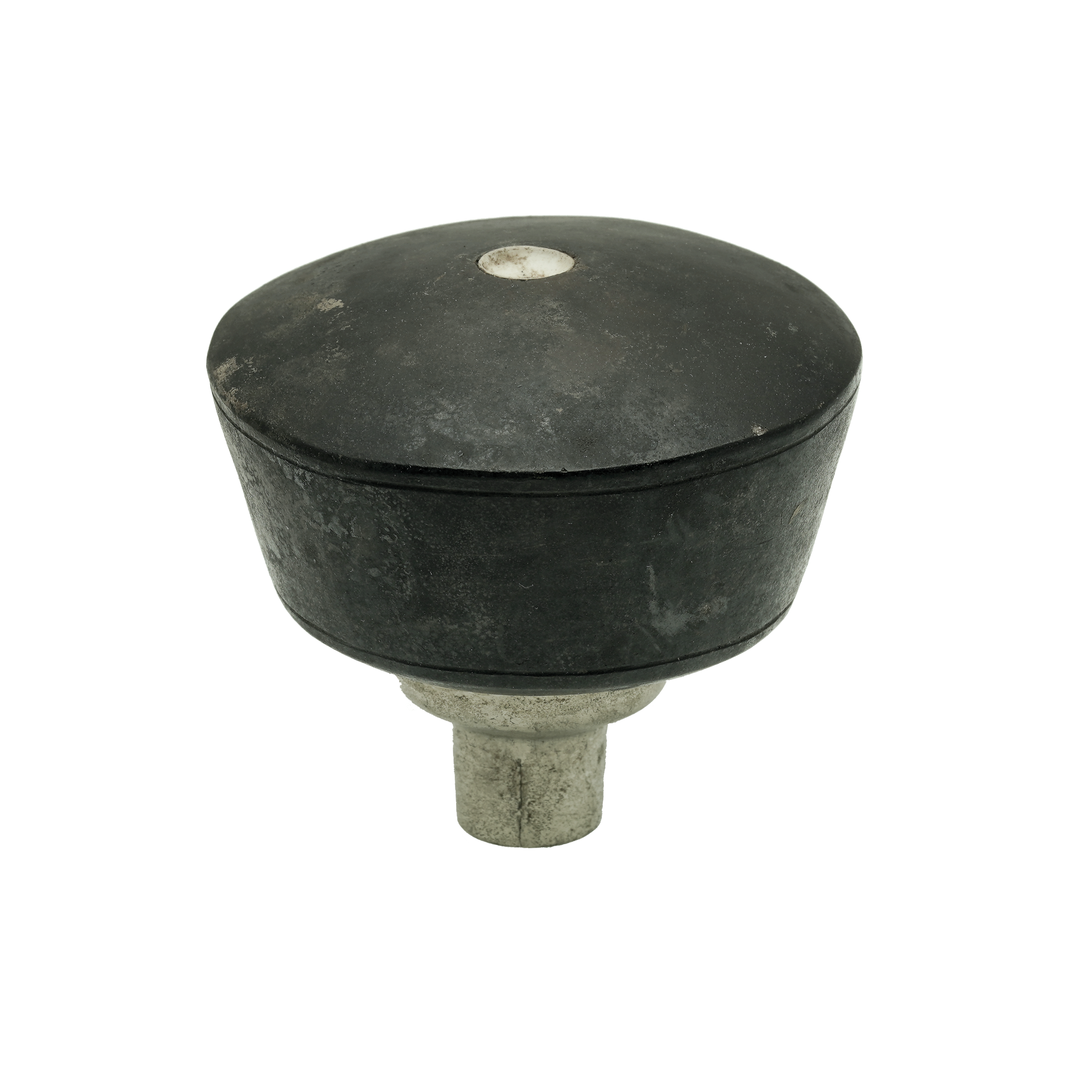
Opium Pipe Bowl – Ceramic
Dimensions: Appro 6 × 7 cm
Ceramic opium pipe bowl with a slightly tapered cylindrical body and domed top, featuring a small central aperture. Finished in a matte black glaze with minor surface wear. Likely late 19th to early 20th century, used for heating and vaporizing opium during smoking.
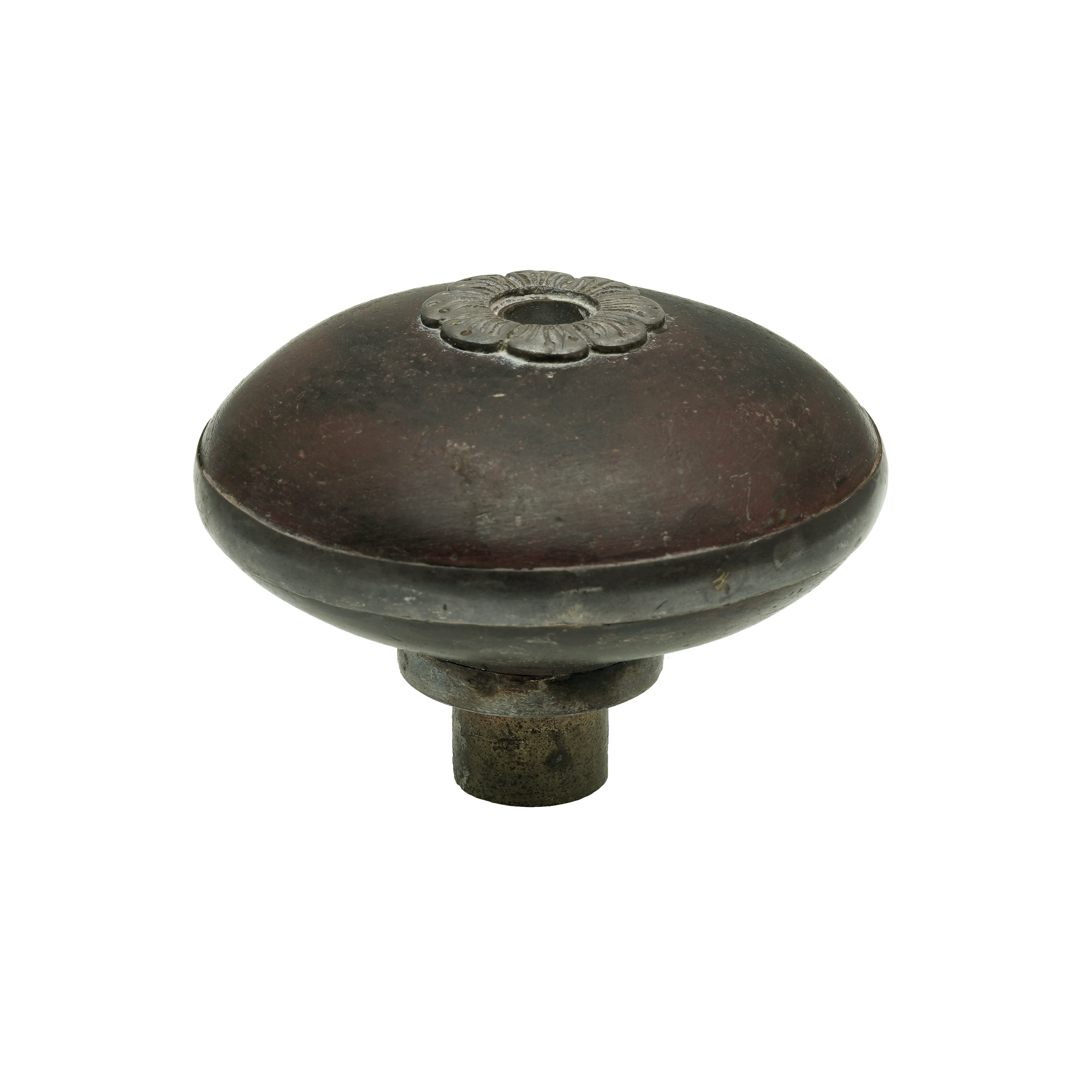
Opium Pipe Bowl – Ceramic
Dimensions: Appro 7 × 6 cm
Ceramic opium pipe bowl with a rounded, domed form and small central aperture encircled by a molded floral motif. Finished in a dark brown glaze with signs of wear from use. Likely late 19th to early 20th century, employed in the heating and vaporization of opium.
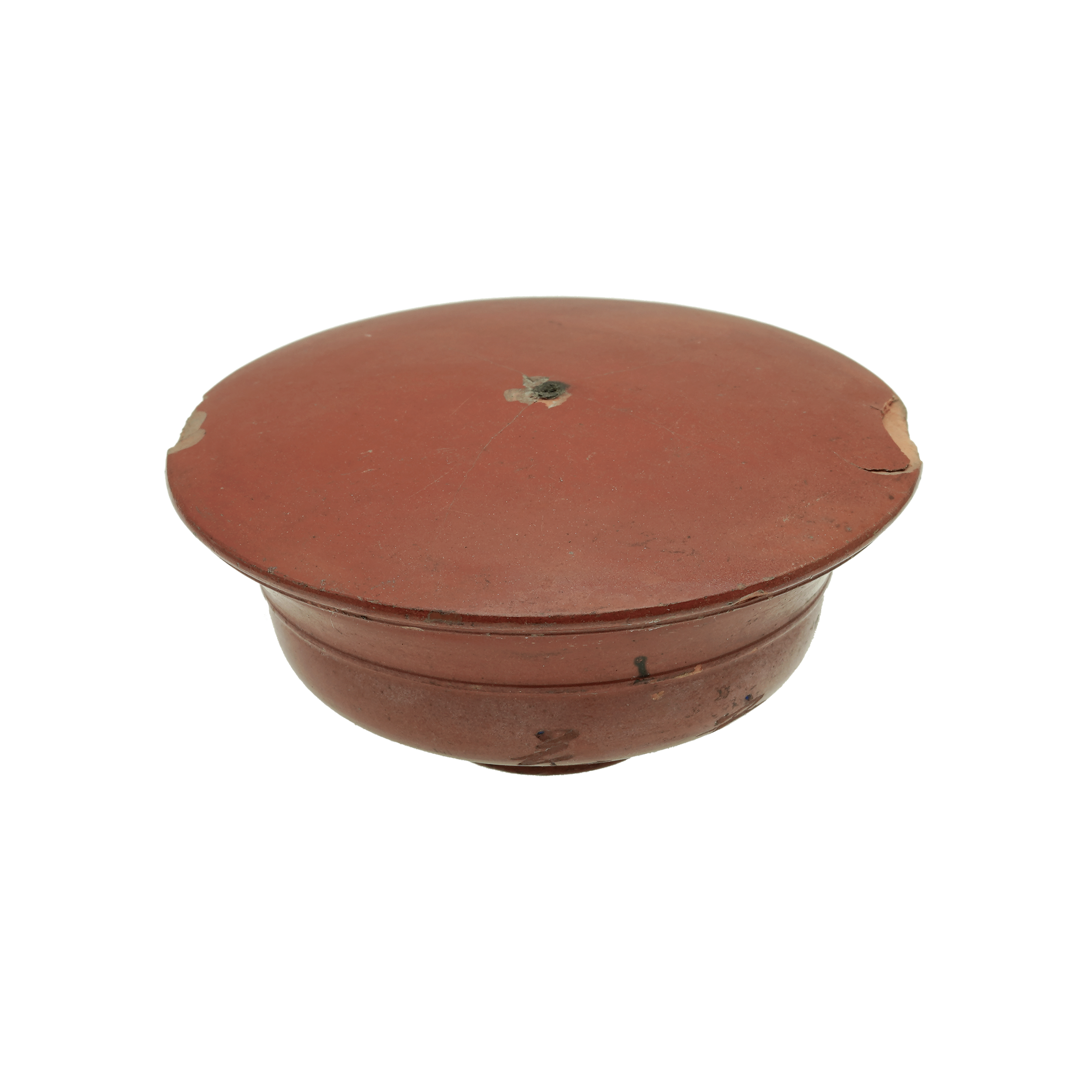
Opium Pipe Bowl – Ceramic
Dimensions: Appro 4 × 8 cm
Ceramic opium pipe bowl with a broad, flat, circular form and small central aperture. Finished in a matte red slip, now worn in places to reveal the underlying material. Likely late 19th to early 20th century, used in the preparation and smoking of opium.
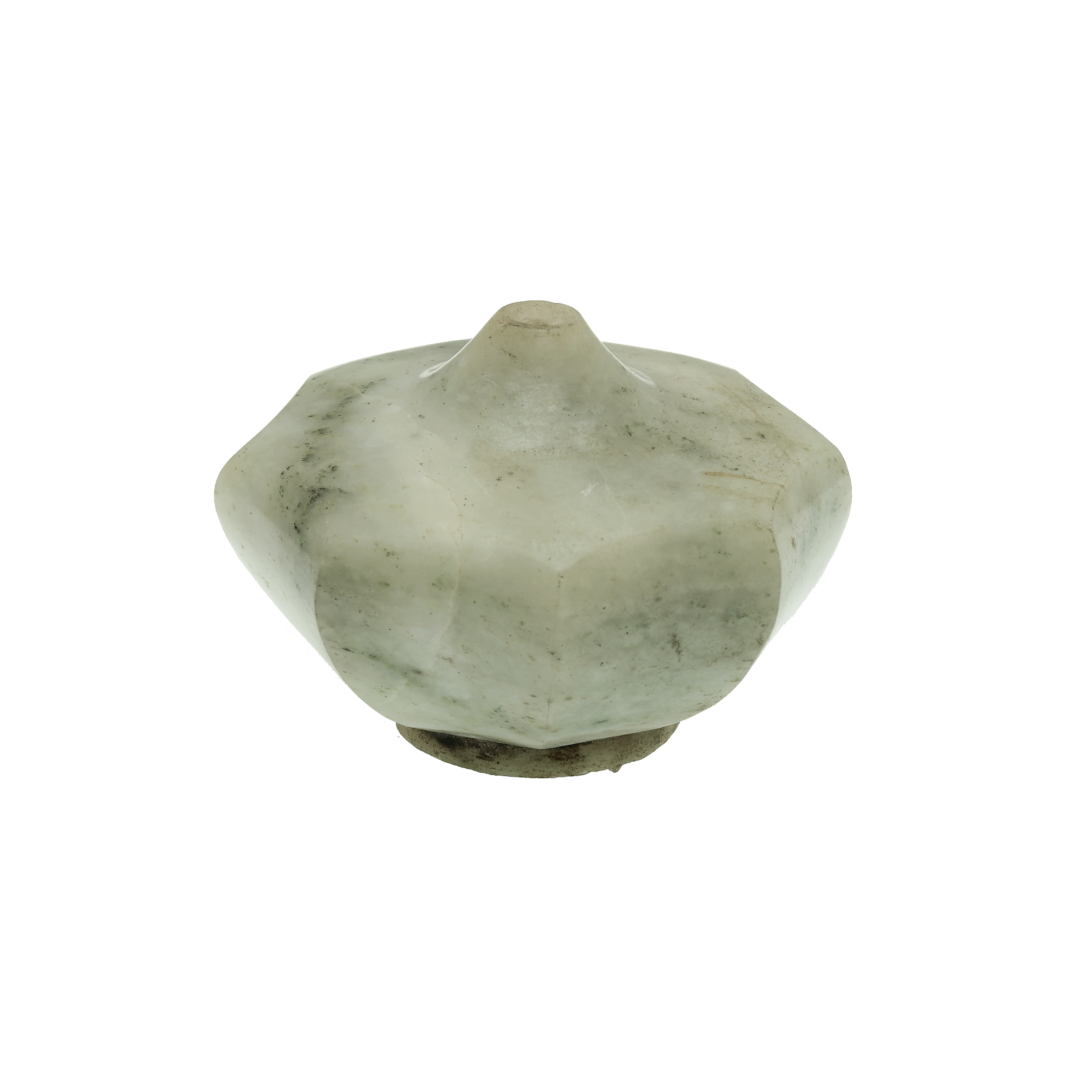
Opium Pipe Bowl – Stone
Dimensions: Appro 6 × 5 cm
Stone opium pipe bowl with a faceted, lobed body tapering to a small central aperture. The pale greenish surface suggests use of a hardstone such as jade or serpentine. Likely late 19th to early 20th century, employed for heating opium in traditional smoking practices.
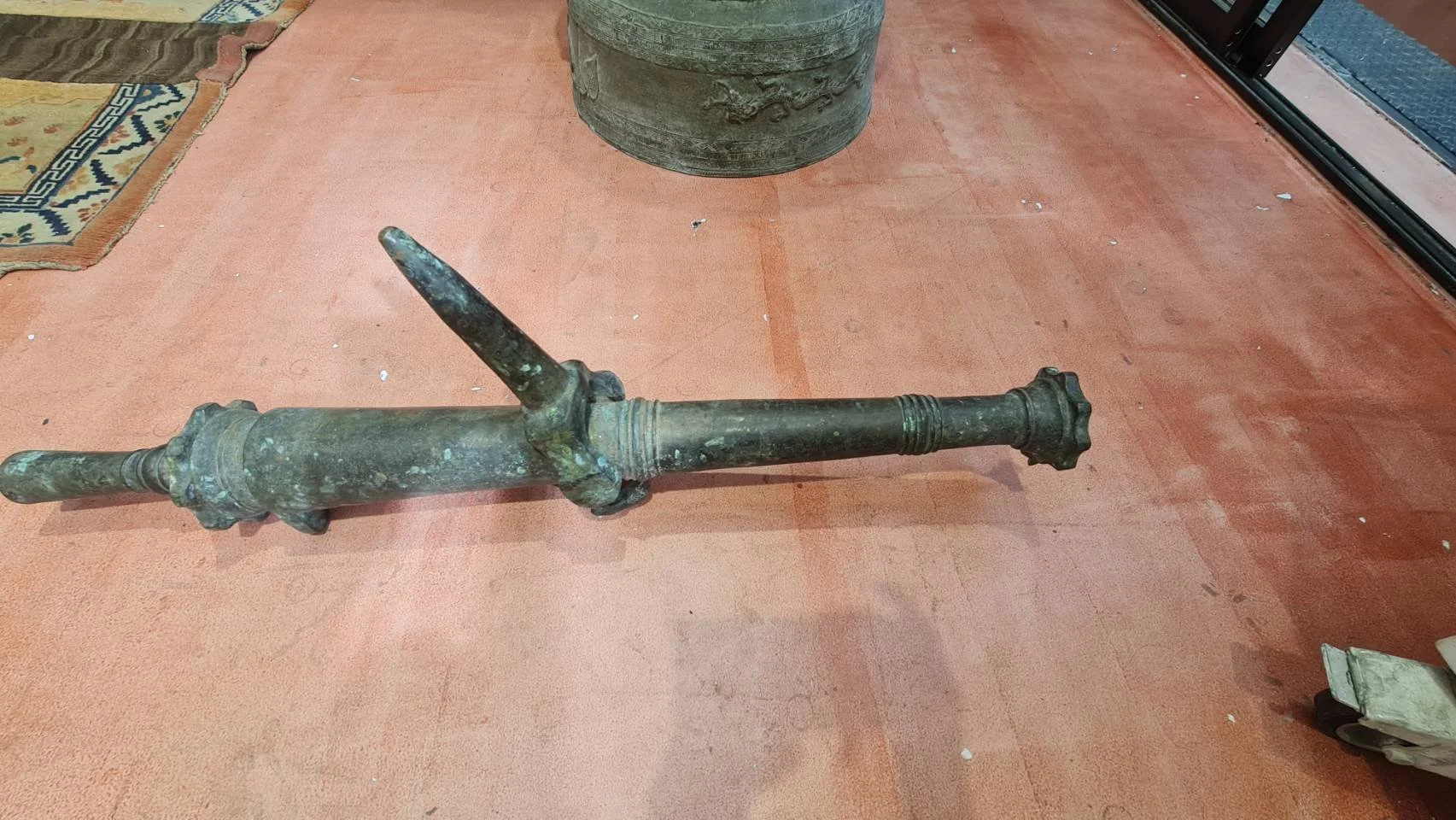
UNKNOWN ARTIST
Circa 1800-1820
Original Item: One of a Kind. Here we have a wonderful original bronze lantaka swivel cannon barrel, dating to about 1800-1820. While these were used throughout South East Asia, this style is from the “East Indies”, more properly known as South Eastern Asia. These were used only at close quarters, used to fire lead balls, stones and other debris while mounted on boats and other ocean going craft during the age of Sailing.
The cannon is very heavy, weighing in at 33lbs, a good sign as later copies are much lighter and sometimes are filled internally with foam to be sold as fakes.
Totally authentic but not too big to display in home or office.
Dimensions:
Lantaka or rentaka was a type of bronze portable cannon or swivel gun, sometimes mounted on merchant vessels and warships in Maritime Southeast Asia. It was commonly equipped by native seafaring vessels from Indonesia, Philippines, Brunei, and Malaysia. Lela and rentaka are known by the Malays as meriam kecil (lit. "small cannon"), the difference is that rentaka is smaller in length and bore than a lela.
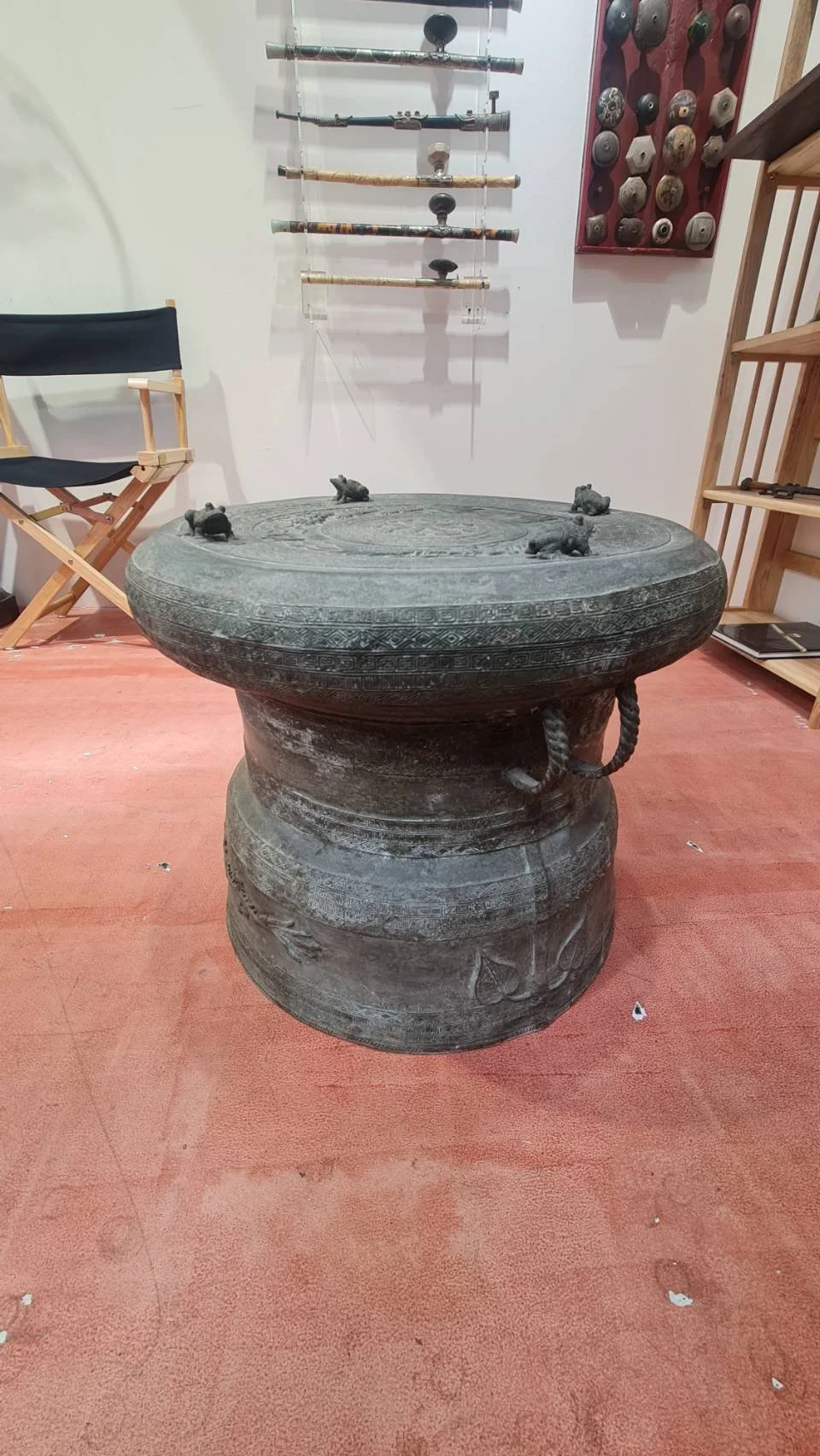
UNKNOWN ARTIST
The object in the image is a type of Southeast Asian bronze drum, commonly known as a "rain drum" or "frog drum". These drums are found across various cultures in Southeast Asia and as far away as Indonesia.
Dimensions:
The drums are typically decorated with frogs around the rim, which are symbols of water and rain, and associated with fertility. The sound produced by striking the drum is sometimes likened to the roar of thunder or a bullfrog, heralding the monsoon rains.
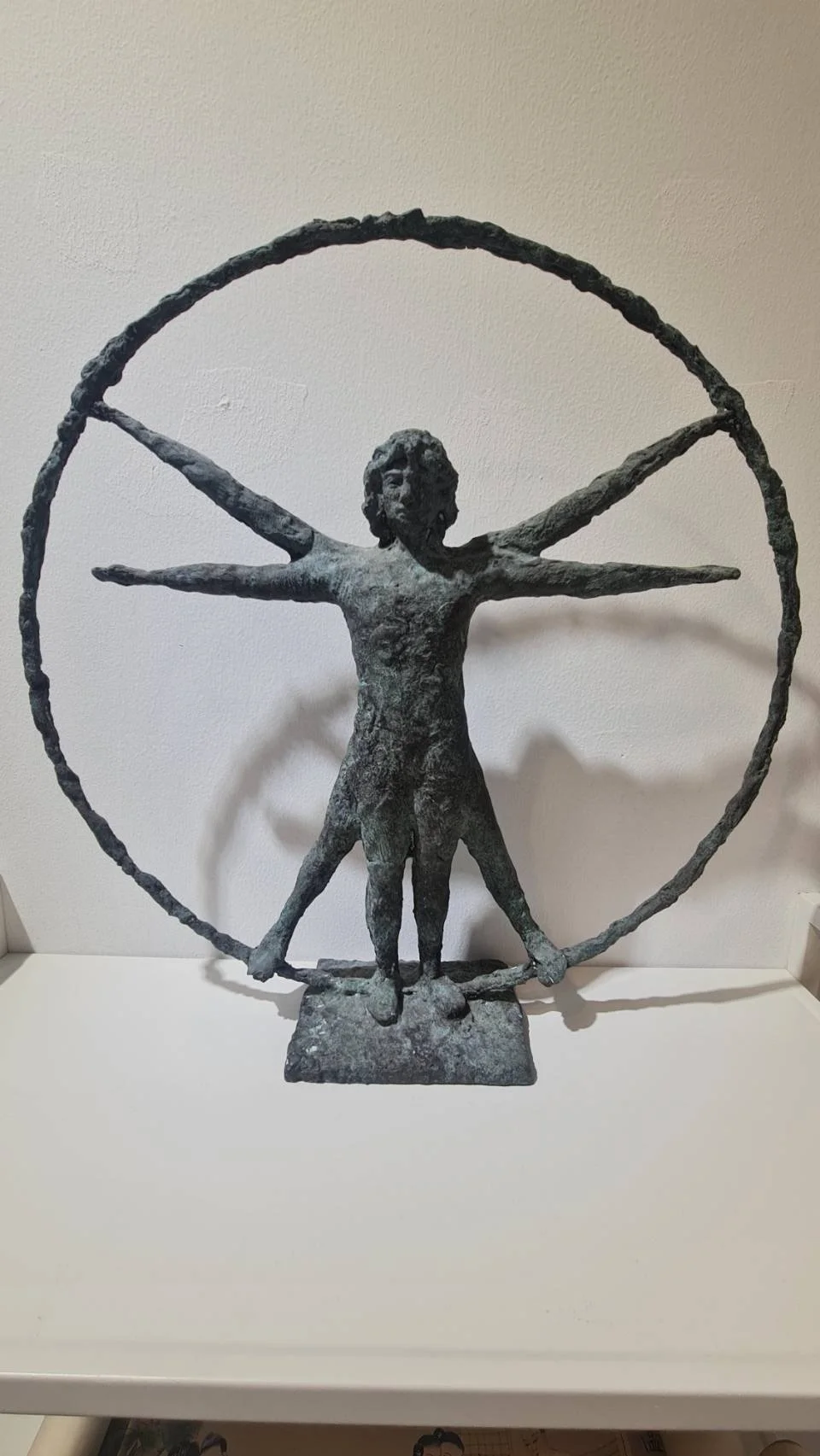
BOZE
JIM MORRISON inspired by Leonardo Da Vinci,
Bronze sculpture with green patina
Dimensions: 25 × 20 cm
This bronze sculpture reinterprets Leonardo da Vinci’s iconic Vitruvian Man, translating the Renaissance master’s study of human proportions into three-dimensional form. The figure stands within a large circular frame, arms and legs extended to convey balance, symmetry, and the harmony between man and the universe. Cast with a textured surface and green patina, the work evokes a timeless quality, bridging classical ideals with modern sculptural expression. It serves as both an homage to da Vinci’s pursuit of knowledge and a meditation on the enduring quest for human perfection.
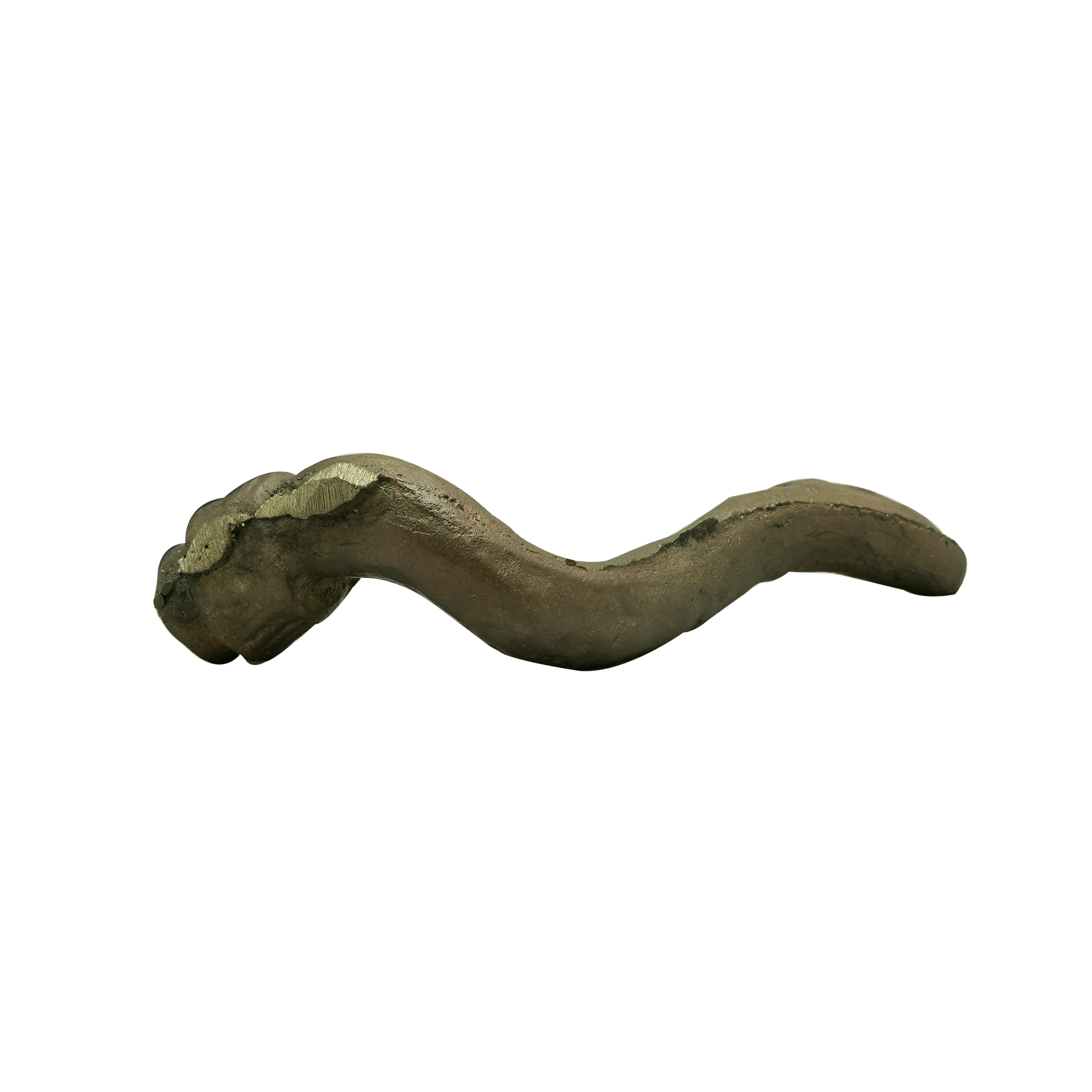
Door Handle by Diego Giacometti
Bronze, mid-20th century
Dimensions: 12 × 4 cm
This sculptural bronze door handle by Diego Giacometti exemplifies his organic and tactile approach to functional design. The handle, with its fluid, undulating form, suggests a natural branch or creature in motion, blurring the boundary between utility and art. Giacometti’s rough-textured surface treatment enhances its hand-crafted character, inviting touch while emphasizing the artist’s signature style rooted in nature and simplicity.
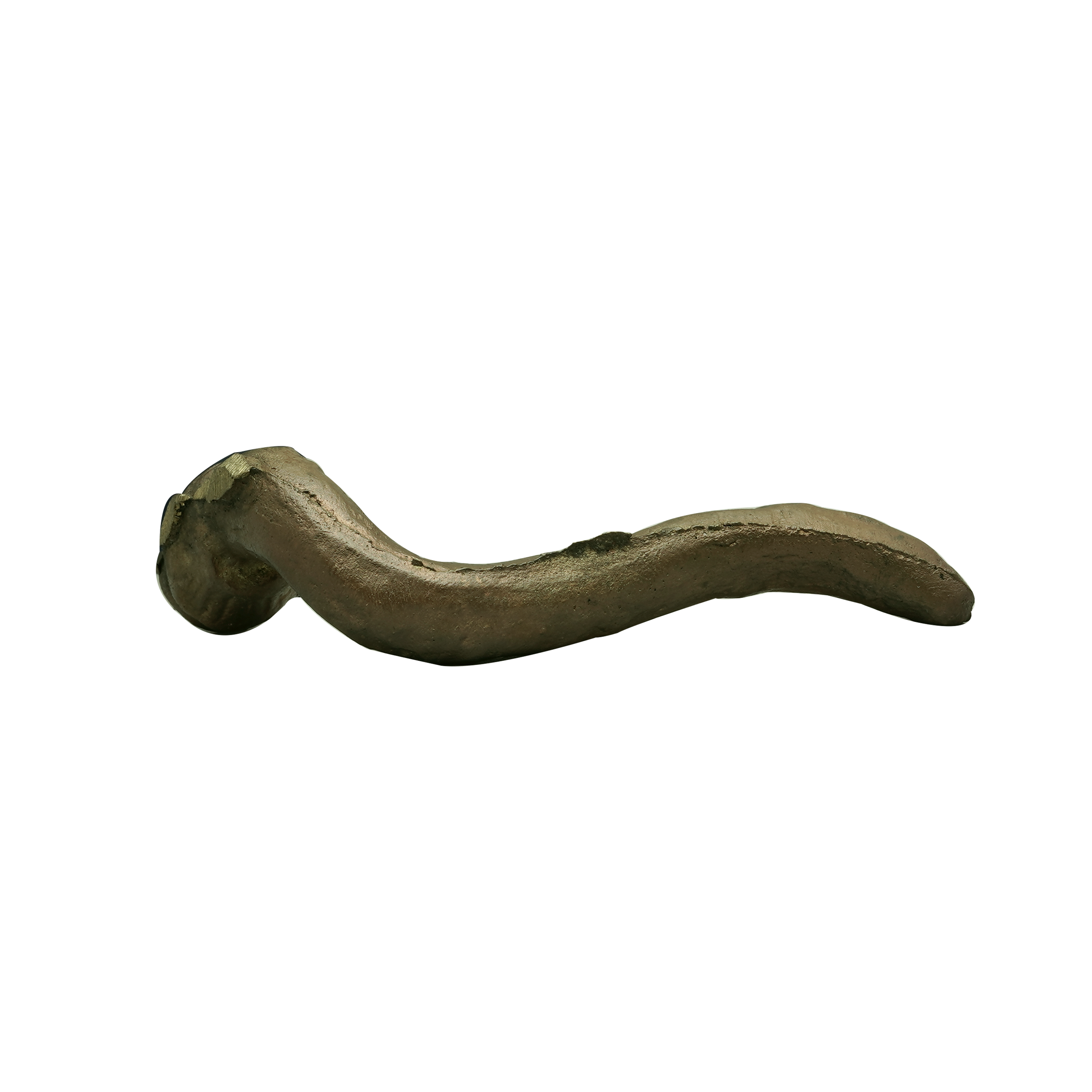
Door Handle
Diego Giacometti (1902–1985)
Bronze
Dimensions: 12 × 4 cm
This door handle by Diego Giacometti demonstrates his organic and tactile approach to design. Shaped with subtle irregularity, its gently undulating form evokes natural motifs—such as branches or animal silhouettes—while remaining functional as an everyday object. The hand-finished surface bears the artist’s signature texture, a hallmark of his work that blends sculpture with utility. Giacometti’s creations transformed simple furnishings into poetic works of art, merging craftsmanship with imagination.
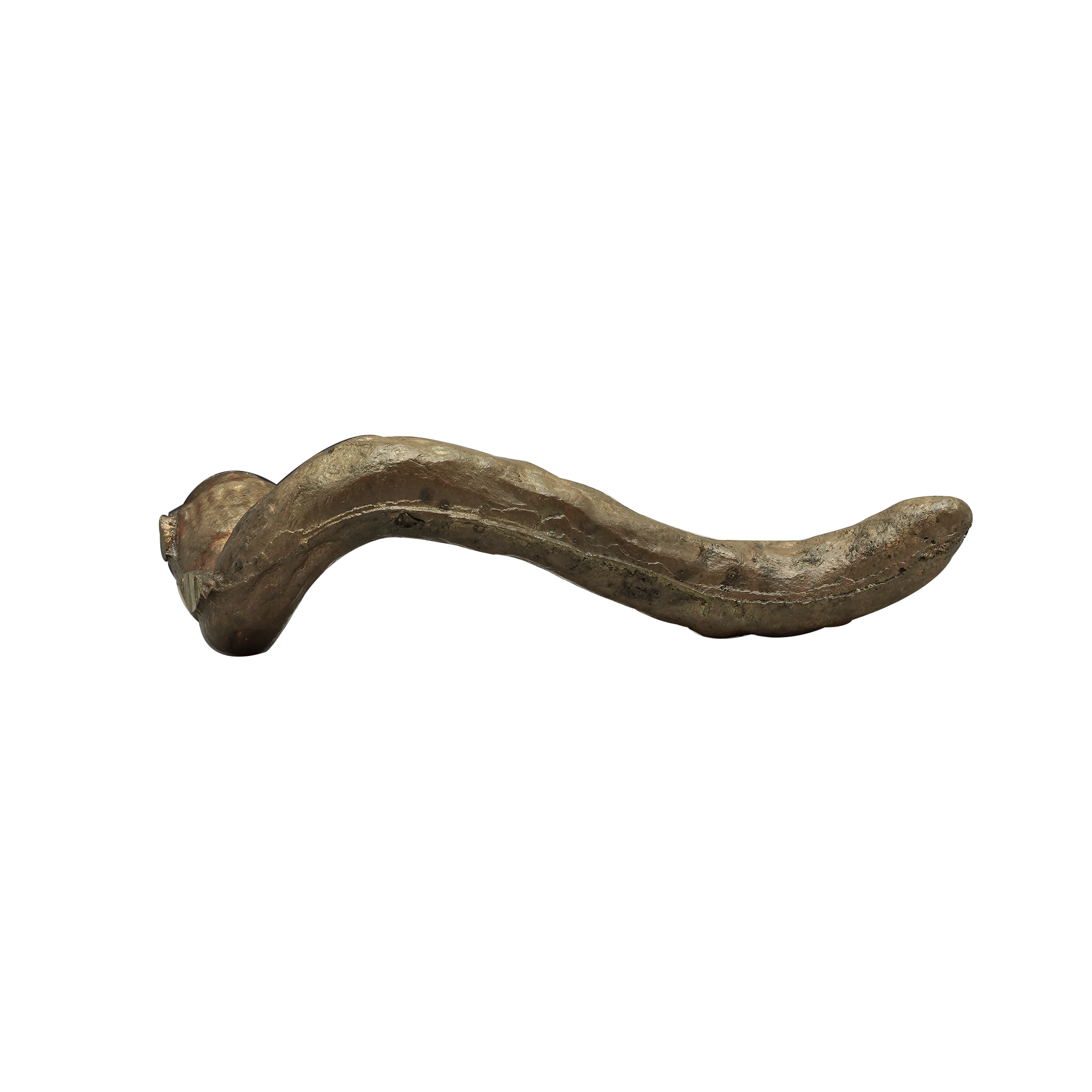
Door Handle by Diego Giacometti
Bronze, mid-20th century
Dimensions: 12 × 4 cm
Bronze door handle, designed by Diego Giacometti, exemplifies his ability to transform everyday objects into sculptural works of art. With its organic, sinuous form, the handle blurs the line between functionality and artistry, echoing natural shapes while remaining tactile and practical. Giacometti’s distinct textured surfaces give the piece a handmade, almost primitive quality, reflecting his philosophy that beauty lies in simplicity and imperfection.
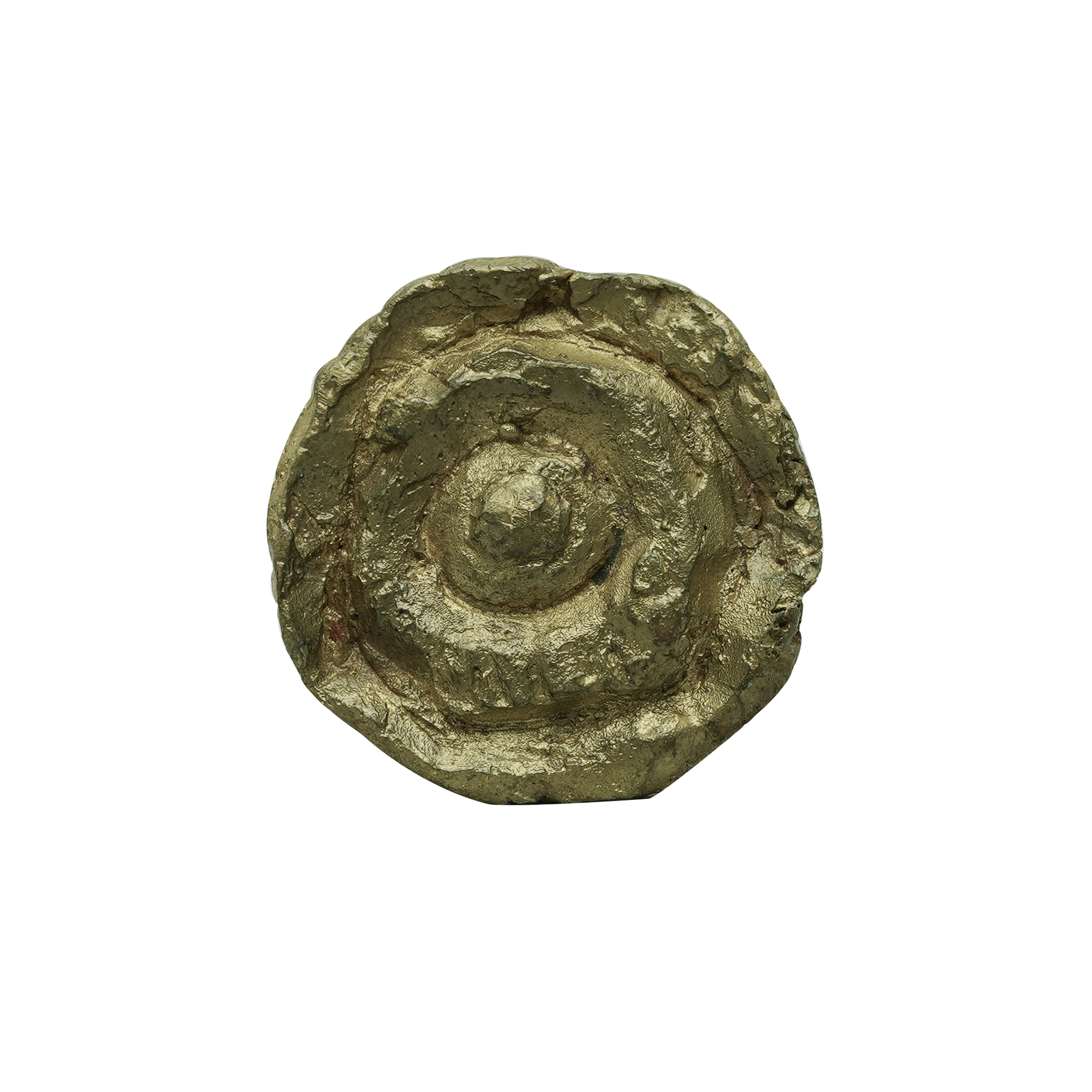
Diego Giacometti (1902–1985)
Door Handle, Bronze
Dimensions: 6 × 5 cm
Sculptural door handle exemplifying Diego Giacometti’s distinctive approach to functional art. Cast in bronze with a textured, organic surface, the piece transforms a utilitarian object into a tactile artwork. The design, reminiscent of ancient artifacts and natural forms, reflects Giacometti’s ability to merge simplicity with poetic expression. Its irregular, hand-worked finish underscores the artisanal quality that made his creations both intimate and timeless.
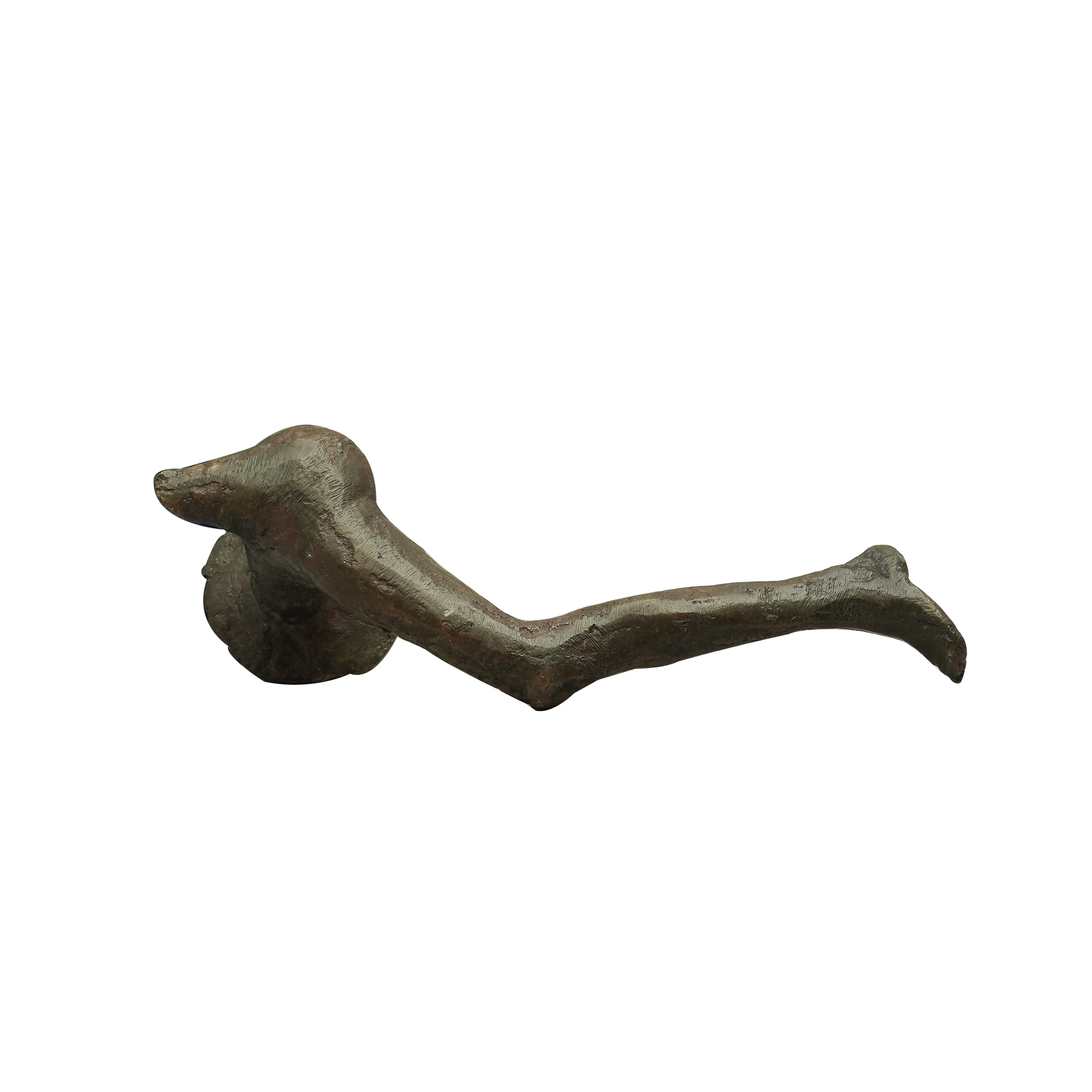
Diego Giacometti (1902–1985)
Door Handle in the Form of a Reclining Figure
Bronze, patinated, c. 1960s–1980s
Dimensions: 3 × 12 cm
This bronze door handle shows Diego Giacometti’s gift for turning everyday objects into works of art. The reclining figure, both abstract and playful, reflects his signature blend of utility and poetry. Known for his furniture and decorative pieces, Giacometti infused even the smallest designs with elegance and imagination.
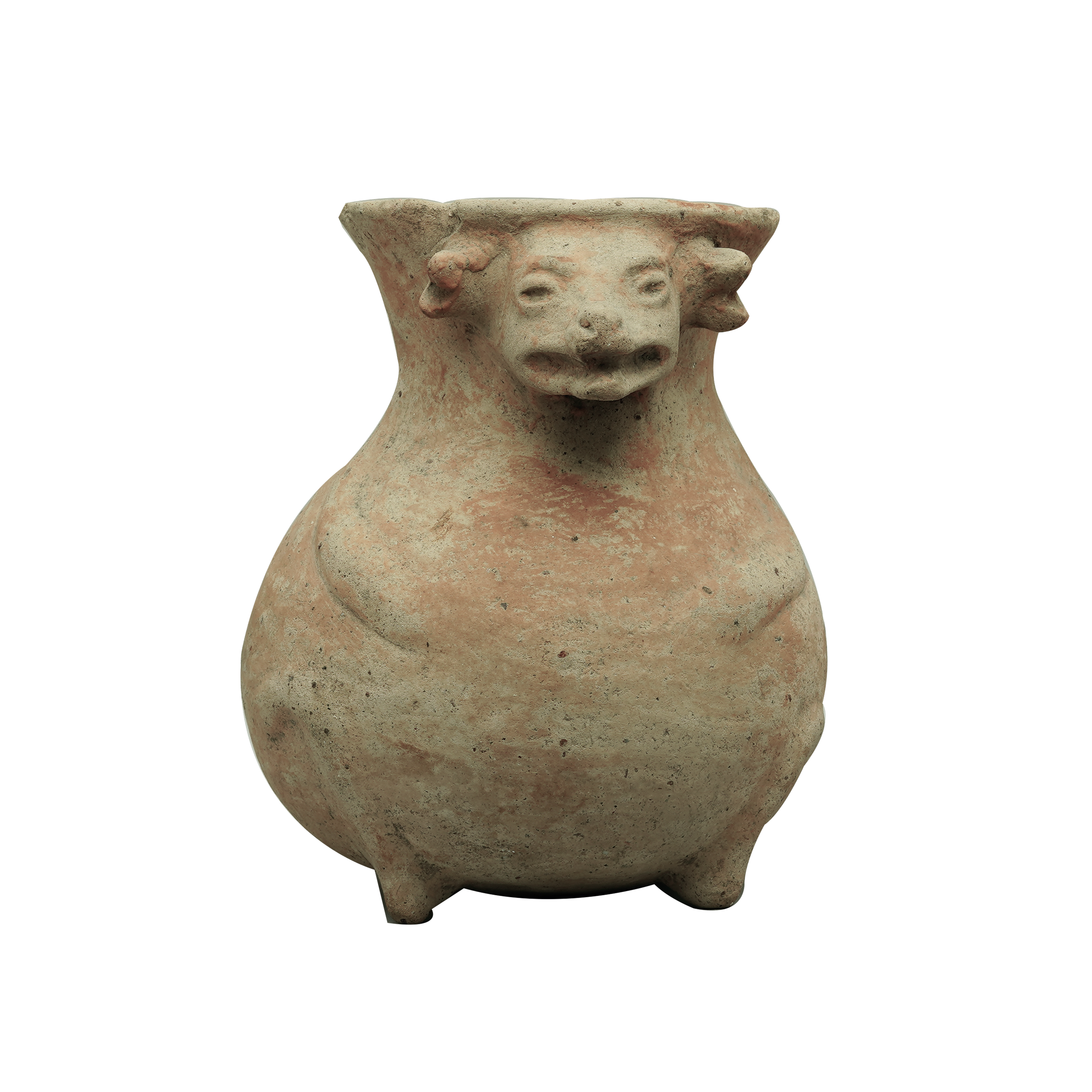
Maya Animal Effigy Vessel
Maya Culture, ca. 600–900 CE
Terracotta
Dimensions: 15 High -13 wide cm
Globular ceramic vessel featuring an animal head modeled at the rim, with rounded body and small tripod supports. The expressive snout, eyes, and ears suggest a symbolic creature, likely linked to fertility or protection. Used in ritual or domestic settings, such effigy jars combined utility with spiritual meaning, reflecting the Maya tradition of imbuing everyday objects with sacred significance.
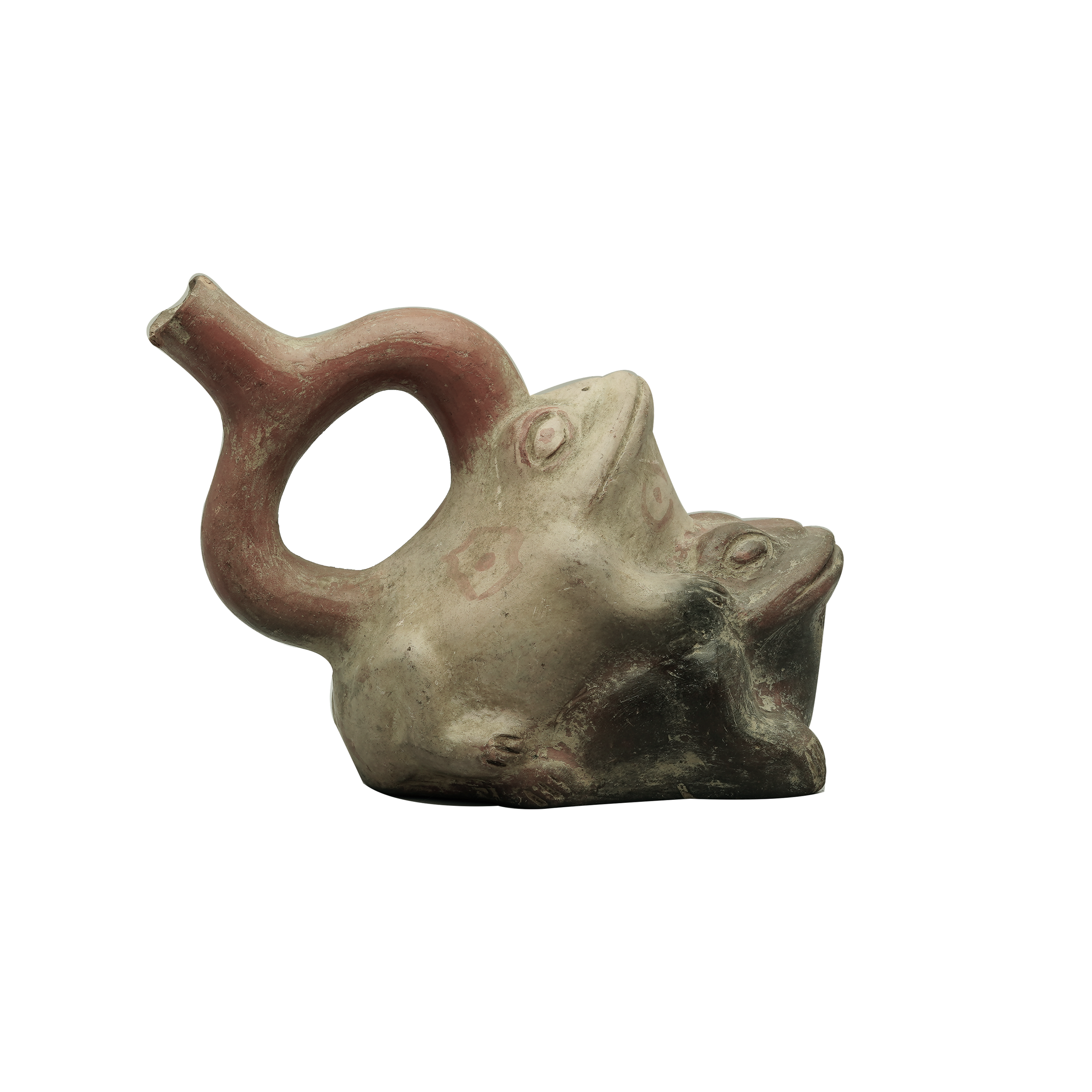
Stirrup-Spout Vessel with Frogs
Pre-Columbian, Moche Culture (100–700 CE)
Ceramic, slip-painted
Dimensions: 18x14 cm
Crafted vessel depicting two frogs in dynamic composition, rendered with naturalistic detail. The stirrup-shaped spout, characteristic of Moche ceramics, allowed for controlled pouring while also serving symbolic purposes. Frogs were powerful symbols of fertility, transformation, and water abundance, closely tied to agricultural cycles and rain.
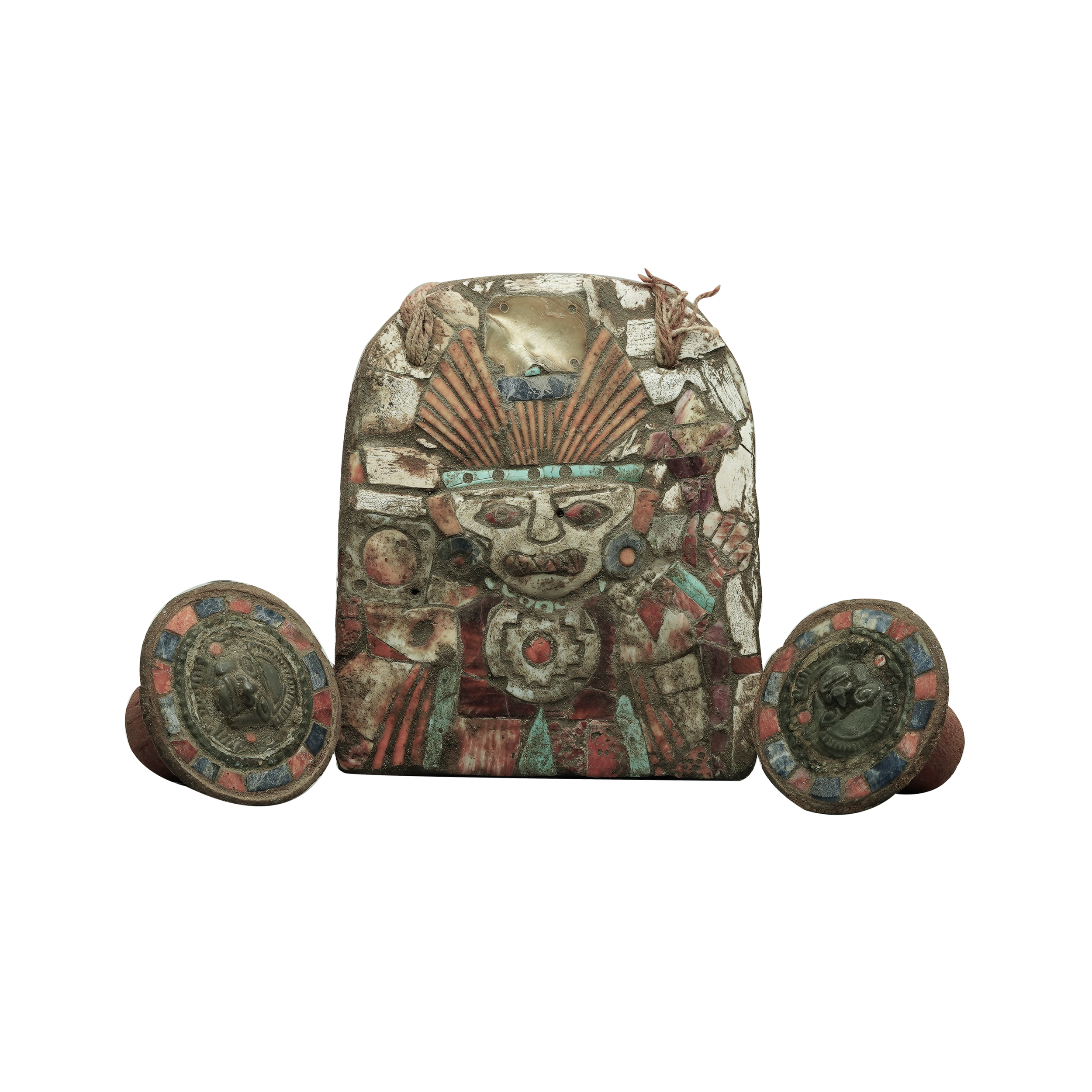
Ceremonial Polychrome Pectoral
Late Postclassic Period (c. 1200–1500 CE)
Peru, Inca or Central Highlands
Dimensions: 13 × 11 cm
Polychrome ceramic pectoral depicting a richly adorned deity or priestly figure, rendered with vibrant pigments of red, turquoise, white, and black. The central plaque features a stylized face framed by a dramatic headdress and elaborate ornaments, signifying high status and sacred authority. The two accompanying round earspools, decorated with modeled faces and colorful geometric borders, would have complemented the regalia, evoking themes of ritual power and divine presence.
Such pectorals were likely used in ceremonial contexts, possibly as part of ritual attire or as offerings, symbolizing the connection between earthly rulers and the divine. The bold iconography and careful workmanship reflect the importance of costume and ornament in pre-Columbian religious and political life.
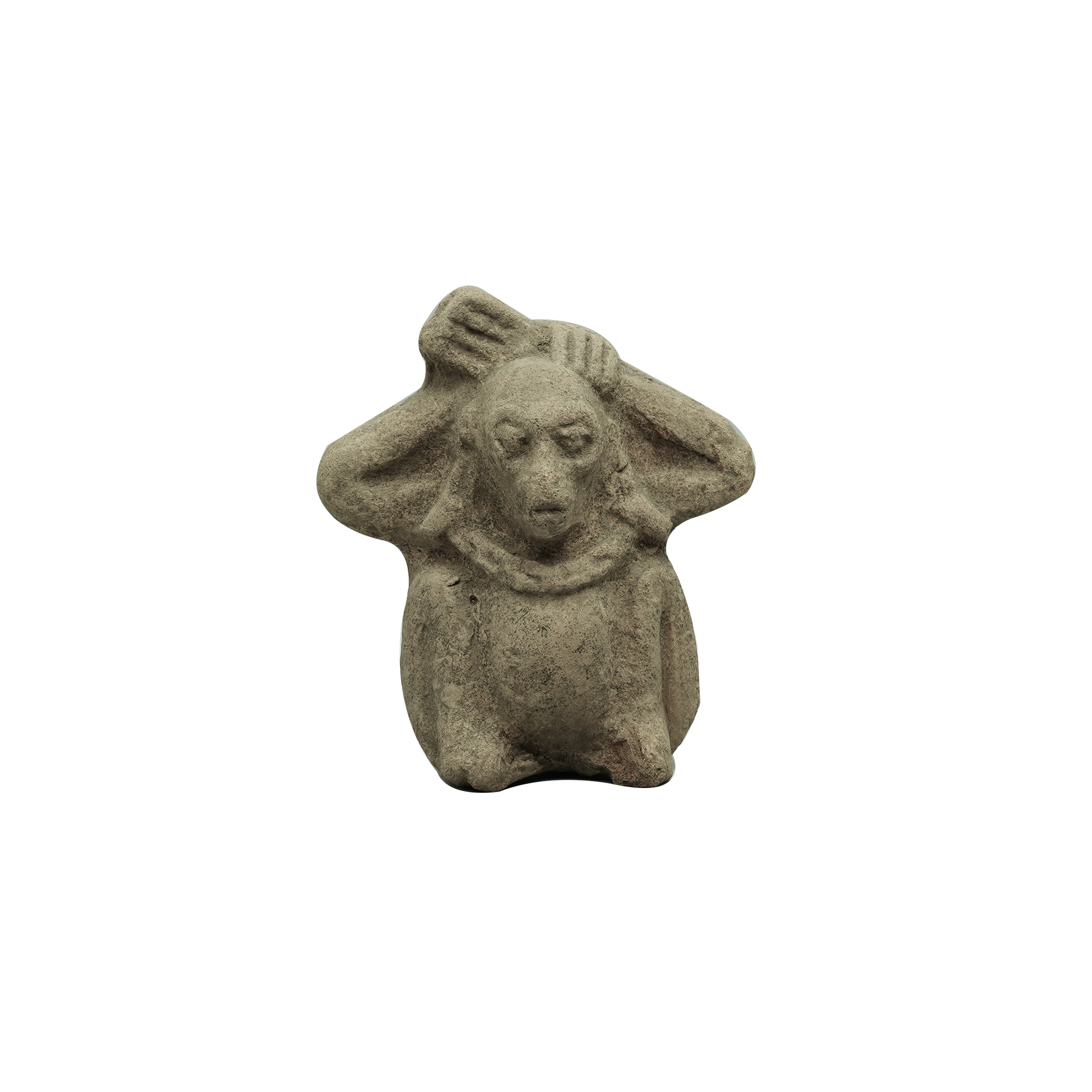
Pre-Columbian / Maya Ceramic Figurine
Late Classic Period (c. 600–900 CE)
Dimensions: 9 × 6 cm
Small ceramic figure depicting a seated monkey with arms raised to its head. Monkeys were significant in Maya culture, linked to scribes, musicians, and mythological beings from the Popol Vuh. The simple modeling emphasizes posture and expression rather than surface detail. Likely used in a ritual or domestic context, the figurine reflects both artistic skill and symbolic meaning in Maya society.
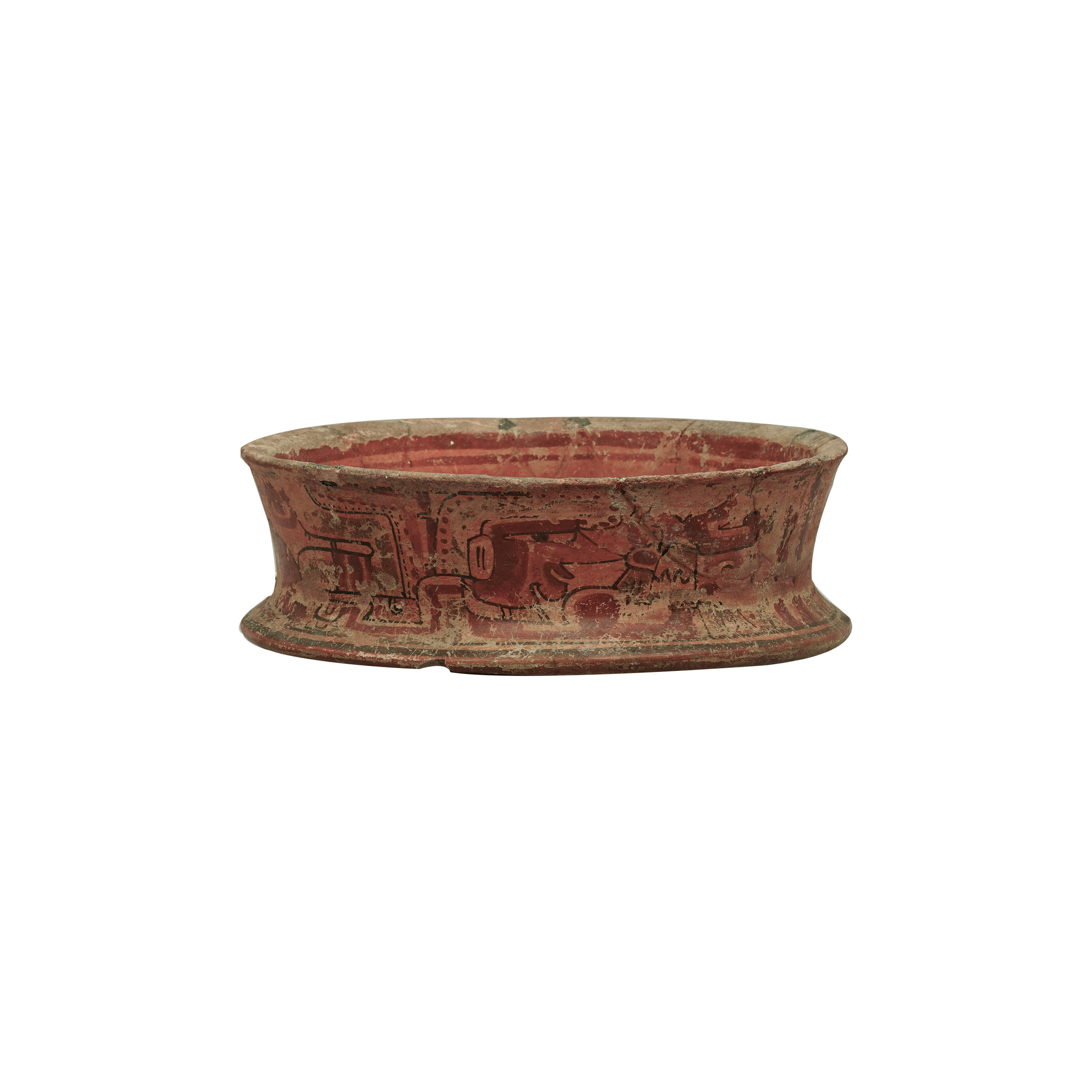
Maya Shallow Bowl with Painted Motifs
Maya Civilization, ca. 400–900 CE
Ceramic with red slip and painted decoration
Dimensions: 21 × 9 cm
Shallow ceramic bowl featuring painted motifs along its flaring sides, rendered in dark pigment against a red slip surface. Its wide, open form suggests use in serving food or drink, possibly in elite feasting or ritual contexts. The fine decoration and careful shaping reflect the Maya tradition of combining utility with artistic expression, making such vessels both functional and symbolic objects in daily and ceremonial life.
Maya Ceramic Goblet
Maya Civilization, ca. 400–900 CE
Ceramic with red slip and surface encrustation
Dimensions: 8 × 7 cm
Small goblet, with traces of red pigment and darkened patina from age, reflects the utilitarian yet symbolic ceramics of the Maya. Such vessels were likely used for drinking cacao or other ritual beverages, linking daily life with ceremonial practice. Its simple cylindrical form and worn surface suggest both practical use and enduring cultural significance.si
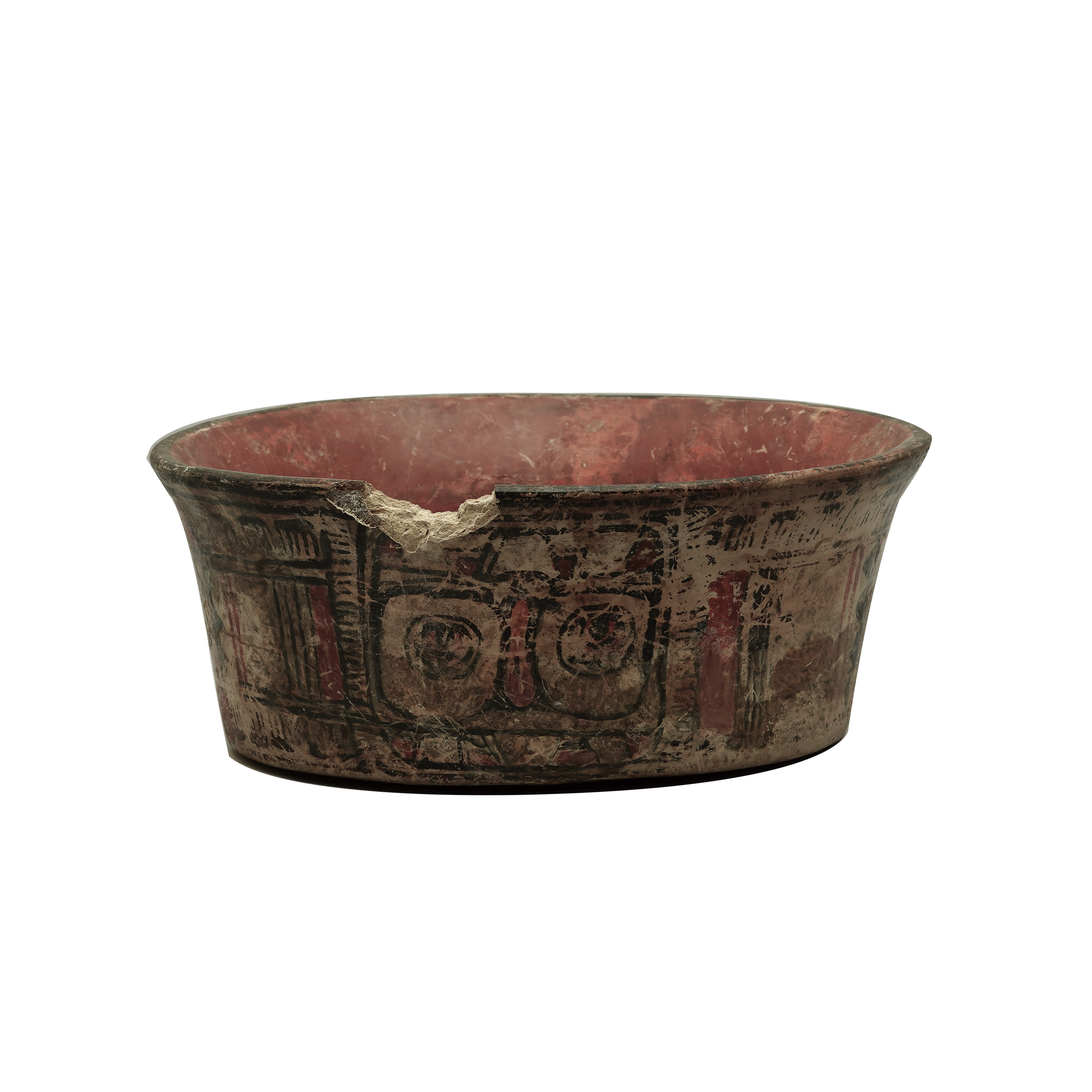
Maya Polychrome Bowl
Maya Civilization, ca. 600–900 CE
Ceramic with red and black painted decoration
Dimensions: 19 × 7 cm
Shallow bowl, decorated with geometric and symbolic motifs in red and black, exemplifies the sophistication of Maya painted ceramics. The interior features a radiating design, possibly symbolizing the sun or cosmic order, while the exterior displays glyph-like and abstract imagery. Such vessels were used in both daily life and ritual contexts, often for serving food or drink, and sometimes placed in tombs as offerings to accompany the deceased in the afterlife.
Maya Ceramic Bowl
Dimensions: 17 × 11 cm
Maya Civilization, ca. 300 BCE – 600 CE
Burnished ceramic with red slip
Rounded bowl, with its simple form and subtle red slip finish, reflects the utilitarian yet refined craftsmanship of Maya ceramics. Such vessels were used in daily life for storing and serving food, while also carrying symbolic meaning when placed in ritual or funerary contexts.
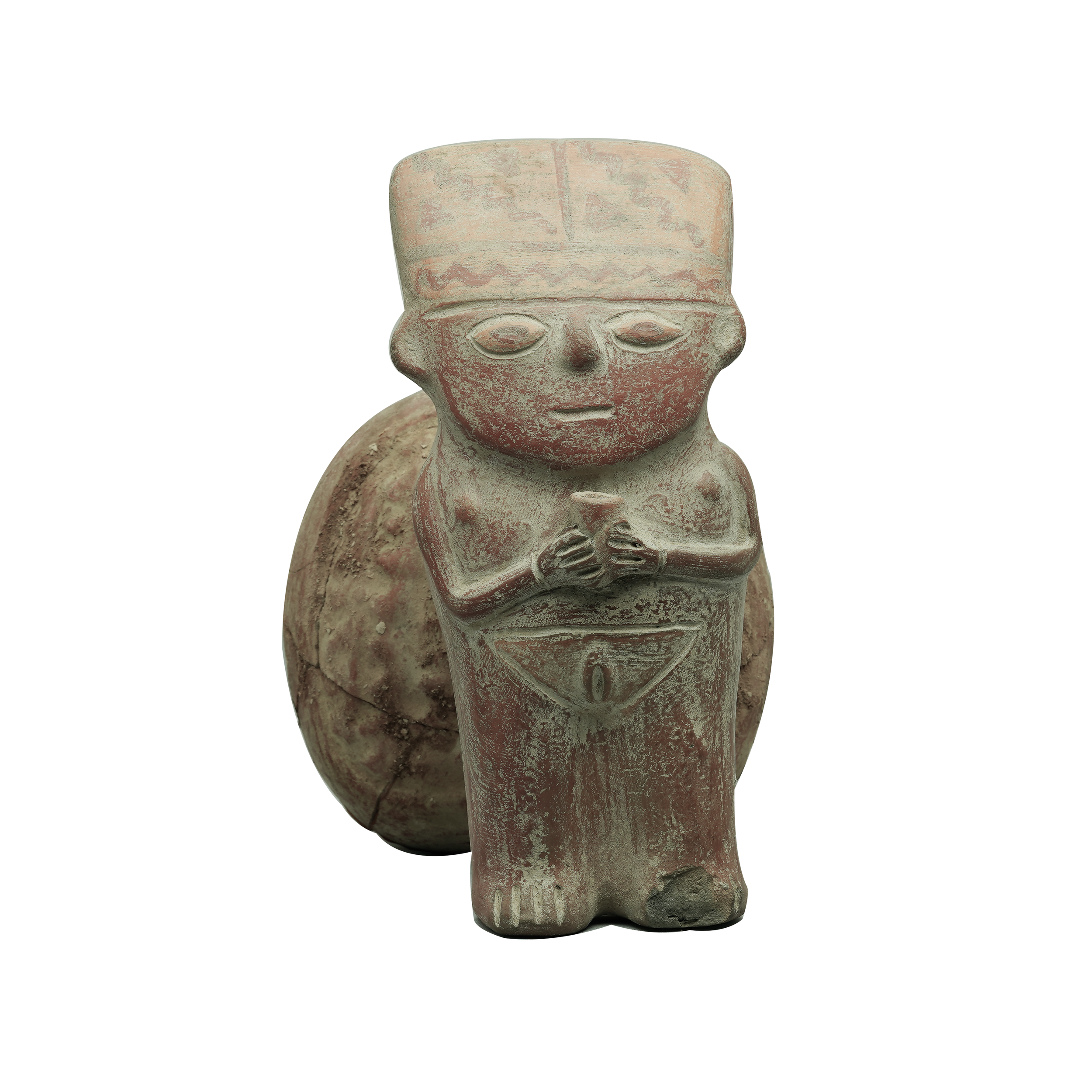
Figural Vessel with Standing Figure
Pre-Columbian, likely Inca, ca. 300–800 CE
Ceramic with red slip
Dimensions: 22 x 22 cm
Vessel combining practical function with symbolic representation. The body of the container is modeled as a gourd-like form, while a standing human figure, wearing a headdress and loincloth, emerges from its side. The figure holds an object, possibly an offering or cup, suggesting ritual or ceremonial use.
Such figural vessels were often associated with elite contexts, serving as containers for liquids or offerings, and may have symbolized fertility, abundance, or the connection between human ritual and agricultural sustenance.
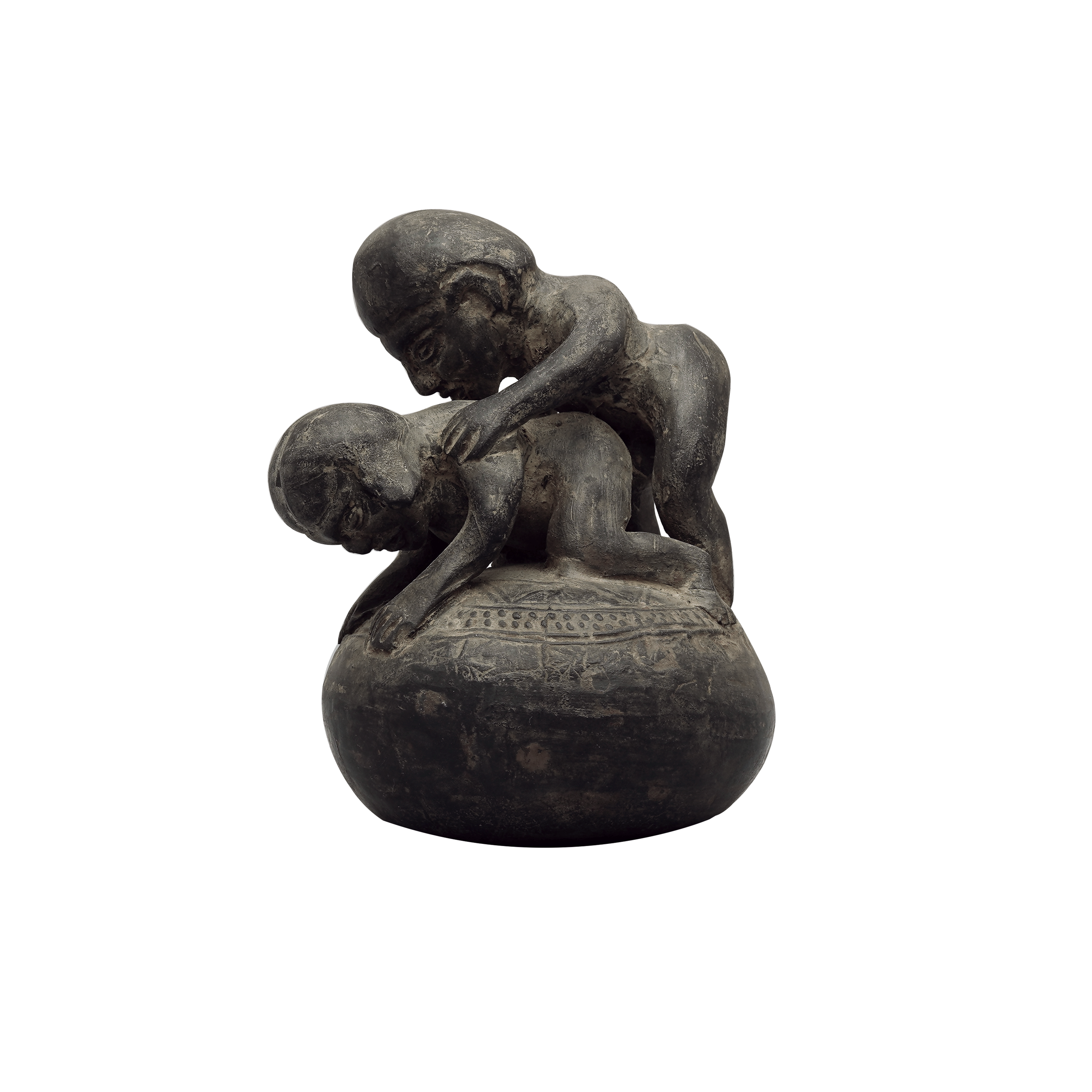
Erotic Figurative Vessel
West Mexico (Nayarit/Colima), ca. 200 BCE – 500 CE
Burnished black ceramic
Dimensions: 17 × 13 cm
Ceramic vessel depicting two intertwined human figures in an intimate pose, modeled with striking realism and vitality. Such works are part of the West Mexican shaft tomb tradition, where ceramics were placed as offerings for the dead. Erotic imagery in these vessels is believed to symbolize fertility, continuity, and the regenerative forces that link life and death.
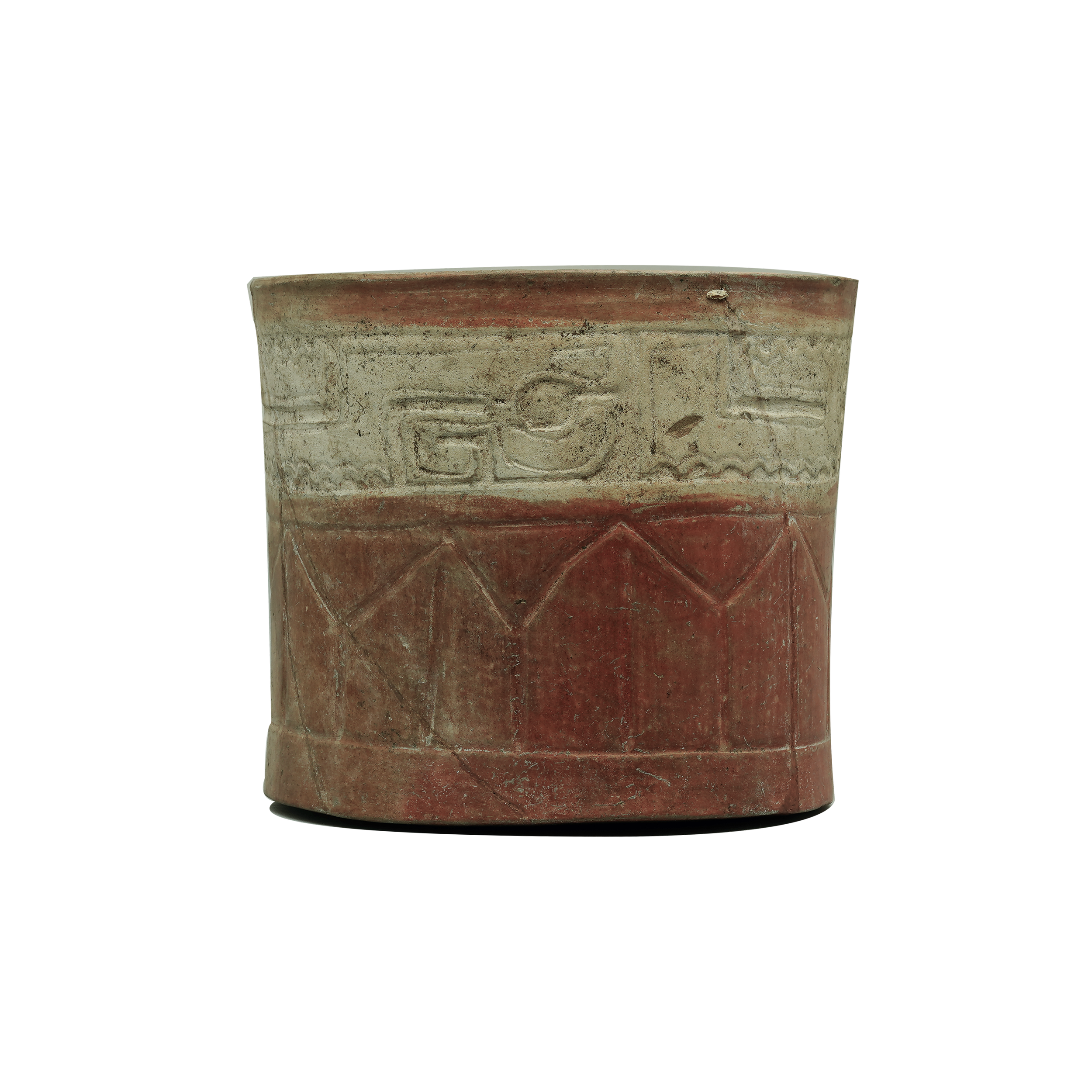
Maya Cylindrical Vessel
Maya Civilization, ca. 400 BCE – 500 CE
Ceramic with red slip and incised decoration
Dimensions: 15 × 17 cm
Cylindrical vessel, decorated with geometric and glyph-like motifs, reflects the artistry of early Maya ceramics. Likely used in ritual or elite contexts, such vessels served as containers for food, drink, or offerings and were often placed in burials as symbols of status and sustenance for the afterlife.
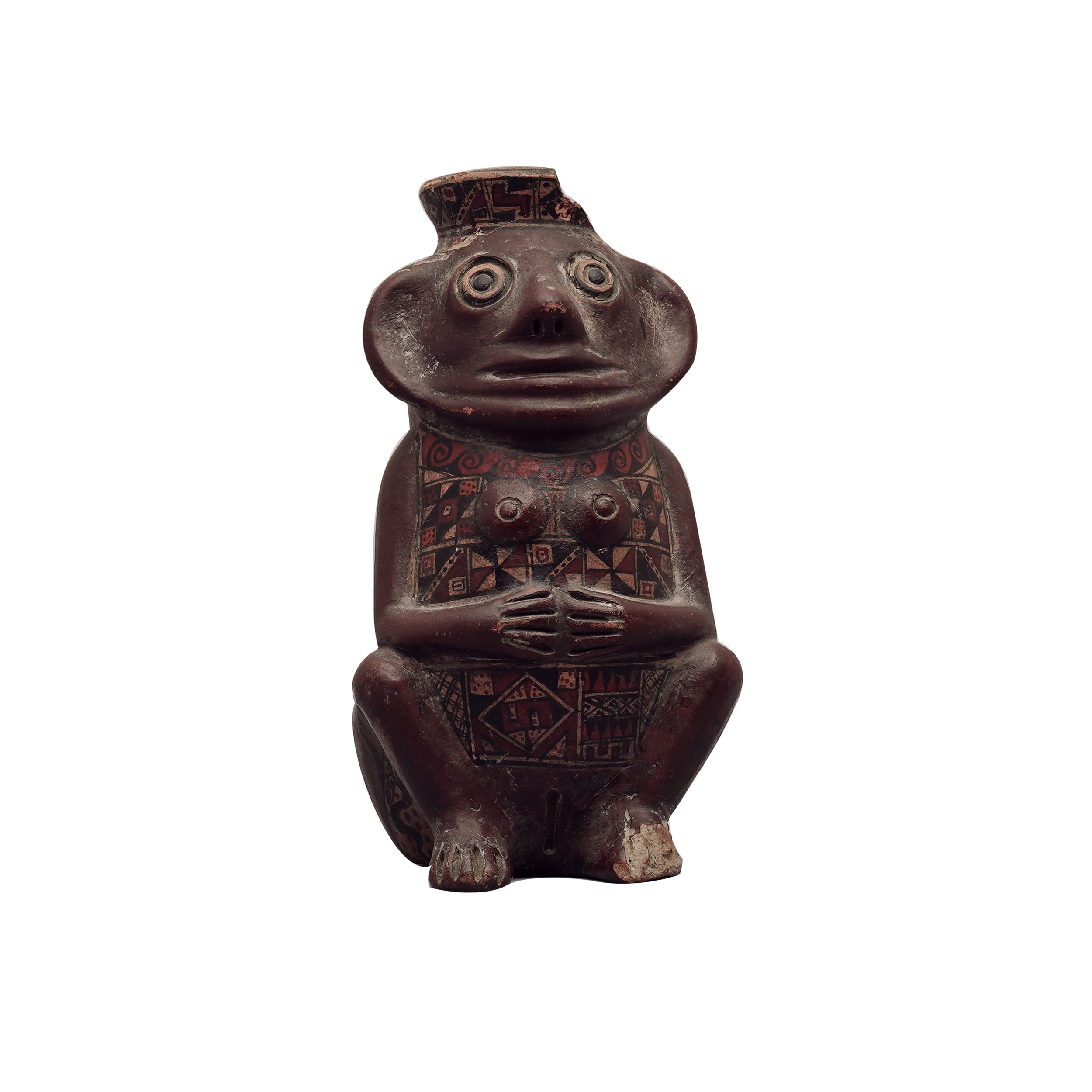
Seated Anthropomorphic Vessel
Pre-Columbian, Inca Culture (Peru), ca. 500 BCE (c. 2500 years old)
Dimensions: 14 ×9 cm
Ceramic figure representing a seated anthropomorphic being, possibly a deity, ancestor, or ritual participant. Crafted with great care, the figure displays exaggerated facial features, wide circular eyes, and a pronounced mouth, embodying both human and supernatural traits. The body is decorated with intricate geometric patterns painted in red and black, symbols that may have conveyed identity, rank, or cosmological meaning.
The figure’s hollow form and opening at the top suggest it may have served as a vessel, perhaps used in ceremonial offerings of liquids or other sacred substances.
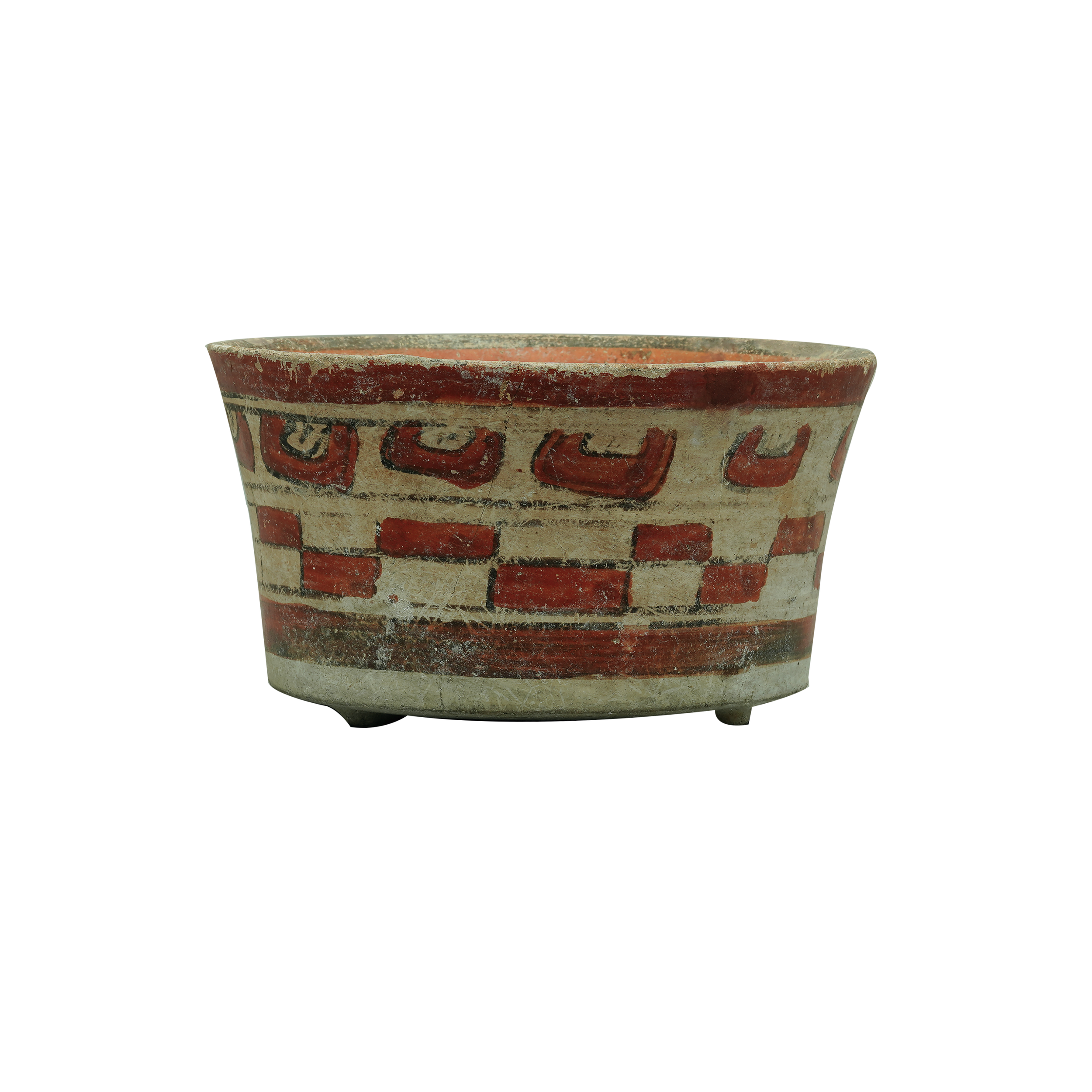
Maya Polychrome Bowl
Painted Ceramic, c. 600–900 CE
Maya Civilization, Mesoamerica
Dimensions: 19 × 10 cm
Painted ceramic vessel features bold geometric motifs in red and black on a cream background, framed by horizontal registers. The exterior is decorated with repeating stepped and scroll-like patterns, symbols associated with Maya cosmology and ritual meaning. The interior, coated in a rich red slip, contrasts with the exterior.
Such bowls were often used for food offerings, ritual libations, or as burial goods, linking everyday sustenance with spiritual continuity.
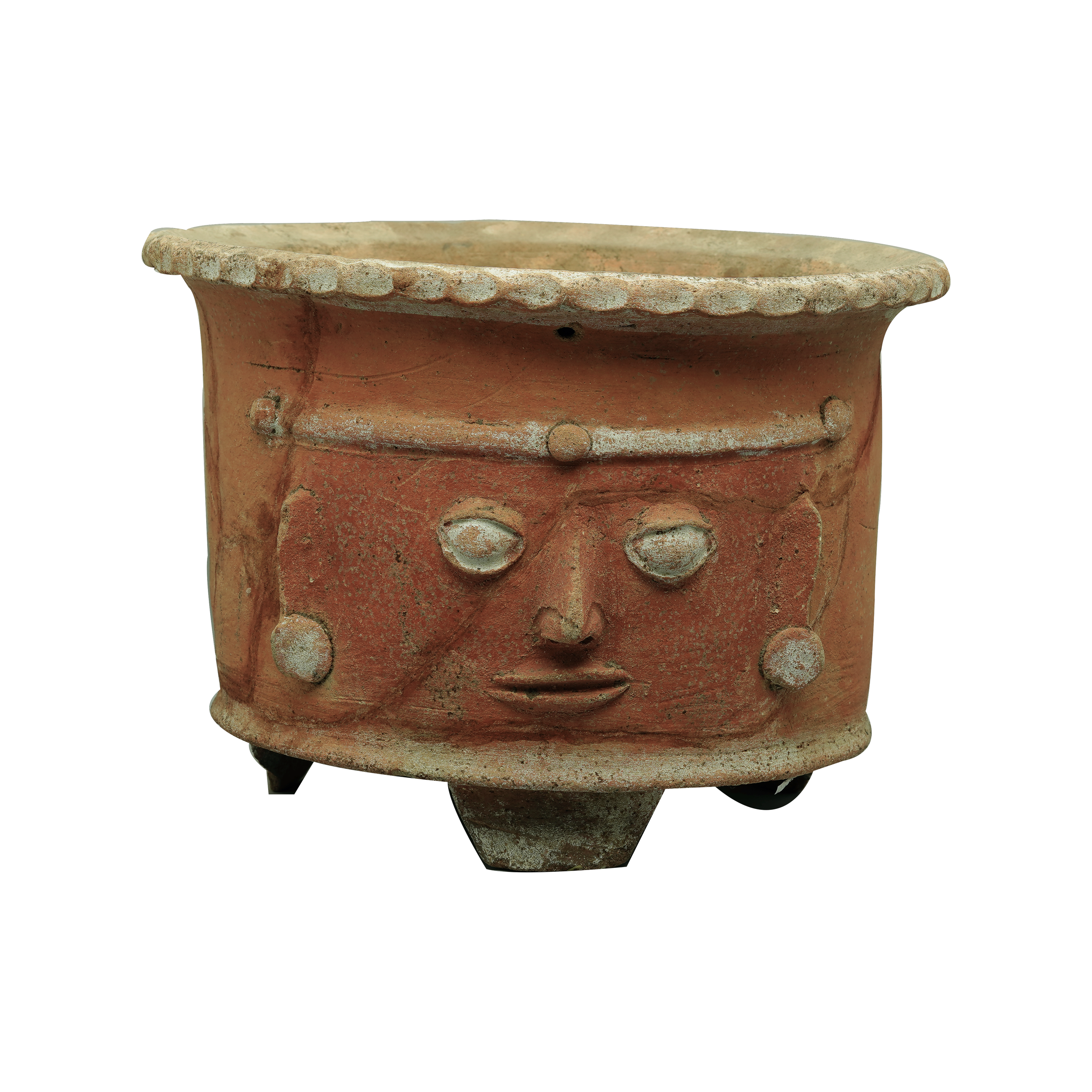
Tripod Vessel with Human Face
Pre-Columbian, Maya Culture, c. 600–900 CE
Ceramic with red slip
Dimensions: 19 × 26 cm
Cylindrical tripod vessel decorated with a modeled human face, complete with earspools and a rim of raised dots. The form and red slip suggest its use in ritual contexts, likely for offerings of food or drink. The human visage may represent an ancestor or deity, reflecting Maya beliefs in the sacred power of objects and their role in connecting the living with the spiritual world.
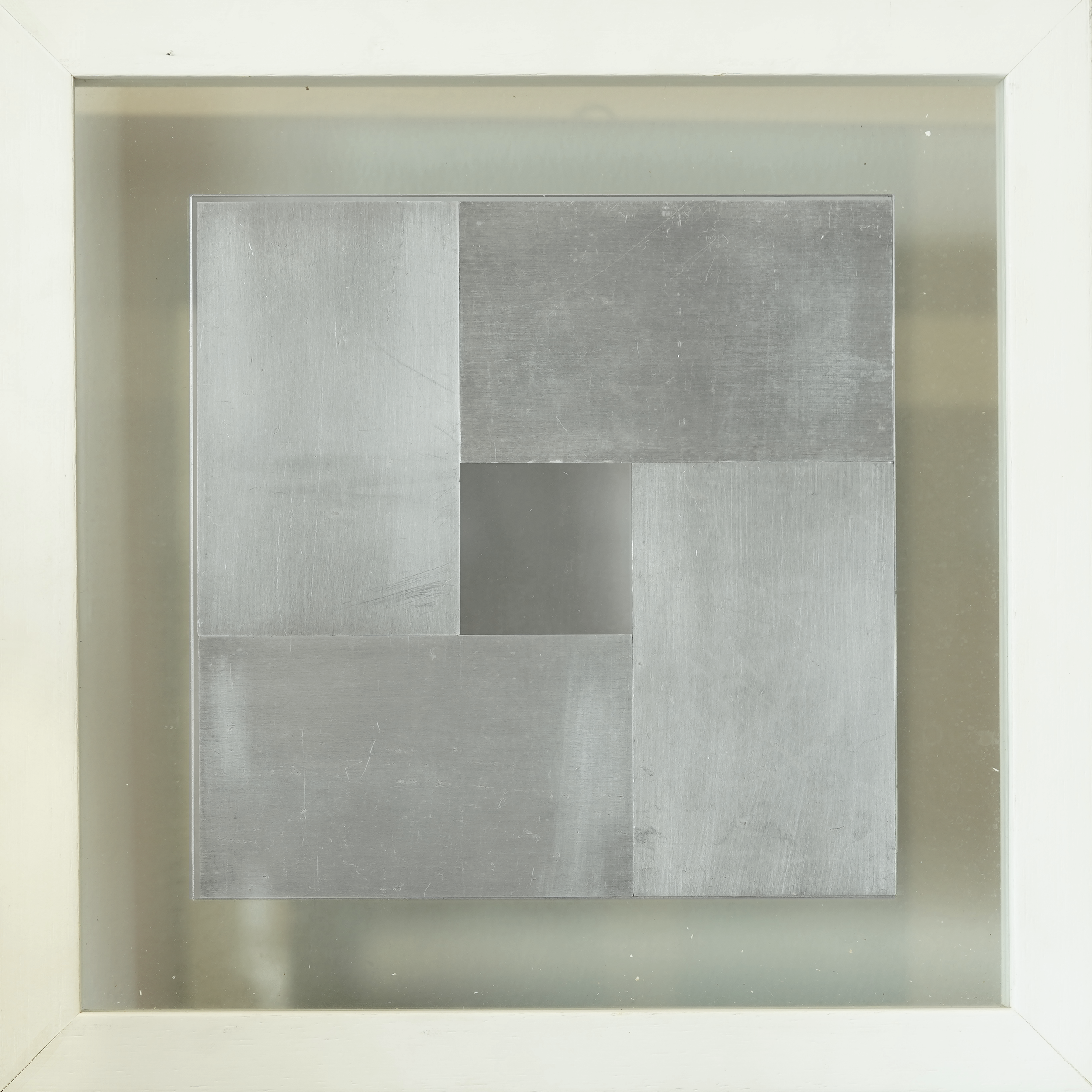
Carl Andre (American, b. 1935)
Untitled, c. 1970s
Aluminum on board
Dimensions: 32× 32 cm
Carl Andre, a leading figure of Minimalist art, is renowned for his radical reduction of form and material. This work exemplifies his geometric rigor and devotion to industrial surfaces. Constructed from brushed aluminum panels arranged in a precise square composition, the piece emphasizes symmetry, repetition, and the inherent qualities of the material itself.
Andre rejected traditional notions of sculpture as modeling or carving, instead presenting raw materials in simple configurations that highlight their physical presence and spatial relationships. The subtle tonal variations across the metallic surface reveal the tactile quality of aluminum while also engaging the viewer in quiet contemplation of order, proportion, and structure.
This work encapsulates Andre’s belief that sculpture should not represent or symbolize, but simply be. Its clarity and restraint embody the essence of Minimalism, transforming industrial matter into an object of profound visual and conceptual intensity.
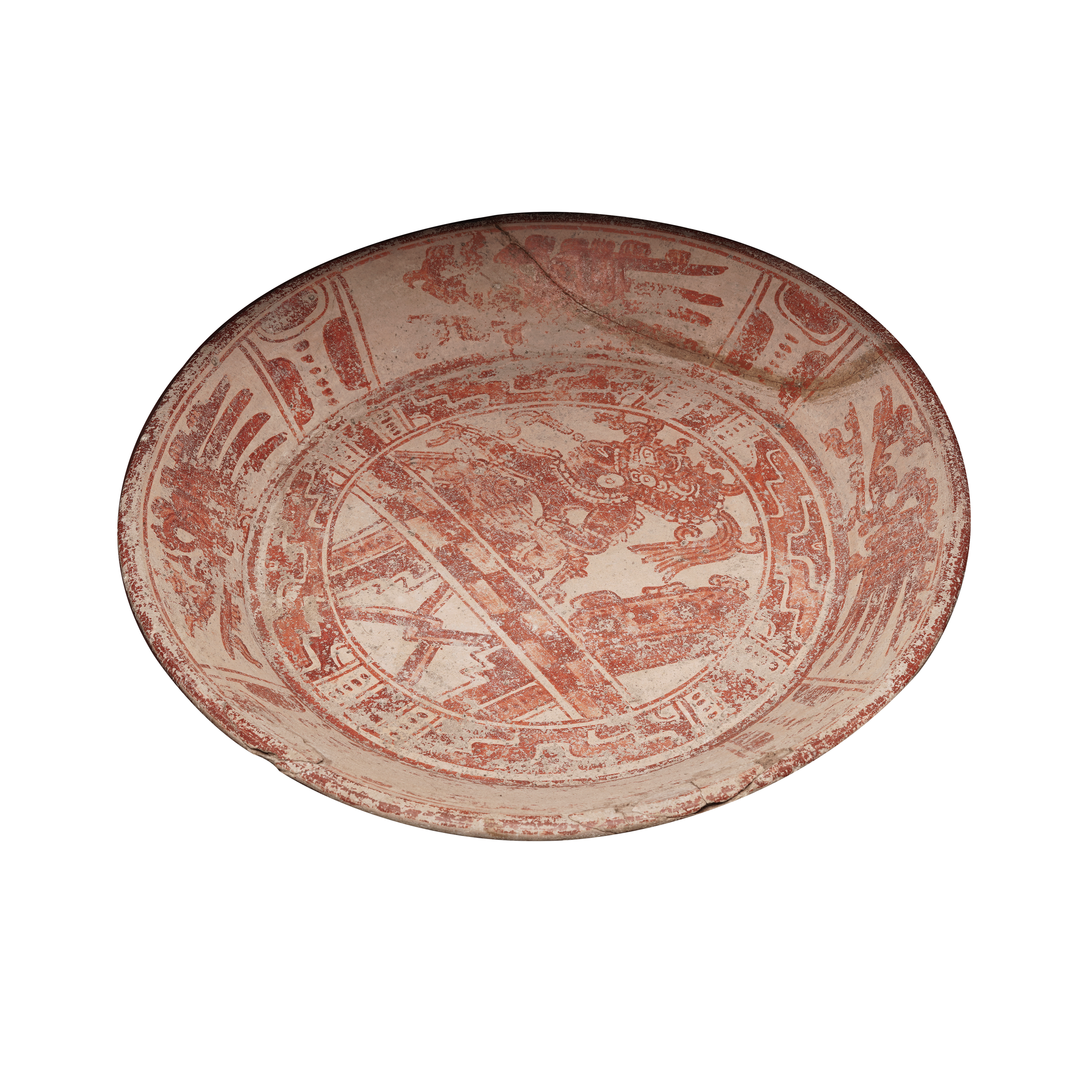
Maya Polychrome Ceramic Plate
Classic Period (c. 600–900 CE), Mesoamerica
Dimensions: 13 × 35 cm
Painted ceramic plate showcasing the artistic and symbolic sophistication of the ancient Maya. Decorated in red slip on a cream ground, the central motif features a mythological scene rendered with dynamic linework and intricate iconography. The figures—possibly deities, mythic creatures, or rulers—are framed by geometric and symbolic borders, reflecting both cosmological and ritual significance.
Maya ceramics such as this were often used in ceremonial feasts, burials, or elite offerings, serving not only as functional vessels but also as carriers of sacred narratives. The circular composition and repeating motifs reinforce the Maya worldview of cyclical time and the cosmic order.
The red pigments, derived from natural minerals, highlight the Maya mastery of polychrome painting techniques, while the worn surface reveals centuries of use and burial. Today, this piece offers invaluable insight into the interconnectedness of Maya art, ritual, and cosmology.
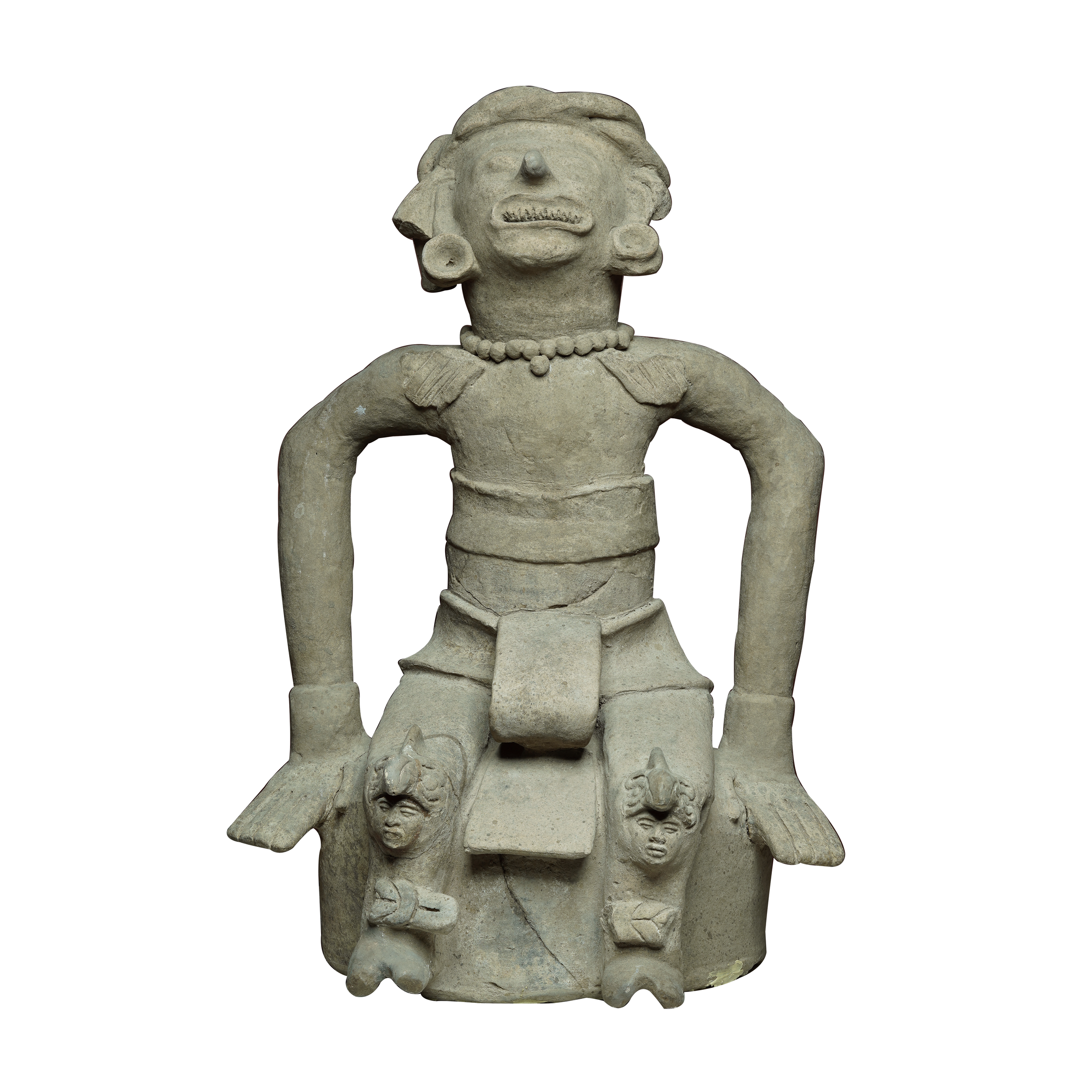
Pre-Columbian Ceramic Figure
Culture: Maya or related Mesoamerican tradition
Material: Ceramic
Date: ca. 600–900 CE (Late Classic Period)
Dimensions: 55 × 35 cm
Ceramic figure representing a richly adorned individual, likely a deity, shaman, or elite figure within Maya culture. The figure’s upright posture, exaggerated facial features, and elaborate headdress suggest a ceremonial role. The necklace, belt, and skirt details emphasize status and authority, while the prominent hands and stylized mouth may symbolize communication with the spiritual realm.
Of particular note are the two small sculpted heads on the figure’s skirt, possibly representing captives, ancestors, or divine beings, reinforcing the figure’s mediating role between the earthly and spiritual worlds. Such imagery reflects the Maya’s strong emphasis on lineage, ritual performance, and the cyclical balance of life and death.
Objects of this type were often placed in tombs or ceremonial centers, serving as guardians, offerings, or representations of powerful intermediaries in Maya cosmology
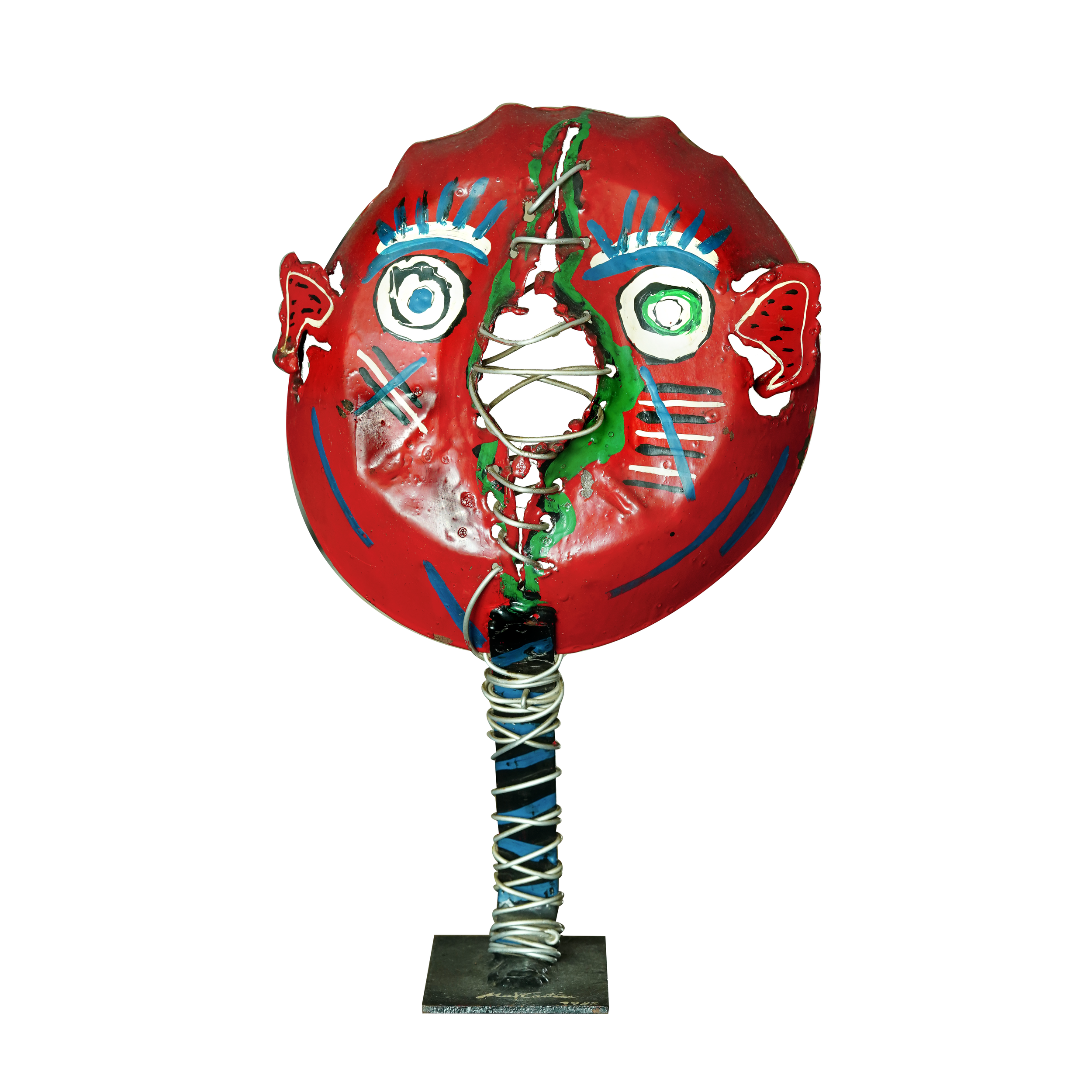
Max Cartier (Italian, b. 1935)
École de Nice, 1987
Painted on a fried pan with wire and mixed media, dedicated with delight to a special chef friend.
Dimensions: 40 × 25 cm
Work by Max Cartier showcasing the artist’s inventive use of industrial materials to create bold, expressive forms. The sculpture, fashioned in 1987, takes the shape of a stylized mask, painted in vivid red with accents of blue, green, and white. The face is punctuated by exaggerated, wide-open eyes, linear markings, and a dramatic central opening.
Cartier’s integration of painted steel, wire bindings, and coiled spring-like structures emphasizes the raw materiality of the object while simultaneously imbuing it with playfulness and theatricality. The mask is mounted on a robust base, its vertical support wrapped in metallic spirals, reinforcing a sense of tension and energy.

Buddha in Meditation with Torana
Dimensions: 44 × 20 cm
Nepal, Kathmandu Valley
Bronze with green patina, c. 12th–15th century
Casted bronze Buddha sitting serenely in meditation (dhyana mudra), framed by an elaborately decorated torana (archway). The figure rests on a double lotus pedestal, symbolizing spiritual purity. The hands are held in the gesture of teaching (vitarka mudra), a sign of wisdom and the transmission of the Dharma.
Nepalese bronzes from the Kathmandu Valley are renowned for their exquisite craftsmanship and synthesis of Pala Indian influences with the distinctive artistry of the Newar sculptors. Such devotional icons were used in both monastic and household shrines, embodying the intimate devotion of Himalayan Buddhism.
The protective torana, with its intricate floral and divine motifs, reflects the Nepalese tradition of blending architecture and sculpture into a single sacred image. Bronze figures like this not only served as focus points for meditation but also traveled across the Himalayas, profoundly influencing Tibetan Buddhist art.
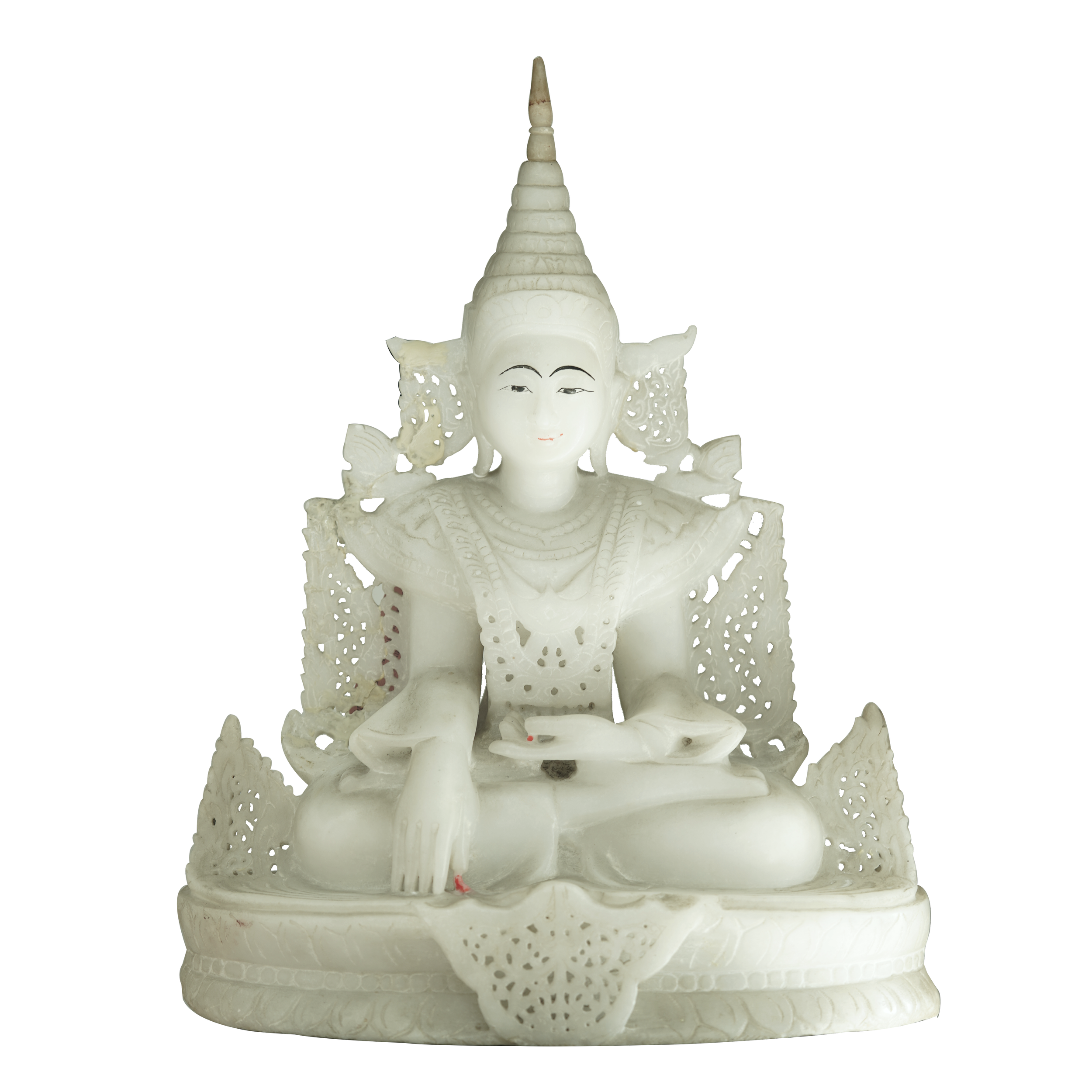
Alaska Crowned Buddha, Myanmar (Burma), 19th century
Dimensions: 40 × 50 cm
Marble, carved and polished
This finely carved marble figure depicts the Buddha in royal attire, seated in meditation with one hand resting gently in his lap. Characterized by the tall, pointed crown and elaborate openwork throne, the sculpture reflects a uniquely Burmese tradition in which the Buddha is portrayed as a universal monarch (Chakravartin). The luminous white marble, a material sourced from the quarries of Mandalay, enhances the sense of purity and serenity, while the refined details evoke the splendor of Burmese courtly art.
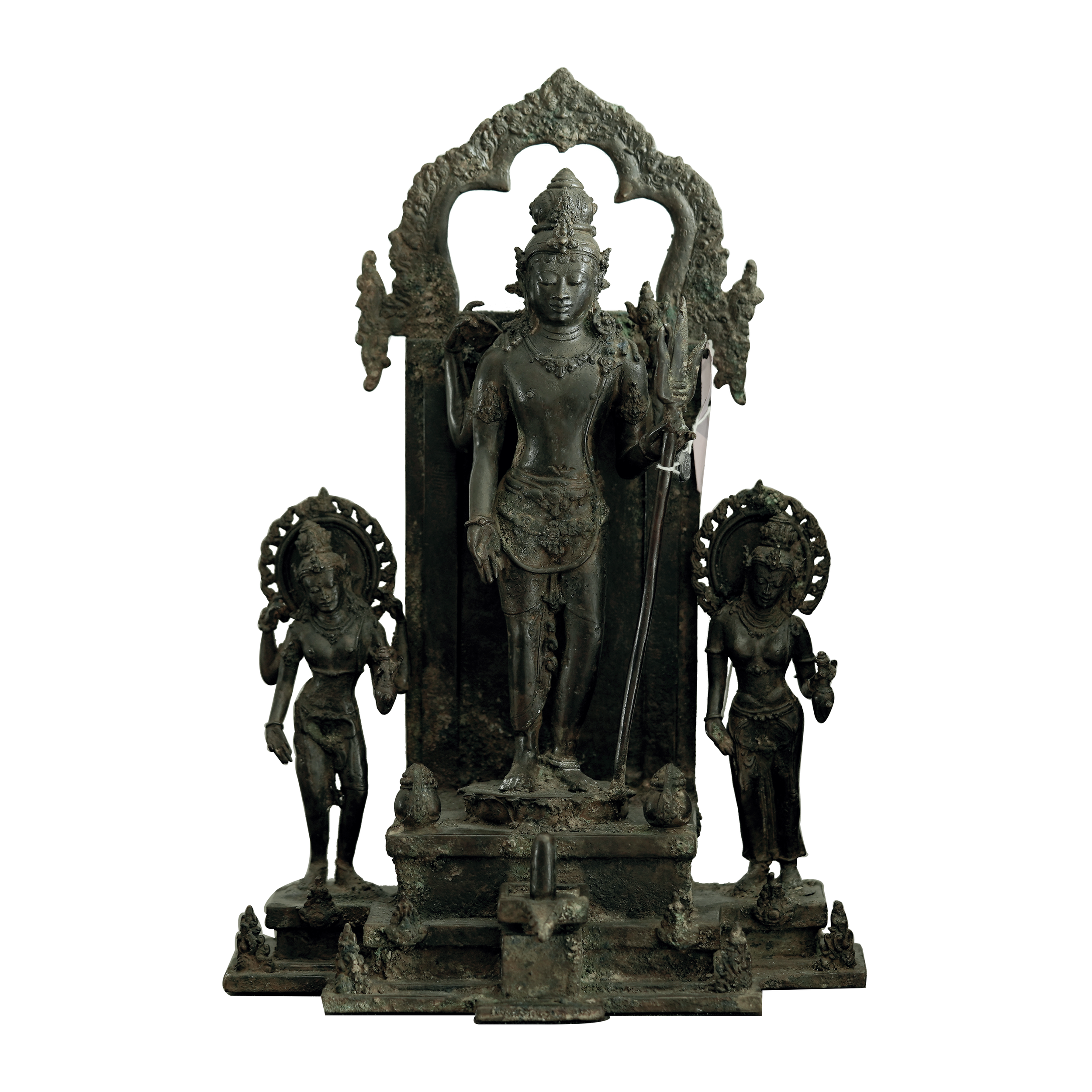
Shiva with Attendants
Dimensions: 35 × 25 cm
South India (Tamil Nadu), Chola Period, 10th–12th century
Bronze, lost-wax casting
This bronze ensemble represents the Hindu god Shiva, shown in a graceful standing posture beneath an elaborate arched aureole (prabhavali). Shiva’s powerful yet serene form is adorned with sacred ornaments, emphasizing his divine authority. At his sides stand two attendant figures, likely his consort Parvati and another divine companion, reinforcing his role within the cosmic order.
Cast using the sophisticated lost-wax technique perfected during the Chola dynasty, this work reflects the period’s mastery of balance, proportion, and spiritual expression. Such bronzes were not static temple icons: they were animated in ritual processions, where devotees encountered the deity directly in streets and courtyards.
While primarily associated with South Indian Shaiva traditions, similar compositions were also produced in Nepal, reflecting the deep interconnections of Hindu and Buddhist art across Asia.
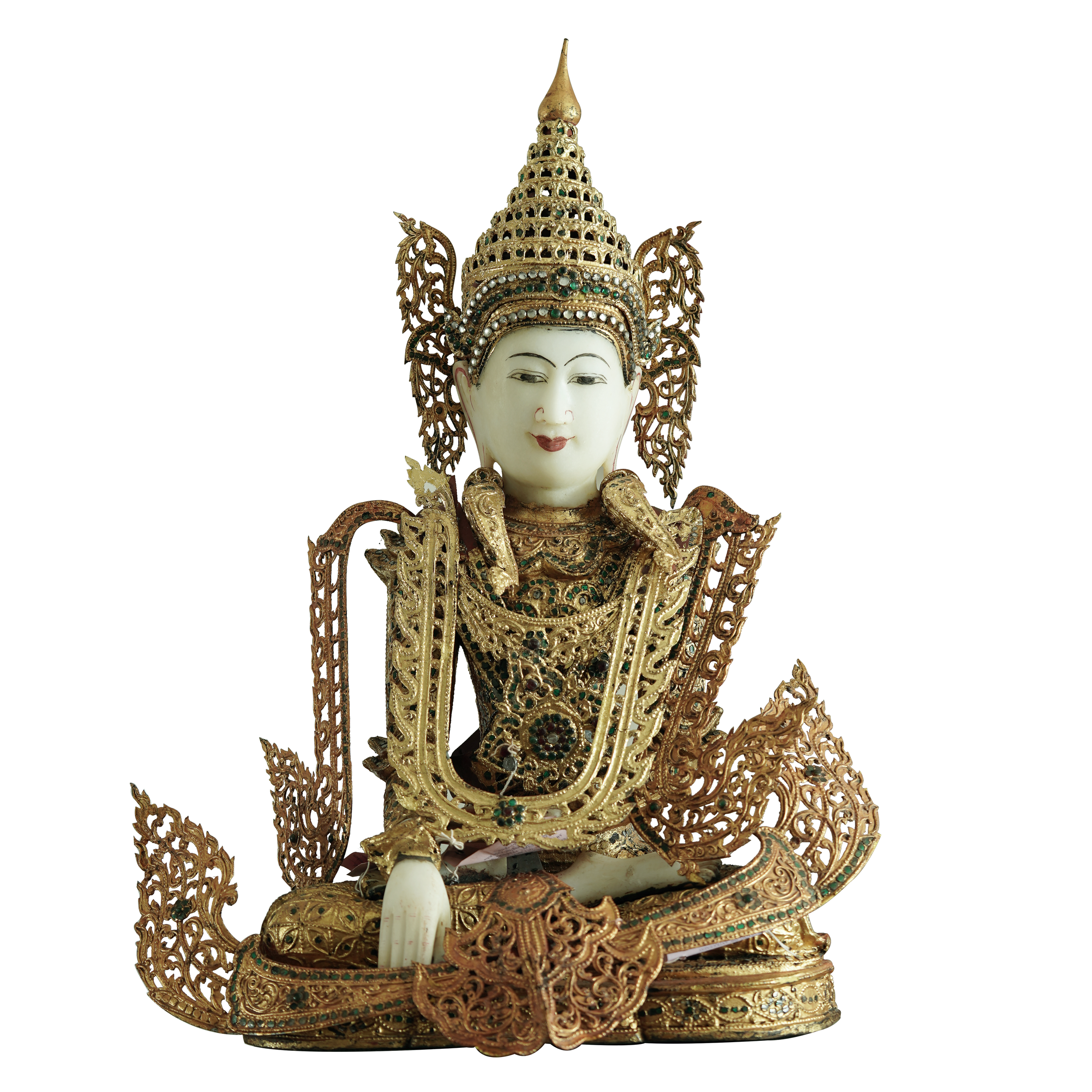
Seated Crowned Buddha
Myanmar (Burma), 19th–20th century
Dimensions: 78 × 56 cm
Gilded wood, alabaster, glass inlay, colored stones
This richly adorned image of the Buddha reflects the Burmese tradition of portraying the Enlightened One in royal attire. The serene white face, carved from alabaster, contrasts with the gilded wooden body, elaborately decorated with glass mosaics and gemstones. The tall pointed crown and intricate shoulder ornaments evoke regal splendor, presenting the Buddha not only as a spiritual teacher but also as a universal monarch (chakravartin).
Seated in the earth-touching gesture (bhūmisparśa mudrā), the figure recalls the moment of the Buddha’s enlightenment. Such images were placed in temples and monasteries, serving as both devotional objects and reminders of the fusion of kingship and sacred authority in Burmese Buddhist art.
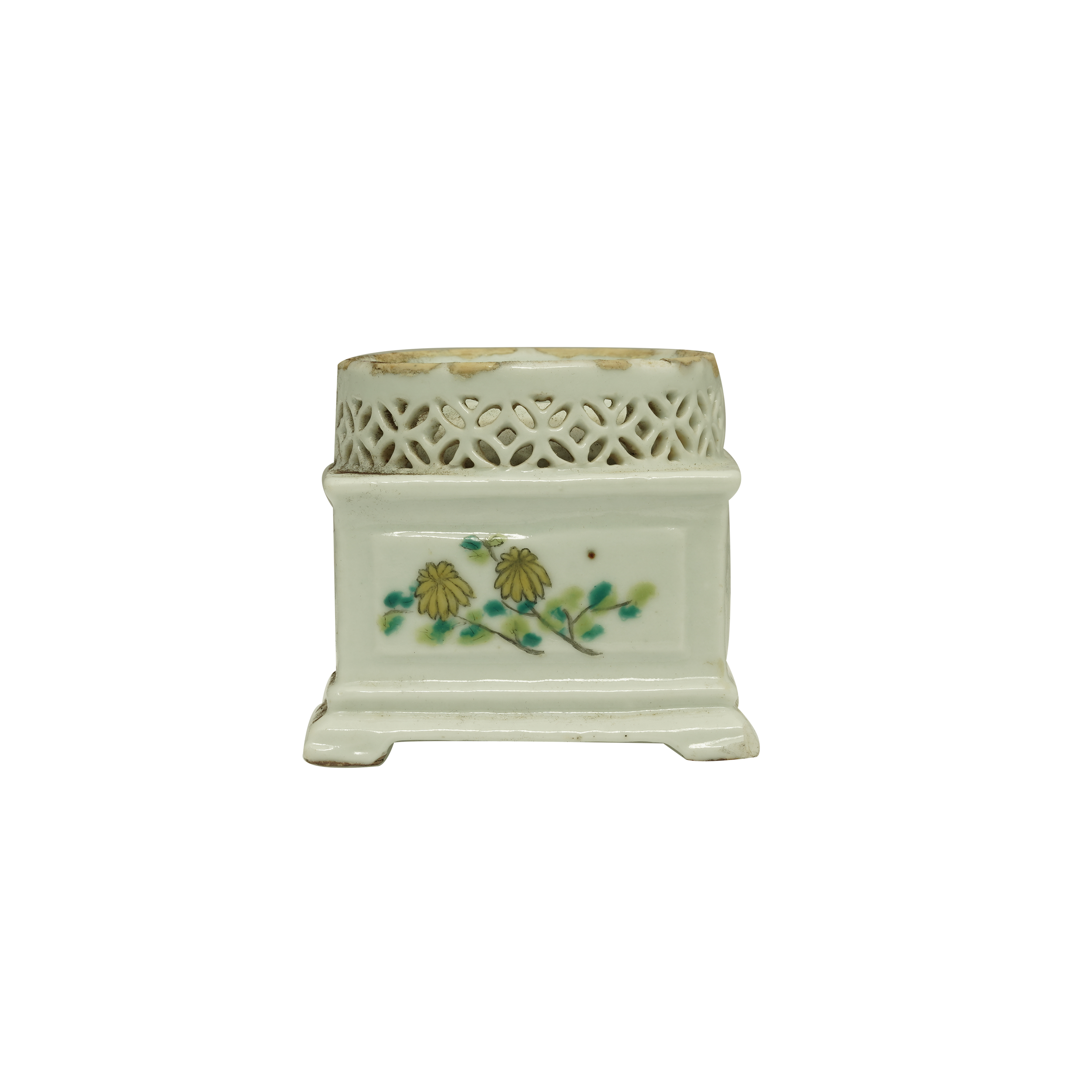
Origin: China
Date: Late 19th–early 20th century
Materials: Glazed porcelain with enamel decoration
Dimensions: Appro 4 × 5 cm
Description:
Small rectangular opium lamp is made of white glazed porcelain and decorated on its sides with hand-painted yellow chrysanthemums and green leaves. The top features a pierced, openwork gallery designed to hold and ventilate the lamp’s chimney and wick. The floral decoration adds an elegant touch to this functional piece, which was used to heat the opium pipe bowl during smoking sessions.
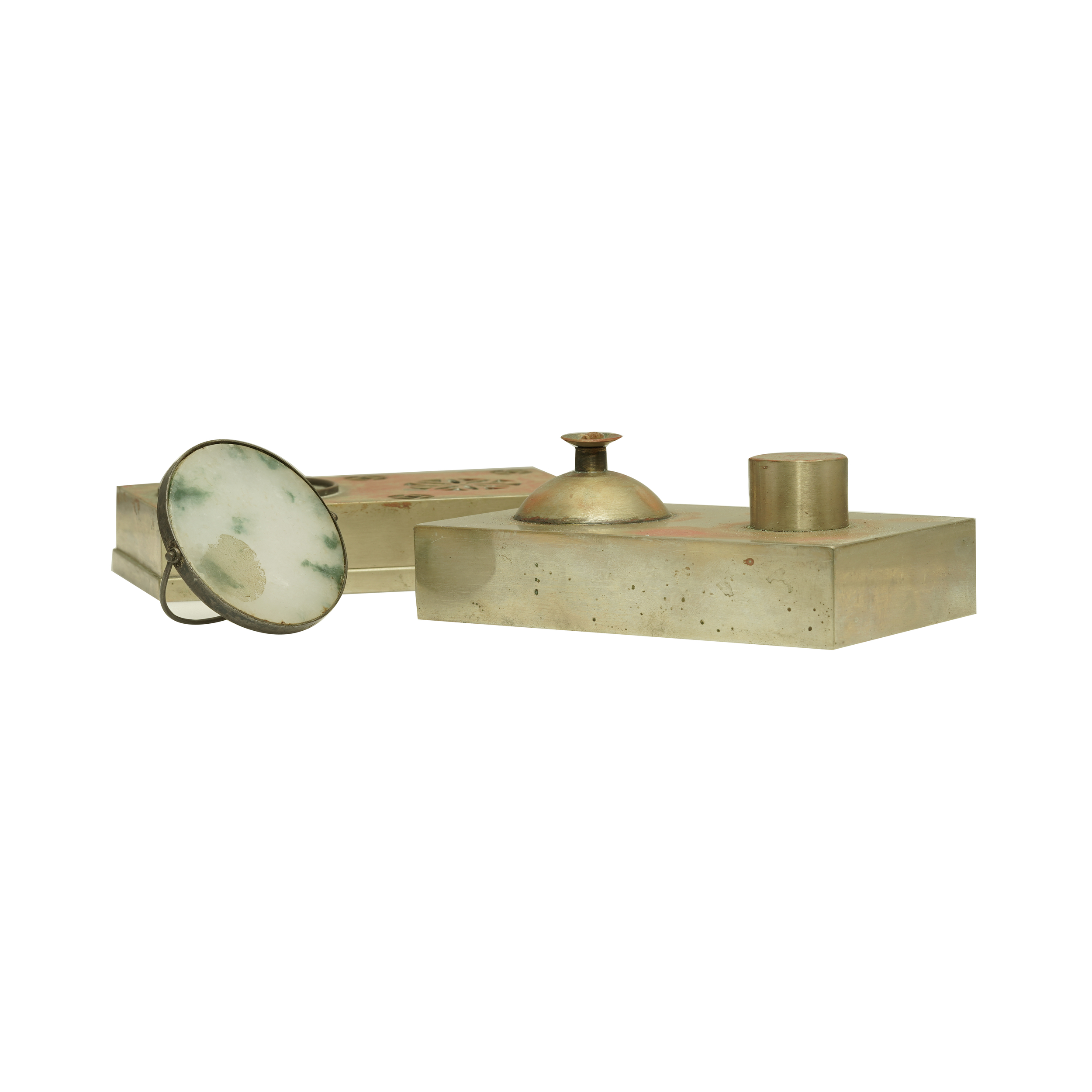
Origin: China
Date: Late 19th–early 20th century
Materials: Brass, jade, glass
Dimensions: Appro 12 × 4 cm
Description:
Rectangular brass opium lamp featuring a domed central burner flanked by a cylindrical reservoir. A detachable jade disk, mounted in a brass ring, served as a heat reflector, focusing the flame’s warmth onto the opium pipe bowl during preparation. The lamp’s sturdy brass construction ensured durability, while the inclusion of jade, reflects the blending of functionality.
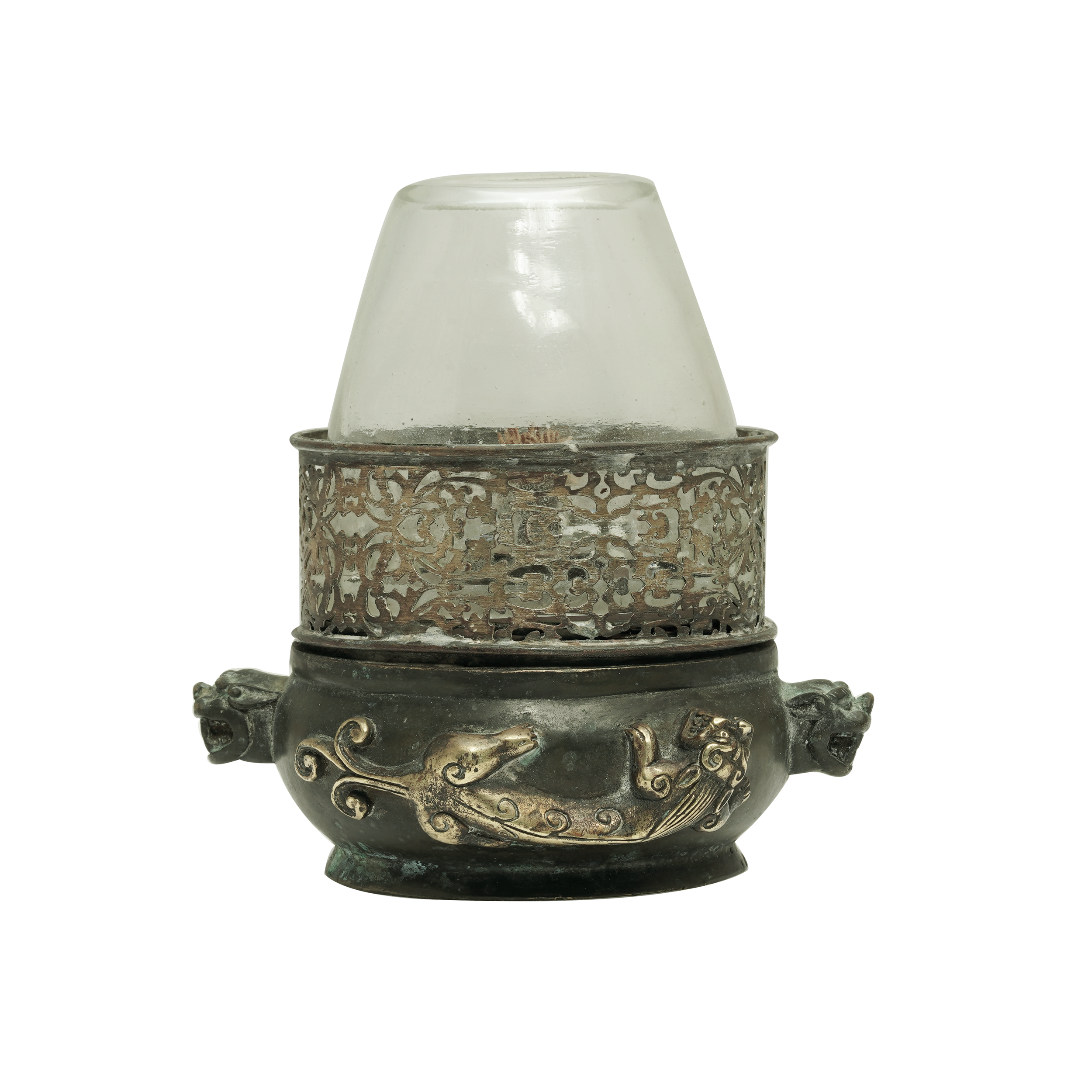
Origin: China
Date: Late 19th–early 20th century
Materials: Cast bronze, gilt decoration, glass
Dimensions: Appro 9 × 8 cm
Description:
Crafted opium pipe lamp consisting of a cast bronze base with gilt decorative elements, a pierced metal gallery, and a clear glass chimney. The base is adorned with gilt relief motifs of stylized mythical animals—possibly chi dragons—on a scrolling background, flanked by handles in the form of lion or dragon heads. The pierced metal gallery above is decorated with an intricate lattice of geometric and foliate designs, allowing heat to dissipate while shielding the flame.
The lamp’s glass chimney, slightly flared and tapering toward the top, would have protected the flame from drafts and ensured a steady burn. Such lamps provided the focused heat necessary for vaporizing prepared opium in the pipe’s bowl.
Cultural Context:
During the height of opium smoking in China, lamps like this were essential components of the ritual. The quality of materials and workmanship in this example suggest it was made for a wealthy user or an upscale opium establishment. The decorative program, blending auspicious animals and fine metalwork, reflects the tendency to imbue even utilitarian smoking implements with artistry and symbolism.
Origin: China
Date: Late 19th–early 20th century
Materials: plated metal, cast and chased; glass with etched decoration
Dimensions: Appro 10 × 8 cm
Description:
Ornate opium pipe lamp modeled in the form of a blooming lotus flower, a symbol of purity and transcendence in Chinese culture. The plated metal base is cast in overlapping lotus petals rising from a footed stand with four outward-curving supports. Above the petals sits a pierced gallery band adorned with small applied animal figures, including a finely detailed lion in relief.
The gallery supports a clear glass chimney, subtly etched with a pattern of flowers and foliage. This chimney would have shielded the lamp’s flame, ensuring a steady source of heat for vaporizing prepared opium in the pipe’s bowl. The lotus motif—paired with the inclusion of protective animals—would have imbued the piece with auspicious associations, blending spiritual symbolism with functional design.
Cultural Context:
During the height of opium smoking in the late Qing Dynasty, lamps of this type were essential tools, yet wealthy patrons often commissioned examples of high craftsmanship. This lamp’s decorative sophistication reflects its probable use in an elite household or refined opium parlor, where artistry and ritual combined in the act of smoking.
Origin: China
Date: Late 19th–early 20th century
Materials: Glass, brass, cotton wick
Dimensions: Appro 14 × 9 cm
Description:
Traditional Chinese opium lamp featuring a fluted, clear glass chimney mounted on an ornate pierced brass base. The base is decorated with cut-out patterns, allowing light to diffuse softly while protecting the flame from drafts. The removable brass burner and fitted cotton wick enabled controlled heating, a critical aspect of preparing opium for smoking. The detachable components reflect both practical design and ease of maintenance.
Origin: China
Date: Late 19th–early 20th century
Materials: Brass, glass
Dimensions: Appro 11 × 9 cm
Description:
Crafted Chinese opium lamp showcasing a faceted brass base, each panel adorned with engraved floral motifs. The cylindrical glass chimney is held in place by an ornate pierced brass collar with a scrolling vine pattern. The combination of a stable, weighty base and the protective glass allowed for a steady, focused flame—essential for heating opium paste in the pipe bowl. The lamp’s compact and robust design reflects both functional precision and decorative artistry.
Origin: China
Date: Late 19th–early 20th century
Materials: Porcelain, glass
Dimensions: Appro 11 × 7 cm
Description:
Opium lamp crafted from blue and white porcelain, its body formed in a lotus-bud motif—an auspicious symbol in Chinese culture. The porcelain base supports a clear glass chimney designed to focus and protect the flame. A small spout-like extension served as the fuel chamber opening, allowing controlled access for lighting and maintaining the lamp.
Origin: China
Date: Late 19th–early 20th century
Materials: Pressed glass, metal
Dimensions: 13 × 11 cm
Description:
Utilitarian opium lamp fashioned from clear pressed glass with faceted and fluted surfaces that refract the lamplight. The conical chimney, integrated with the base, encloses the burner assembly to protect the flame from drafts. A small metal burner cap, now aged with patina, once held the wick in place for precise heating of the opium pipe’s bowl.
Origin: China
Date: Late 19th–early 20th century
Materials: Glass, brass, copper alloy
Dimensions: Appro 18 × 8 cm
Description:
Opium lamp featuring a tall, slightly flared glass chimney secured within ornate pierced brass bands at the top and base. The interior holds a copper burner cup designed to hold the wick, with the removable brass burner cap displayed alongside. The pierced metalwork incorporates scrolling foliate motifs, both decorative and functional, allowing airflow to sustain the flame.
Origin: China
Date: Late 19th–early 20th century
Materials: Glass, brass, copper alloy
Dimensions: Appro 19 × 14 cm
Description:
Opium lamp featuring a tall, clear glass chimney set into an ornate, pierced brass base of octagonal form. The base is finely worked with geometric and foliate patterns, allowing ventilation for the central burner. The metal burner sits elevated within the chimney, designed to hold a wick and produce a steady, focused flame for heating opium in a pipe. The pierced brass work is both decorative and functional, enhancing airflow and stability.
Origin: China
Date: Late 19th–early 20th century
Materials: Cloisonné enamel, brass, glass
Dimensions: 12 × 7 cm
Description:
Opium lamp featuring a square cloisonné enamel base decorated with vibrant floral motifs framed by circular patterns in turquoise, red, and white. Above the base sits an intricately pierced brass gallery with geometric and symbolic designs, allowing airflow to the flame. The lamp is topped with a conical glass chimney, which would protect the flame while focusing heat on the opium bowl during preparation.
Origin: China
Date: Late 19th–early 20th century
Materials: Metal, natural bristles
Dimensions: Appro 17 × 2 cm
Description:
Opium pipe cleaning brush featuring a slender metal shaft terminating in a bundle of coarse natural bristles secured within a conical metal ferrule. The tool was designed to remove residue and ash from the narrow stem of an opium pipe, ensuring a smooth draw and preserving the flavor of the smoke.
Origin: China
Date: Late 19th–early 20th century
Materials: Brass, silver inlay
Dimensions: Appro 17 × 2 cm
Description:
Crafted opium pipe tool featuring a gently curved spatula-like tip, used for handling prepared opium paste during the smoking ritual. The elongated handle is fashioned from brass, decorated with engraved floral motifs and accented with silver inlay bands.
Origin: China
Date: Late 19th–early 20th century
Materials: Copper, wood, leather wrapping
Dimensions: Appro 11 × 2.5 cm
Description:
Utilitarian copper opium cooking spoon features a deep, rounded bowl affixed to a long, narrow handle. The bowl was used to heat opium over a flame, preparing it for smoking. The handle is reinforced with a wrapped leather grip, providing insulation from heat and improved handling during use.
Origin: China
Date: Late 19th–early 20th century
Materials: Metal alloy, mother-of-pearl
Dimensions: Appro 20 × 0.5 cm
Description:
Crafted dual-ended opium pipe tool featuring a coiled metal handle for both strength and grip. One end terminates in a narrow, flat spatula used for scraping opium residue from the pipe’s bowl, while the opposite end is fitted with a sharp needle for clearing obstructions in the stem.
Origin: China
Date: Late 19th–early 20th century
Materials: Metal alloy
Dimensions: Appro 17 × 2 cm
Description:
Opium preparation spoon featuring a long, slender shaft with a rounded, bamboo-inspired handle. At one end, a small hemispherical bowl was used to measure and manipulate prepared opium paste before placing it onto the smoking pipe’s bowl for heating. The metal surface shows patination from prolonged handling and exposure to heat, attesting to its age and use
Origin: China
Date: Late 19th–early 20th century
Materials: Hardwood, metal alloy
Dimensions: Appro 20 × 1 cm
Description:
Opium pipe needle featuring a polished hardwood handle with a tapered form, capped at both ends with metal fittings. The long, narrow metal shaft terminates in a fine point, designed for clearing blockages and cleaning the narrow channels of an opium pipe.
Origin: China
Date: Late 19th–early 20th century
Materials: Metal alloy, wood
Dimensions: Appro 17 × 1.5 cm
Description:
Long-handled opium pipe scraper designed with a bamboo-motif wooden grip, tapering to a narrow metal shaft and ending in a flat, spade-like blade. The tool was used for cleaning the opium pipe’s bowl and stem, removing charred residue to maintain smooth airflow and smoking quality. The stylized bamboo segments along the handle not only provide visual appeal but also improve grip during use.
Origin: China
Date: Late 19th–early 20th century
Materials: Hardwood, iron, copper alloy
Dimensions: Appro 17 × 3 cm
Description:
Opium pipe scraper featuring a turned hardwood handle, elegantly shaped for a comfortable grip, joined to a carved and pierced metal shaft. The flat-ended iron blade was used to scrape residual opium ash and char from the pipe bowl and stem, ensuring a clean airway and optimal smoking experience. A copper alloy collar reinforces the junction between handle and shaft, adding both durability and decorative contrast.
Origin: China
Date: Late 19th–early 20th century
Materials: Gilded brass
Dimensions: Appro 16 × 2.5 cm
Description:
Gilded brass needle used in the preparation and cleaning of opium pipes. Its sharp, tapered point allowed smokers to manipulate the opium pellet within the pipe bowl or clear residue from the narrow airway. The handle is topped with a delicately crafted poppy pod finial, a direct reference to the opium poppy (Papaver somniferum) and the source of the drug.
Origin: China
Date: Late 19th–early 20th century
Materials: Gilded brass
Dimensions: Appro 17 × 2 cm
Description:
This ornate gilded brass tool was used in the preparation of opium for smoking. Featuring a slender, slightly curved tip, it served for tamping the opium pellet into the bowl and adjusting its position during heating. The handle is richly decorated with engraved patterns and cutwork, with a finial shaped in a stylized fish motif, symbolizing abundance and prosperity in Chinese culture.
Origin: China
Date: Late 19th–early 20th century
Materials: Metal alloy, brass fittings
Dimensions: Appro 16 × 0.5 cm
Description:
This long, slender opium pipe pick features a tapered shaft ending in a sharp point for clearing the small air hole of an opium pipe bowl. At the opposite end, an ornate finial in the form of a stylized bird or feather motif is mounted alongside a small brass floral fitting, adding decorative appeal to this functional implement. Pipe picks were indispensable tools for maintaining an unobstructed draw and ensuring efficient combustion of the opium pellet.
Maya Necklace with Jade Pendant and Beads
Culture: Maya Civilization
Date: c. 600–900 CE (Late Classic Period)
Materials: Carved jadeite, stone beads, shell or bone beads, metal fittings
Dimensions: Pendant height approx. 6 cm; overall necklace length variable
Necklace featuring a carved jadeite pendant in the stylized form of an abstracted insect or shield-like emblem, defined by symmetrical lobes and a central vertical ridge with transverse bar. The pendant’s smooth, mottled green surface is characteristic of high-quality jadeite prized in Maya culture.
The necklace strand is composed of cylindrical jadeite beads, smaller green stone beads, and darker interspersed beads, possibly made of shell, bone, or stone. These are strung on metal-linked connectors, forming a V-shaped drop that emphasizes the central pendant.
Provenance:
Likely from the Maya lowlands, in present-day Guatemala, Belize, or southern Mexico.
Maya Necklace with Seated Figures and Central Jade Pendant
Culture: Maya Civilization
Date: c. 600–900 CE (Late Classic Period)
Materials: Carved jadeite, metal (gilded metal), metal chain
Dimensions: Central pendant height approx. 6 cm; total width with figures approx. 10–12 cm
Ceremonial necklace featuring a central jadeite carving flanked by two cast metal anthropomorphic figures. The jade element, carved from deep green stone, depicts a stylized form possibly representing an animal-headed or deity-like figure. It is polished smooth with minimal incised detail, emphasizing the natural beauty of the jade.
On each side, finely crafted metal figures are shown seated cross-legged, holding an object across their chests. They wear large semicircular headdresses with openwork and geometric patterns, suggesting elite status or ceremonial roles. The figures are symmetrically placed and joined to the jade pendant by small connecting mounts, with the entire assembly suspended from a simple oval-link chain.
Provenance:
Likely from the southern Maya lowlands, in present-day Guatemala or southern Mexico.
Maya Necklace with Jade Zoomorphic Pendant and Opal Inlay
Culture: Maya Civilization
Date: c. 600–900 CE (Late Classic Period)
Materials: Carved jadeite, opal inlay, metal (gilded metal)
Dimensions: Pendant length approx. 7–8 cm; chain length variable
Necklace featuring a pendant carved from jadeite in an elongated zoomorphic form, possibly representing a crocodile, lizard, or serpent—animals with deep symbolic meaning in Maya cosmology. The jade surface is pierced with three circular holes and decorated with incised stepped and linear patterns that may suggest scales or ritual markings.
One end of the pendant is enclosed in a textured metal fitting set with an oval cabochon opal. The opal’s shifting iridescence contrasts strikingly with the rich green of the jade, creating a visual focal point. The pendant is suspended from a chain composed of alternating round and elongated bar links, enhancing the necklace’s refined and balanced design.
Provenance:
Likely from the Maya lowlands, in present-day Guatemala, Belize, or southern Mexico.
Maya Necklace with Jade Mask and Anthropomorphic Figures
Culture: Maya Civilization
Date: c. 600–900 CE (Late Classic Period)
Materials: Carved jadeite, metal (gilded metal), metal chain
Dimensions: Pendant approx. 6 cm x 9 cm width chain length variable
Necklace showing a central jadeite mask carved in a stylized human form, with geometric facial features, drilled eyes, and incised mouth. The carving exhibits the green hue and subtle mottling characteristic of jadeite valued in Maya culture. The mask is mounted in a simple metal frame and flanked by two cast metal anthropomorphic figures in full ceremonial attire. Each figure wears a headdress, earspools, and layered garments, with one hand resting on the chest in a gesture of authority.
The figures are attached directly to the central mask, forming a symmetrical pendant suspended from a simple oval-link chain. The juxtaposition of jade carving and detailed metal work demonstrates both the lapidary skill and the metallurgical craftsmanship of the piece.
Provenance:
Likely from the Maya lowlands, present-day Guatemala, Belize, or southern Mexico.
Maya Necklace with Winged Jade Pendant
Culture: Maya Civilization
Date: c. 600–900 CE (Late Classic Period)
Materials: Carved jadeite, metal (gilded metal), metal chain
Dimensions: Pendant height approx. 10–12 cm; wingspan approx. 16-20 cm
Ceremonial necklace featuring a central carved jadeite pendant depicting a stylized human or deity figure. The face is rendered with drilled eyes, a squared jawline, and incised details suggesting a headdress or cranial adornment. The body below is simplified into geometric sections, a hallmark of Classic Maya lapidary style.
Flanking the central jade carving are two finely cast metal wings, each composed of layered feather motifs with subtle texturing, extending outward to form a dramatic, symmetrical composition. The wings are attached to a sturdy metal chain, indicating the piece was intended to be worn prominently across the chest.
Provenance:
Likely from the Maya lowlands, in present-day Guatemala or southern Mexico.

Artist: BOZE
Date: Unknown
Medium: Oil on canvas
Signature: Not Visible
Dimensions: 29 × 37 cm
This portrait depicts a dog rendered with human posture and expression, dressed in a green beret marked by a red star and a red jacket. The work playfully merges animal imagery with revolutionary iconography, creating a figure that is at once humorous, and quietly unsettling. Rich, warm tones define the face, while energetic splatters of paint animate the background, adding movement and contemporary edge.
Artistic Context:
BOZE is known for creating expressive, figurative paintings that blend humor, symbolism, and social commentary. Working primarily in oil on canvas, the artist often uses animals as stand-ins for human characters, allowing complex political or emotional ideas to be explored with irony and warmth. BOZE’s style combines strong draftsmanship with painterly textures and contemporary pop references, resulting in works that are immediately approachable yet layered in meaning.