

Cesar LEAL
César Leal Jiménez (1948–2024) was a Cuban painter, draftsman, engraver, and graphic designer, César Leal was known for his socially engaged work and commitment to artistic freedom. A graduate of the National School of Art in Havana, he also studied journalism and taught at the Academy of San Alejandro and the Instituto Superior de Arte (ISA), shaping new generations of Cuban artists.
His paintings often combined human figures with symbolic elements, addressing themes of freedom, censorship, and resilience during Cuba’s turbulent history. Notably, his 1972 piece Secuencia en Uno is held in the National Museum of Fine Arts in Havana.
Beyond his studio practice, Leal was a vocal advocate for cultural and political expression, using exhibitions, community projects, and social media to foster dialogue and creativity. His legacy remains in both his art and his influence on Cuba’s contemporary cultural landscape.
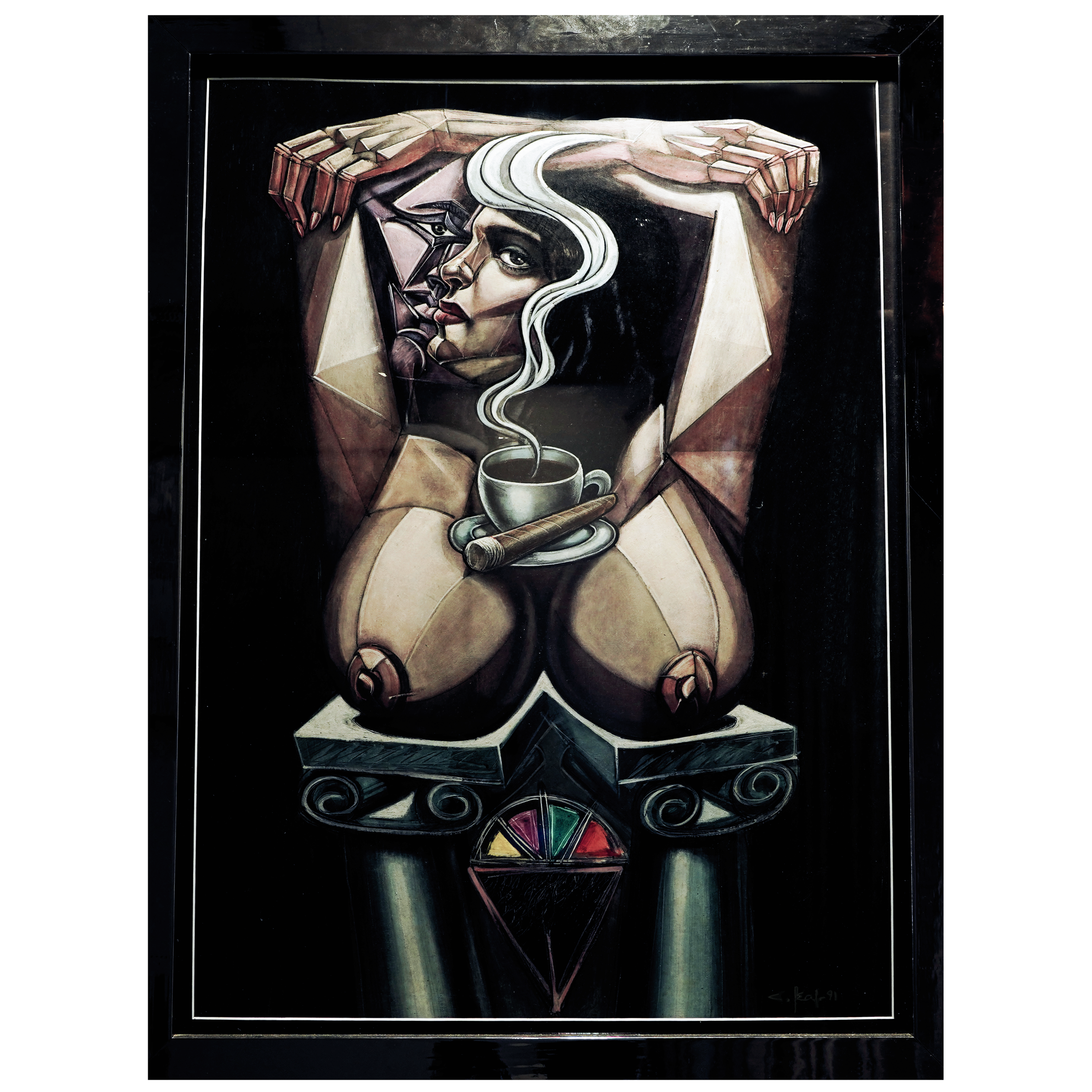
Acrylic on board by Cesar LEAL JIMENEZ. Dated and signed bottom right “C LEAL 91”
“FUNDATIONS OF CUBA”
Year: 1991
Artist: César Leal Jiménez
Medium: Oil on canvas
Dimensions: 80 × 60 cm
Description:
Painting by César Leal Jiménez blenings elements of Cubism and surrealism to depict a woman emerging from an architectural pedestal. Her fragmented, geometric form emphasizes both strength and sensuality, with her body serving as both structure and symbol. A cup of steaming coffee and a cigar rest upon her chest, their smoke entwining with her flowing white hair, linking pleasure, ritual, and identity.
César Leal Jiménez’s work often explores the complexity of feminine identity through bold symbolism and architectural references. Here, the female figure becomes both temple and totem—embodying power, allure, and cultural resonance in a single enigmatic composition.
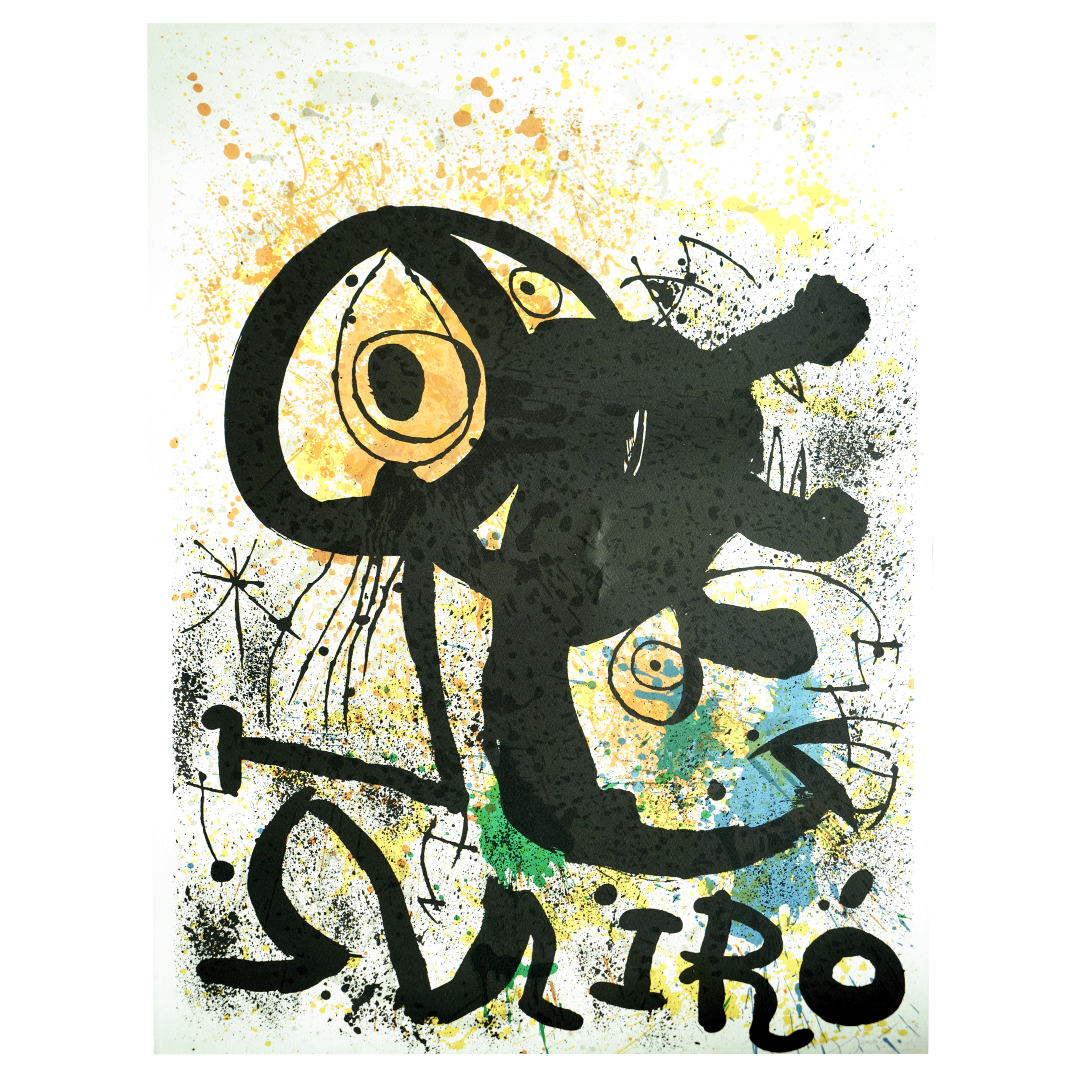
Joan Miró (1893–1983)
Untitled, c. 1960s–70s
Color lithograph on paper
Dimensions: 86 × 59 cm
Lithograph capturing Joan Miró’s fascination with spontaneity, movement, and the dreamlike world of abstraction. Bold black forms dominate the composition, animated by bursts of yellow, green, and blue splatters that evoke both cosmic energy and childlike play. Miró’s gestural lines and biomorphic shapes suggest a universe alive with symbols, where imagination transforms into visual poetry.
As in much of his graphic work, Miró uses lithography not only as a means of reproduction but as a medium of invention, preserving the immediacy and vitality of his painterly touch.
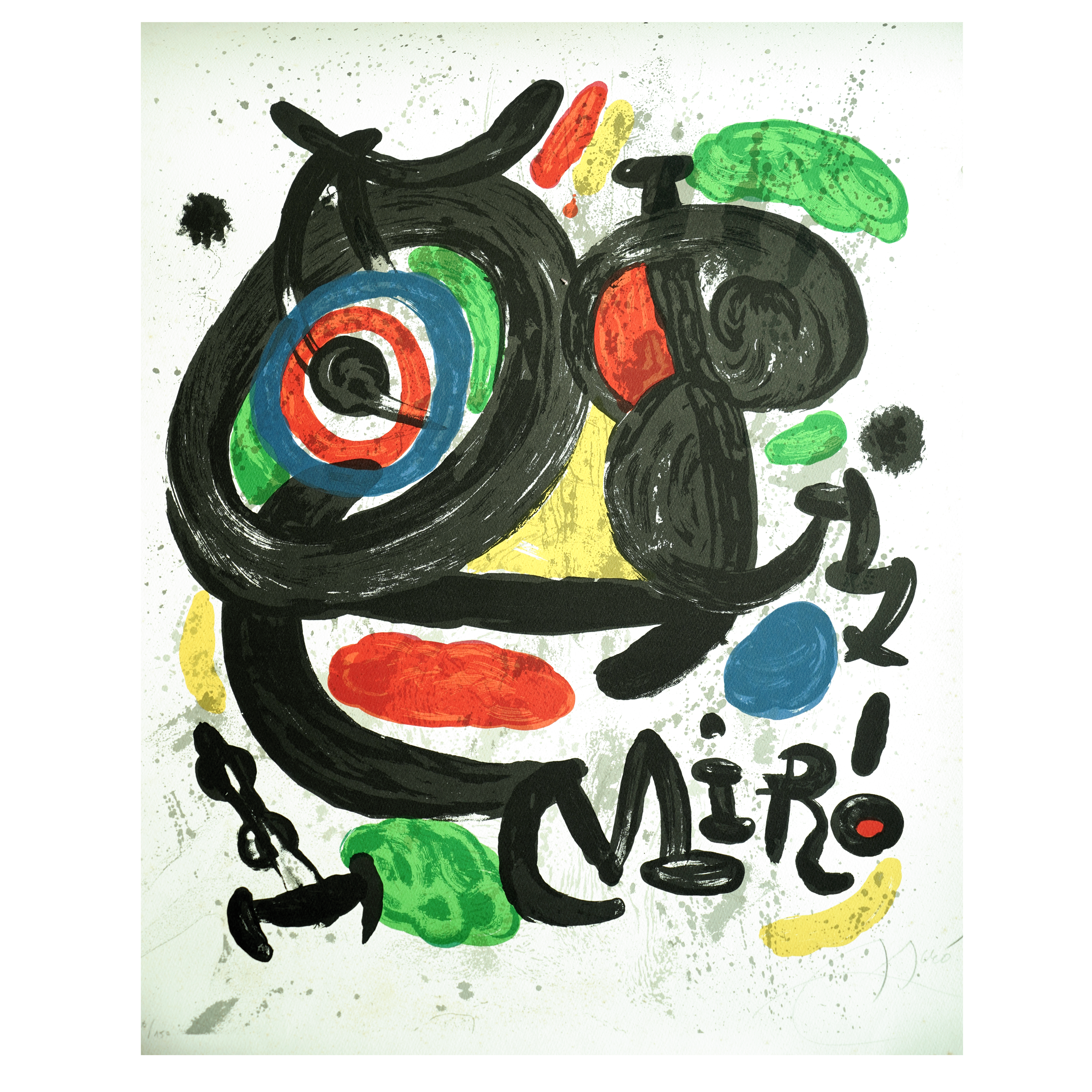
Joan Miró (1893–1983)
Untitled, c. 1960s
Color lithograph on paper
Dimensions: 86 × 59 cm
Lithograph exemplifying Joan Miró’s playful and poetic visual language. Bold black forms intertwine with bursts of primary colors—red, blue, yellow, and green—set against a dynamic field of painterly textures and gestural marks. The composition embodies Miró’s signature balance between abstraction and spontaneity, evoking a dreamlike world of symbols, movement, and imagination.
Miró’s graphic works, such as this, highlight his ability to translate the energy of his paintings into printmaking, making color and form accessible while preserving their expressive intensity.
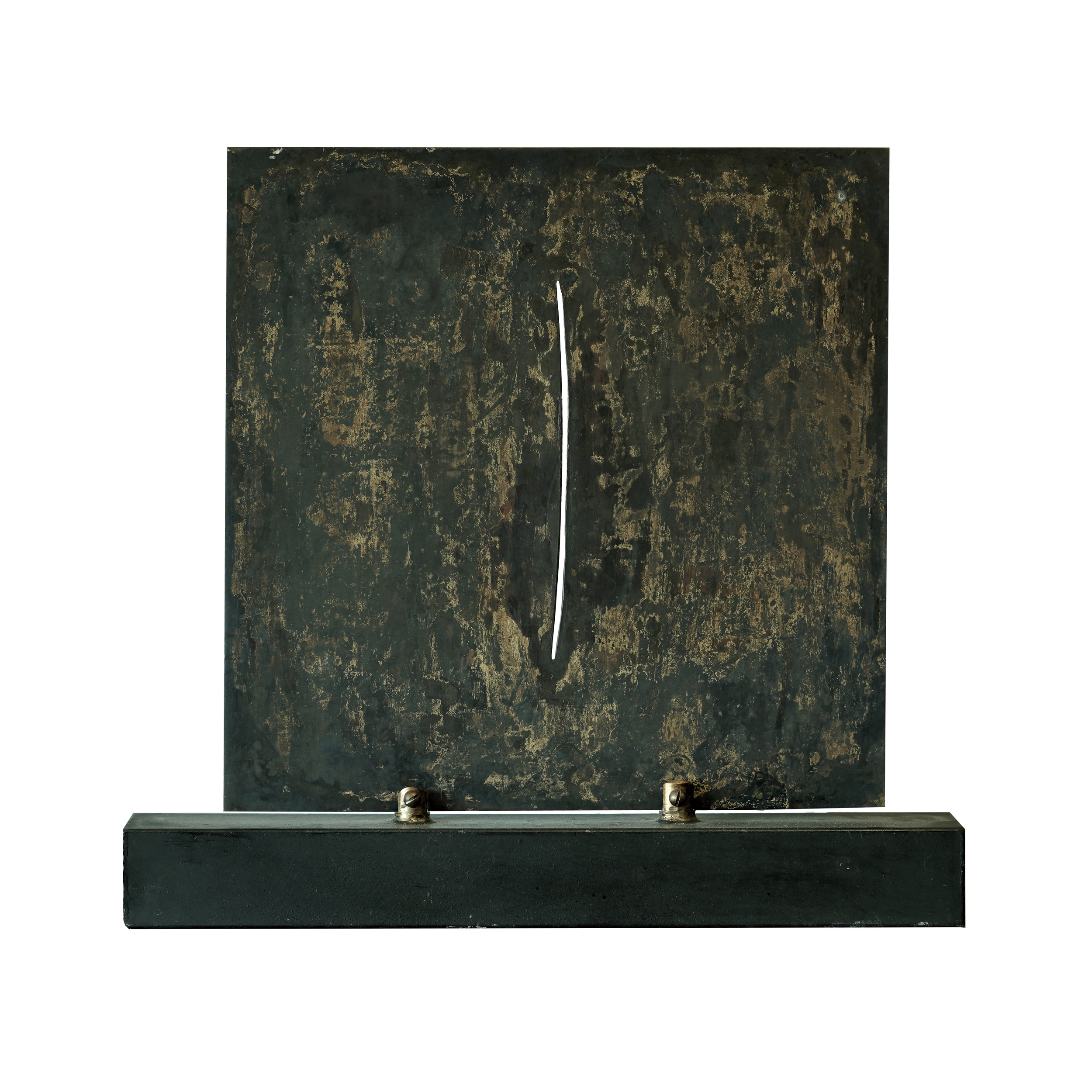
Lucio Fontana (1899–1968)
Concetto Spaziale, Renove, 1965
Bronze with incision, mounted on base
Dimensions: 48 × 50 cm
This minimalist yet striking sculpture by Argentine-Italian artist Lucio Fontana embodies his pioneering Spatialism movement. The work features a single, deliberate incision in a square steel plate, transforming the flat surface into a space of infinite depth. By cutting through the metal, Fontana rejects traditional sculptural volume, instead inviting the viewer to contemplate the void and the space beyond the object itself. The raw, weathered surface contrasts with the clean precision of the slit, reflecting Fontana’s interest in the dialogue between materiality and the metaphysical.
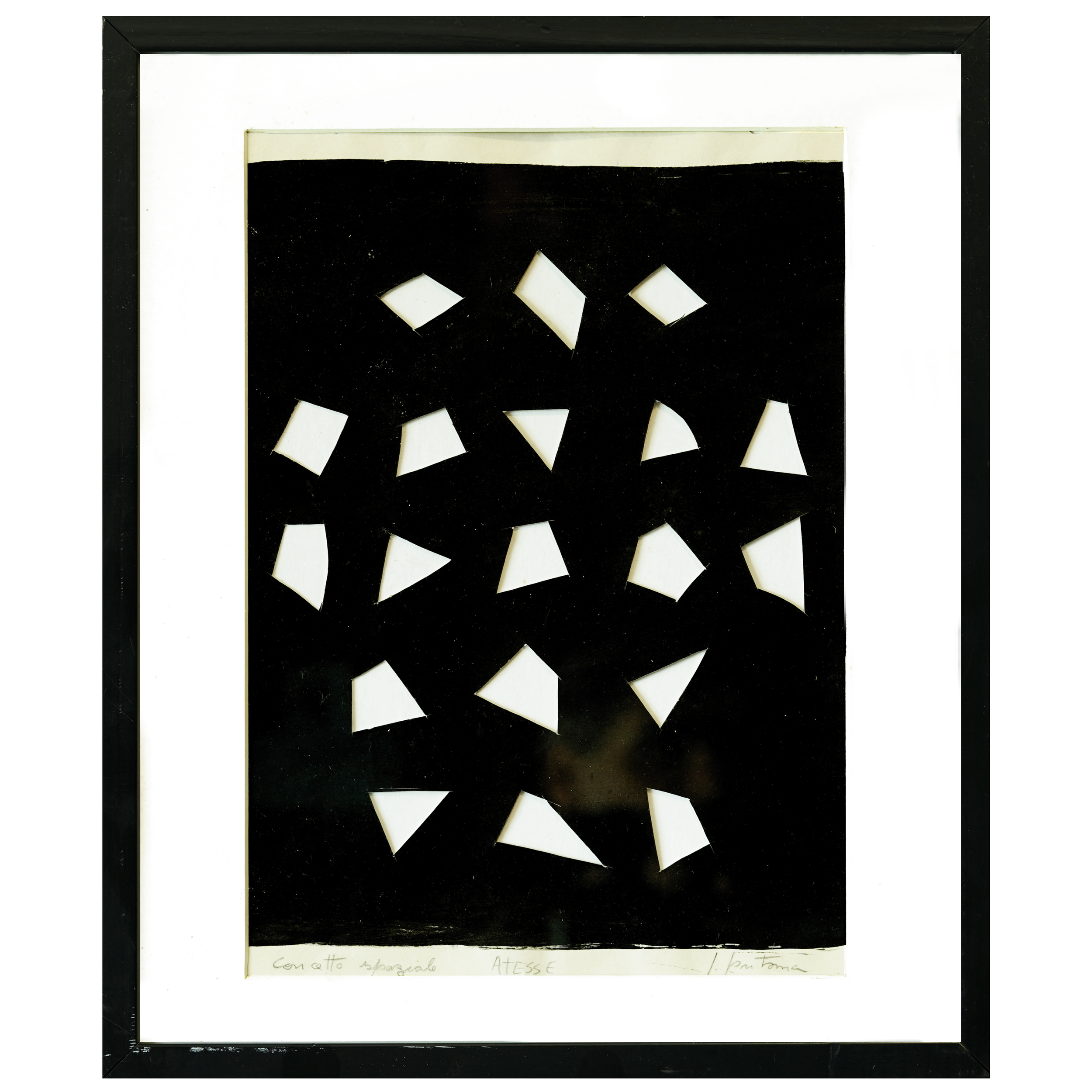
LUCIO FONTANA - Original “Concetto Spaziale”. Dated and signed at the bottom
Artist: Lucio Fontana (1899–1968)
Date: c. 1960s
Medium: Cut paper with black ink
Dimensions: 30 × 21 cm
Collection: Private Collection
Description:
Artwork part of Lucio Fontana’s Concetto Spaziale, Attese series. The piece features a black surface with a grid of precise cuts through the paper. The white background visible through the cuts creates a contrast that emphasizes space and depth.
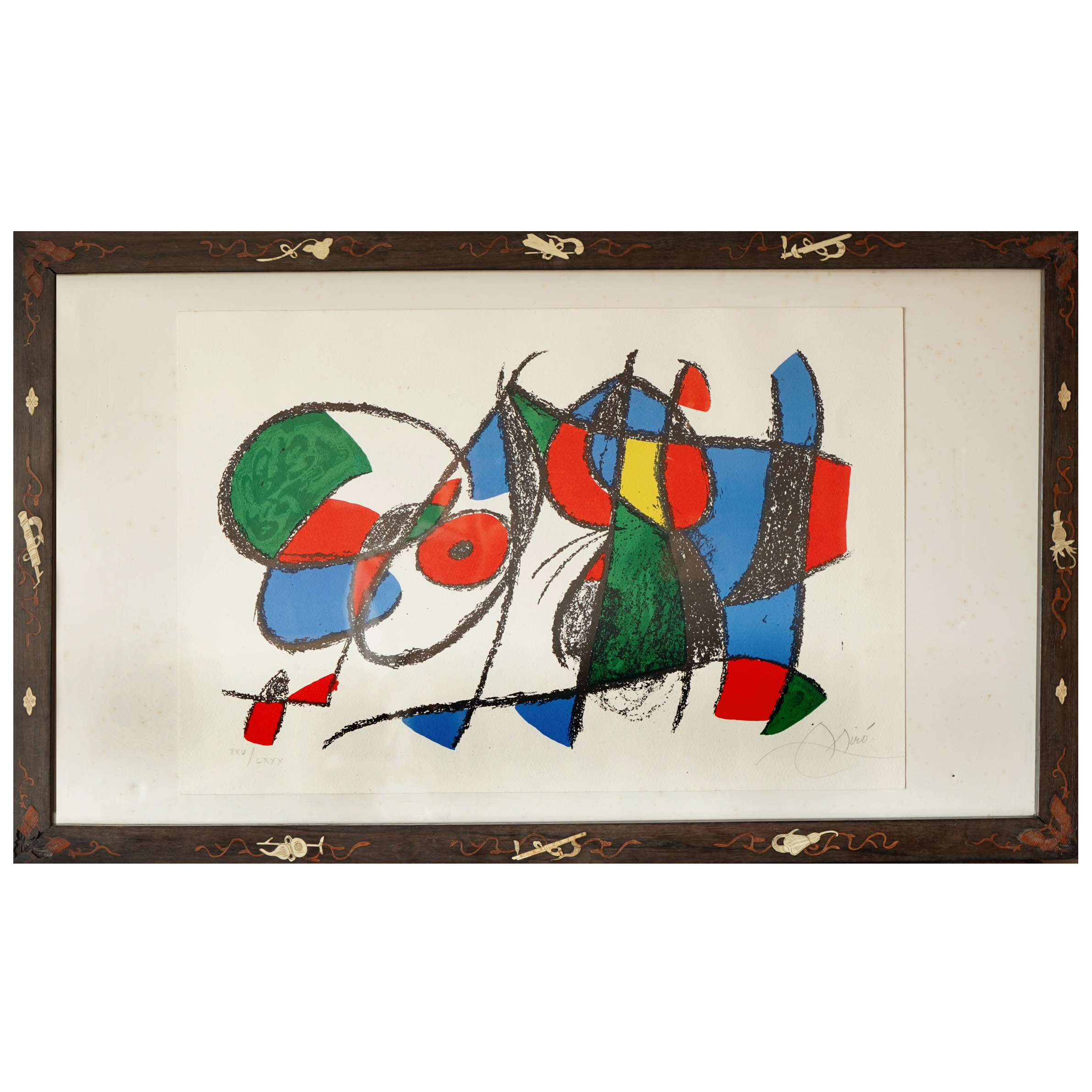
JOAN MIRO Lithographe Original. Signed bottom right
XXV / LXXX
Year: 1979
Title:Untitled (Abstract Composition)
Artist: Joan Miró (Spanish, 1893–1983)
Medium: Color lithograph on paper
Signature: Hand-signed "Miró" (lower right)
Dimensions: 36 × 55 cm
Description:
Lithograph by Joan Miró showing the artist’s mastery of color and abstract form. Composed of energetic black lines intertwined with vibrant zones of red, blue, green, and yellow, the piece captures the rhythmic dynamism that defines much of Miró’s later work. The playful, looping forms and whimsical geometry evoke a sense of freedom and imagination, hallmarks of his unique visual language..
This lithograph belongs to a series of works that reflect Miró’s enduring interest in the subconscious and the symbolic. His bold, modernist vocabulary — characterized by floating biomorphic shapes and surreal gestures — had a profound influence on 20th-century abstraction.
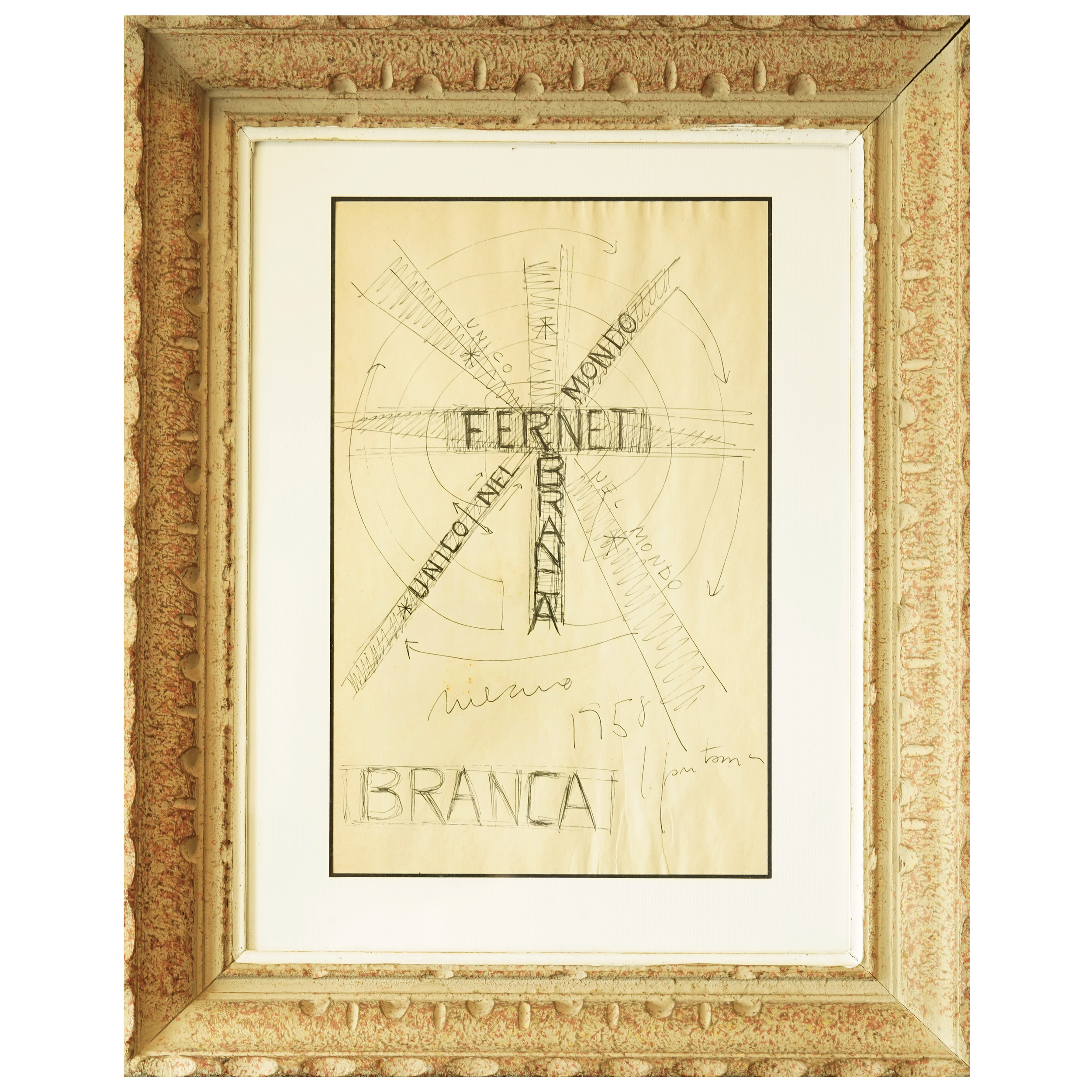
LUCIO FONTANA - Original Drawing “FERNET BRANCA”. Dated and signed bottom right
Year: 1958
Title:Fernet Branca Study
Artist: Lucio Fontana (1899–1968)
Medium: Pencil on paper
Dimensions: 33 × 21 cm
Description:
Original drawing by Lucio Fontana offering a glimpse into the conceptual design process of the artist. Featuring hand-drawn lettering and radiating arrows, the work centers around the words “FERNET BRANCA,” referencing the iconic Italian amaro. The concentric forms and dynamic arrows suggest movement and global reach—possibly a design sketch for an advertisement or poster.
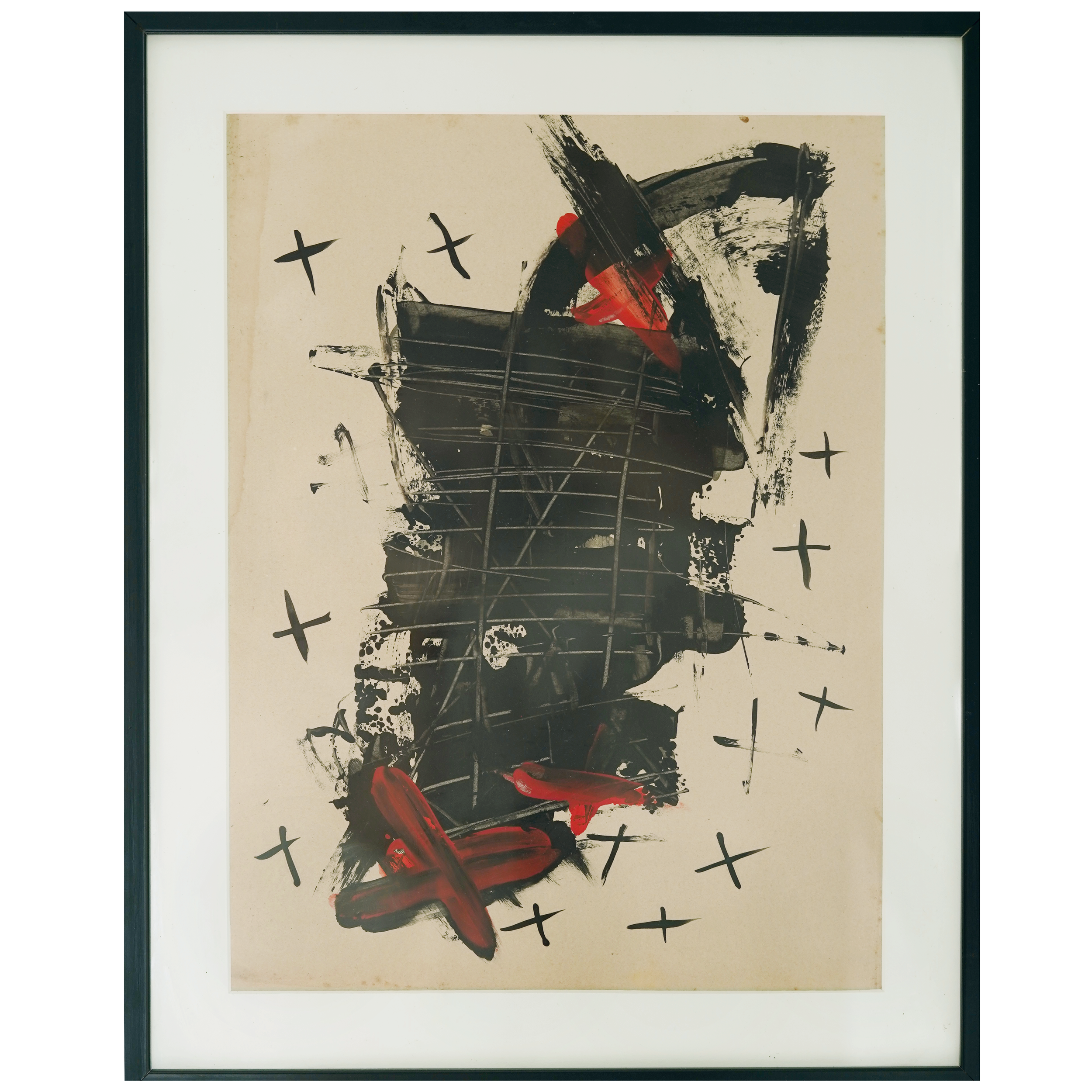
ANTONI TAPIES - Original Painting Untitled
Title:Untitled
Artist: Antoni Tàpies (1923–2012)
Medium: Mixed media on paper
Dimensions: 40 × 30 cm
Description:
Composition by Antoni Tàpies combining gestural brushstrokes, abstract symbolism, and raw texture to evoke a sense of emotional tension and philosophical depth. Dominated by black and red pigments, the piece features layered forms suggestive of barricades or scratched surfaces, with cross-like marks floating in space.
A leading figure in postwar European abstraction, Antoni Tàpies fused material experimentation with deep metaphysical concerns. His work often challenges the boundary between painting and object, using humble media to express inner and social conflict. This piece exemplifies his mature style, balancing chaos with control, and abstraction with symbolic charge.
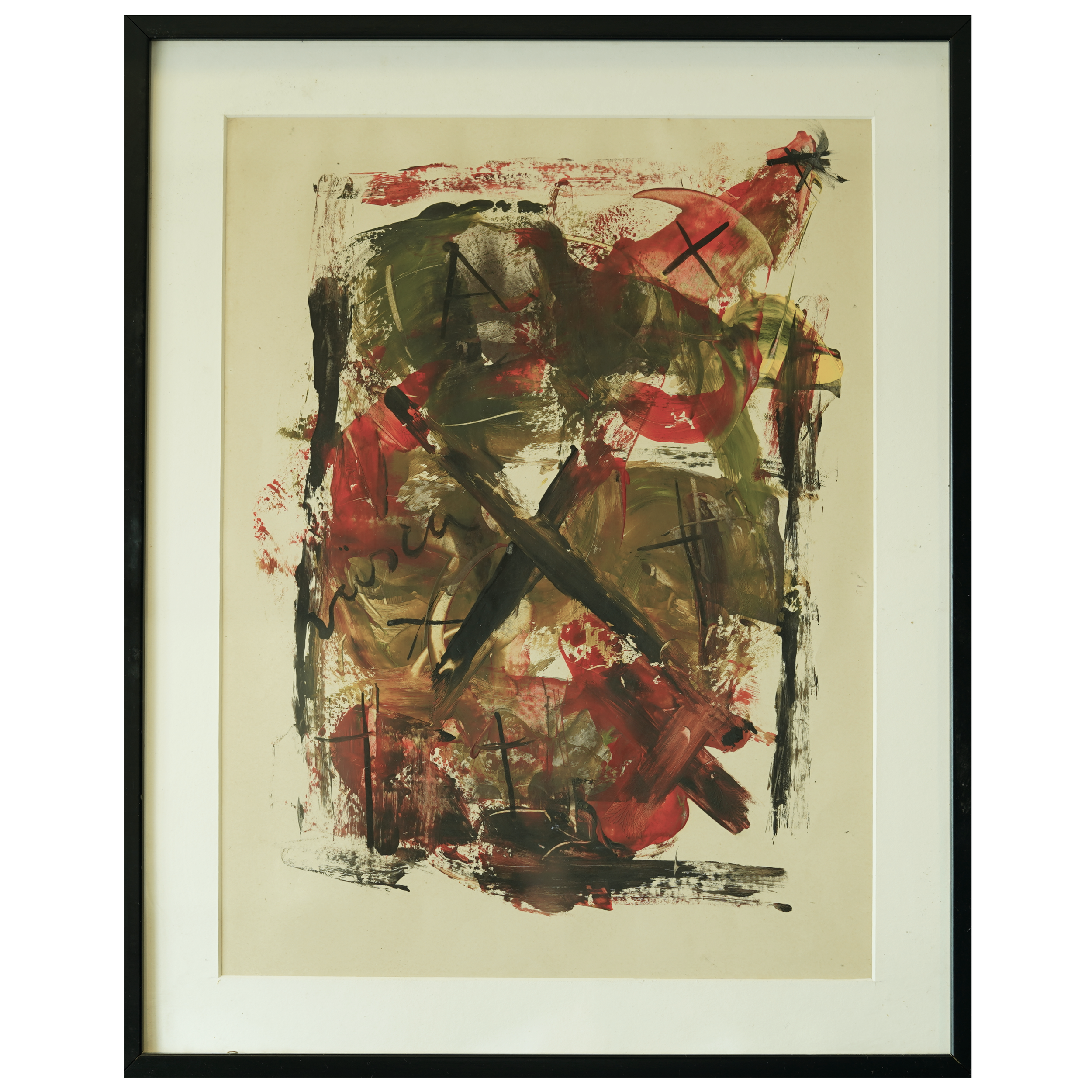
ANTONI TAPIES - Original Painting Untitled
Title:Untitled
Artist: Antoni Tàpies (1923–2012)
Medium: Mixed media on paper
Dimensions: 40 × 30 cm
Description:
Artwork by Antoni Tàpies, layers of earthy reds, greens, blacks, and ochres collide and blend across the paper in a dense field of marks and textures. Bold gestural strokes and scratched-in symbols—most notably recurring X and cross motifs—create a chaotic, raw surface that invites introspection.
Antoni Tàpies, a pivotal figure in the postwar European avant-garde, developed a unique approach that fused abstract expressionism with a material-focused sensibility. His works often confront the viewer with physicality and spiritual tension.
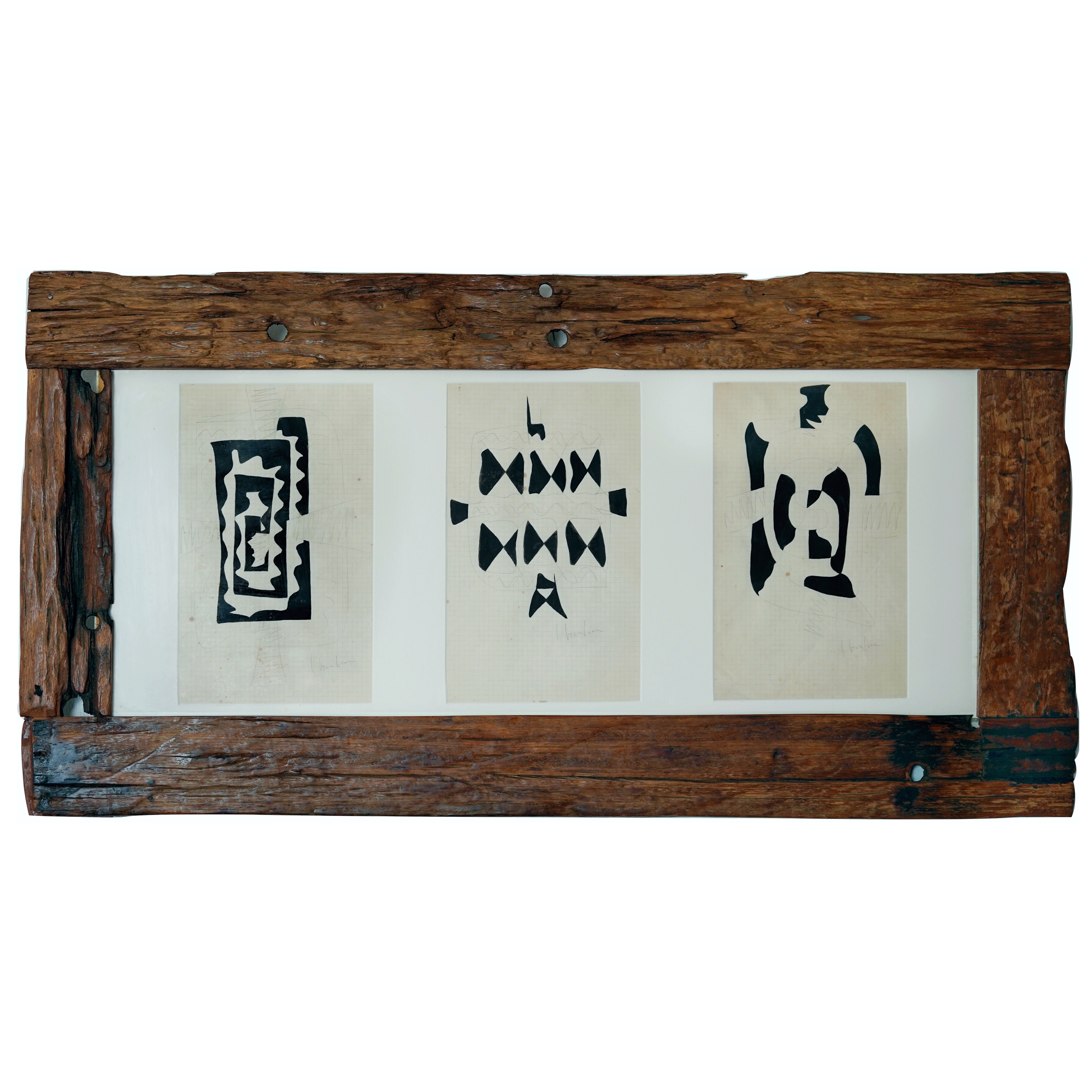
LUCIO FONTANA - Concetto Spaziale. Signed on each bottom right
Title:Spatial Concepts (Triptych)
Artist: Lucio Fontana (1899–1968)
Medium: Ink on graph paper, mounted in reclaimed wood frame
Dimensions: 33 × 20 cm (x3) -with frame : 52 × 117 cm
Description:
Triptych by Lucio Fontana featuring three abstract ink drawings on graph paper, each exploring a unique spatial rhythm through black geometric forms. The compositions display Fontana’s signature interest in breaking traditional pictorial boundaries, reducing form to raw, symbolic essence. Mounted in a rough-hewn wooden frame.
Lucio Fontana, founder of the Spatialism movement, sought to go beyond the flat surface of the canvas and redefine art through space, light, and gesture. In this rare triptych, Fontana turns to paper to explore spatial energy in two dimensions, creating meditative symbols that appear to pulse with dynamic force.
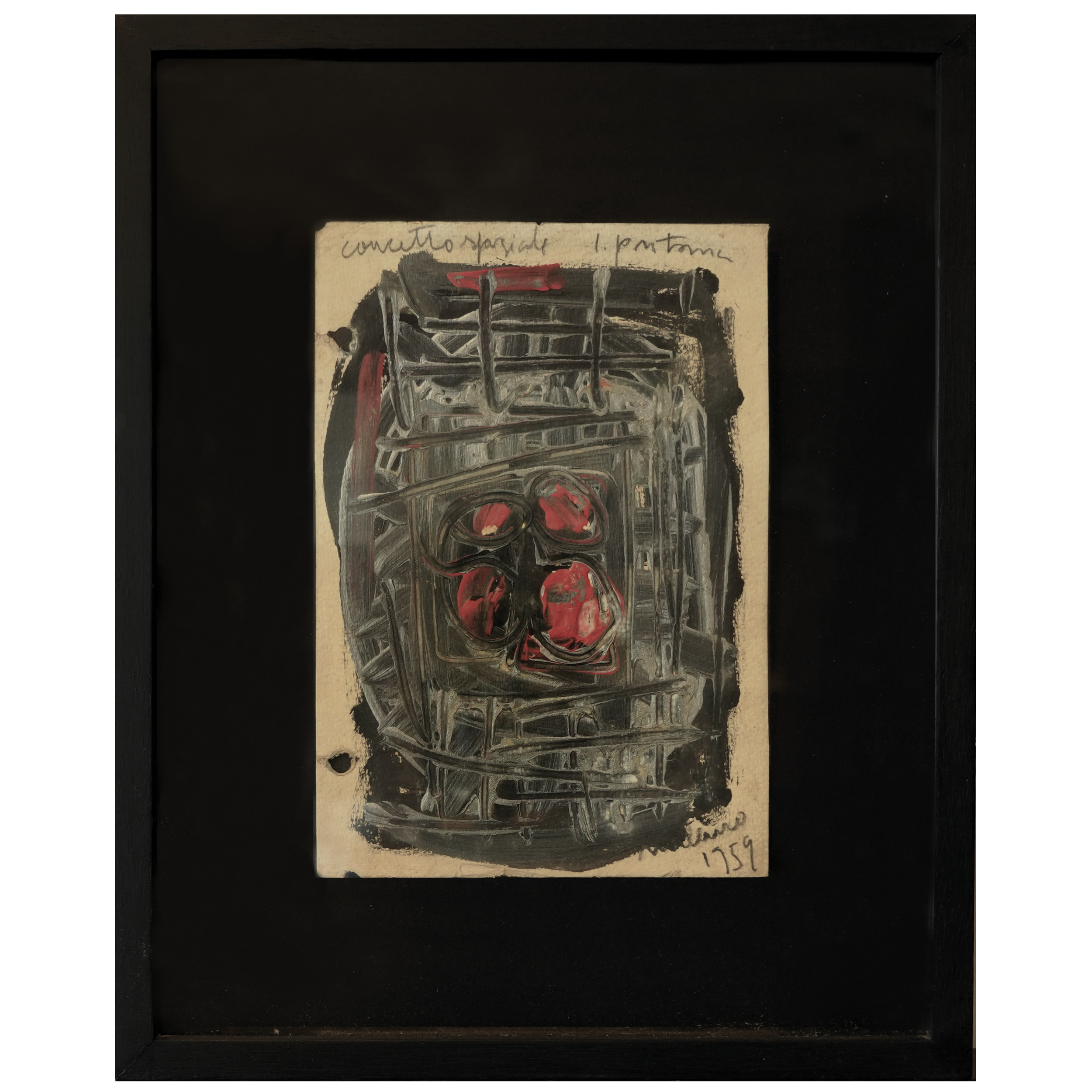
Painting on paper by Lucio Fontana, Concetto Spaziale
Title:Concetto Spaziale (Spatial Concept)
Artist: Lucio Fontana (1899–1968)
Medium: Mixed media on paper
Dimensions: 23 × 16 cm
Description:
Artwork by Lucio Fontana featuring a dense interplay of white, black, and red pigments applied with energetic gestures over a layered surface. At the center, a cluster of vibrant red forms pulses within an intricate web of strokes and lines, evoking spatial tension and organic energy. The handwritten inscription "Concetto Spaziale" above the composition anchors the work in Fontana’s broader artistic pursuit of transcending traditional two-dimensional art.
As the founder of Spatialism, Lucio Fontana sought to integrate space, movement, and materiality into a new visual language. This painting is a vivid testament to that vision, merging abstract form and visceral texture to create a sense of depth and rupture.
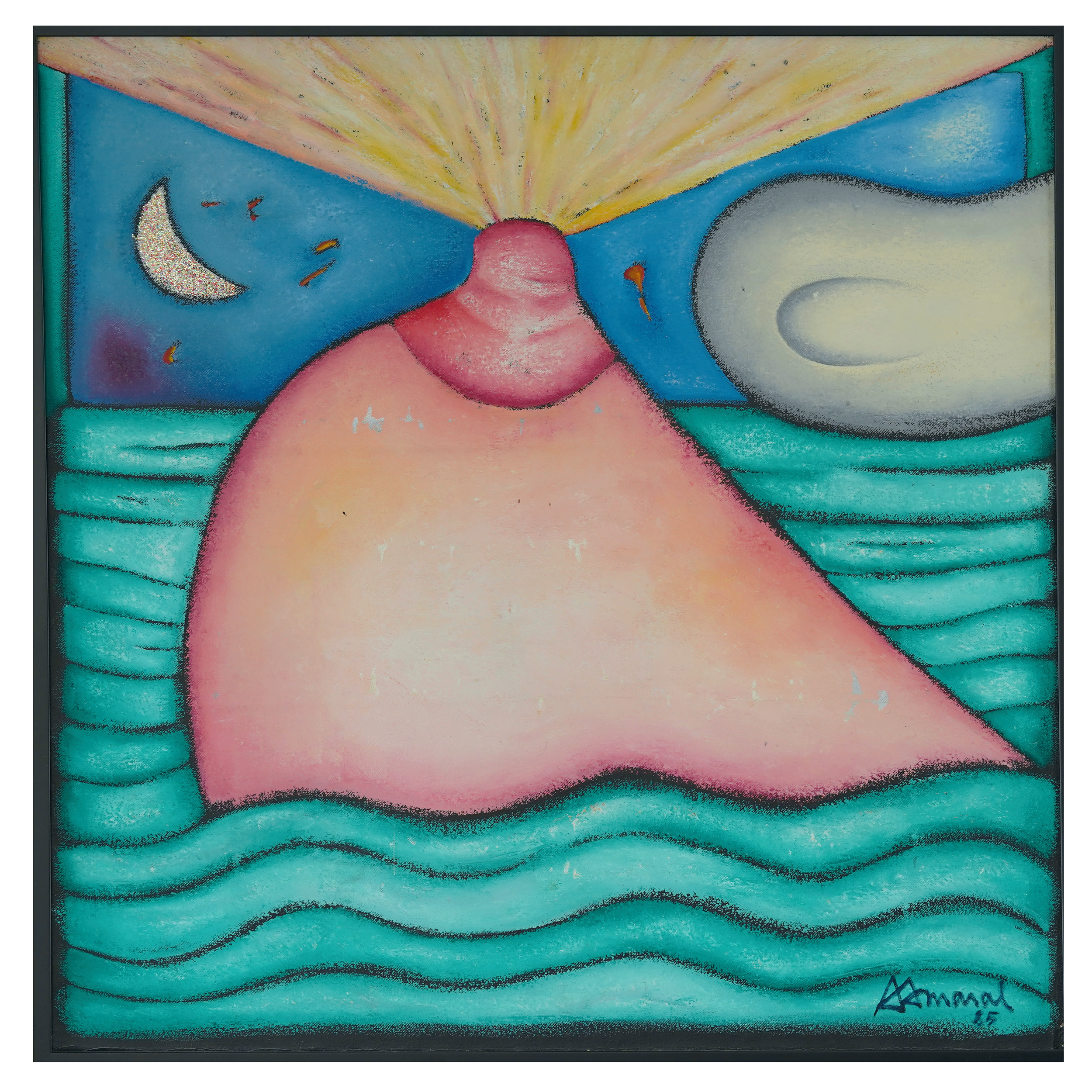
ANTONIO HENRIQUE AMARAL. Acrylic on canevas. Signed bottom right
Title:Untitled
Artist: Antonio Enrique Amaral (1935–2006)
Medium: Pastel and mixed media on paper
Dimensions: 102 × 102 cm
Description:
Composition by Antonio Enrique Amaral fusing human anatomy with elements of nature, depicting a breast-shaped volcano rising from stylized turquoise waves. The volcano erupts with radiant energy into a deep blue sky, where a crescent moon and cloud float nearby, reinforcing the dreamlike quality of the work. Amaral's use of bold color, curved lines, and sensual forms evokes a playful yet symbolic narrative of creation, nature, and transformation.
A prominent figure in Latin American modernism, Amaral often explored themes of power, identity, and the body through surreal allegories. This work reflects his signature fusion of political symbolism and poetic imagery, offering a visual meditation on the intersection of the natural world and the human form.
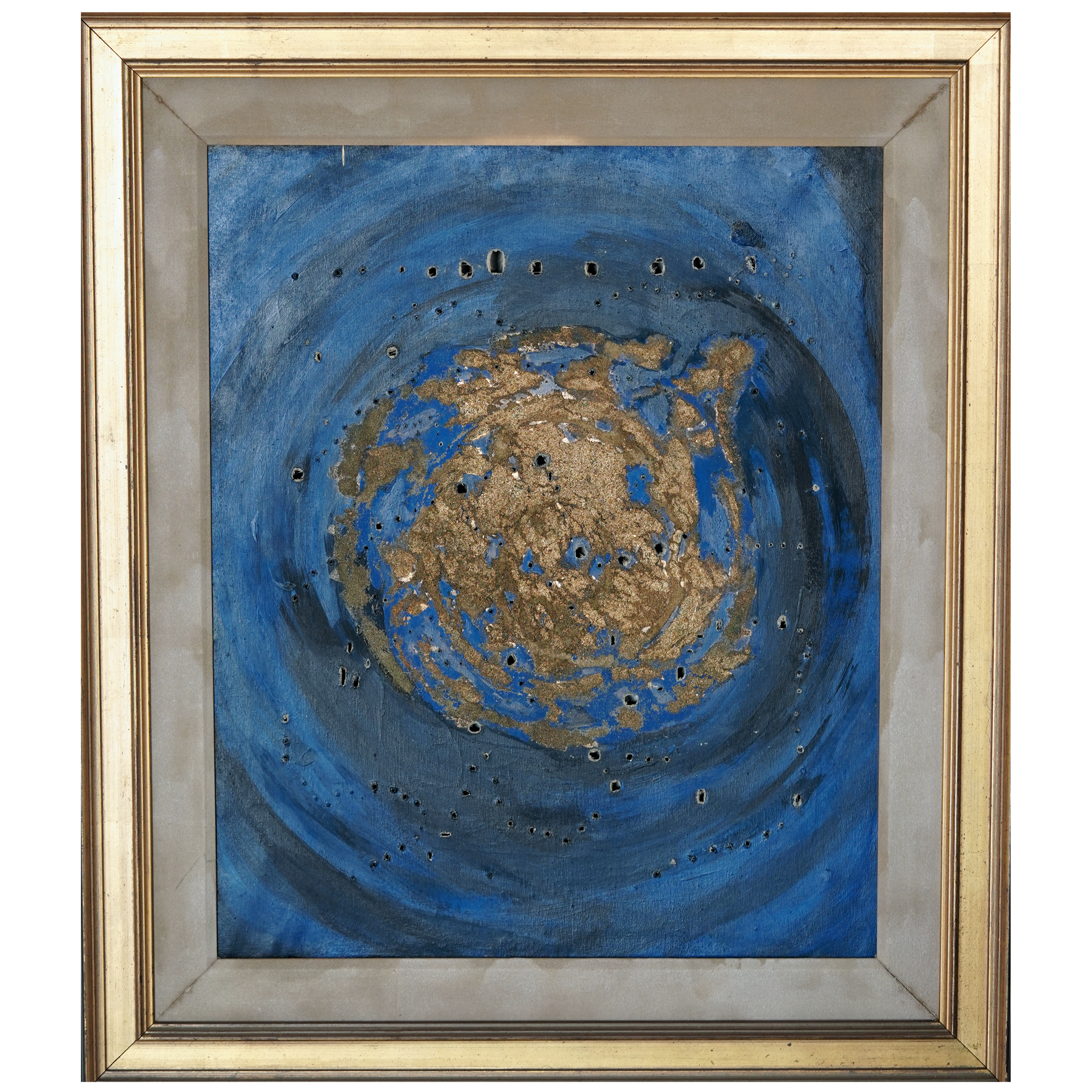
Painting by Lucio Fontana, from Original Concetto Spaziale
Title:Concetto Spaziale
Artist: Lucio Fontana (Italian, 1899–1968)
Medium: Oil, gold leaf, and perforations on canvas
Dimensions: 79 × 68 cm
Description:
Concetto Spaziale (Spatial Concept), Lucio Fontana transcends the two-dimensional limits of traditional painting. At the heart of the canvas lies a swirling planetary form rendered in lustrous gold, set against a rich, celestial field of blue. True to Fontana’s radical vision, the surface is punctuated by a constellation of deliberate perforations, creating literal and conceptual depth.
Lucio Fontana's Concetto Spaziale works marked a groundbreaking shift in postwar art, merging painting, sculpture, and conceptualism. This piece, with its dynamic textures, tactile incisions, and cosmic overtones, exemplifies Fontana’s revolutionary aim to open the artwork to new dimensions—literally piercing the veil of representation to embrace the void beyond.

Joan Miró (1893–1983)
Lithograph
Dimensions: 86 × 59 cm
Lithograph by Joan Miró showcasing the artist’s distinctive visual language of bold colors, organic shapes, and playful abstraction. With its rhythmic black forms interwoven with striking reds, blues, and yellows, the work reflects Miró’s exploration of the subconscious and his desire to evoke a dreamlike, poetic universe. Characterized by spontaneity and imagination, this print exemplifies Miró’s pivotal role in Surrealism and his lasting influence on modern art.