
Eclectic Collectors: A Diverse Array of Artistic Masterpieces
Step into a space where modern art legends come alive.
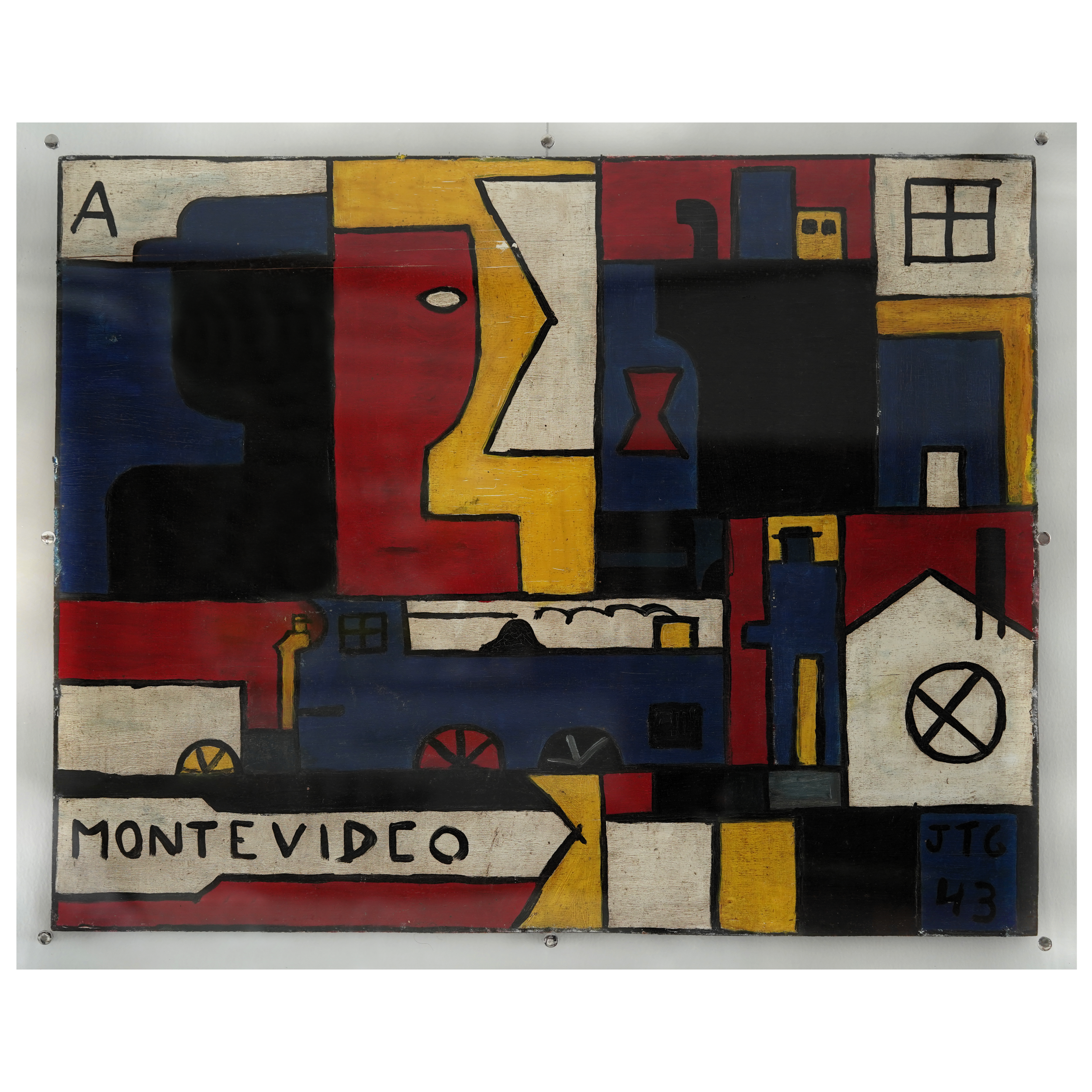
Our collection includes original works by Picasso, Matisse, Cocteau, Giacometti, Wilfredo Lam, and more.
Discover rare Picasso drawings and his bold final etching series, “347.” Lucio Fontana’s slashed canvases redefine space, while Armando Morales' sensual oils and sketches reveal deep emotion. Cocteau’s poetic linework and Giacometti’s refined figures offer intimacy and soul.
Explore BEN’s provocative phrases, and minimalist contrasts from Sol Lewitt and Carl Andre.
This isn’t just about names—it’s about stories, ideas, and emotion.
Whether you’re collecting or simply curious, we invite you to connect with the art.
Private viewings and guided discovery available.
FEATURED ARTIST
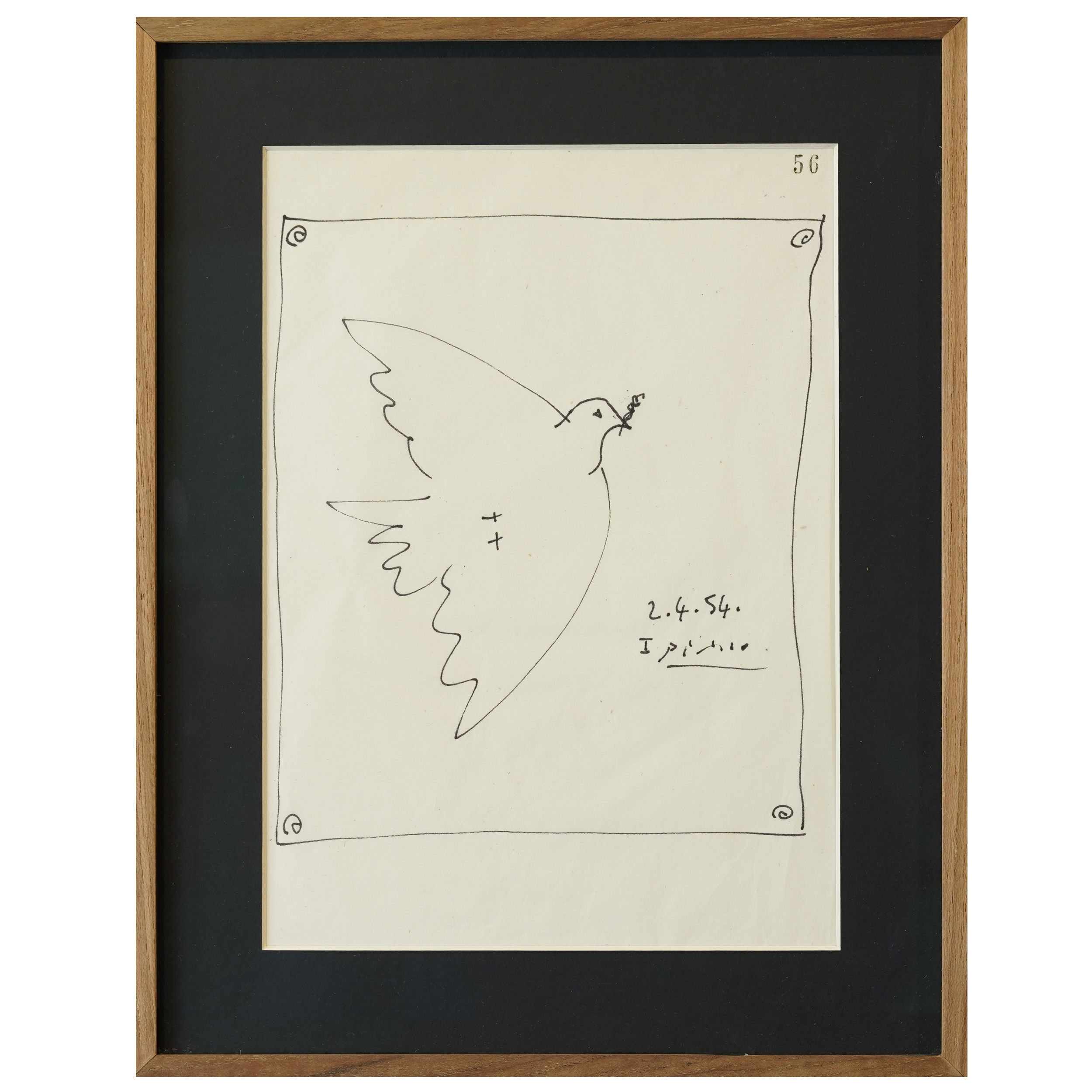

Spain, 1881 - 1973
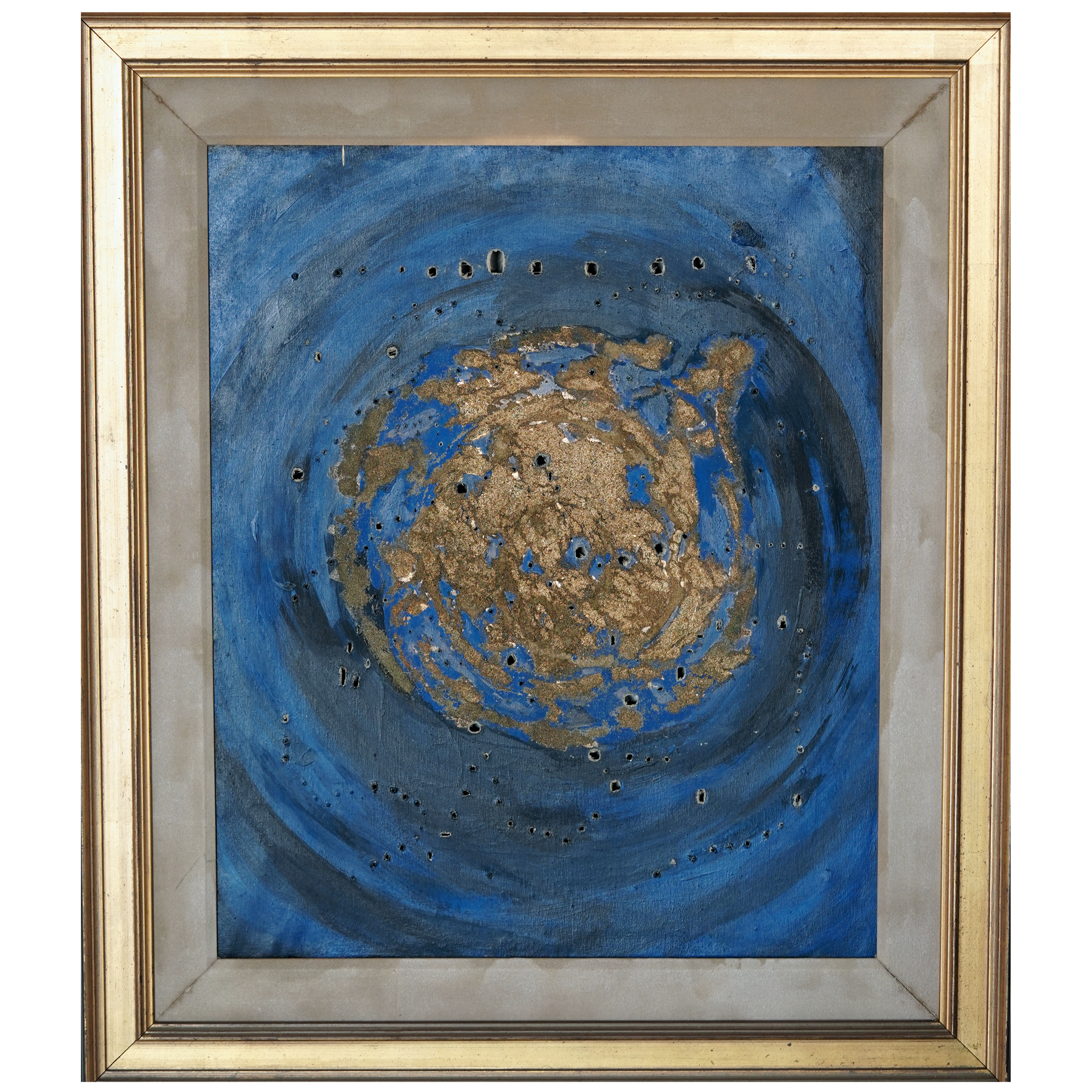
Italy, 1899 - 1968
France, 1869 - 1954
France-Russian, 1887 - 1985


USA, 1958 - 1990
Spain, 1923 - 2012
FEATURED MEDIUM


FEATURED ART
Mayan jade jewellery, esteemed for its vibrant green tones, embodied symbols of life, power, and divinity. Finely crafted into beads, pendants, and ceremonial adornments, these works reflect the artistry and spiritual values of the Maya elite.
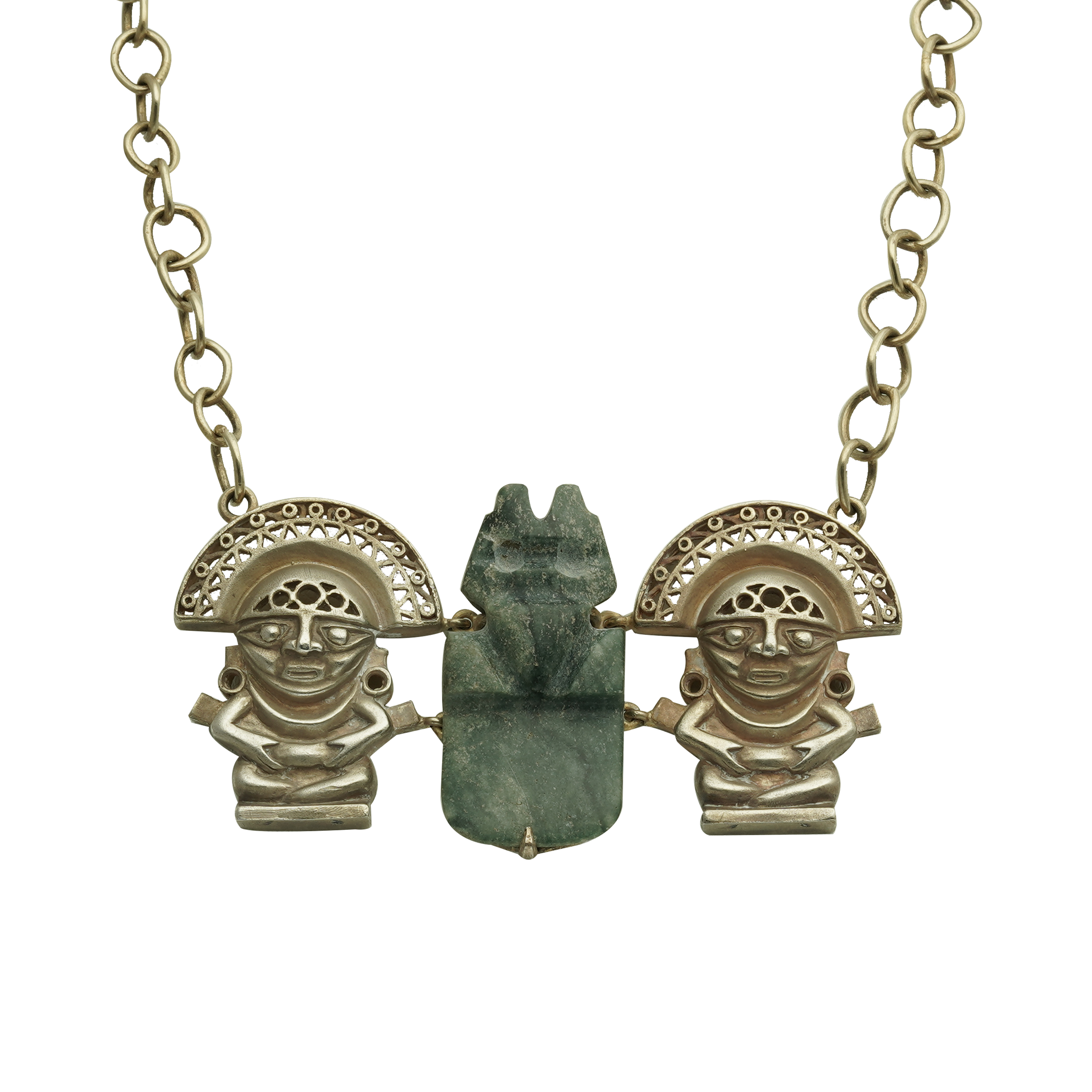
Maya Necklace with Seated Figures and Central Jade Pendant
Culture: Maya Civilization
Date: c. 600–900 CE (Late Classic Period)
Materials: Carved jadeite, metal (gilded metal), metal chain
Dimensions: Central pendant height approx. 6 cm; total width with figures approx. 10–12 cm
Ceremonial necklace featuring a central jadeite carving flanked by two cast metal anthropomorphic figures. The jade element, carved from deep green stone, depicts a stylized form possibly representing an animal-headed or deity-like figure. It is polished smooth with minimal incised detail, emphasizing the natural beauty of the jade.
On each side, finely crafted metal figures are shown seated cross-legged, holding an object across their chests. They wear large semicircular headdresses with openwork and geometric patterns, suggesting elite status or ceremonial roles. The figures are symmetrically placed and joined to the jade pendant by small connecting mounts, with the entire assembly suspended from a simple oval-link chain.
Provenance:
Likely from the southern Maya lowlands, in present-day Guatemala or southern Mexico.
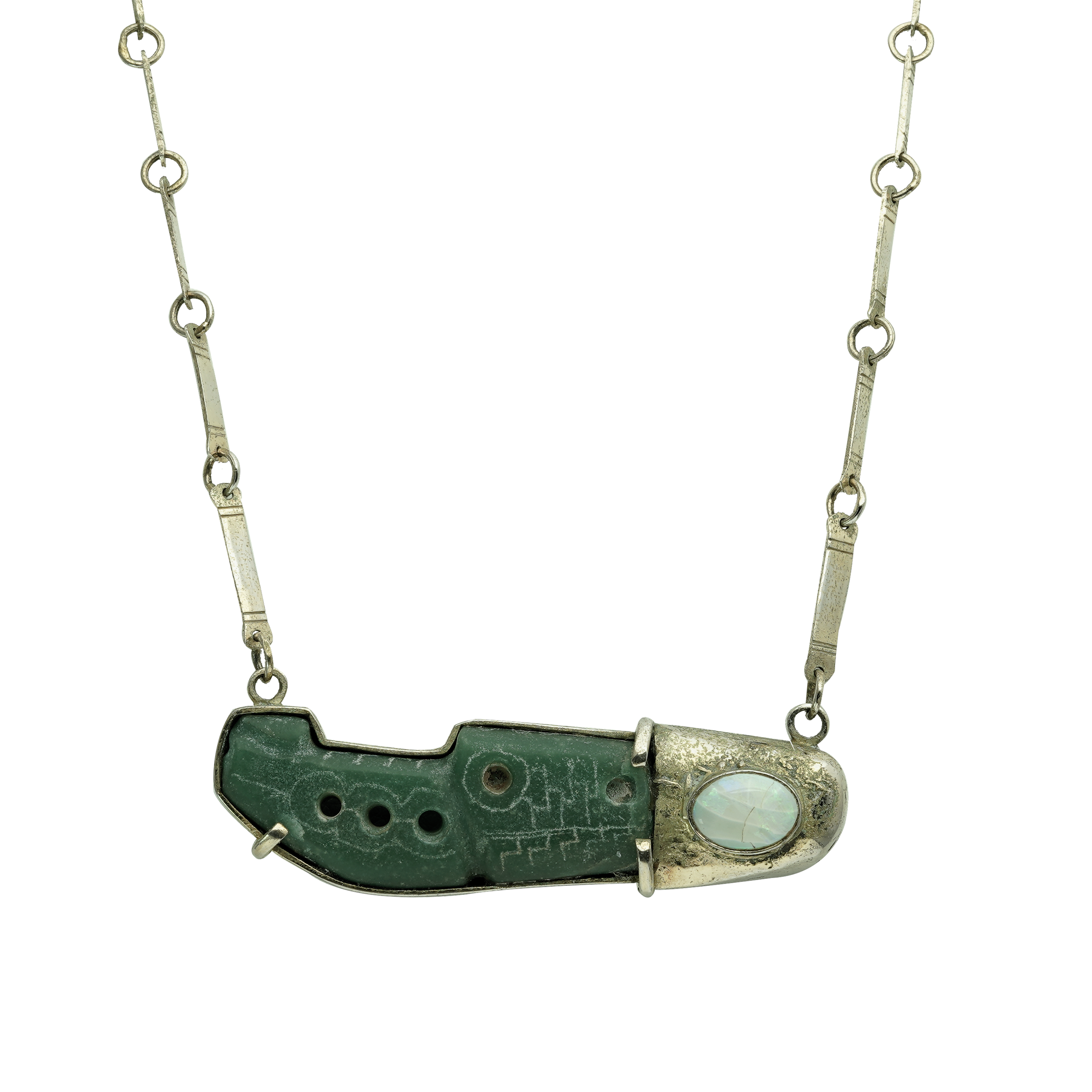
Maya Necklace with Jade Zoomorphic Pendant and Opal Inlay
Culture: Maya Civilization
Date: c. 600–900 CE (Late Classic Period)
Materials: Carved jadeite, opal inlay, metal (gilded metal)
Dimensions: Pendant length approx. 7–8 cm; chain length variable
Necklace featuring a pendant carved from jadeite in an elongated zoomorphic form, possibly representing a crocodile, lizard, or serpent—animals with deep symbolic meaning in Maya cosmology. The jade surface is pierced with three circular holes and decorated with incised stepped and linear patterns that may suggest scales or ritual markings.
One end of the pendant is enclosed in a textured metal fitting set with an oval cabochon opal. The opal’s shifting iridescence contrasts strikingly with the rich green of the jade, creating a visual focal point. The pendant is suspended from a chain composed of alternating round and elongated bar links, enhancing the necklace’s refined and balanced design.
Provenance:
Likely from the Maya lowlands, in present-day Guatemala, Belize, or southern Mexico.
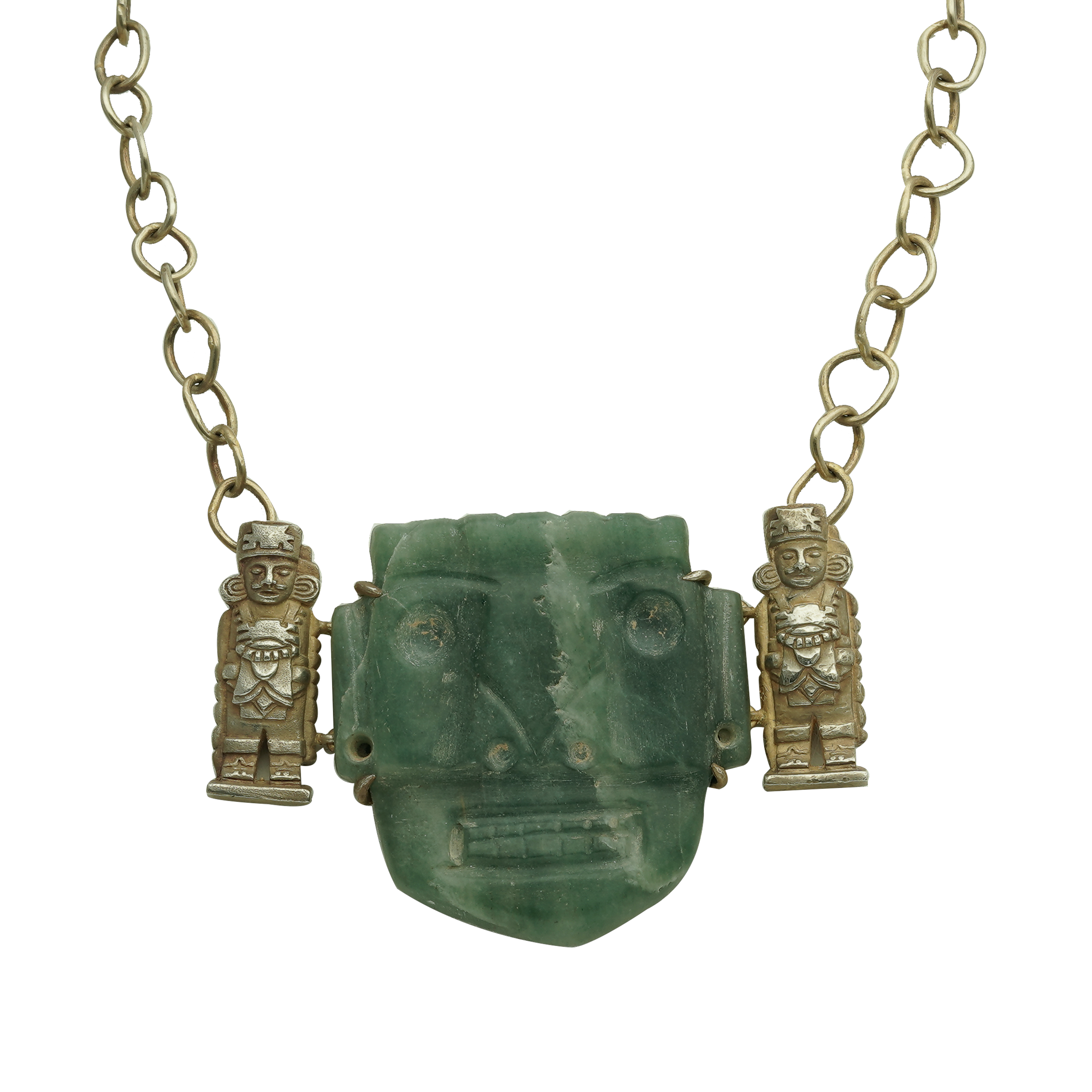
Maya Necklace with Jade Mask and Anthropomorphic Figures
Culture: Maya Civilization
Date: c. 600–900 CE (Late Classic Period)
Materials: Carved jadeite, metal (gilded metal), metal chain
Dimensions: Pendant approx. 6 cm x 9 cm width chain length variable
Necklace showing a central jadeite mask carved in a stylized human form, with geometric facial features, drilled eyes, and incised mouth. The carving exhibits the green hue and subtle mottling characteristic of jadeite valued in Maya culture. The mask is mounted in a simple metal frame and flanked by two cast metal anthropomorphic figures in full ceremonial attire. Each figure wears a headdress, earspools, and layered garments, with one hand resting on the chest in a gesture of authority.
The figures are attached directly to the central mask, forming a symmetrical pendant suspended from a simple oval-link chain. The juxtaposition of jade carving and detailed metal work demonstrates both the lapidary skill and the metallurgical craftsmanship of the piece.
Provenance:
Likely from the Maya lowlands, present-day Guatemala, Belize, or southern Mexico.
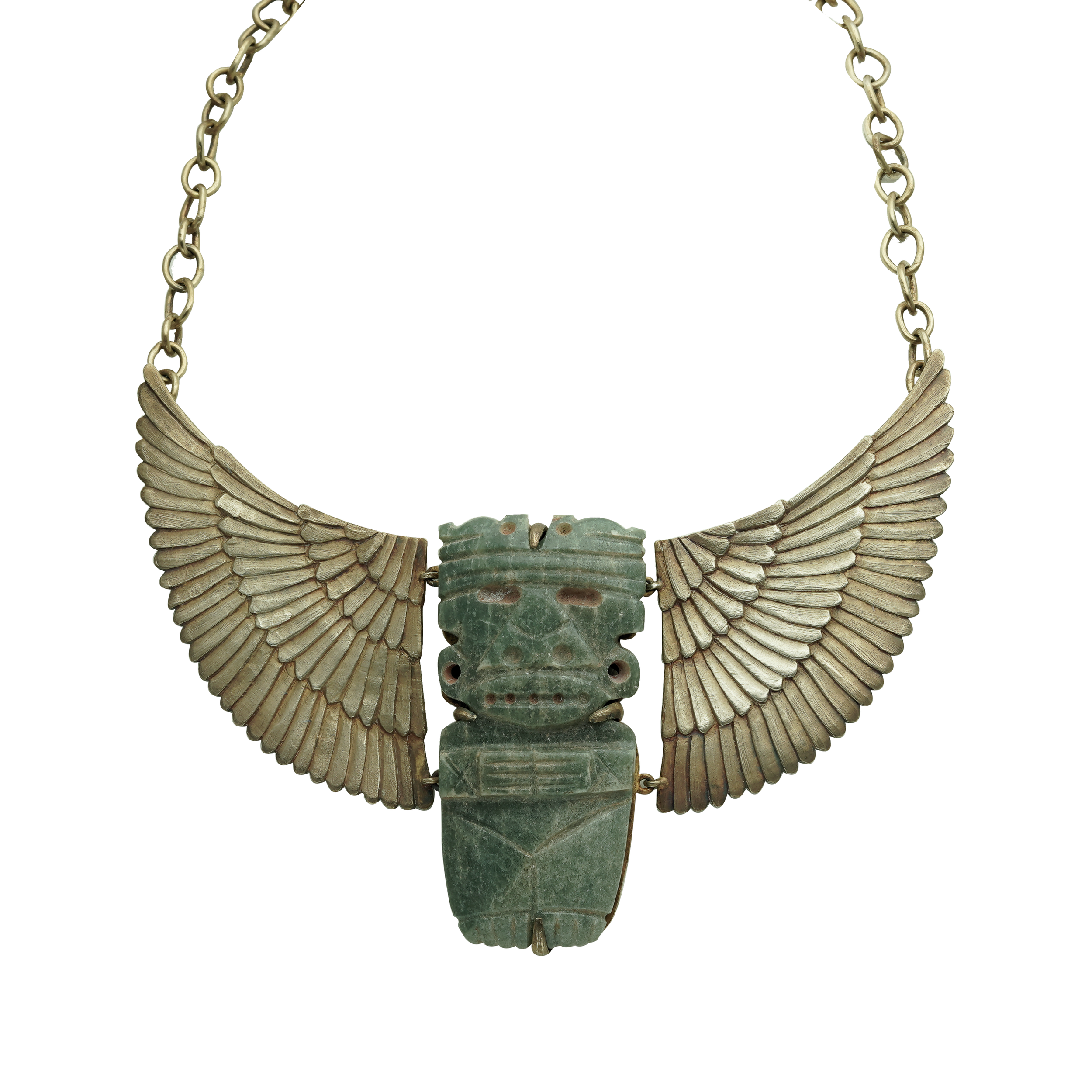
Maya Necklace with Winged Jade Pendant
Culture: Maya Civilization
Date: c. 600–900 CE (Late Classic Period)
Materials: Carved jadeite, metal (gilded metal), metal chain
Dimensions: Pendant height approx. 10–12 cm; wingspan approx. 16-20 cm
Ceremonial necklace featuring a central carved jadeite pendant depicting a stylized human or deity figure. The face is rendered with drilled eyes, a squared jawline, and incised details suggesting a headdress or cranial adornment. The body below is simplified into geometric sections, a hallmark of Classic Maya lapidary style.
Flanking the central jade carving are two finely cast metal wings, each composed of layered feather motifs with subtle texturing, extending outward to form a dramatic, symmetrical composition. The wings are attached to a sturdy metal chain, indicating the piece was intended to be worn prominently across the chest.
Provenance:
Likely from the Maya lowlands, in present-day Guatemala or southern Mexico.
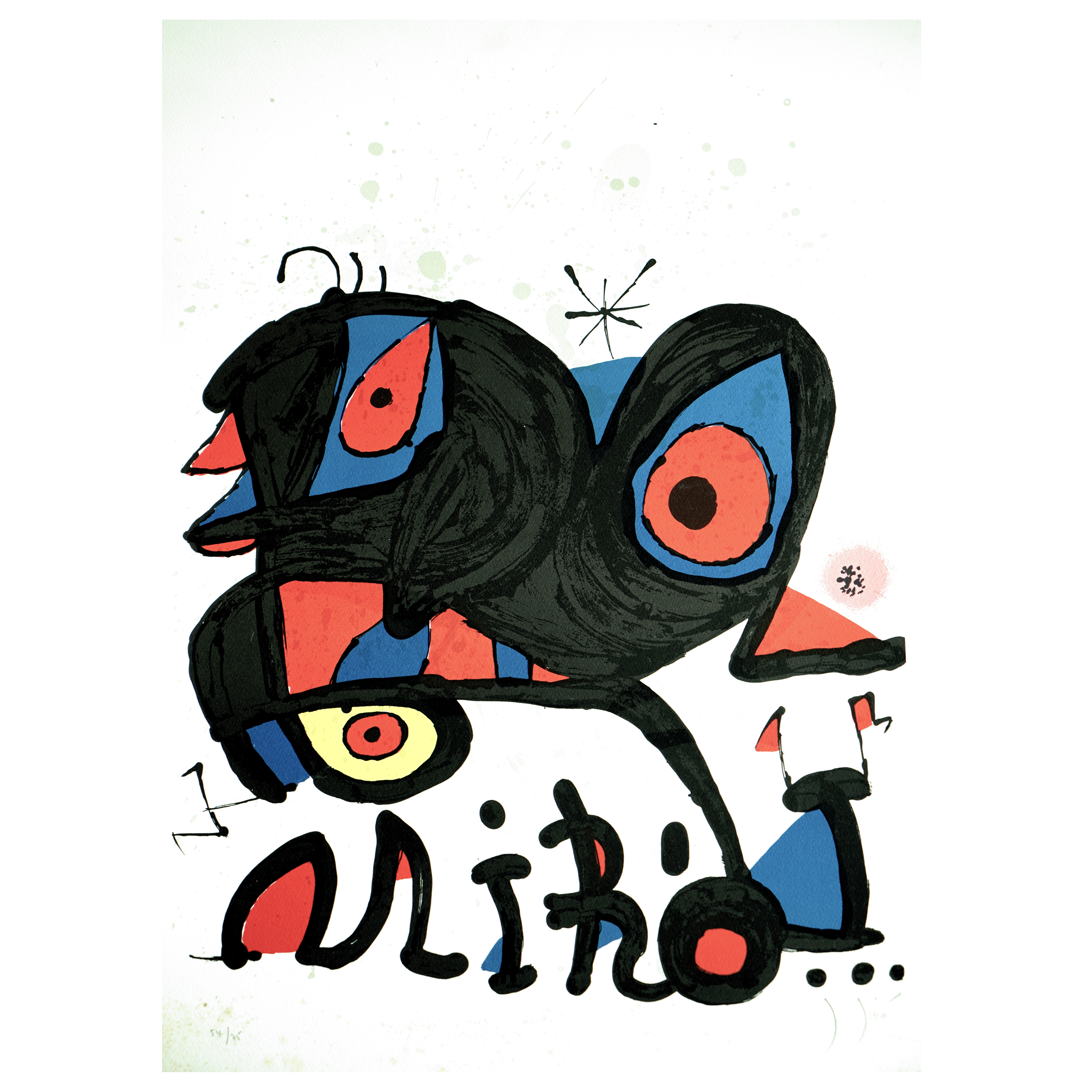
Joan Miró (1893–1983)
Lithograph
Dimensions: 86 × 59 cm
Lithograph by Joan Miró showcasing the artist’s distinctive visual language of bold colors, organic shapes, and playful abstraction. With its rhythmic black forms interwoven with striking reds, blues, and yellows, the work reflects Miró’s exploration of the subconscious and his desire to evoke a dreamlike, poetic universe. Characterized by spontaneity and imagination, this print exemplifies Miró’s pivotal role in Surrealism and his lasting influence on modern art.
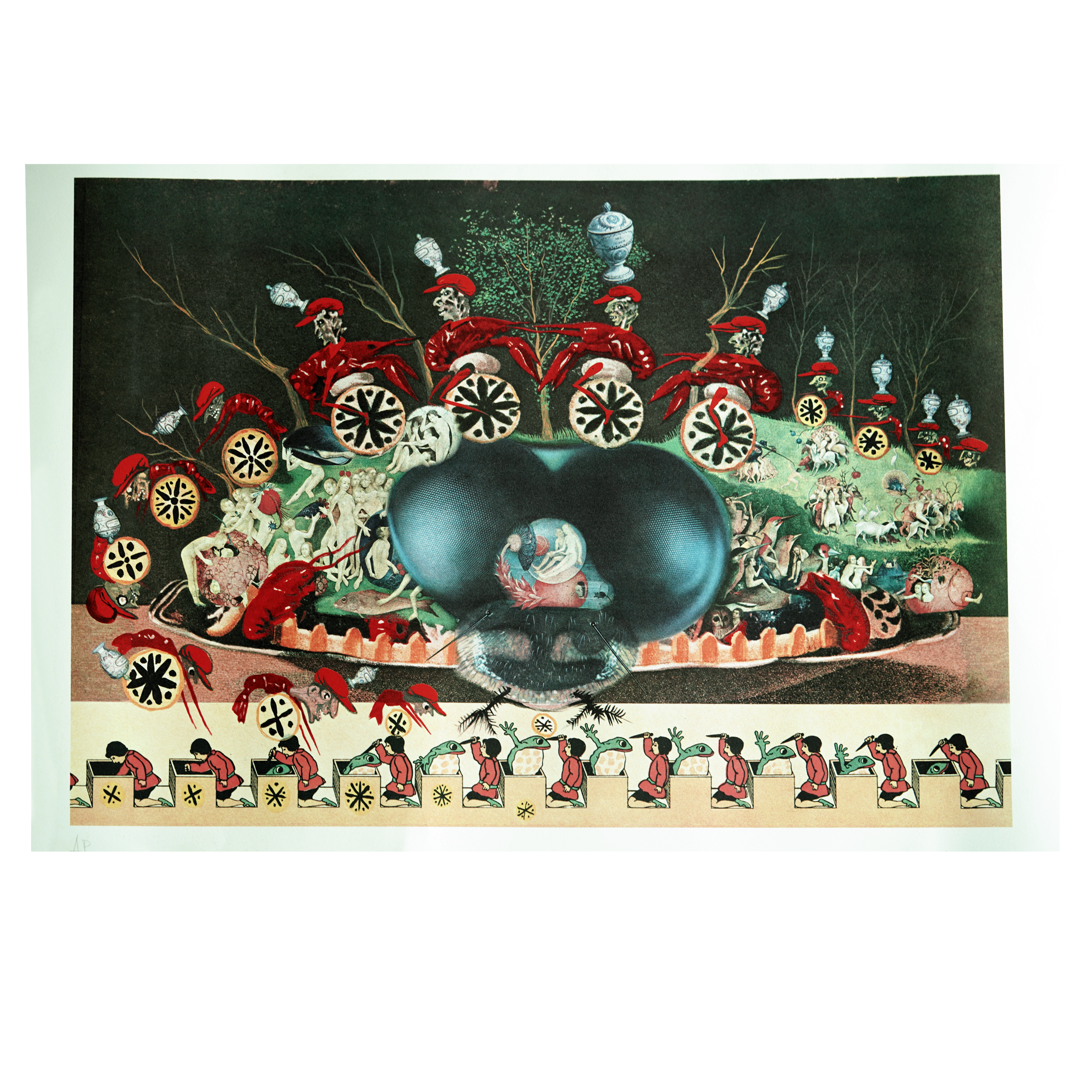
Salvador Dalí (1904–1989)
Lithograph after "The Garden of Earthly Delights"
Lithograph on paper
Dimensions: 41 × 58 cm
This lithograph by Salvador Dalí reinterprets Hieronymus Bosch’s The Garden of Earthly Delights through the surrealist’s unique vision. Combining fantastical figures, dreamlike landscapes, and symbolic imagery, Dalí pays homage to Bosch while infusing the work with his own eccentric and provocative style. The composition reflects Dalí’s fascination with the subconscious, metamorphosis, and the interplay of fantasy and reality, themes central to his career as one of the most influential artists of the 20th century.
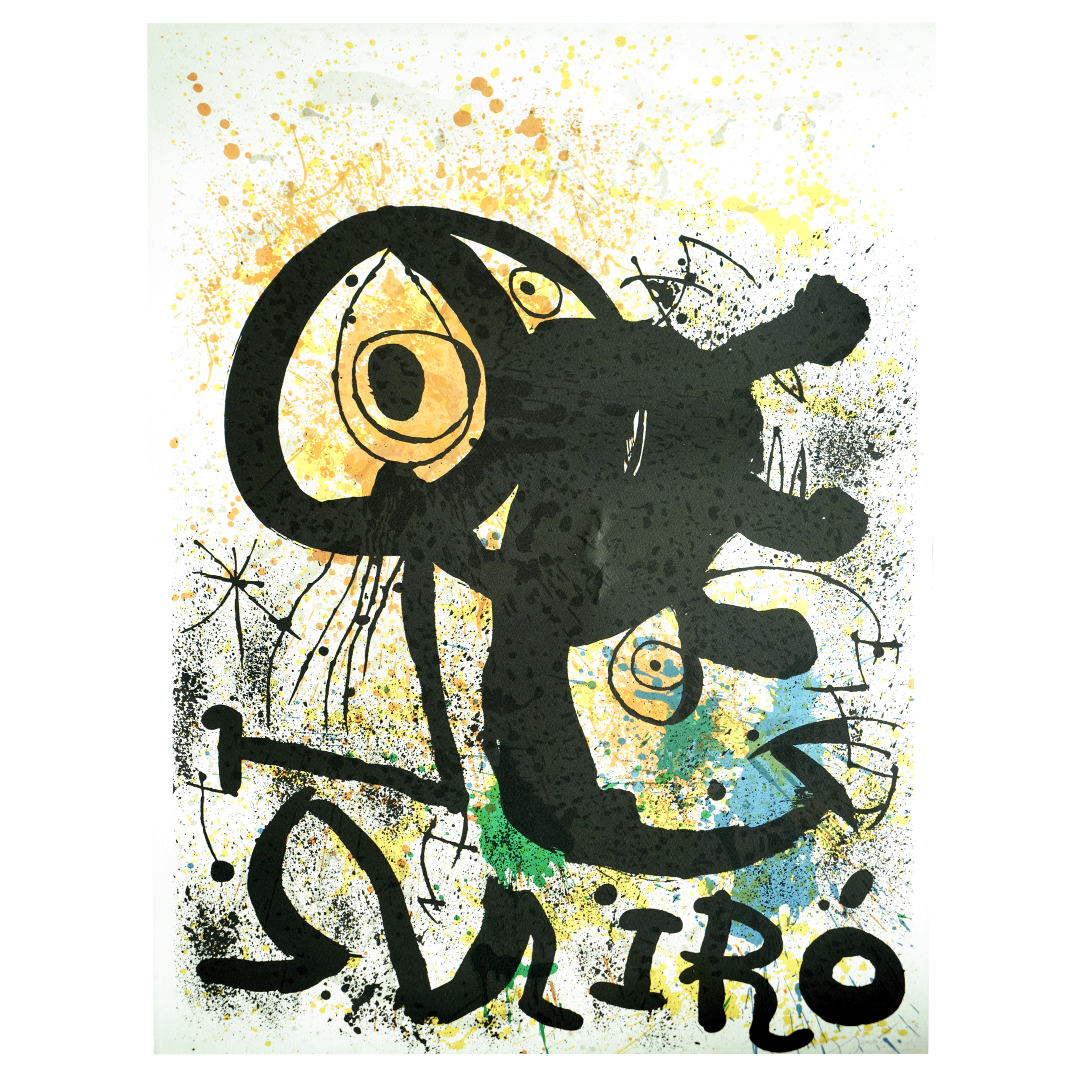
Joan Miró (1893–1983)
Untitled, c. 1960s–70s
Color lithograph on paper
Dimensions: 86 × 59 cm
Lithograph capturing Joan Miró’s fascination with spontaneity, movement, and the dreamlike world of abstraction. Bold black forms dominate the composition, animated by bursts of yellow, green, and blue splatters that evoke both cosmic energy and childlike play. Miró’s gestural lines and biomorphic shapes suggest a universe alive with symbols, where imagination transforms into visual poetry.
As in much of his graphic work, Miró uses lithography not only as a means of reproduction but as a medium of invention, preserving the immediacy and vitality of his painterly touch.
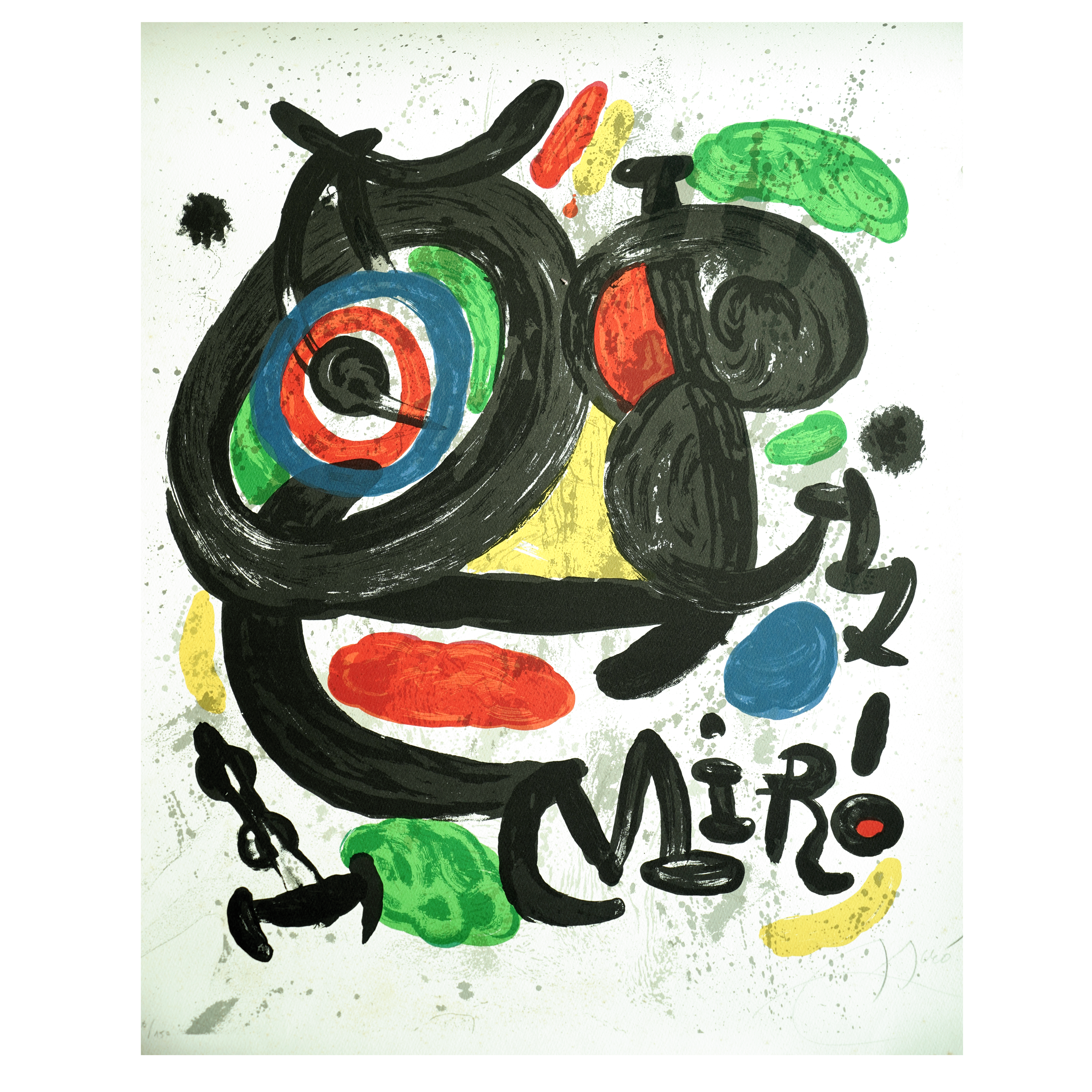
Joan Miró (1893–1983)
Untitled, c. 1960s
Color lithograph on paper
Dimensions: 86 × 59 cm
Lithograph exemplifying Joan Miró’s playful and poetic visual language. Bold black forms intertwine with bursts of primary colors—red, blue, yellow, and green—set against a dynamic field of painterly textures and gestural marks. The composition embodies Miró’s signature balance between abstraction and spontaneity, evoking a dreamlike world of symbols, movement, and imagination.
Miró’s graphic works, such as this, highlight his ability to translate the energy of his paintings into printmaking, making color and form accessible while preserving their expressive intensity.
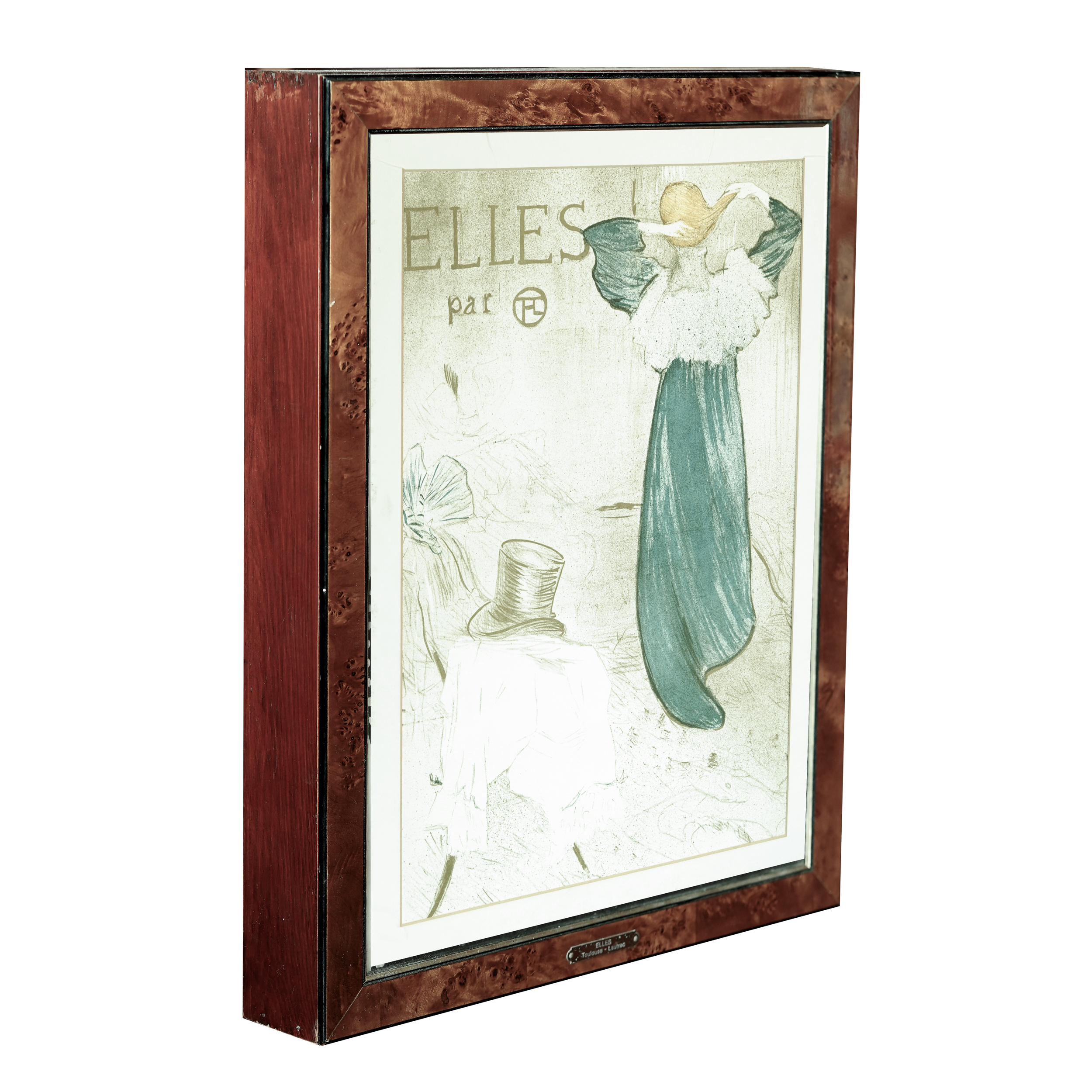
Henri de Toulouse-Lautrec (1864–1901)
Elles, 1896
Suite of pochoir lithographs
Dimensions: 60 × 49 cm
The Elles series, published in 1896, is one of Toulouse-Lautrec’s most intimate and revealing bodies of work. Comprising twelve lithographs and a cover, it depicts the daily lives of women in Parisian brothels—not in moments of spectacle, but in their private routines: waking, bathing, dressing, and resting.
With soft lines, muted tones, and a compassionate gaze, Lautrec strips away the stereotypes of the courtesan to portray women with humanity and dignity. Far from caricature, Elles stands as a sensitive testimony to intimacy and the quiet beauty of everyday life.
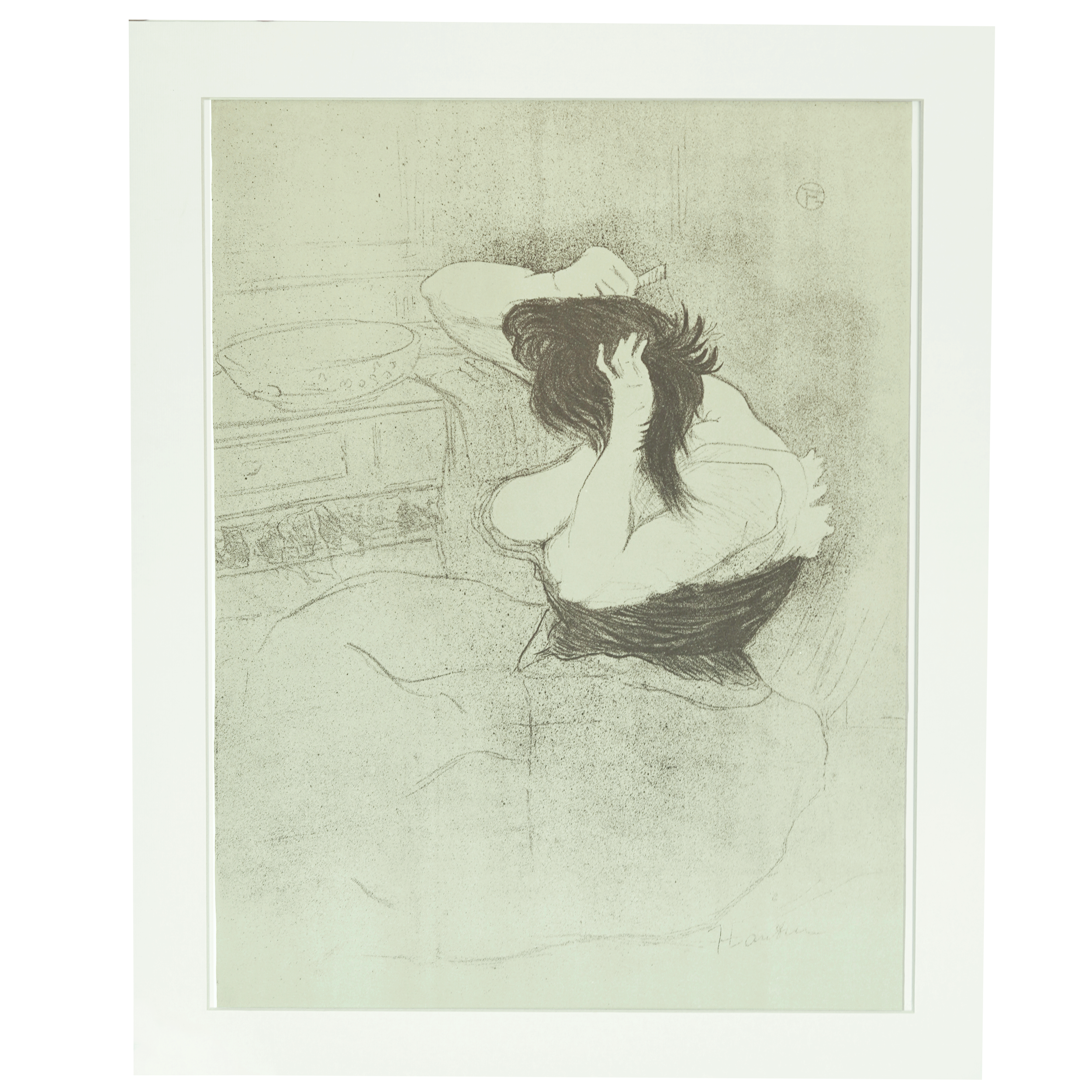
Henri de Toulouse-Lautrec (1864–1901)
Woman Combing Her Hair, from the series Elles, 1896
Lithograph
Dimensions: 60 × 49 cm
This work belongs to Toulouse-Lautrec’s celebrated Elles portfolio, which intimately portrays the private lives of women working in Parisian maisons closes. Here, a woman is shown in a moment of personal grooming, seated and absorbed in the simple act of combing her hair.
Rendered with soft lines and delicate tonal shading, the composition avoids dramatization, instead capturing the dignity of everyday gestures. Lautrec’s empathetic vision elevates the ordinary, offering a rare and humanizing perspective on women who were often marginalized in 19th-century society.
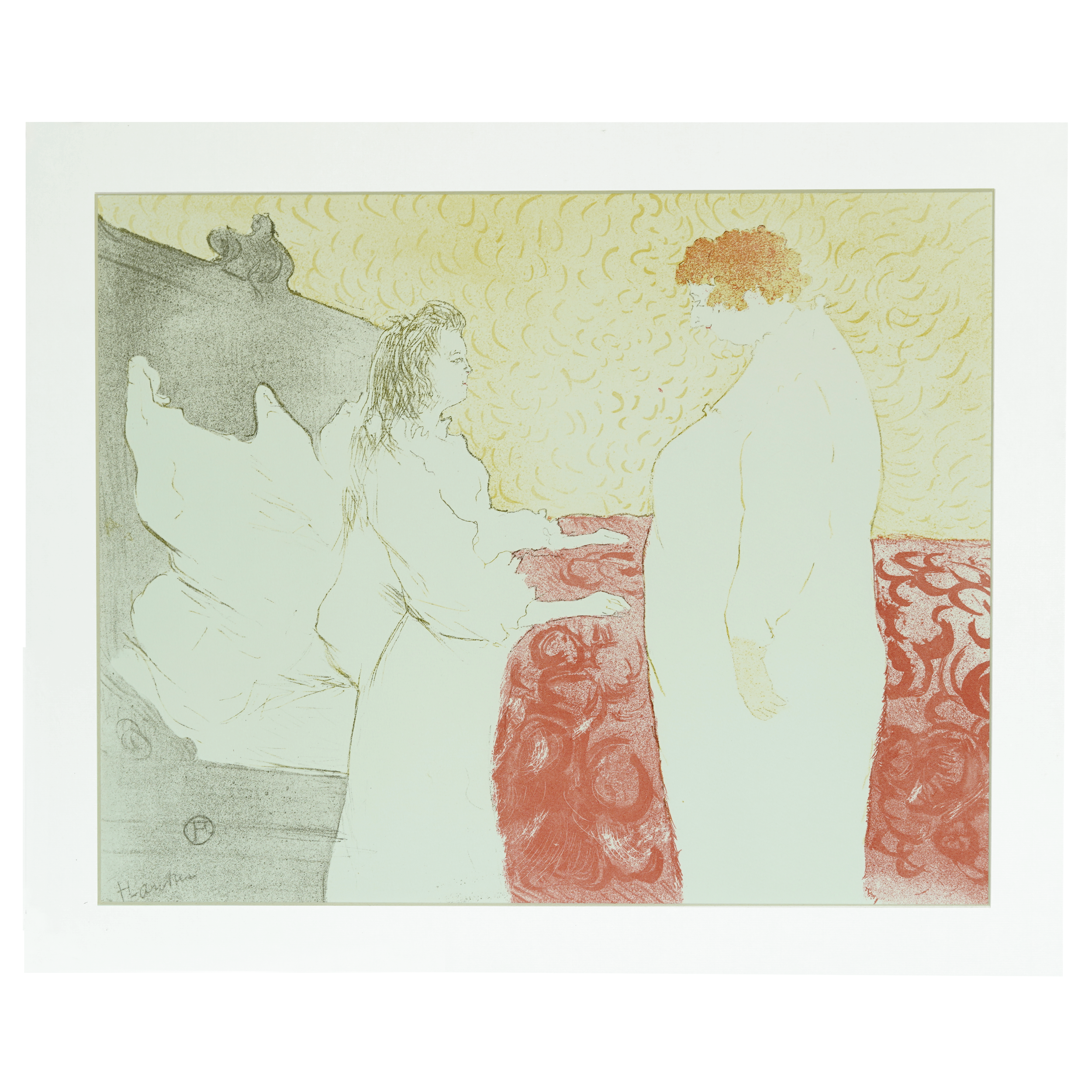
Henri de Toulouse-Lautrec (1864–1901)
Two Women in Bed, from the series Elles, 1896
Lithograph
Dimensions: 49 × 60 cm
Lithograph belonging to Lautrec’s Elles series, a groundbreaking portfolio depicting the daily lives of Parisian courtesans with honesty and empathy. Here, two women are shown in an intimate, unguarded moment—standing by a bed, their gestures casual and unposed. Lautrec avoids sensationalism, instead emphasizing companionship and the quiet rhythm of private life.
With its soft palette and simplified lines, the work conveys warmth and humanity, underscoring Lautrec’s unique ability to portray marginalized women with dignity and subtle psychological depth.
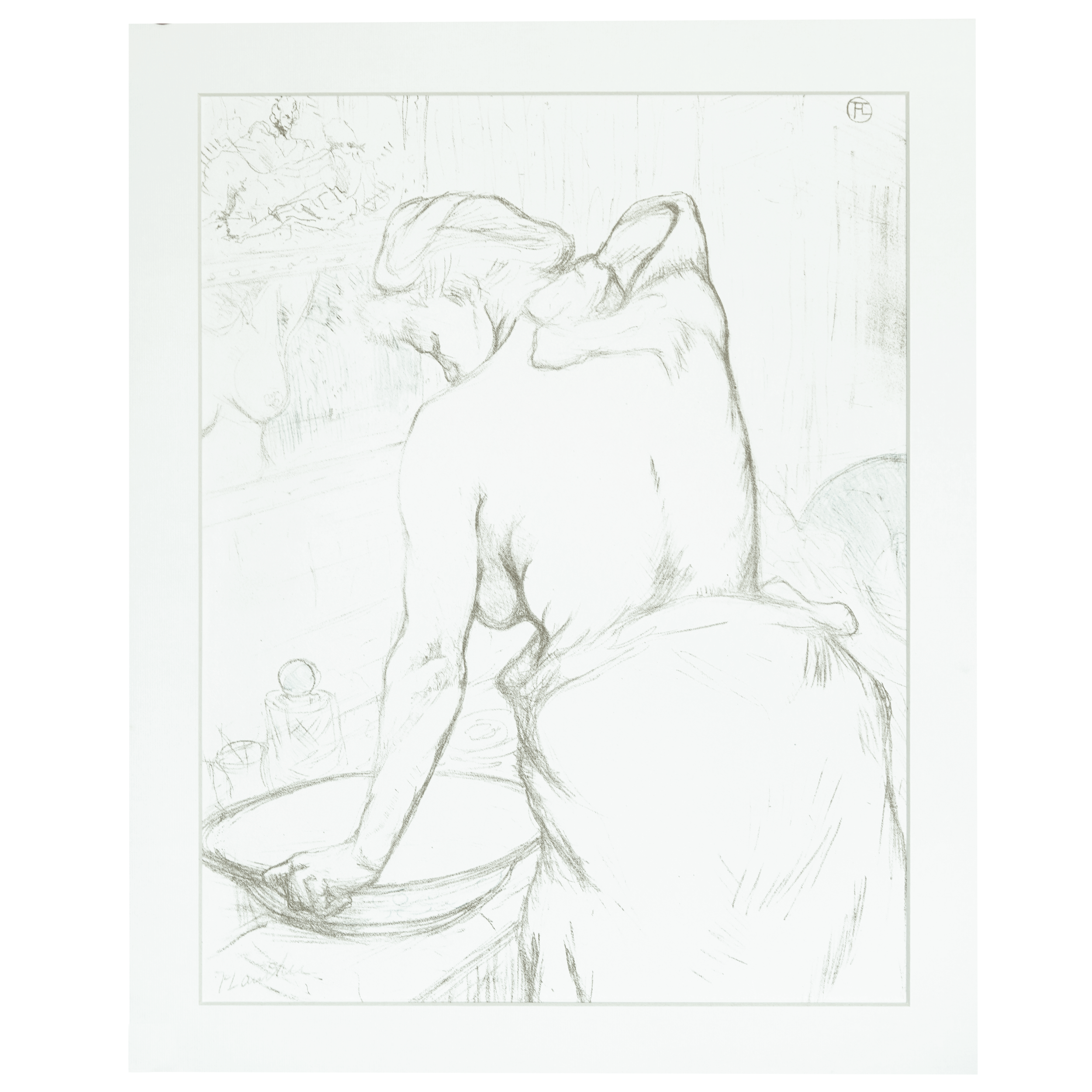
Henri de Toulouse-Lautrec (1864–1901)
Woman at Her Toilette, from the series Elles, 1896
Lithograph
Dimensions: 60 × 49 cm
Lithograph belonging to Lautrec’s celebrated Elles series, which portrays women in the private spaces of brothels. Rather than focusing on eroticism, Lautrec captured their quiet, everyday routines with intimacy and empathy. Here, a woman bends over a washbasin, her body rendered in fluid lines that emphasize both her physical presence and the ordinariness of the moment.
By highlighting gestures of self-care, Lautrec dignifies the lives of these women, offering a rare and compassionate view that challenged the stereotypes of his time.
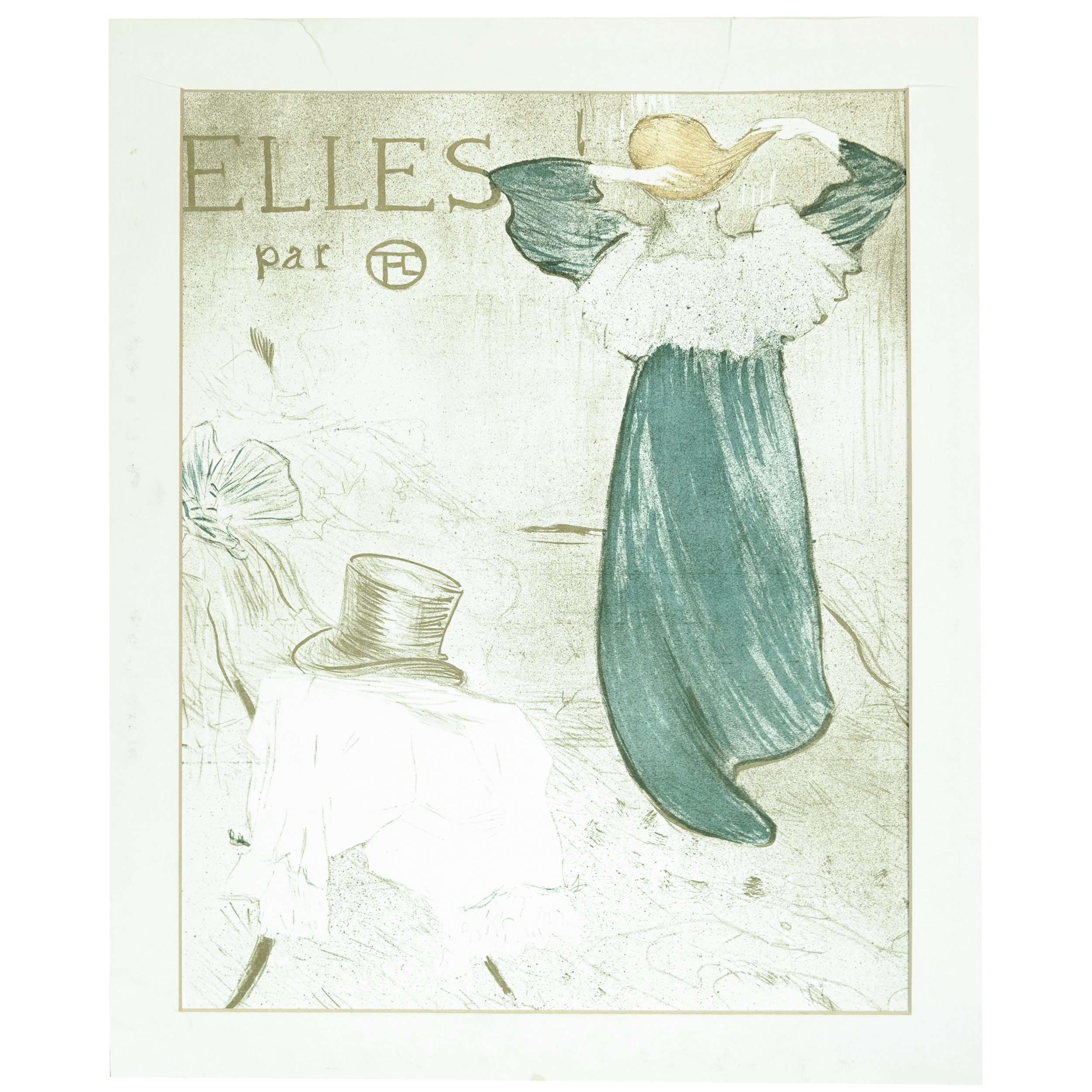
Henri de Toulouse-Lautrec (1864–1901)
Frontispiece for the series "Elles", 1896
Lithograph with pochoir coloring
Dimensions: 60 × 49 cm
This lithograph served as the frontispiece to Lautrec’s celebrated Elles series, published in 1896. The portfolio presents intimate scenes of Parisian prostitutes, focusing on their daily routines rather than their public personas. Here, a woman in a dressing gown adjusts her hair, her back turned to the viewer, embodying the quiet privacy and unposed dignity that define the series.
Lautrec’s refined lines and flat planes of color highlight his mastery of lithography, while the Elles suite reflects his sympathetic portrayal of marginalized women, offering a rare, humanizing perspective in 19th-century art.
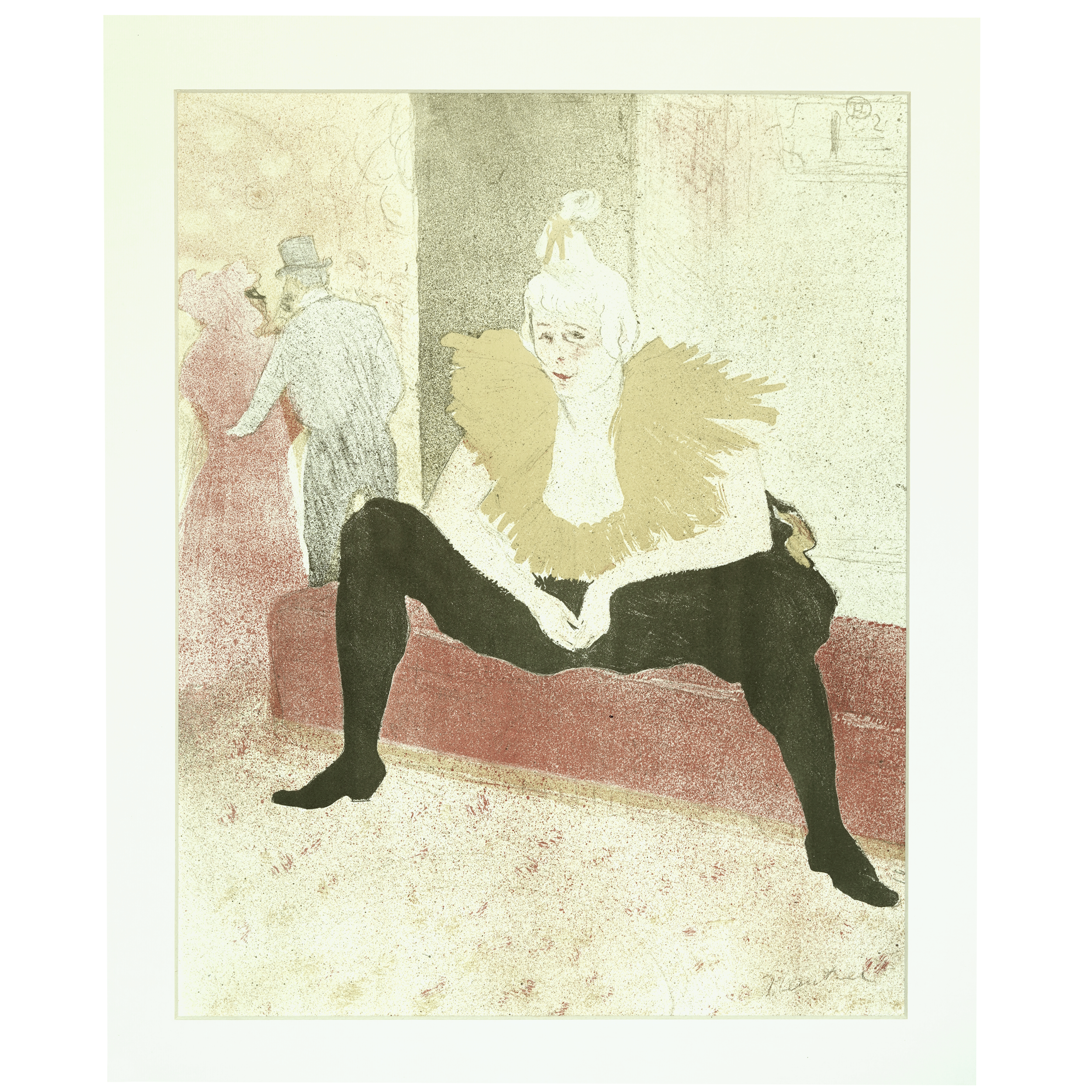
Henri de Toulouse-Lautrec (1864–1901)
Lithograph from the series "Elles", 1896
Dimensions: 60 × 49 cm
Lithograph belonging to Lautrec’s Elles series, created in 1896, which depicts the intimate and everyday lives of Parisian prostitutes. Unlike his famous cabaret posters, these works are quieter, offering tender and empathetic portrayals of women beyond the stage, shown in moments of rest, reflection, and vulnerability.
Executed with pochoir (stencil coloring), the print demonstrates Lautrec’s bold yet delicate use of line and flat color. Far from caricature, Elles captures humanity and dignity, reflecting Lautrec’s deep understanding of the social realities of Montmartre’s demi-monde.
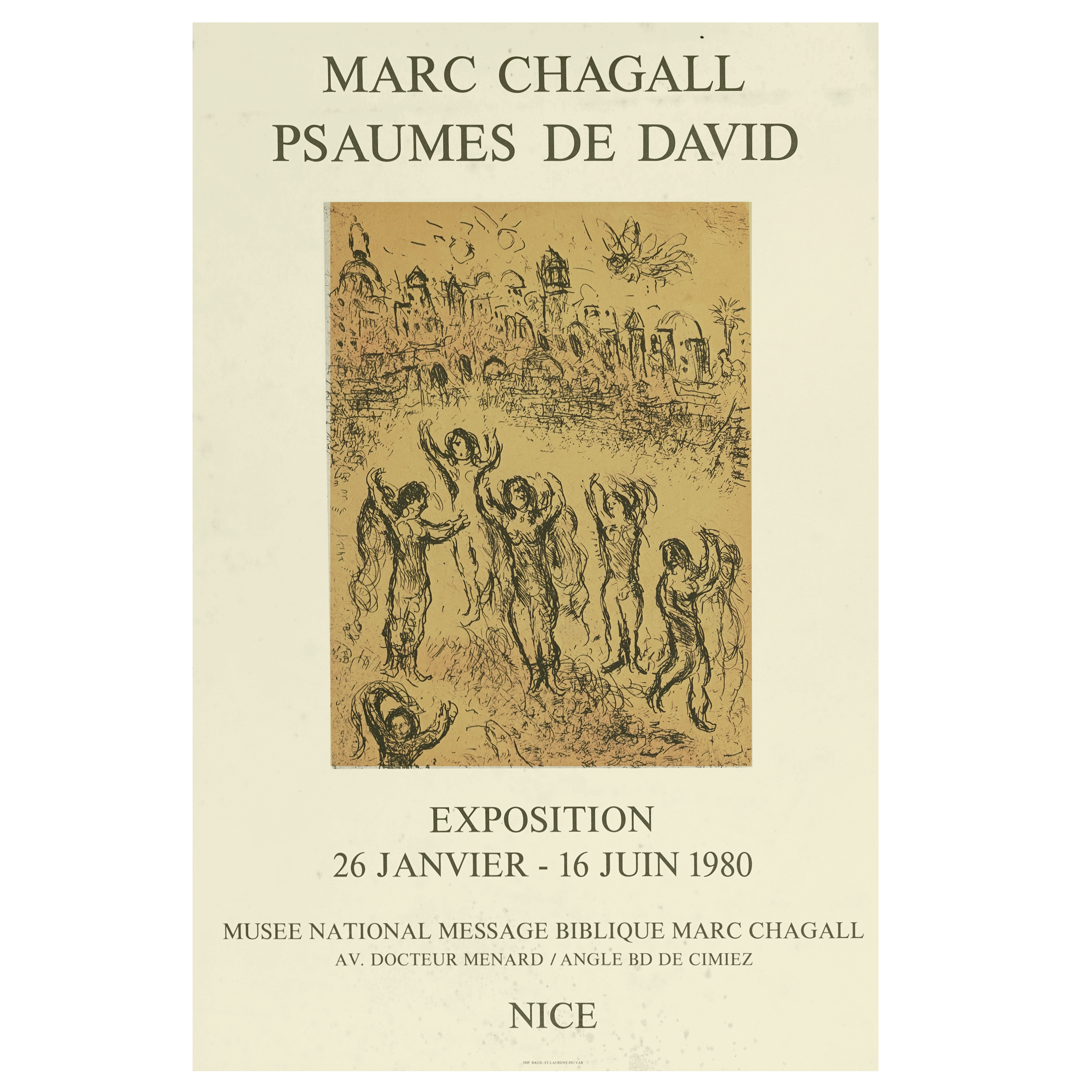
Marc Chagall (1887–1985)
Psaumes de David (Psalms of David)
Lithograph on paper
Exhibition poster, Musée National Message Biblique Marc Chagall, Nice, 1980
Dimensions: 69 × 43 cm
This lithograph, created for the exhibition Psaumes de David at the Musée National Message Biblique Marc Chagall in Nice, reflects the artist’s lifelong dialogue between biblical themes and his poetic, dreamlike visual language. Executed in his characteristic style of fluid lines and floating figures, the work illustrates a joyful dance of figures set against a symbolic cityscape, evoking both the biblical Jerusalem and Chagall’s own memory-laden imagination.
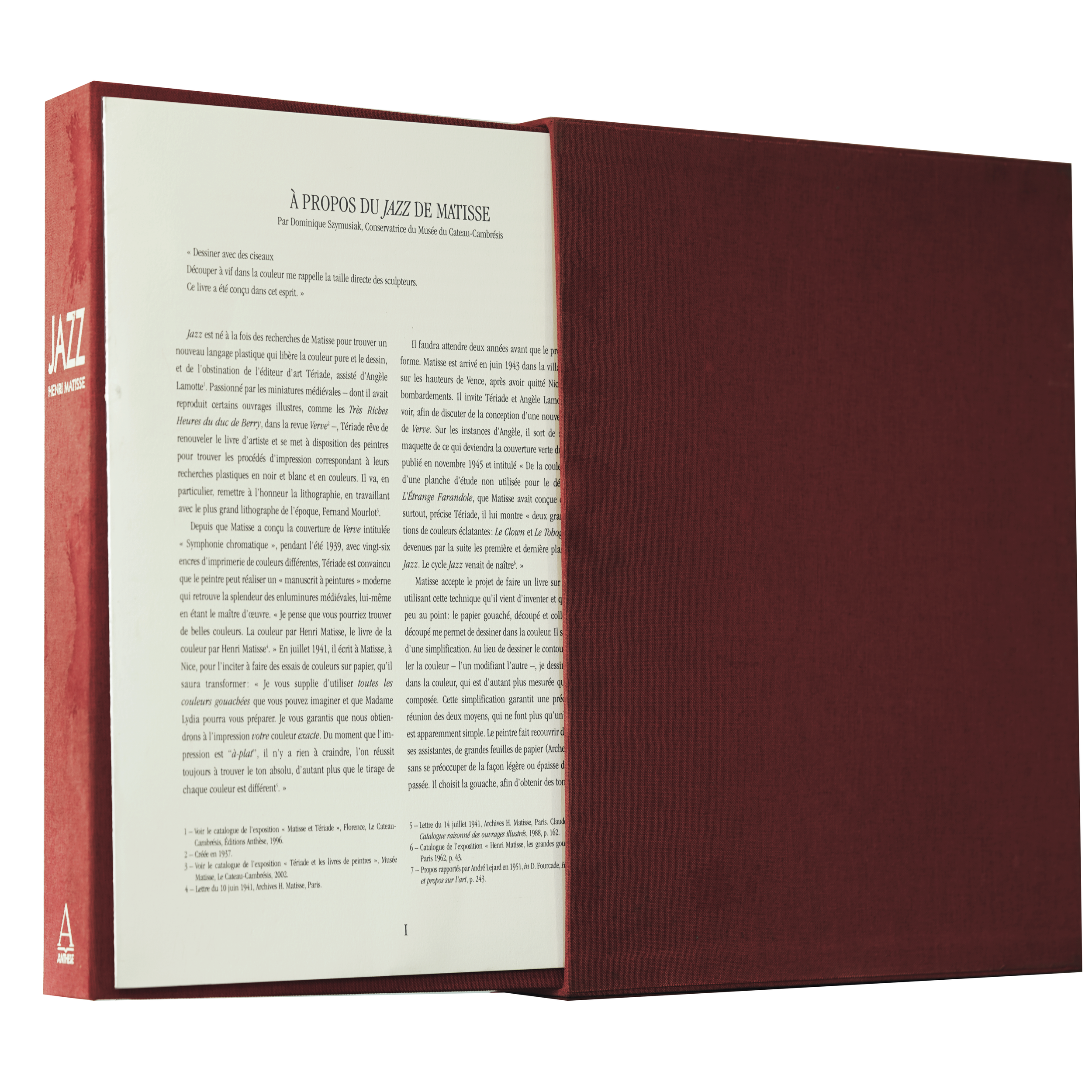
Henri Matisse (French, 1869–1954)
Jazz
Artist’s book with pochoir prints, text in French
Dimensions: 43 × 32 × 7 cm
Matisse’s Jazz is one of the most celebrated artist books of the 20th century, uniting vivid images and poetic reflections. Published in 1947 by Tériade, the work consists of twenty color stencil (pochoir) prints derived from Matisse’s paper cut-outs, accompanied by his handwritten text. The title evokes improvisation and rhythm, qualities that define both jazz music and Matisse’s late artistic style.
Created during a period of convalescence when the artist was largely confined to bed, the cut-outs offered Matisse a new way to “draw with scissors.” The resulting imagery—circus performers, acrobats, mythological figures—captures energy, movement, and joy, balanced by passages of personal meditation.
Jazz is not only a masterpiece of modern printmaking but also a deeply introspective work, blending color, form, and text into a unified expression of vitality and resilience.
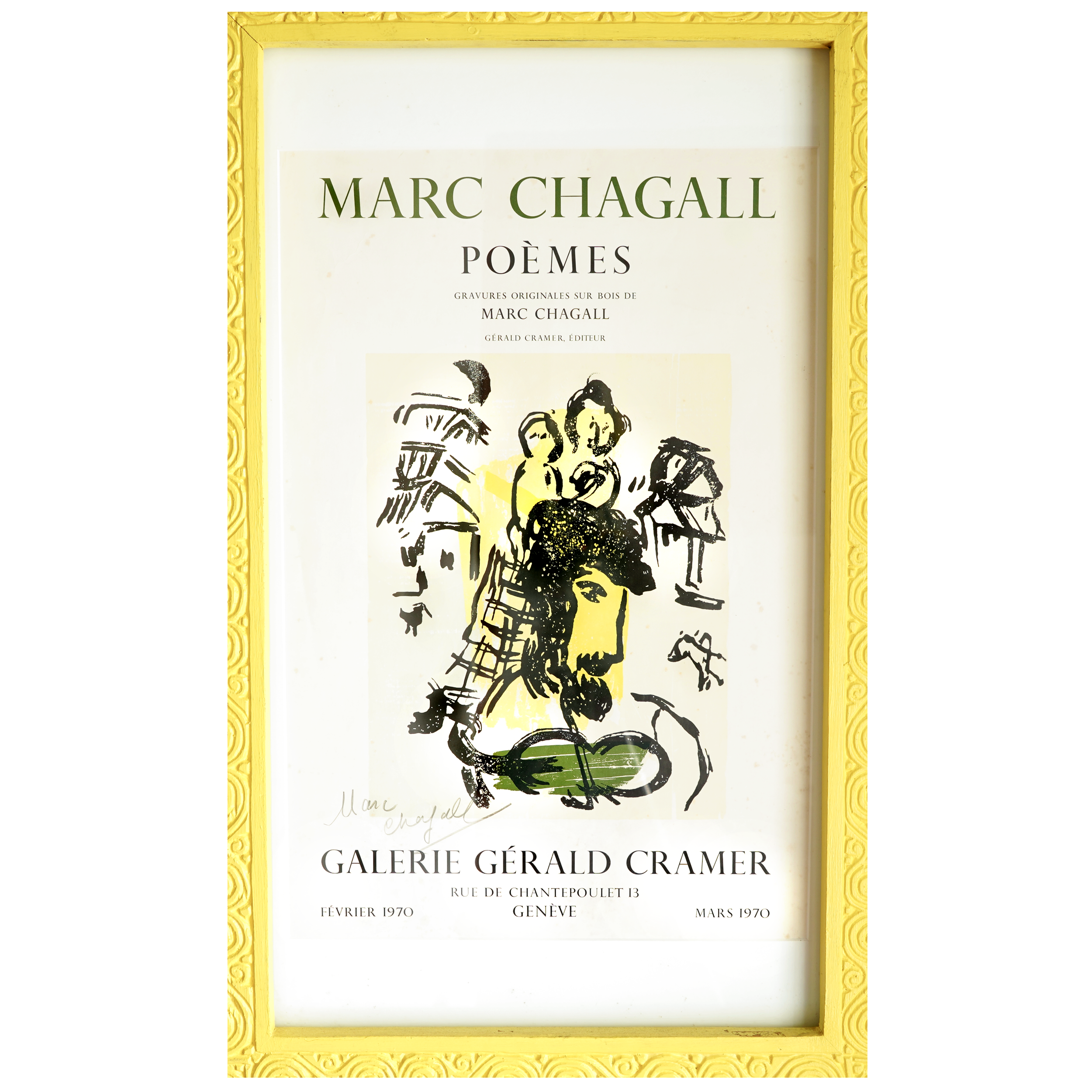
MARC CHAGALL Printed lithograph “Gallerie Gerard Cramer”. Signed by the artist bottom left
Title:Poèmes (Exhibition Poster)
Artist: Marc Chagall (Russian-French, 1887–1985)
Medium: Lithograph on paper
Dimensions: 57 × 38 cm
Publisher: Gérald Cramer, Geneva
Location: Galerie Gérald Cramer, Rue de Chantepoulet 13, Geneva
Description:
Lithographic poster created by Marc Chagall to accompany his 1970 exhibition Poèmes at Galerie Gérald Cramer in Geneva. The image features one of Chagall’s signature dreamlike compositions, combining human figures, animals, and abstract forms in a vibrant palette dominated by yellow, green, and black.
As both an artwork and promotional material, this piece reflects Chagall’s close collaboration with Swiss publisher Gérald Cramer, who championed his graphic works. The poster represents the artist’s ongoing exploration of visual storytelling and his capacity to merge poetry and painting into a unified, emotional language.
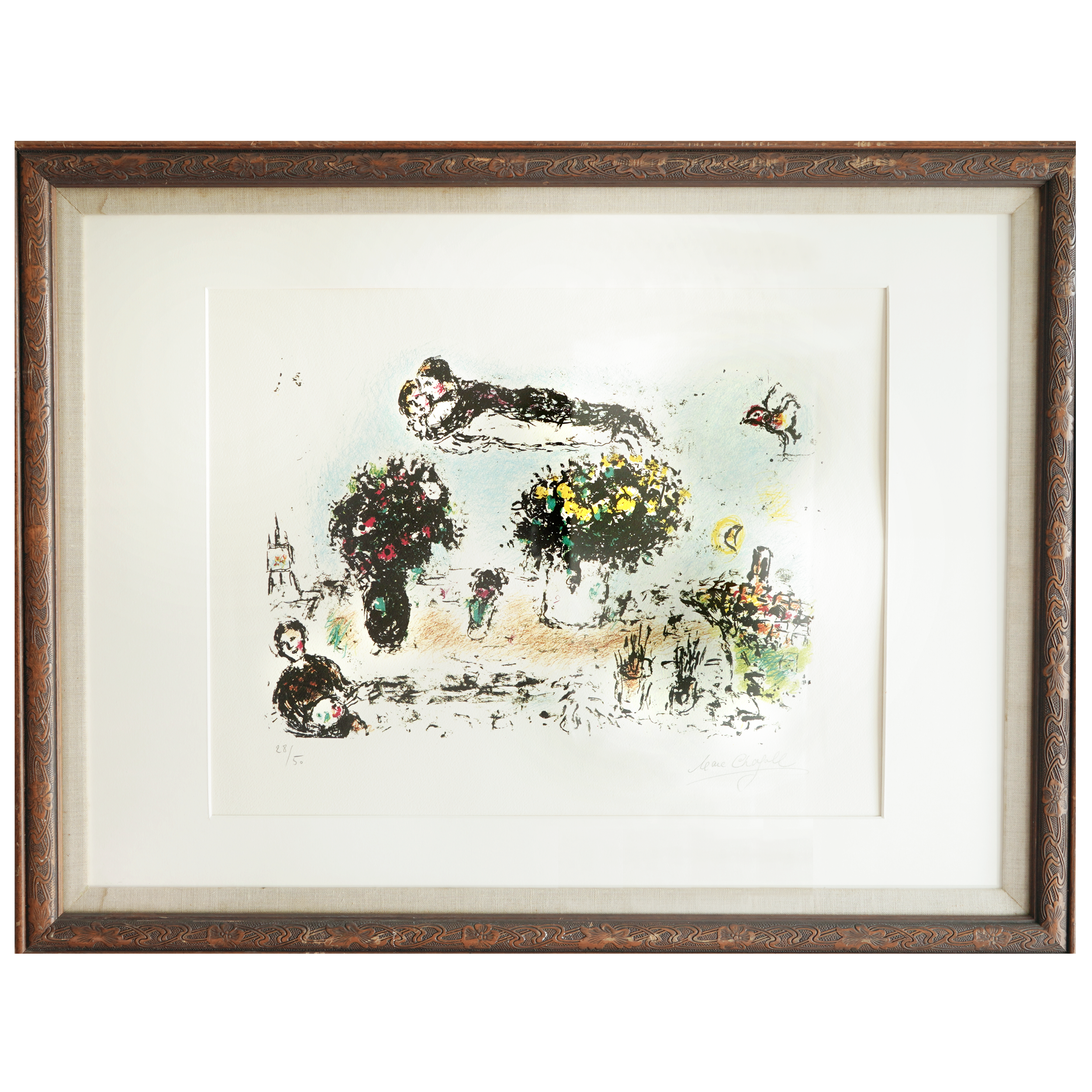
MARC CHAGALL Original Lithograph. Signed bottom right, limited edition
Edition: 28/50
Artist: Marc Chagall (Russian-French, 1887–1985)
Medium: Color lithograph on paper
Dimensions: 43 × 55 cm
Edition: Numbered 28/50
Signature: Hand-signed by the artist in pencil, lower right
Description:
Original lithograph by Marc Chagall capturing the artist’s dreamlike vision of love and memory. Floating lovers embrace mid-air above a blooming garden, while figures, trees, and village structures create a lyrical, pastoral landscape below.
Marc Chagall’s lithographs are celebrated for their poetic and mystical quality. This work exemplifies his recurring motifs of love and flight—symbols of spiritual transcendence and personal history. As with much of his graphic oeuvre, the composition is infused with warmth and whimsy, inviting viewers into a world where emotion shapes reality. Lithographs such as this one were printed in limited editions and hand-signed by the artist, underscoring their collectible value.
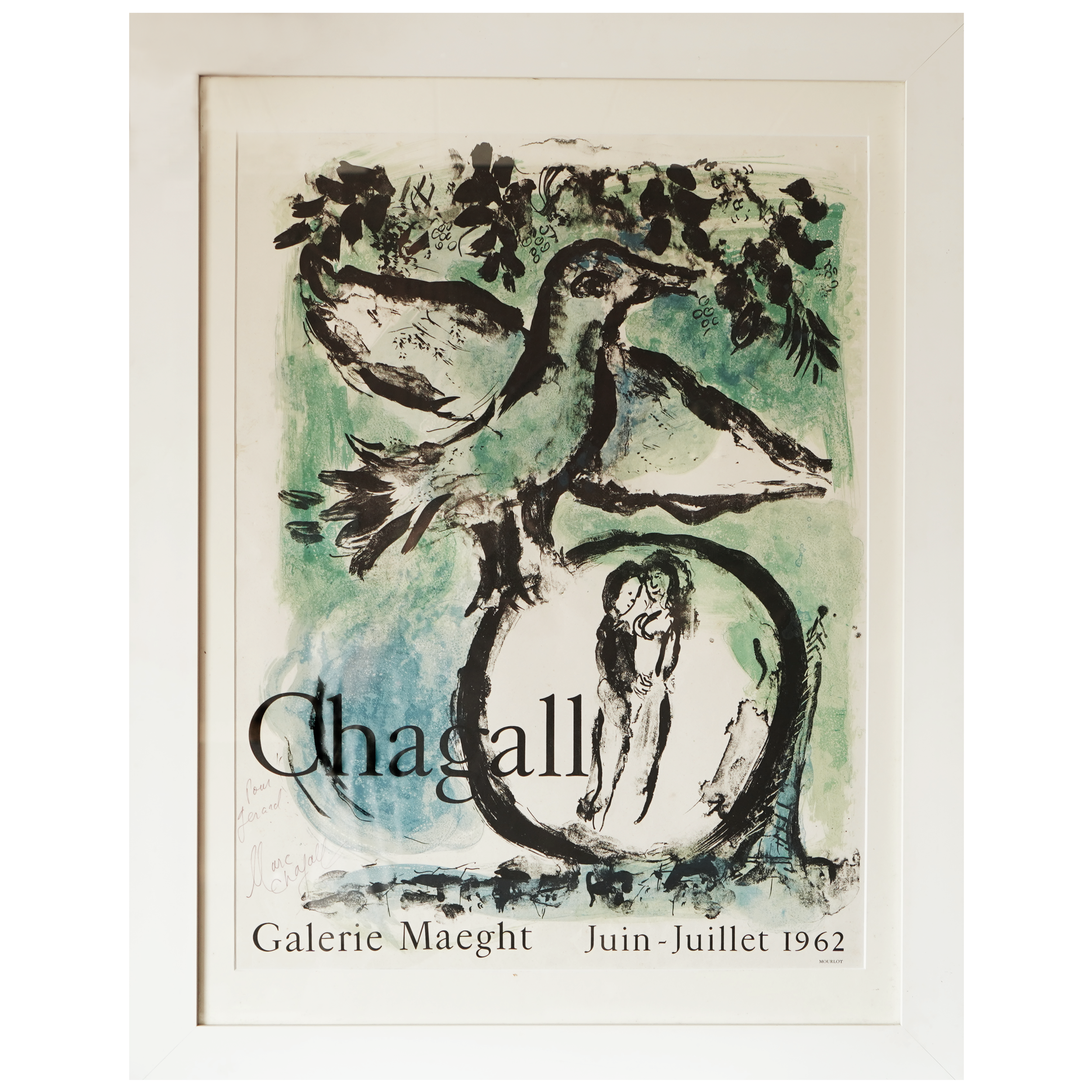
MARC CHAGALL Lithograph Print “Gallery Maeght”. Signed by the artist bottom left
Title:Chagall, Galerie Maeght Exhibition Poster
Artist: Marc Chagall (1887–1985)
Medium: Color lithograph on paper
Dimensions: [Not specified]
Printed by: Mourlot, Paris
Dimensions: 69 × 52 cm
Description:
Lithographic poster created by Marc Chagall to promote his exhibition at Galerie Maeght in Paris in June–July 1962. The image features a large bird with outstretched wings perched on a circular form enclosing a loving couple, rendered in Chagall’s dreamy, expressive style. Above, branches with leaves and berries enhance the composition.
Chagall often celebrated themes of love, memory, and peace through surreal imagery. This poster, combining a symbolic bird and embracing figures, reflects his lyrical approach to art and his lifelong connection to romance and nature. It was printed by the famed Mourlot studio, known for collaborating with major modern artists.
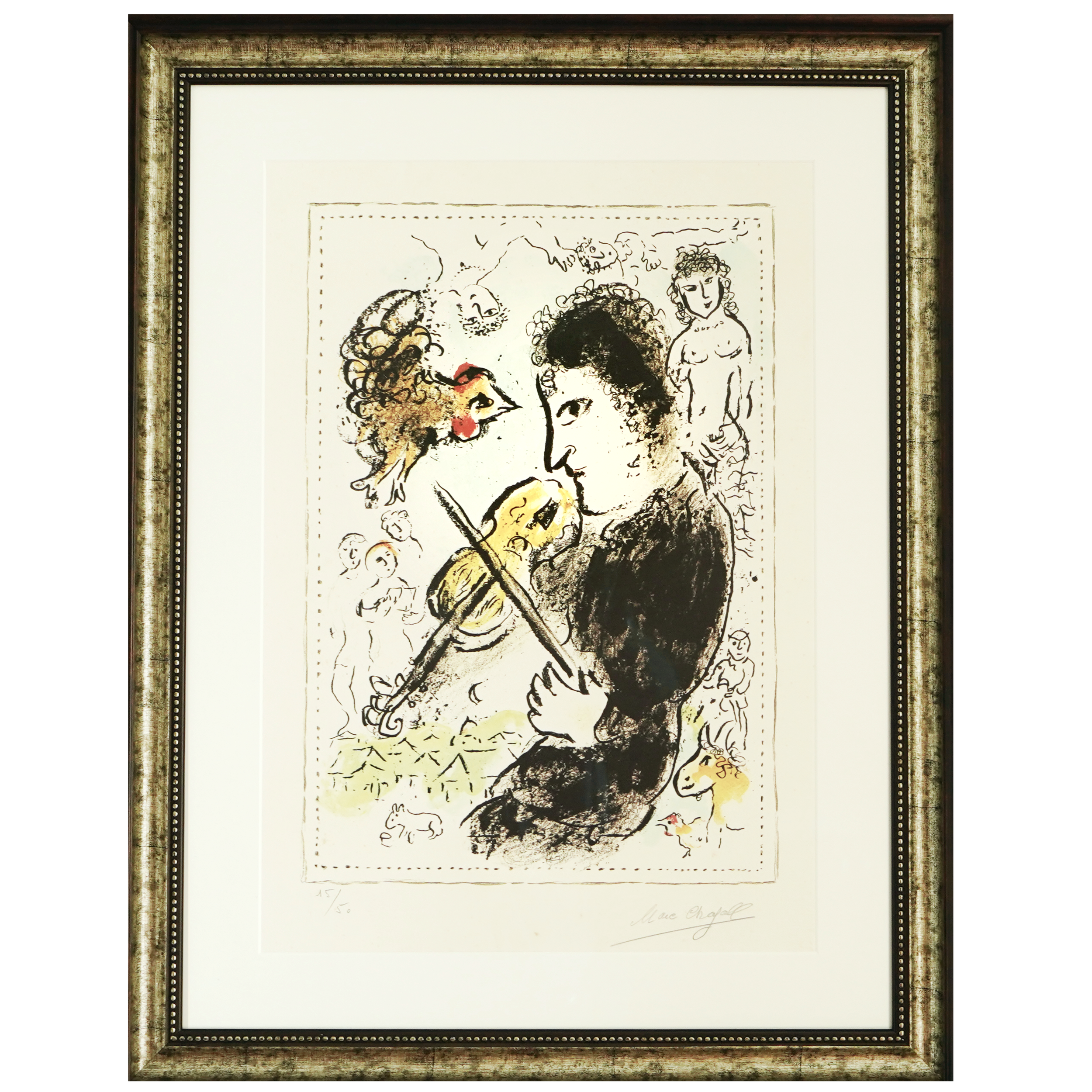
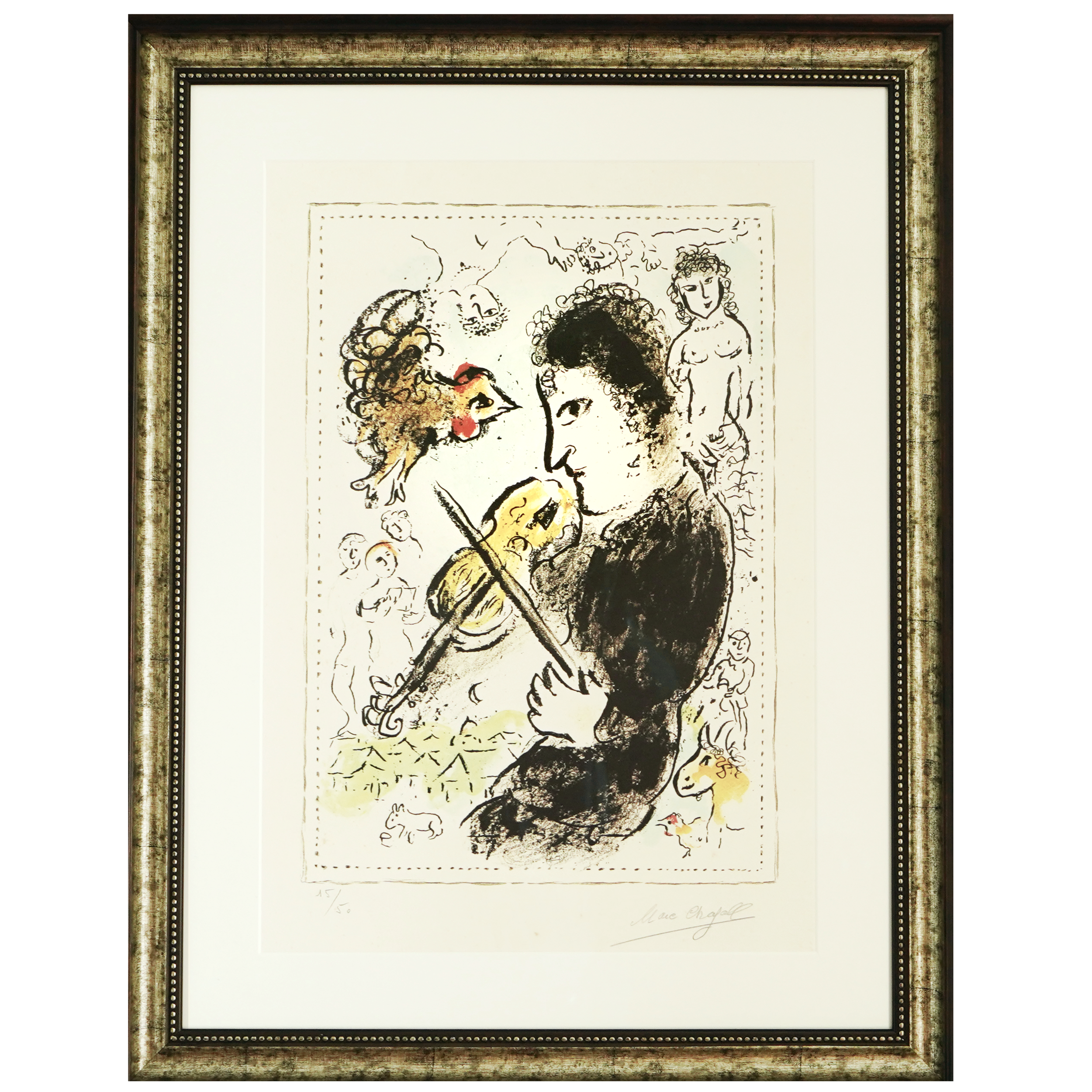
MARC CHAGALL Etching drawing. Signed bottom right, limited edition
Edition: 15/50
Title:Le Violoniste
Artist: Marc Chagall (1887–1985)
Date: Mid-20th century
Medium: Color lithograph on paper
Dimensions: 56 × 40 cm
Description:
Lithograph by Marc Chagall showing a man playing a violin, surrounded by dreamlike figures including a rooster, a nude woman, and a dog. The background includes a village scene and floating heads, all drawn in Chagall’s distinctive style.
Chagall often used the figure of the violinist to reflect his Jewish heritage and memories of his childhood in Russia. The warm colors and flowing lines create a sense of emotion and nostalgia.
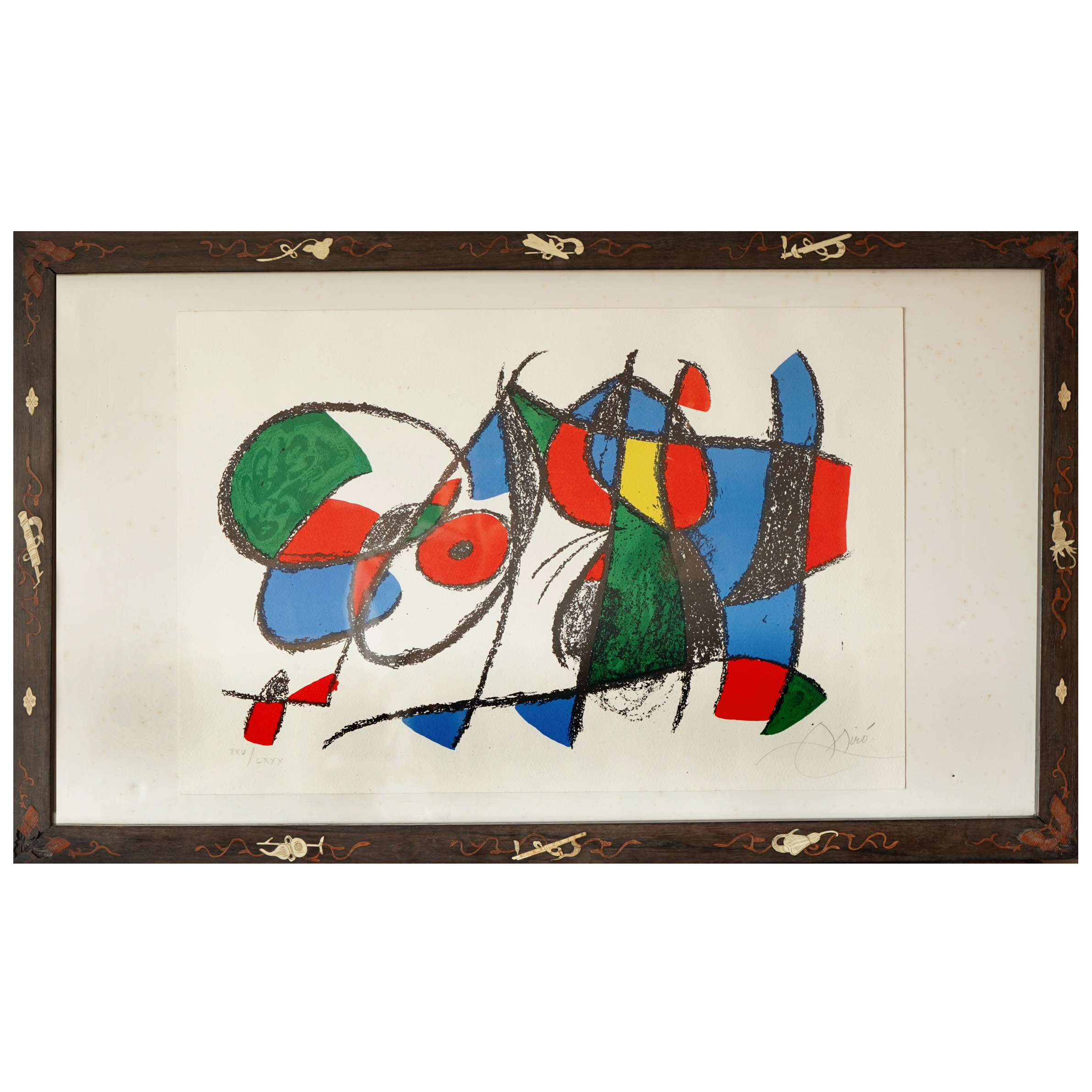
JOAN MIRO Lithographe Original. Signed bottom right
XXV / LXXX
Year: 1979
Title:Untitled (Abstract Composition)
Artist: Joan Miró (Spanish, 1893–1983)
Medium: Color lithograph on paper
Signature: Hand-signed "Miró" (lower right)
Dimensions: 36 × 55 cm
Description:
Lithograph by Joan Miró showing the artist’s mastery of color and abstract form. Composed of energetic black lines intertwined with vibrant zones of red, blue, green, and yellow, the piece captures the rhythmic dynamism that defines much of Miró’s later work. The playful, looping forms and whimsical geometry evoke a sense of freedom and imagination, hallmarks of his unique visual language..
This lithograph belongs to a series of works that reflect Miró’s enduring interest in the subconscious and the symbolic. His bold, modernist vocabulary — characterized by floating biomorphic shapes and surreal gestures — had a profound influence on 20th-century abstraction.
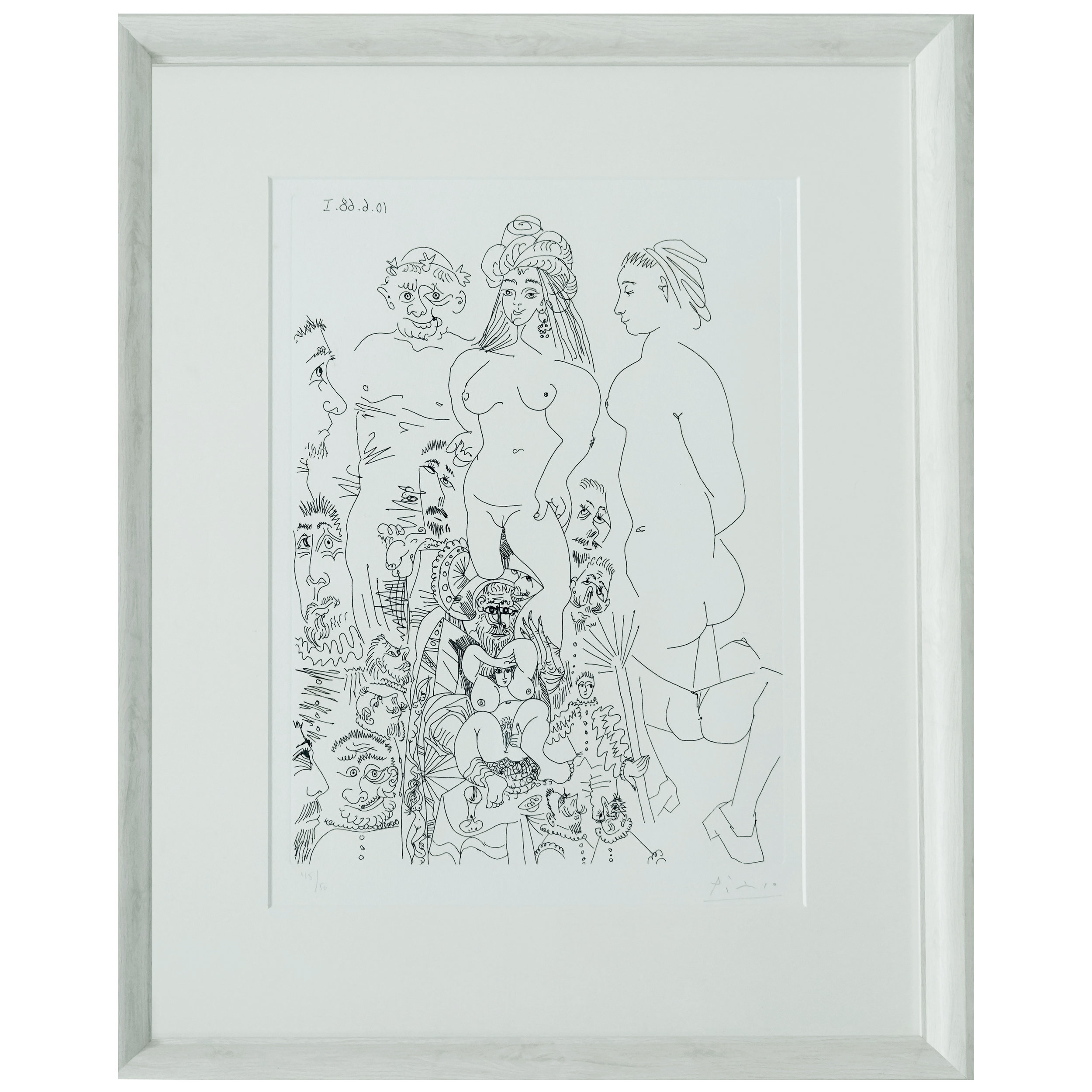
Etching by Picasso depicting the Characters from El Entierro del Conde de Orgaz dated and signed
Edition: 45/50
Artist: Pablo Picasso (1881–1973)
Medium: Etching on paper
Dimensions: 40 × 29 cm
Description:
Etching by Pablo Picasso showcasing a dense and playful mythological composition, filled with nude figures, stylized faces, and fantastical beings. Rendered in fluid, assured lines, the work captures Picasso’s fascination with classical themes, eroticism, and the grotesque, all distilled into a single theatrical tableau.
Picasso’s graphic works often allowed for greater freedom and experimentation than his paintings. This etching, with its layered forms and crowded composition, echoes the bacchanalian energy of ancient myths while embracing the spontaneity of surrealism.
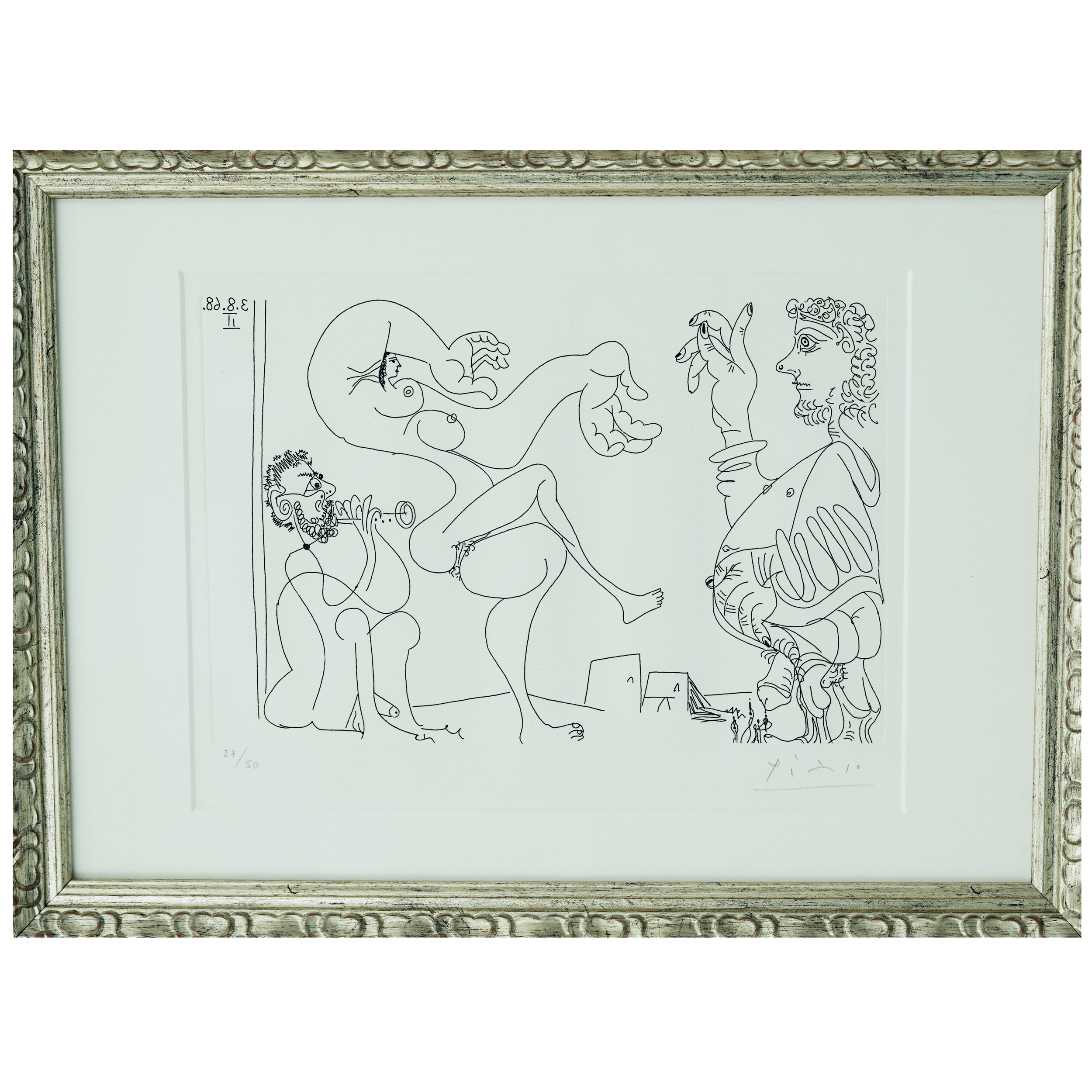
An Etching drawing by Picasso representing a belly dancer, flute player and exposed man with painted fingernails signed and dated
Edition: 15/50
Dimensions: 20 × 26 cm
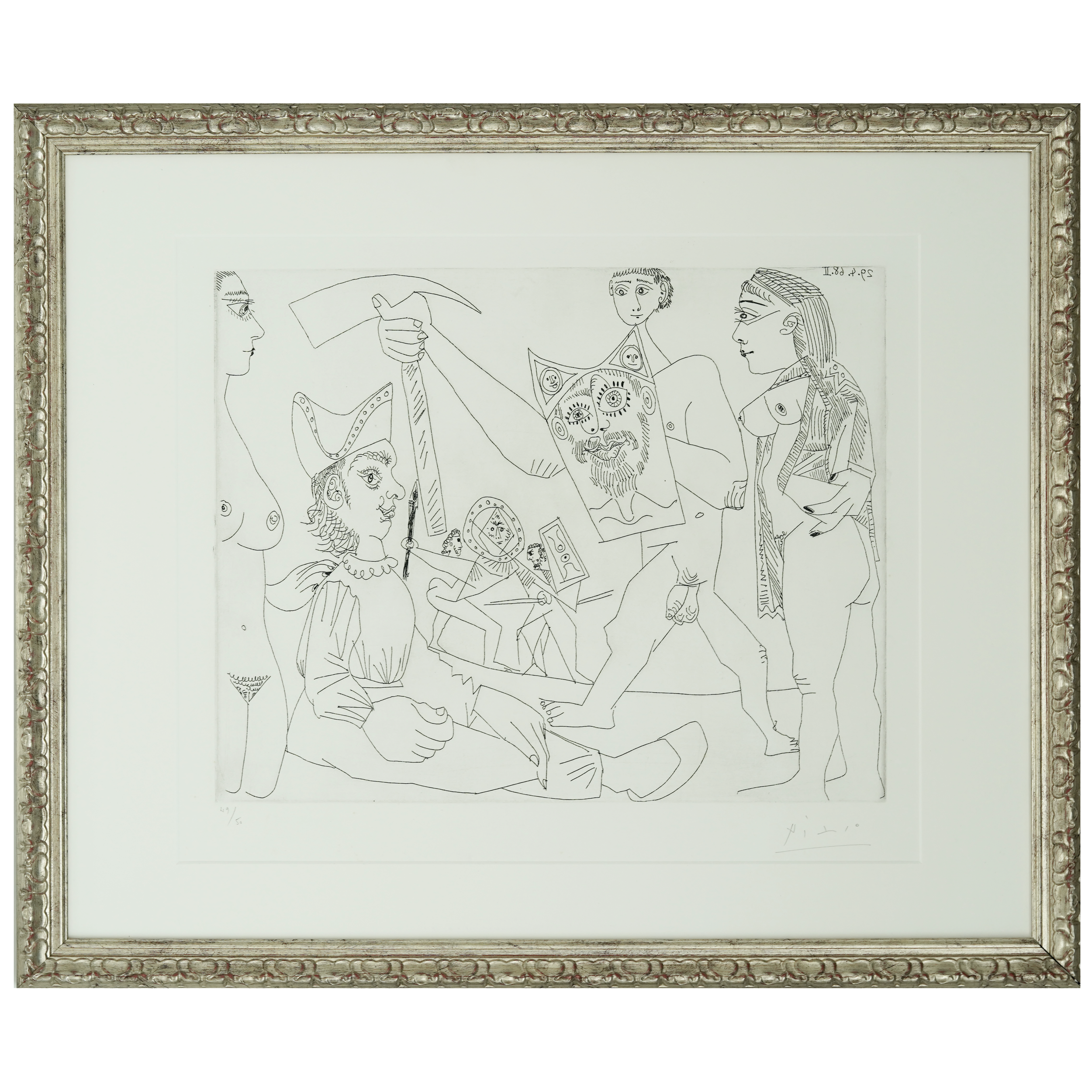
Picasso etching representing some gladiators, nudes and seated figure in two cornered hat, signed and dated with pencil 4/29/1968 II
Edition: 49/50

Maya Necklace with Jade Pendant and Beads
Culture: Maya Civilization
Date: c. 600–900 CE (Late Classic Period)
Materials: Carved jadeite, stone beads, shell or bone beads, metal fittings
Dimensions: Pendant height approx. 6 cm; overall necklace length variable
Necklace featuring a carved jadeite pendant in the stylized form of an abstracted insect or shield-like emblem, defined by symmetrical lobes and a central vertical ridge with transverse bar. The pendant’s smooth, mottled green surface is characteristic of high-quality jadeite prized in Maya culture.
The necklace strand is composed of cylindrical jadeite beads, smaller green stone beads, and darker interspersed beads, possibly made of shell, bone, or stone. These are strung on metal-linked connectors, forming a V-shaped drop that emphasizes the central pendant.
Provenance:
Likely from the Maya lowlands, in present-day Guatemala, Belize, or southern Mexico.