

ALL DRAWINGS
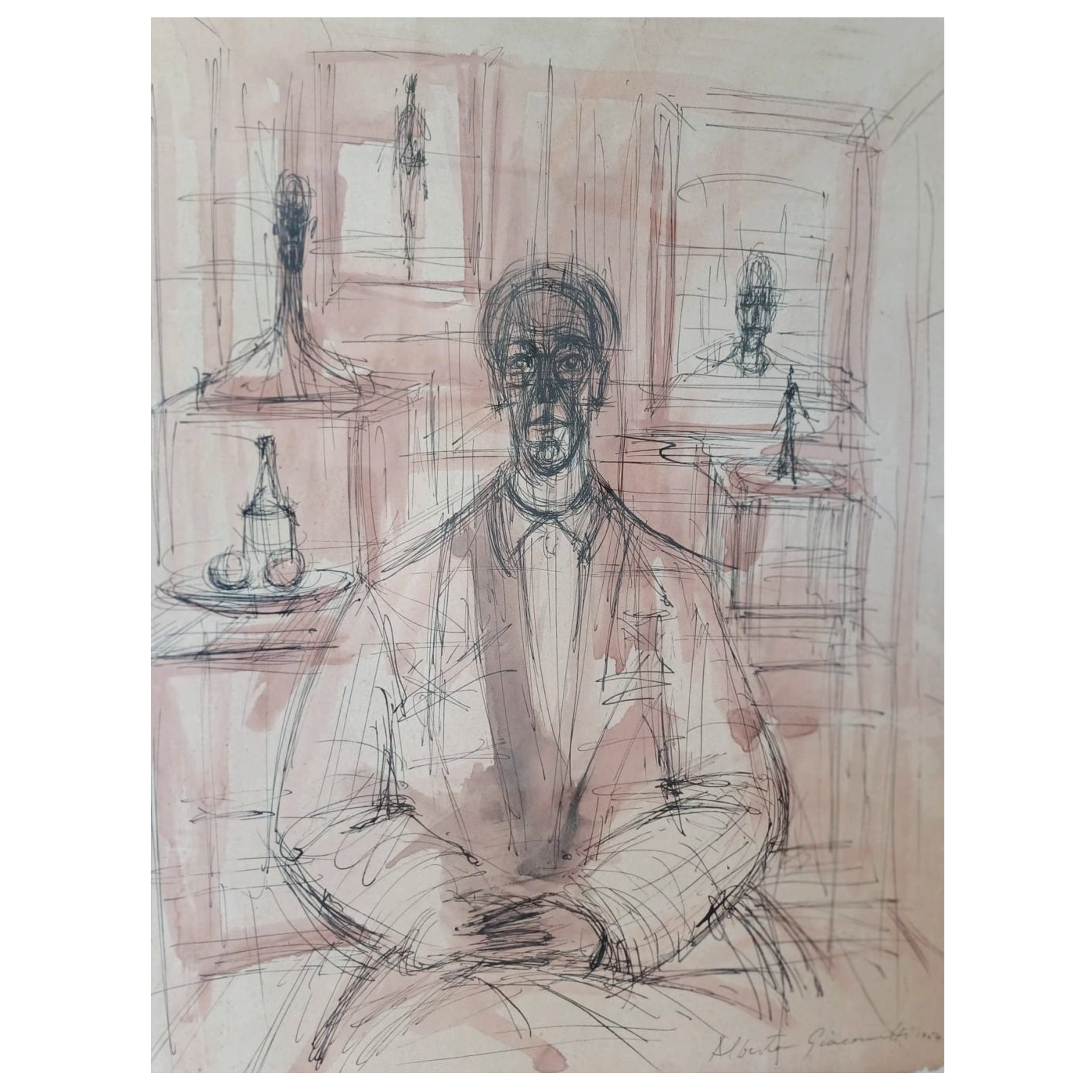
Alberto Giacometti (1901–1966)
Seated Man in Interior
Ink and wash on paper, c. 1950s
Drawing by Alberto Giacometti exemplifying his distinctive draftsmanship, where restless lines and overlapping contours convey both form and psychological presence. The central figure, seated in a frontal pose, is defined through dense linear crosshatching and layered washes of muted tones. Surrounding him, Giacometti sketches elements of a studio interior: sculptures, paintings, and still-life objects that echo the artist’s lifelong exploration of the human figure and its relation to space.

Artist: Alberto Giacometti (Swiss, 1901–1966)
Medium: Lithograph on paper
Edition: Numbered lower left 47/100
Signature: Printed signature of the artist lower right, Alberto Giacometti
Dimensions: 47 × 31 cm
Description:
Lithograph reproducing a seated male figure in Alberto Giacometti’s distinctive, searching line. The subject, rendered with sparse yet deliberate marks, sits in a relaxed but introspective pose, arms loosely resting on his knees. Giacometti’s trademark web of overlapping lines conveys both the structure of the body and the artist’s intense process of observation, imbuing the image with an almost vibrating presence.
The composition leaves the background bare, allowing the figure to emerge in isolation. The head and upper body are drawn with heightened focus, evoking a psychological depth that is characteristic of Giacometti’s portrait work.
Artistic Context:
Giacometti’s lithographs, often based on his original drawings, preserve the immediacy and spontaneity of his hand while making his vision accessible to a wider audience. They reflect his enduring fascination with the human figure as an existential presence, existing between physical form and fleeting perception.
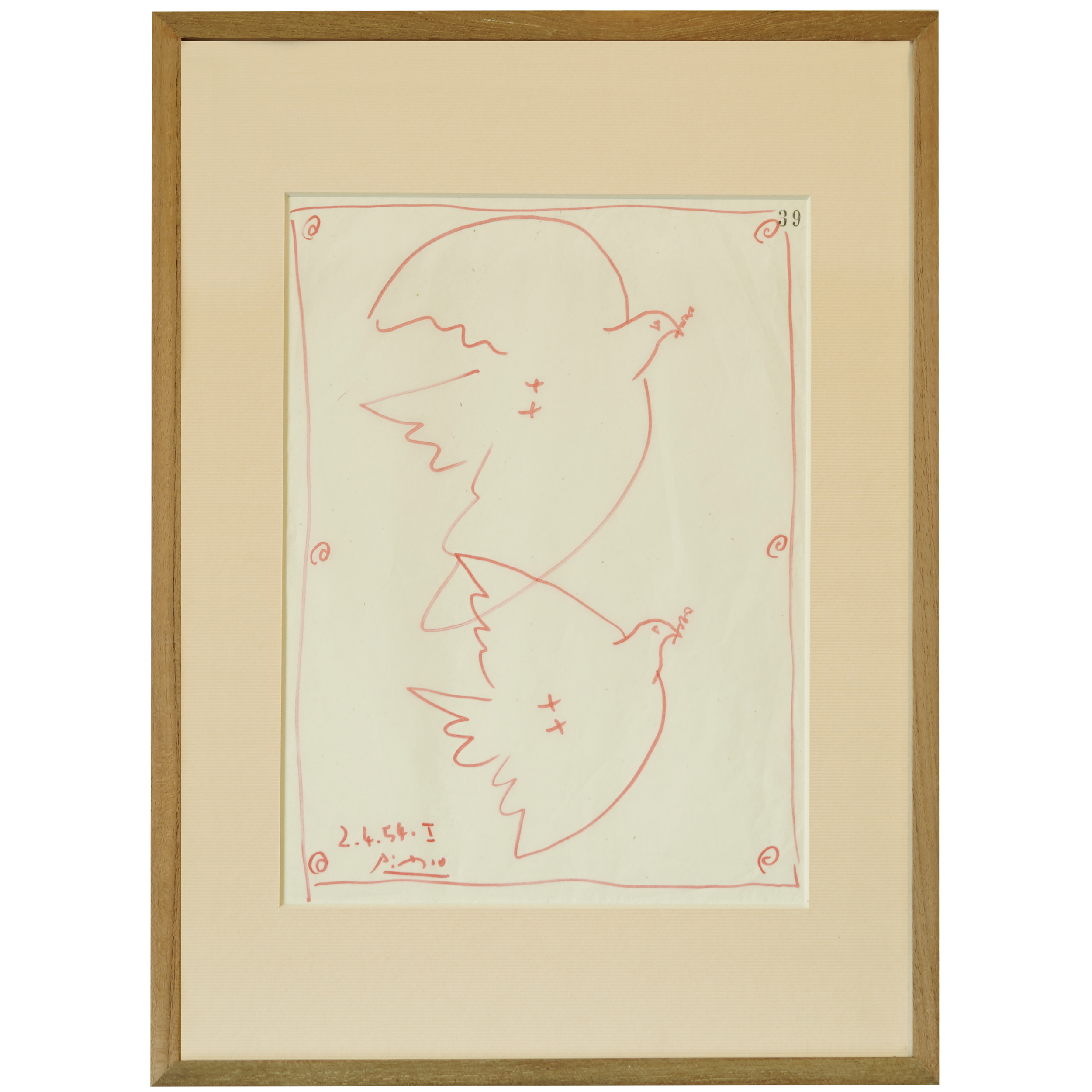
Original PICASSO two doves of peace, in flight, a sprig of olive in the beak. Dated and signed bottom left 2.4.54 I
Year: 1954
Dimensions: 27 × 20 cm
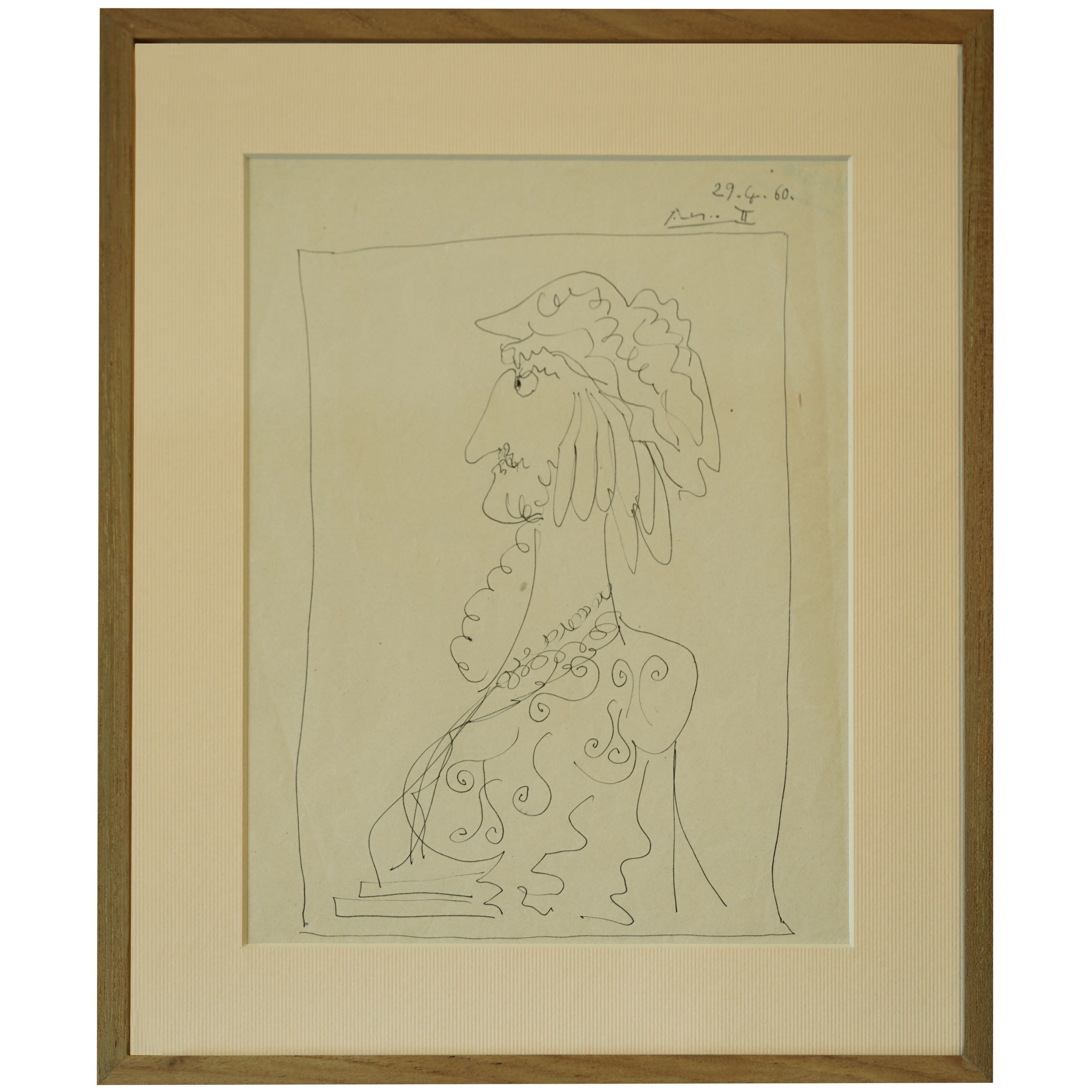
Bust profile of a burlesque character, wearing a headpiece, looking to the left, outlined by a rectangular ink stroke. Dated and signed top right 29.4.60 II
Year: 1960
Dimensions: 26 × 20 cm
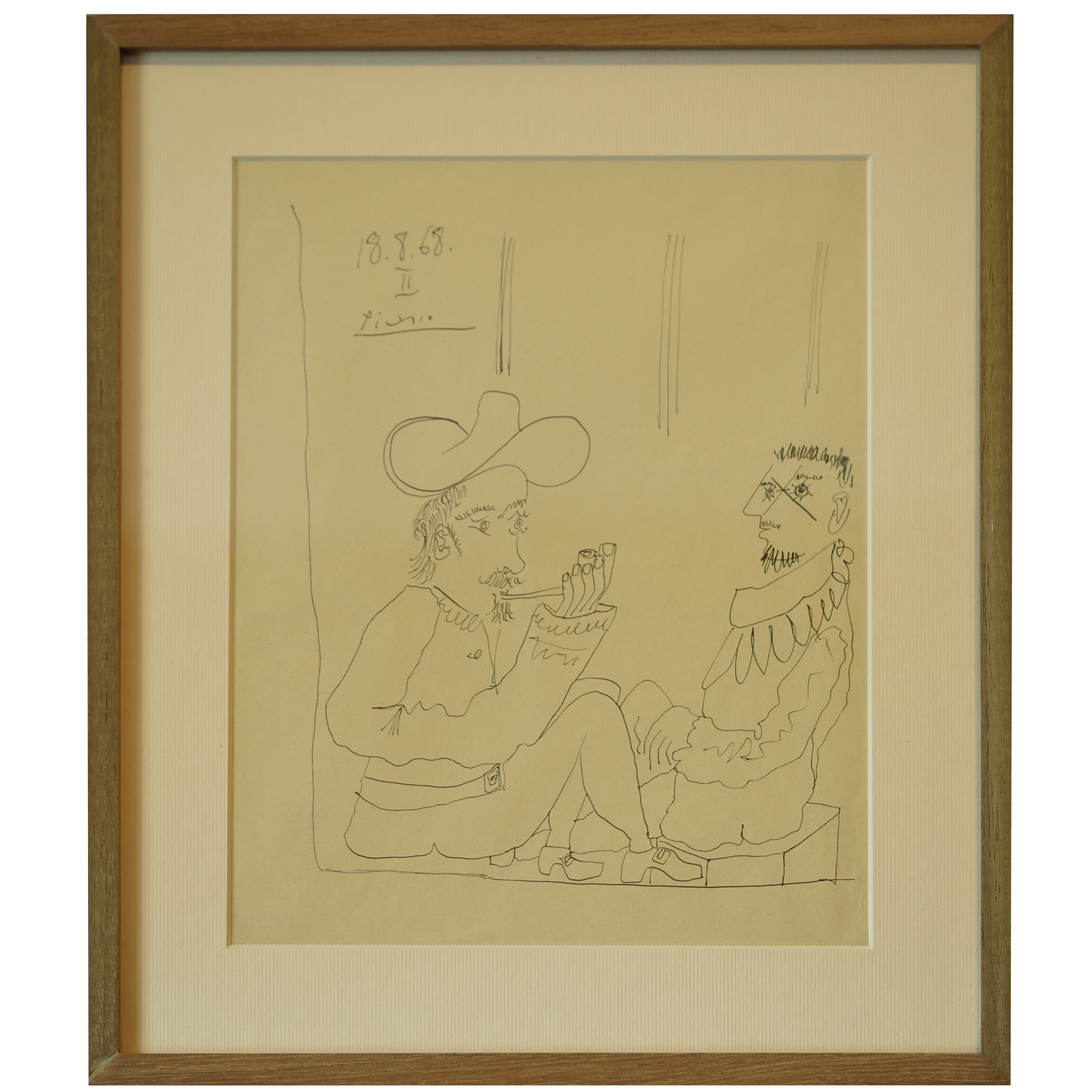
A hatted pipe smoker sits facing a figure with an X-shaped face and a jabot, set before a row of columns. Dated and signed top left 18.8.68 II
Year: 1968
Dimensions: 26 × 20 cm

Original Picasso horned bull’s head carried by two running legs. Dated and signed top left 1.2.54 XV
Year: 1954
Dimensions: 16 × 22 cm

Original Picasso, Galerie Louise Leiris, 8th arrondissement, surmounting a lively scene of a picador on his mount, flanked by two toreadors signed bottom left
Year:
Dimensions: 20 × 20 cm
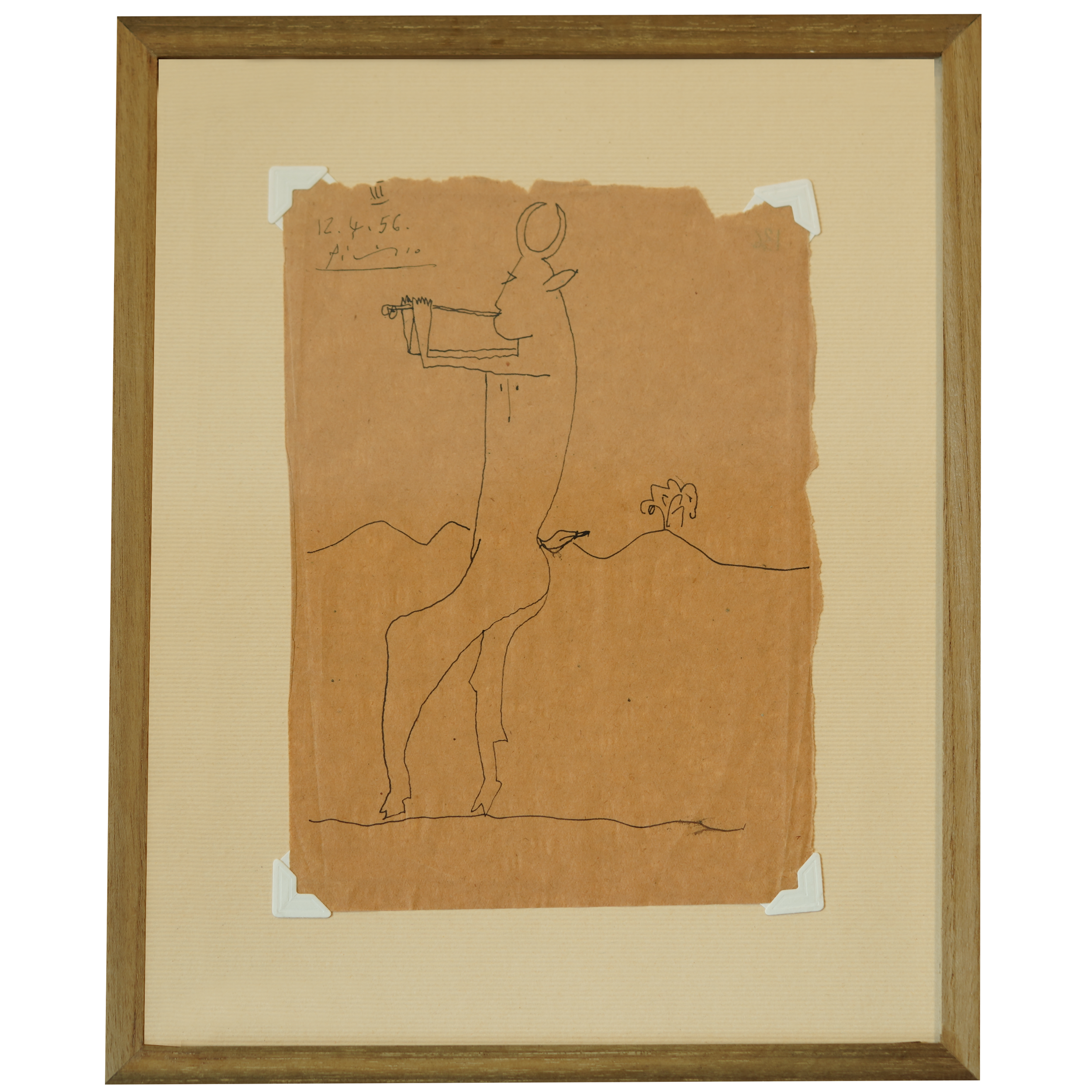
Horned faun standing, playing the flute in front of a tree-lined ridge dated and signed bottom right 12.4.56 III
Year: 1956
Dimensions: 19 × 14 cm
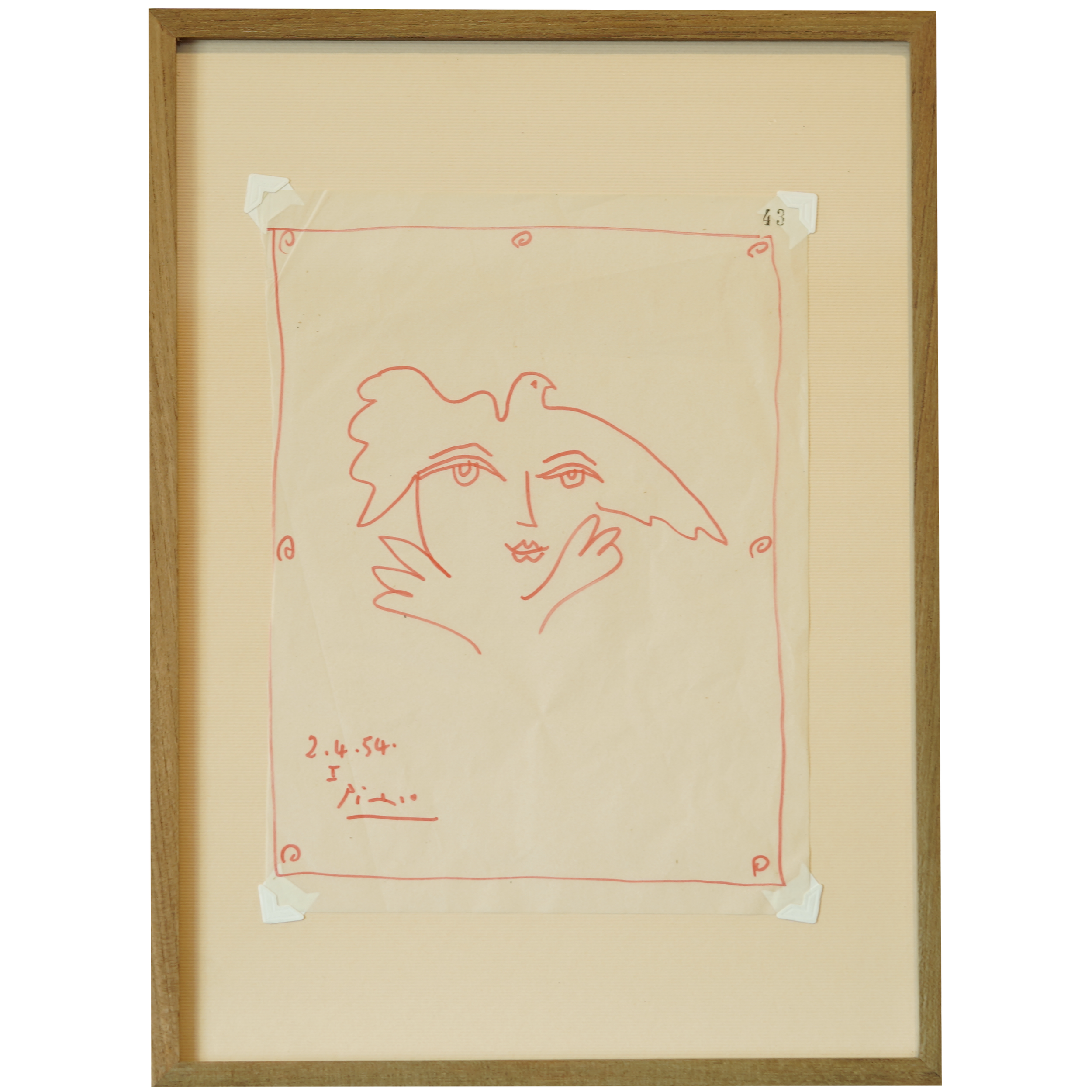
Feminine face adorned with a dove with outstretched wings, supported by two open hands dated and signed bottom left 2.4.54 I
Year: 1954
Dimensions: 27 × 20 cm
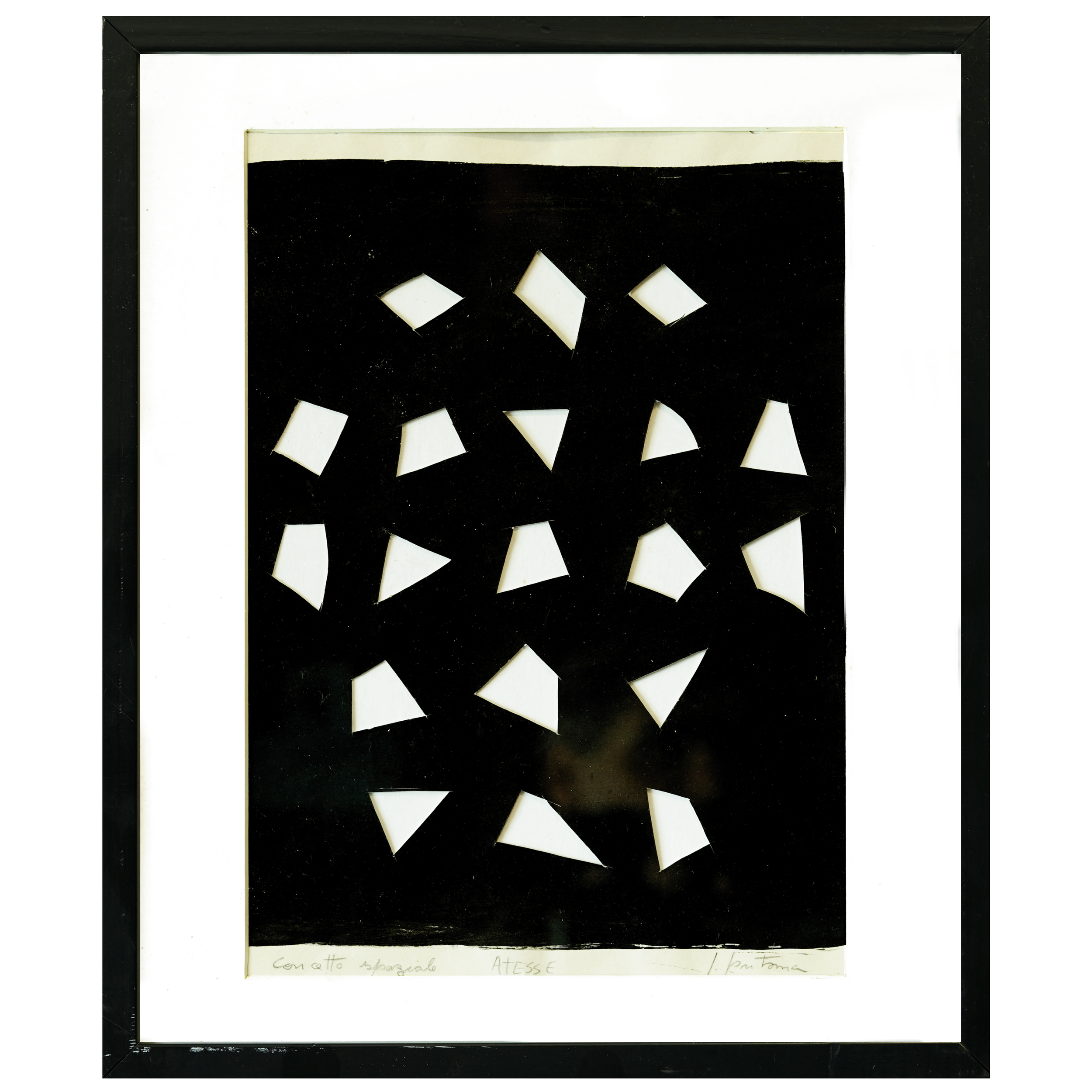
LUCIO FONTANA - Original “Concetto Spaziale”. Dated and signed at the bottom
Artist: Lucio Fontana (1899–1968)
Date: c. 1960s
Medium: Cut paper with black ink
Dimensions: 30 × 21 cm
Collection: Private Collection
Description:
Artwork part of Lucio Fontana’s Concetto Spaziale, Attese series. The piece features a black surface with a grid of precise cuts through the paper. The white background visible through the cuts creates a contrast that emphasizes space and depth.
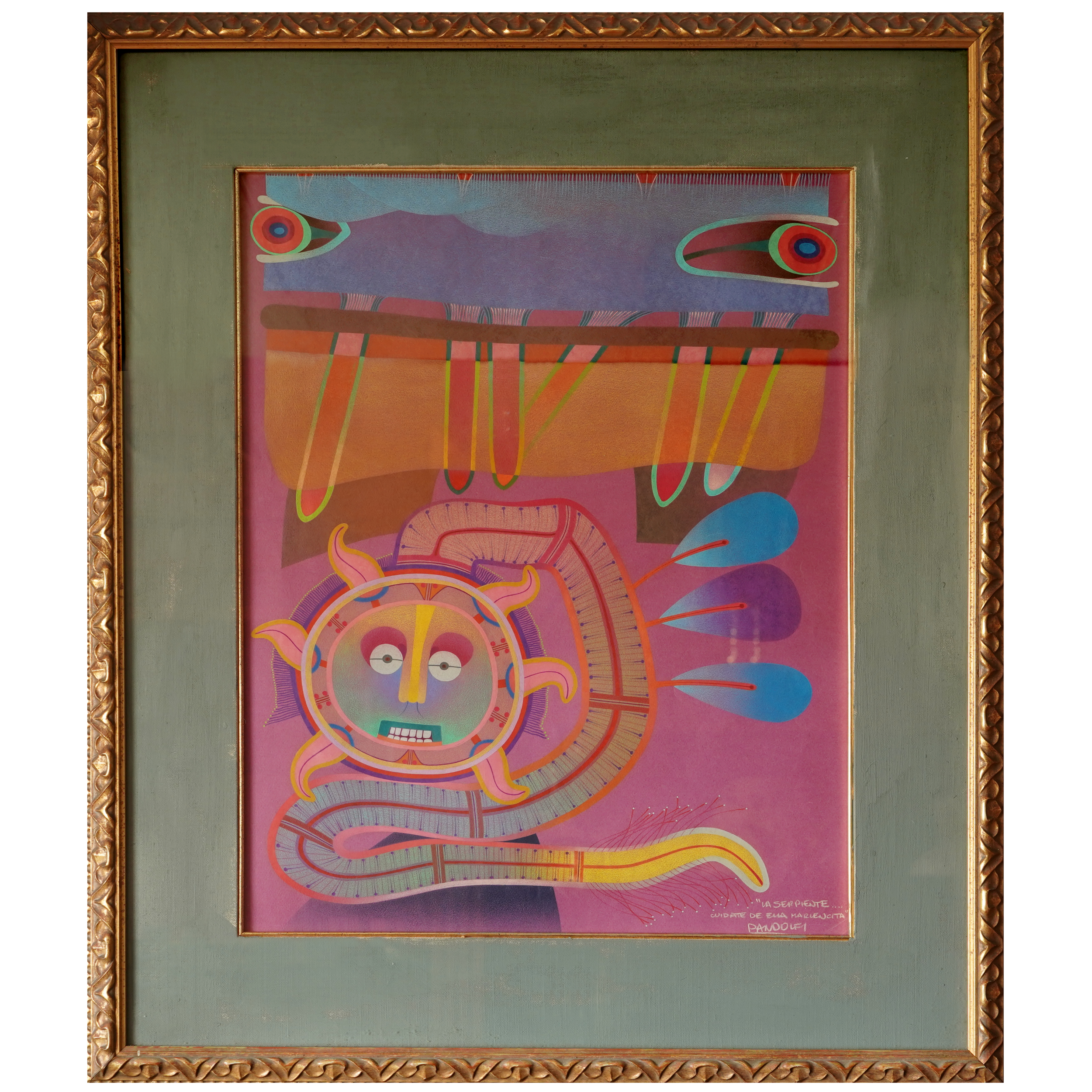
ROBERTO PANDOLFI. ORIGINAL DRAWING. Signed bottom right
Artist: Roberto Pandolfi (Argentine, 20th–21st century)
Medium: Ink and colored pencil (or pastel) on paper
Dimensions: 60 × 47 cm
Description:
Original drawing by Roberto Pandolfi depicting a fantastical figure composed of serpentine and humanoid elements. The central face, surrounded by sinuous, coiling forms and appendages, appears both mechanical and organic. Set against a vivid magenta background, the composition bursts with electric hues—neon yellows, blues, and reds—evoking a psychedelic or dreamlike state.
Pandolfi’s work merges Latin American symbolism with a personal surrealist language, often exploring dualities—man and beast, spirit and matter, inner and outer vision. In this piece, the creature’s hypnotic gaze and winding body suggest transformation, control, and introspection. The composition’s playful menace and intense chromatic contrasts reflect Pandolfi’s unique voice in contemporary visionary art.
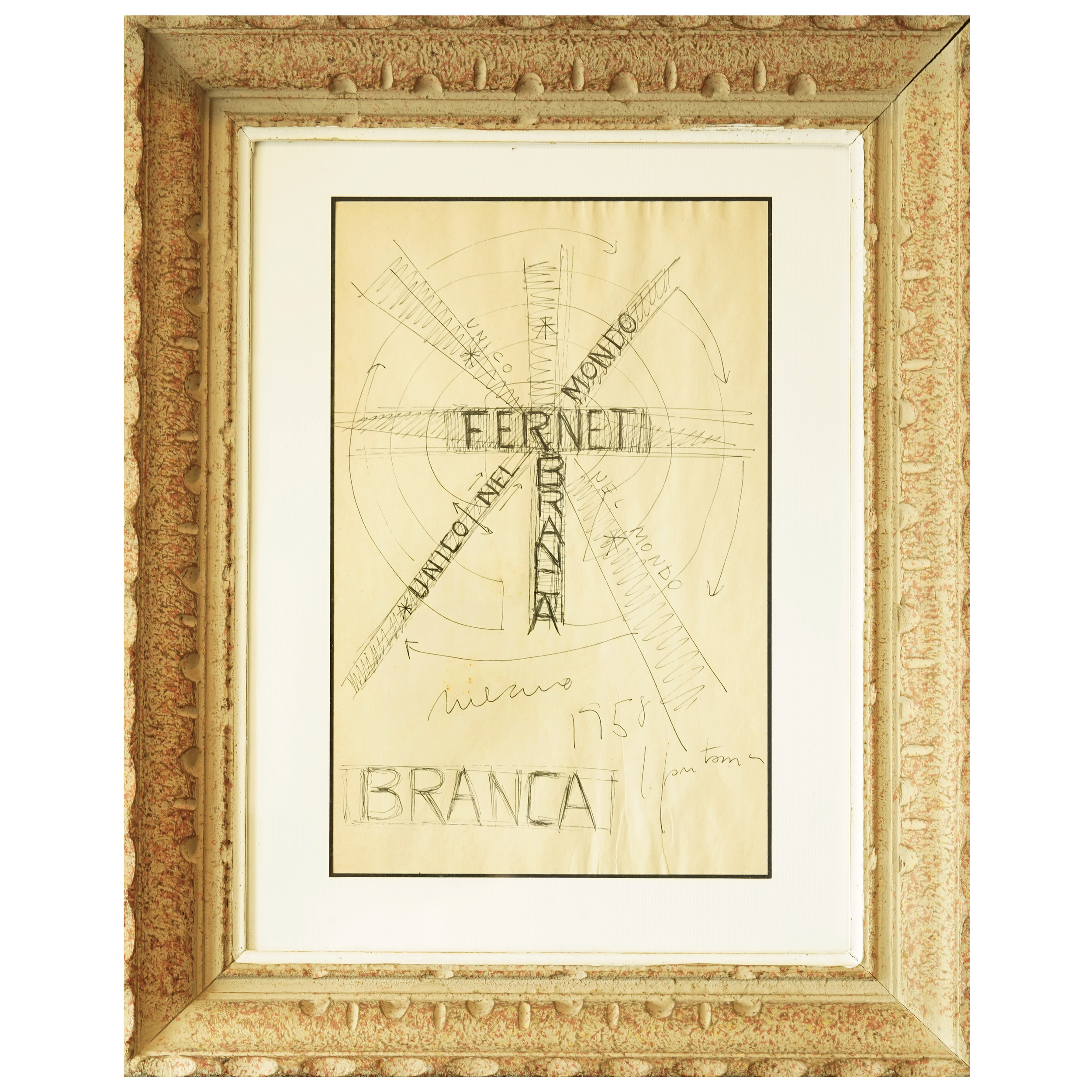
LUCIO FONTANA - Original Drawing “FERNET BRANCA”. Dated and signed bottom right
Year: 1958
Title:Fernet Branca Study
Artist: Lucio Fontana (1899–1968)
Medium: Pencil on paper
Dimensions: 33 × 21 cm
Description:
Original drawing by Lucio Fontana offering a glimpse into the conceptual design process of the artist. Featuring hand-drawn lettering and radiating arrows, the work centers around the words “FERNET BRANCA,” referencing the iconic Italian amaro. The concentric forms and dynamic arrows suggest movement and global reach—possibly a design sketch for an advertisement or poster.
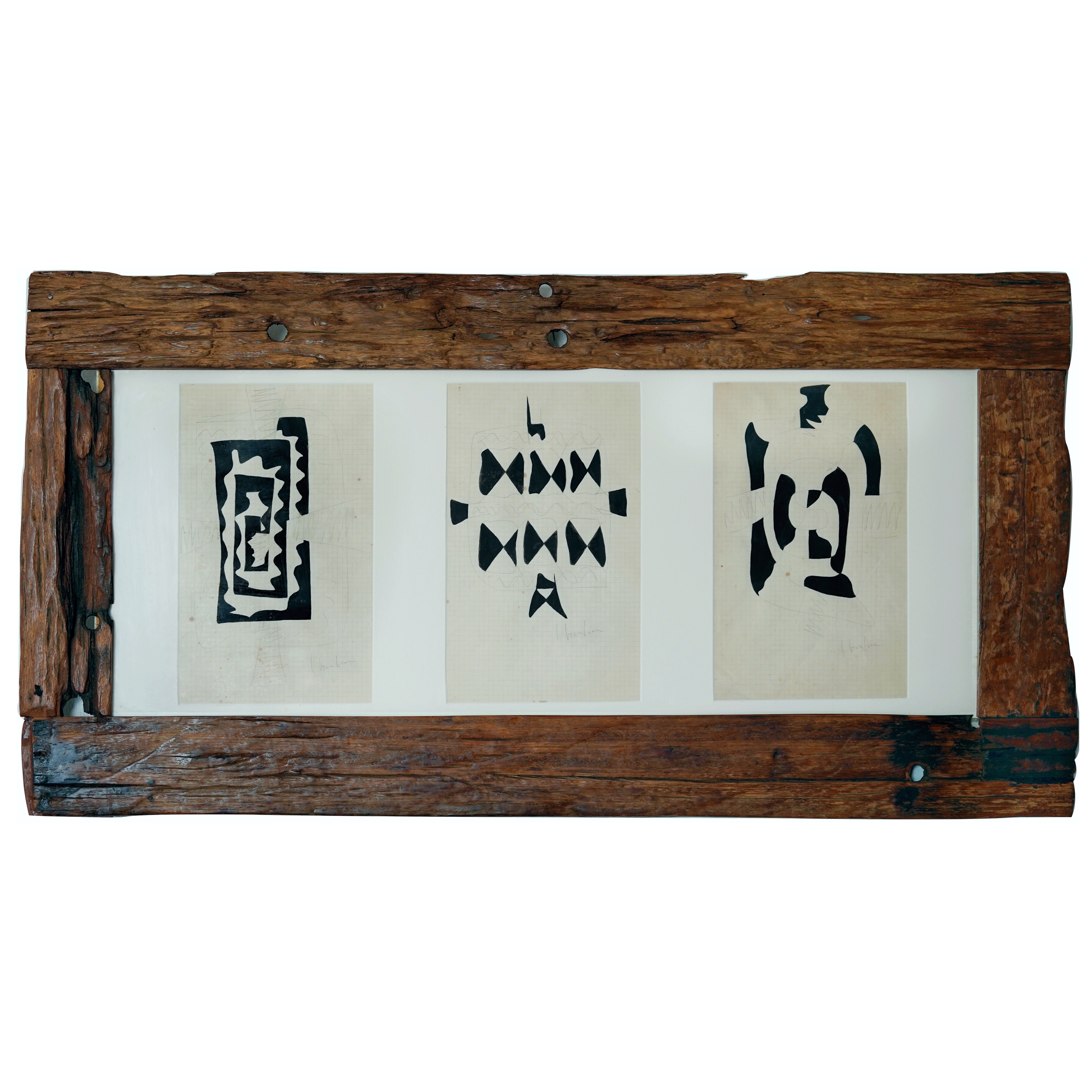
LUCIO FONTANA - Concetto Spaziale. Signed on each bottom right
Title:Spatial Concepts (Triptych)
Artist: Lucio Fontana (1899–1968)
Medium: Ink on graph paper, mounted in reclaimed wood frame
Dimensions: 33 × 20 cm (x3) -with frame : 52 × 117 cm
Description:
Triptych by Lucio Fontana featuring three abstract ink drawings on graph paper, each exploring a unique spatial rhythm through black geometric forms. The compositions display Fontana’s signature interest in breaking traditional pictorial boundaries, reducing form to raw, symbolic essence. Mounted in a rough-hewn wooden frame.
Lucio Fontana, founder of the Spatialism movement, sought to go beyond the flat surface of the canvas and redefine art through space, light, and gesture. In this rare triptych, Fontana turns to paper to explore spatial energy in two dimensions, creating meditative symbols that appear to pulse with dynamic force.
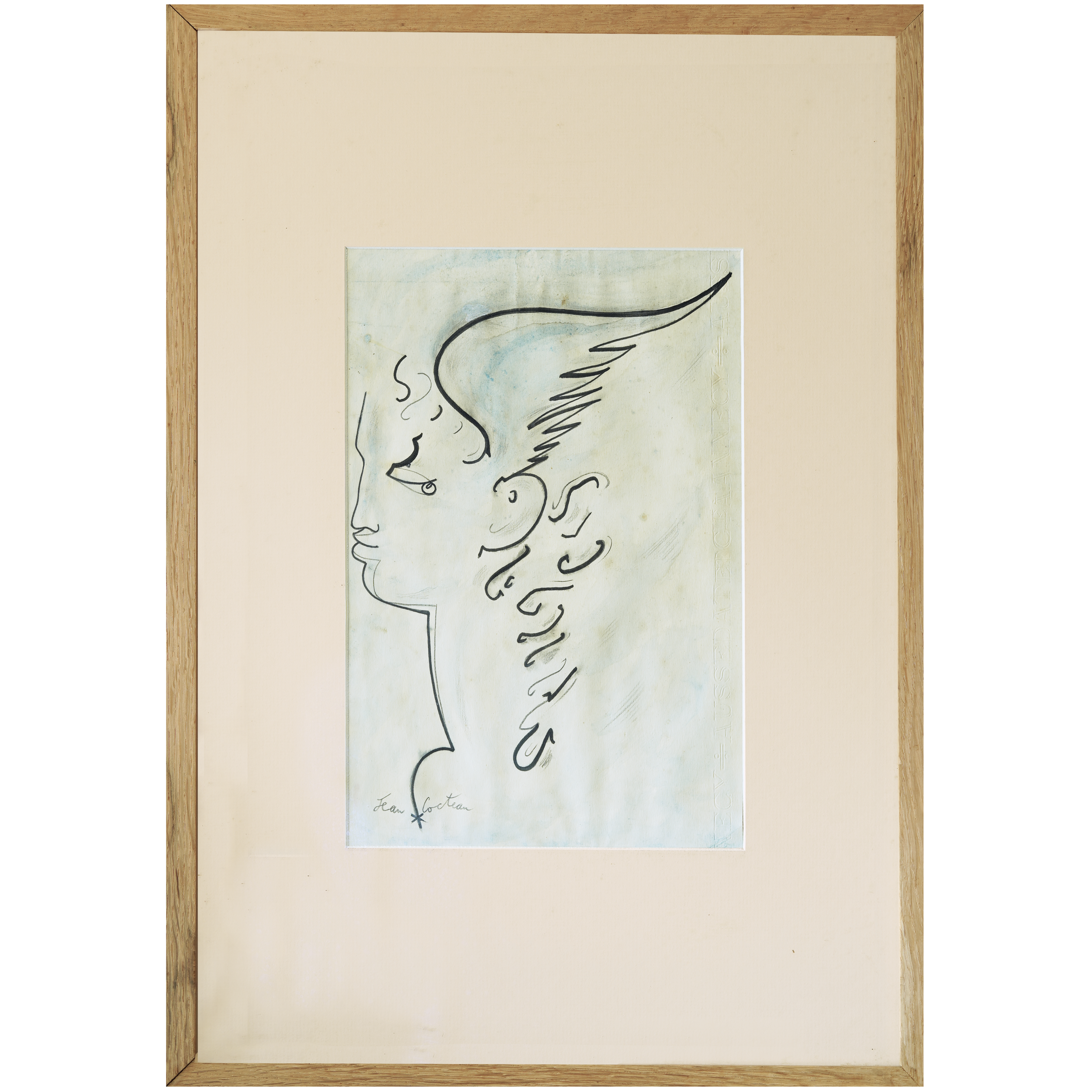
Original drawing by Jean COCTEAU depicting a winged profile.
Title:Winged Profile
Artist: Jean Cocteau (1889–1963)
Medium: Ink on paper
Dimensions: 32 x 21 cm
Description:
Original drawing by Jean Cocteau presenting a stylized human profile with wing-like extensions flowing from the head, evoking classical mythology and poetic symbolism. Rendered in fluid, elegant lines, the figure's face is both serene and enigmatic, a hallmark of Cocteau’s linear aesthetic. The composition is signed by the artist at the bottom.
Jean Cocteau, a French polymath and central figure of 20th-century avant-garde art, often blended poetry, myth, and surrealism in his work. This drawing exemplifies his ability to merge simplicity of line with psychological depth, evoking themes of transformation, flight, and inner vision.
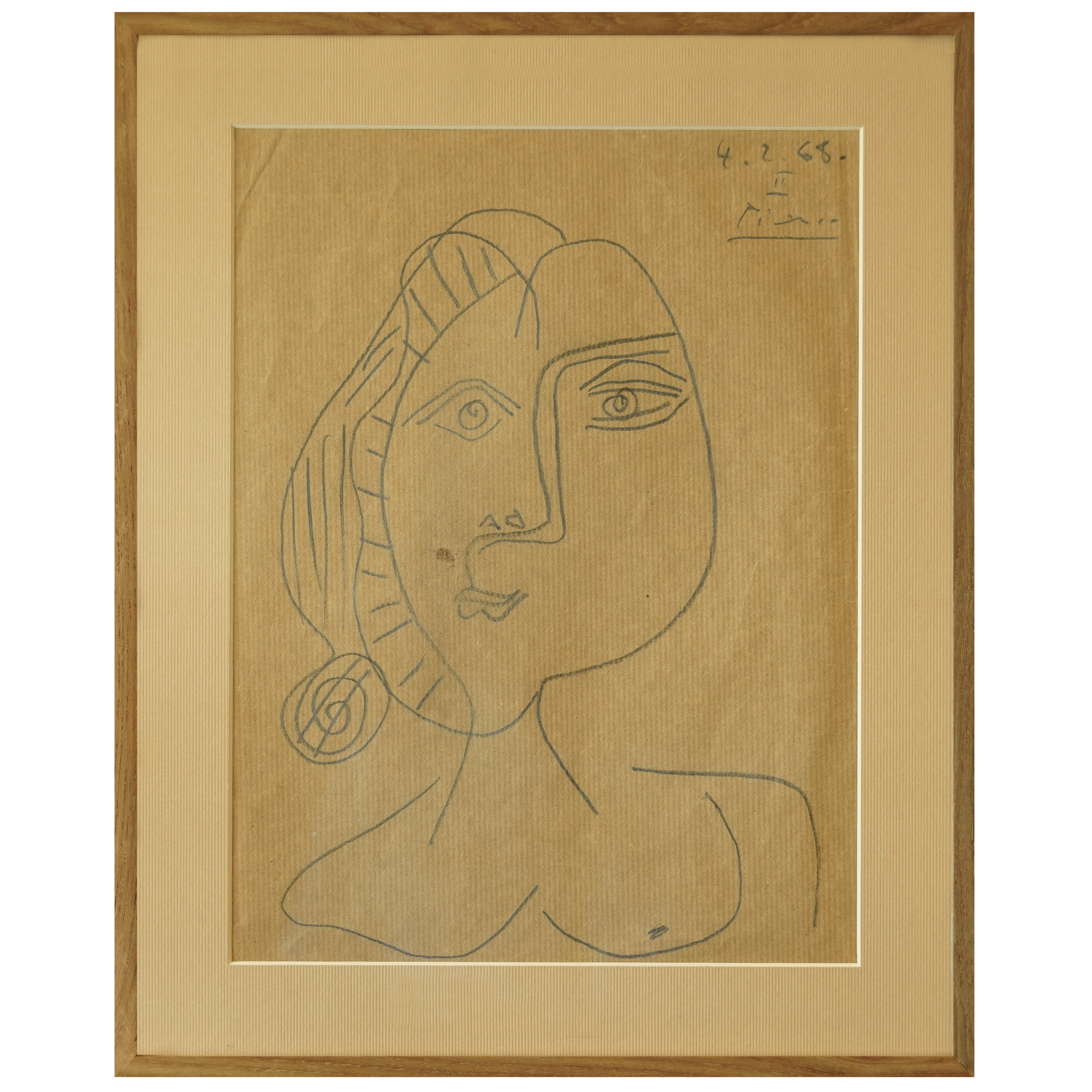
Original drawing by Picasso depicting a woman’s face, executed with pencil on brown paper, dated and signed at the top right 4.2.68 II
Year: 1968
Artist: Pablo Picasso (1881–1973)
Medium: Graphite on brown paper
Signature: Dated and signed upper right
Dimensions: 32 × 24 cm
Description:
Drawing by Pablo Picasso capturing the essence of his late period: confident, fluid, and bold in its abstraction. Rendered in a few uninterrupted lines, this drawing portrays a woman's bust-length figure, with a split or dual visage—two profiles merging into a single frontal form.
The use of brown paper and sparse line work highlights Picasso’s mastery of expressive minimalism. Despite the simplicity of the materials, the drawing conveys a vivid sense of presence, sensuality, and introspection.
Dated February 4, 1965, this work reflects Picasso’s continued fascination with the female form and psychological duality. The face, at once serene and enigmatic, is emblematic of the artist’s late-in-life synthesis of Cubist innovation and Mediterranean lyricism.
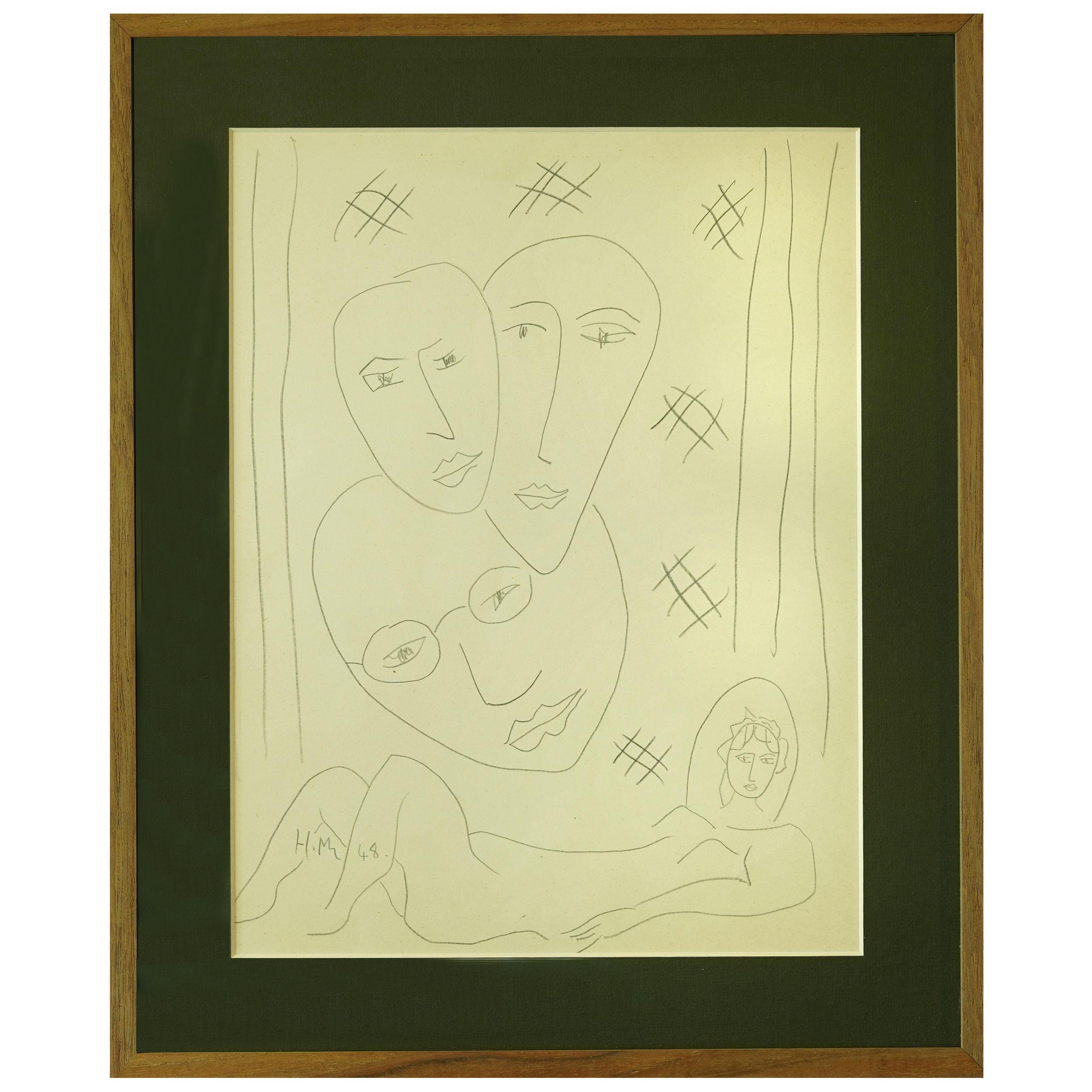
Original pencil drawing depicting a reclining woman, topped by three stylized faces, bearing Matisse's monogram "HM" and dated '48
Year: 1948
Title:Trois Visages et Figure Allongée
Artist: Henri Matisse (1869–1954)
Medium: Pencil on paper
Signature: Signed and dated lower left "H. M. 48"
Dimensions: 29 × 23 cm
Description:
Drawing by Henri Matisse capturing the artist’s late-career mastery of minimalism and expression. Rendered in a few delicate strokes, the composition juxtaposes three stylized heads, suspended in space, above a reclining figure.
Created in 1948, during Matisse’s late period, this drawing exemplifies his pursuit of purity through line. It reflects his deep interest in human emotion, abstraction, and the lyrical simplicity that defined his later works. The dreamlike grouping of figures evokes both intimacy and distance—hallmarks of Matisse’s poetic visual language.
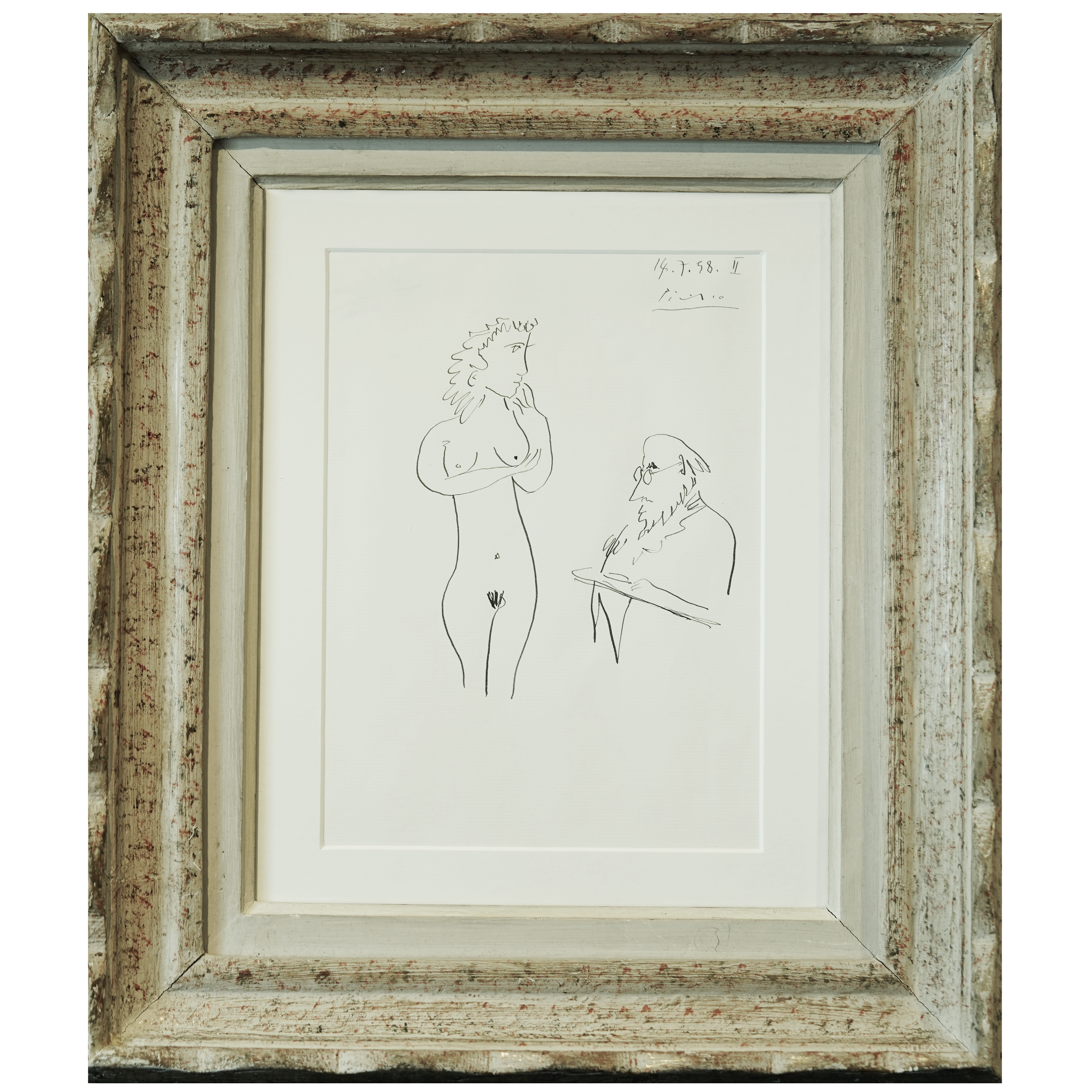
Original drawing by Picasso depicting a nude woman and a man. Drawing in black ink on beige paper, dated and signed in the top right 14.7.58 II
Year: 1958
Artist: Pablo Picasso (1881–1973)
Medium: Ink on paper
Dimensions: 26 × 18 cm
Signature: Signed and dated upper right
Description:
Original drawing by Pablo Picasso capturing a classic artistic theme—the intimate moment between an artist and his nude model. Executed with remarkable economy of line, the composition features a seated male figure sketching a standing nude woman.
In his later years, Picasso frequently returned to the theme of the artist and his muse—a dynamic reflecting both his own life and the enduring classical tradition. Here, the sparse elegance of line reflects his masterful control and spontaneous energy. Dated July 14, 1958, this drawing belongs to a prolific period where Picasso explored the fusion of eroticism, artistic creation, and mythic intimacy in its most distilled form.
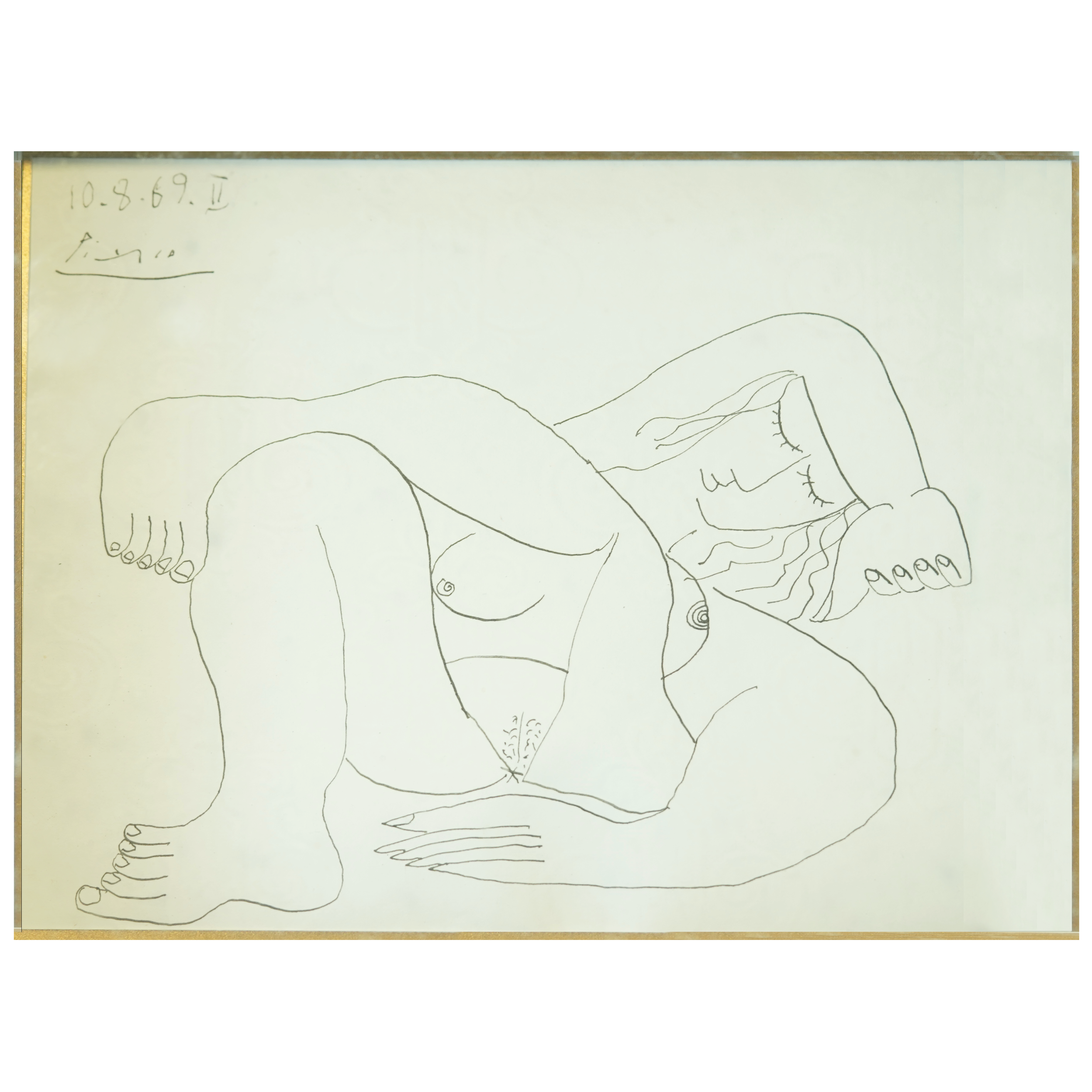
Original ink drawing depicting a reclining nude woman, bearing PICASSO's monogram and dated on the top left 10/08/1969 II
Year: 1969
Title:Reclining Nude
Artist: Pablo Picasso (1881–1973)
Medium: Ink on paper
Signature: Signed and dated upper left “10.8.69 II / Picasso”
Dimensions: 17 × 22 cm
Description:
Drawing by Pablo Picasso capturing a reclining nude in a pose that is both sensual and serene. Executed with characteristic fluency and economy of line, the female figure is shown folded into herself, limbs curled and overlapping in a contorted yet natural position.
Created in the final years of Picasso’s life, this drawing reflects his undiminished fascination with the female form and his continued exploration of expressive distortion.
Drawn in 1969 at the age of 88, this work stands as a testament to Picasso’s enduring creative vitality. His late style embraced a raw spontaneity that distilled decades of mastery into unfiltered expression.
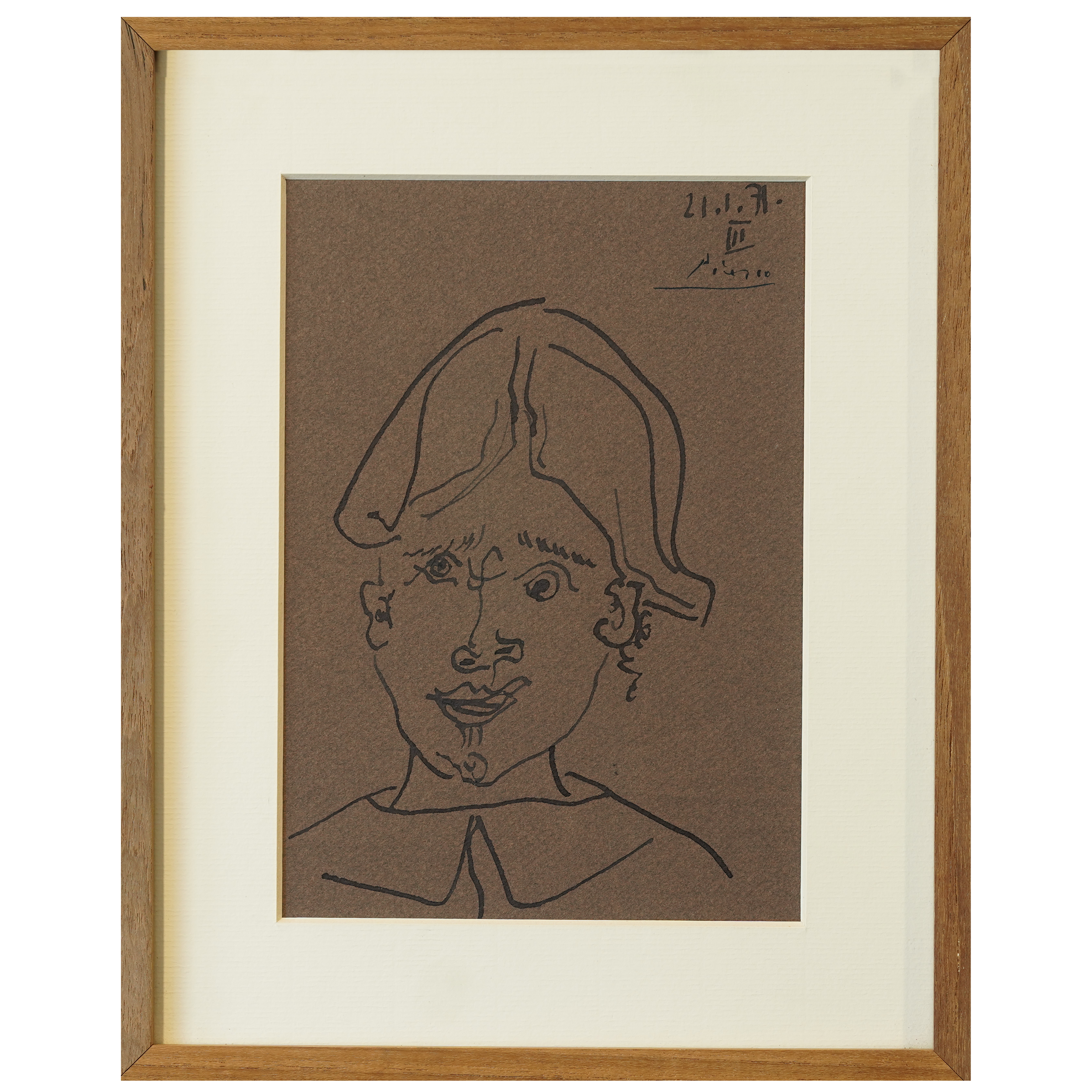
Original drawing by Picasso depicting the head of a capped Pierrot, executed in black ink on brown paper, dated and signed at the top right 21.1.71 II
Year: 1971
Title:Pierrot
Artist: Pablo Picasso (1881–1973)
Medium: Ink on brown paper
Signature: Signed and dated upper right
Dimensions: 20 × 14 cm
Description:
Drawing by Pablo Picasso reimagining Pierrot—the melancholic clown from the Italian Commedia dell’arte tradition—through his distinctive late-period style. With confident, continuous lines, the artist distills the character to its emotional essence. The figure’s wide-brimmed hat, delicate features, and stylized collar unmistakably evoke the iconic costume of the theatrical sad clown.
Drawn in the final years of his life, Pierrot reflects Picasso’s enduring fascination with theatrical archetypes, identity, and the emotional power of gesture.
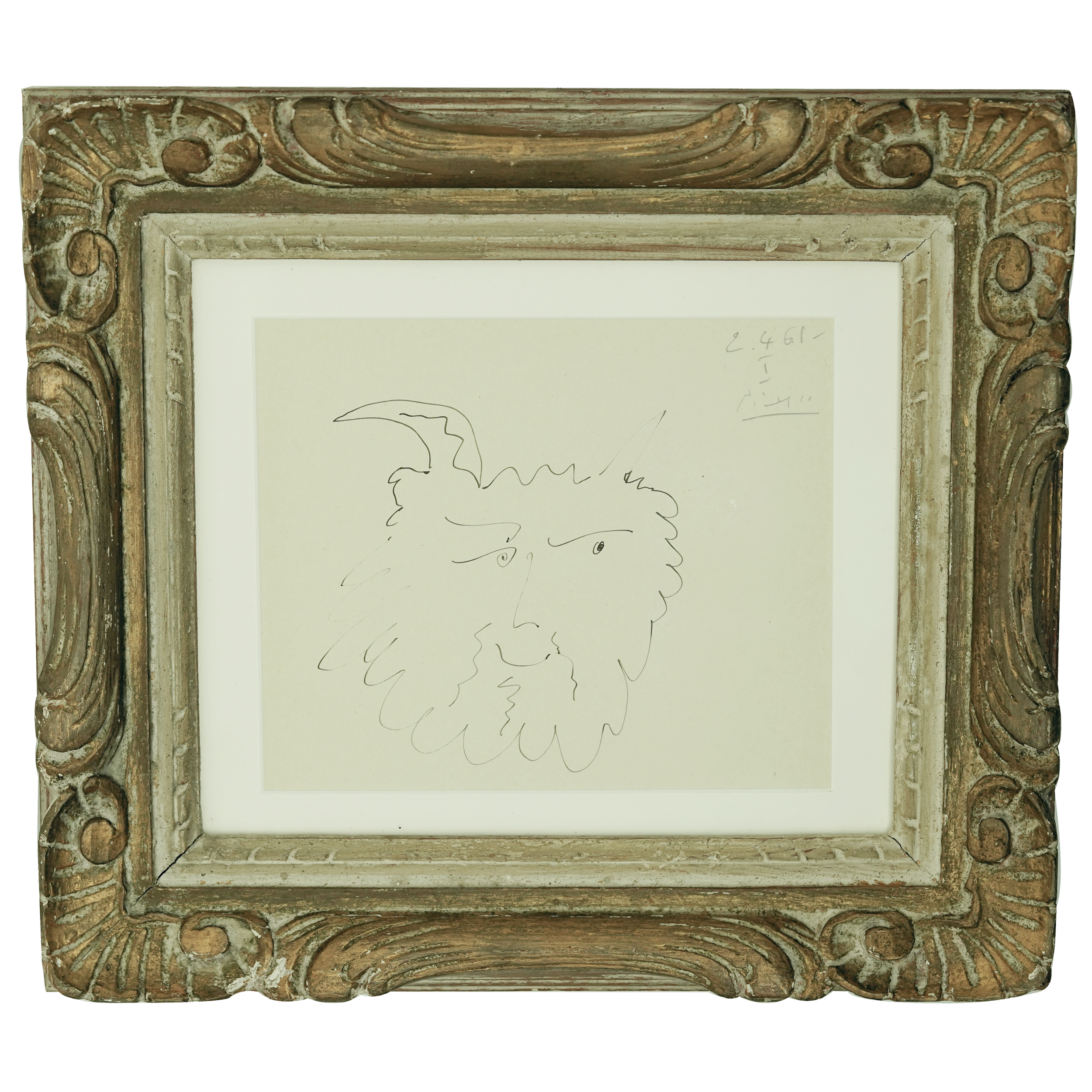
Original drawing by Picasso depicting a "Head of a Faune." Drawing in black ink on beige paper, dated and signed in pencil at the top right: 2.4.61
Year: 1961
Title:Head of a Faun
Artist: Pablo Picasso (1881–1973)
Medium: Ink on paper
Signature: Dated and signed upper right
Dimensions: 17 × 21 cm
Description:
Original drawing by Pablo Picasso depicting the head of a faun, a recurring mythological subject in his oeuvre. Executed with a few fluid and confident ink lines, the composition captures the essence of the creature’s dual nature—part man, part beast—with a single curved horn, a pointed ear, and an unruly beard framing an enigmatic expression. Despite its apparent simplicity, the drawing exudes character, wit, and Picasso’s mastery of spontaneous line.
In his later years, Picasso often returned to mythological and classical themes with renewed freedom and economy of gesture. This work distills the faun’s identity into a minimal yet evocative image, underscoring the artist’s lifelong fascination with Mediterranean mythology. "Head of a Faun" is both whimsical and archetypal, revealing the artist’s ability to imbue even the briefest sketch with expressive depth and symbolic resonance.
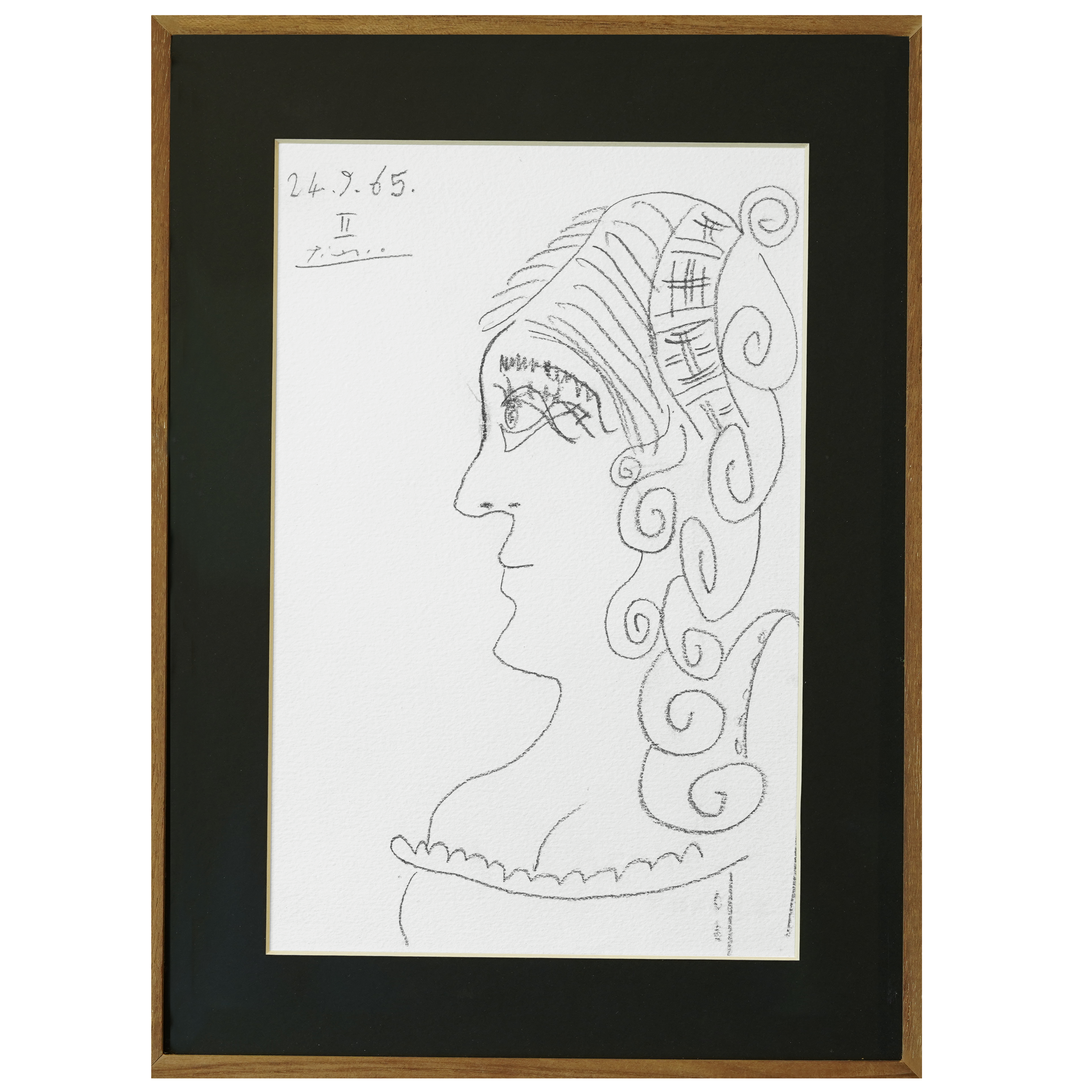
Original drawing by Picasso, in grease pencil, depicting the profile of a young woman with a low neckline over her chest, signed and dated at the top left: 24.9.65
Year: 1965
Title:Portrait of a Woman in Profile
Artist: Pablo Picasso (1881–1973)
Medium: Pencil on paper
Signature: Dated and signed upper left
Dimensions: 27 × 18 cm
Description:
Original drawing by Pablo Picasso presenting a stylized profile of a woman, rendered with fluid yet deliberate pencil strokes. The elegant subject is shown in left-facing profile, her hair composed of a rhythmic play of curls, loops, and crosshatched textures that frame her composed features. Her large, expressive eye and delicate neckline suggest a sense of classical serenity while simultaneously revealing Picasso’s playful linear abstraction.
Created in 1965, this portrait reflects the late period of Picasso’s career, during which he embraced spontaneity, confidence, and minimalism in his drawing practice. The economy of line and ornamental composition in Portrait of a Woman in Profile captures the artist’s enduring fascination with the female figure—now distilled to its essential, lyrical essence. It is both a tribute to tradition and an assertion of Picasso’s bold artistic language.
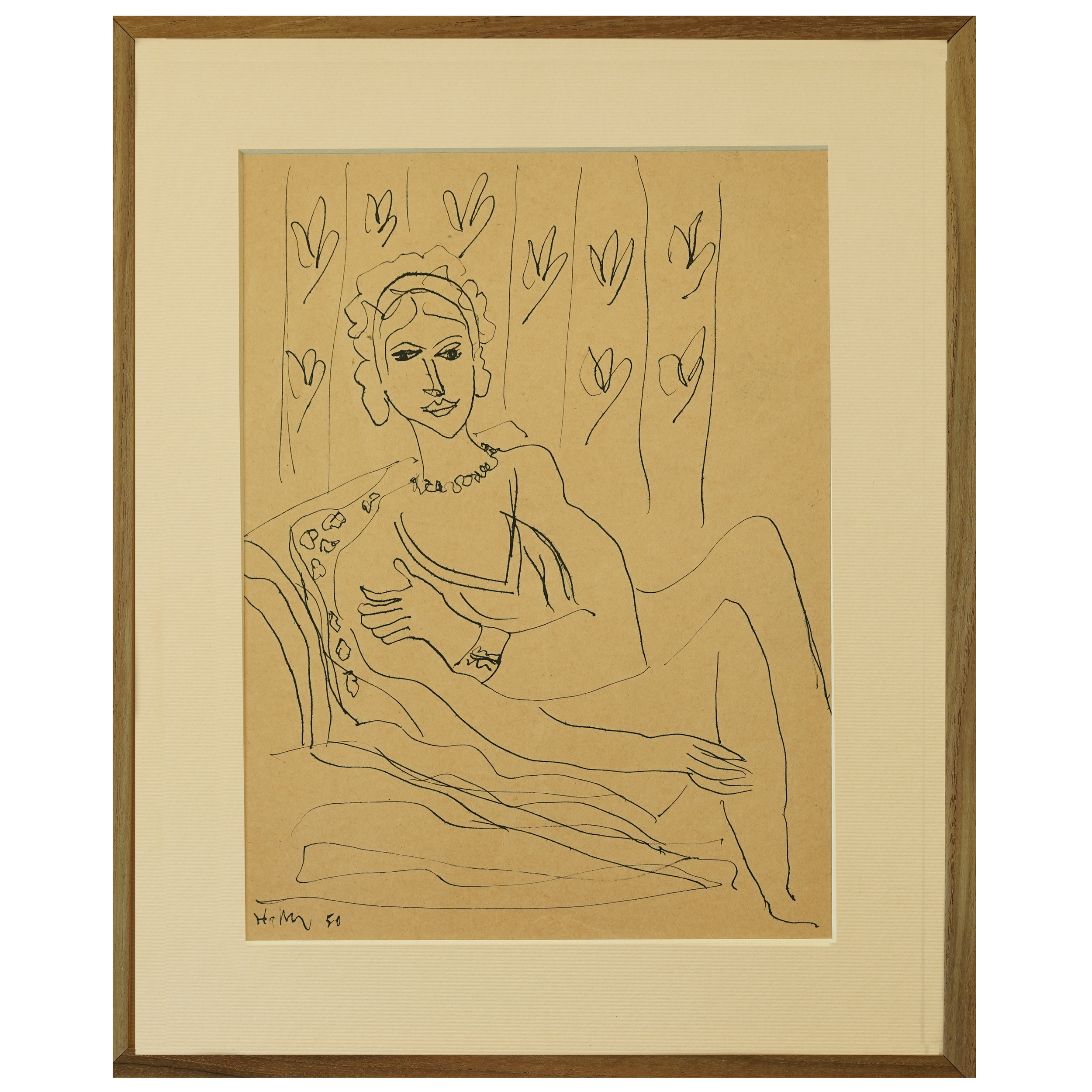
Original pencil drawing depicting a reclining woman, bearing Matisse's monogram "HM" and dated '50
Year: 1950
Title:Reclining Woman with Floral Drapery
Artist: Henri Matisse (1869–1954)
Medium: Ink on paper
Signature: Signed and dated lower left "H. M. 51"
Dimensions: 26 × 20 cm
Description:
Drawing by Henri Matisse’s refined late style, where bold, economical line work conveys elegance, sensuality, and grace. A reclining woman gazes outward with calm poise, her figure gently undulating across the page.
Created in the final years of Matisse’s life, this drawing reflects his ongoing fascination with the female form and interior space. It embodies the artist’s pursuit of harmony and clarity, and illustrates his belief that art should be “something like a good armchair” — comforting, beautiful, and serene.
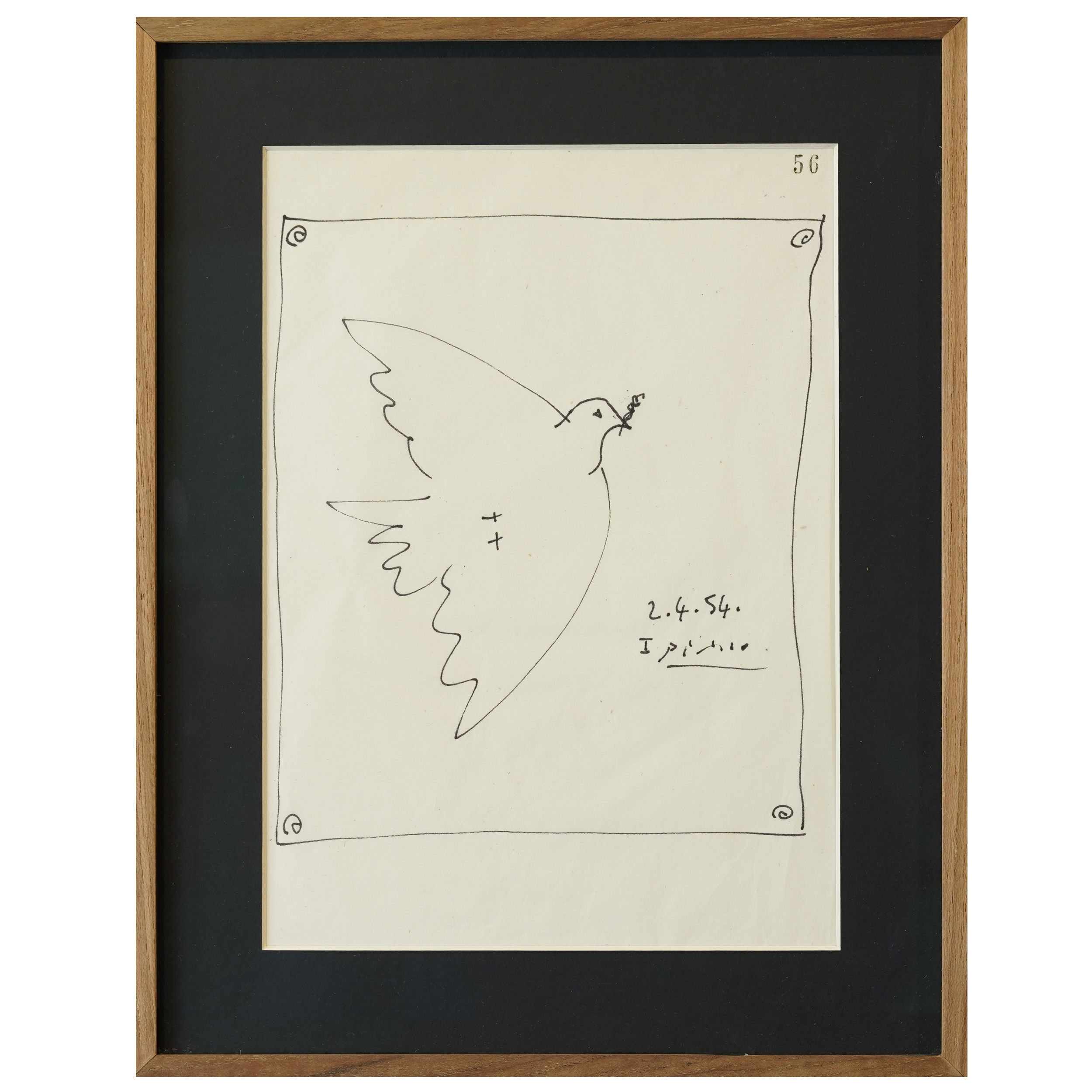
Original drawing by Picasso, in India ink on tracing paper, depicting a dove, signed and dated at the bottom right: 2.4.54
Year: 1954
Title:Dove of Peace
Artist: Pablo Picasso (1881–1973)
Medium: Ink on paper
Signature: Signed and dated lower right
Dimensions: 26 × 19 cm
Description:
This minimalist yet powerful drawing captures one of Pablo Picasso’s most iconic symbols: the dove. Rendered with a few confident lines, the bird is shown in flight, bearing an olive branch in its beak — a universal emblem of peace. The image radiates both movement and serenity, embodying Picasso’s ability to convey profound meaning through simplicity.
Originally adopted as the emblem for the 1949 World Peace Congress in Paris, the dove became a recurring motif in Picasso’s work and a personal symbol of his political engagement. This particular version, executed in 1954, exemplifies his mature graphic style, where form is distilled to its essence while maintaining emotional weight and clarity.
Dove of Peace is more than a drawing — it is a message. Created in a post-war world still striving for harmony, Picasso’s bird became a beacon of hope, embraced worldwide by peace movements. The artist’s line, fluid and unwavering, turns a simple sketch into a timeless plea for unity.
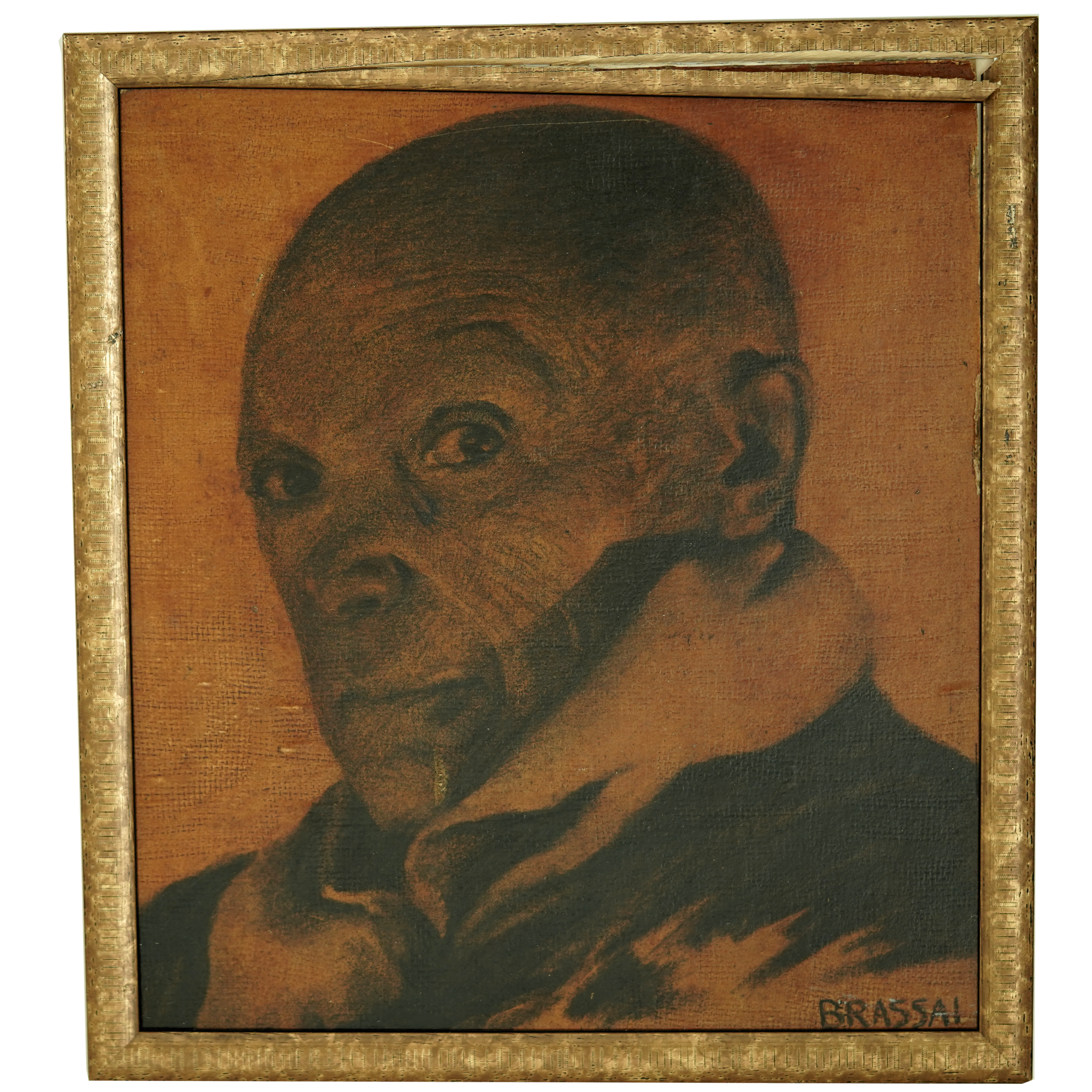
Title:Portrait of Pablo Picasso
Artist: Brassaï (Hungarian-French, 1899–1984)
Medium: Charcoal and pigment on canvas
Dimensions: 32 × 28 cm
Signed: Lower right, "Brassaï"
Description:
Portrait of Pablo Picasso by Brassaï revealing an introspective and intense depiction of one of the most influential artists of the 20th century. Rendered in a restrained yet striking palette of burnt sienna and black, the image radiates a quiet force. .
Better known for his photography, Brassaï was deeply immersed in the artistic circles of Paris and held a close friendship with Picasso, whom he photographed extensively over several decades. This rare painted work demonstrates Brassaï’s deep understanding of his subject, capturing Picasso not only as an iconic figure of modern art but also as a man immersed in thought and creative gravity.
This portrait stands as a powerful testament to the mutual admiration and artistic dialogue between Brassaï and Picasso. With its hauntingly intimate perspective, the painting bridges the realms of photography, painting, and psychological portraiture, showcasing Brassaï’s ability to capture the essence of a person with profound sensitivity.

Original drawing by Picasso depicting reclining nude man. Drawing in black ink on beige paper, signed in the top right II
Title:Reclining Bearded Man
Artist: Pablo Picasso (1881–1973)
Date: Undated (inscribed “II” in upper right corner)
Medium: Ink on paper
Signature: Signed "Picasso" upper right
Dimensions: 20 × 20 cm
Description:
Drawing by Pablo Picasso presenting a reclining male nude with a prominent beard and an air of calm self-possession. Rendered with his unmistakable linear economy, the figure appears at once archaic and contemporary — a classical pose stripped to its essentials through modernist abstraction.
Picasso's late drawings reflect a liberated, confident hand that distilled decades of technical skill into immediate visual poetry. In Reclining Bearded Man, the artist combines sensuality, wit, and timeless form in a deceptively simple composition.
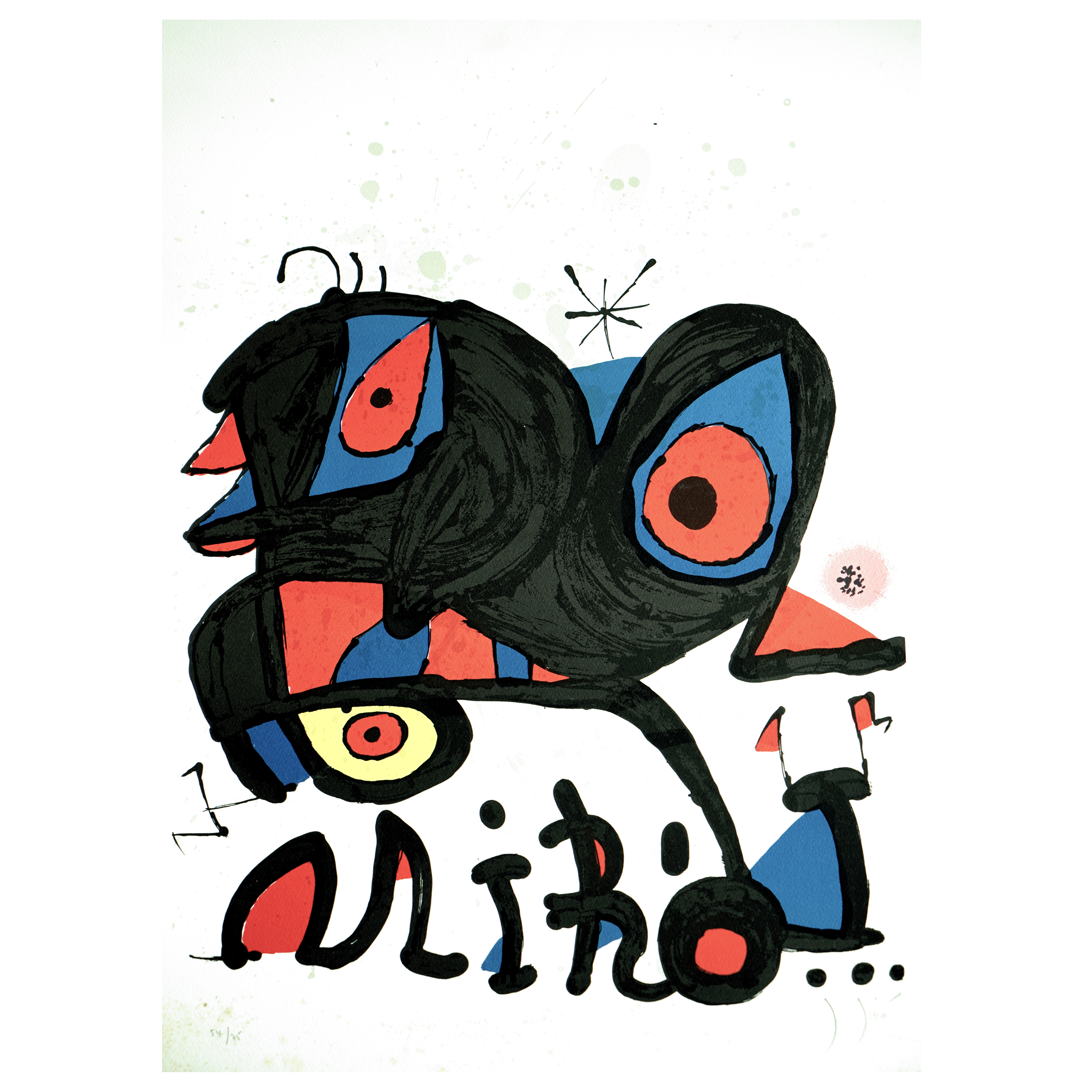
Joan Miró (1893–1983)
Lithograph
Dimensions: 86 × 59 cm
Lithograph by Joan Miró showcasing the artist’s distinctive visual language of bold colors, organic shapes, and playful abstraction. With its rhythmic black forms interwoven with striking reds, blues, and yellows, the work reflects Miró’s exploration of the subconscious and his desire to evoke a dreamlike, poetic universe. Characterized by spontaneity and imagination, this print exemplifies Miró’s pivotal role in Surrealism and his lasting influence on modern art.
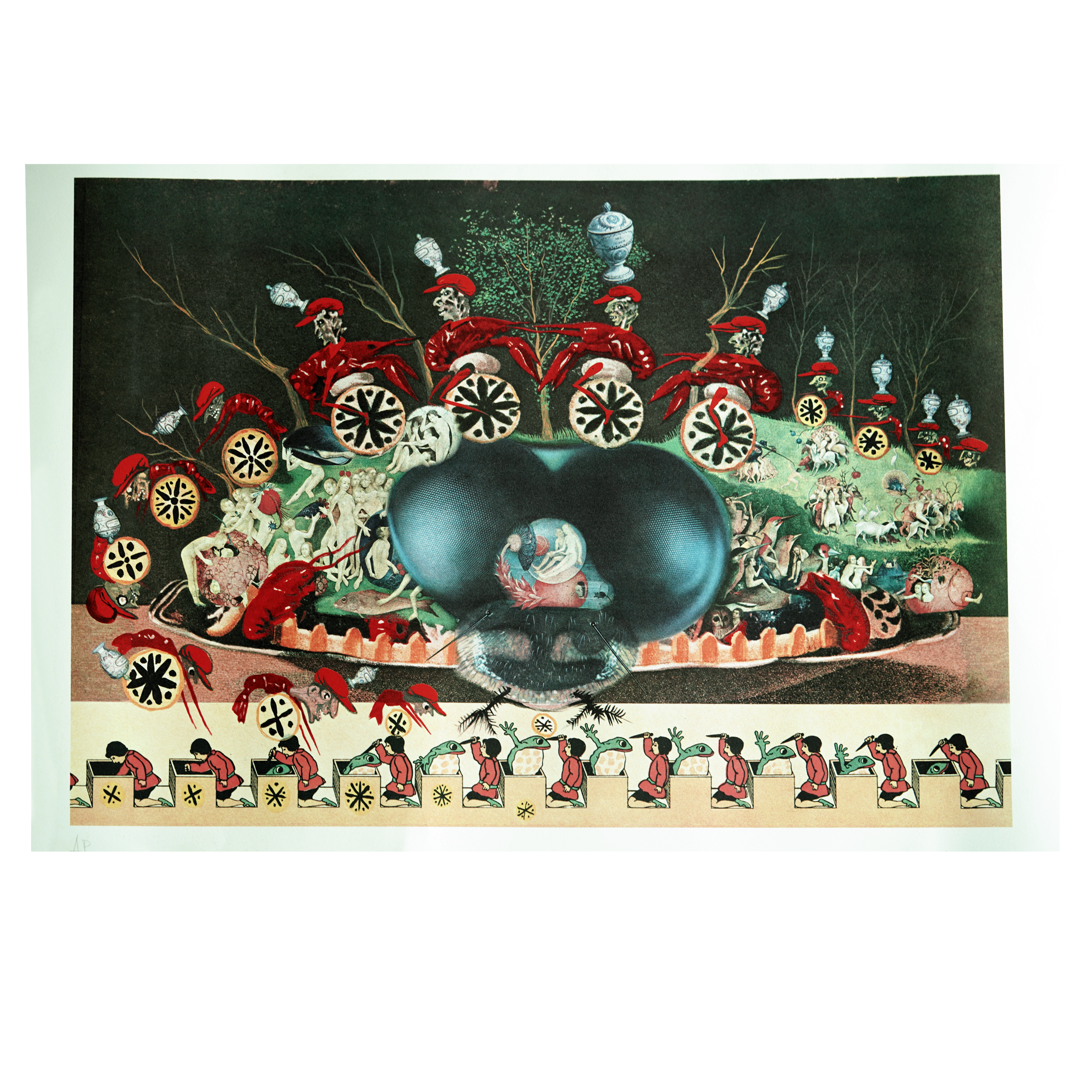
Salvador Dalí (1904–1989)
Lithograph after "The Garden of Earthly Delights"
Lithograph on paper
Dimensions: 41 × 58 cm
This lithograph by Salvador Dalí reinterprets Hieronymus Bosch’s The Garden of Earthly Delights through the surrealist’s unique vision. Combining fantastical figures, dreamlike landscapes, and symbolic imagery, Dalí pays homage to Bosch while infusing the work with his own eccentric and provocative style. The composition reflects Dalí’s fascination with the subconscious, metamorphosis, and the interplay of fantasy and reality, themes central to his career as one of the most influential artists of the 20th century.
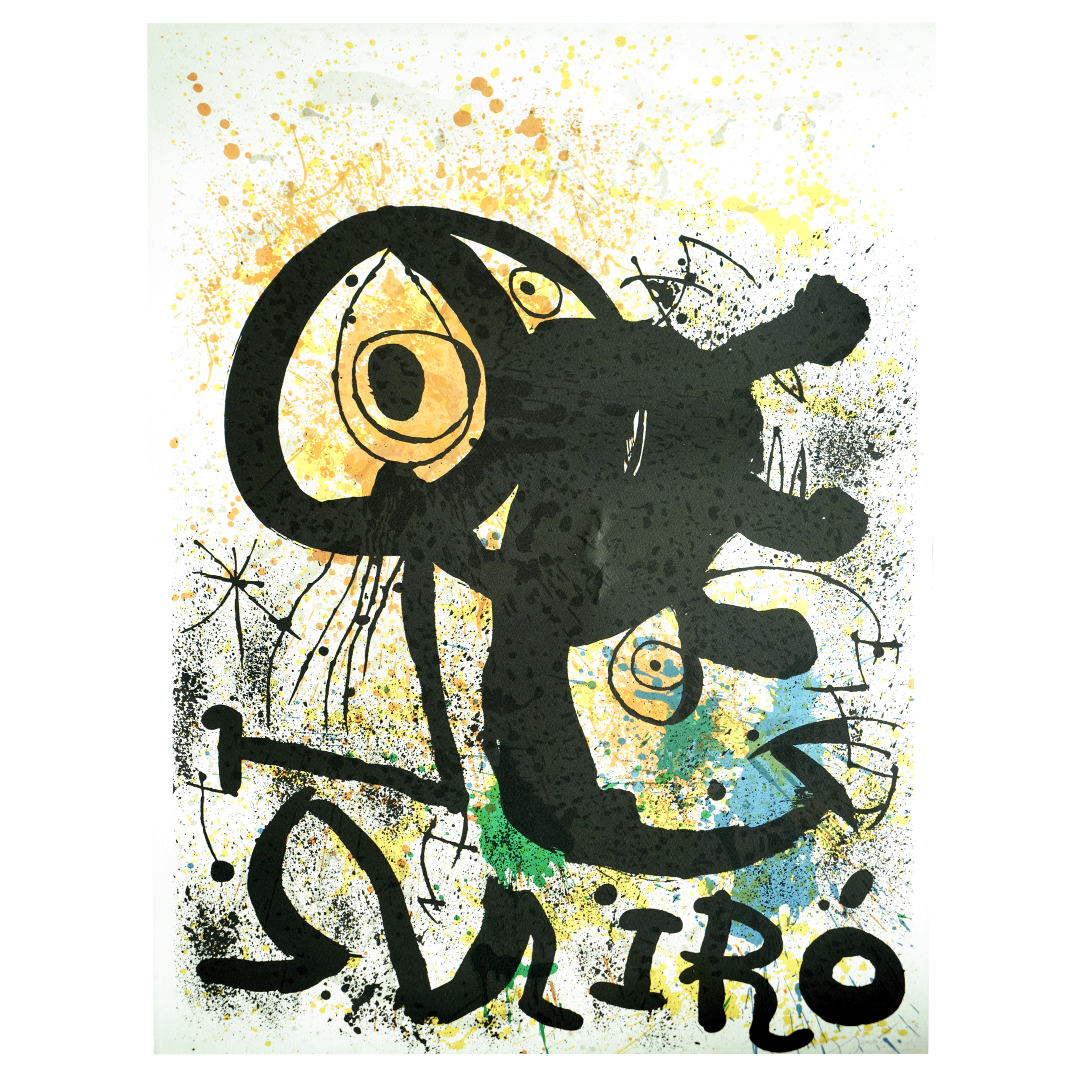
Joan Miró (1893–1983)
Untitled, c. 1960s–70s
Color lithograph on paper
Dimensions: 86 × 59 cm
Lithograph capturing Joan Miró’s fascination with spontaneity, movement, and the dreamlike world of abstraction. Bold black forms dominate the composition, animated by bursts of yellow, green, and blue splatters that evoke both cosmic energy and childlike play. Miró’s gestural lines and biomorphic shapes suggest a universe alive with symbols, where imagination transforms into visual poetry.
As in much of his graphic work, Miró uses lithography not only as a means of reproduction but as a medium of invention, preserving the immediacy and vitality of his painterly touch.
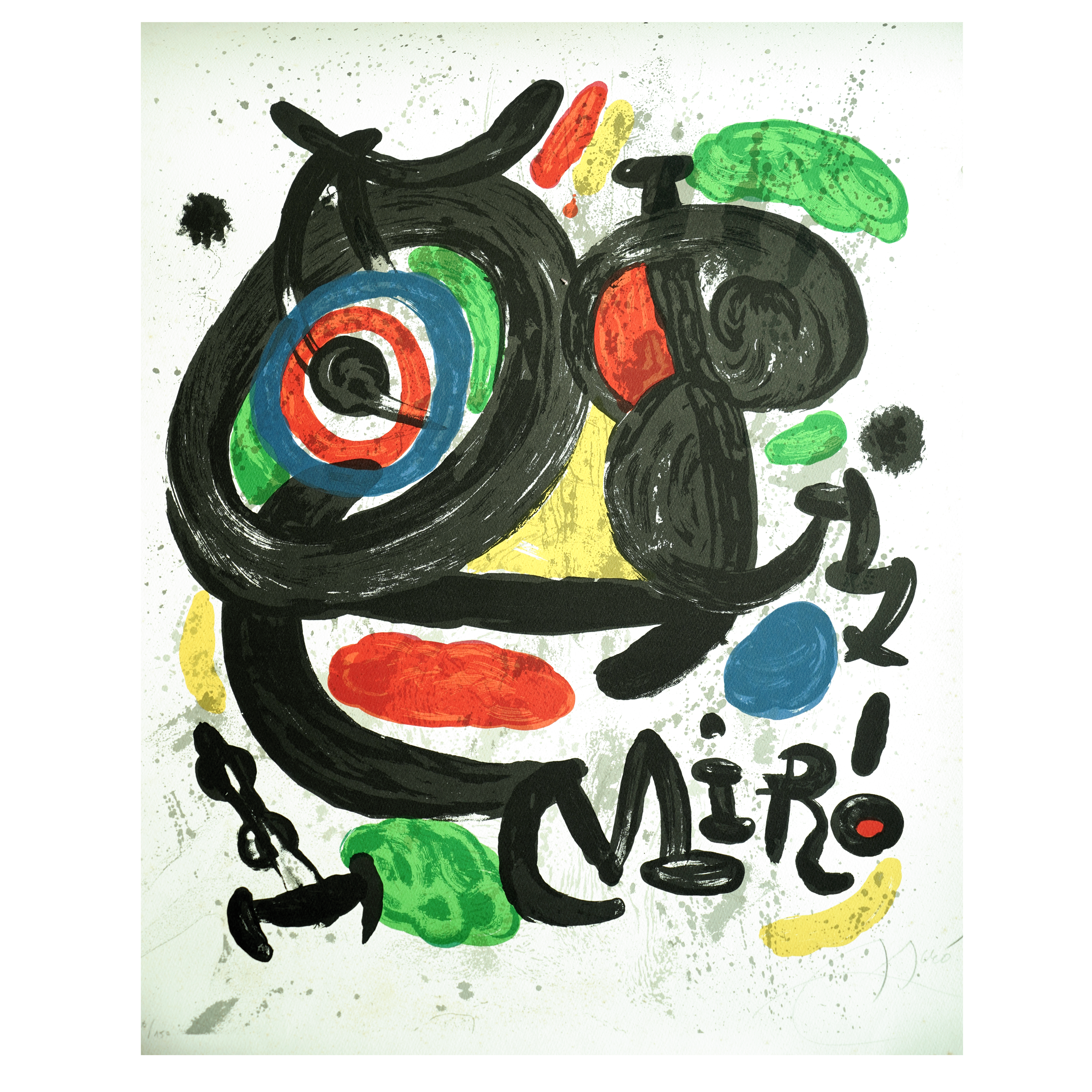
Joan Miró (1893–1983)
Untitled, c. 1960s
Color lithograph on paper
Dimensions: 86 × 59 cm
Lithograph exemplifying Joan Miró’s playful and poetic visual language. Bold black forms intertwine with bursts of primary colors—red, blue, yellow, and green—set against a dynamic field of painterly textures and gestural marks. The composition embodies Miró’s signature balance between abstraction and spontaneity, evoking a dreamlike world of symbols, movement, and imagination.
Miró’s graphic works, such as this, highlight his ability to translate the energy of his paintings into printmaking, making color and form accessible while preserving their expressive intensity.
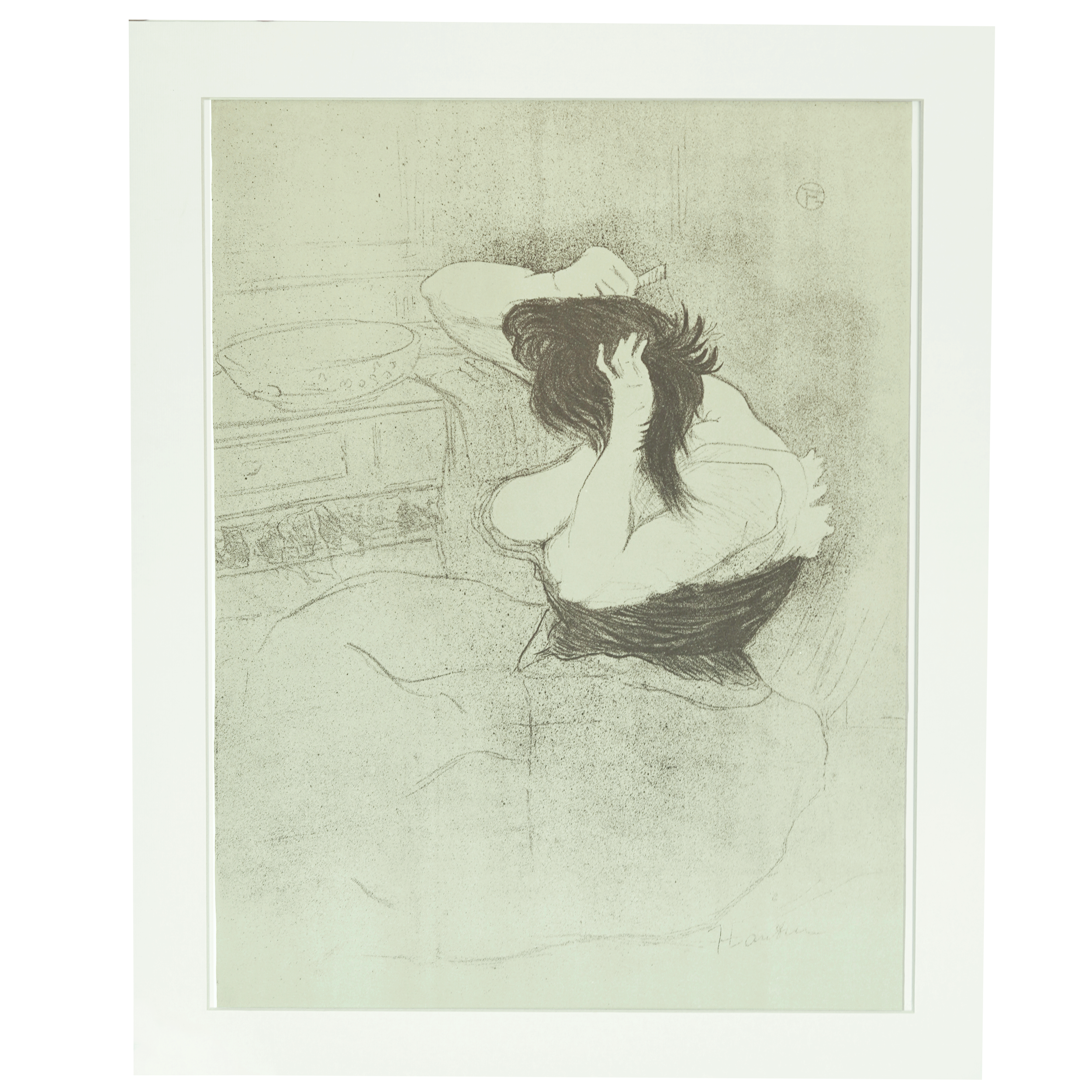
Henri de Toulouse-Lautrec (1864–1901)
Woman Combing Her Hair, from the series Elles, 1896
Lithograph
Dimensions: 60 × 49 cm
This work belongs to Toulouse-Lautrec’s celebrated Elles portfolio, which intimately portrays the private lives of women working in Parisian maisons closes. Here, a woman is shown in a moment of personal grooming, seated and absorbed in the simple act of combing her hair.
Rendered with soft lines and delicate tonal shading, the composition avoids dramatization, instead capturing the dignity of everyday gestures. Lautrec’s empathetic vision elevates the ordinary, offering a rare and humanizing perspective on women who were often marginalized in 19th-century society.
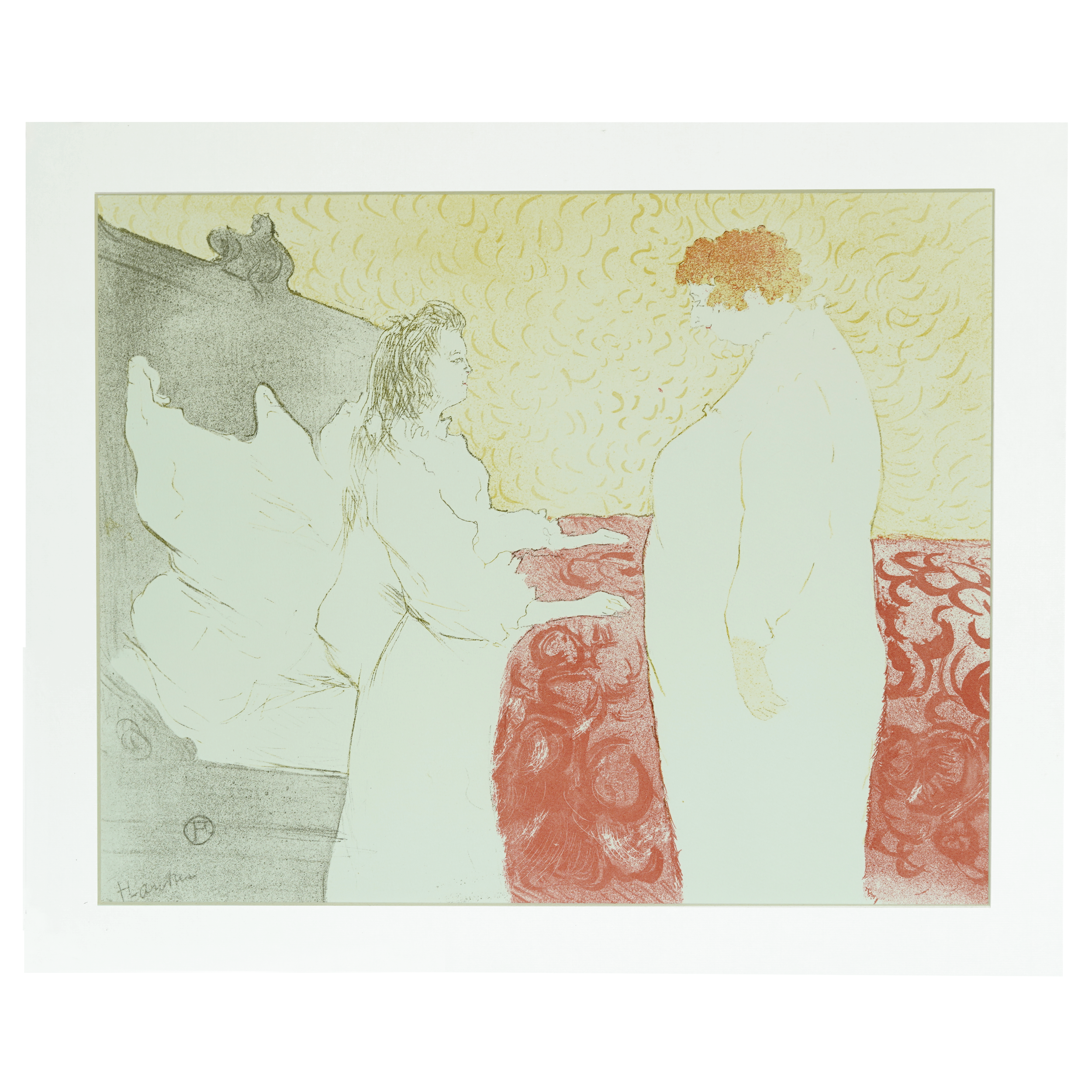
Henri de Toulouse-Lautrec (1864–1901)
Two Women in Bed, from the series Elles, 1896
Lithograph
Dimensions: 49 × 60 cm
Lithograph belonging to Lautrec’s Elles series, a groundbreaking portfolio depicting the daily lives of Parisian courtesans with honesty and empathy. Here, two women are shown in an intimate, unguarded moment—standing by a bed, their gestures casual and unposed. Lautrec avoids sensationalism, instead emphasizing companionship and the quiet rhythm of private life.
With its soft palette and simplified lines, the work conveys warmth and humanity, underscoring Lautrec’s unique ability to portray marginalized women with dignity and subtle psychological depth.
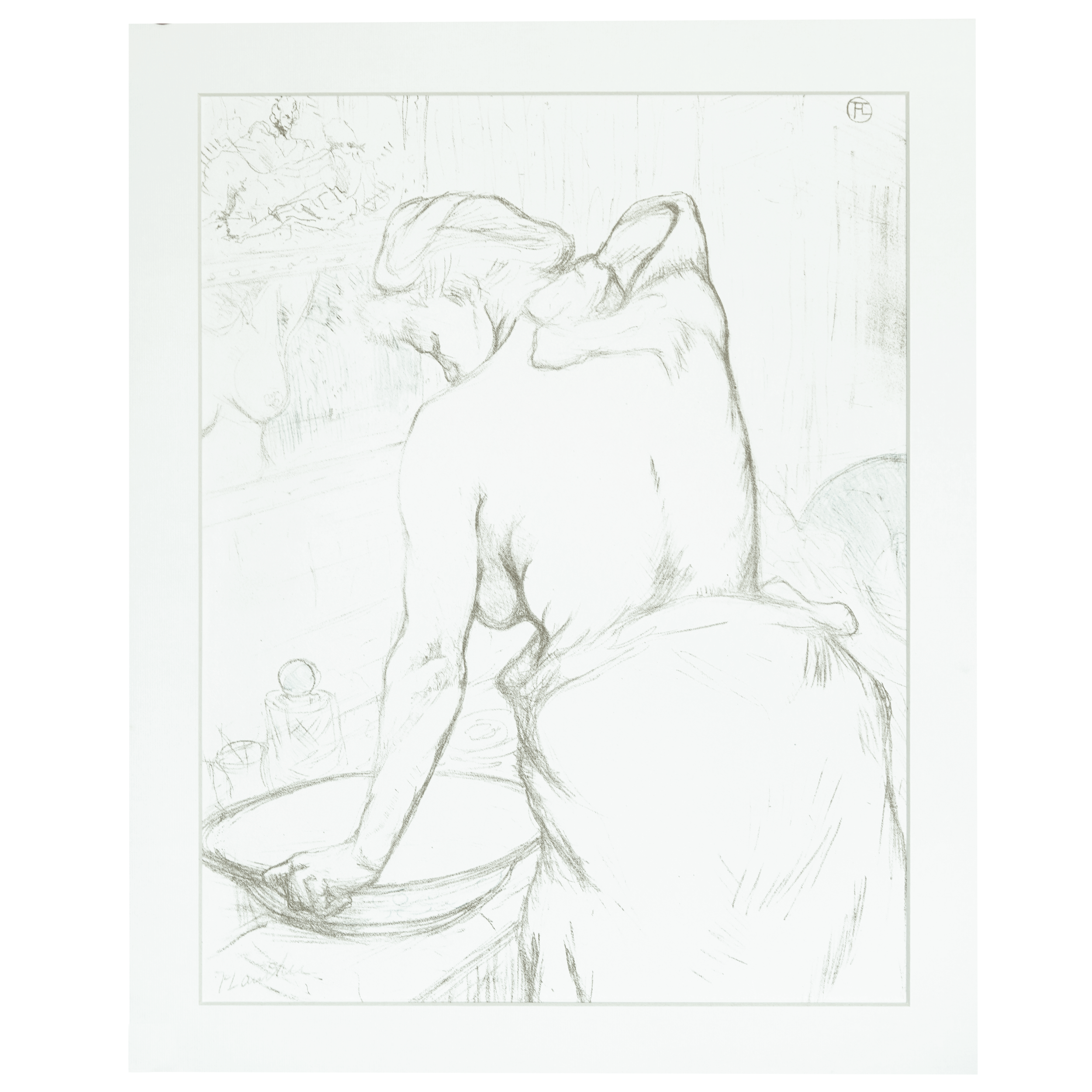
Henri de Toulouse-Lautrec (1864–1901)
Woman at Her Toilette, from the series Elles, 1896
Lithograph
Dimensions: 60 × 49 cm
Lithograph belonging to Lautrec’s celebrated Elles series, which portrays women in the private spaces of brothels. Rather than focusing on eroticism, Lautrec captured their quiet, everyday routines with intimacy and empathy. Here, a woman bends over a washbasin, her body rendered in fluid lines that emphasize both her physical presence and the ordinariness of the moment.
By highlighting gestures of self-care, Lautrec dignifies the lives of these women, offering a rare and compassionate view that challenged the stereotypes of his time.
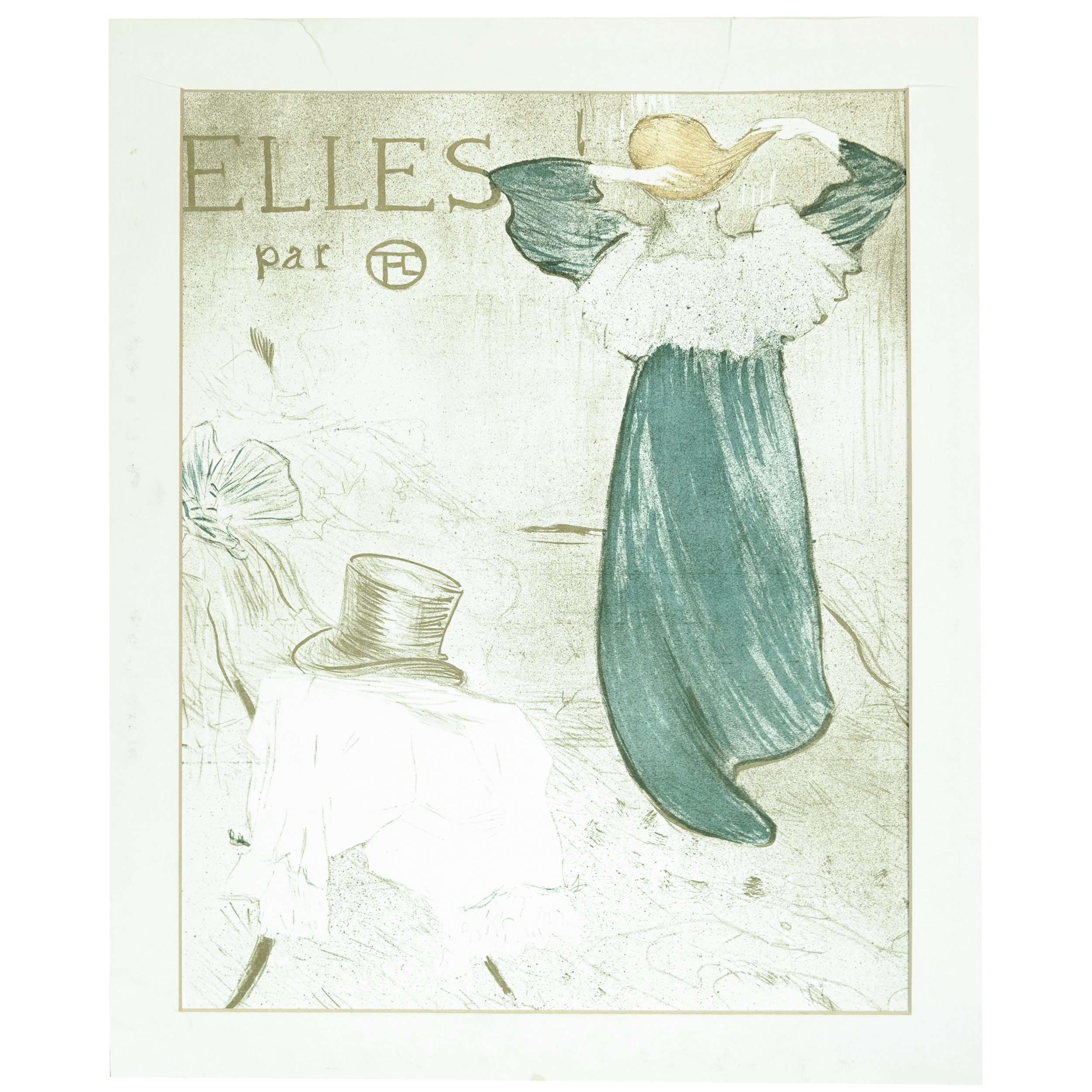
Henri de Toulouse-Lautrec (1864–1901)
Frontispiece for the series "Elles", 1896
Lithograph with pochoir coloring
Dimensions: 60 × 49 cm
This lithograph served as the frontispiece to Lautrec’s celebrated Elles series, published in 1896. The portfolio presents intimate scenes of Parisian prostitutes, focusing on their daily routines rather than their public personas. Here, a woman in a dressing gown adjusts her hair, her back turned to the viewer, embodying the quiet privacy and unposed dignity that define the series.
Lautrec’s refined lines and flat planes of color highlight his mastery of lithography, while the Elles suite reflects his sympathetic portrayal of marginalized women, offering a rare, humanizing perspective in 19th-century art.
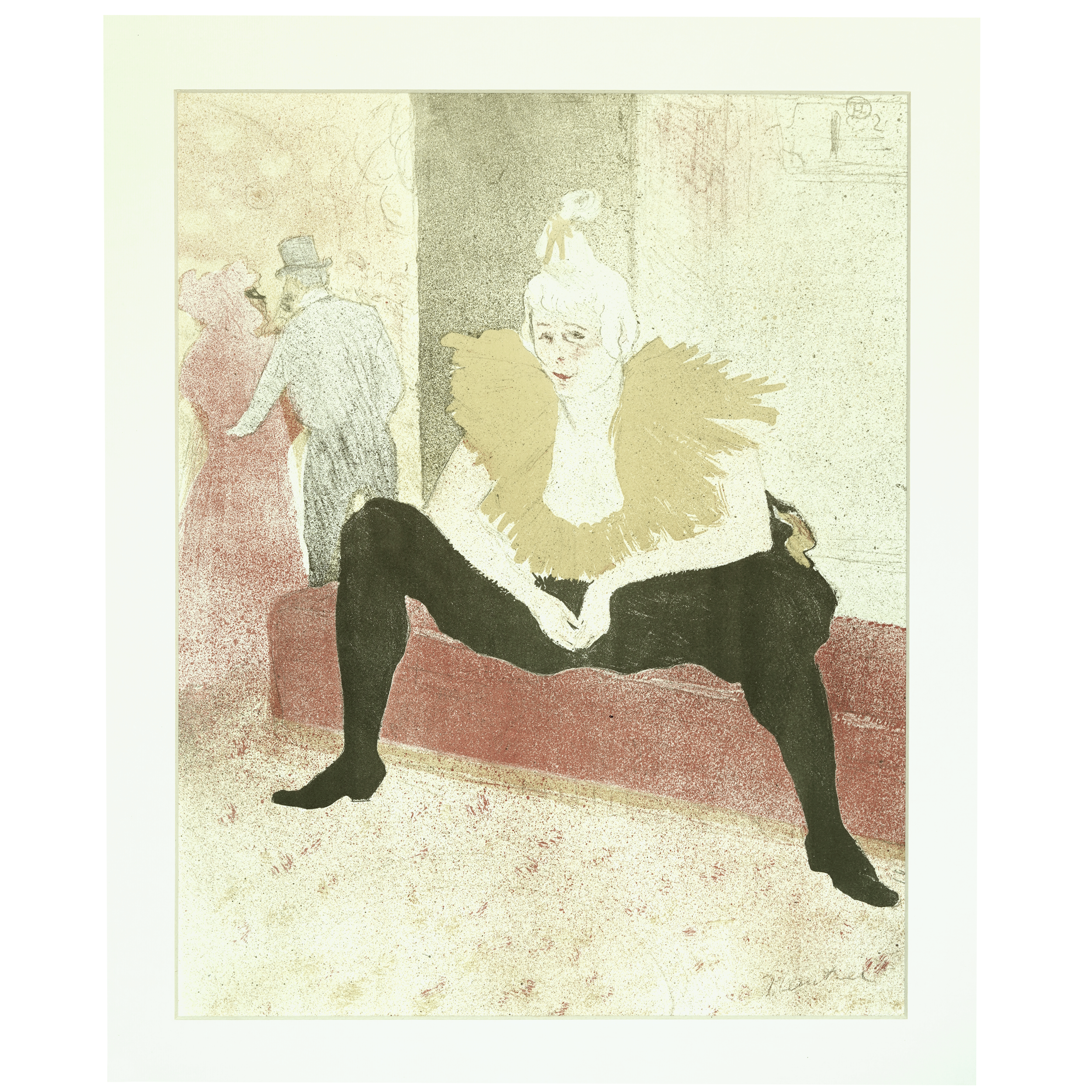
Henri de Toulouse-Lautrec (1864–1901)
Lithograph from the series "Elles", 1896
Dimensions: 60 × 49 cm
Lithograph belonging to Lautrec’s Elles series, created in 1896, which depicts the intimate and everyday lives of Parisian prostitutes. Unlike his famous cabaret posters, these works are quieter, offering tender and empathetic portrayals of women beyond the stage, shown in moments of rest, reflection, and vulnerability.
Executed with pochoir (stencil coloring), the print demonstrates Lautrec’s bold yet delicate use of line and flat color. Far from caricature, Elles captures humanity and dignity, reflecting Lautrec’s deep understanding of the social realities of Montmartre’s demi-monde.
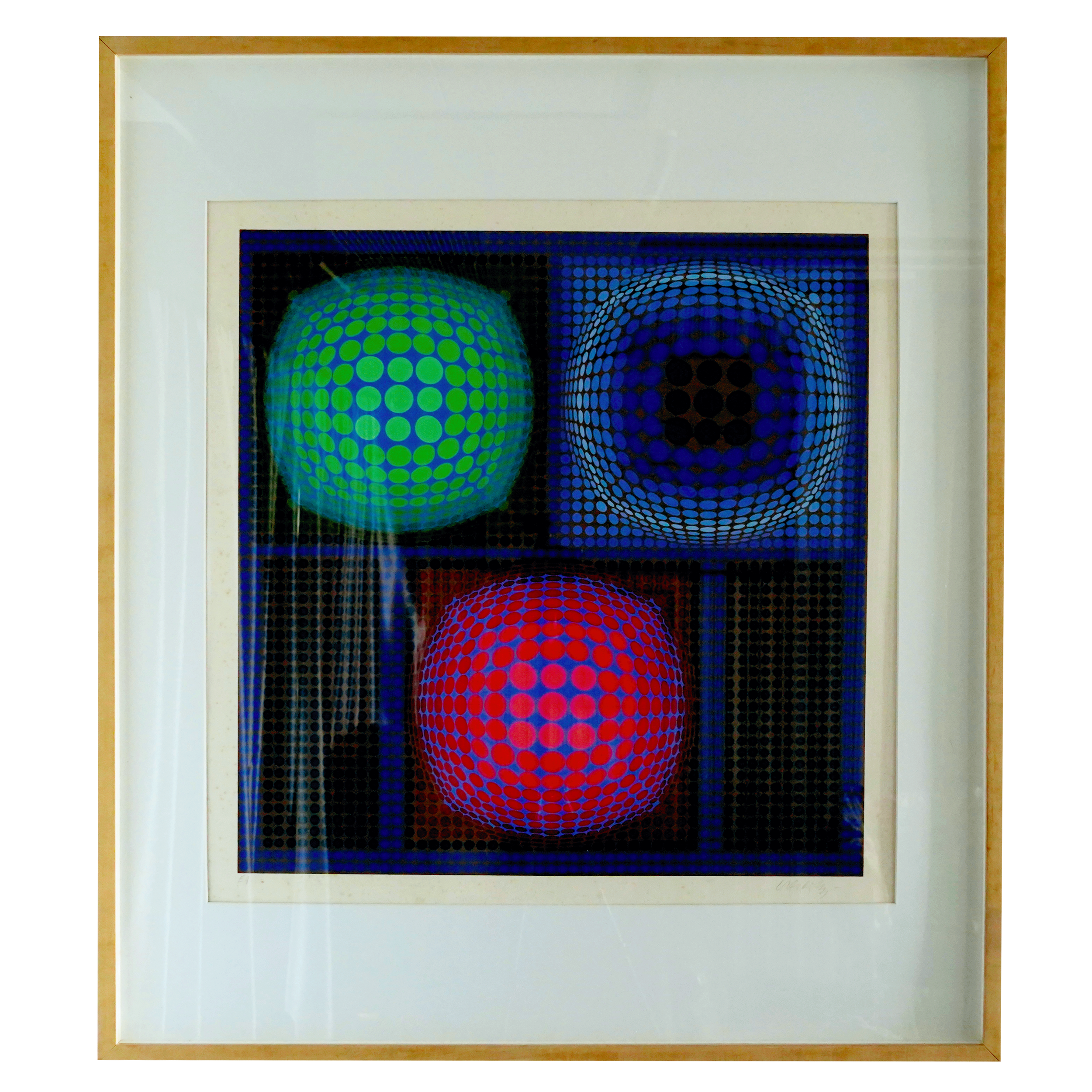
Victor Vasarely (1906–1997)
Untitled (Op Art Composition with Spheres)
Serigraph on paper
Dimensions: 112 × 90 cm
Victor Vasarely, widely regarded as the father of the Op Art movement, explored the optical possibilities of color, geometry, and perception. In this striking work, Vasarely constructs three spherical forms—rendered in vivid green, blue, and red—that appear to pulse and expand beyond the flat surface. Using systematic arrangements of dots and grids, the artist creates a dynamic illusion of three-dimensional depth, engaging the viewer’s eye in a constant play of movement.
This piece exemplifies Vasarely’s lifelong interest in science, mathematics, and visual psychology, reflecting his belief that art could be universal through its reliance on optical laws rather than cultural references. By destabilizing the viewer’s perception, the work transforms static form into kinetic experience, bridging art and technology in a way that defined the visual language of the 20th century.
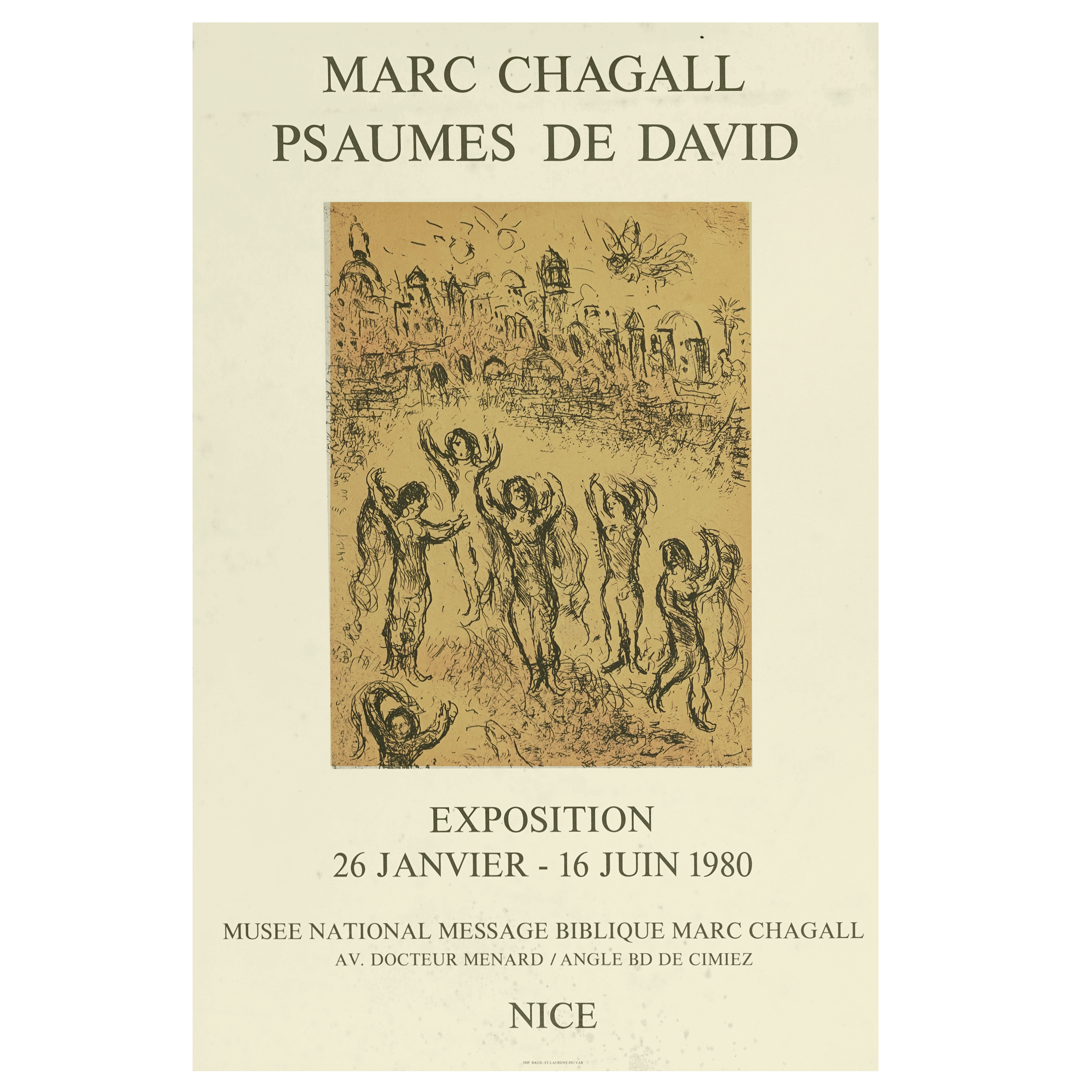
Marc Chagall (1887–1985)
Psaumes de David (Psalms of David)
Lithograph on paper
Exhibition poster, Musée National Message Biblique Marc Chagall, Nice, 1980
Dimensions: 69 × 43 cm
This lithograph, created for the exhibition Psaumes de David at the Musée National Message Biblique Marc Chagall in Nice, reflects the artist’s lifelong dialogue between biblical themes and his poetic, dreamlike visual language. Executed in his characteristic style of fluid lines and floating figures, the work illustrates a joyful dance of figures set against a symbolic cityscape, evoking both the biblical Jerusalem and Chagall’s own memory-laden imagination.
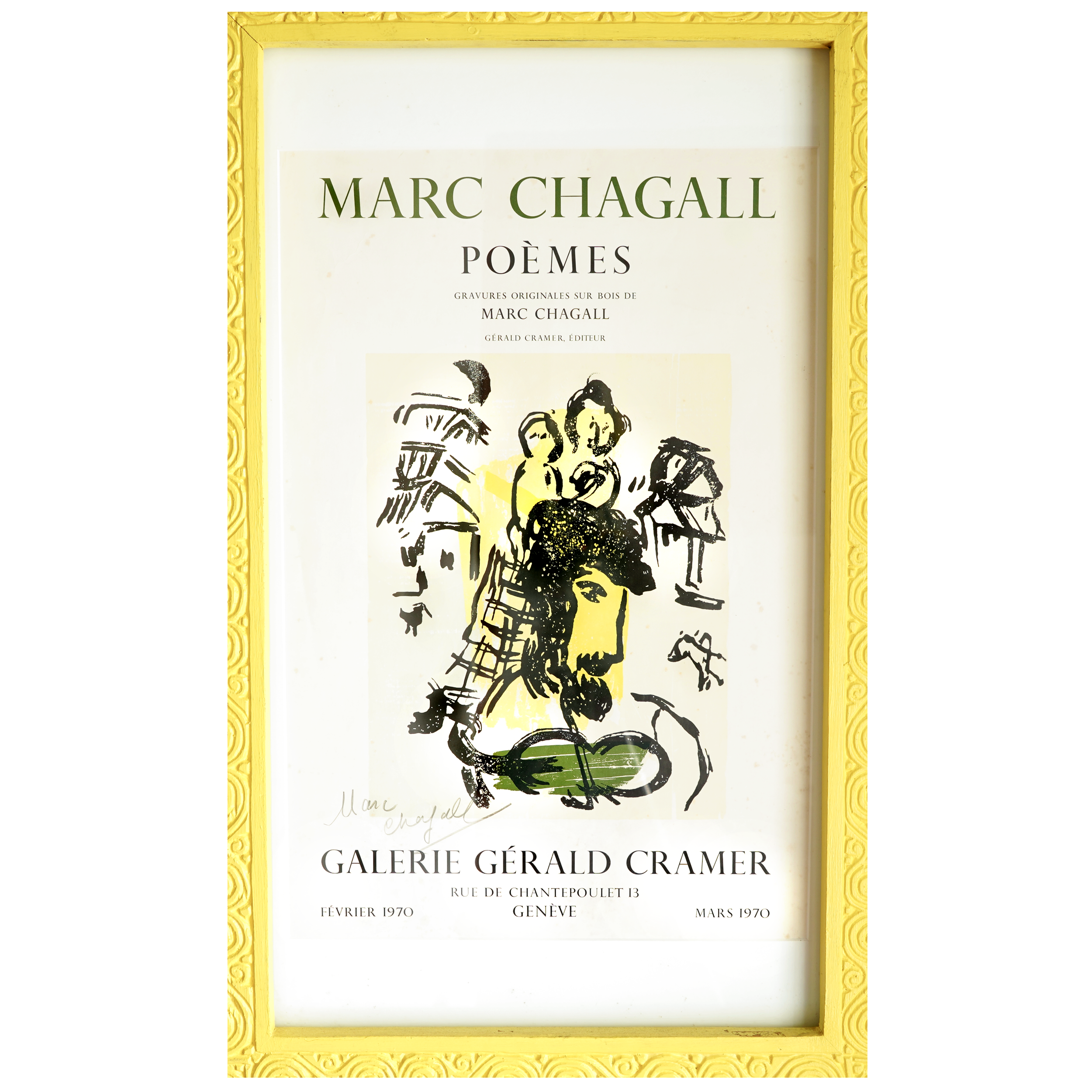
MARC CHAGALL Printed lithograph “Gallerie Gerard Cramer”. Signed by the artist bottom left
Title:Poèmes (Exhibition Poster)
Artist: Marc Chagall (Russian-French, 1887–1985)
Medium: Lithograph on paper
Dimensions: 57 × 38 cm
Publisher: Gérald Cramer, Geneva
Location: Galerie Gérald Cramer, Rue de Chantepoulet 13, Geneva
Description:
Lithographic poster created by Marc Chagall to accompany his 1970 exhibition Poèmes at Galerie Gérald Cramer in Geneva. The image features one of Chagall’s signature dreamlike compositions, combining human figures, animals, and abstract forms in a vibrant palette dominated by yellow, green, and black.
As both an artwork and promotional material, this piece reflects Chagall’s close collaboration with Swiss publisher Gérald Cramer, who championed his graphic works. The poster represents the artist’s ongoing exploration of visual storytelling and his capacity to merge poetry and painting into a unified, emotional language.
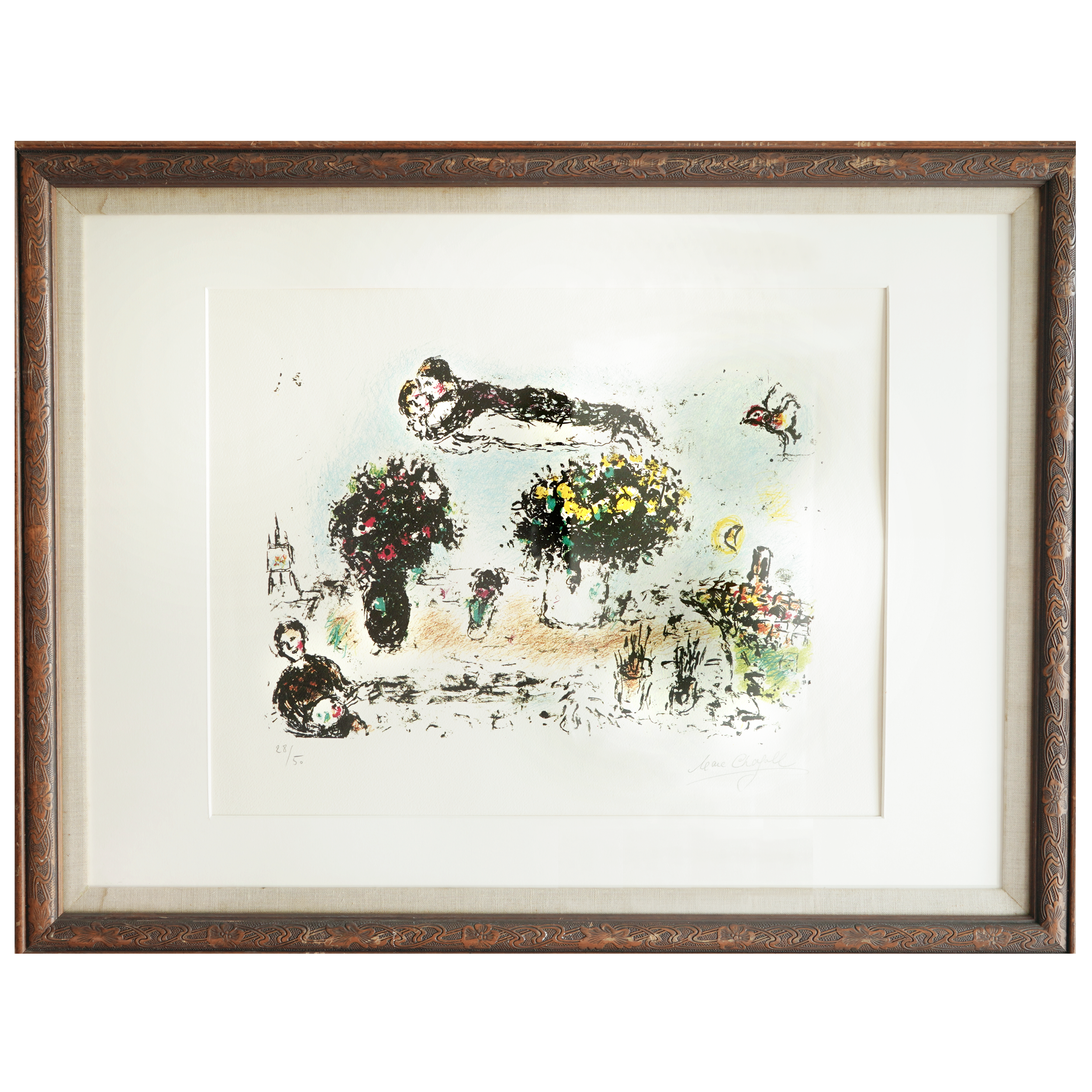
MARC CHAGALL Original Lithograph. Signed bottom right, limited edition
Edition: 28/50
Artist: Marc Chagall (Russian-French, 1887–1985)
Medium: Color lithograph on paper
Dimensions: 43 × 55 cm
Edition: Numbered 28/50
Signature: Hand-signed by the artist in pencil, lower right
Description:
Original lithograph by Marc Chagall capturing the artist’s dreamlike vision of love and memory. Floating lovers embrace mid-air above a blooming garden, while figures, trees, and village structures create a lyrical, pastoral landscape below.
Marc Chagall’s lithographs are celebrated for their poetic and mystical quality. This work exemplifies his recurring motifs of love and flight—symbols of spiritual transcendence and personal history. As with much of his graphic oeuvre, the composition is infused with warmth and whimsy, inviting viewers into a world where emotion shapes reality. Lithographs such as this one were printed in limited editions and hand-signed by the artist, underscoring their collectible value.
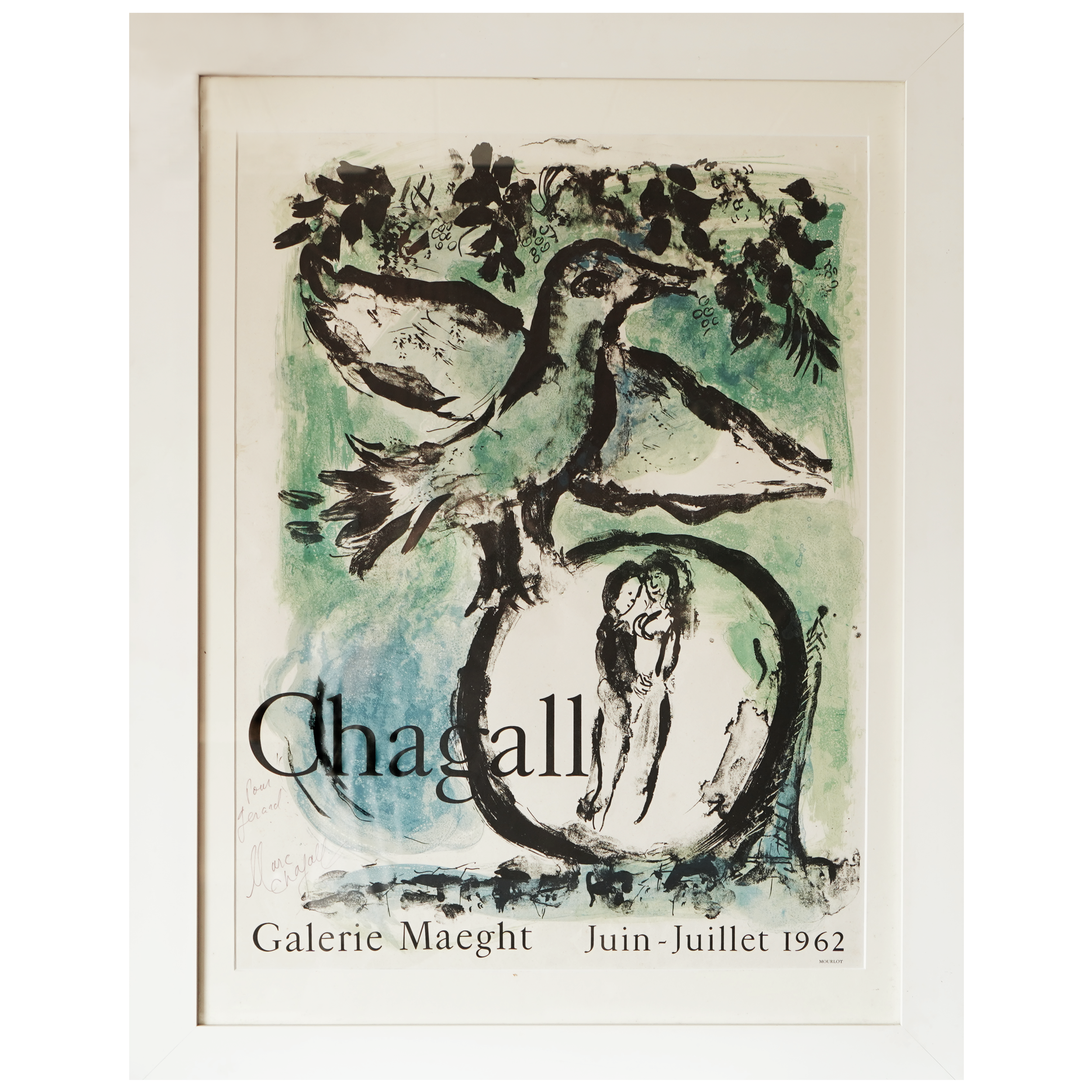
MARC CHAGALL Lithograph Print “Gallery Maeght”. Signed by the artist bottom left
Title:Chagall, Galerie Maeght Exhibition Poster
Artist: Marc Chagall (1887–1985)
Medium: Color lithograph on paper
Dimensions: [Not specified]
Printed by: Mourlot, Paris
Dimensions: 69 × 52 cm
Description:
Lithographic poster created by Marc Chagall to promote his exhibition at Galerie Maeght in Paris in June–July 1962. The image features a large bird with outstretched wings perched on a circular form enclosing a loving couple, rendered in Chagall’s dreamy, expressive style. Above, branches with leaves and berries enhance the composition.
Chagall often celebrated themes of love, memory, and peace through surreal imagery. This poster, combining a symbolic bird and embracing figures, reflects his lyrical approach to art and his lifelong connection to romance and nature. It was printed by the famed Mourlot studio, known for collaborating with major modern artists.
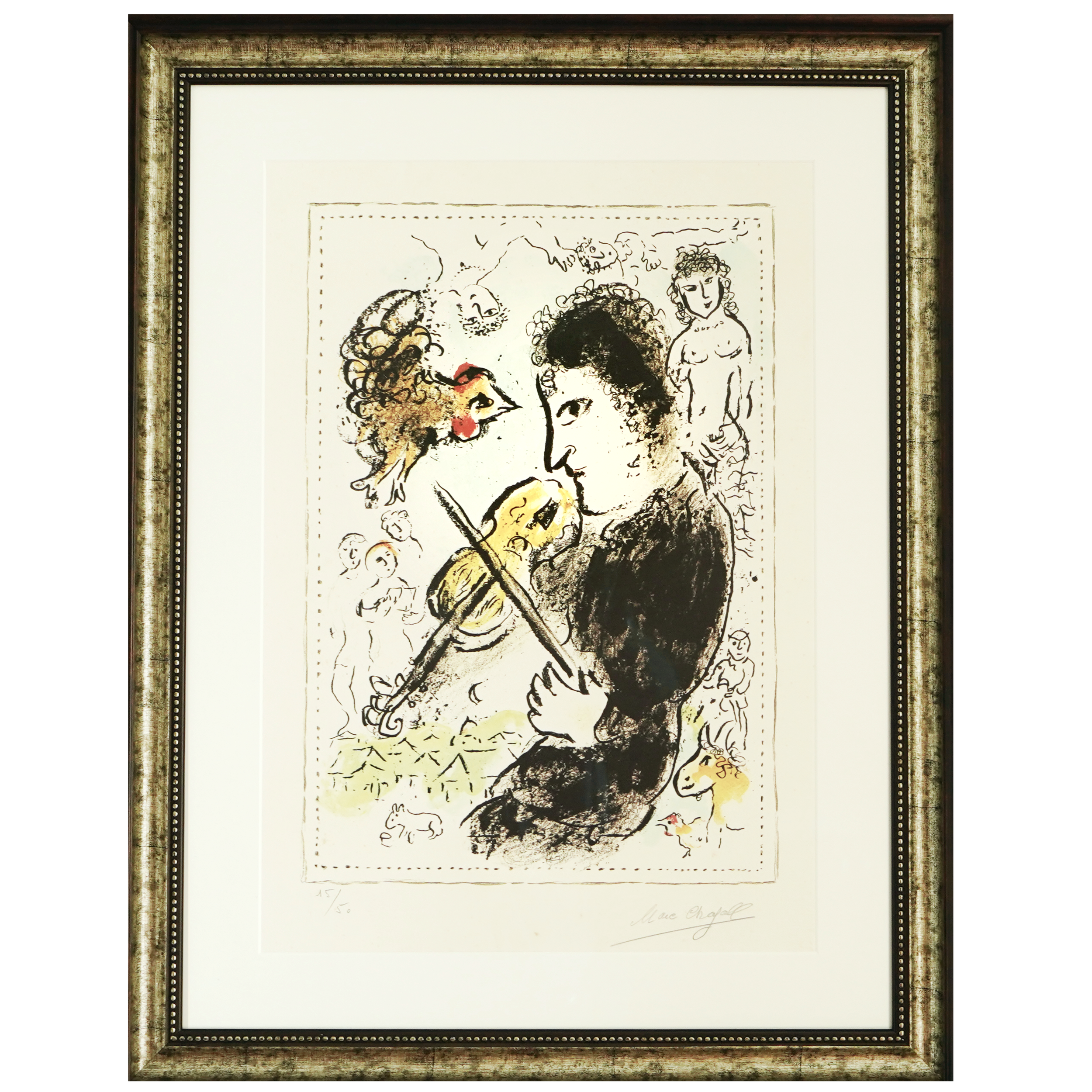
MARC CHAGALL Etching drawing. Signed bottom right, limited edition
Edition: 15/50
Title:Le Violoniste
Artist: Marc Chagall (1887–1985)
Date: Mid-20th century
Medium: Color lithograph on paper
Dimensions: 56 × 40 cm
Description:
Lithograph by Marc Chagall showing a man playing a violin, surrounded by dreamlike figures including a rooster, a nude woman, and a dog. The background includes a village scene and floating heads, all drawn in Chagall’s distinctive style.
Chagall often used the figure of the violinist to reflect his Jewish heritage and memories of his childhood in Russia. The warm colors and flowing lines create a sense of emotion and nostalgia.
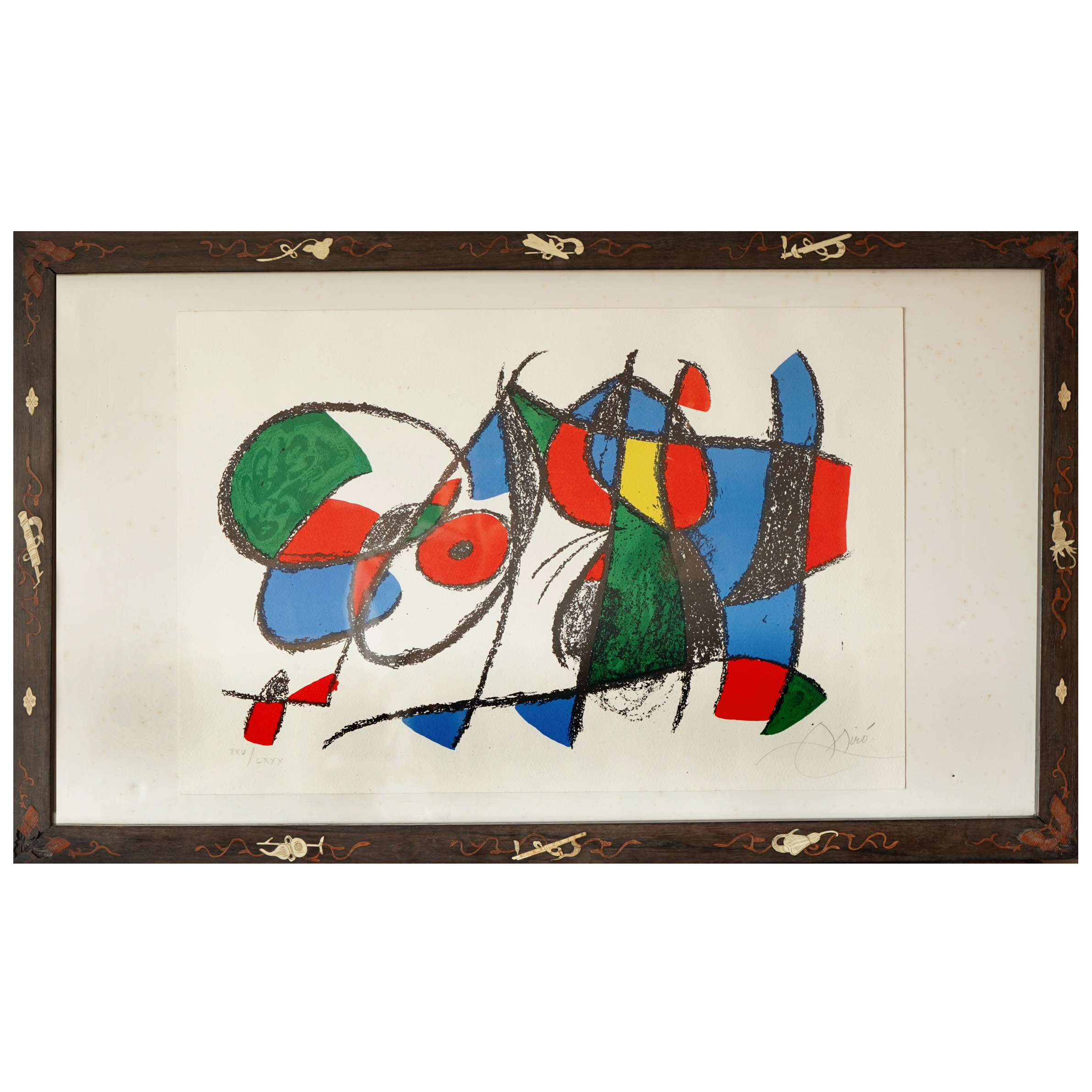
JOAN MIRO Lithographe Original. Signed bottom right
XXV / LXXX
Year: 1979
Title:Untitled (Abstract Composition)
Artist: Joan Miró (Spanish, 1893–1983)
Medium: Color lithograph on paper
Signature: Hand-signed "Miró" (lower right)
Dimensions: 36 × 55 cm
Description:
Lithograph by Joan Miró showing the artist’s mastery of color and abstract form. Composed of energetic black lines intertwined with vibrant zones of red, blue, green, and yellow, the piece captures the rhythmic dynamism that defines much of Miró’s later work. The playful, looping forms and whimsical geometry evoke a sense of freedom and imagination, hallmarks of his unique visual language..
This lithograph belongs to a series of works that reflect Miró’s enduring interest in the subconscious and the symbolic. His bold, modernist vocabulary — characterized by floating biomorphic shapes and surreal gestures — had a profound influence on 20th-century abstraction.
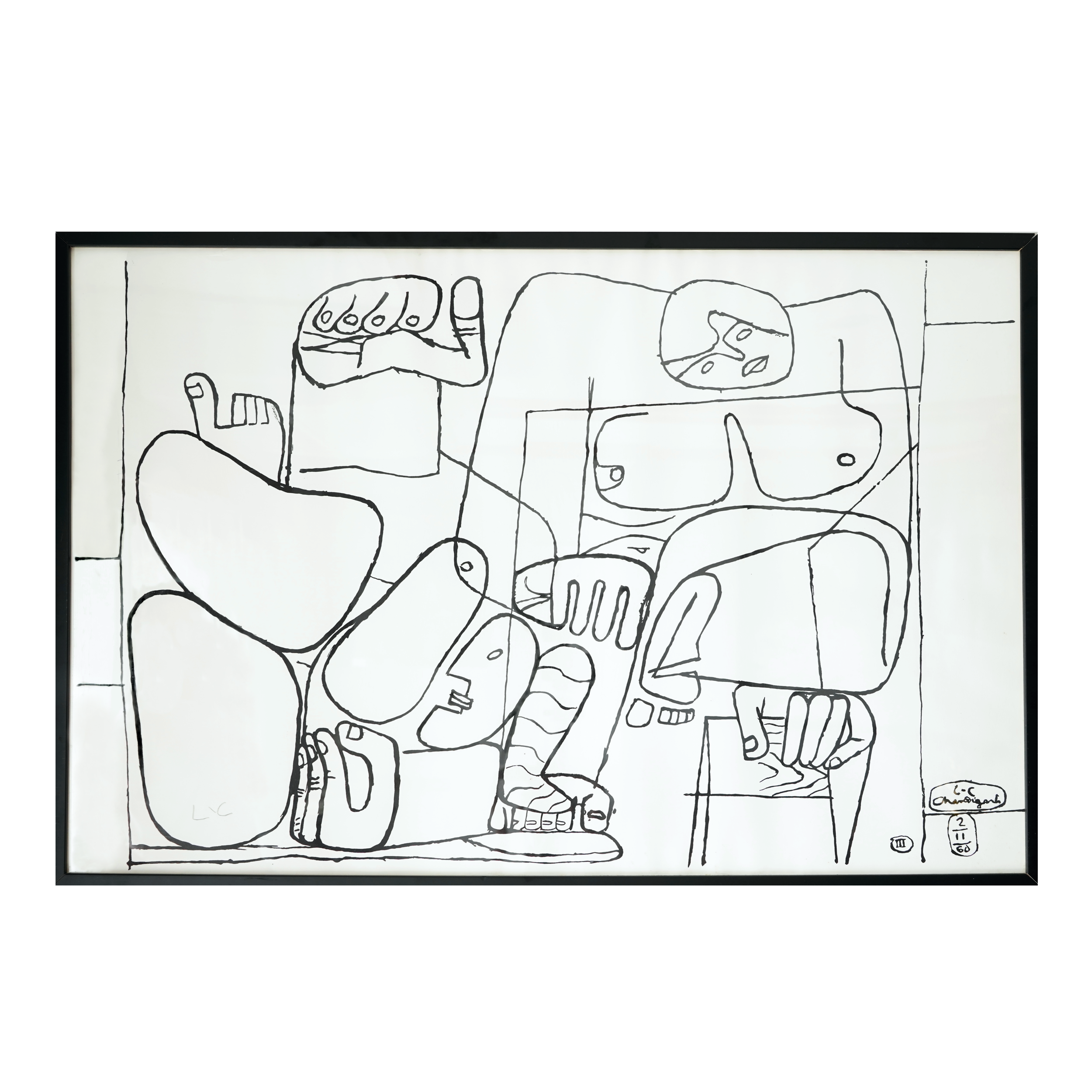
Original drawing by LE CORBUSIER depicting The Fall of Barcelona. Drawing in black ink , dated and signed at the bottom right 2.11.60 III
Year: 1960
Title:the fall of Barcelona
Artist: Le Corbusier (Charles-Édouard Jeanneret, 1887–1965)
Medium: Ink on paper
Dimensions: 70 × 100 cm
Description:
Drawing by Le Corbusier exploring the human form through an architectural lens. Using bold, continuous lines and abstracted shapes, he intertwines limbs, torsos, and faces into a unified, almost mechanical composition. Despite the flatness of the medium, the figures exude rhythm and movement, forming a visual architecture of the body.
Best known for his revolutionary contributions to modern architecture, Le Corbusier was also a prolific visual artist. His drawings reflect the same principles found in his buildings: harmony, order, and a fascination with the human figure as both organic and constructed form. This piece captures his unique synthesis of art and architecture.
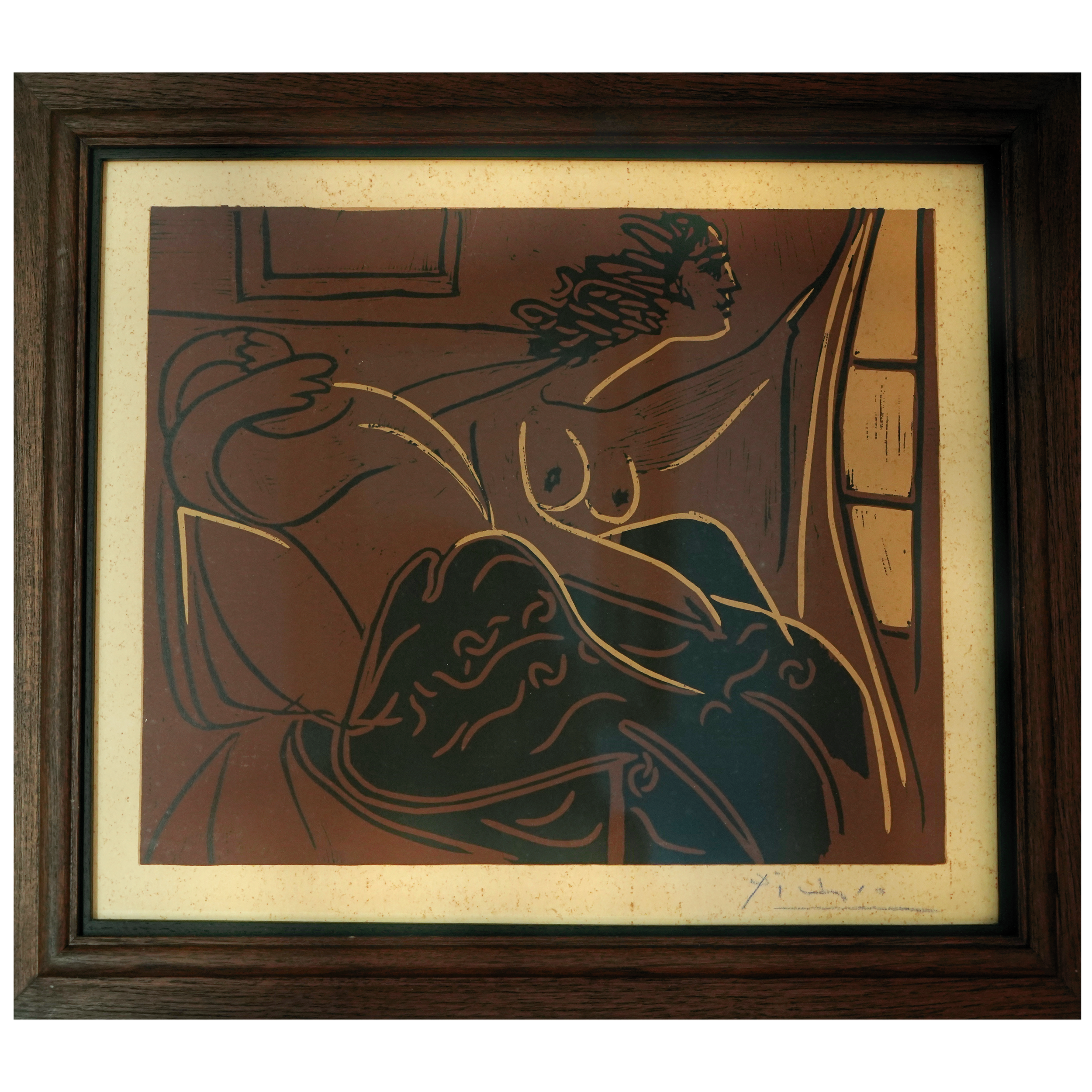
PICASSO Linocut depicting a young woman looking out the window, signed at the bottom right
Year: 1962
Title:Femme à la fenêtre (Woman at the Window)
Artist: Pablo Picasso (Spanish, 1881–1973)
Medium: Linocut on paper
Dimensions: 27 × 32 cm
Signature: Signed in pencil lower right
Description:
In Femme à la fenêtre, Pablo Picasso harnesses the expressive potential of linocut to depict a woman poised in a moment of sensual reflection. The figure, nude and dramatically outlined in bold, sinuous contours, reclines across a richly patterned surface while reaching toward an unseen view beyond the window.
Created during Picasso’s prolific final decades, Femme à la fenêtre exemplifies his mastery of the linocut technique—a medium he embraced for its directness and sculptural immediacy. This work reflects both his classical influences and his radical innovations in form, line, and gesture. It is a testament to Picasso’s ability to reinvent figuratio
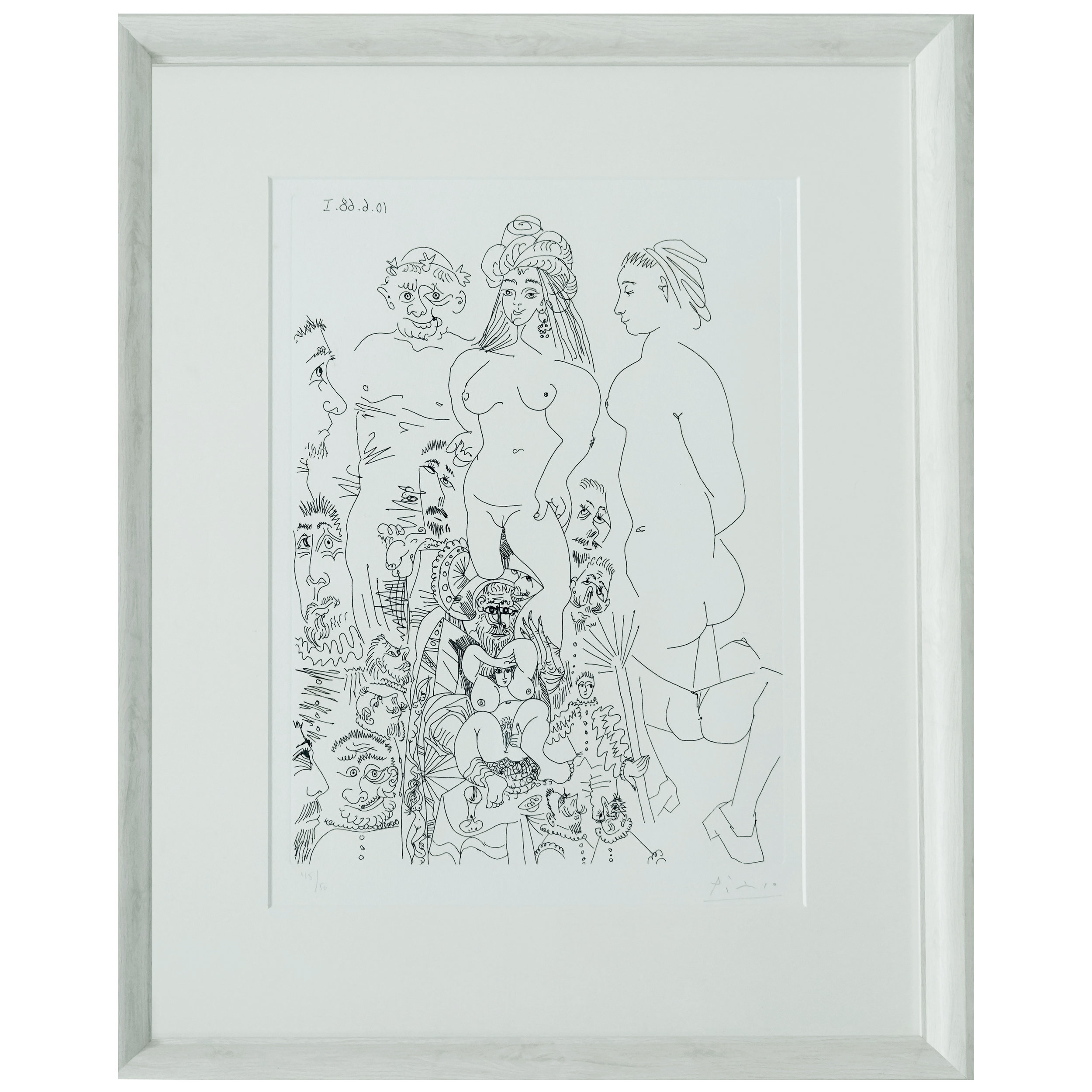
Etching by Picasso depicting the Characters from El Entierro del Conde de Orgaz dated and signed
Edition: 45/50
Artist: Pablo Picasso (1881–1973)
Medium: Etching on paper
Dimensions: 40 × 29 cm
Description:
Etching by Pablo Picasso showcasing a dense and playful mythological composition, filled with nude figures, stylized faces, and fantastical beings. Rendered in fluid, assured lines, the work captures Picasso’s fascination with classical themes, eroticism, and the grotesque, all distilled into a single theatrical tableau.
Picasso’s graphic works often allowed for greater freedom and experimentation than his paintings. This etching, with its layered forms and crowded composition, echoes the bacchanalian energy of ancient myths while embracing the spontaneity of surrealism.
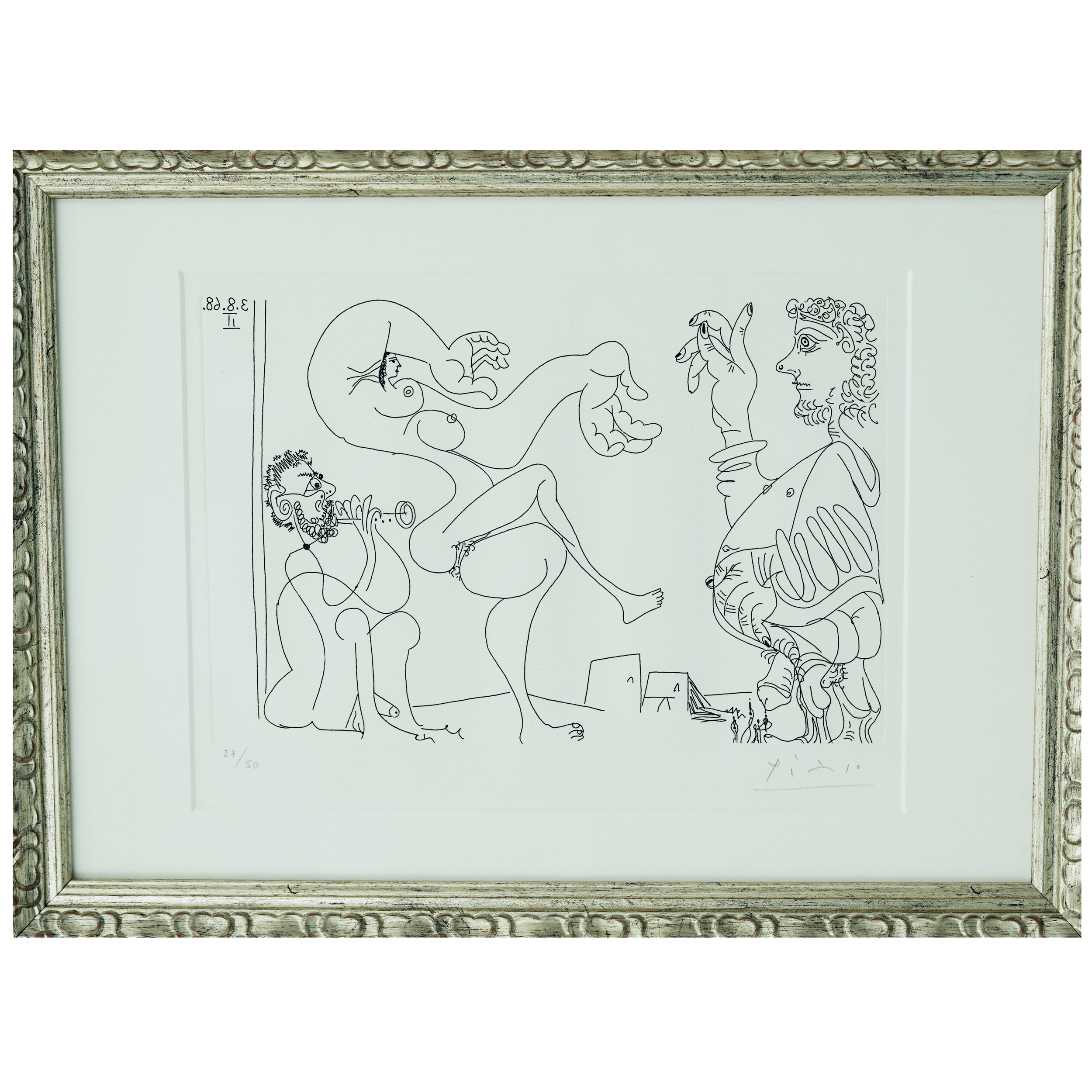
An Etching drawing by Picasso representing a belly dancer, flute player and exposed man with painted fingernails signed and dated
Edition: 15/50
Dimensions: 20 × 26 cm
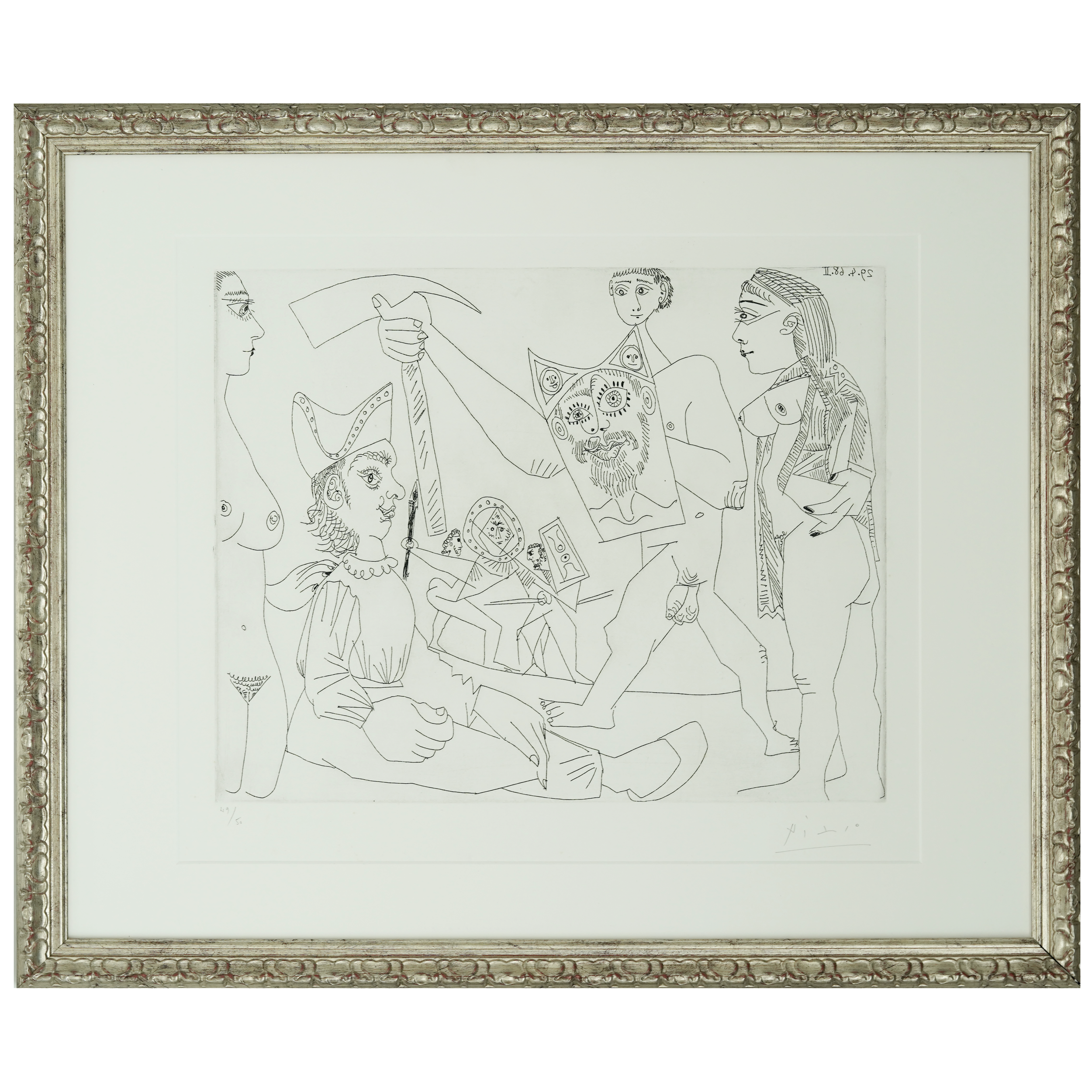
Picasso etching representing some gladiators, nudes and seated figure in two cornered hat, signed and dated with pencil 4/29/1968 II
Edition: 49/50

Alberto Giacometti (1901–1966)
Figure Studies
Ink and wash on paper
Drawing exemplifying Alberto Giacometti’s relentless search for the essence of human presence. Combining studies of heads with elongated standing nudes, the composition reveals his characteristic linear draftsmanship—nervous, repetitive strokes that seem to etch the figure into existence. The attenuated bodies anticipate the sculptural forms for which Giacometti is most celebrated, evoking both fragility and permanence. The ink wash adds tonal depth, situating the figures in a spatial field while underscoring their spectral, almost immaterial quality.