

ORIGINAL WORKS
Original Works by Artists
This section is dedicated to original creations by artists, each piece a unique expression of their vision, technique, and creativity. These works represent the authenticity and individuality of the artists behind them, offering collectors and viewers a direct connection to contemporary artistic practice
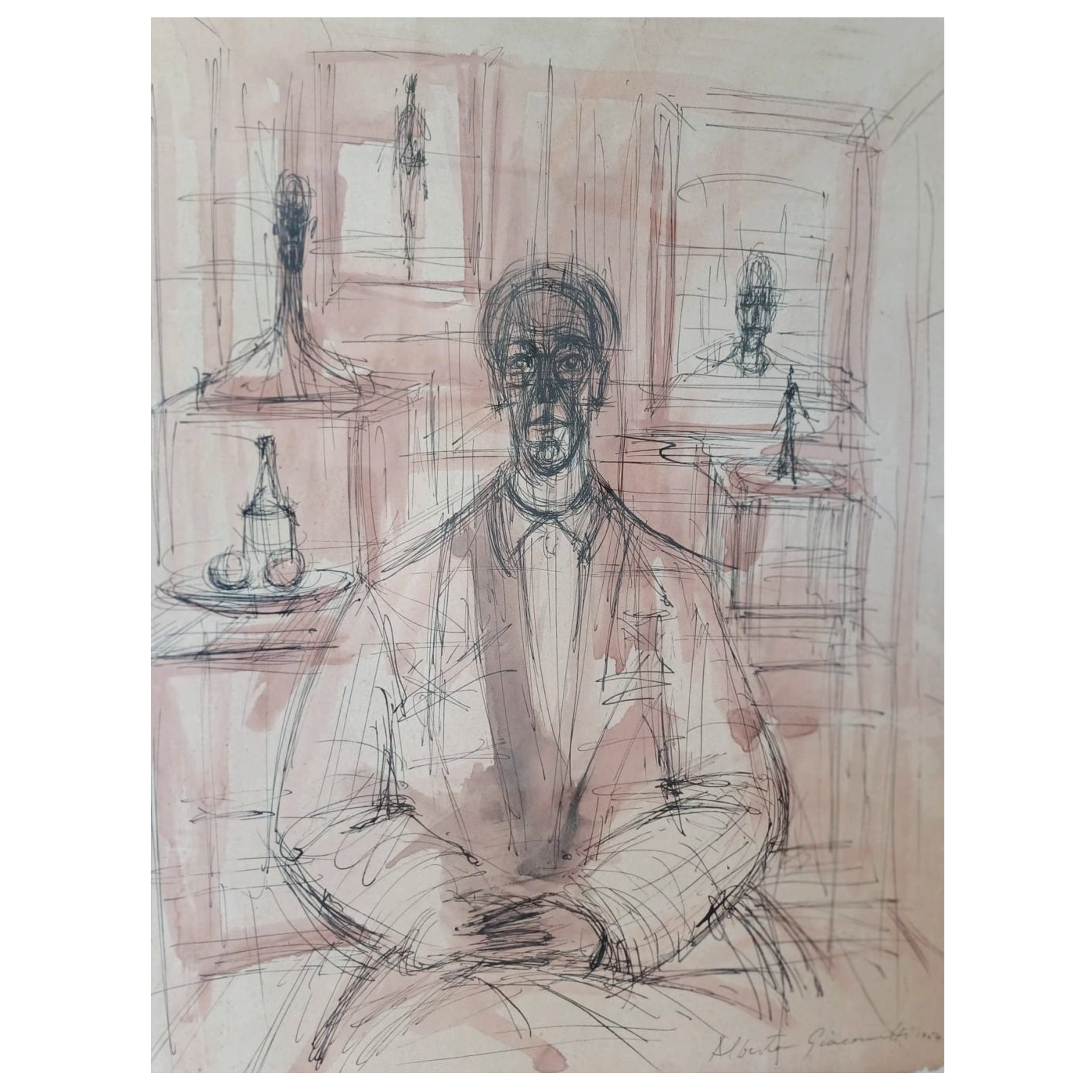
Alberto Giacometti (1901–1966)
Seated Man in Interior
Ink and wash on paper, c. 1950s
Drawing by Alberto Giacometti exemplifying his distinctive draftsmanship, where restless lines and overlapping contours convey both form and psychological presence. The central figure, seated in a frontal pose, is defined through dense linear crosshatching and layered washes of muted tones. Surrounding him, Giacometti sketches elements of a studio interior: sculptures, paintings, and still-life objects that echo the artist’s lifelong exploration of the human figure and its relation to space.

Artist: Alberto Giacometti (Swiss, 1901–1966)
Medium: Lithograph on paper
Edition: Numbered lower left 47/100
Signature: Printed signature of the artist lower right, Alberto Giacometti
Dimensions: 47 × 31 cm
Description:
Lithograph reproducing a seated male figure in Alberto Giacometti’s distinctive, searching line. The subject, rendered with sparse yet deliberate marks, sits in a relaxed but introspective pose, arms loosely resting on his knees. Giacometti’s trademark web of overlapping lines conveys both the structure of the body and the artist’s intense process of observation, imbuing the image with an almost vibrating presence.
The composition leaves the background bare, allowing the figure to emerge in isolation. The head and upper body are drawn with heightened focus, evoking a psychological depth that is characteristic of Giacometti’s portrait work.
Artistic Context:
Giacometti’s lithographs, often based on his original drawings, preserve the immediacy and spontaneity of his hand while making his vision accessible to a wider audience. They reflect his enduring fascination with the human figure as an existential presence, existing between physical form and fleeting perception.
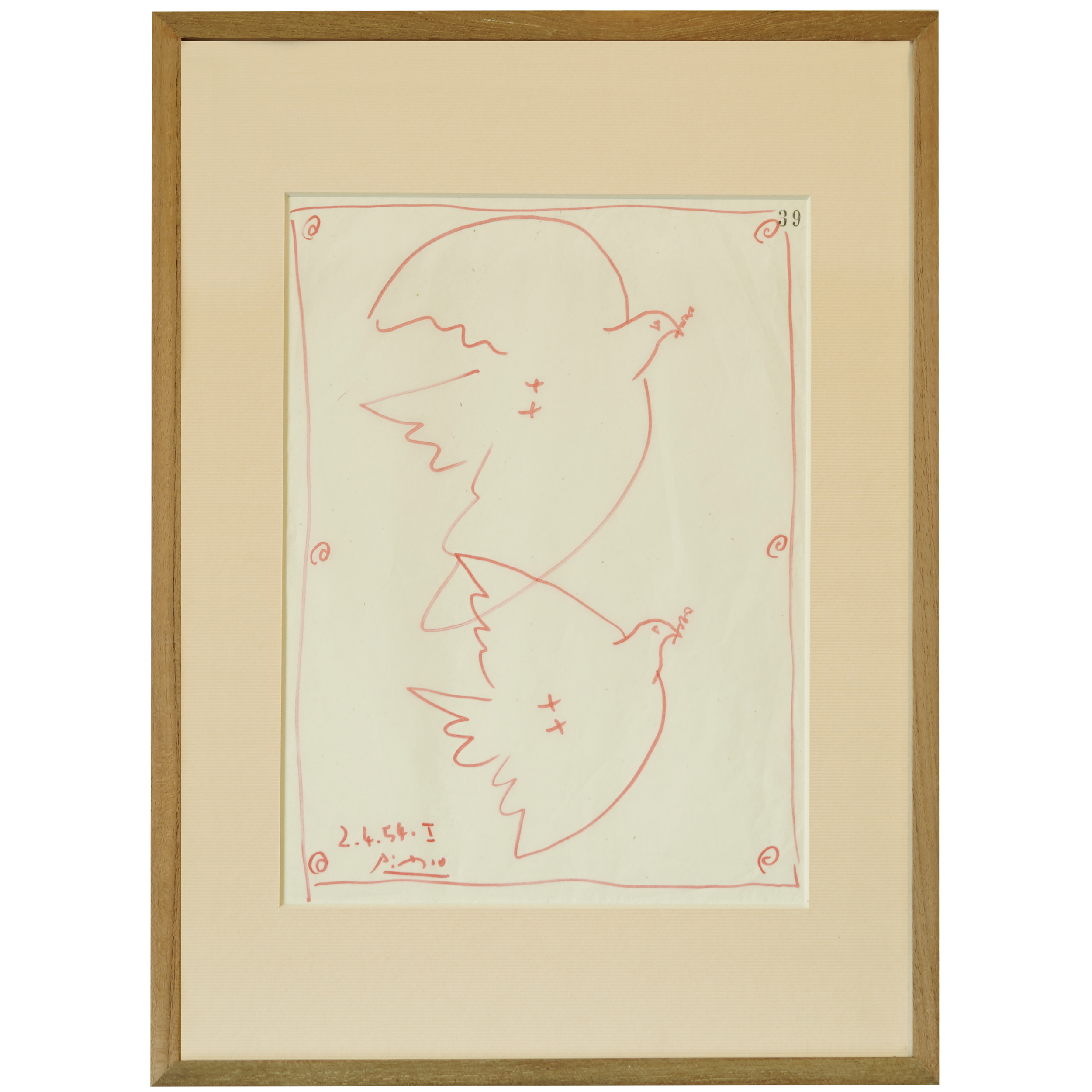
Original PICASSO two doves of peace, in flight, a sprig of olive in the beak. Dated and signed bottom left 2.4.54 I
Year: 1954
Dimensions: 27 × 20 cm
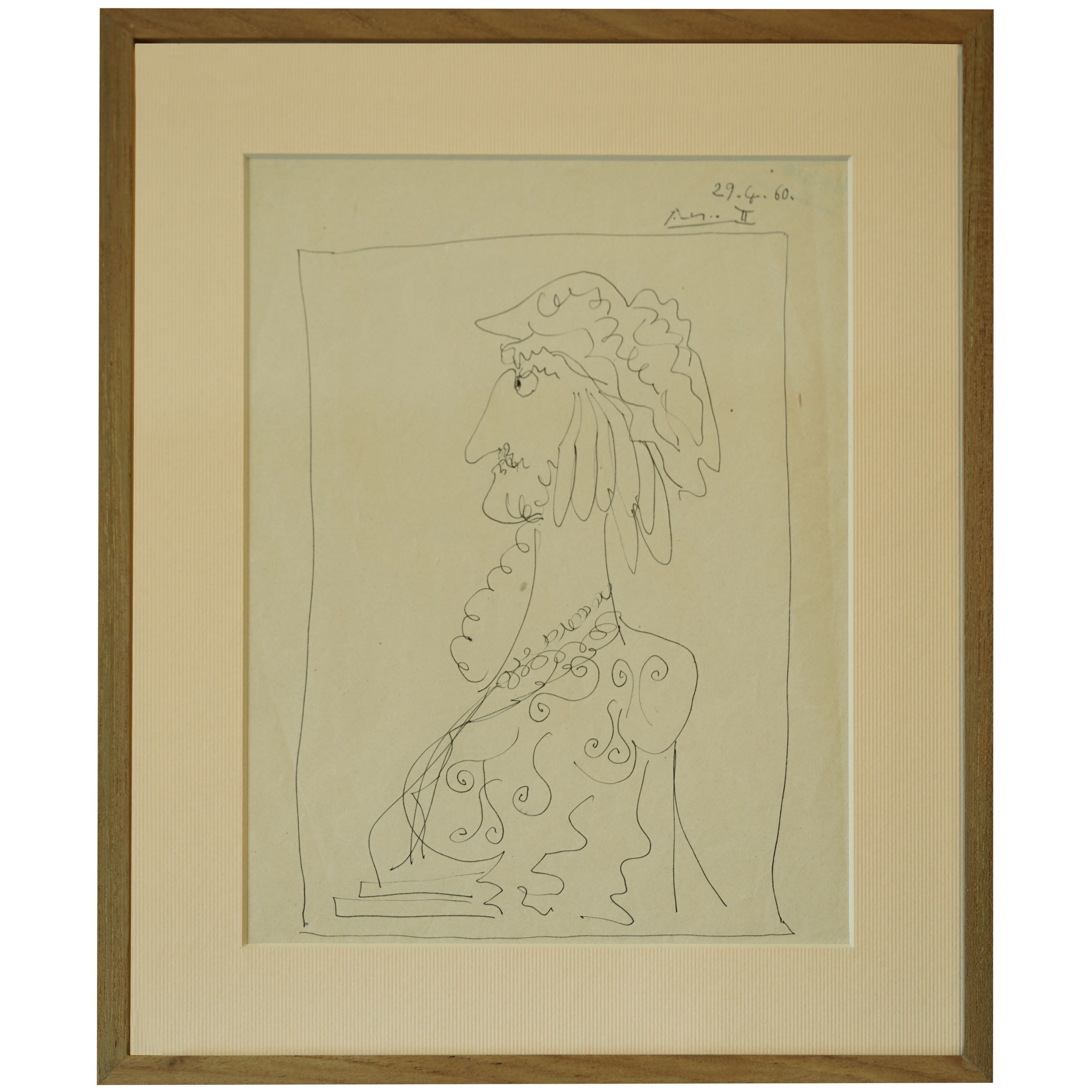
Bust profile of a burlesque character, wearing a headpiece, looking to the left, outlined by a rectangular ink stroke. Dated and signed top right 29.4.60 II
Year: 1960
Dimensions: 26 × 20 cm
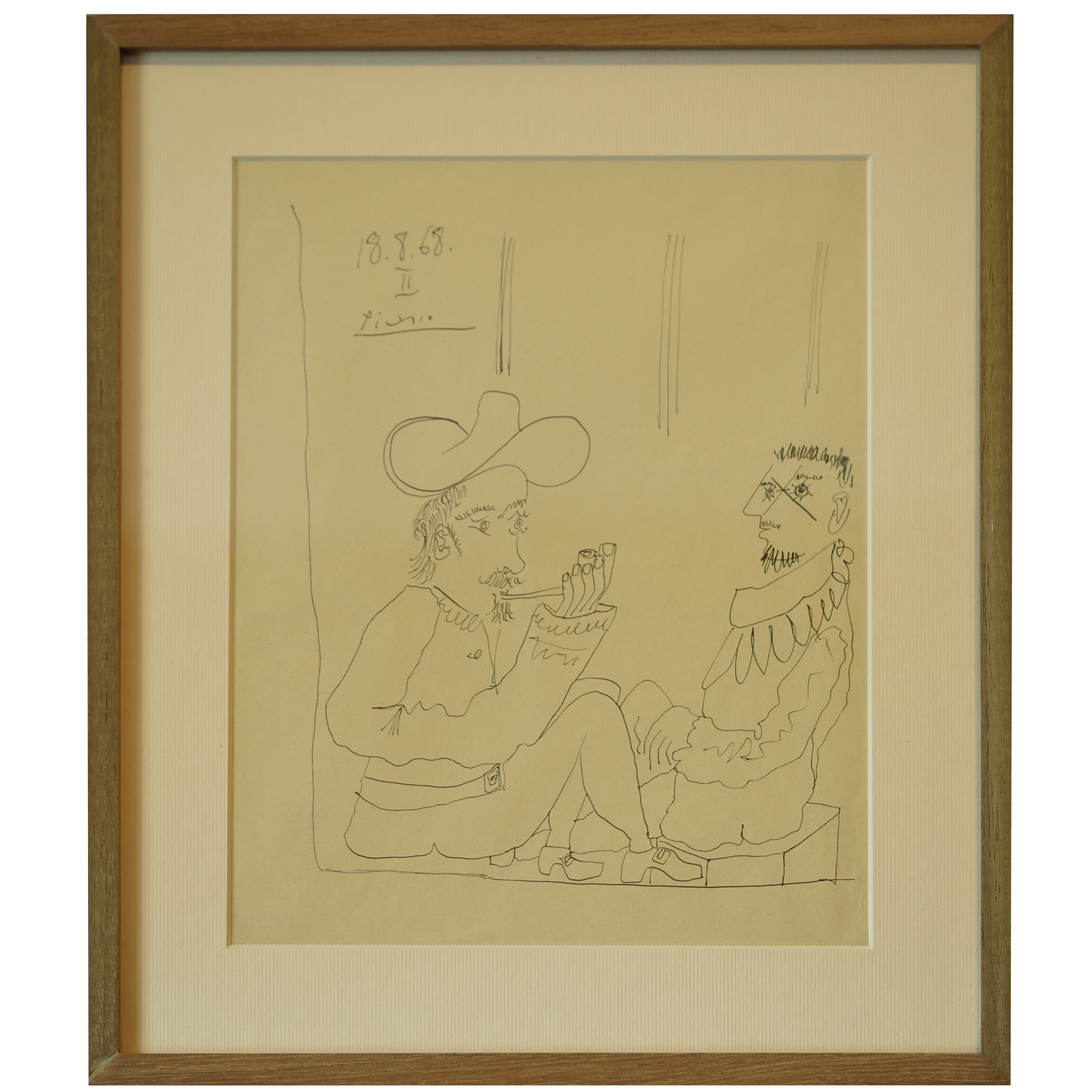
A hatted pipe smoker sits facing a figure with an X-shaped face and a jabot, set before a row of columns. Dated and signed top left 18.8.68 II
Year: 1968
Dimensions: 26 × 20 cm

Original Picasso horned bull’s head carried by two running legs. Dated and signed top left 1.2.54 XV
Year: 1954
Dimensions: 16 × 22 cm

Original Picasso, Galerie Louise Leiris, 8th arrondissement, surmounting a lively scene of a picador on his mount, flanked by two toreadors signed bottom left
Year:
Dimensions: 20 × 20 cm
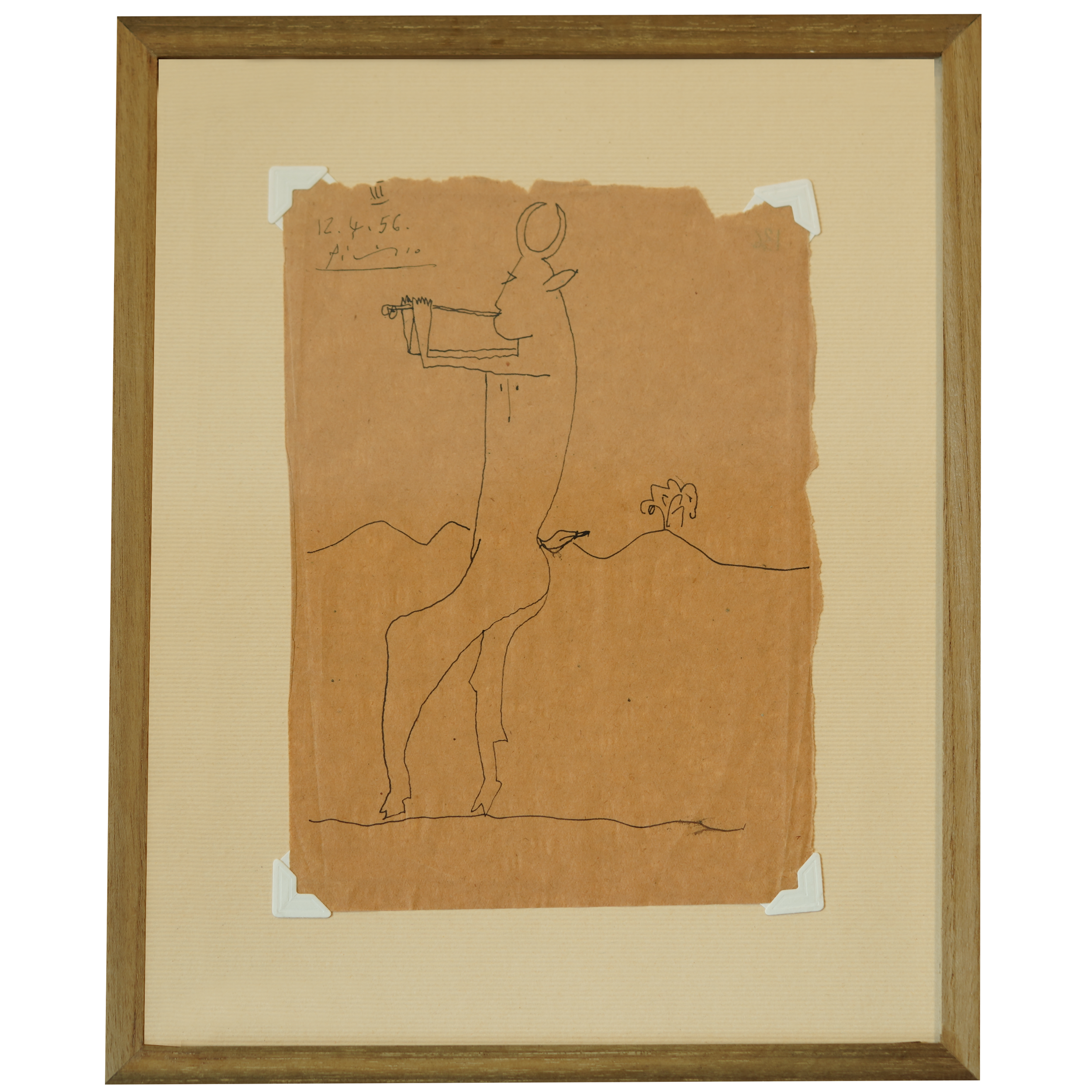
Horned faun standing, playing the flute in front of a tree-lined ridge dated and signed bottom right 12.4.56 III
Year: 1956
Dimensions: 19 × 14 cm
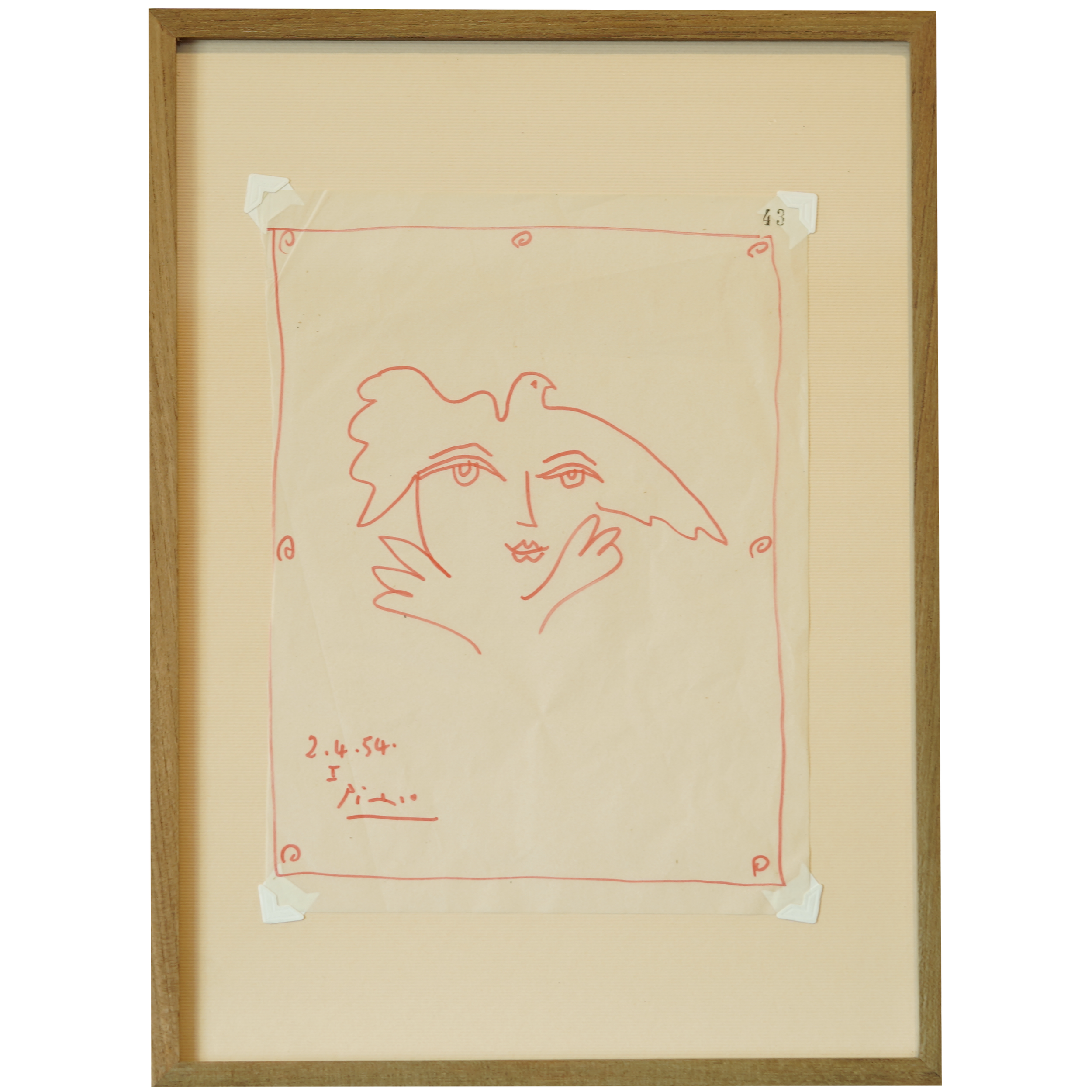
Feminine face adorned with a dove with outstretched wings, supported by two open hands dated and signed bottom left 2.4.54 I
Year: 1954
Dimensions: 27 × 20 cm

Artist: Sol LeWitt (American, 1928–2007)
Medium: Painted wood panel with triangular cutout
Dimensions: 37 × 37 cm
Collection: Private Collection
Description:
Artwork by Sol LeWitt featuring a sharply incised triangular form cut through a black-painted panel, revealing layered strata of red and underlying hues. The geometric intervention disrupts the otherwise solid surface, emphasizing LeWitt's conceptual interest in structure, process, and visual logic.
LeWitt was a leading figure of Minimalism and Conceptual Art. This work reflects his exploration of simple forms and systems, where the act of cutting or modifying the surface becomes part of the aesthetic language. The triangle — precise yet raw — invites viewers to consider the materiality of the object and the ideas behind its construction.
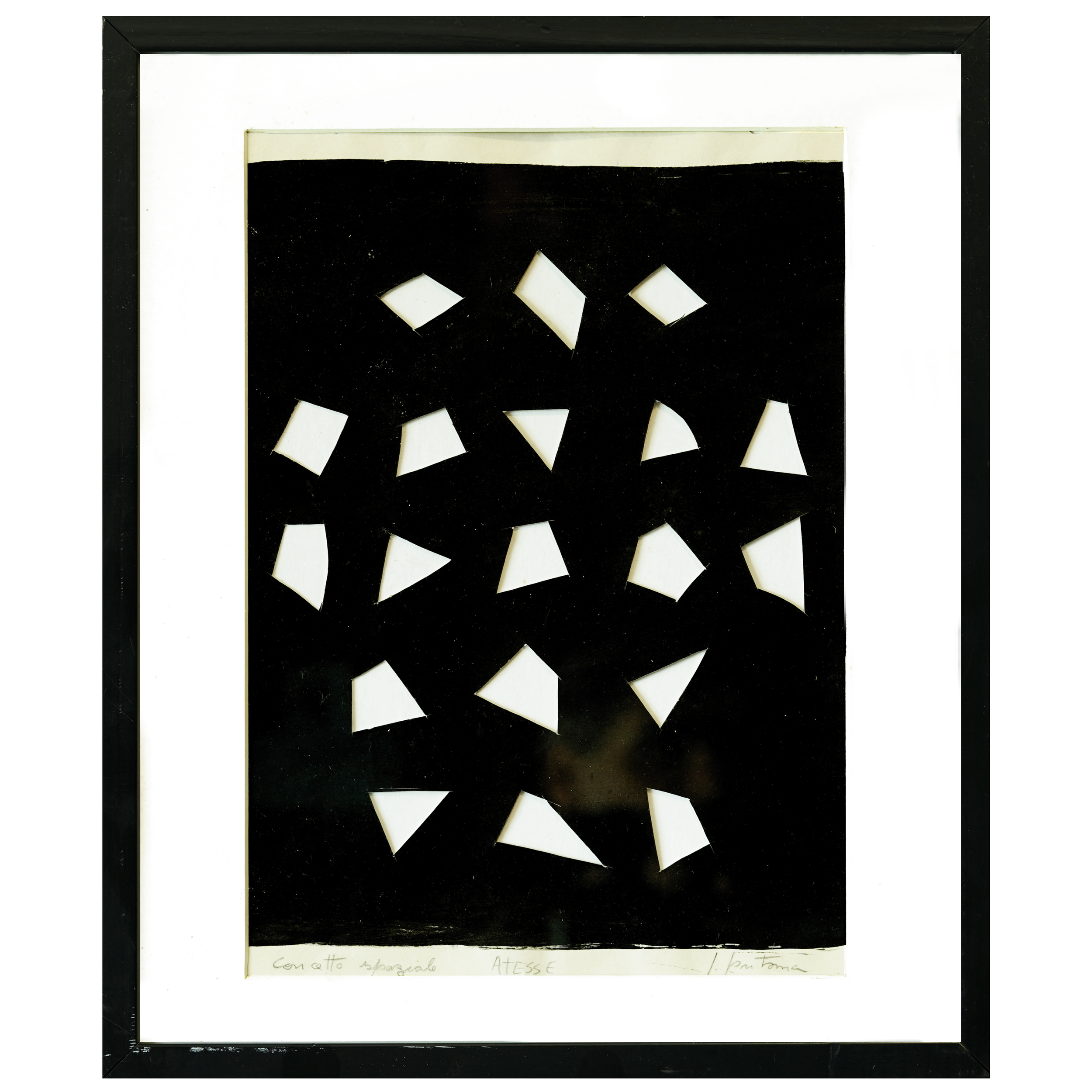
LUCIO FONTANA - Original “Concetto Spaziale”. Dated and signed at the bottom
Artist: Lucio Fontana (1899–1968)
Date: c. 1960s
Medium: Cut paper with black ink
Dimensions: 30 × 21 cm
Collection: Private Collection
Description:
Artwork part of Lucio Fontana’s Concetto Spaziale, Attese series. The piece features a black surface with a grid of precise cuts through the paper. The white background visible through the cuts creates a contrast that emphasizes space and depth.
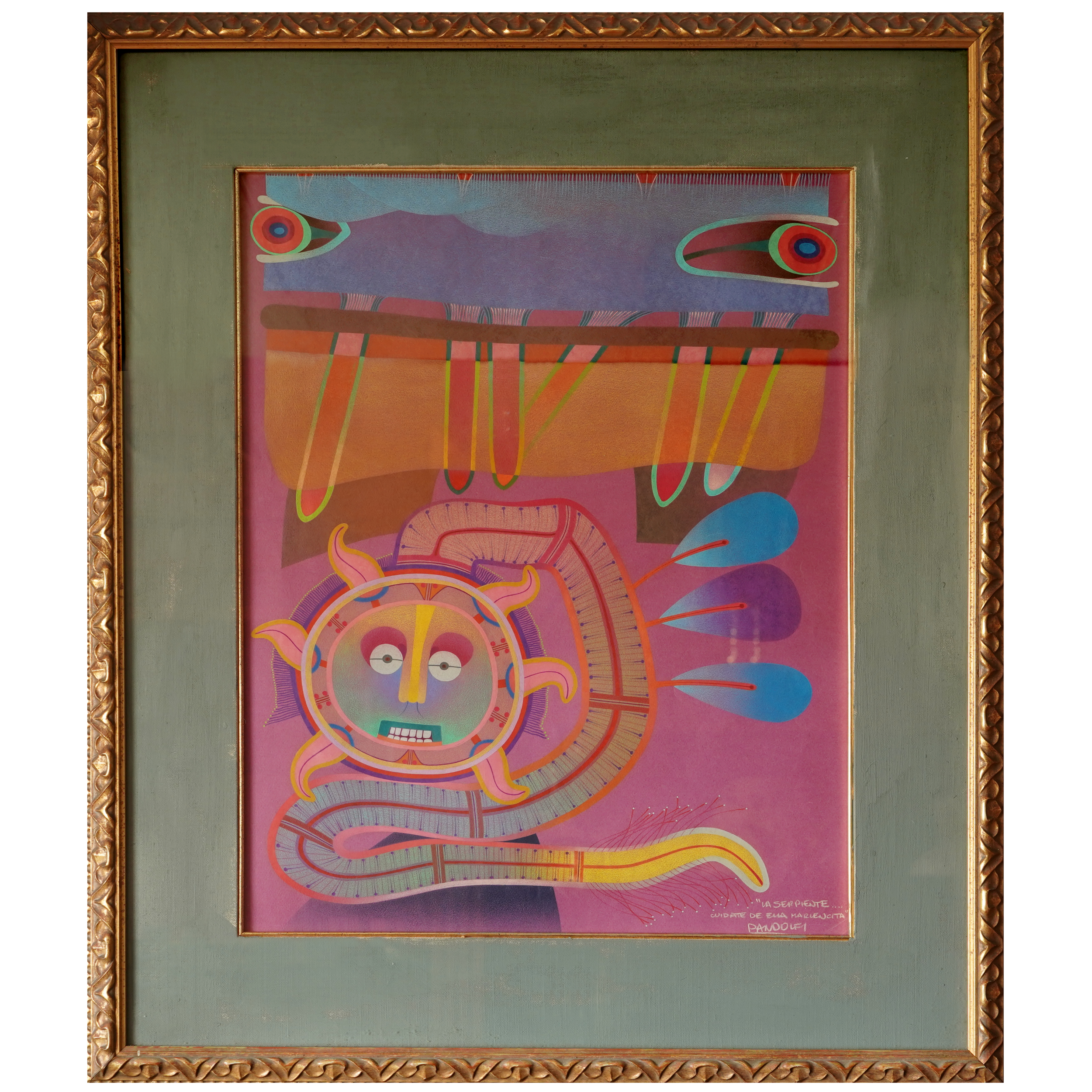
ROBERTO PANDOLFI. ORIGINAL DRAWING. Signed bottom right
Artist: Roberto Pandolfi (Argentine, 20th–21st century)
Medium: Ink and colored pencil (or pastel) on paper
Dimensions: 60 × 47 cm
Description:
Original drawing by Roberto Pandolfi depicting a fantastical figure composed of serpentine and humanoid elements. The central face, surrounded by sinuous, coiling forms and appendages, appears both mechanical and organic. Set against a vivid magenta background, the composition bursts with electric hues—neon yellows, blues, and reds—evoking a psychedelic or dreamlike state.
Pandolfi’s work merges Latin American symbolism with a personal surrealist language, often exploring dualities—man and beast, spirit and matter, inner and outer vision. In this piece, the creature’s hypnotic gaze and winding body suggest transformation, control, and introspection. The composition’s playful menace and intense chromatic contrasts reflect Pandolfi’s unique voice in contemporary visionary art.
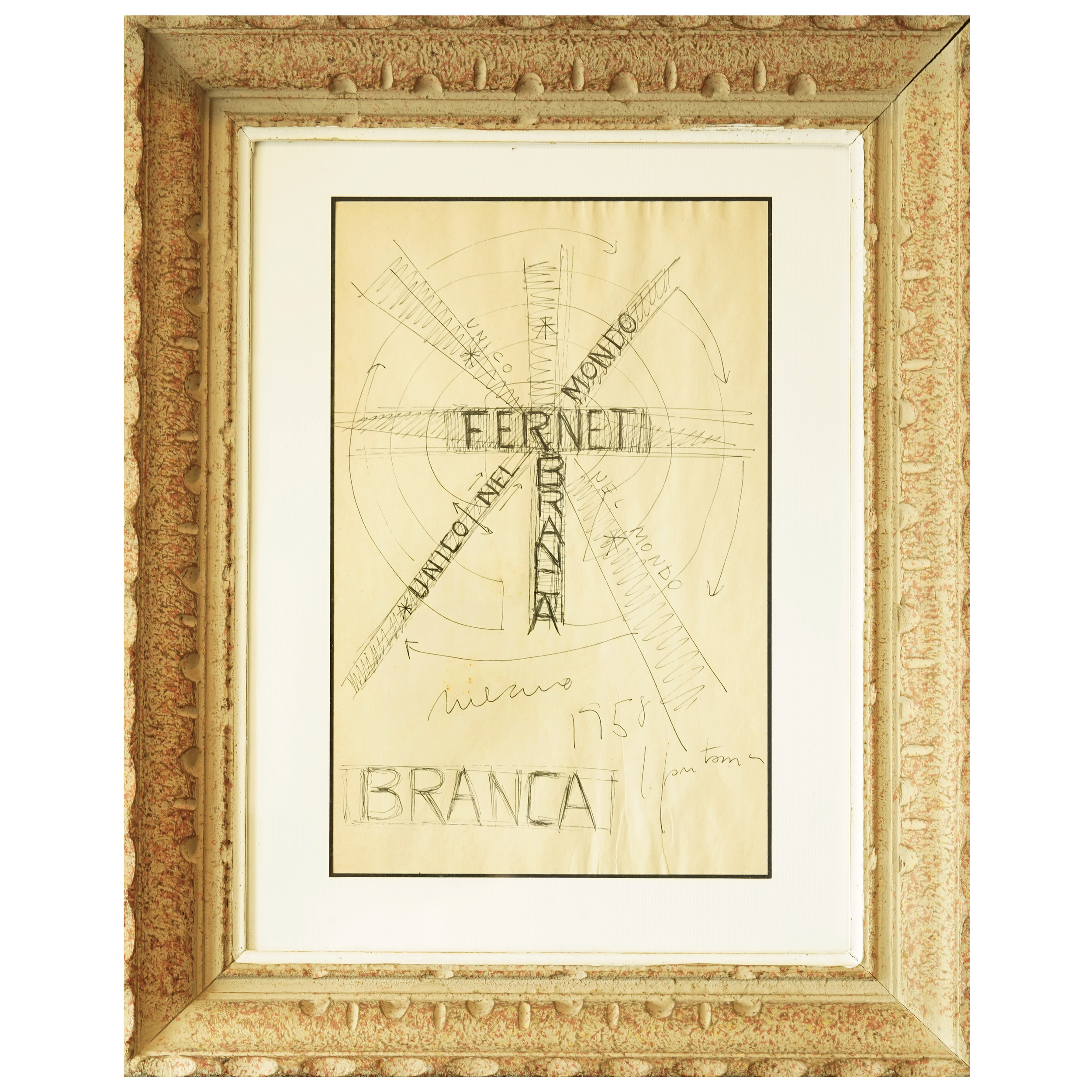
LUCIO FONTANA - Original Drawing “FERNET BRANCA”. Dated and signed bottom right
Year: 1958
Title:Fernet Branca Study
Artist: Lucio Fontana (1899–1968)
Medium: Pencil on paper
Dimensions: 33 × 21 cm
Description:
Original drawing by Lucio Fontana offering a glimpse into the conceptual design process of the artist. Featuring hand-drawn lettering and radiating arrows, the work centers around the words “FERNET BRANCA,” referencing the iconic Italian amaro. The concentric forms and dynamic arrows suggest movement and global reach—possibly a design sketch for an advertisement or poster.
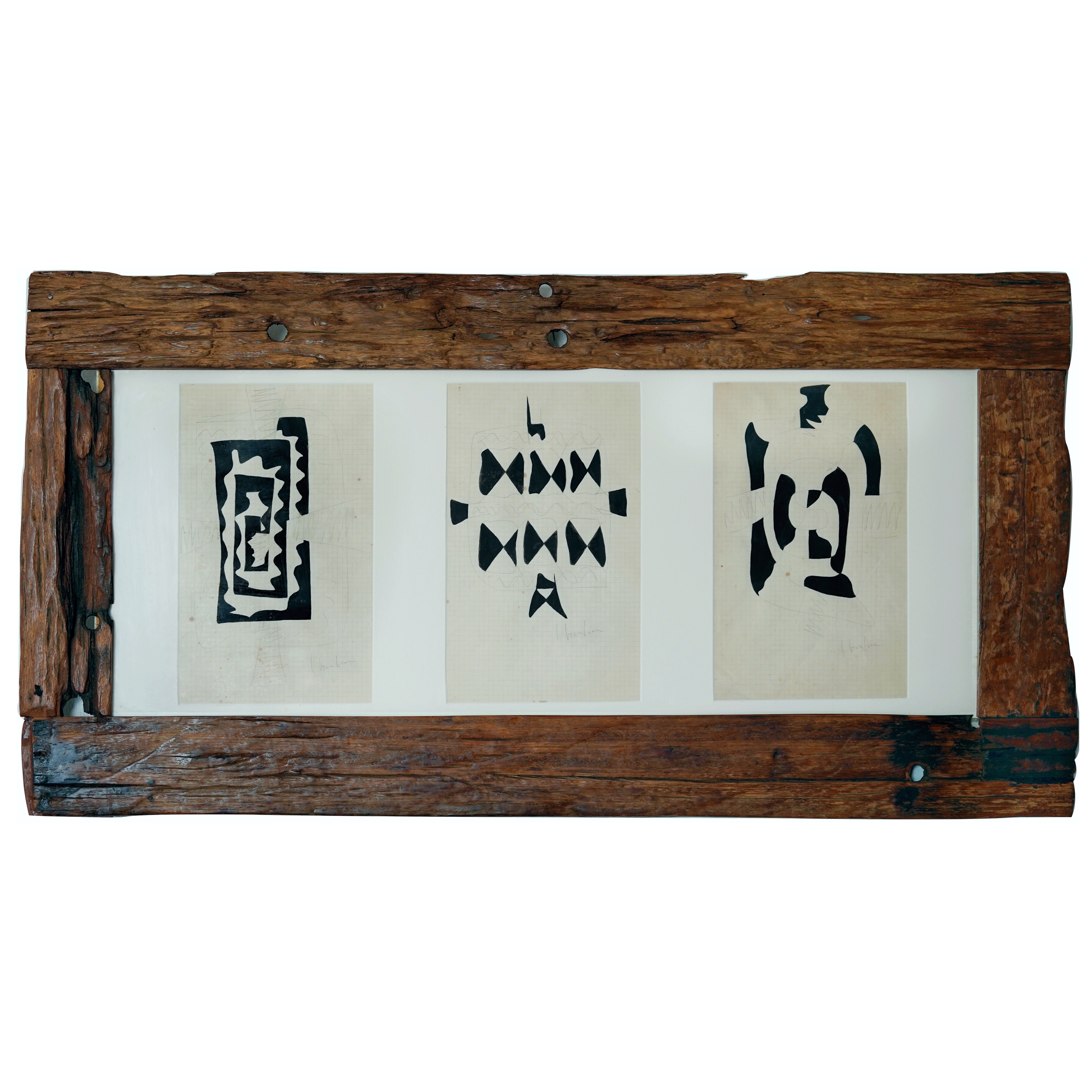
LUCIO FONTANA - Concetto Spaziale. Signed on each bottom right
Title:Spatial Concepts (Triptych)
Artist: Lucio Fontana (1899–1968)
Medium: Ink on graph paper, mounted in reclaimed wood frame
Dimensions: 33 × 20 cm (x3) -with frame : 52 × 117 cm
Description:
Triptych by Lucio Fontana featuring three abstract ink drawings on graph paper, each exploring a unique spatial rhythm through black geometric forms. The compositions display Fontana’s signature interest in breaking traditional pictorial boundaries, reducing form to raw, symbolic essence. Mounted in a rough-hewn wooden frame.
Lucio Fontana, founder of the Spatialism movement, sought to go beyond the flat surface of the canvas and redefine art through space, light, and gesture. In this rare triptych, Fontana turns to paper to explore spatial energy in two dimensions, creating meditative symbols that appear to pulse with dynamic force.
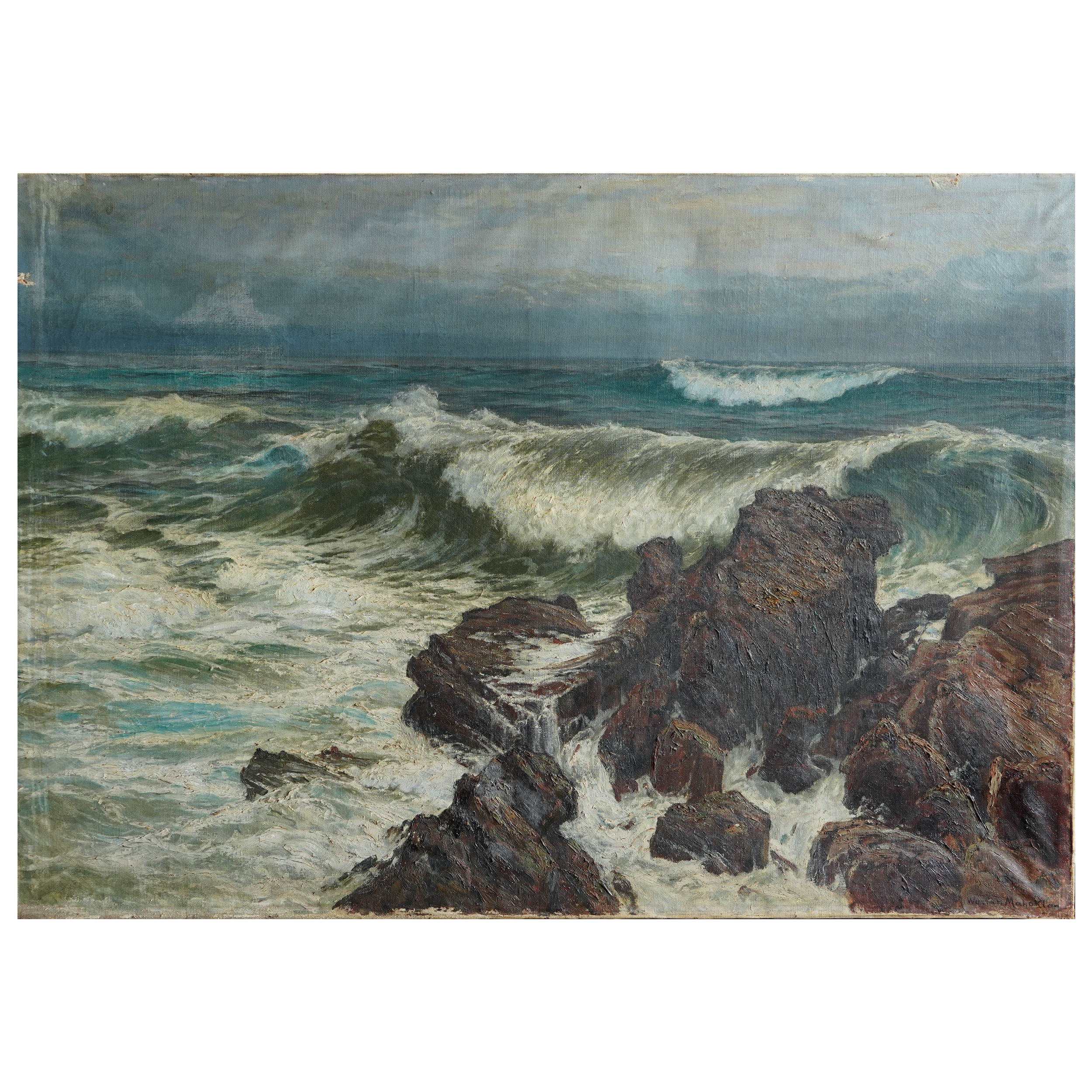
VARTAN MAHOKIAN. Marine painting. Signed bottom right
Title:Rocky Coast with Breaking Waves
Artist: Vartan Mahokian (1869–1937)
Medium: Oil on canvas
Dimensions: 82 × 118 cm
Description:
Original seascape painting by Vartan Mahokian capturing the raw energy of the ocean as waves crash against jagged coastal rocks. The artist’s command of brushwork and tonal variation brings a sense of movement and tension to the composition, while the swirling foam and turbulent skies suggest both natural beauty and elemental power.
Renowned for his maritime scenes, Mahokian was one of the rare Armenian painters of his time devoted almost entirely to seascapes. His works reflect both technical precision and an emotional reverence for the sea. This piece exemplifies his gift for portraying the grandeur and volatility of coastal landscapes.
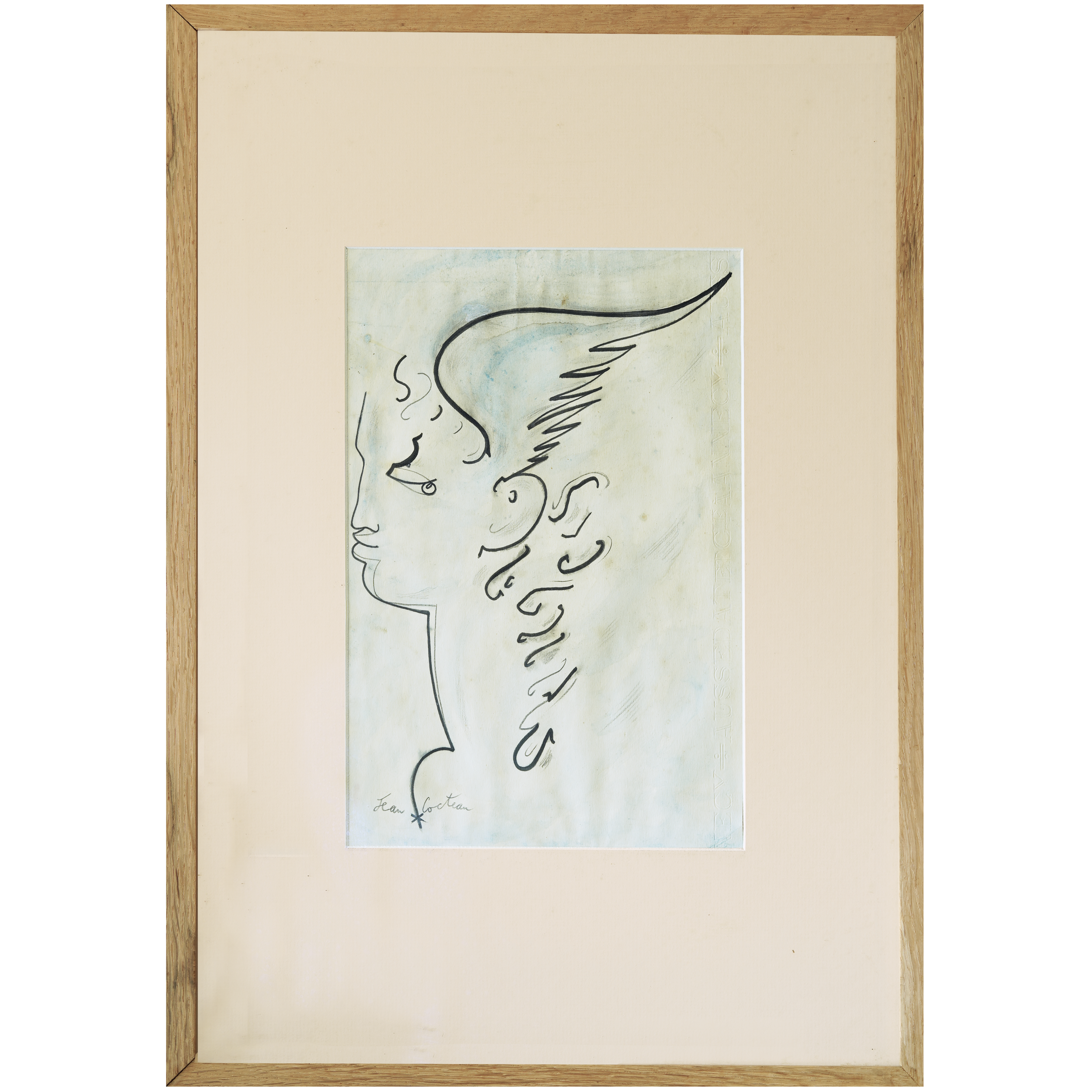
Original drawing by Jean COCTEAU depicting a winged profile.
Title:Winged Profile
Artist: Jean Cocteau (1889–1963)
Medium: Ink on paper
Dimensions: 32 x 21 cm
Description:
Original drawing by Jean Cocteau presenting a stylized human profile with wing-like extensions flowing from the head, evoking classical mythology and poetic symbolism. Rendered in fluid, elegant lines, the figure's face is both serene and enigmatic, a hallmark of Cocteau’s linear aesthetic. The composition is signed by the artist at the bottom.
Jean Cocteau, a French polymath and central figure of 20th-century avant-garde art, often blended poetry, myth, and surrealism in his work. This drawing exemplifies his ability to merge simplicity of line with psychological depth, evoking themes of transformation, flight, and inner vision.
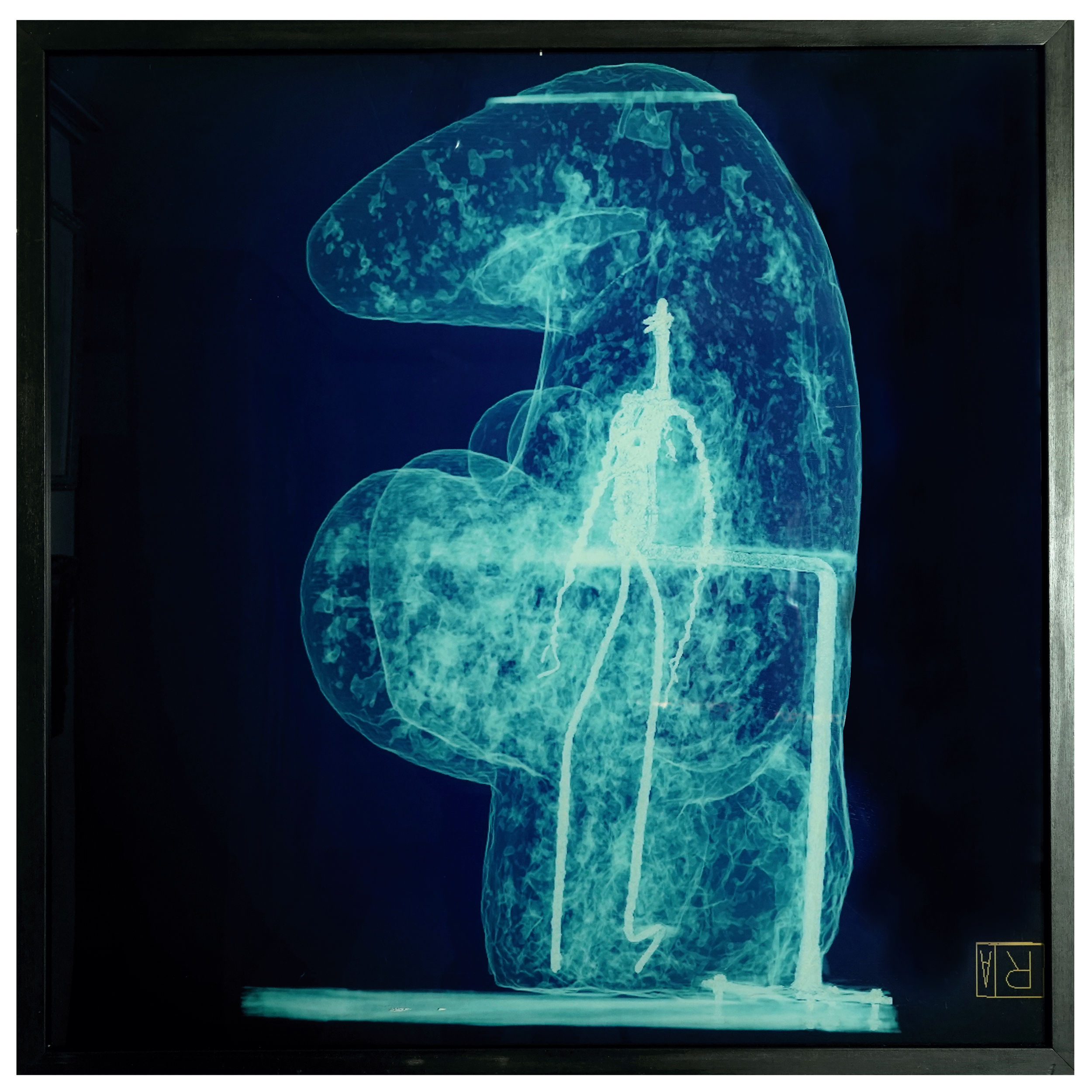
Radiography by Xavier LUCCHESI of a PICASSO sculpture, signed at the bottom right
Title:Radiographic Revelation: After Picasso
Artist: Xavier Lucchesi (b. 1959)
Medium: X-ray on photographic film
Dimensions: 122 × 122 cm
Description:
Radiographic image by Xavier Lucchesi unveiling the internal structure of a sculptural work by Pablo Picasso, transforming the invisible into a luminous composition. Using medical imaging technology, Lucchesi captures the soul of the sculpture—its bones, voids, and materials—rendered in spectral blue and white. The result is a ghostly presence that transcends the physical object, revealing its hidden anatomy in a way that is both forensic and poetic.
Lucchesi’s artistic practice merges art, science, and technology, interrogating how we perceive and interpret form. His radiographic works invite viewers to reflect on transparency, memory, and the unseen layers of creation.
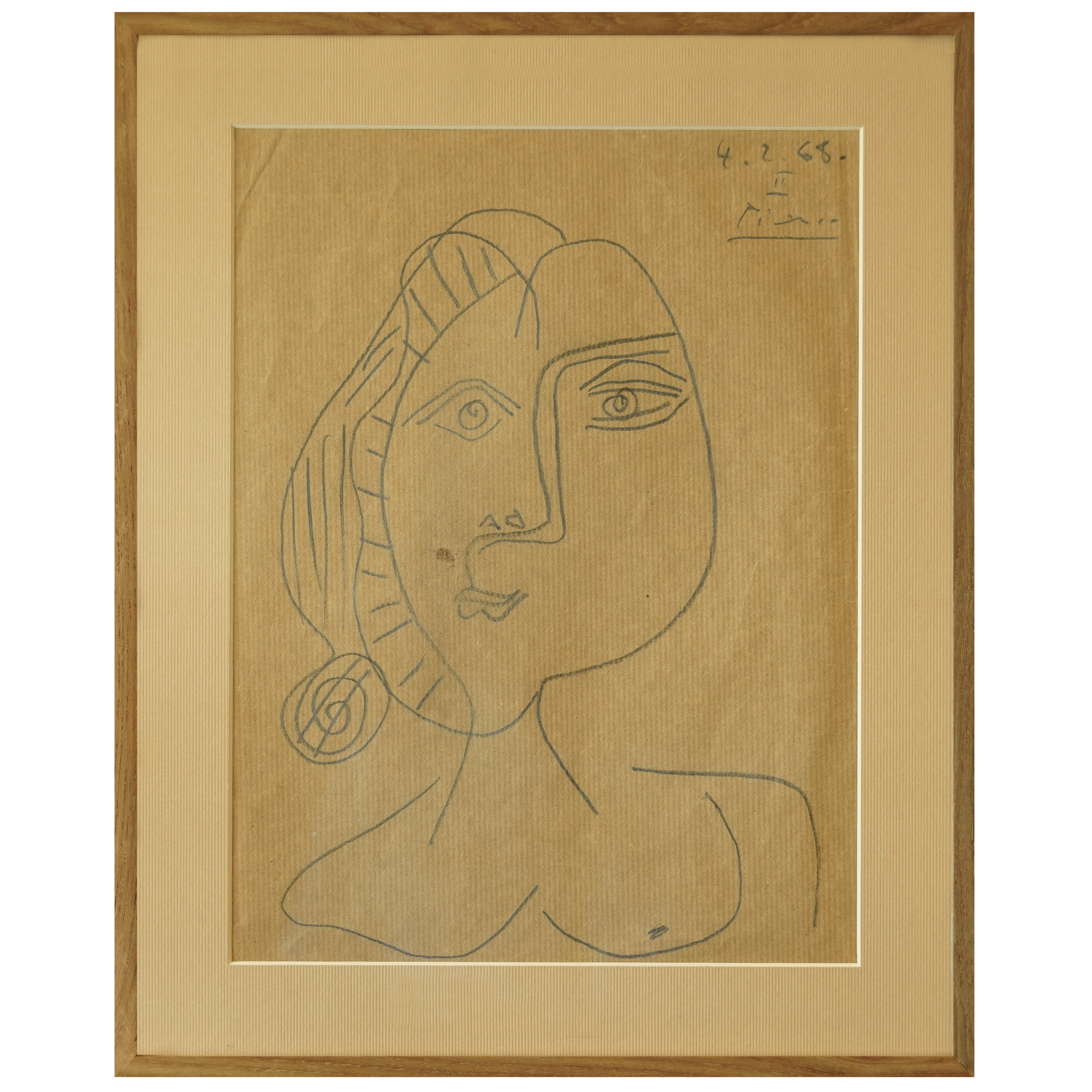
Original drawing by Picasso depicting a woman’s face, executed with pencil on brown paper, dated and signed at the top right 4.2.68 II
Year: 1968
Artist: Pablo Picasso (1881–1973)
Medium: Graphite on brown paper
Signature: Dated and signed upper right
Dimensions: 32 × 24 cm
Description:
Drawing by Pablo Picasso capturing the essence of his late period: confident, fluid, and bold in its abstraction. Rendered in a few uninterrupted lines, this drawing portrays a woman's bust-length figure, with a split or dual visage—two profiles merging into a single frontal form.
The use of brown paper and sparse line work highlights Picasso’s mastery of expressive minimalism. Despite the simplicity of the materials, the drawing conveys a vivid sense of presence, sensuality, and introspection.
Dated February 4, 1965, this work reflects Picasso’s continued fascination with the female form and psychological duality. The face, at once serene and enigmatic, is emblematic of the artist’s late-in-life synthesis of Cubist innovation and Mediterranean lyricism.
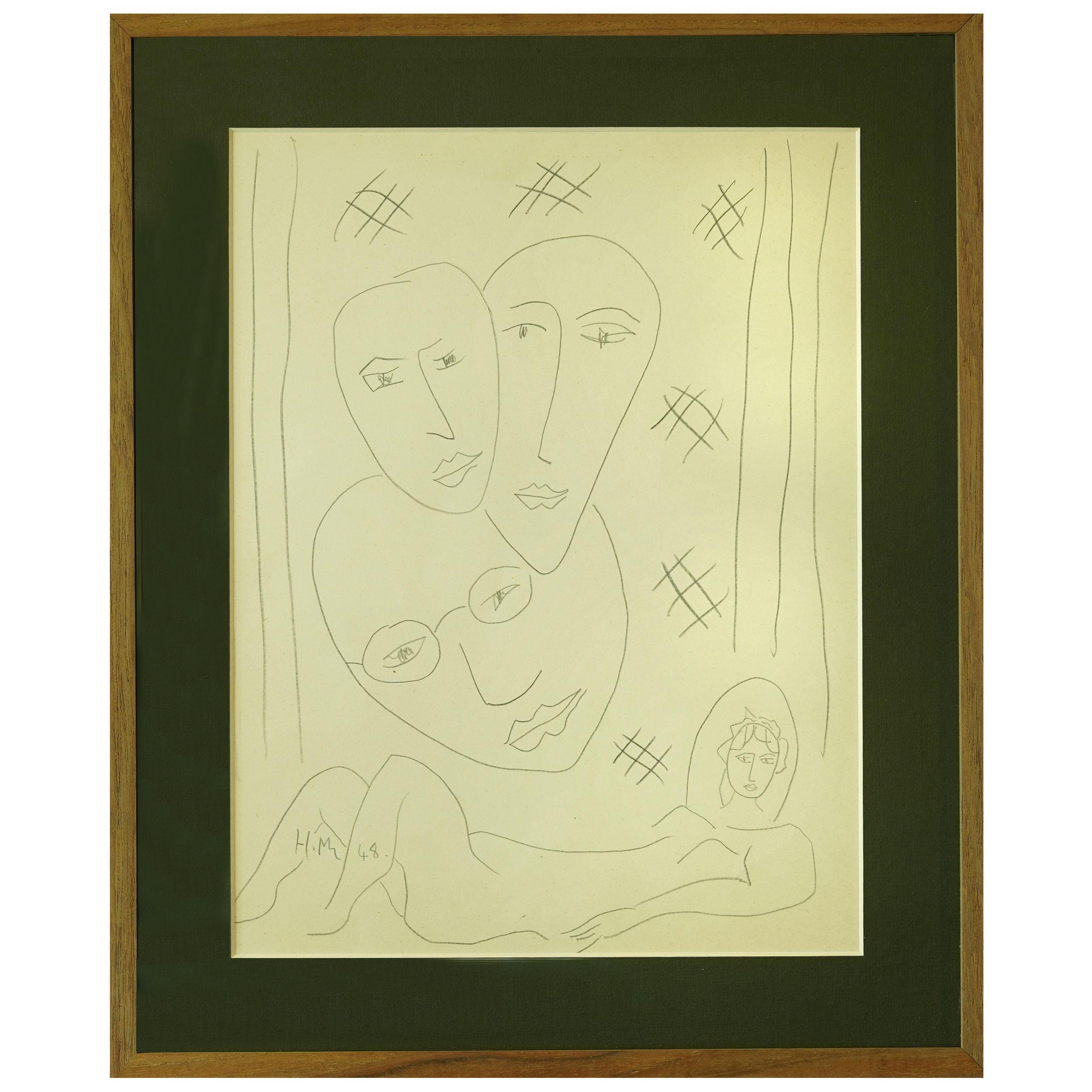
Original pencil drawing depicting a reclining woman, topped by three stylized faces, bearing Matisse's monogram "HM" and dated '48
Year: 1948
Title:Trois Visages et Figure Allongée
Artist: Henri Matisse (1869–1954)
Medium: Pencil on paper
Signature: Signed and dated lower left "H. M. 48"
Dimensions: 29 × 23 cm
Description:
Drawing by Henri Matisse capturing the artist’s late-career mastery of minimalism and expression. Rendered in a few delicate strokes, the composition juxtaposes three stylized heads, suspended in space, above a reclining figure.
Created in 1948, during Matisse’s late period, this drawing exemplifies his pursuit of purity through line. It reflects his deep interest in human emotion, abstraction, and the lyrical simplicity that defined his later works. The dreamlike grouping of figures evokes both intimacy and distance—hallmarks of Matisse’s poetic visual language.
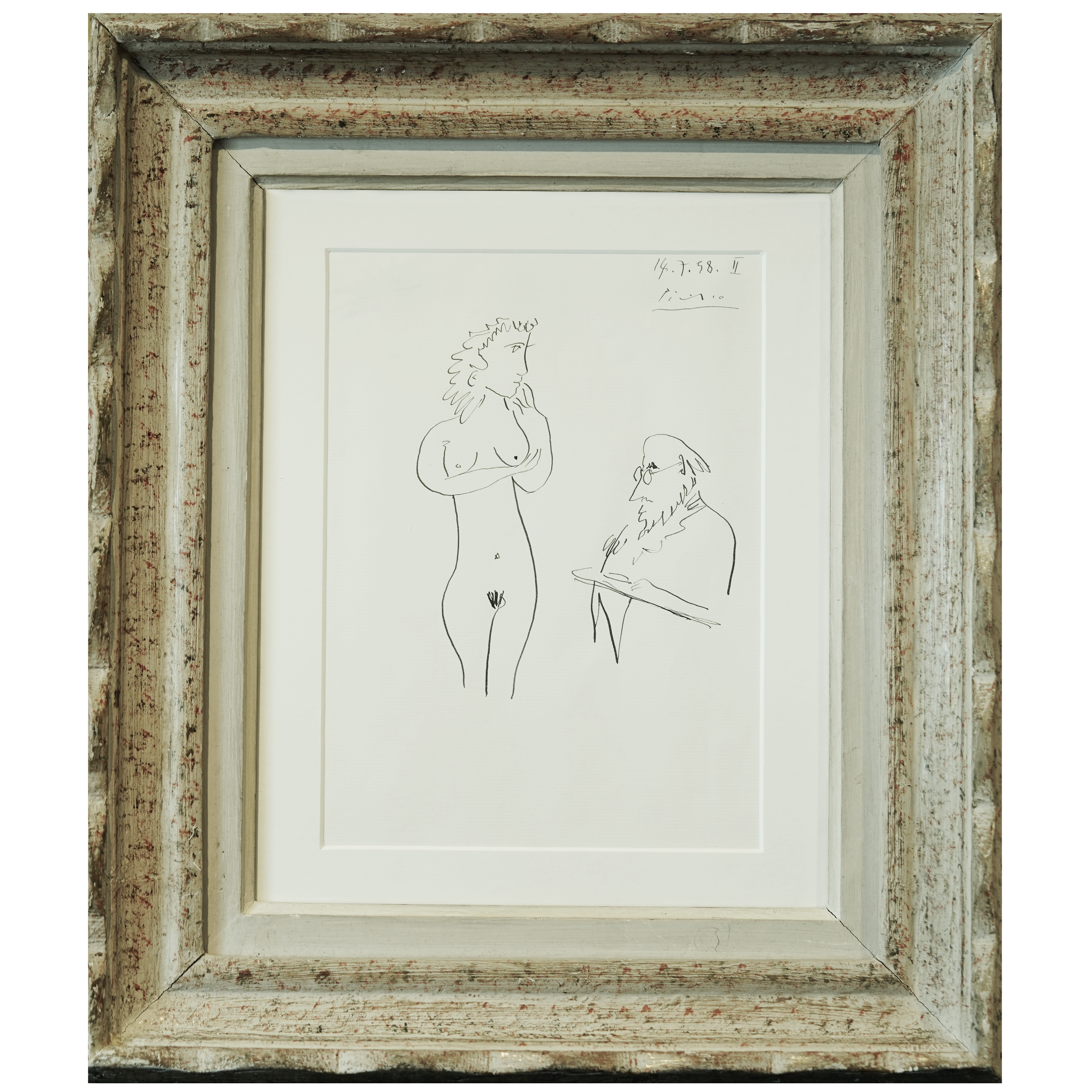
Original drawing by Picasso depicting a nude woman and a man. Drawing in black ink on beige paper, dated and signed in the top right 14.7.58 II
Year: 1958
Artist: Pablo Picasso (1881–1973)
Medium: Ink on paper
Dimensions: 26 × 18 cm
Signature: Signed and dated upper right
Description:
Original drawing by Pablo Picasso capturing a classic artistic theme—the intimate moment between an artist and his nude model. Executed with remarkable economy of line, the composition features a seated male figure sketching a standing nude woman.
In his later years, Picasso frequently returned to the theme of the artist and his muse—a dynamic reflecting both his own life and the enduring classical tradition. Here, the sparse elegance of line reflects his masterful control and spontaneous energy. Dated July 14, 1958, this drawing belongs to a prolific period where Picasso explored the fusion of eroticism, artistic creation, and mythic intimacy in its most distilled form.
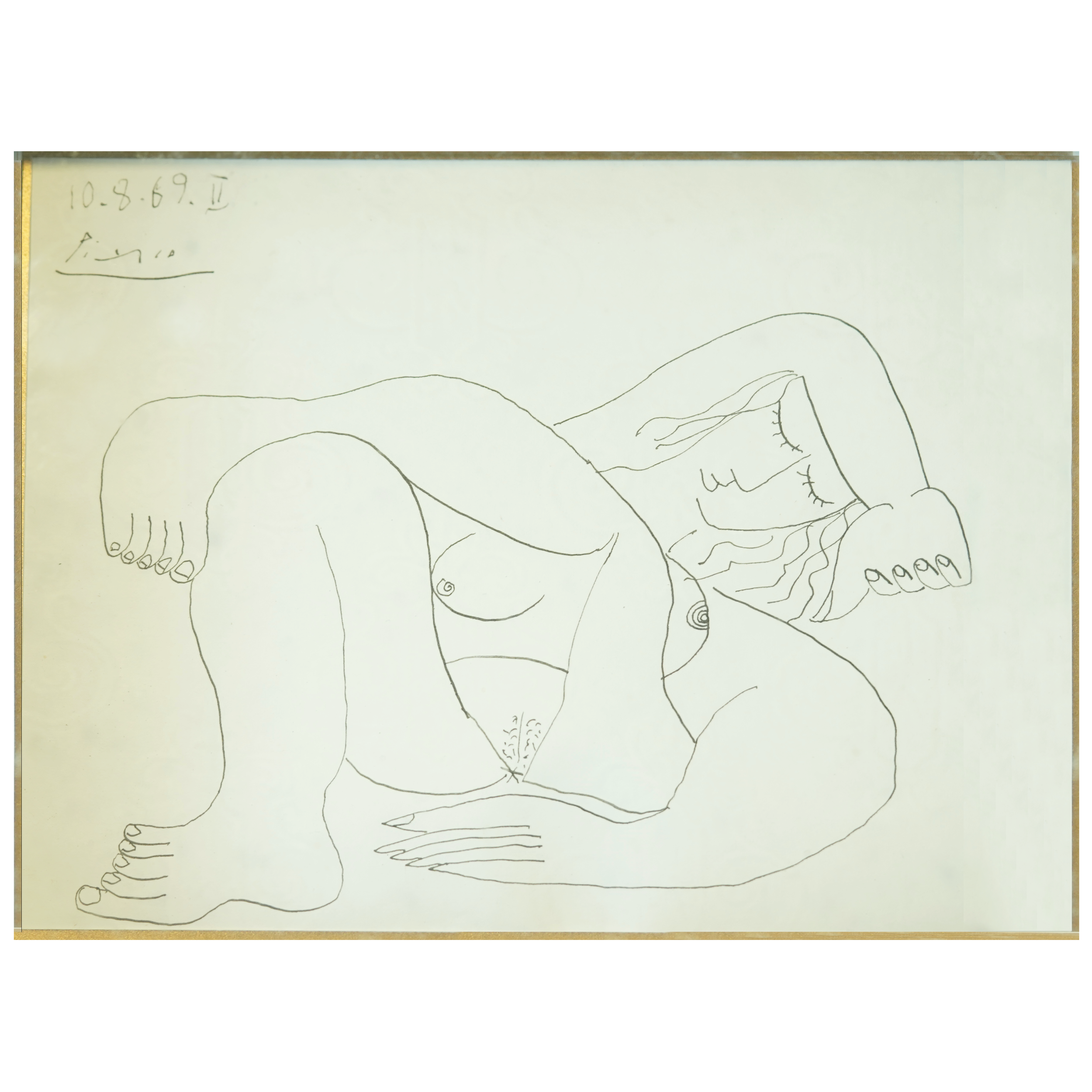
Original ink drawing depicting a reclining nude woman, bearing PICASSO's monogram and dated on the top left 10/08/1969 II
Year: 1969
Title:Reclining Nude
Artist: Pablo Picasso (1881–1973)
Medium: Ink on paper
Signature: Signed and dated upper left “10.8.69 II / Picasso”
Dimensions: 17 × 22 cm
Description:
Drawing by Pablo Picasso capturing a reclining nude in a pose that is both sensual and serene. Executed with characteristic fluency and economy of line, the female figure is shown folded into herself, limbs curled and overlapping in a contorted yet natural position.
Created in the final years of Picasso’s life, this drawing reflects his undiminished fascination with the female form and his continued exploration of expressive distortion.
Drawn in 1969 at the age of 88, this work stands as a testament to Picasso’s enduring creative vitality. His late style embraced a raw spontaneity that distilled decades of mastery into unfiltered expression.
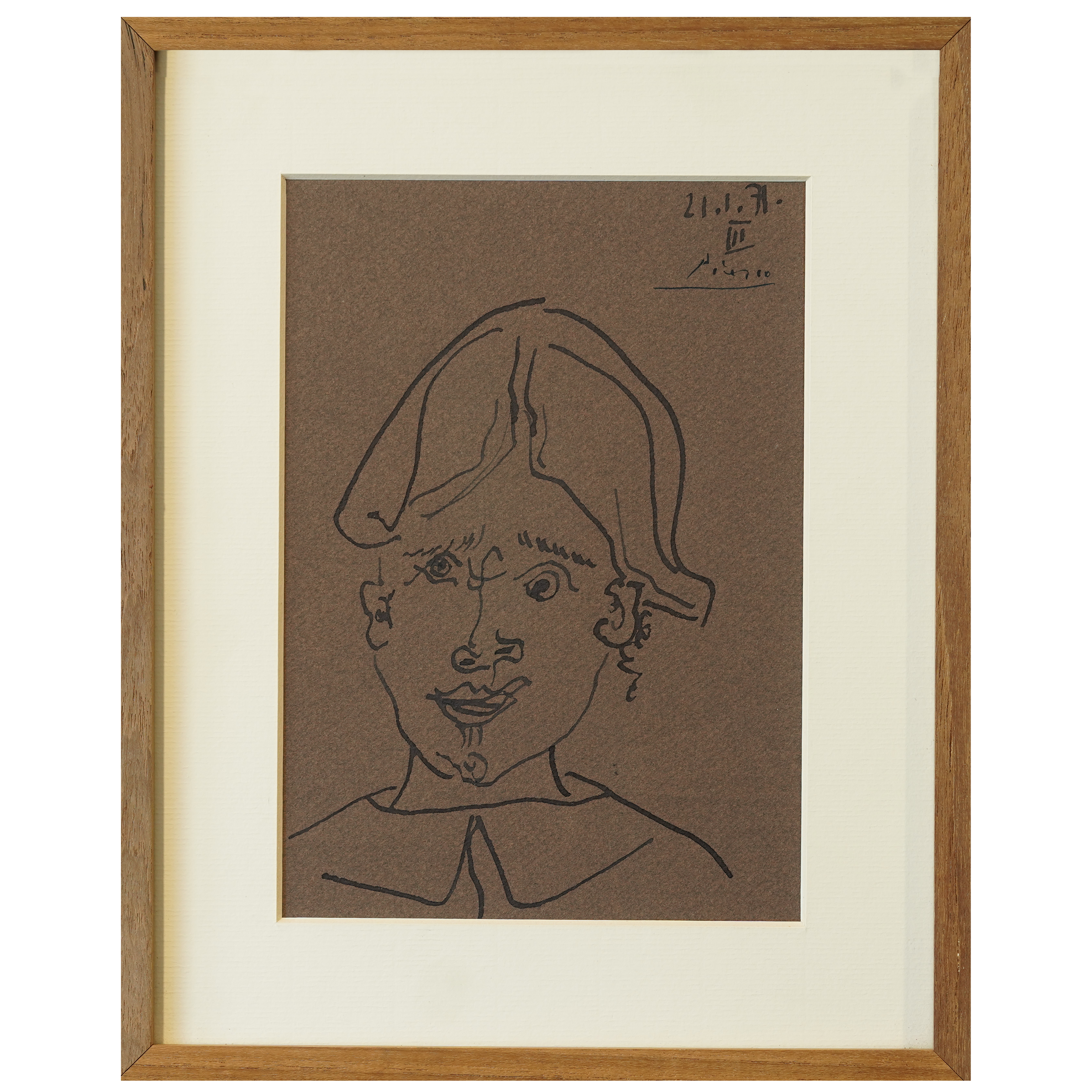
Original drawing by Picasso depicting the head of a capped Pierrot, executed in black ink on brown paper, dated and signed at the top right 21.1.71 II
Year: 1971
Title:Pierrot
Artist: Pablo Picasso (1881–1973)
Medium: Ink on brown paper
Signature: Signed and dated upper right
Dimensions: 20 × 14 cm
Description:
Drawing by Pablo Picasso reimagining Pierrot—the melancholic clown from the Italian Commedia dell’arte tradition—through his distinctive late-period style. With confident, continuous lines, the artist distills the character to its emotional essence. The figure’s wide-brimmed hat, delicate features, and stylized collar unmistakably evoke the iconic costume of the theatrical sad clown.
Drawn in the final years of his life, Pierrot reflects Picasso’s enduring fascination with theatrical archetypes, identity, and the emotional power of gesture.
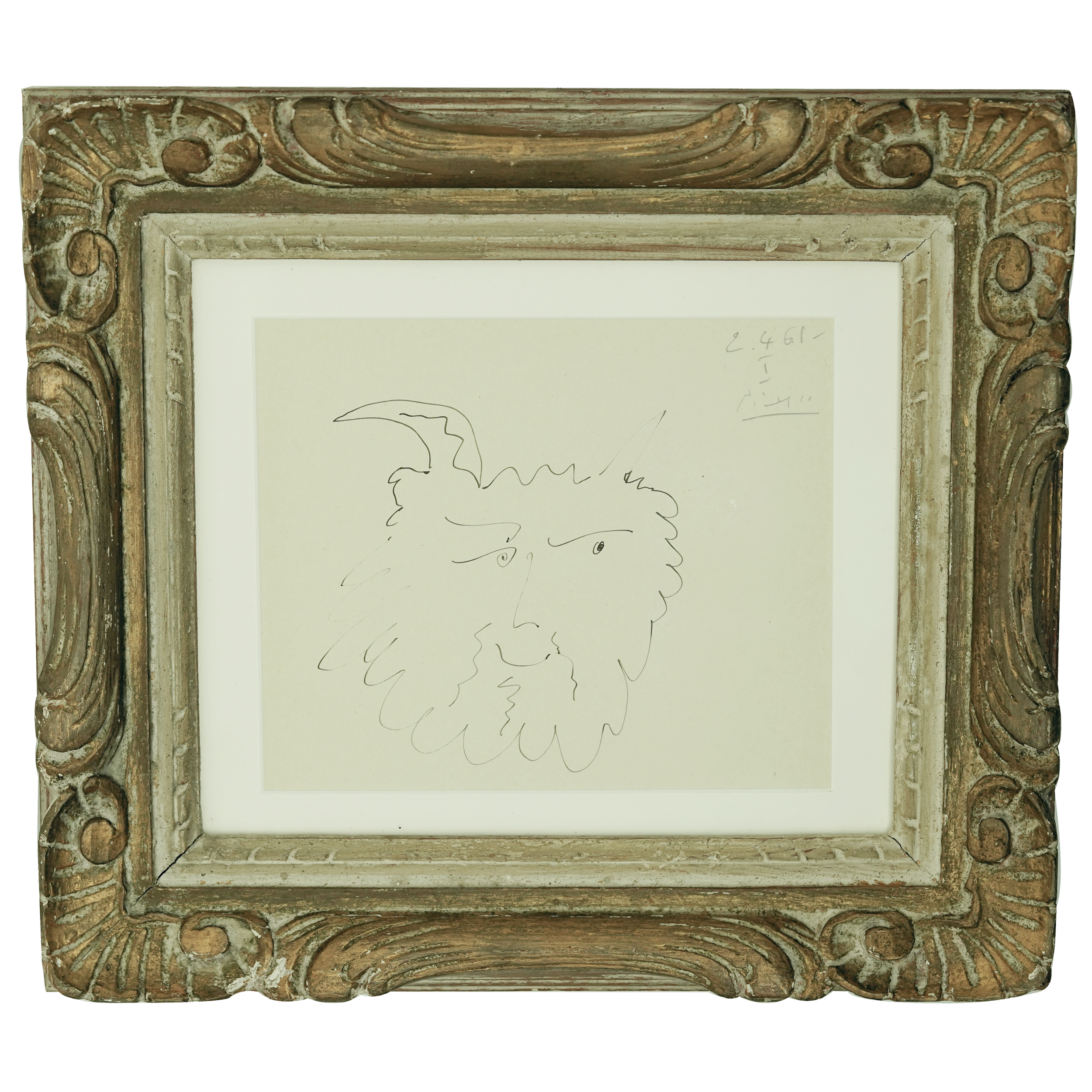
Original drawing by Picasso depicting a "Head of a Faune." Drawing in black ink on beige paper, dated and signed in pencil at the top right: 2.4.61
Year: 1961
Title:Head of a Faun
Artist: Pablo Picasso (1881–1973)
Medium: Ink on paper
Signature: Dated and signed upper right
Dimensions: 17 × 21 cm
Description:
Original drawing by Pablo Picasso depicting the head of a faun, a recurring mythological subject in his oeuvre. Executed with a few fluid and confident ink lines, the composition captures the essence of the creature’s dual nature—part man, part beast—with a single curved horn, a pointed ear, and an unruly beard framing an enigmatic expression. Despite its apparent simplicity, the drawing exudes character, wit, and Picasso’s mastery of spontaneous line.
In his later years, Picasso often returned to mythological and classical themes with renewed freedom and economy of gesture. This work distills the faun’s identity into a minimal yet evocative image, underscoring the artist’s lifelong fascination with Mediterranean mythology. "Head of a Faun" is both whimsical and archetypal, revealing the artist’s ability to imbue even the briefest sketch with expressive depth and symbolic resonance.
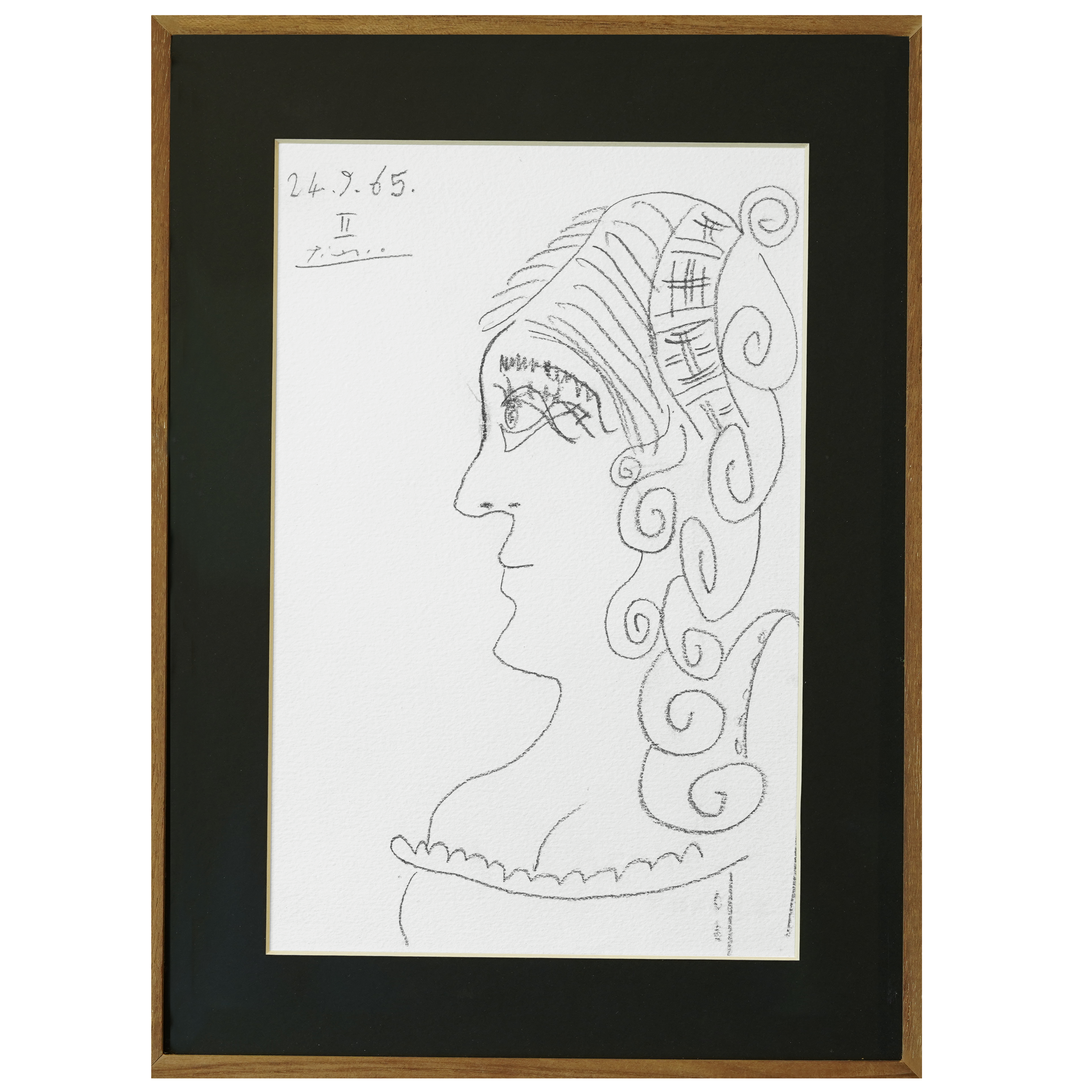
Original drawing by Picasso, in grease pencil, depicting the profile of a young woman with a low neckline over her chest, signed and dated at the top left: 24.9.65
Year: 1965
Title:Portrait of a Woman in Profile
Artist: Pablo Picasso (1881–1973)
Medium: Pencil on paper
Signature: Dated and signed upper left
Dimensions: 27 × 18 cm
Description:
Original drawing by Pablo Picasso presenting a stylized profile of a woman, rendered with fluid yet deliberate pencil strokes. The elegant subject is shown in left-facing profile, her hair composed of a rhythmic play of curls, loops, and crosshatched textures that frame her composed features. Her large, expressive eye and delicate neckline suggest a sense of classical serenity while simultaneously revealing Picasso’s playful linear abstraction.
Created in 1965, this portrait reflects the late period of Picasso’s career, during which he embraced spontaneity, confidence, and minimalism in his drawing practice. The economy of line and ornamental composition in Portrait of a Woman in Profile captures the artist’s enduring fascination with the female figure—now distilled to its essential, lyrical essence. It is both a tribute to tradition and an assertion of Picasso’s bold artistic language.
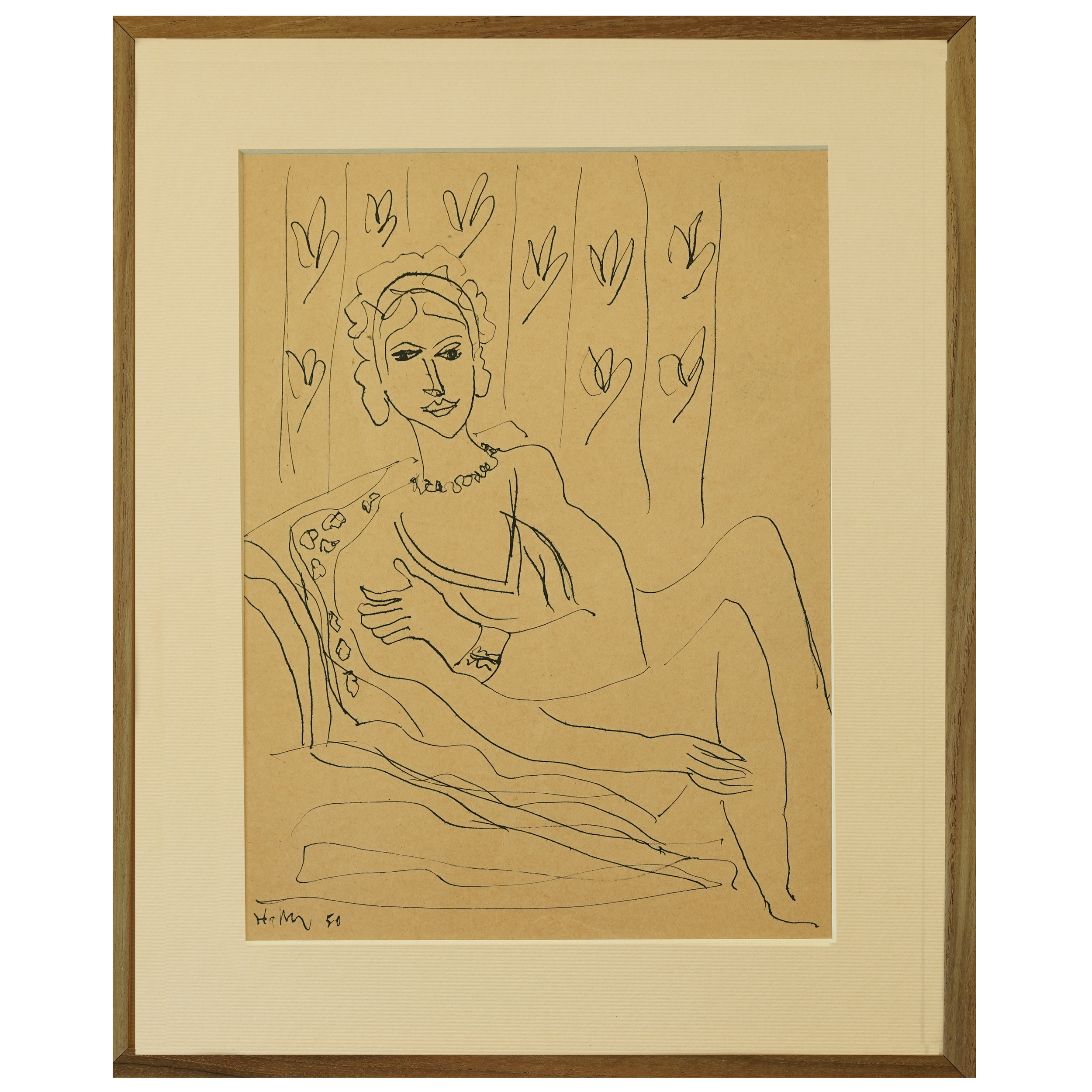
Original pencil drawing depicting a reclining woman, bearing Matisse's monogram "HM" and dated '50
Year: 1950
Title:Reclining Woman with Floral Drapery
Artist: Henri Matisse (1869–1954)
Medium: Ink on paper
Signature: Signed and dated lower left "H. M. 51"
Dimensions: 26 × 20 cm
Description:
Drawing by Henri Matisse’s refined late style, where bold, economical line work conveys elegance, sensuality, and grace. A reclining woman gazes outward with calm poise, her figure gently undulating across the page.
Created in the final years of Matisse’s life, this drawing reflects his ongoing fascination with the female form and interior space. It embodies the artist’s pursuit of harmony and clarity, and illustrates his belief that art should be “something like a good armchair” — comforting, beautiful, and serene.
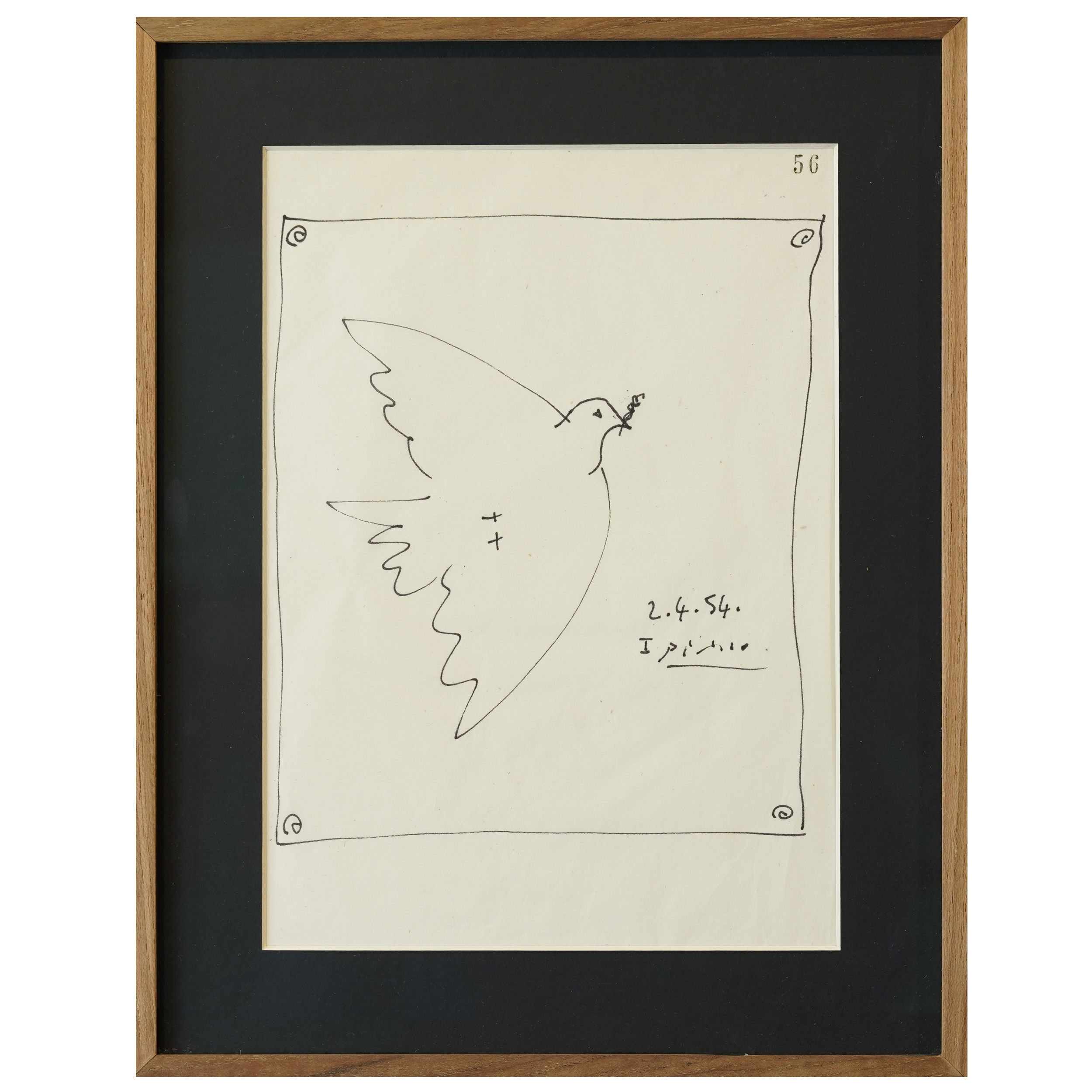
Original drawing by Picasso, in India ink on tracing paper, depicting a dove, signed and dated at the bottom right: 2.4.54
Year: 1954
Title:Dove of Peace
Artist: Pablo Picasso (1881–1973)
Medium: Ink on paper
Signature: Signed and dated lower right
Dimensions: 26 × 19 cm
Description:
This minimalist yet powerful drawing captures one of Pablo Picasso’s most iconic symbols: the dove. Rendered with a few confident lines, the bird is shown in flight, bearing an olive branch in its beak — a universal emblem of peace. The image radiates both movement and serenity, embodying Picasso’s ability to convey profound meaning through simplicity.
Originally adopted as the emblem for the 1949 World Peace Congress in Paris, the dove became a recurring motif in Picasso’s work and a personal symbol of his political engagement. This particular version, executed in 1954, exemplifies his mature graphic style, where form is distilled to its essence while maintaining emotional weight and clarity.
Dove of Peace is more than a drawing — it is a message. Created in a post-war world still striving for harmony, Picasso’s bird became a beacon of hope, embraced worldwide by peace movements. The artist’s line, fluid and unwavering, turns a simple sketch into a timeless plea for unity.
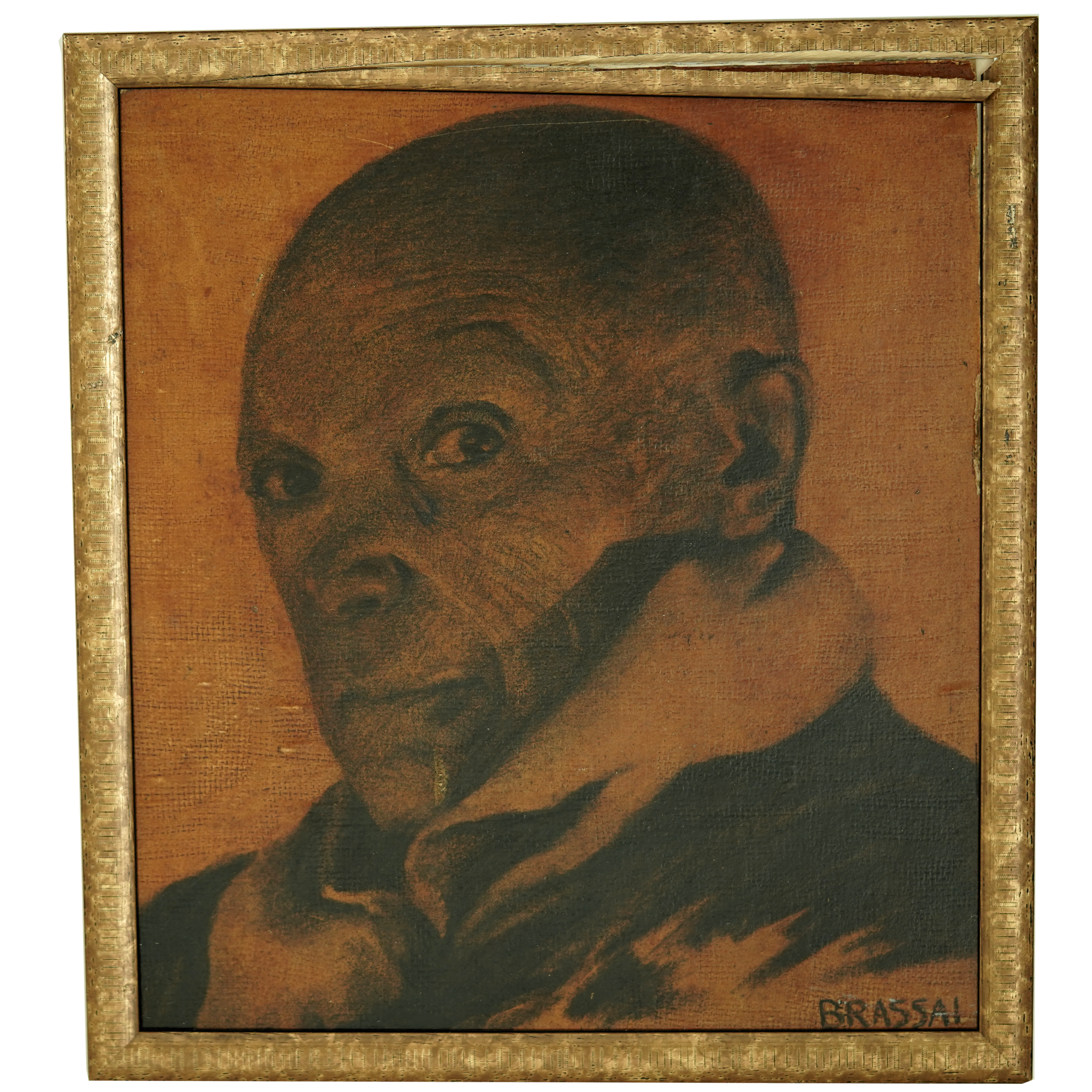
Title:Portrait of Pablo Picasso
Artist: Brassaï (Hungarian-French, 1899–1984)
Medium: Charcoal and pigment on canvas
Dimensions: 32 × 28 cm
Signed: Lower right, "Brassaï"
Description:
Portrait of Pablo Picasso by Brassaï revealing an introspective and intense depiction of one of the most influential artists of the 20th century. Rendered in a restrained yet striking palette of burnt sienna and black, the image radiates a quiet force. .
Better known for his photography, Brassaï was deeply immersed in the artistic circles of Paris and held a close friendship with Picasso, whom he photographed extensively over several decades. This rare painted work demonstrates Brassaï’s deep understanding of his subject, capturing Picasso not only as an iconic figure of modern art but also as a man immersed in thought and creative gravity.
This portrait stands as a powerful testament to the mutual admiration and artistic dialogue between Brassaï and Picasso. With its hauntingly intimate perspective, the painting bridges the realms of photography, painting, and psychological portraiture, showcasing Brassaï’s ability to capture the essence of a person with profound sensitivity.

Original drawing by Picasso depicting reclining nude man. Drawing in black ink on beige paper, signed in the top right II
Title:Reclining Bearded Man
Artist: Pablo Picasso (1881–1973)
Date: Undated (inscribed “II” in upper right corner)
Medium: Ink on paper
Signature: Signed "Picasso" upper right
Dimensions: 20 × 20 cm
Description:
Drawing by Pablo Picasso presenting a reclining male nude with a prominent beard and an air of calm self-possession. Rendered with his unmistakable linear economy, the figure appears at once archaic and contemporary — a classical pose stripped to its essentials through modernist abstraction.
Picasso's late drawings reflect a liberated, confident hand that distilled decades of technical skill into immediate visual poetry. In Reclining Bearded Man, the artist combines sensuality, wit, and timeless form in a deceptively simple composition.
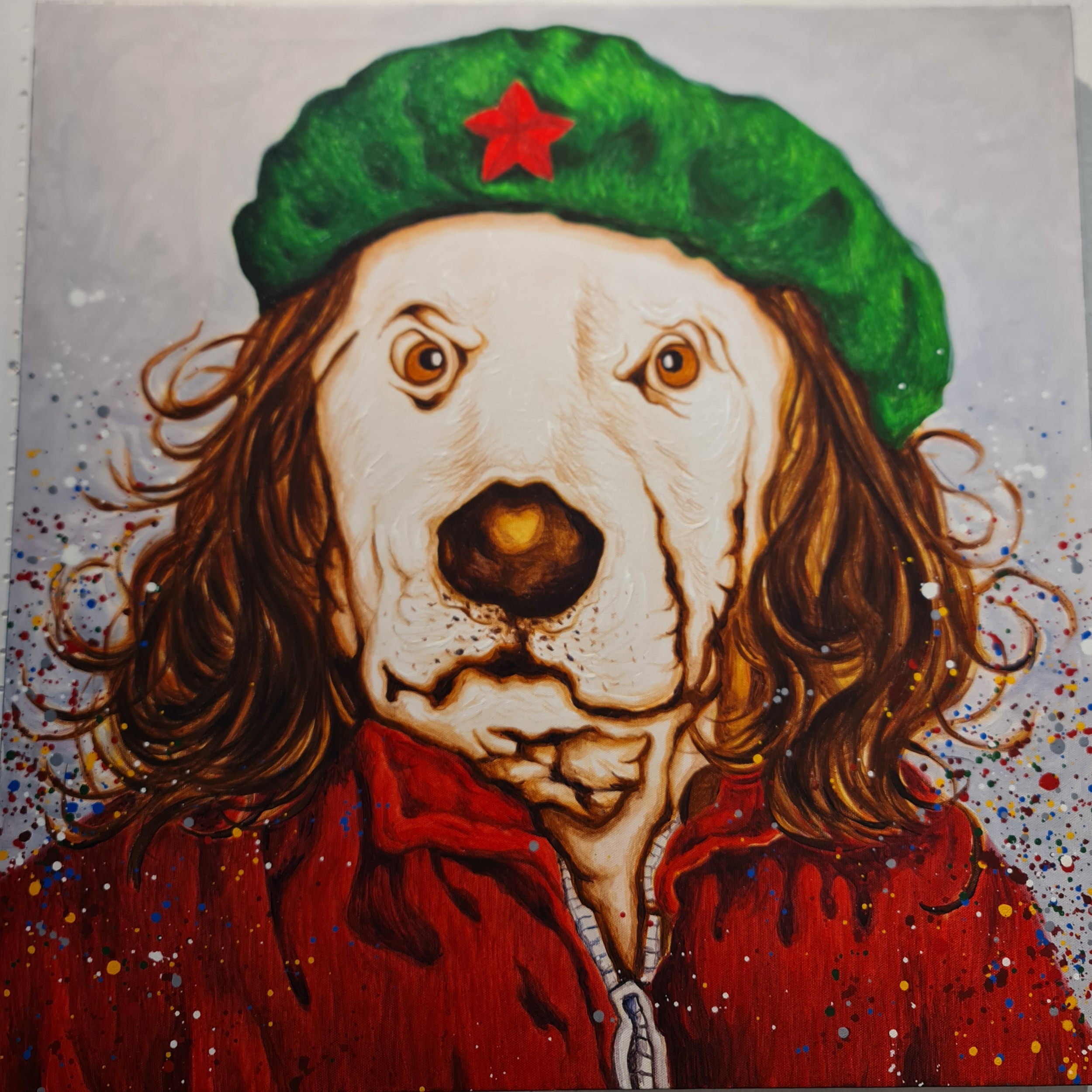
Artist: BOZE
Date: Unknown
Medium: Oil on canvas
Signature: Not Visible
Dimensions: 29 × 37 cm
This portrait depicts a dog rendered with human posture and expression, dressed in a green beret marked by a red star and a red jacket. The work playfully merges animal imagery with revolutionary iconography, creating a figure that is at once humorous, and quietly unsettling. Rich, warm tones define the face, while energetic splatters of paint animate the background, adding movement and contemporary edge.
Artistic Context:
BOZE is known for creating expressive, figurative paintings that blend humor, symbolism, and social commentary. Working primarily in oil on canvas, the artist often uses animals as stand-ins for human characters, allowing complex political or emotional ideas to be explored with irony and warmth. BOZE’s style combines strong draftsmanship with painterly textures and contemporary pop references, resulting in works that are immediately approachable yet layered in meaning.
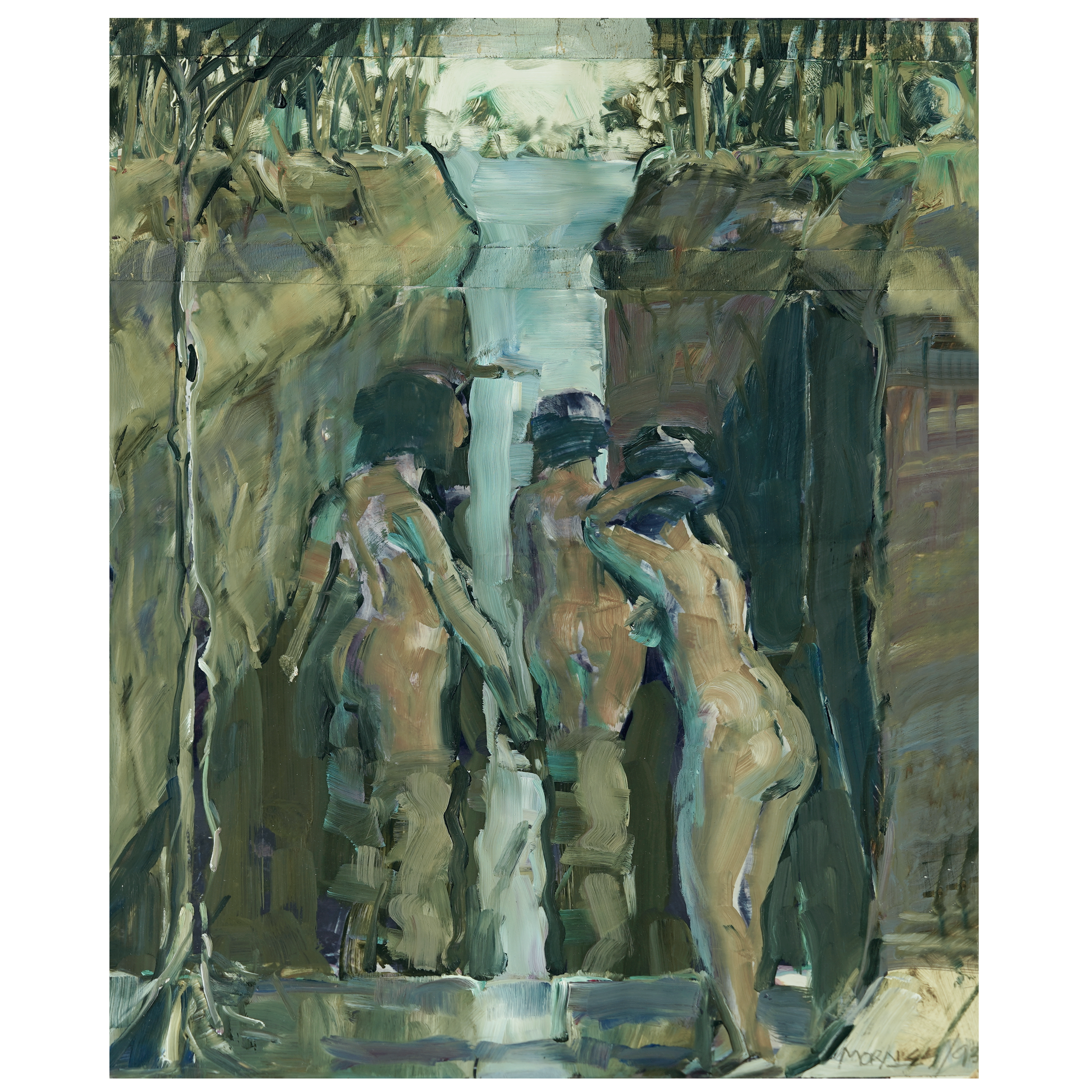
Armando Morales (1927–2011)
Oil on canvas
Dimensions: 35 × 28 cm
Composition by Nicaraguan painter Armando Morales depicting three nude figures gathered at the edge of a cascading waterfall, immersed in a timeless ritual of bathing. Executed in his characteristic painterly style, Morales layers earthy and muted green-blue tones, capturing both the sensuality of the human form and the raw vitality of nature.
Morales, renowned for his fusion of figuration and abstraction, frequently revisited themes of memory, myth, and sensuality. In this work, the tactile impasto brushwork conveys both movement and intimacy, as the figures appear simultaneously rooted in their environment and dreamlike in presence. The interplay between shadow and light accentuates the mystery of the scene, suggesting a timeless moment of communion between humanity and nature.
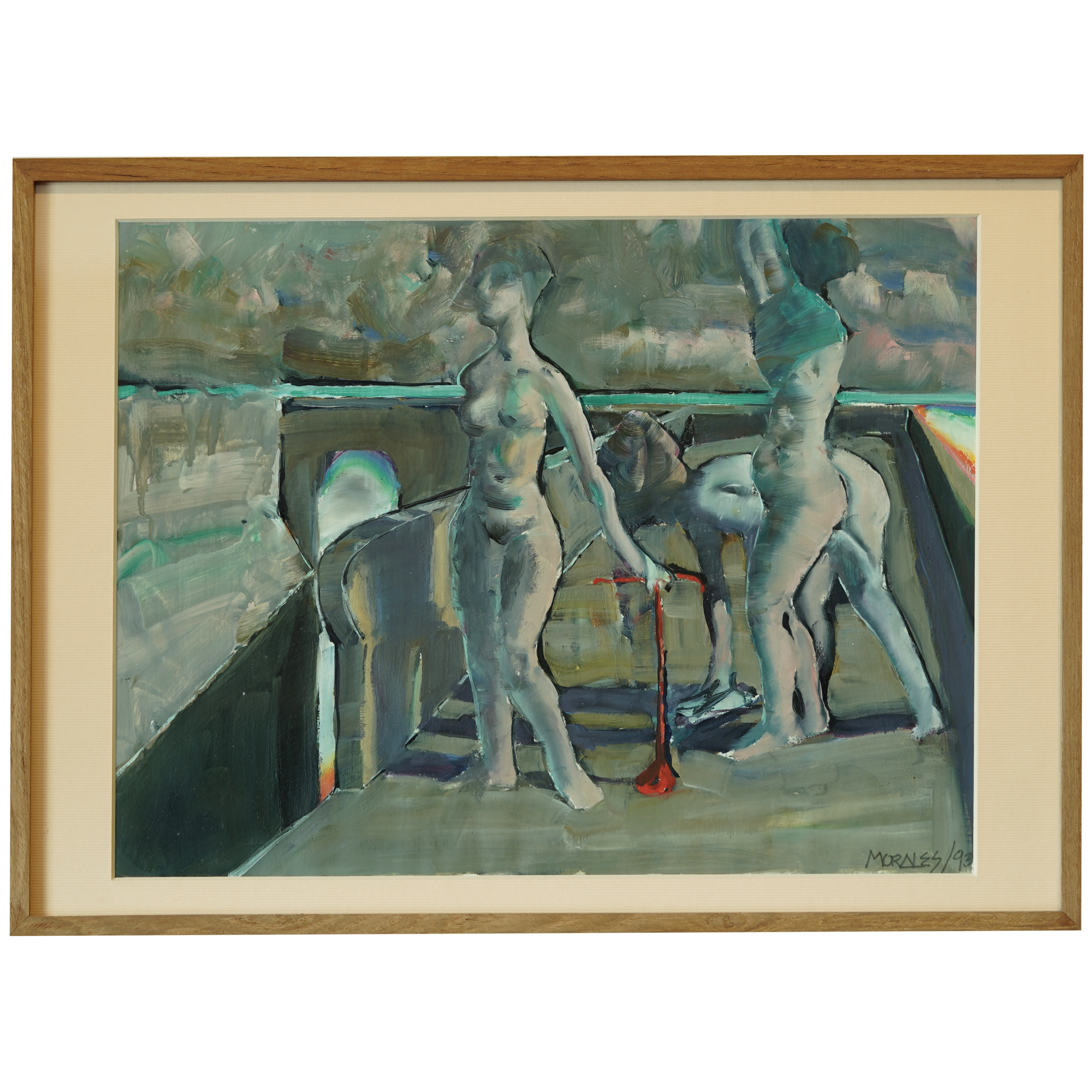
Artist: Armando Morales (Nicaraguan, 1927–2011)
Date: 1993
Medium: Oil on canvas
Signature: Signed and dated lower right, Morales / 93
Dimensions: 29 × 37 cm
Oil on canvas from 1993, Armando Morales presents three nude female figures set within a monumental architectural setting that opens onto a distant seascape. Painted in a restrained, cool-toned palette dominated by muted blues, greens, and greys, the figures emerge with sculptural solidity, their contours modeled with both softness and precision. One central figure holds a striking red staff, a vivid vertical accent that disrupts the otherwise harmonious tonal composition..
Artistic Context:
Armando Morales is celebrated as one of Latin America’s foremost modern painters, renowned for merging realist figuration with surrealist and symbolic elements. His paintings often combine nudes, still lifes, and landscapes in enigmatic, timeless environments. This work exemplifies Morales’s mature style of the late 1970s, in which the human form is reimagined within architecturally inspired, almost stage-like settings that invite multiple readings—mythological, allegorical, or psychological.
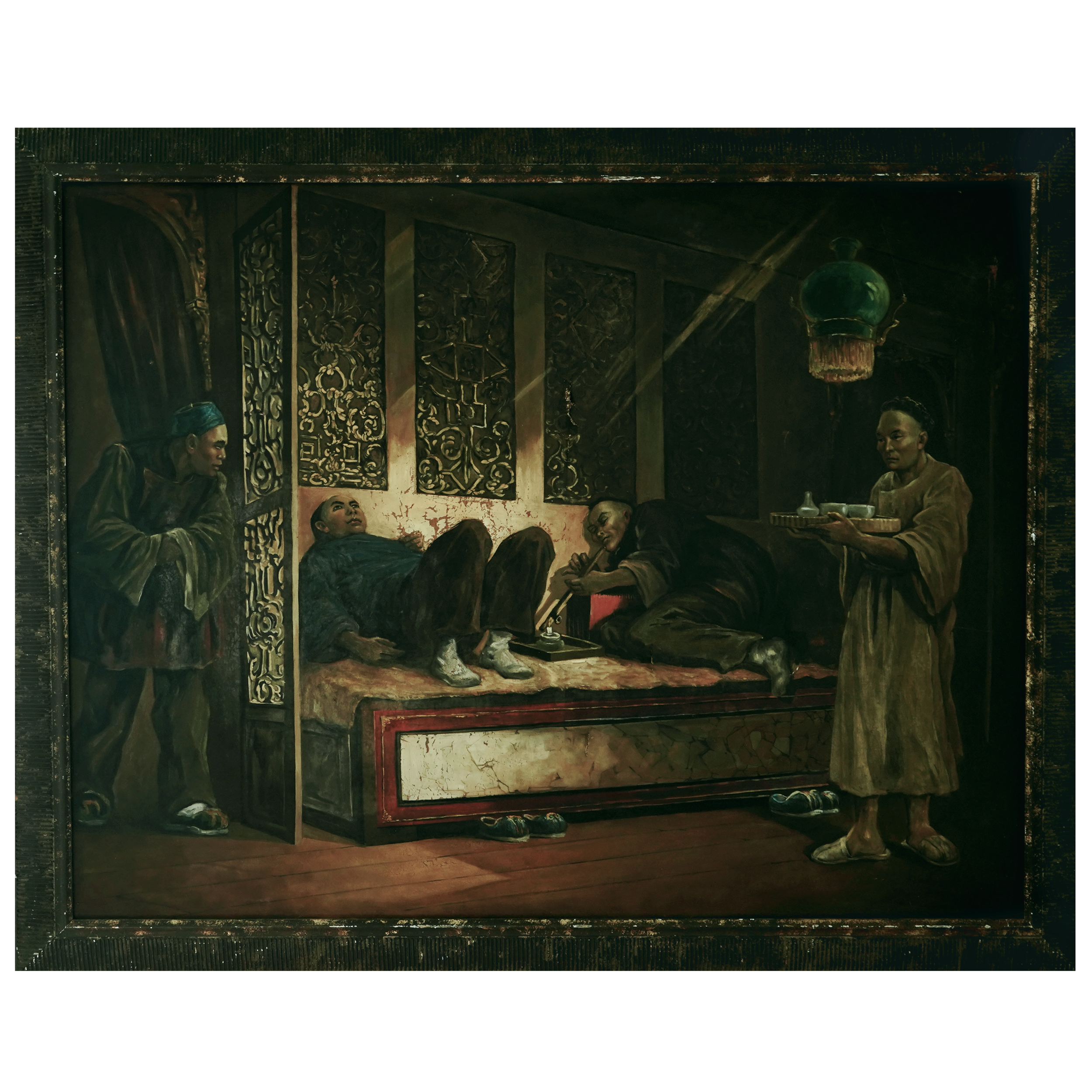
UNKNOWN ARTIST. “Opium Den” 19th Century Oil Painting
Year: 19th Century
Title:Opium Den
Artist: Unknown
Date: Late 19th to early 20th century
Medium: Oil on canvas
Dimensions: 115 X 145 cm
Collection: Private Collection
Description:
Painting presenting a hauntingly atmospheric glimpse into an opium den, most likely located in East Asia during the height of the opium trade and its social consequences. The composition captures a richly detailed interior—a semi-private chamber adorned with carved wooden panels and dimly lit by a hanging lantern. The subdued color palette, dominated by deep browns, ochres, and dark greens, intensifies the somber mood.
The artist’s attention to costume, architecture, and gesture suggests not only a documentary interest but also a critical lens, hinting at themes of escapism, colonial trade, and social decay. The use of directed light—illuminating the figures on the bed while casting the rest of the room into shadow—enhances the psychological depth of the composition.
While the artist remains unidentified, the painting offers rare insight into the cultural and historical context of opium use in the East during a tumultuous period shaped by imperialism, addiction, and moral ambiguity.
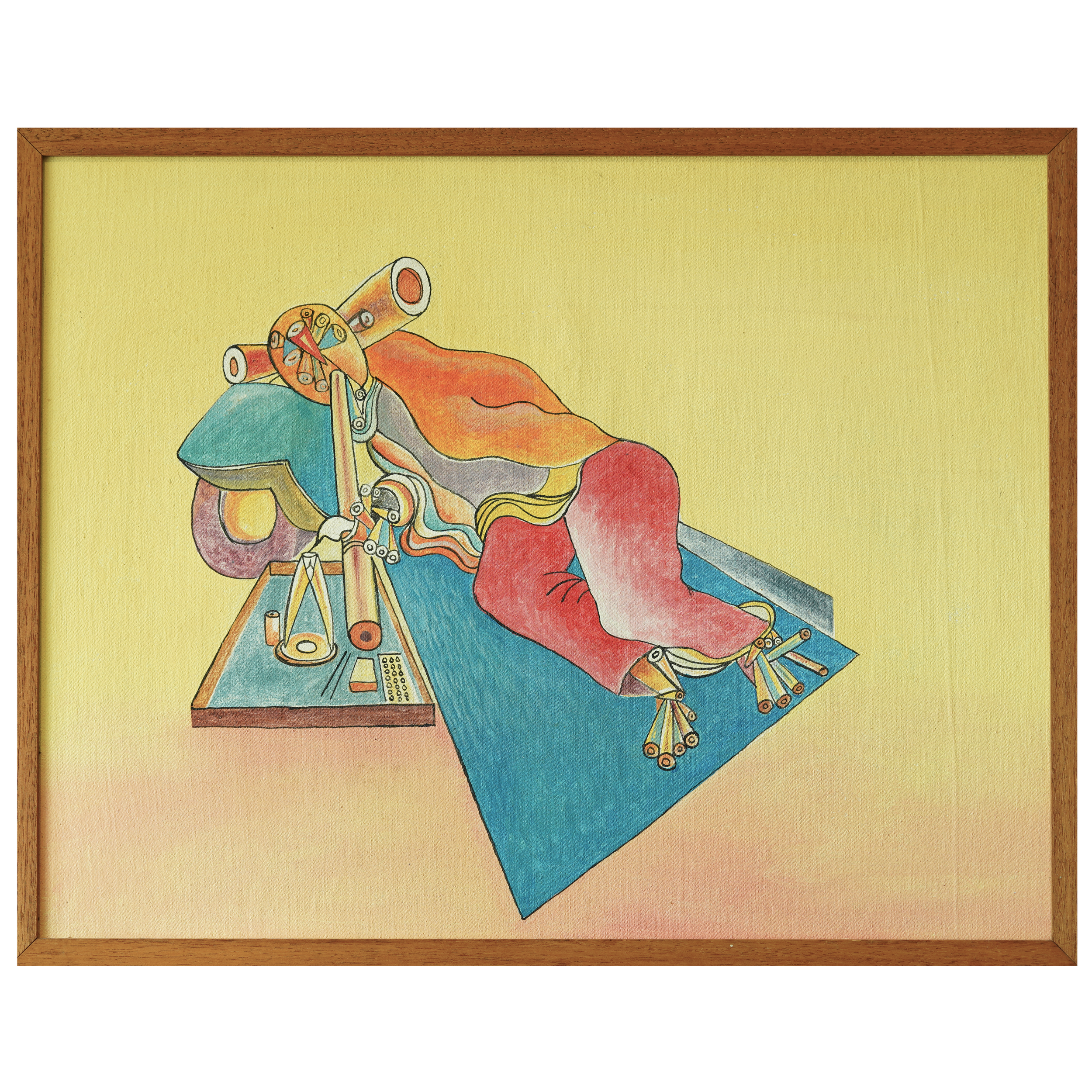
BOZE Oil painting.
Title:Opium Smoker
Artist: BOZE (French, 20th century)
Medium: Acrylic on canvas
Dimensions: 39 × 50 cm
Description:
Original painting by BOZE depicting a reclining man smoking opium. The figure is stylized with mechanical and abstract forms, combining human anatomy with components reminiscent of gears, levers, and tubes. Rendered in warm reds, oranges, and blues against a soft yellow background, the scene evokes both dreamlike detachment and physical ritual.
Boze’s work reinterprets traditional opium-smoking imagery through a surreal and modern lens. The composition reflects the introspective and isolating nature of the opium experience, while the mechanical details suggest the ritual’s repetition and systemic place in society.
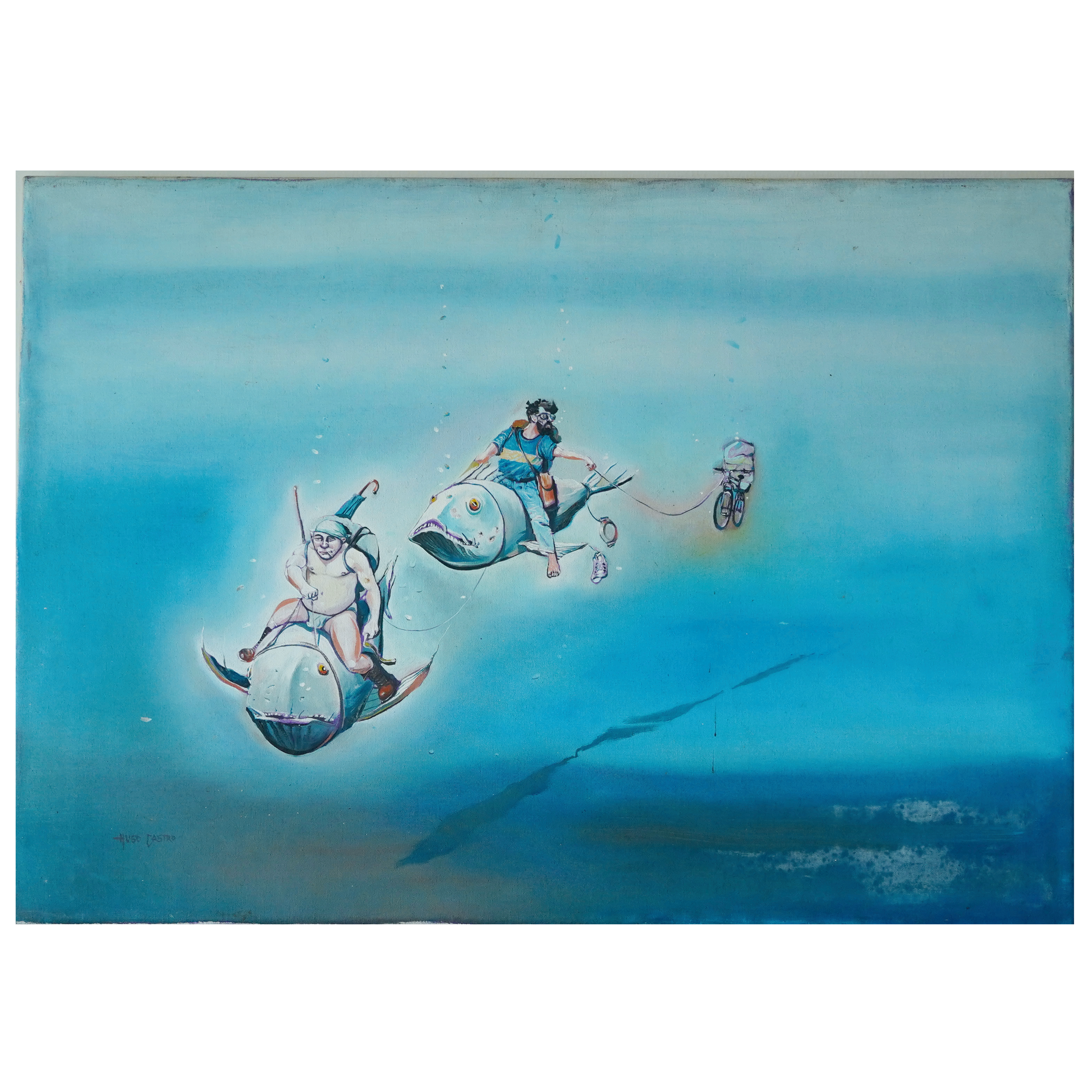
HUGO CASTRO Original Acrylic Painting. Signed bottom left
Artist: Hugo Castro (Mexican, 20th–21st century)
Medium: Acrylic on canvas
Dimensions: 50 × 70 cm
Description:
Underwater scene, Hugo Castro is depicting a fantastical journey through the deep sea. Two human figures, dressed in modern and playful attire, ride large mechanical fish with expressive, cartoon-like faces. A child follows behind, seemingly tethered to the group and riding a small bicycle
Blending fantasy, satire, and a touch of science fiction, Castro’s work reflects on themes of escapism, environmental imagination, and childlike wonder. The fluid motion of the composition and the vibrant palette create a sense of weightlessness and absurd adventure. The juxtaposition of human and mechanical-animal forms challenges traditional boundaries between nature, machine, and human experience.
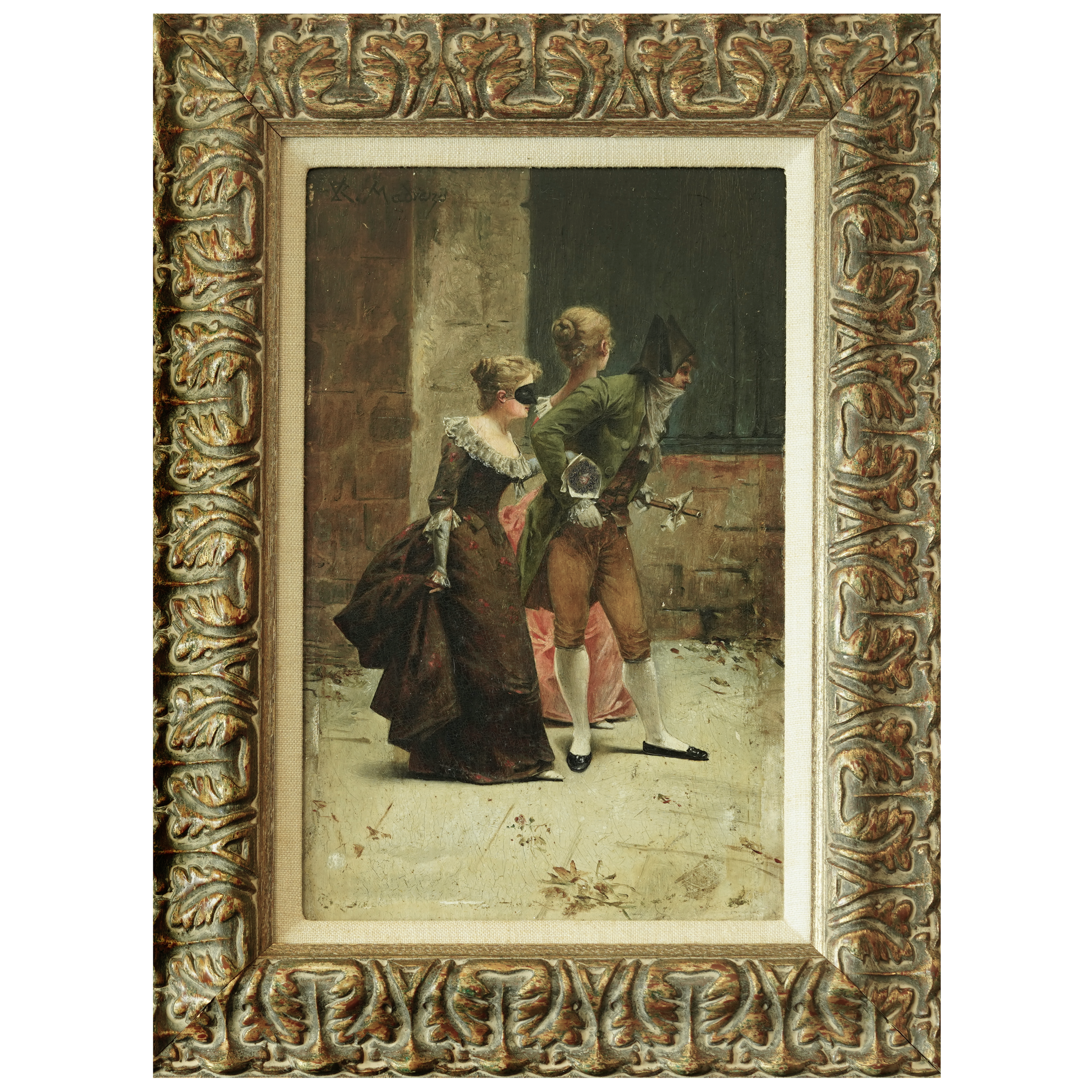
RAIMUNDO MADRAZO. Original Oil painting. Signed top left
Artist: Raimundo de Madrazo y Garreta (1841–1920)
Date: Late 19th century
Medium: Oil on canvas
Dimensions: 32 × 21 cm
Museum Description:
Painting by Raimundo Madrazo showing a scene with two women and one man dressed in 18th-century clothing. One woman is wearing a dark gown and a mask, while the man, dressed in a green coat.
Madrazo was known for painting elegant and romantic scenes. This artwork captures a moment with great attention to costume and detail.
Raimundo Madrazo was known for his depictions of refined interiors and courtly figures. His work often draws on themes of flirtation, gallantry, and historical nostalgia, making this painting a quintessential example of his richly romantic style.

MARIANO FORTUNY. Oil painting. Signed bottom left
Artist: Mariano Fortuny y Marsal (1838–1874)
Date: c. 1860s
Medium: Oil on canvas
Dimensions: 17 × 31 cm
Museum Description:
Mariano Fortuny captures a quiet riverside scene with several figures in traditional clothing. The background features a broad landscape and distant hills under a soft blue sky, while the foreground shows figures walking or gathering near the water and ruins.
Fortuny was known for his detailed brushwork and vivid use of light. This painting combines everyday life with architectural remnants.
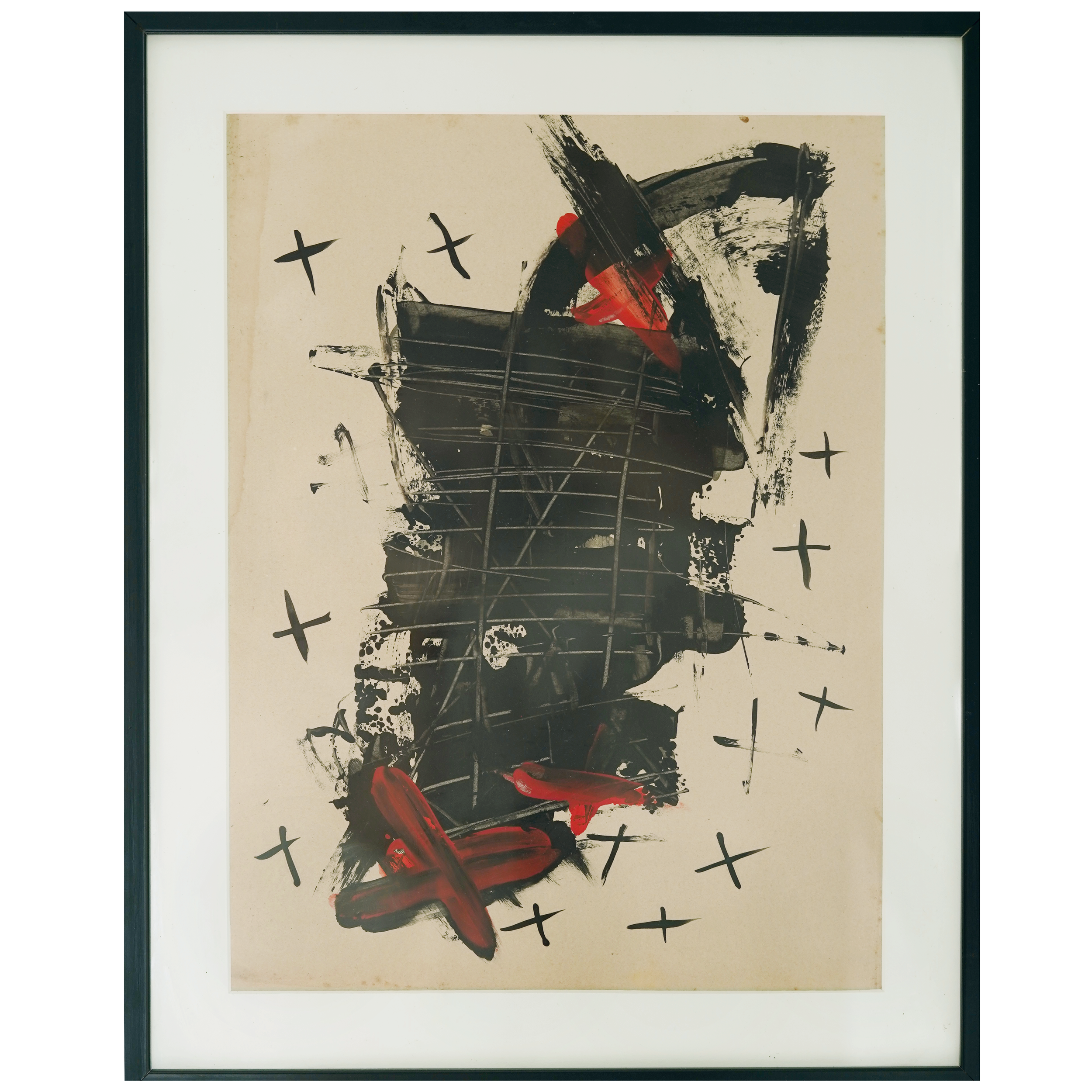
ANTONI TAPIES - Original Painting Untitled
Title:Untitled
Artist: Antoni Tàpies (1923–2012)
Medium: Mixed media on paper
Dimensions: 40 × 30 cm
Description:
Composition by Antoni Tàpies combining gestural brushstrokes, abstract symbolism, and raw texture to evoke a sense of emotional tension and philosophical depth. Dominated by black and red pigments, the piece features layered forms suggestive of barricades or scratched surfaces, with cross-like marks floating in space.
A leading figure in postwar European abstraction, Antoni Tàpies fused material experimentation with deep metaphysical concerns. His work often challenges the boundary between painting and object, using humble media to express inner and social conflict. This piece exemplifies his mature style, balancing chaos with control, and abstraction with symbolic charge.
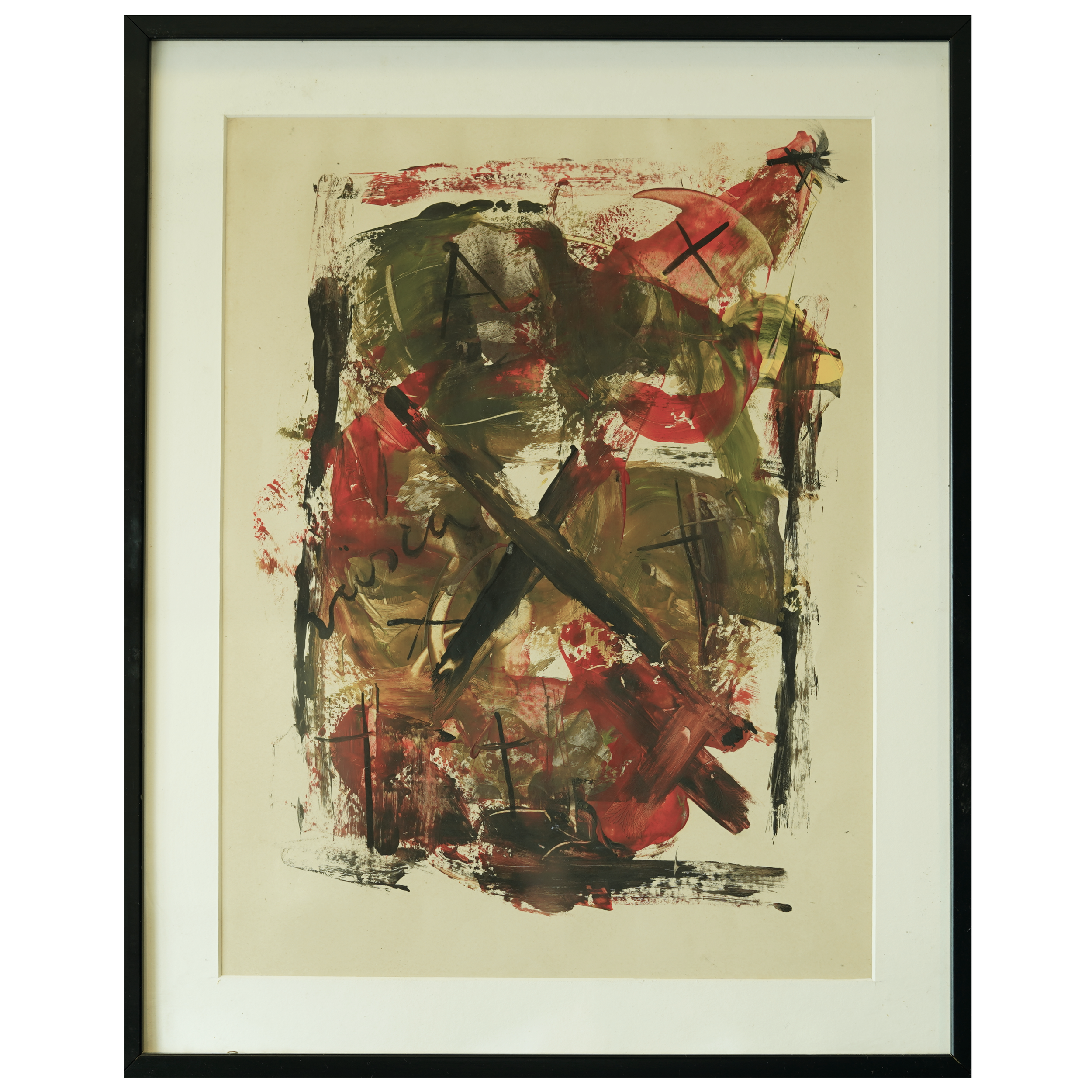
ANTONI TAPIES - Original Painting Untitled
Title:Untitled
Artist: Antoni Tàpies (1923–2012)
Medium: Mixed media on paper
Dimensions: 40 × 30 cm
Description:
Artwork by Antoni Tàpies, layers of earthy reds, greens, blacks, and ochres collide and blend across the paper in a dense field of marks and textures. Bold gestural strokes and scratched-in symbols—most notably recurring X and cross motifs—create a chaotic, raw surface that invites introspection.
Antoni Tàpies, a pivotal figure in the postwar European avant-garde, developed a unique approach that fused abstract expressionism with a material-focused sensibility. His works often confront the viewer with physicality and spiritual tension.
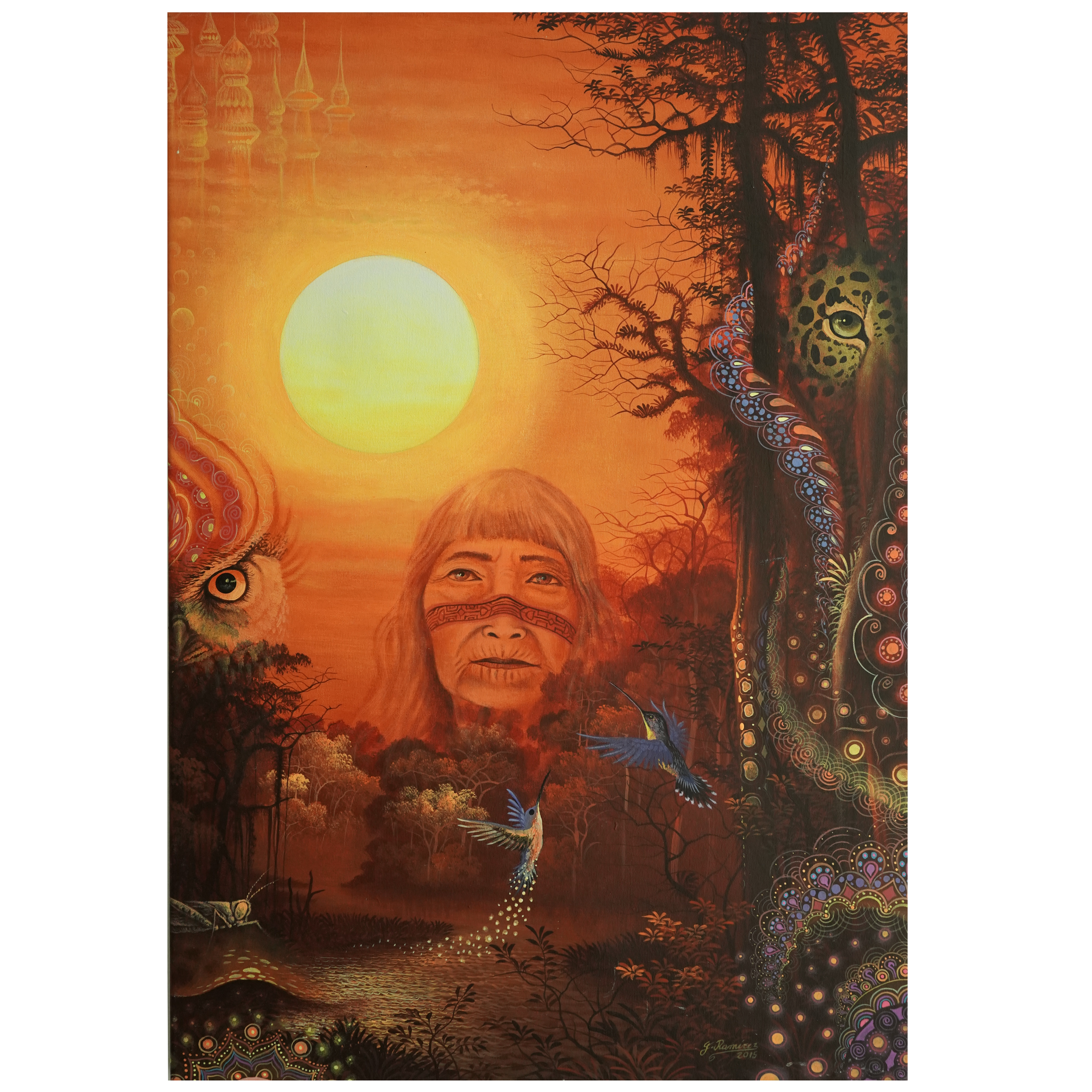
J RAMIREZ. “Ayahuasca Reverie “ Acrylic on canevas. Signed bottom right
Year: 2015
Artist: J Ramírez
Medium: Acrylic on canvas
Dimensions: 80 × 55 cm
Description:
Original painting by Peruvian artist J Ramírez evoking the spiritual depth of the Amazon rainforest. In the warm glow of an otherworldly sun, the central figure—a shamanic presence—emerges from the misty foliage, surrounded by a symphony of natural and mythical elements. Eyes of jaguars and owls peer from the trees, vibrant birds soar with luminous trails, and intricate visionary patterns echo the influence of ayahuasca-inspired visions.
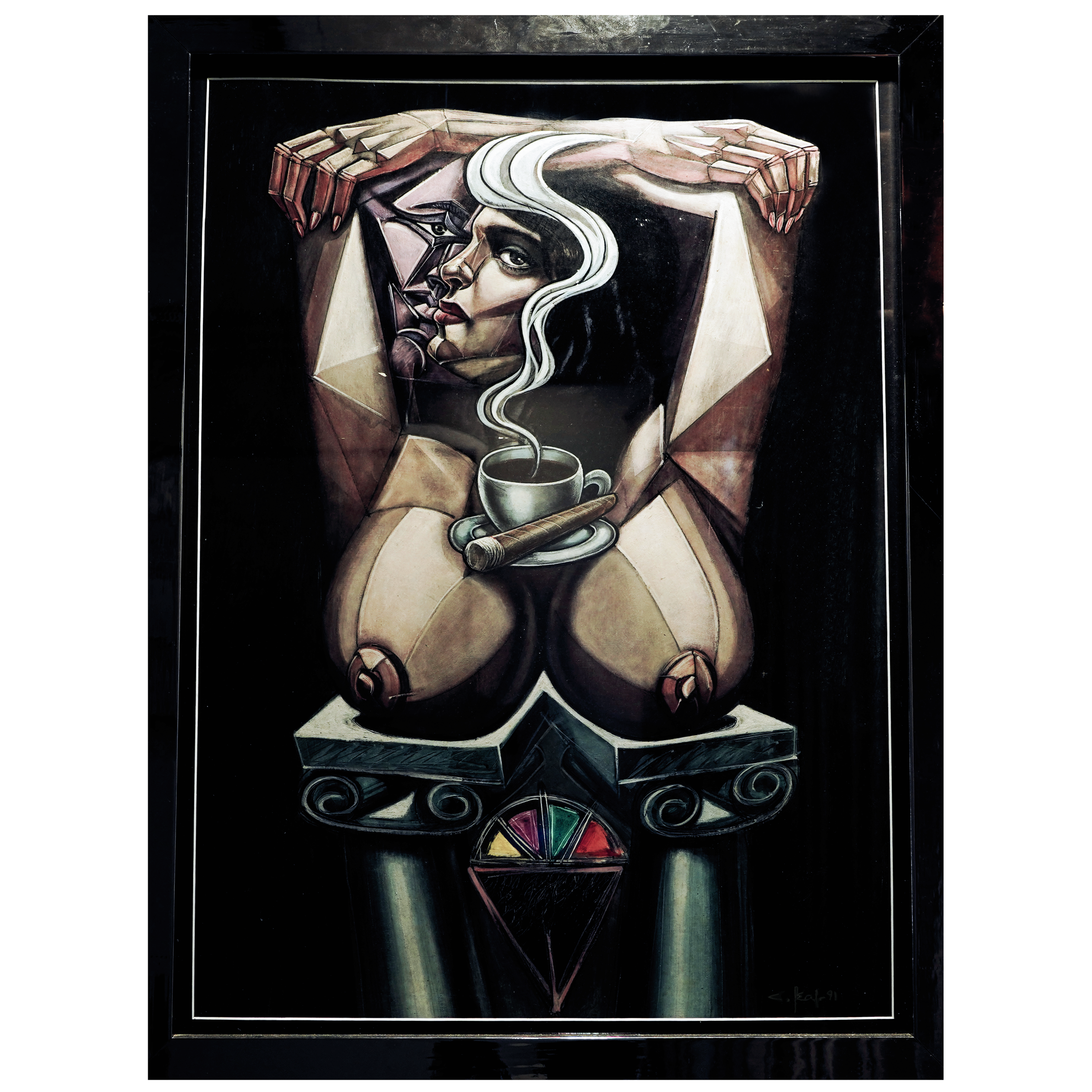
Acrylic on board by Cesar LEAL JIMENEZ. Dated and signed bottom right “C LEAL 91”
“FUNDATIONS OF CUBA”
Year: 1991
Artist: César Leal Jiménez
Medium: Oil on canvas
Dimensions: 80 × 60 cm
Description:
Painting by César Leal Jiménez blenings elements of Cubism and surrealism to depict a woman emerging from an architectural pedestal. Her fragmented, geometric form emphasizes both strength and sensuality, with her body serving as both structure and symbol. A cup of steaming coffee and a cigar rest upon her chest, their smoke entwining with her flowing white hair, linking pleasure, ritual, and identity.
César Leal Jiménez’s work often explores the complexity of feminine identity through bold symbolism and architectural references. Here, the female figure becomes both temple and totem—embodying power, allure, and cultural resonance in a single enigmatic composition.
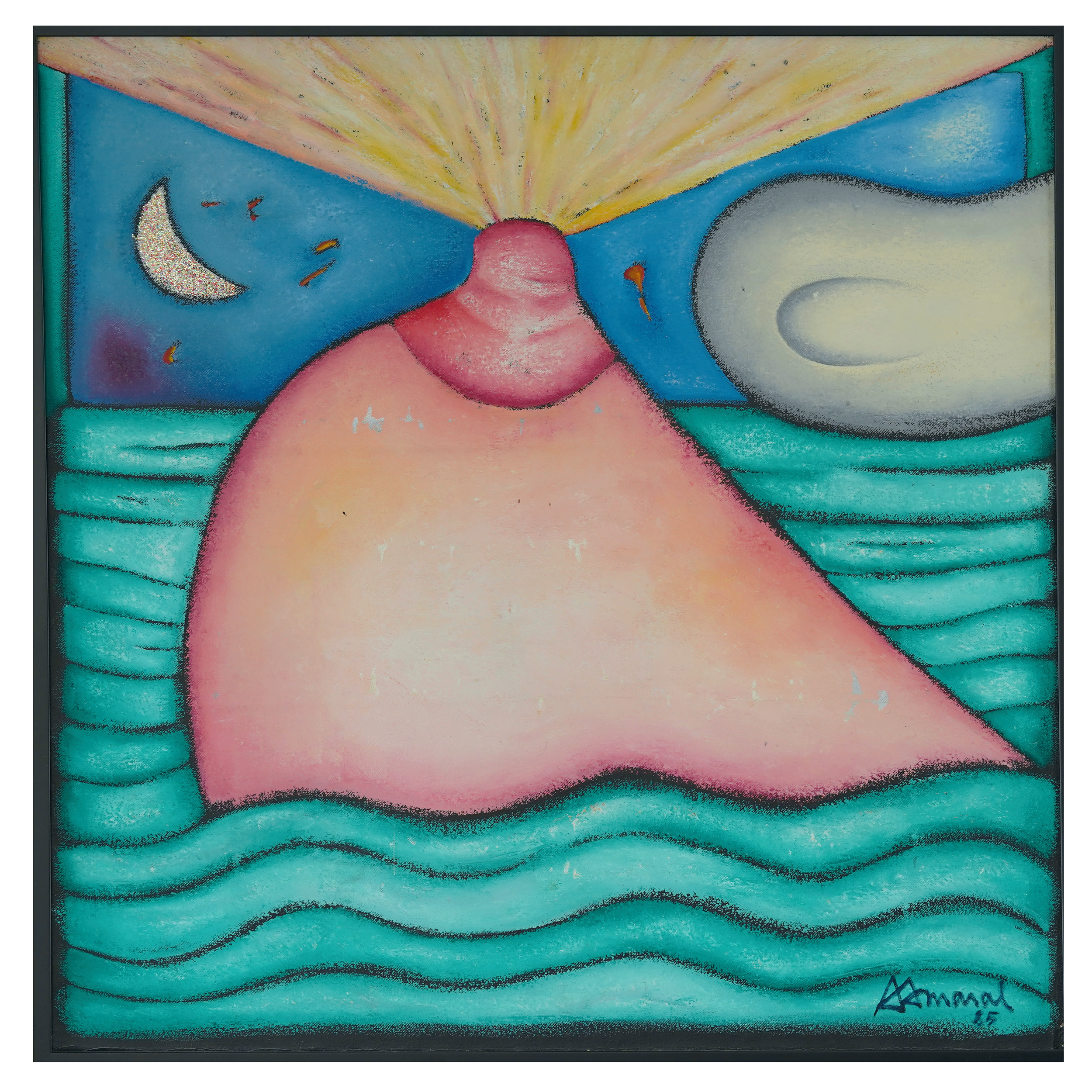
ANTONIO HENRIQUE AMARAL. Acrylic on canevas. Signed bottom right
Title:Untitled
Artist: Antonio Enrique Amaral (1935–2006)
Medium: Pastel and mixed media on paper
Dimensions: 102 × 102 cm
Description:
Composition by Antonio Enrique Amaral fusing human anatomy with elements of nature, depicting a breast-shaped volcano rising from stylized turquoise waves. The volcano erupts with radiant energy into a deep blue sky, where a crescent moon and cloud float nearby, reinforcing the dreamlike quality of the work. Amaral's use of bold color, curved lines, and sensual forms evokes a playful yet symbolic narrative of creation, nature, and transformation.
A prominent figure in Latin American modernism, Amaral often explored themes of power, identity, and the body through surreal allegories. This work reflects his signature fusion of political symbolism and poetic imagery, offering a visual meditation on the intersection of the natural world and the human form.
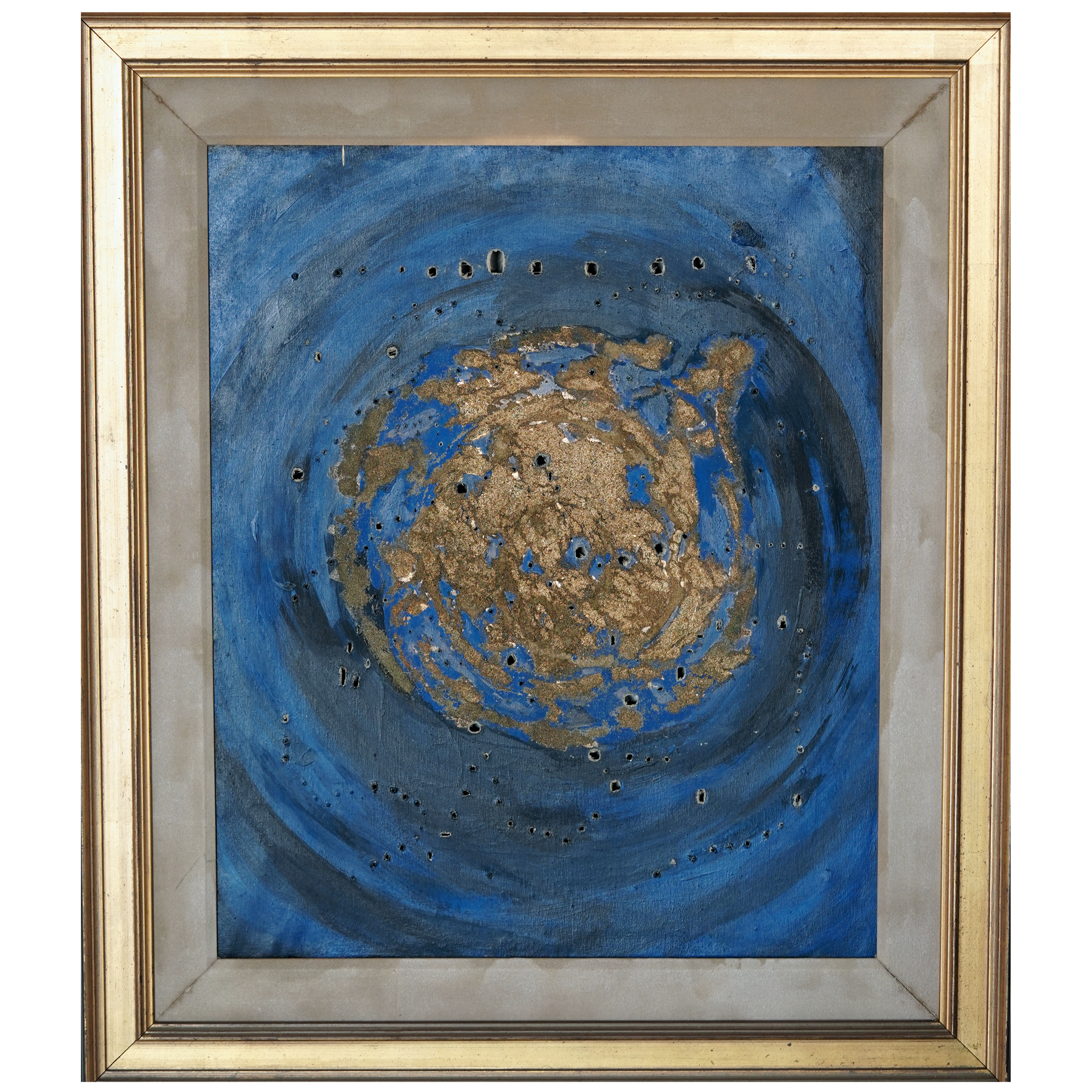
Painting by Lucio Fontana, from Original Concetto Spaziale
Title:Concetto Spaziale
Artist: Lucio Fontana (Italian, 1899–1968)
Medium: Oil, gold leaf, and perforations on canvas
Dimensions: 79 × 68 cm
Description:
Concetto Spaziale (Spatial Concept), Lucio Fontana transcends the two-dimensional limits of traditional painting. At the heart of the canvas lies a swirling planetary form rendered in lustrous gold, set against a rich, celestial field of blue. True to Fontana’s radical vision, the surface is punctuated by a constellation of deliberate perforations, creating literal and conceptual depth.
Lucio Fontana's Concetto Spaziale works marked a groundbreaking shift in postwar art, merging painting, sculpture, and conceptualism. This piece, with its dynamic textures, tactile incisions, and cosmic overtones, exemplifies Fontana’s revolutionary aim to open the artwork to new dimensions—literally piercing the veil of representation to embrace the void beyond.
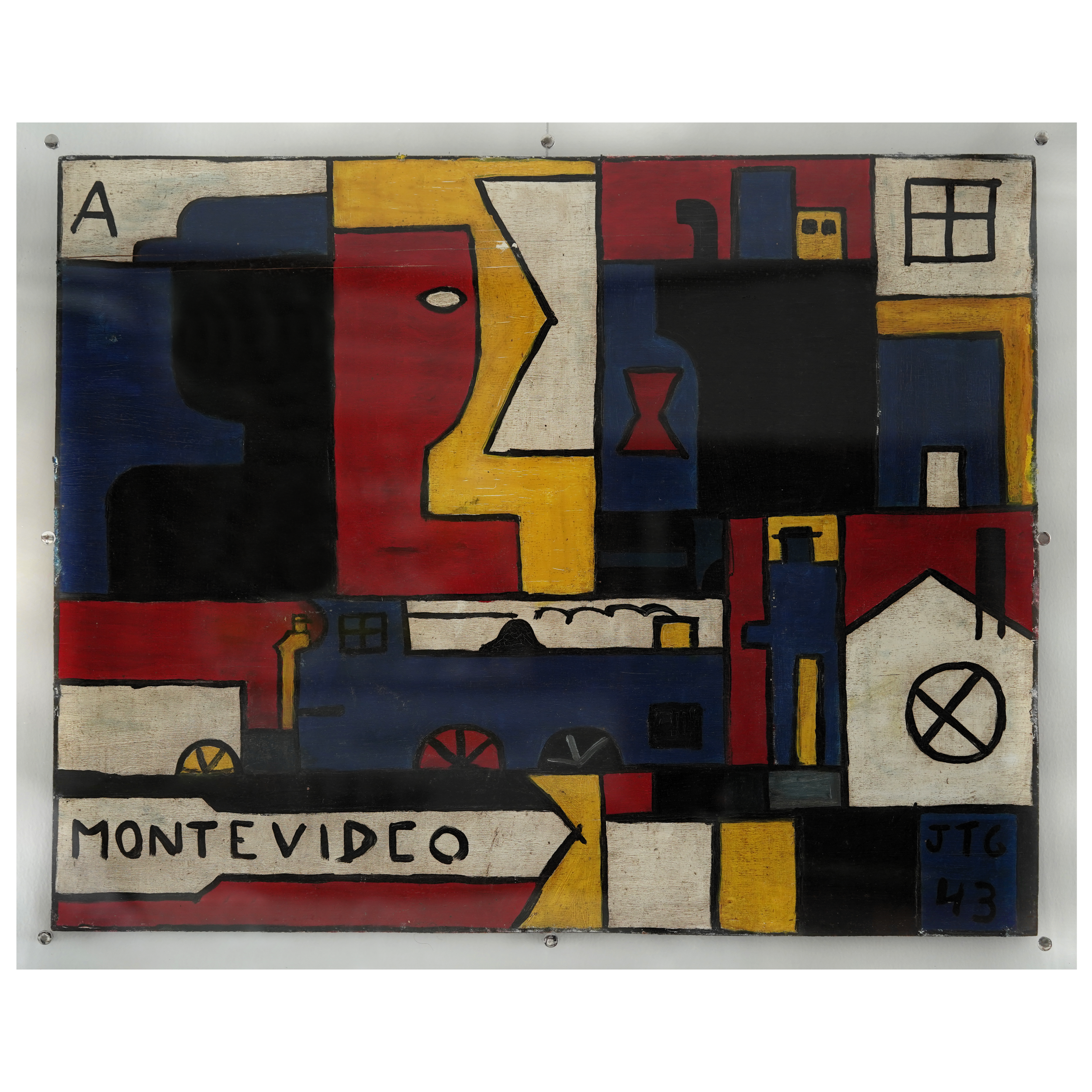
Year: 1943
Title:Montevideo
Artist: Joaquín Torres-García (1874–1949)
Medium: Oil on board
Dimensions: 52 × 65 cm
Description:
Composition by Joaquín Torres-García rendering the city of Montevideo through a symbolic and constructivist lens. Geometric forms—houses, trains, arrows, clocks, and abstracted figures—are arranged in a structured grid, evoking both urban dynamism and spiritual balance. The palette of primary colors (red, blue, yellow) paired with black and white reflects his characteristic visual language.
A leading figure in Latin American modernism, Torres-García sought to merge European avant-garde principles with indigenous and universal symbolism. His philosophy of Constructive Universalism aimed to connect ancient traditions with modern abstraction. Painted upon his return to Uruguay, this piece is a visual testament to his cultural synthesis—placing Montevideo at the crossroads of memory, identity, and modern thought.
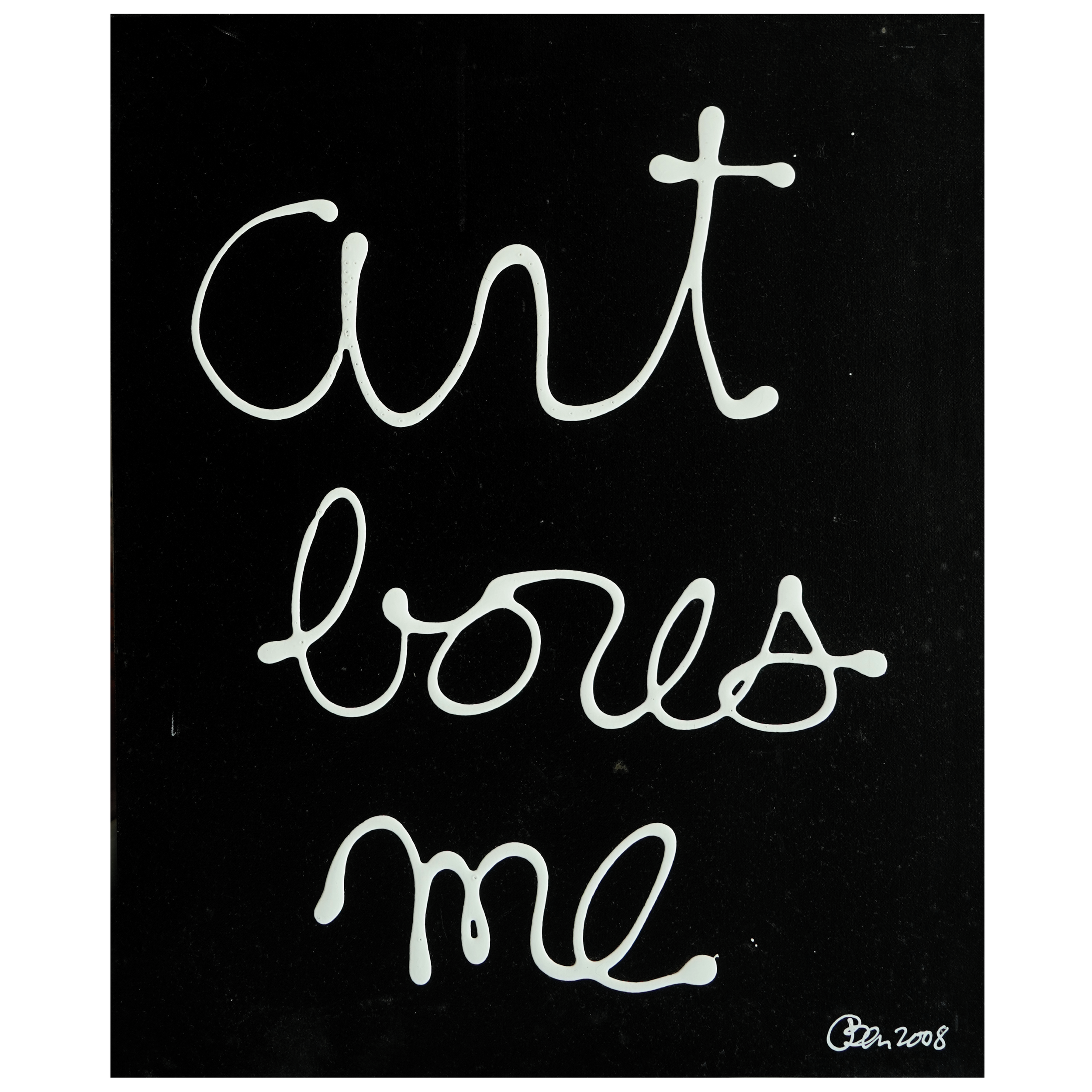
Title:Art Bores Me
Artist: Ben Vautier (born 1935)
Date: 2008
Medium: Acrylic on canvas
Dimensions: 61 × 50 cm
Signature: Signed and dated “Ben 2008” (lower right)
Description:
With his unmistakable handwriting and minimalist style, Ben Vautier delivers a paradoxical statement: “Art bores me.” Painted in white on a stark black background, this work exemplifies his conceptual approach to art, where language is both the subject and the medium.
Art Bores Me functions as both artwork and anti-artwork, in line with the Dadaist spirit Ben often channels. By using the written word as a visual object, he blurs the line between art and statement, and between artist and viewer. In this way, the work becomes a mirror — asking not whether art is boring, but why we look at it in the first place.
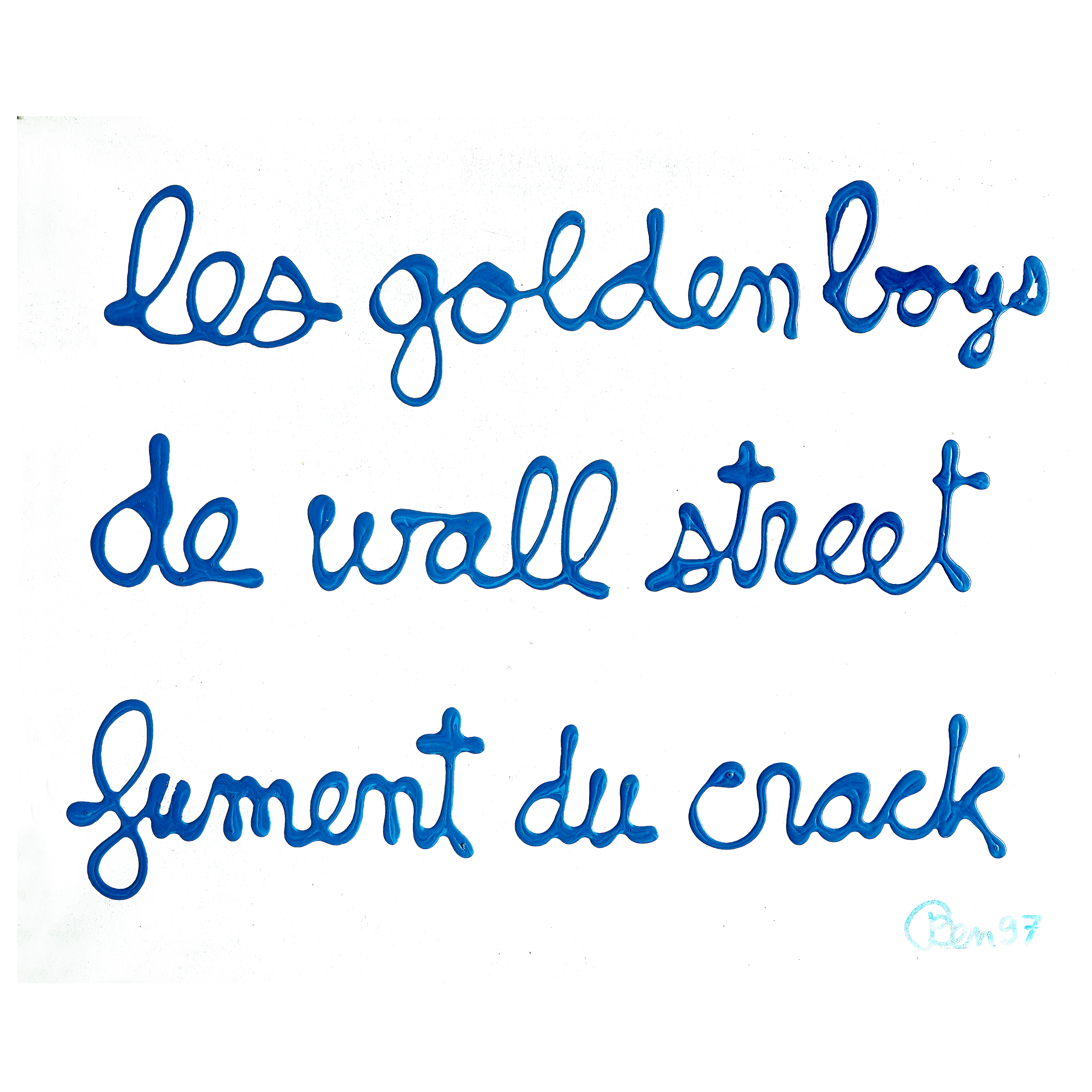
Title:Les golden boys de Wall Street fument du crack
Artist: Ben Vautier (born 1935)
Medium: Acrylic on canvas
Dimensions: 50 × 61 cm
Signature: Signed and dated “Ben 97” (lower right)
Description:
Ben Vautier delivers a biting commentary on capitalism and financial culture. The text, rendered in his signature cursive style in vibrant blue acrylic, reads: “les golden boys de Wall Street fument du crack” ("the golden boys of Wall Street smoke crack").
Ben’s use of text as image forces a direct encounter between viewer and idea. This piece exemplifies his flair for mixing irony and protest, confronting the viewer with the absurdities and excesses of contemporary society. Like much of his oeuvre, it raises questions rather than answers — about money, morality, and the messages we choose to display.

Alberto Giacometti (1901–1966)
Figure Studies
Ink and wash on paper
Drawing exemplifying Alberto Giacometti’s relentless search for the essence of human presence. Combining studies of heads with elongated standing nudes, the composition reveals his characteristic linear draftsmanship—nervous, repetitive strokes that seem to etch the figure into existence. The attenuated bodies anticipate the sculptural forms for which Giacometti is most celebrated, evoking both fragility and permanence. The ink wash adds tonal depth, situating the figures in a spatial field while underscoring their spectral, almost immaterial quality.