
 Image 1 of 1
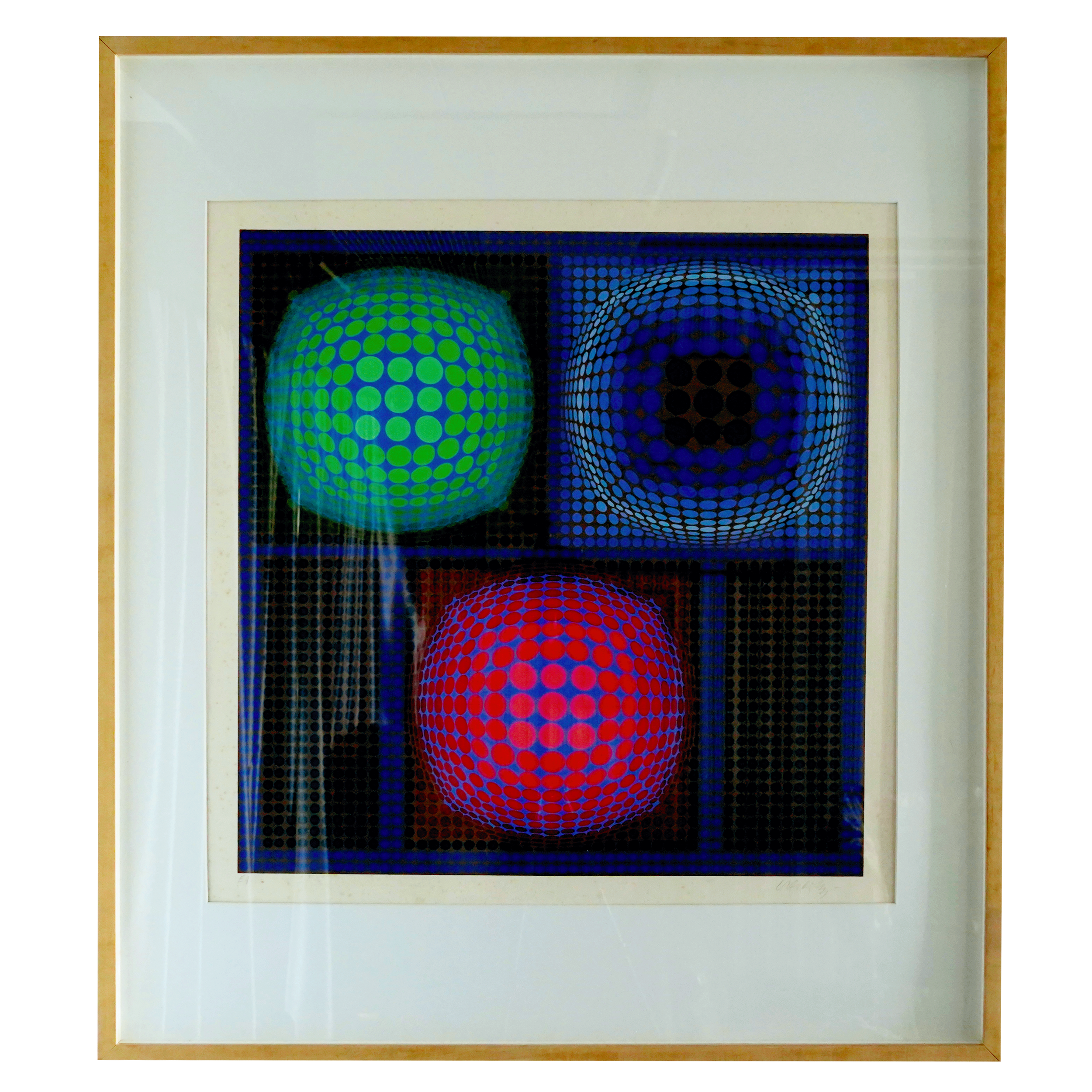
VICTOR VASARELY- UNTITLED
Victor Vasarely (1906–1997)
Untitled (Op Art Composition with Spheres)
Serigraph on paper
Dimensions: 112 × 90 cm
Victor Vasarely, widely regarded as the father of the Op Art movement, explored the optical possibilities of color, geometry, and perception. In this striking work, Vasarely constructs three spherical forms—rendered in vivid green, blue, and red—that appear to pulse and expand beyond the flat surface. Using systematic arrangements of dots and grids, the artist creates a dynamic illusion of three-dimensional depth, engaging the viewer’s eye in a constant play of movement.
This piece exemplifies Vasarely’s lifelong interest in science, mathematics, and visual psychology, reflecting his belief that art could be universal through its reliance on optical laws rather than cultural references. By destabilizing the viewer’s perception, the work transforms static form into kinetic experience, bridging art and technology in a way that defined the visual language of the 20th century.
Victor Vasarely (1906–1997)
Untitled (Op Art Composition with Spheres)
Serigraph on paper
Dimensions: 112 × 90 cm
Victor Vasarely, widely regarded as the father of the Op Art movement, explored the optical possibilities of color, geometry, and perception. In this striking work, Vasarely constructs three spherical forms—rendered in vivid green, blue, and red—that appear to pulse and expand beyond the flat surface. Using systematic arrangements of dots and grids, the artist creates a dynamic illusion of three-dimensional depth, engaging the viewer’s eye in a constant play of movement.
This piece exemplifies Vasarely’s lifelong interest in science, mathematics, and visual psychology, reflecting his belief that art could be universal through its reliance on optical laws rather than cultural references. By destabilizing the viewer’s perception, the work transforms static form into kinetic experience, bridging art and technology in a way that defined the visual language of the 20th century.
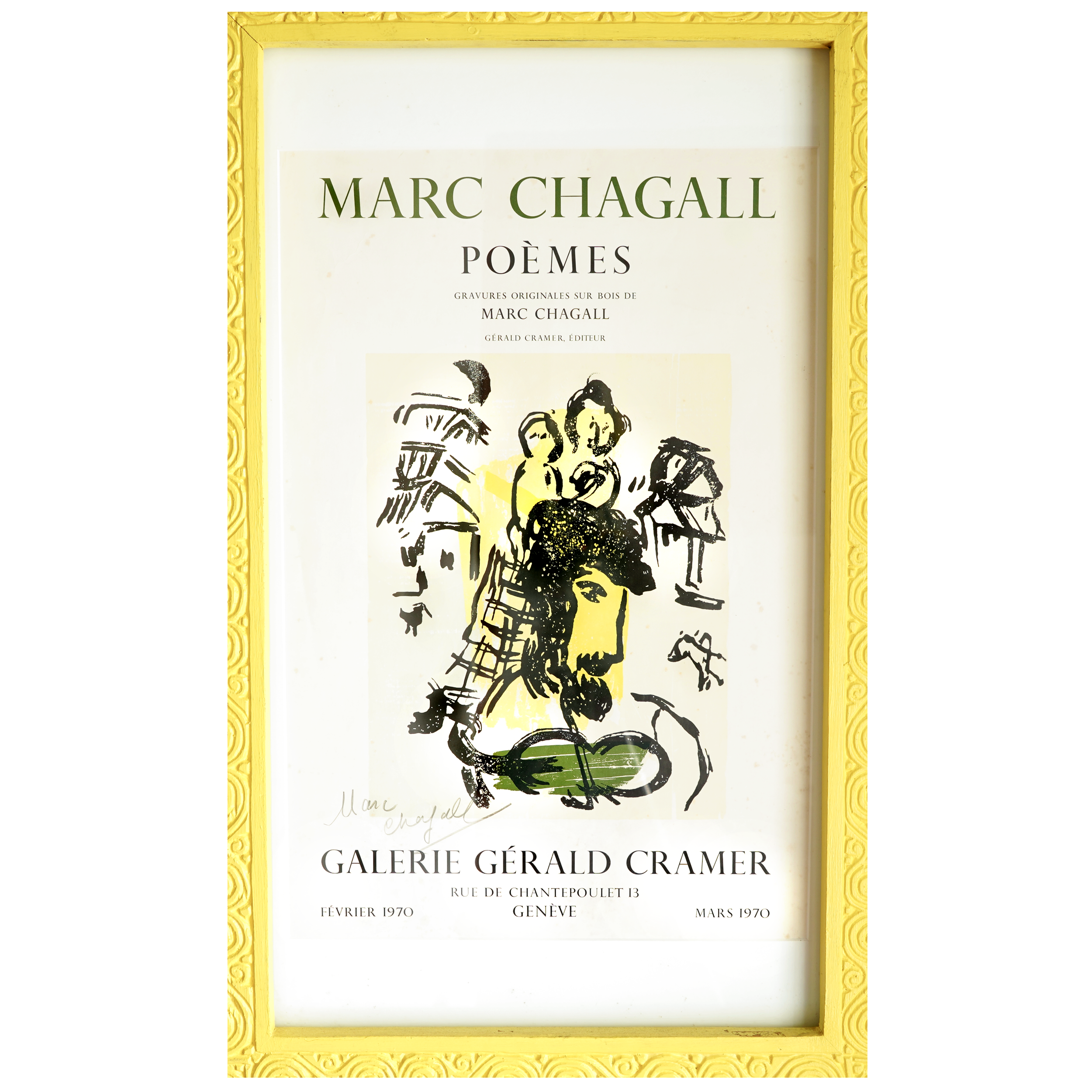
MARC CHAGALL Printed lithograph “Gallerie Gerard Cramer”. Signed by the artist bottom left
Title:Poèmes (Exhibition Poster)
Artist: Marc Chagall (Russian-French, 1887–1985)
Medium: Lithograph on paper
Dimensions: 57 × 38 cm
Publisher: Gérald Cramer, Geneva
Location: Galerie Gérald Cramer, Rue de Chantepoulet 13, Geneva
Description:
Lithographic poster created by Marc Chagall to accompany his 1970 exhibition Poèmes at Galerie Gérald Cramer in Geneva. The image features one of Chagall’s signature dreamlike compositions, combining human figures, animals, and abstract forms in a vibrant palette dominated by yellow, green, and black.
As both an artwork and promotional material, this piece reflects Chagall’s close collaboration with Swiss publisher Gérald Cramer, who championed his graphic works. The poster represents the artist’s ongoing exploration of visual storytelling and his capacity to merge poetry and painting into a unified, emotional language.
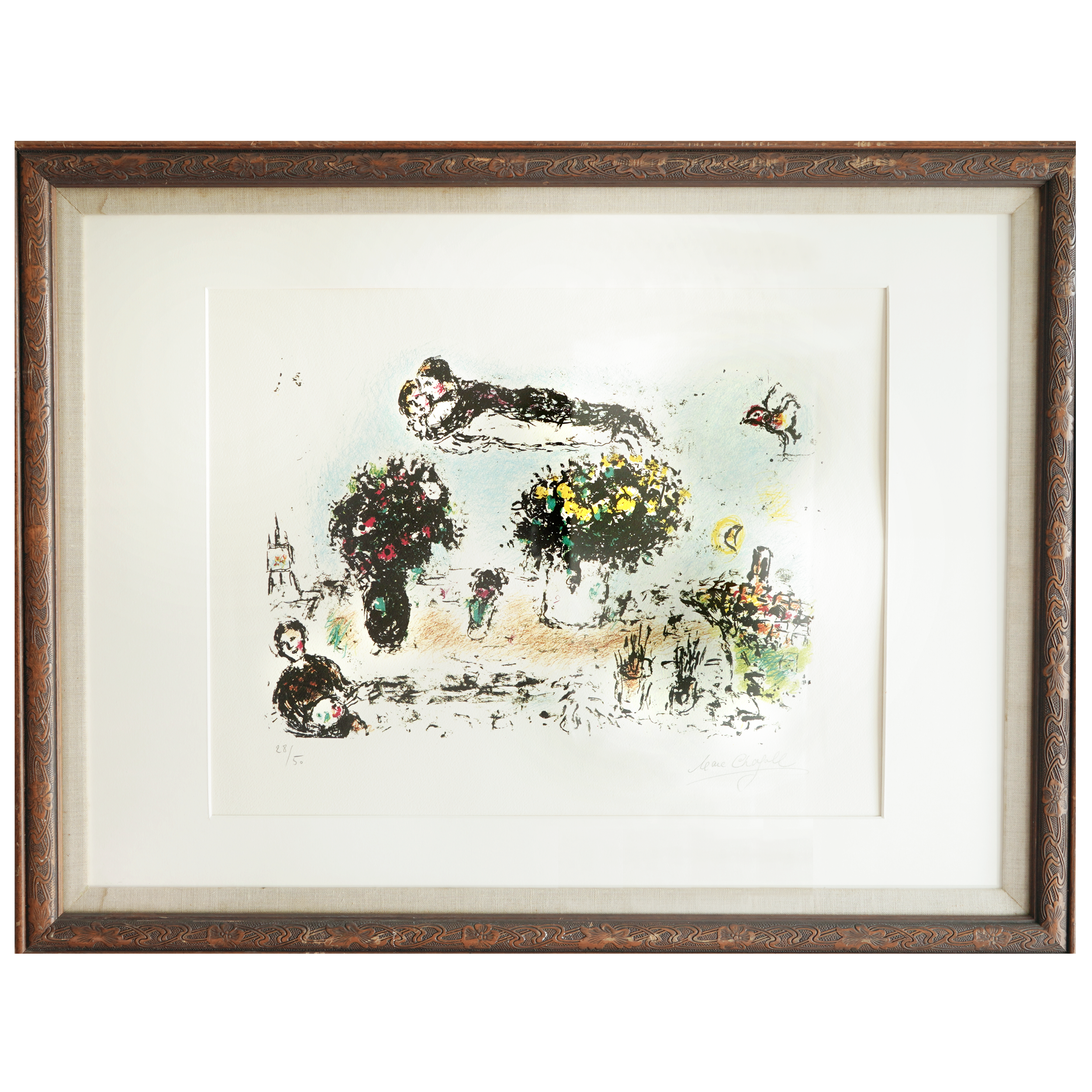
MARC CHAGALL Original Lithograph. Signed bottom right, limited edition
Edition: 28/50
Artist: Marc Chagall (Russian-French, 1887–1985)
Medium: Color lithograph on paper
Dimensions: 43 × 55 cm
Edition: Numbered 28/50
Signature: Hand-signed by the artist in pencil, lower right
Description:
Original lithograph by Marc Chagall capturing the artist’s dreamlike vision of love and memory. Floating lovers embrace mid-air above a blooming garden, while figures, trees, and village structures create a lyrical, pastoral landscape below.
Marc Chagall’s lithographs are celebrated for their poetic and mystical quality. This work exemplifies his recurring motifs of love and flight—symbols of spiritual transcendence and personal history. As with much of his graphic oeuvre, the composition is infused with warmth and whimsy, inviting viewers into a world where emotion shapes reality. Lithographs such as this one were printed in limited editions and hand-signed by the artist, underscoring their collectible value.
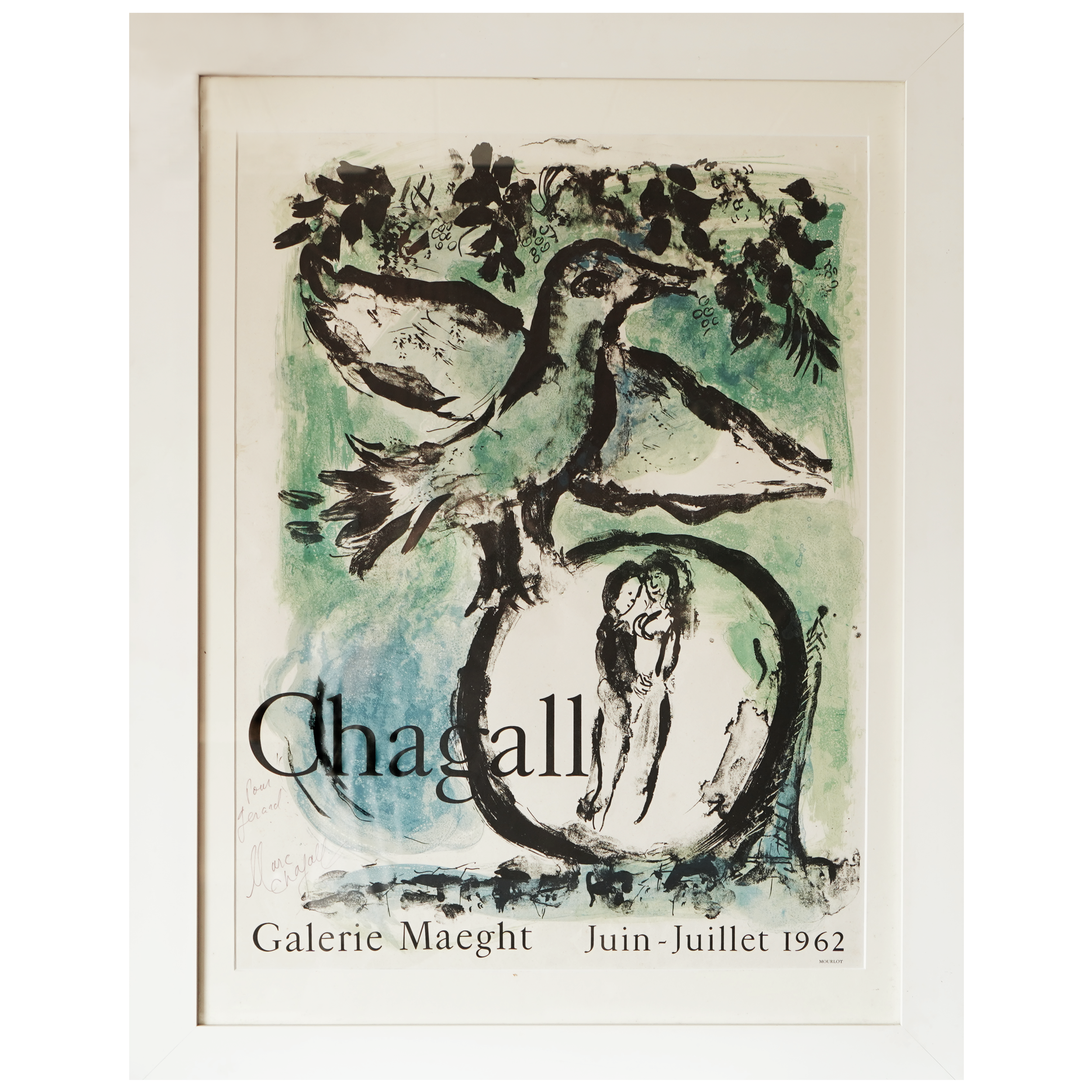
MARC CHAGALL Lithograph Print “Gallery Maeght”. Signed by the artist bottom left
Title:Chagall, Galerie Maeght Exhibition Poster
Artist: Marc Chagall (1887–1985)
Medium: Color lithograph on paper
Dimensions: [Not specified]
Printed by: Mourlot, Paris
Dimensions: 69 × 52 cm
Description:
Lithographic poster created by Marc Chagall to promote his exhibition at Galerie Maeght in Paris in June–July 1962. The image features a large bird with outstretched wings perched on a circular form enclosing a loving couple, rendered in Chagall’s dreamy, expressive style. Above, branches with leaves and berries enhance the composition.
Chagall often celebrated themes of love, memory, and peace through surreal imagery. This poster, combining a symbolic bird and embracing figures, reflects his lyrical approach to art and his lifelong connection to romance and nature. It was printed by the famed Mourlot studio, known for collaborating with major modern artists.
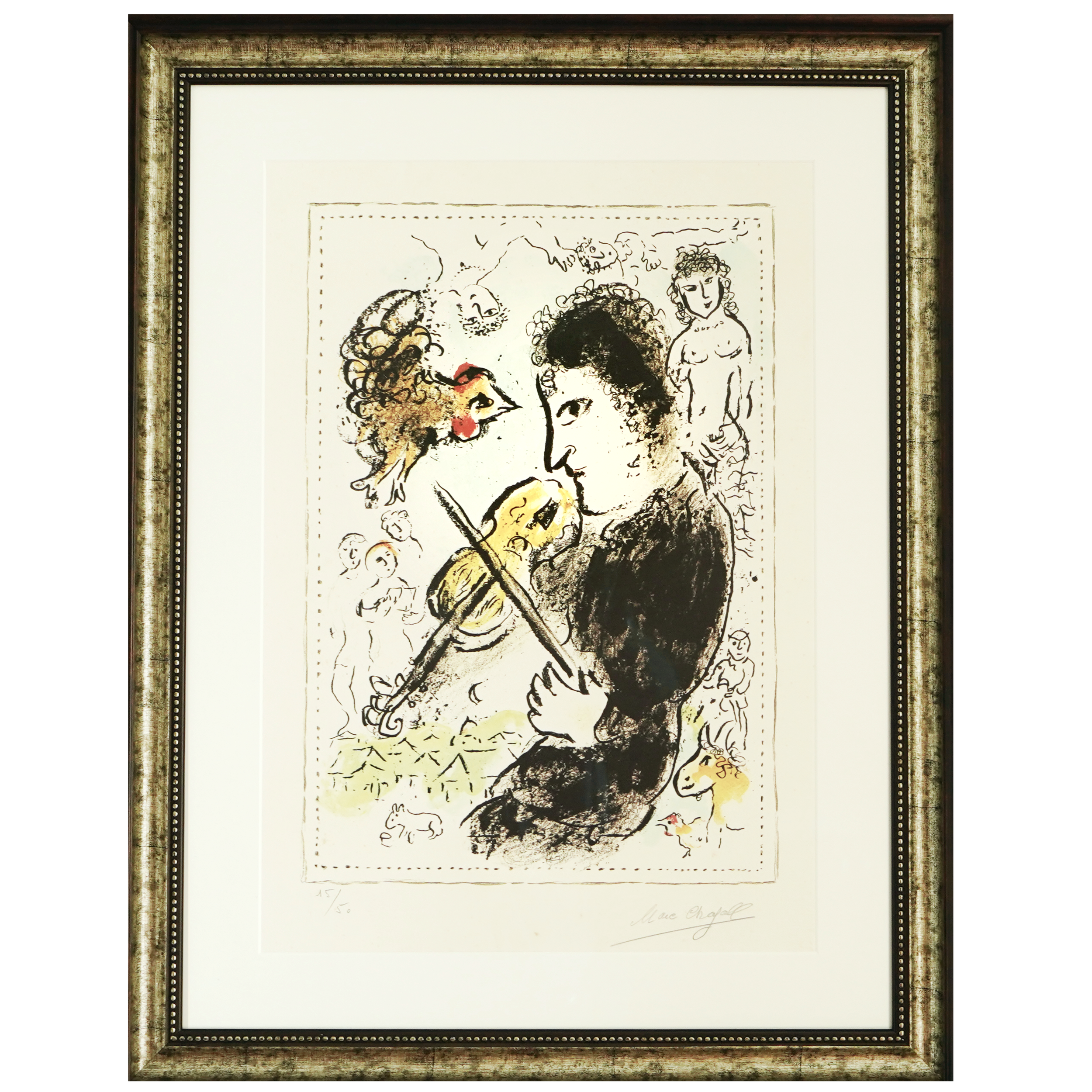
MARC CHAGALL Etching drawing. Signed bottom right, limited edition
Edition: 15/50
Title:Le Violoniste
Artist: Marc Chagall (1887–1985)
Date: Mid-20th century
Medium: Color lithograph on paper
Dimensions: 56 × 40 cm
Description:
Lithograph by Marc Chagall showing a man playing a violin, surrounded by dreamlike figures including a rooster, a nude woman, and a dog. The background includes a village scene and floating heads, all drawn in Chagall’s distinctive style.
Chagall often used the figure of the violinist to reflect his Jewish heritage and memories of his childhood in Russia. The warm colors and flowing lines create a sense of emotion and nostalgia.
ENQUIRY:

Marc Chagall (1887–1985)
Psaumes de David (Psalms of David)
Lithograph on paper
Exhibition poster, Musée National Message Biblique Marc Chagall, Nice, 1980
Dimensions: 69 × 43 cm
This lithograph, created for the exhibition Psaumes de David at the Musée National Message Biblique Marc Chagall in Nice, reflects the artist’s lifelong dialogue between biblical themes and his poetic, dreamlike visual language. Executed in his characteristic style of fluid lines and floating figures, the work illustrates a joyful dance of figures set against a symbolic cityscape, evoking both the biblical Jerusalem and Chagall’s own memory-laden imagination.